Curaçao Hato International Airport (CUR) — The Complete Master Guide 2026
The ABC island that escapes hurricanes, prints its own pastel waterfront, and quietly outsells Aruba on dive sites — a Hato airport guide built for the traveler who wants Willemstad in 20 minutes and Westpunt by sunset.
Quick Reference
Hato is small enough that you can walk the entire airside concourse in eight minutes, but it carries more European routes than any other ABC-island airport. KLM lands a 787 here every day from Amsterdam, JetBlue and American feed New York and Miami, and the regional turboprops to Aruba and Bonaire run nearly hourly. The airport sits on the windward north coast about 14 km from Willemstad — a single-runway field with one passenger terminal, a single VIP Lounge (Priority Pass accepted), and a duty-free strip that rotates Curaçao Liqueur, Dutch chocolate, and a surprising volume of Cuban cigars.
Table of Contents
🏢 1. Terminals, Architecture & Hato’s Single-Building Logic
Curaçao runs on one passenger terminal — 18,000 sqm on two levels (departures upstairs, arrivals below), expanded in a major project completed in 2018 — a long, low, sand-coloured pavilion closer to Aruba in spirit than to the steel-and-glass mega-terminals of Sint Maarten or Punta Cana. There is one passport hall, one baggage carousel hall (four belts), and one airside concourse with five jet bridges. The whole field handles fewer flights in a day than NAS handles in two hours, which is why your security wait at 06:30 is twelve minutes and your passport stamp at 18:00 is fifteen.
The single concourse and gate layout
Fifteen apron stands, five of them with jet bridges; the rest are hardstands used mainly by the regional turboprops — Divi Divi, EZAir, and Winair (no direct Saba or Statia service; those islands connect via Sint Maarten). The daily KLM 787 is the widebody event; American and JetBlue narrowbodies and Avianca’s A320s from Bogotá take the jet-bridge stands. The concourse runs roughly 380 metres from end to end, with airside shopping in the centre.
Arrivals: passport, ED card, baggage, customs
The Embarkation/Disembarkation card is mandatory for every visitor, including transit. Most travellers fill it online at dicardcuracao.com within 48 hours of arrival; printed-paper ED cards on the plane have been phased out as of 2024. Baggage carousels arrive within 12–18 minutes for most flights.
Departures: check-in, security, airside
Check-in counters open three hours pre-flight; KLM and Avianca run their own dedicated bag-drop zones. Security is a single screening point post-passport-exit; expect 10–15 minutes at peak (08:00–10:00 outbound North America, 18:00–20:00 outbound Europe). Liquids in 100ml containers, laptops out, standard ICAO rules — Curaçao does not run TSA-precheck-equivalent.
Family services, accessibility, baby change
One family room landside (near arrivals exit), two airside (one each end of the concourse). Wheelchair assistance must be pre-booked through your airline at least 48 hours out — walk-in requests at the airport have a 30–60 minute wait because lift teams shuttle between flights. Baby-change rooms are functional but not flashy.
Editor’s note — Hato is the most relaxing major-island Caribbean airport we’ve flown out of in 2025. The single-terminal layout means you cannot get lost; the cap on flight volume means security never feels crisis-mode; and the absence of a hub-carrier home base means there’s no twelve-aircraft delay cascade like Punta Cana on a stormy Saturday. Pack thirty extra minutes if you’re flying KLM at 18:30 (the only widebody push of the day), otherwise budget 90 minutes door-to-gate and you’ll have time to drink a Curaçao Liqueur in duty-free.
🛂 2. Visa, Currency, Entry
Visa-free entry — who, how long, what to bring
USA, Canada, UK, EU/EEA, Switzerland, Israel, Japan, Singapore, South Korea, most of Latin America (Argentina, Brazil, Chile, Colombia, Mexico, Peru, Uruguay, Venezuela), Australia, New Zealand, and South Africa enter visa-free for 90 days. Required: passport valid 6 months past entry, return or onward ticket, accommodation address, ED Card filled online. Travelers from outside the visa-free list need a visa from a Dutch consulate — processed in 4–8 weeks.
ED Card — the digital arrival form
Mandatory for every traveler since 2020. Fill at dicardcuracao.com within 48 hours of arrival. Free, no health-questionnaire (the COVID-era version was replaced in 2023 with the simple tourism declaration). You receive a QR code by email; show it at passport control on arrival. Without the ED Card you’ll fill a paper form on arrival and add 30–45 minutes to your immigration wait.
Currency — the Caribbean guilder (XCG) and the 1.79 peg
Local currency is the Caribbean guilder (Cg, ISO code XCG), which replaced the Netherlands Antillean guilder (ANG) on 31 March 2025 at the same 1.79-per-USD peg; ANG stopped being legal tender on 1 July 2025. In practice, USD is universally accepted: hotels, resorts, dive shops, beach bars, taxis, restaurants. EUR accepted at upscale Punda boutiques but at unfavorable rates. ATMs dispense guilders by default; some allow USD selection. Tip: tip in USD — 10% standard, 15% great service.
Departure — the Passenger Facility Charge and duty-free
Curaçao charges a Passenger Facility Charge on departure: USD 51.74 for international flights (USD 35.74 to Aruba/St Maarten, USD 19.47 to Bonaire, USD 13.74 in transfer). American, KLM, TUI fly, Air Canada, WestJet, Copa, Avianca and Surinam Airways include it in the ticket; on other airlines — JetBlue included — you pay at the airport pay stations before departure, so budget for it. Duty-free outbound: the Curaçao Liqueur 750ml bottle is the iconic souvenir and exempts most US/EU customs allowances; cigars from the airport stock are mostly Dominican (legal entry to the US) with limited Cuban (still illegal entry to the US, do not buy if connecting through Miami).
🚚 3. Transport — From Hato to Willemstad to Westpunt
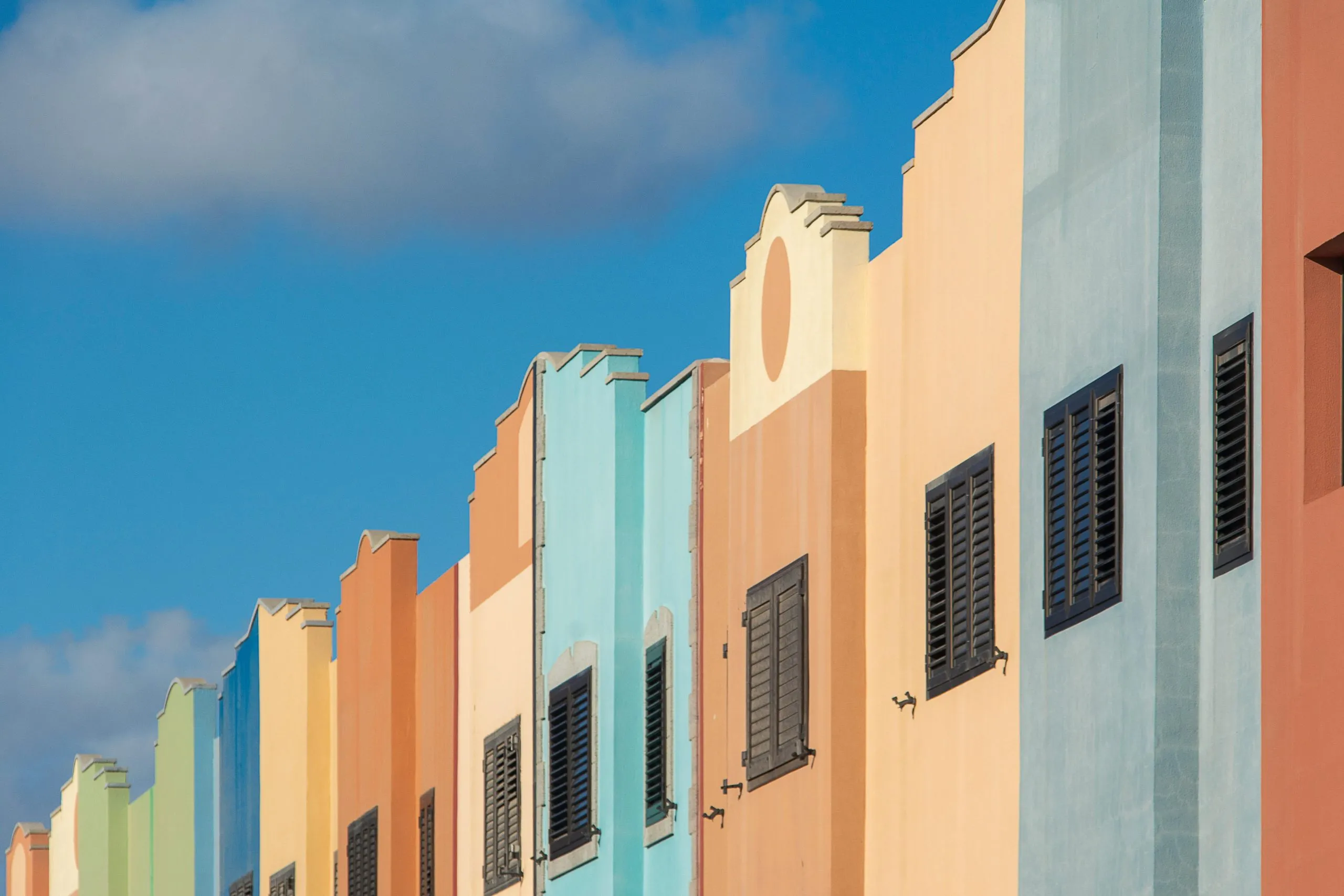
Hato is on the north coast of an east-west island. Willemstad — the UNESCO-listed capital with the iconic pastel waterfront — is 14 km southeast (20 minutes by car). The far western beaches of Westpunt (Cas Abao, Kenepa) are 35 km west (50 minutes). And there is essentially no rideshare. Plan for a rental car if you’re staying more than two days, or a taxi-plus-resort-shuttle pattern if you’re on an all-inclusive.
Taxi — the only on-demand option
Government-regulated rates: USD 25–35 (about Cg 63–72) airport to Willemstad/Punda; USD 35–50 airport to Westpunt beaches; USD 18–25 airport to Mambo Beach / Sea Aquarium. Surcharge after 23:00 is +25%. Drivers take USD readily. Taxi rank is directly outside the arrivals doors; no booking app, no haggling — the rate sheet is posted at the rank.
Rental car — recommended for 2+ day stays
Major chains on-site landside: Alamo, Avis, Budget, Dollar, Enterprise, Hertz, National, Sixt and Thrifty; Europcar operates off-site with a shuttle. Economy from USD 40/day, mid-size SUV USD 55–75. Driving is on the right (Dutch convention), most signage in Dutch and English, fuel ~USD 1.30/litre. Insurance: bring a credit-card CDW or buy at counter (USD 12–18/day extra). Curaçao is small (444 sq km) and you can drive end-to-end in 90 minutes.
Public bus (Konvoi) — cheap but slow
Konvoi buses — konvòi is the local Papiamentu name for the big public buses, operated by Autobusbedrijf Curaçao (ABC) — run line 4B from the airport entrance to Willemstad’s Otrobanda terminal at Cg 2.50 (USD 1.40) one-way, roughly hourly 06:00–19:00, less frequent on Sundays. Travel time 35–50 minutes vs 20 by taxi. From Willemstad, transfer to local routes for Westpunt (limited service, ~2 hours total airport-to-Kenepa-Beach via bus).
No Uber, no Lyft, no Bolt — what to use instead
Rideshare apps do not operate in Curaçao. The local equivalent is the regulated taxi system plus pre-booked private transfers (Curaçao Airport Shuttle, Hato2Hotel) starting USD 30 one-way for groups up to 6. Several resorts (Renaissance, Sandals, Curaçao Marriott Beach) include airport transfers in package bookings — check before paying for taxi.
Practical — If you’re a diver or a beach-hopper, rent a car day one. If you’re a Willemstad-stay-and-eat traveler, taxi in, walk Punda, take day-trip taxis to Sea Aquarium, fly home — you don’t need a car. The middle case (3-day visit, beach + town) is awkward without wheels: budget USD 200+ in taxi fares or rent for two days at USD 90 total. The math favors the rental.
🛍️ 4. Lounges — One VIP Lounge, No Airline Clubs
Hato has exactly one lounge: the independent VIP Lounge on the airside concourse. There is no Plaza Premium here and no KLM Crown Lounge — Crown Lounges exist only at Amsterdam Schiphol, and KLM points its own premium passengers to the same VIP Lounge. Compared to Punta Cana’s lounge row this is modest — but in the small-island context, one decent lounge is plenty.
VIP Lounge — the only lounge on the field
Located post-security on the airside concourse, opposite Gate 4. Open 08:30–20:30 daily. Priority Pass, LoungeKey and DragonPass are all accepted; maximum stay is three hours. It is independently operated — no airline runs its own club at CUR — and it includes a children’s area.
Flying KLM business? There is no Crown Lounge here
KLM Crown Lounges exist only at Amsterdam Schiphol. At Curaçao, KLM directs its World Business Class passengers and paid-lounge customers to the airport’s VIP Lounge — there is no separate KLM facility, whatever an older guide may promise.
Prayer rooms, smoking
Two single-stall prayer rooms (one airside, one landside) accommodate Muslim travelers; no formal Christian chapel but multi-faith space adjacent to landside arrivals. No smoking inside the terminal anywhere; designated outdoor smoking area outside arrivals doors and outside check-in. Vape rules same as cigarette — outdoor only.
Lounge math — If you have Priority Pass through a credit card (Chase Sapphire Reserve, Amex Platinum, Capital One Venture X), the VIP Lounge at Hato is a solid use of it — the alternative is hard-plastic seats and a coffee queue. Mind the three-hour maximum stay and the 08:30–20:30 opening hours; a very early departure will miss it. For under 90 minutes, skip it — the duty-free zone is just as comfortable.
🥩 5. Food, Duty-Free & Curaçao Liqueur Reality
Airport food at Hato is functional rather than memorable — you eat better in any beach bar in Mambo. But duty-free is genuinely interesting because Curaçao is the source of one specific liqueur in the global cocktail canon, and the regulated production of that liqueur happens 12 km from the airport at the Senior & Co distillery in Willemstad.
What’s actually here — fast food and coffee
Landside you get Wendy’s, Auntie Anne’s, Cinnabon, Bar 22 Express, Juan Valdez, Panda Express and Victoria Gelati. Airside the line-up is e Marshe, Bar 22, Juan Valdez and Popcorn. It is fast-food-and-coffee territory rather than sit-down dining — plan your proper Krioyo meal for Willemstad, not the terminal.
Local plates worth flying for — if you have time
Funchi: cornmeal polenta, dense, grilled or fried, served with stew. Stoba: slow-cooked beef or goat in tomato-pepper sauce. Keshi yena: hollowed Edam wheel stuffed with spiced chicken — a colonial-Dutch dish unique to Curaçao. Pastechi: empanada-shaped pastry, savory fillings (tuna, cheese, ham). The airport outlets do not really cover these dishes — with 2 hours to spare, taxi 12 minutes to Plasa Bieu (Punda’s old market food court) for the authentic version.
Duty-free — the Curaçao Liqueur question
The original Curaçao Liqueur (Senior & Co, distilled since 1896 from Laraha bitter-orange peel grown only on the island) comes in five colors and one rainbow. The blue is the famous one but the orange and white are arguably better-tasting. Hato duty-free runs the full Senior range plus generic-brand Bols Blue. Buy the Senior — the price is the same as in Willemstad shops and the bottle is the only one with the “original” certification.
Cigars, chocolate, Delft — secondary buys
Dominican cigars (legal to bring to USA): Romeo y Julieta, Montecristo, Cohiba (Dominican branch — not Cuban Cohiba), USD 8–25 per stick. Cuban cigars: stocked but illegal for US travelers to bring home; Europeans/Canadians can buy freely. Dutch chocolate: Tony’s Chocolonely 180g bars USD 6–8, KLM-branded blue Delft miniatures USD 12–30.
Eat-and-fly — Hato is not where you’ll have your best Curaçao meal. The best meals are at Plasa Bieu, at Mundo Bizarro on Pietermaai, at Restaurant & Cafe Gouverneur de Rouville on the Otrobanda waterfront. Save your eating for those places; treat the airport as the place where you collect a Senior Curaçao bottle and a coffee on the way to AMS.
💡 6. Insider Tips — What Aruba Doesn’t Tell You
Curaçao gets compared to Aruba constantly — both are ABC islands, both Dutch, both hurricane-rare, both English-speaking. The differences are real and they shape your trip. Curaçao has a UNESCO capital where Aruba has a strip mall; Curaçao has 70+ dive sites where Aruba has 30; Curaçao has no US preclearance where Aruba does. Here’s what to actually plan around.
Hurricane belt: you are below it — here’s what that means
Curaçao sits at 12.2°N, well south of the main Atlantic hurricane track. Hurricane Felix grazed the island in 2007 and Omar passed close in 2008; Hurricane Tomas (November 2010) dropped roughly 265 mm of rain — Curaçao’s worst flooding on record, with two deaths and around USD 115 million in damage. Tropical storm Bret (2023) and tropical depression remnants are the more typical risk — not full hurricane landfall. June-November is peak season for the rest of the Caribbean but is still a viable window here. Insurance premiums reflect this: Curaçao trip-insurance is 30–40% cheaper than Bahamas/Florida summer travel.
Spirit Airlines collapsed in May 2026 — route reality
Spirit’s shutdown removed Fort Lauderdale-Curaçao (FLL-CUR) and Orlando-Curaçao (MCO-CUR) from the schedule. JetBlue picked up FLL-CUR (3x weekly), American expanded MIA-CUR to daily. If your booking platform still shows Spirit on this route, the ticket has been refunded or rebooked — verify with the new operating airline before showing up at the airport.
ABC connector turboprops — Aruba and Bonaire in 25 minutes
Divi Divi Air and EZAir run small turboprops — nine-seat Islanders, 19-seat Twin Otters and ~34-seat Saab 340s — between Curaçao, Aruba, and Bonaire. CUR-AUA: 25 minutes, USD 90–130 one-way. CUR-BON: 20 minutes, USD 80–110. Three to seven flights per day each direction. Schedule occasionally collapses (Divi Divi has had two grounded periods in 2024–2025); always have a Plan B by ferry (Aruba) or longer connection.
No US preclearance — what to expect on US arrival
Unlike Aruba (which has full US Customs & Border Protection preclearance at AUA), Curaçao does not. You arrive in the US (Miami, JFK, Atlanta) as an international passenger and clear US immigration there. Add 45–90 minutes to your connection time at MIA on a busy weekend. Global Entry helps; APC kiosks are available at most US-Caribbean gateways.
The honest comparison — Curaçao is the better island for divers, history nerds, and travelers who want a working capital city alongside the beaches. Aruba is the better island for resort-only escapism with US-preclearance convenience. Both are outside the hurricane zone. If you can only pick one and you want a real-place feeling rather than a manufactured-resort feeling, pick Curaçao — and Hato is the airport that gets you there with the least friction.
FAQ — Frequently Asked Questions
Eight questions we get most from first-time Curaçao travelers, answered with current 2026 information.
Do I need a visa to visit Curaçao?
If you hold a US, Canadian, EU, UK, Swiss, Israeli, Japanese, Singaporean, South Korean, Australian, New Zealand, South African, or major Latin American passport, you enter visa-free for 90 days. You need a passport valid 6 months past your entry, a return or onward ticket, and a completed online ED Card from dicardcuracao.com. Travelers from outside the visa-free list need a Caribbean Netherlands tourist visa from a Dutch consulate — processed in 4–8 weeks.
Does my Schengen visa work for Curaçao?
No. The same applies to Aruba, Bonaire, and Sint Maarten.
What currency should I bring — USD, EUR, or guilders?
Bring USD. The local Caribbean guilder (Cg, XCG) — which replaced the Netherlands Antillean guilder (ANG) on 31 March 2025 — is pegged 1:1.79 to the dollar, but US dollars are universally accepted at hotels, restaurants, taxis, dive shops, beach bars, and most retail. Tip in USD. EUR is accepted at upscale Punda boutiques but at unfavorable rates. ATMs at the airport dispense guilders by default; some allow USD selection. Keep small USD bills (1, 5, 10, 20) for tips and small purchases.
Is Curaçao safe in hurricane season (June-November)?
Yes — Curaçao sits at 12.2°N latitude, below the main Atlantic hurricane track. Direct hits are rare but real: Felix grazed in 2007, Omar in 2008, and Hurricane Tomas (November 2010) caused Curaçao’s worst flooding on record. Tropical storm Bret passed in 2023. June-November is statistically the cheapest travel window because the rest of the Caribbean is at hurricane peak, while Curaçao remains a low-risk destination. Pack a light rain jacket; otherwise no special precautions needed.
How do I get from CUR airport to Willemstad?
Three options: (1) Taxi — 20 minutes, USD 25–35 fixed rate, taxi rank outside arrivals; (2) Public bus (Konvoi) — 35–50 minutes, USD 1.40 one-way, hourly 06:00–19:00; (3) Rental car — recommended for stays of 2+ days, all major chains on-site, USD 40–60/day economy. Uber, Lyft, and Bolt do not operate in Curaçao — the regulated taxi system is the only on-demand option.
Are Uber and Lyft available in Curaçao?
No. Rideshare apps do not operate in Curaçao. Use the regulated taxi system (rate sheets posted at the rank), pre-booked private transfers via WhatsApp (Curaçao Airport Shuttle, Hato2Hotel, USD 30+ for groups up to 6), or rent a car. Most resorts include airport transfers in package bookings — verify before paying for a separate taxi.
Is US preclearance available at Hato?
No. Unlike Aruba (AUA), which has full US Customs and Border Protection preclearance, Curaçao does not. You clear US immigration on arrival at your US gateway (Miami, JFK, Atlanta, Charlotte). Build at least 2.5 hours connection time at MIA on busy weekends — the 90-minute legal-connection estimate on booking sites does not account for international-arrival queues. Global Entry and APC kiosks at US gateways help significantly.
How is Curaçao different from Aruba?
Both ABC islands, both Dutch, both hurricane-rare, both English-friendly. Differences: Curaçao has a UNESCO-listed capital (Willemstad) while Aruba is more resort-strip; Curaçao has 70+ recognized dive sites versus Aruba’s 30; Curaçao has no US preclearance while Aruba does (saves connection time on US returns); Curaçao trends slightly cheaper across hotels, food, and rental cars. If you want resort-only and US-easy: Aruba. If you want history, diving, and a real capital city: Curaçao.
2026 Summary Data Table
The full 2026 reference table for Hato International Airport at a glance.
| Feature | Detail |
|---|---|
| IATA / ICAO | CUR / TNCC |
| Country / status | Curaçao — autonomous constituent country, Kingdom of the Netherlands |
| Capital city | Willemstad — UNESCO World Heritage (since 1997) |
| Airport location | Hato, north coast, ~14 km from Willemstad |
| Annual passengers (2024) | 2,117,605 (~2.1 million, record year) |
| Single runway | 11/29 — 3,410 m (11,188 ft) |
| Major airlines (2026) | KLM, JetBlue, American, Air Canada Rouge, Avianca, Copa, Divi Divi, EZAir, Winair |
| Currency | Caribbean guilder (Cg, XCG) at 1.79/USD — USD universal; replaced ANG on 31 March 2025 |
| Languages | Dutch (official), Papiamentu, English, Spanish |
| Visa-free entry | USA, Canada, EU/UK, most Latin America — 90 days |
| ED Card required | Yes — dicardcuracao.com, free, 48 hours pre-arrival |
| Departure charge (PFC) | USD 51.74 international — included in the ticket by some airlines; on others (incl. JetBlue) you pay at the airport |
| US preclearance | No (unlike Aruba) |
| Hurricane risk | Very low — below 12°N latitude, outside main Atlantic track |
| Lounge | VIP Lounge (airside) — Priority Pass / LoungeKey / DragonPass, 08:30–20:30, max 3h stay |
| Rideshare apps | Not available — regulated taxi or pre-booked transfer |
This guide is current as of May 2026 and reflects the post-Spirit-collapse North American route map (JetBlue absorbed FLL-CUR, American expanded MIA-CUR to daily). For weekly route updates and Curaçao flight deals, follow our aifly.one main feed.