Mataveri International Airport (IPC) — Airport Guide 2026
The most isolated commercial airport on the planet is served by one airline, one runway, and no fallback. Santiago sits 3,760 km east; the nearest inhabited neighbour, Pitcairn, is roughly 2,000 km away and has no airstrip at all.
Quick Reference
IPC / SCIP
Mataveri International Airport / Aeropuerto Mataveri / Isla de Pascua
Southern edge of Hanga Roa, the island’s only town
~3 km; 5–7 minutes by car
Single-storey, one boarding gate
3,318 m (extended 1987 as a NASA Shuttle abort site; never used)
LATAM Airlines
Santiago (SCL), ~5.5 h; Lima service intermittent — verify before booking
Chilean peso (CLP); ~894/USD, ~1,045/EUR (late May 2026)
Mandatory FUI at ingresorapanui.interior.gob.cl — complete before boarding
30 days; round-trip ticket within 30 days required
SERNATUR-registered booking required to board
Visa-free 90 days for most Western nationalities
Not required
CLP 95,000 (~US$80) foreign adult; 10-day validity; accredited guide mandatory at major sites
None
🏗️ Terminal, Runway, and the Space Shuttle That Never Landed
Mataveri is a single-storey building arranged around one open hall. LATAM check-in counters run along one wall, security sits behind them, and the departure area is compact enough that you can see the full operation from the door. One gate handles departures. On a day with one rotation, the terminal is calm; on a rare day with two, it fills quickly — it was not designed for volume.
The runway is where the airport gets interesting. At 3,318 m (10,885 ft), it is absurdly long for a facility handling roughly a dozen flights a week. The explanation is American. Under the Mataveri Agreement signed on 2 August 1985, the US and Chilean governments authorised NASA to use Easter Island as an emergency abort-landing site for Space Shuttle missions launched into polar orbit from Vandenberg Air Force Base in California. That required extending the original ~2,000 m strip to orbiter length; the extended runway opened in 1987. The Challenger disaster subsequently reshaped the Shuttle programme, the island fell out of the abort geometry, polar launches from Vandenberg were cancelled, and no Shuttle ever touched down here.
The extended strip still functions as a recognised technical diversion option for trans-Pacific flights in distress — a quiet insurance policy that costs nothing to maintain. For the ordinary passenger, it means wide-body aircraft operate with runway to spare even on hot afternoons.
The runway’s footprint tells you something about the island’s scale. It begins just inland from the southeast coast and runs almost to the west coast, nearly bisecting the southern tip from the Rano Kau volcano. On approach, the crater rim of Rano Kau — with Orongo ceremonial village on its lip — sits directly off one wingtip. The terminal is on the southern edge of Hanga Roa, which is why the drive into town takes minutes rather than the half-hour transfers that characterise most island airports.
A new or expanded terminal has been discussed for completion around late 2026. Treat that timeline as provisional; island construction schedules slip, and the existing terminal is what you will most likely find through 2026.
Inside: free Wi-Fi, restrooms, seating, a café, and craft and souvenir stalls selling carved moai replicas and Rapa Nui textiles. There is no airside hotel, no transit lounge worth the name beyond the old Papeete-transit room (a relic of the former LATAM Santiago–Easter Island–Tahiti routing), and no rail anywhere on the island.
⚠️ One carrier, no alternative
If LATAM cancels your flight, there is no second airline, no ferry, and no road off the island. You wait for the next aircraft. This is not a contingency to plan around — it is the defining operational reality of Easter Island. Buy travel insurance that covers missed connections and extended stays before you board in Santiago.
🛂 Border & Visa
Rapa Nui has two layers of entry requirements: those that apply to Chile broadly, and those specific to this island. Both are cleared on the mainland, at your Santiago departure gate, before boarding — not on arrival.
The FUI Form
The rule that catches people out is the FUI — the Formulario Único de Ingreso (Single Entry Form), completed online at the official Ministry of the Interior portal, ingresorapanui.interior.gob.cl. The form window opens 21 days before arrival and closes at boarding time. Do it days in advance, not at the airport.
Three things are required for approval: a round-trip ticket with a return date no more than 30 days after your outbound flight; proof of accommodation at a SERNATUR-registered lodging, or a formal invitation letter from a resident; and your personal arrival details. LATAM and the Policía de Investigaciones (PDI) check the approved FUI confirmation at the Santiago gate. Print or save the confirmation — you may be asked for it again at the PDI counter on arrival.
⚠️ No FUI, no boarding
LATAM checks the approved FUI confirmation at the Santiago gate, before you walk down the jet bridge. Completing it en route or at the airport is too late. Start the form at least 48 hours ahead, and save both the submission confirmation and your accommodation booking reference somewhere you can access offline.
The 30-day maximum stay is a hard cap. Extensions exist for specific circumstances and must be arranged through Chilean or island authorities — do not plan around getting one.
Chilean Visa Rules
Citizens of the US, Canada, the UK, the EU, Australia, New Zealand, and most of Latin America enter Chile visa-free for 90 days as tourists, and that allowance covers Rapa Nui. On arrival at the mainland you receive a PDI tourist stamp — keep the slip. Yellow fever vaccination is not required for entry to Chile or Rapa Nui, and there is no general health-entry form beyond the FUI. Hanga Roa sits essentially at sea level; there are no altitude considerations.
Currency
The Chilean peso (CLP). Notes circulate in CLP 1,000, 2,000, 5,000, 10,000 and 20,000; coins in 10, 50, 100 and 500. The peso replaced the escudo in 1975 at a rate of 1,000 escudos to one new peso and has been a clean decimal currency since — there is no parallel rate or black market to navigate, unlike some South American neighbours. At the late-May 2026 rate, CLP 95,000 is about US$106, which is relevant because that is the park ticket price every visitor pays.
The National Park Ticket
The Rapa Nui National Park ticket is the real cost of the island, not the visa. A foreign adult (aged 13 and over) pays CLP 95,000, quoted by the park as US$80; children pay a reduced rate. The ticket is valid for 10 days from first use and covers all archaeological sites, but Rano Raraku and Orongo can each be entered only once — plan those visits as single, deliberate trips.
Buy it from the Ma’u Henua Indigenous Community, which has administered the park since 2017, either online before travel or at their office in Hanga Roa or at the airport on arrival.
🎟️ Ticket + Guide = Two Costs, Not One
Entry to the major sites — Rano Raraku, Orongo, Ahu Tongariki, and others — is mandatory with an accredited Ma’u Henua guide. The guide is a separate charge on top of the park ticket, typically around US$80–120 for a half- or full-day group tour (rates vary by group size and season). The honest “cost to see the moai properly” is the CLP 95,000 ticket plus a guide fee. Budget both.
🚗 Getting to Hanga Roa
Forget the apps. There is no Uber, Cabify, or Didi on Easter Island, and no scheduled public bus or rail of any kind — the island has none. What exists is short and straightforward, though priced at island economics.
The terminal is about 3 km from central Hanga Roa, a 5–7 minute drive.
Hotel transfer is the default for most visitors. Almost every SERNATUR-registered lodging meets guests at the terminal — often included, sometimes a small charge — and frequently with a flower-lei welcome. Shared transfers run around US$10–15 per person where charged. Because you must hold an accommodation booking to clear the FUI, you will typically have a transfer arranged before you land. Confirm it at booking time; it is the least stressful and usually cheapest option.
Private taxi. Taxis wait at the terminal; expect roughly US$25–40 for a private car into Hanga Roa or a more distant property. There is no app-metered fare — agree the price before you get in. For a 3 km journey that figure is steep, but it reflects island supply-chain costs rather than a tourist premium.
Rental car. The most useful option if you intend to explore independently between guided-site visits. Rates run about US$30–60 per day; a 3-day rental lands around US$170–270. Small SUVs and pickups dominate the fleet because some site approaches are rough. Book ahead — the island’s fleet is finite and sells out in high season (December–February and around the early-February Tapati festival). Fuel is sold at the single station in Hanga Roa and costs more than on the mainland.
Bicycle, scooter, or on foot. Hanga Roa is walkable end to end, and bikes and scooters rent by the day. Walking the 3 km from the terminal is feasible for light travellers in 30–40 minutes, but there is no continuous footpath for stretches of the route, and it is not the sensible choice on arrival day with luggage.
🚗 Rent or Transfer — A Simple Comparison
A rental car for three days (~US$200) costs roughly what two private airport taxis plus a single full-day hired-vehicle circuit would. If you are staying three nights or more and are comfortable driving, renting is the better value and gives you freedom to reach Anakena or Tongariki at sunrise on your own schedule. For a short, tightly guided trip, the hotel transfer plus guided tours is simpler.
One specific hazard: free-roaming horses and cattle wander the island’s roads and are a real collision risk at dusk, not a scenic detail. There is no car-insurance market on the island comparable to the mainland — read what your rental agreement actually covers before you accept the keys.
🛋️ Lounges
There is no lounge at Mataveri. No Priority Pass, LoungeKey, DragonPass, or LATAM VIP facility — none of the major networks operate here. A premium credit card that admits you to airside comfort in Santiago buys nothing at IPC. This is one of the few international airports where lounge access is simply irrelevant.
The departure hall offers open seating, the café, free Wi-Fi, and souvenir stalls. The return flight to Santiago is about 5.5 hours; plan to be comfortable before you reach the terminal. LATAM premium-cabin and elite passengers receive priority boarding and mainland lounge access at the Santiago end, not here.
💡 Last Hour on the Island
The right move before a Santiago departure is a long lunch on the Caleta Hanga Roa waterfront — the terminal has nothing worth arriving early for. Check-in opens a few hours before departure; clear any admin (FUI confirmation, park ticket) earlier in your stay, eat in town, and reach the terminal with enough margin for bag-drop rather than treating IPC as a place to spend time.
🍽️ Food Before You Fly
The airport café handles coffee, sandwiches, and empanadas — adequate, priced above the town equivalent. A coffee and empanada that runs CLP 3,000–4,000 in Hanga Roa costs more airside, and the selection is thin. There is no full restaurant inside the terminal and no meaningful duty-free; the souvenir stalls sell crafts, not liquor or perfume. Buy water and a proper meal in town before heading to the airport.
The food worth your money is in Hanga Roa, five to seven minutes away. The island’s signature is tuna — yellowfin and bigeye land fresh — served as ceviche, as carpaccio, and as atún a la piedra (seared on a hot stone at the table). Po’e is the traditional sweet, a baked banana-and-pumpkin pudding; umu, a Polynesian earth-oven feast of meat, fish, and sweet potato cooked underground, appears at cultural dinners. A main of fresh tuna at a sit-down restaurant typically runs CLP 12,000–20,000 (~US$13–22) — roughly double the mainland equivalent, because nearly everything except the fish itself is imported.
Restaurants operating in 2026: Te Moana Sunset, a seafood spot with an upstairs terrace known for ceviche and sashimi; La Kaleta, on the Caleta Hanga Roa waterfront, focused on grilled catch of the day beside the breaking surf; Kotaro, a small Japanese kitchen that consistently ranks among the island’s best and works heavily with fresh tuna; and Kaloa Lounge, the ocean-facing option for a slower meal. Reserve in high season — the island has tens of restaurants, not hundreds, and the good ones fill.
Self-catering is viable but not cheap. Hanga Roa’s small supermarkets stock basics at a premium, and produce freshness varies through the week depending on when the LATAM cargo flights arrived. If you are renting an apartment, shop early in your stay.
📅 Tapati Rapa Nui: 3–14 February 2026
Two weeks of cultural competition, dance, the haka pei banana-trunk sled race, and body-painting that draw the island’s largest crowds of the year. If you are travelling for Tapati, book accommodation, transfers, and LATAM seats months ahead — the island sells out. If you want quieter sites and easier restaurant bookings, avoid early February and the December–January peak.
💡 Beyond the Terminal: Sites and Departure-Day Math
Mataveri is not a transit airport. One carrier, one main route, a 5.5-hour flight each way, and entry rules that require a multi-day round-trip ticket mean there is no connecting traffic — every passenger here is staying for days. “Doing the moai on a layover” does not exist. Plan for two to three full days minimum to see the major sites properly.
The Sites
Driving times from Hanga Roa:
Ahu Tongariki — fifteen restored moai on the island’s largest ceremonial platform, facing inland against the open Pacific. About 30 minutes / ~18 km by the coastal road. Go at dawn for the best light and the smallest crowd; guided entry required.
Rano Raraku — the quarry where almost every moai was carved, with hundreds of statues at every stage of completion, many half-buried on the hillside. Roughly 20–25 minutes from town, about 1 km from Tongariki, so pair the two. Your park ticket admits you here only once — this is not a site to rush. Guided entry required.
Orongo — the stone ceremonial village of the Tangata Manu (Birdman) cult on the rim of the Rano Kau crater, a short drive uphill from Hanga Roa. The cult was practised for roughly two centuries, from approximately 1680 to 1866: each year, contenders’ representatives swam to the offshore islet of Motu Nui, waited for the first sooty-tern egg of the season, swam back through open water and climbed the cliff face to Orongo; the man who delivered the egg first made his sponsor the year’s Tangata Manu. Catholic missionaries ended the practice after 1866. Standing on the crater rim with Motu Nui visible below, the competition makes sense in a way no museum panel achieves. Single-entry on your park ticket; guided.
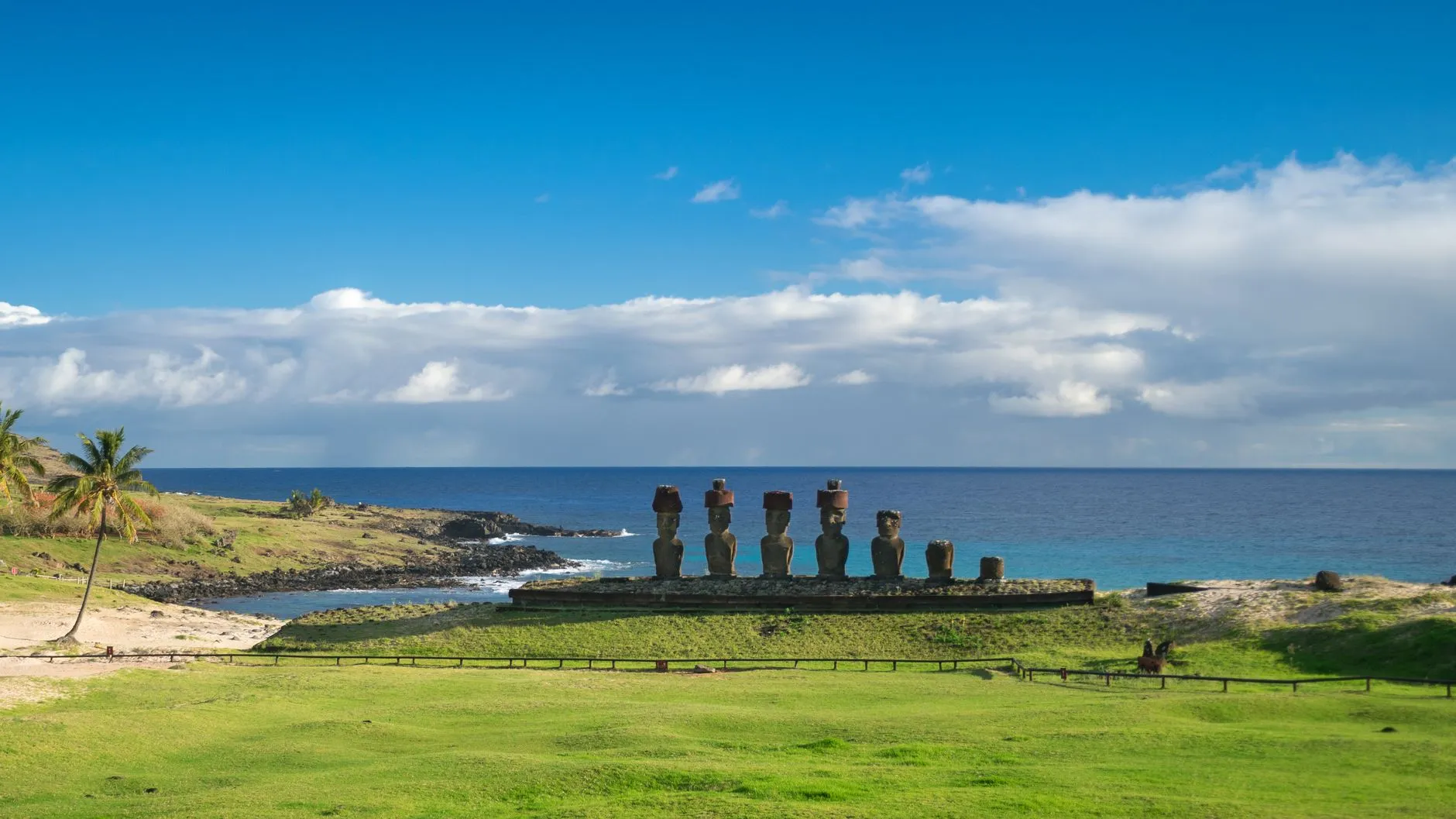
Anakena — the island’s swimming beach: white coral sand backed by the Ahu Nau Nau moai and a grove of palms, about 16 km / 20–25 minutes from Hanga Roa on the far side of the island. The only site that functions as a place to actually swim rather than look.
Ahu Akivi — an inland platform of seven moai that, unusually, face the sea. A short drive from town and less visited than the coastal sites.
Father Sebastian Englert Anthropological Museum in Hanga Roa is the island’s only museum, founded in 1973, and free to enter. It holds one of the few moai with restored coral-and-obsidian eyes and is the best way to orient yourself before reaching the outdoor sites. Opening hours are roughly Tuesday–Friday 09:30–17:30, weekends 09:30–12:30, closed Mondays — it has had temporary closures, so verify before you go.
A Workable Schedule
Arrive midday on the LATAM flight; settle and walk the in-town ahu and the museum that afternoon. A full guided day for the eastern circuit: Tongariki at sunrise, Rano Raraku, the coast. A second day for Orongo, Anakena, and Ahu Akivi. Return flight on day three. That clears the single-entry sites once each, inside the 10-day ticket window.
For departure-day timing: the airport is 5–7 minutes from town, the terminal is compact, but check-in and bag-drop for a single wide-body flight bunch up. Leave Hanga Roa about two hours before a Santiago departure — there is no lengthy security queue, but you have exactly one flight to catch.
🔧 Practical Notes
Mobile and Wi-Fi
Entel is effectively the only mobile network with usable coverage on the island; signal is solid in Hanga Roa and patchy to absent at remote sites and crater rims. If you want a Chilean SIM, buy it on the mainland before you fly — Entel has kiosks at Santiago airport — because island stock is limited. Hotel and airport Wi-Fi is slower than mainland connections; the whole island runs on a single satellite-and-cable link. Do not count on streaming-grade speeds.
Currency on the Ground
Cards are accepted at most hotels, tour operators, and the better restaurants. Carry pesos in cash for small purchases, market stalls, taxis, and tips. The Banco Estado ATM in Hanga Roa can run dry around busy weekends and festival dates — withdraw before you need it. The posted rate is the rate; there is no black market.
Safety
Violent crime against visitors is rare and there is no organised criminal presence; the realistic risk is opportunistic petty theft — leave nothing visible in a parked rental and watch your bag in crowded moments in Hanga Roa. The greater hazards are environmental: strong sun, no shade at open archaeological sites, sheer unfenced crater edges at Rano Kau and Orongo, and Pacific surf that is stronger than it looks along the rocky coast. Anakena is the safe swimming beach; most of the rest of the coastline is not.
Tap Water and Tipping
Tap water in Hanga Roa comes from treated underground reservoirs and is generally considered safe to drink, though travellers with sensitive stomachs often prefer bottled. Restaurants commonly add a suggested 10% propina to the bill, which you can adjust or decline; guides and drivers appreciate a tip but do not demand one. Round up for taxis.
The Cost Reality
As a rough anchor: a careful independent traveller should expect to spend well above a mainland-Chile daily budget once the fixed costs are in — the US$80 park ticket, a guide, a rental car or transfers, and restaurant meals at CLP 12,000–20,000 a main add up fast. The fixed costs (the flight, the park ticket, the guide) are the same whether you stay three days or ten. A slightly longer trip spreads them more sensibly than a rushed two-night dash.
❓ FAQ
📊 At a Glance — IPC 2026
| Category | Detail |
|---|---|
| Airport | Mataveri International (IPC / SCIP) |
| Other names | Aeropuerto Mataveri / Isla de Pascua |
| Location | Southern edge of Hanga Roa, Easter Island (Rapa Nui), Chile |
| Remoteness | ~3,760 km from Santiago; most isolated commercial airport on Earth |
| Distance to town | ~3 km / 5–7 min drive to central Hanga Roa |
| Terminal | One single-storey terminal, one boarding gate |
| Runway | 3,318 m — extended 1987 as a NASA Space Shuttle abort site; never used |
| Sole carrier | LATAM Airlines |
| Main route | Santiago (SCL), ~5.5 h; Lima intermittent (verify before booking) |
| Currency | Chilean peso (CLP); ~894/USD, ~1,045/EUR (late May 2026) |
| Visa | Visa-free 90 days for most Western nationalities |
| Entry form | Mandatory FUI at ingresorapanui.interior.gob.cl — before boarding |
| Maximum stay | 30 days; round-trip ticket within 30 days required |
| Accommodation | SERNATUR-registered booking required to board |
| Yellow fever | Not required |
| Park ticket | CLP 95,000 (~US$80) foreign adult; 10-day validity; accredited guide mandatory at major sites |
| Guide cost | ~US$80–120 for a group half-/full-day tour (separate from ticket) |
| Transport | Hotel transfer ~US$10–15 pp; taxi ~US$25–40; rental ~US$30–60/day |
| Rideshare / bus / rail | None |
| Airport lounge | None (no Priority Pass / LoungeKey / DragonPass / LATAM VIP) |
| Mobile network | Entel — buy SIM on mainland; Wi-Fi available but slow |
| Tap water | Treated; generally considered safe in Hanga Roa |
| Top sites | Tongariki (~30 min), Rano Raraku (~20–25 min), Orongo (uphill from town), Anakena (~20–25 min) |
| Tapati festival | 3–14 February 2026 — book everything months ahead |