Pune International Airport, Lohegaon (PNQ) — Airport Guide 2026
Pune is a city of seven million running through a runway shared with the Indian Air Force, and Terminal 2 — the airport’s first genuinely modern building — only opened to passengers in July 2024.
Quick Reference
PNQ / VAPO
T1 (domestic, older) + T2 New Integrated Terminal (opened 14 Jul 2024)
~11 km northeast of central Pune (Shivajinagar)
Single, 10/28, 2,539 m asphalt — shared civil-military
Civil enclave on Lohegaon Air Force Station; IAF controls ATC
Indian rupee (INR, ₹); ~₹95 = US$1, ~₹112 = €1 (May 2026)
India e-Visa via indianvisaonline.gov.in; visa-free only Nepal & Bhutan
IndiGo, Air India, Air India Express, Akasa Air, SpiceJet, Alliance Air, Star Air, Fly91
Dubai, Singapore (operating); Netherlands, Germany (announced mid-2026, unconfirmed)
App cab ₹250–400; prepaid taxi ₹400–600; PMPML electric bus to Ramwadi Metro
Elysian (T2, Priority Pass/DragonPass); Earth Lounge (T1 domestic)
10,457,694 (+9.8% year-on-year)
Permitted under temporary AAI–IAF arrangement, not guaranteed
New Pune (Purandar) greenfield — planned, land disputes ongoing, not open
🏢 Terminals & the Military Field
For most of its passenger life Pune ran out of a cramped 1990s building — 6,500 m², two extensions bolted on in 2008, still undersized the day each was finished. The structure still operates as T1 for domestic traffic. T2, inaugurated by Prime Minister Modi on 10 March 2024 and open to passengers from 14 July 2024, is the fix: roughly 52,000 m², over nine million passengers per year capacity, 34 check-in counters, 25 self-check-in kiosks, and five aerobridges. That last number matters. For years almost every Pune departure meant a bus to a remote stand and a walk up airstairs in 38°C heat. T2 makes jetbridge boarding the default; remote stands still appear at peak, but they’re no longer the norm.
The split as of 2026: T1 handles domestic, T2 is the newer building carrying both international traffic and part of the domestic load. The handover has been gradual and the signage has not always kept pace, so check your boarding pass for which terminal you want — they are close enough to reach on foot in a few minutes, but not the same door.
🎖️ What Running an Airport on an Air Force Base Actually Means
The single runway (10/28, 2,539 m) belongs to the Indian Air Force’s Lohegaon station. The IAF runs the air traffic control. Two things follow directly.
The 2,539 m runway length is below what big-city international operations typically want for fully-loaded long-haul departures. It’s part of why widebody intercontinental service has been slow to materialise — not just the IAF’s preferences, but physics.
More pressing for a traveller: military movements take priority. Runway work, fighter operations, or an incident involving a military aircraft can close the field for hours with no civilian recourse. This has happened before.
⚠️ Night flights are not guaranteed
The current arrangement permitting civilian night landings rests on a temporary AAI–IAF understanding rather than a permanent right. Past runway maintenance windows (roughly 8pm to 8am) have forced airlines to reschedule. Late-evening and red-eye flights from Pune are the first to shift when the Air Force needs the field. Build a buffer if a tight onward connection at Mumbai or Delhi depends on an on-time Pune departure.
🏗️ The Airport That’s Been About to Replace Itself for a Decade
New Pune International Airport, a greenfield project near Purandar southeast of the city, has been described as imminent in every Pune airport article since the mid-2010s. It is not open. Land acquisition has been the chronic obstacle — farmers in the affected villages have contested compulsory purchase for years, and the timeline has moved repeatedly. Plan your 2026 trip around Lohegaon.
🛂 Border & Visa
India does not do casual entry. Almost every foreign visitor needs a visa arranged before flying — there is no general visa-on-arrival. Visa-free entry is limited to Nepali and Bhutanese nationals.
💾 The e-Visa
Apply only through indianvisaonline.gov.in. This needs saying plainly because there is a large industry of look-alike sites that charge US$40–100 in “service fees” on top of the actual government cost. Search engines surface these sites above the official one. The government portal processes the same application for the government fee plus a 3% bank transaction charge, and nothing else.
The tourist e-Visa comes in three durations: 30-day multiple-entry, 1-year multiple-entry, and 5-year multiple-entry. Only the 30-day fee moves with the calendar: US$10 for April–June, US$25 for July–March. The 1-year fee is a flat US$40 and is not a reduced rate. The 5-year is US$200 on the standard tier — US$160 on a United States passport and US$484 on a United Kingdom one. Fees are set per nationality, so check the country-specific fee table on the official portal before you apply.
⚠️ e-Visa scam sites — official portal only
Third-party “visa service” sites charge US$40–100 on top of actual government fees for identical processing. Apply only at indianvisaonline.gov.in. Allow 4–7 days for processing.
The COVID-era Air Suvidha self-declaration form was discontinued. You do not need it. Anyone telling you to fill one out is working from a stale checklist.
Those who cannot use the e-Visa — certain nationalities, journalists, longer or purpose-specific stays — need a conventional paper visa from an Indian mission before travel. There is no fixing this at Pune immigration on arrival.
💉 Health Entry Requirements
No vaccination certificate is required for entry from most countries. The exception is a yellow fever certificate, required only if arriving from or recently transiting a yellow-fever-endemic country (much of sub-Saharan Africa and tropical South America). From Europe, the Gulf, North America, or East Asia: nothing.
💱 Money
The currency is the Indian rupee (INR, ₹). As of May 2026 the rate sits around ₹95 to US$1 and ₹112 to €1; the rupee has drifted weaker through the year, so treat those as approximate. Notes in circulation: ₹10, ₹20, ₹50, ₹100, ₹200, ₹500. The ₹2,000 note was withdrawn in 2023 — you won’t see one. The ₹500 is currently the largest note in circulation. Coins run ₹1, ₹2, ₹5, ₹10.
Dollars and euros are not accepted at shops or stalls. The rupee is what you spend.
💵 ATMs beat exchange counters
Airport ATMs in both terminals dispense rupees on foreign cards at the bank rate. Currency-exchange counters build in a wide spread. Withdraw a working amount at the airport ATM, then rely on cards and UPI QR payment thereafter — Pune is heavily digital, and even small vendors take QR codes.
A practical note on notes: the ₹100 and ₹200 do most of the day-to-day work. A ₹500 note at an autorickshaw stand early in the morning will often get waved away for lack of change. Break large notes at a shop when you can. The current note family looks the way it does because of the 2016 demonetisation (when the old ₹500 and ₹1,000 notes were voided overnight) and the 2023 ₹2,000 withdrawal.
India restricts importing and exporting rupees. Declare foreign cash over the US$5,000 equivalent (or US$10,000 combined cash and instruments) on the customs form.
🚆 Getting Into the City
The airport is about 11 km northeast of central Pune, in Lohegaon. That is close on the map and slow in practice — Pune traffic is dense, and the 11 km to Shivajinagar or Pune Junction can take 30 minutes off-peak and well over an hour in the evening crush.
⭐ App Cabs — Ola, Uber, Rapido
The default, and the right choice for most arrivals. Ola, Uber, and Rapido all operate at Pune on government-approved meter rates introduced city-wide on 1 May 2025: roughly ₹37 for the first 1.5 km, then ₹25/km for an AC cab. A run from the airport to central Pune — Shivajinagar, the railway station, Koregaon Park — typically lands at ₹250–400 depending on destination and surge. Rapido also offers cheaper motorbike-taxi rides for light travellers.
Book through the app and meet the driver at the designated pickup zone. The apps fix the fare, which removes the haggling at the cab rank.
🚕 App cab reality check
Driver cancellations are common at surge times, and the wait at the airport pickup point can run 10–20 minutes at peak. If your flight lands late evening, factor that in.
🚖 Prepaid Taxi
Both terminals have a prepaid taxi counter: pay a fixed fare upfront against your destination, hand the receipt to the driver. Higher than an app cab, but no surge and no on-the-meter dispute. Useful late at night or with heavy bags. Expect roughly ₹400–600 to central Pune. Take the counter receipt and ignore freelance tout offers in the arrivals hall.
🚌 PMPML Bus and the Metro Feeder
PMPML, Pune’s public bus operator, runs air-conditioned electric buses on the airport corridor, including a feeder service linking the airport to Ramwadi, the eastern terminus of Pune Metro’s Corridor 2 (Vanaz–Ramwadi), which runs through Pune Railway Station and Deccan. It is Corridor 2, not Corridor 1: if your destination is on Corridor 1 you change trains rather than ride straight through. The bus fare is a fraction of a cab; the metro adds little more. Once you’re on the train you’re clear of road traffic.
The trade-off: slower door-to-door than a cab, and awkward with large luggage. The metro does not run directly to the airport terminal — the feeder bus bridges the gap to Ramwadi. There is no rail or metro station inside the airport itself. Verify current feeder timings before relying on this for a late flight; the schedule has changed more than once.
🛺 Autorickshaws — In Town, Not at the Airport
The auto is Pune’s workhorse for short city hops. From the airport it’s less practical than an app cab: not all autos will do the airport run, and the meter is a perennial negotiation point at arrivals. Once you’re in the city, autos are metered under the May 2025 revised government rates. Insist on the meter or agree the fare before you get in. Rapido and Ola also let you book an auto through the app — fixed fare, no haggling — which is the cleanest way to use one if you don’t speak Marathi or Hindi.
🚗 Car Rental — Not What You Think
Self-drive rental exists but is not the right call for a first-time visitor. Pune traffic is assertive, lane discipline is notional, and parking in the old city is genuinely difficult. For day-trips to forts and hill stations, a car with a driver — booked through your hotel or an outstation cab app — costs little more than self-drive once fuel and stress are accounted for, and it solves the navigation and parking problem entirely.
🛋️ Lounges
Pune’s lounge offering is modest. There is no airline-flagship lounge, no dedicated international business-class space of the kind at Mumbai or Delhi, and no arrivals lounge.
The Elysian Lounge outlets in T2 (the New Integrated Terminal) are the main option — in both Priority Pass and DragonPass networks, with a ground-floor lounge and a first-floor lounge running effectively round-the-clock, plus a third unit that runs overnight, 18:00 to 09:00. Expect the standard Indian contract-lounge package: hot buffet, soft and usually alcoholic drinks, wi-fi, washrooms, seating that tightens when two big domestic waves coincide. Functional, not memorable.
In T1 the lounge has historically operated as the Earth Lounge, also on lounge-membership networks. As traffic migrates to T2, confirm which lounge is live in your terminal at travel time — the airport’s lounge footprint has been in flux through the handover.
🛋️ Priority Pass works at Elysian (T2) — confirm before you walk
Elysian appears in both Priority Pass and DragonPass networks. The food is decent Indian airport-standard, not a reason to arrive early. Under T1/T2 transition, check that the lounge you’re heading to is in the terminal printed on your boarding pass.
🍽️ Food Before You Fly
The terminal food is ordinary: a coffee chain, a couple of quick-service Indian counters, packaged snacks, at prices three to four times what the same food costs in town. Eat before you arrive, or wait.
What to eat in the city, all of it Pune/Maharashtra:
Misal pav is the one dish to seek out — a fiery sprouted-bean curry with crunchy farsan on top, served with soft pav bread. This is Pune’s defining breakfast. At a working misal house in the old city the plate runs roughly ₹60–120; the airport charges multiples for an inferior version.
Vada pav — spiced potato fritter in a bun, ₹15–30 from a city cart — needs no introduction if you’ve eaten in Maharashtra before.
🥐 Chitale Bandhu Mithaiwale — the bhakarwadi institution
Founded in 1950, selling bhakarwadi commercially since 1970, Chitale is the standard reference for the sweet-and-spicy fried savoury spiral Pune effectively invented. The original outlet is on Bajirao Road; the brand has many city locations. A box travels well as a gift and keeps for weeks. Verify branch locations before a special trip.
Maharashtrian thali — bhaji, dal, rice, bhakri, koshimbir, a sweet — is the right way to eat a midday meal in the old city.
Mastani is a genuine Pune invention: a thick dessert-drink of milk, ice cream, dry fruit, and mango pulp in season. The name is variously attributed to the Peshwa-era figure Mastani or to “masta” (Marathi: great), and the old-city sweet houses are where to try it on a hot afternoon.
Alphonso (hapus) mango, roughly March–June, is the regional luxury when it’s in season. Maharashtra’s Alphonso is the reference variety; you’ll see it everywhere at the right time of year.
Shrikhand — strained yoghurt sweetened with saffron and cardamom — is a Maharashtrian staple, sold by the tub at Chitale and similar shops.
Duty-free at PNQ is modest: a shop sized for the current Dubai and Singapore services, not a sprawling international hall. For edible gifts, the city beats the terminal on selection and price. A box of Chitale bhakarwadi or jaggery-and-nut chikki from a city sweet shop travels better than anything airside and costs a fraction of the terminal markup.
💡 Insider Tips & Day-Trips
Pune rewards a genuine stopover better than most Indian IT cities because the history is real and close. A layover won’t help — see the layover math below — but a free half-day or a full day gives you actual options.
🏛️ Aga Khan Palace — Closest and Most Significant
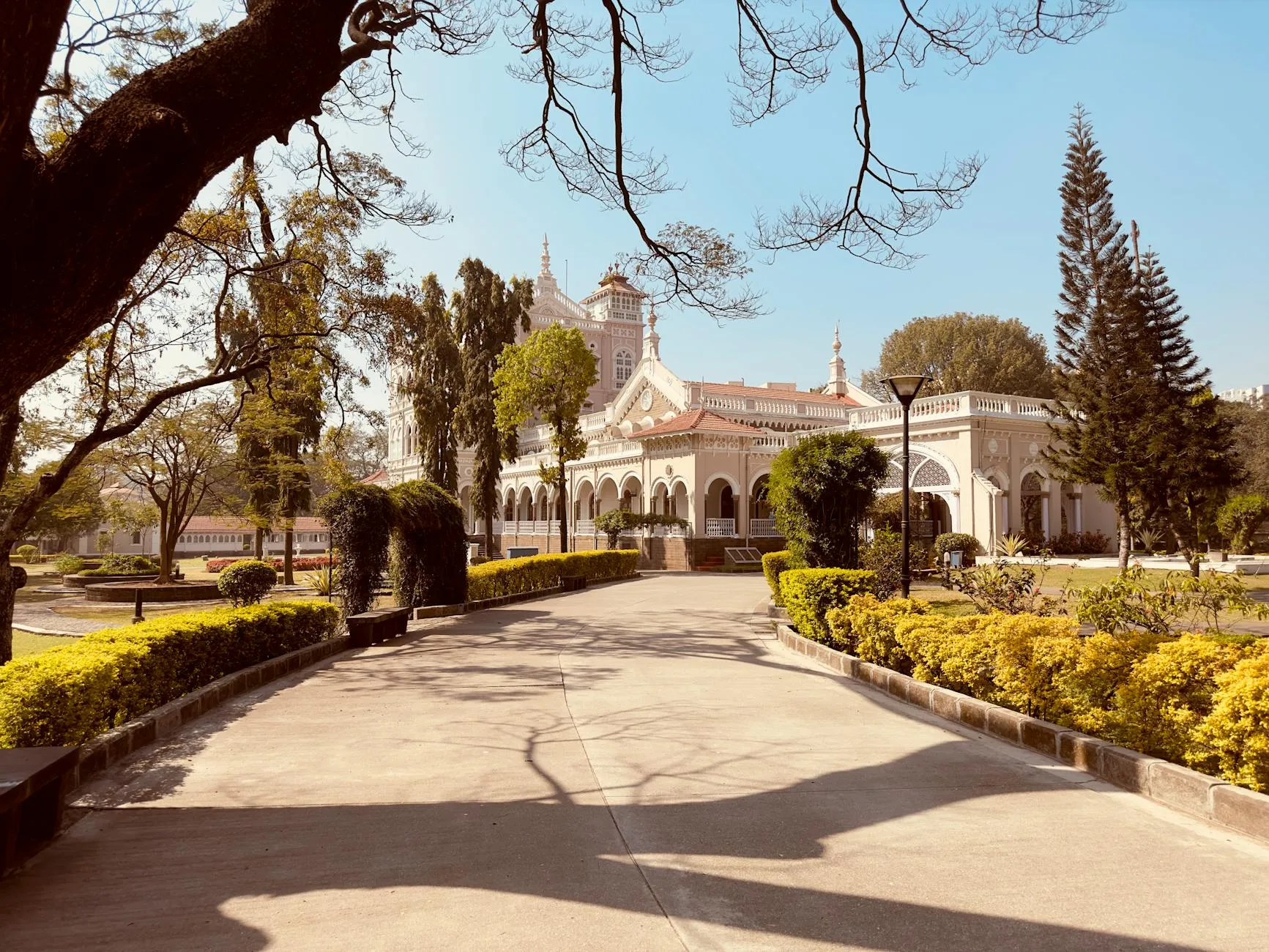
About 7–8 km from Lohegaon, well under 30 minutes off-peak. Built in 1892 by Sultan Muhammed Shah Aga Khan III, the palace became a detention facility: Mahatma Gandhi, his wife Kasturba, and his secretary Mahadev Desai were interned here from 9 August 1942 to 6 May 1944 after the Quit India Movement. Both Kasturba Gandhi and Mahadev Desai died in captivity here in 1944; their memorials (samadhis) stand in the grounds. It now houses a Gandhi museum. Entry is a few rupees for Indians and around ₹100 for foreign visitors — verify the current Archaeological Survey rate, which has increased over time.
For a traveller with a couple of free hours this is the obvious choice: the nearest major sight and the most historically significant.
🏯 Shaniwar Wada
The fortified seat of the Peshwa rulers of the Maratha Empire, built in 1732 in the heart of the old city, about 10–12 km and 30–45 minutes from the airport in traffic. A great fire in 1828 gutted the wooden interiors, so what survives is the massive stone perimeter, the Delhi Gate with its anti-elephant spikes, and the foundations — more ruin than palace, but the central monument of Maratha Pune. Modest entry fee; allow an hour.
⛰️ Sinhagad Fort
A hill fort about 30 km southwest of the city — roughly an hour each way by road, more on weekends — at 1,300 m. Scene of the 1670 night assault led by the Maratha commander Tanaji Malusare, who died taking it for Shivaji. The climb and the Sahyadri ridge views are the draw, along with the famous roadside pithla-bhakri and hot bhajis at the top. Entry is nominal, around ₹20. A half-day minimum; better as a morning out.
🏞️ Khadakwasla Dam
On the way to or from Sinhagad, the Khadakwasla reservoir is a popular evening drive from the city for the lakeside food stalls and the breeze. Worth folding into a Sinhagad trip rather than treating as a destination on its own.
🌄 Lonavala and Khandala
The classic hill-station day-trip: Lonavala about 65 km from Pune, roughly 1 to 1.5 hours via the Mumbai–Pune Expressway, with Khandala right beside it. Western Ghats greenery — spectacular in and just after the June–September monsoon — viewpoints, hill forts, and the chikki the town is known for. A full day from Pune; manageable as a morning-to-evening loop with a car and driver.
☕ Koregaon Park and the Osho Ashram
Koregaon Park is Pune’s leafy, upscale quarter — cafes, restaurants, and the Osho International Meditation Resort, the ashram built around Rajneesh/Osho. The resort has a paid day-pass entry system; the surrounding neighbourhood is the best part of the city for a meal and coffee.
⏱️ Layover Math
Be honest with the arithmetic. The airport is 11 km out and Pune traffic is heavy, so a city round-trip is 60–90 minutes of driving before you’ve seen anything. On return you re-clear security from scratch — domestic check-in counters close 45–60 minutes before departure, and you want to be airside 60–90 minutes out.
Under about 5 hours between flights: stay in the terminal. With 5–6 hours you might manage the Aga Khan Palace and back if traffic cooperates, but it is tight — a single jam kills it. Anything in town beyond Aga Khan Palace needs a half-day you won’t have on a connection. If you want Pune, build in an overnight.
⏱️ Layover reality: the city is not close enough
11 km sounds manageable until you add Pune’s traffic, then the return security queue. Under 5 hours between flights, stay airside. With 5–6 hours, Aga Khan Palace is the only sight that fits — barely. Everything else requires an overnight.
🔧 Practical Notes
Wi-fi and SIM. Airport wi-fi exists but is patchy and time-limited. For any stay beyond a day or two, an Indian SIM is worth the effort. Jio and Airtel have the broadest coverage; prepaid tourist plans bundle generous data. Buying a physical SIM requires your passport, visa, and a passport photo, with a short KYC activation delay (sometimes a few hours). An eSIM from Jio or Airtel — or an international travel eSIM bought before you fly — sidesteps the paperwork and has data live the moment you land, which matters for booking the cab from the arrivals hall.
Payments. Pune is close to cashless. UPI QR-code payment runs everything from market stalls to autorickshaws. UPI needs an Indian bank account that most visitors won’t have, so for international travellers it’s cards plus a cash cushion. Keep small notes (₹10–100) for autos, tips, and stalls; ₹500s are awkward to break early in the morning.
Safety and scams. Pune is among the safer large Indian cities and the airport is orderly. At arrivals: ignore freelance taxi touts and use the app or the prepaid counter. The “your hotel is closed, let me take you to a better one” routine is the other classic at Indian airport arrivals — don’t engage. Petty theft is opportunistic; keep bags zipped on crowded metro and market stretches. Solo women travellers consistently report Pune as more comfortable than much of north India.
Tipping. Not obligatory and not expected at Western levels. Round up the cab fare, leave 5–10% at a sit-down restaurant if service isn’t already included, ₹20–50 for a porter. App-cab and auto drivers don’t expect anything beyond rounding.
Water and health. Tap water is not for drinking — bottled or properly filtered only, including ice at cheaper places. Sealed bottled water is cheap and everywhere. Street food is part of the point in Pune: pick busy stalls with high turnover, eat it freshly cooked and hot, and give your stomach a day before hitting the more adventurous end of the menu.
Climate. Pune sits on the Deccan plateau at about 560 m — evenings cool down, humidity is lower than coastal Maharashtra. April–May is hot and dry; the southwest monsoon runs roughly June–September with rain that greens the Sahyadri hills; October–February is the comfortable window. Flights run year-round but monsoon brings delays.
❓ FAQ
📊 At a Glance — PNQ 2026
| Feature | Detail |
|---|---|
| IATA / ICAO | PNQ / VAPO |
| Airport name | Pune International Airport, Lohegaon |
| Operator | Airports Authority of India (civil enclave) |
| Field owner | Indian Air Force, Lohegaon AF Station |
| Terminals | T1 (domestic, older) + T2 New Integrated Terminal (opened 14 Jul 2024) |
| T2 size / capacity | ~52,000 m²; over 9 million passengers/year |
| T2 facilities | 34 check-in counters, 25 self-check-in kiosks, 5 aerobridges |
| Runway | Single, 10/28, 2,539 m asphalt, shared civil-military |
| Distance to city | ~11 km northeast of central Pune |
| Passengers FY2024-25 | 10,457,694 (+9.8%) |
| Aircraft movements | 68,830 (FY2024-25) |
| Domestic carriers | IndiGo, Air India, Air India Express, Akasa Air, SpiceJet, Alliance Air, Star Air, Fly91 |
| Top domestic routes | Delhi, Bengaluru, Chennai |
| International (operating) | Dubai, Singapore |
| International (planned) | Netherlands, Germany — announced mid-2026, unconfirmed |
| Entry system | India e-Visa (indianvisaonline.gov.in); visa-free Nepal/Bhutan only |
| e-Visa tiers | 30-day / 1-year / 5-year; only the 30-day fee is seasonal, all are nationality-specific (5-year US$200 standard, US$160 US, US$484 UK) |
| Currency | Indian rupee (₹); ~₹95/US$, ~₹112/€ (May 2026) |
| Health form | None (Air Suvidha discontinued); yellow fever cert only if from endemic country |
| App cab to city | ₹250–400 (Ola/Uber/Rapido), more at peak surge |
| Prepaid taxi to city | ~₹400–600, fixed fare, no surge |
| Public transport | PMPML electric feeder bus → Ramwadi → Pune Metro Corridor 2 (Vanaz–Ramwadi) |
| Lounges | Elysian (T2, Priority Pass/DragonPass); Earth Lounge (T1 domestic) |
| Premium lounge | None (no airline-flagship or dedicated international business lounge) |
| Closest major sight | Aga Khan Palace (~7–8 km; Gandhi/Kasturba internment 1942–44) |
| Hill-station day-trip | Lonavala, ~65 km, ~1–1.5 hr via Expressway |
| Replacement airport | New Pune (Purandar) greenfield — planned, not open, land disputes ongoing |