Cologne Bonn Airport (CGN) — Airport Guide 2026
Cologne Bonn is one of Germany’s few genuinely 24-hour airports — cargo never stops, and Eurowings runs its largest base here alongside Ryanair, serving more than 10 million passengers a year from a site 15 km southeast of the city.
Quick Reference
Flughafen Köln/Bonn “Konrad Adenauer”
CGN / EDDK
~15 km southeast of Cologne city centre
2 — Terminal 1 (Eurowings) and Terminal 2 (Ryanair and others)
S-Bahn S19 → Köln Hauptbahnhof, ~15 min, ~€3.40 (VRS tariff)
~€30–40, ~20–25 min
Euro (€)
Yes — EES live since 10 April 2026; ETIAS expected, date not announced
The Lounge Koeln-Bonn, T1 and T2 — Priority Pass / LoungeKey / Diners Club; €25 walk-in
Eurowings (largest base), Ryanair (base); FedEx / UPS / DHL cargo
🏢 Terminal Layout & the 24-Hour Operation
Two passenger terminals share an underground S-Bahn station between them. Eurowings concentrates in Terminal 1; Ryanair and several other carriers use Terminal 2. The walk between them landside is short, but security queues, lounge location, and gate layout differ — confirm your terminal from the boarding pass before you head anywhere.
What makes CGN structurally unusual among German airports is the night-flight regime: three runways operate around the clock, which is why FedEx, UPS and DHL all route freight through here. The airport ranks among Germany’s top three cargo hubs. For a passenger this mostly means you can book early morning or late evening departures that simply do not exist at Frankfurt or Munich, and the terminal never achieves the uncanny emptiness that some airports have at 04:00.
The passenger schedule is dominated by Eurowings’s European network — broad coverage, not particularly glamorous — with Ryanair adding competitive fares on leisure routes, heaviest in summer and around school holidays. There is no long-haul terminal; CGN is a European and medium-haul airport.
⚠️ Check your terminal before you move
Eurowings is Terminal 1. Ryanair and others are Terminal 2. Heading to the wrong terminal is a genuine time-waster — security and the lounge are not shared.
🛂 Border & Visa: EES Live, ETIAS Pending
Germany is full Schengen, so arrivals from within the zone clear with no passport control at all. For everyone else, two systems apply — one already live, one still pending.
🔵 EES — Live Since 10 April 2026
The Entry/Exit System replaced the manual passport stamp after a phased rollout from October 2025. It records a biometric entry and exit — facial image and fingerprints — against the 90-in-180-day short-stay limit. Your first entry in a new cycle takes longer than a stamp used to; subsequent entries are faster once the record exists. The practical upshot: allow a bit more time at passport control on first arrival.
🟡 ETIAS — with no announced launch date, Not Yet Required
ETIAS is a separate online pre-authorisation for visa-exempt visitors — UK, US, Canadian, Australian, and similar nationalities. It is not live. Until it is, a valid passport is enough to board a flight to CGN. Once it launches, you will need to apply and pay online before departure; the authorisation links to your passport.
| Passport | Visa needed? | EES records entry? | ETIAS once live? |
|---|---|---|---|
| EU / EEA / Swiss | No | No | No |
| UK | No (≤90/180 days) | Yes | Yes |
| USA / Canada / Australia / NZ | No (≤90/180 days) | Yes | Yes |
| Japan / South Korea / Singapore | No (≤90/180 days) | Yes | Yes |
| India / China / South Africa | Yes — Schengen visa | Yes (recorded at entry) | N/A while visa required |
🛂 EES first-entry buffer
If this is your first Schengen entry of the 180-day cycle, allow extra time at passport control — the biometric record creation is slower than a stamp. Not dramatic, but worth knowing if you have a tight connection.
🚆 Getting Into the City: The S19
The airport has its own underground station, accessed from between the two terminals. The S-Bahn S19 runs from Köln/Bonn Flughafen to Köln Hauptbahnhof in about 15 minutes, roughly every 20 minutes. A single VRS ticket is around €3.40.
Two things to get right: buy the correct zone — the cheapest city single does not cover the airport, and travelling short is a fineable offence — and check the platform, because the S19 runs in both directions, toward Cologne and toward Bonn. For Bonn allow considerably longer than 15 minutes.
There are no ticket barriers. Inspectors check regularly. The machines on the platform sell the right ticket if you select the airport zone correctly; contactless payment works.
Taxis from the official rank outside arrivals run about €30–40 into Cologne, 20–25 minutes depending on traffic. Use the official rank rather than anything solicited inside the terminal.
🚆 S19 — ~15 min, ~€3.40 to the Hauptbahnhof
Buy at the platform machine and select the VRS airport zone — the cheap city single won’t cover it. Runs roughly every 20 minutes. Check the direction board before boarding; both Cologne and Bonn directions use the same platform.
🛋️ The Lounge Koeln-Bonn
Cologne Bonn’s contract lounge runs under a single name — The Lounge Koeln-Bonn — with a branch in each terminal. Use the one that matches your departure terminal; they are not practically interchangeable once you are airside.
Terminal 1’s branch is on the upper level of Concourse D, opposite Gate D50, open roughly 06:00–21:00 on weekdays. Terminal 2’s branch runs roughly 05:00–22:00 with a four-hour maximum stay enforced.
Both accept Priority Pass, LoungeKey and Diners Club. Walk-in is around €25, and pre-booking is advised to guarantee entry — this is a mid-sized airport and the lounges are not large. The offer is standard German contract lounge: coffee, soft drinks, beer, wine, light buffet. The honest pitch is a quiet seat away from a busy terminal, not a destination experience.
🛋️ The Lounge Koeln-Bonn — €25 walk-in, Priority Pass accepted
One branch per terminal; use the one for your departure. Terminal 2 enforces a four-hour maximum stay. Pre-book if you want to guarantee entry, particularly at peak times.
🍽️ Rhineland Food, Kölsch & 4711 Before You Fly
Cologne’s most distinctive export is its beer. Kölsch is a pale, top-fermented local style — legally, only breweries in the Cologne region can call it that — served cold in slim 0.2-litre Stange glasses. The Köbes, the apron-wearing waiters in a traditional Brauhaus, keep bringing fresh ones until you put your beermat on top of the glass. One Stange is the signal you want to think about it; two means you are staying.
The Rhineland snack names are intentionally misleading: a Halver Hahn — literally “half a chicken” — is actually a rye roll with aged Gouda. Himmel un Ääd, “heaven and earth,” is black pudding with mashed potato and apple. Reibekuchen are fried potato pancakes, eaten with apple sauce, and they are exactly as good as they sound. None of this is available to a meaningful standard in the airport itself; all of it is available in the Altstadt ten minutes’ walk from the Hauptbahnhof.
For the carry-home: 4711 Echt Kölnisch Wasser, the original Eau de Cologne, has been made in the city since the 18th century and is sold at the Glockengasse house. A bottle of Kölsch and the cologne both clear EU customs without issue.
🍺 Kölsch at the source
Served in 0.2-litre Stange glasses, not pints. Put the beermat on top when you want to stop; the Köbes will otherwise keep coming. This is a Cologne rule, not an optional convention.
💡 Insider: The Dom at the Station Exit
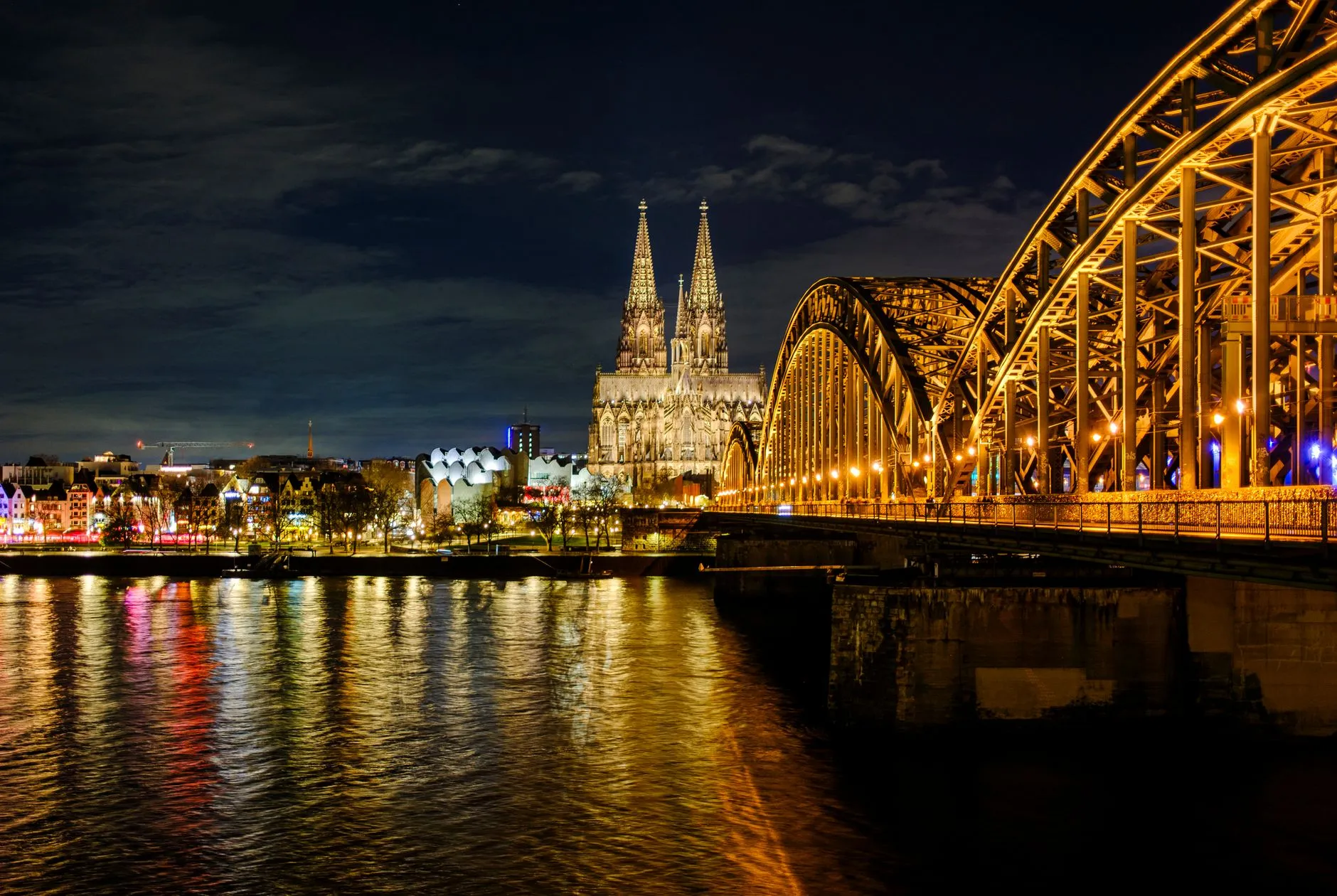
Cologne has an unusually short distance between airport and flagship sight. Walk out of the Hauptbahnhof and the Kölner Dom is immediately in front of you — not a walk, not a tram ride, not a landmark you navigate toward. The twin-spired Gothic cathedral is a UNESCO World Heritage site; for four years in the 1880s it was the tallest building in the world. You can stand inside under the vaults or climb the 533 steps of the south tower for the city-and-Rhine panorama.
Behind the Dom, the Hohenzollern Bridge crosses the Rhine — it is heavily coated in padlocks at this point, which you can ignore — and the Ludwig Museum (Pop Art and Picasso) sits directly behind. For a Kölsch, the old-town Brauhäuser are a few minutes’ walk south; the obvious ones near the Dom are tourist-heavy and fine, not a trap.
The layover calculation is honest: the S19 is 15 minutes each way, and the Dom is at the exit of the station, which removes the usual city-exploration overhead. A 3.5-hour layover is enough to see the cathedral and have a Kölsch, provided you allow 75–90 minutes for the return and security. Four hours is comfortable and adds the tower climb or the Ludwig. Under three hours, stay airside — you can get there but the margin disappears.
CGN is, on this specific metric, one of Germany’s best airports for a short layover. Frankfurt is faster to reach but the old town is further from the Hauptbahnhof. Munich is longer to the centre and the Marienplatz is fine without being exceptional. Cologne wins on the proximity of a genuinely significant building to the station exit.
💡 3.5 hours: the Dom and a Kölsch
S19 is 15 min each way; the Dom is at the station exit. 75–90 min buffer for return + security. Four hours adds the south tower climb (533 steps). Under 3 hours, the maths gets uncomfortable.
⚠️ Under 3 hours: stay airside
The city is close but not instant. A 2.5-hour layover puts you at the Dom for perhaps 30 minutes before you need to move. That is fine if you know it going in; it is not fine if you expected something relaxed.
🧭 Practical Notes
-
VRS zone. The S19 to Hauptbahnhof requires the airport zone ticket (~€3.40). The city single does not cover it. Buying short and getting checked is a fine and a delay. The platform machine handles it correctly if you select the airport zone.
-
Terminal first. Eurowings at Terminal 1, Ryanair and others at Terminal 2. Check the boarding pass, not the airline’s general reputation for which terminal it uses.
-
Cash. Germany uses cards and contactless widely but runs on cash more than most of western Europe. Use a bank ATM rather than a bureau de change at the airport; the spread at exchange desks is not competitive.
-
Reduced-mobility assistance. Free under EU rules, but must be requested through the airline at least 48 hours before departure. Meeting points are signed in both terminals.
❓ Frequently Asked Questions
📊 At a glance — CGN 2026
| Feature | Detail |
|---|---|
| Official name | Flughafen Köln/Bonn “Konrad Adenauer” |
| IATA / ICAO | CGN / EDDK |
| Location | ~15 km southeast of Cologne |
| Annual passengers | More than 10 million |
| Terminals | 2 (T1: Eurowings; T2: Ryanair and others) |
| Train to centre | S-Bahn S19, ~15 min, ~€3.40 VRS tariff |
| Taxi to centre | ~€30–40, ~20–25 min |
| Currency | Euro (€) |
| Schengen | Yes — EES live since 10 April 2026; ETIAS pending |
| Lounge | The Lounge Koeln-Bonn, T1 and T2; Priority Pass / LoungeKey / Diners; ~€25 walk-in |
| Dominant carriers | Eurowings (largest base), Ryanair (base); FedEx / UPS / DHL cargo |
| Operations | 24-hour; three runways; top-three German cargo hub |
| Best layover move | S19 to Hauptbahnhof — the Dom is at the station exit; viable from 3.5 hours |