Vágar Airport (FAE) — Airport Guide 2026
Since March 2026, travellers holding a Danish or Schengen residence permit no longer need a separate Faroese visa — the most practical change to hit FAE in years, affecting a significant slice of the people who actually fly this route.
Quick Reference
Vágar Airport (Faroe Islands)
FAE / EKVG
Vágar island; ~45 km west of Tórshavn via the Vágatunnilin sub-sea tunnel
Bus 300 (SSL) ~55 min, ~75–90 DKK (€10–12) — does not meet every flight; taxi ~250 DKK (€33) fixed fare, ~45 min
Available at the airport; Vágar tunnel toll ~€13 round trip, usually billed through the rental company
Danish krone / Faroese króna (DKK), ~7.5 = €1; card-first economy
Kingdom of Denmark, outside the EU and Schengen; Nordic Passport Union applies
None
Atlantic Airways (based here), SAS, Widerøe
Copenhagen
Edinburgh (twice weekly, into early December), London Gatwick, Paris, Keflavík, Aalborg
✈️ The Terminal & Atlantic Airways
Vágar was laid down as a Royal Air Force airfield during the Second World War — the flat valley by Sørvágur was the only ground in a country of cliffs where a runway could be built — and it has been the Faroes’ sole airport ever since, extended into the modern terminal now in use. Atlantic Airways, the Faroese flag carrier, is headquartered here at Sørvágur and runs most of the schedule; Copenhagen is the year-round backbone, with Edinburgh, London Gatwick, Paris, Keflavík and Aalborg running on summer-weighted frequencies in 2026. SAS and Widerøe also serve the airport. Edinburgh drops to twice weekly and runs into early December; everything else narrows or stops in winter.
The terminal is small enough that end-to-end orientation takes about two minutes. The practical thing to know is that flight times cluster: the building is genuinely busy around a departure wave and quiet enough between them that the café is the only competition for a seat.
🛂 Border & Visa
The Faroes are part of the Kingdom of Denmark but sit outside the European Union and the Schengen Area entirely. They belong to the Nordic Passport Union instead, which means entry runs on Faroese rules, not European ones — a distinction that catches people out.
⚠️ A Schengen visa does not cover the Faroes
If your nationality requires a visa, you need a Faroese one, applied for through Danish authorities with the Faroes specified. A plain Schengen visa will not get you through passport control at FAE.
Who needs what:
| Passport | Visa required? | Notes |
|---|---|---|
| Nordic (DK / NO / SE / FI / IS) | No | Passport or national ID showing citizenship; may live and work |
| EU / UK / US / Canada / Australia / most Western | No | Visa-free up to 90 days; valid passport required |
| Visa-required nationalities | Yes — Faroese visa | Apply via Danish authorities; specify the Faroes |
| Third-country nationals with DK or Schengen residence permit | No (from March 2026) | Travel on the residence permit |
🆕 2026 residence-permit change
Since March 2026, third-country nationals holding a valid Danish or Schengen residence permit can enter the Faroes on that permit without applying separately for a Faroese visa. If this is your situation, this is the rule that changed.
🚐 Getting to Tórshavn
Tórshavn is on Streymoy, the next island east, connected to Vágar by the Vágatunnilin sub-sea tunnel. The capital is roughly 45 km and 45–55 minutes from the airport depending on how you travel.
🚌 Bus 300 (SSL) — ~75–90 DKK, ~55 minutes
Operated by Strandfaraskip Landsins (SSL), this is the cheap option — about €10–12 — but it does not depart after every flight and runs only a handful of times a day, with thinner service on weekends. Check the SSL timetable against your actual arrival before you count on it.
🚖 Taxi — ~250 DKK (~€33) fixed, ~45 minutes, door to door
The reliable fallback when the bus doesn’t align. Pre-book it; taxis do not queue in numbers outside a small airport.
🚗 Rental car — the practical choice for seeing anything
For anywhere beyond Tórshavn, a car is close to essential — the bus network is built around residents’ needs, not sightseeing. Pickup is at the airport. The Vágar tunnel charges a toll of around €13 for the round trip; rental companies typically bill this through the booking rather than requiring cash at the barrier, but confirm before you drive.
There is no rail anywhere in the Faroes.
🛋️ Lounges
There is no lounge at Vágar — no Priority Pass, no pay-in option, no carrier lounge. The terminal has a café, a shop, and seating. That is the complete list. Because departures cluster, the concourse fills around a wave and empties afterwards; if your flight is in a quiet window, the café will do fine.
💵 Money & the Two-Name Currency
The Faroese króna and the Danish krone are the same currency at the same value — two names, two sets of banknotes, one exchange rate. Danish coins circulate throughout. The Faroes are heavily card-based; contactless works in small village shops and on the bus, so you can travel with little or no cash.
⚠️ Faroese banknotes do not spend outside the islands
Unlike Danish krone, Faroese-printed notes are not accepted abroad. Use them up or change them before you leave. Danish krone, by contrast, spend fine across Denmark.
If you want cash, draw from an ATM rather than changing money at the airport, where the spread is worse.
💡 Layover Math: Múlafossur & the Lake
What makes Vágar genuinely unusual for a remote island airport is that its two best sights are on the same island as the runway.
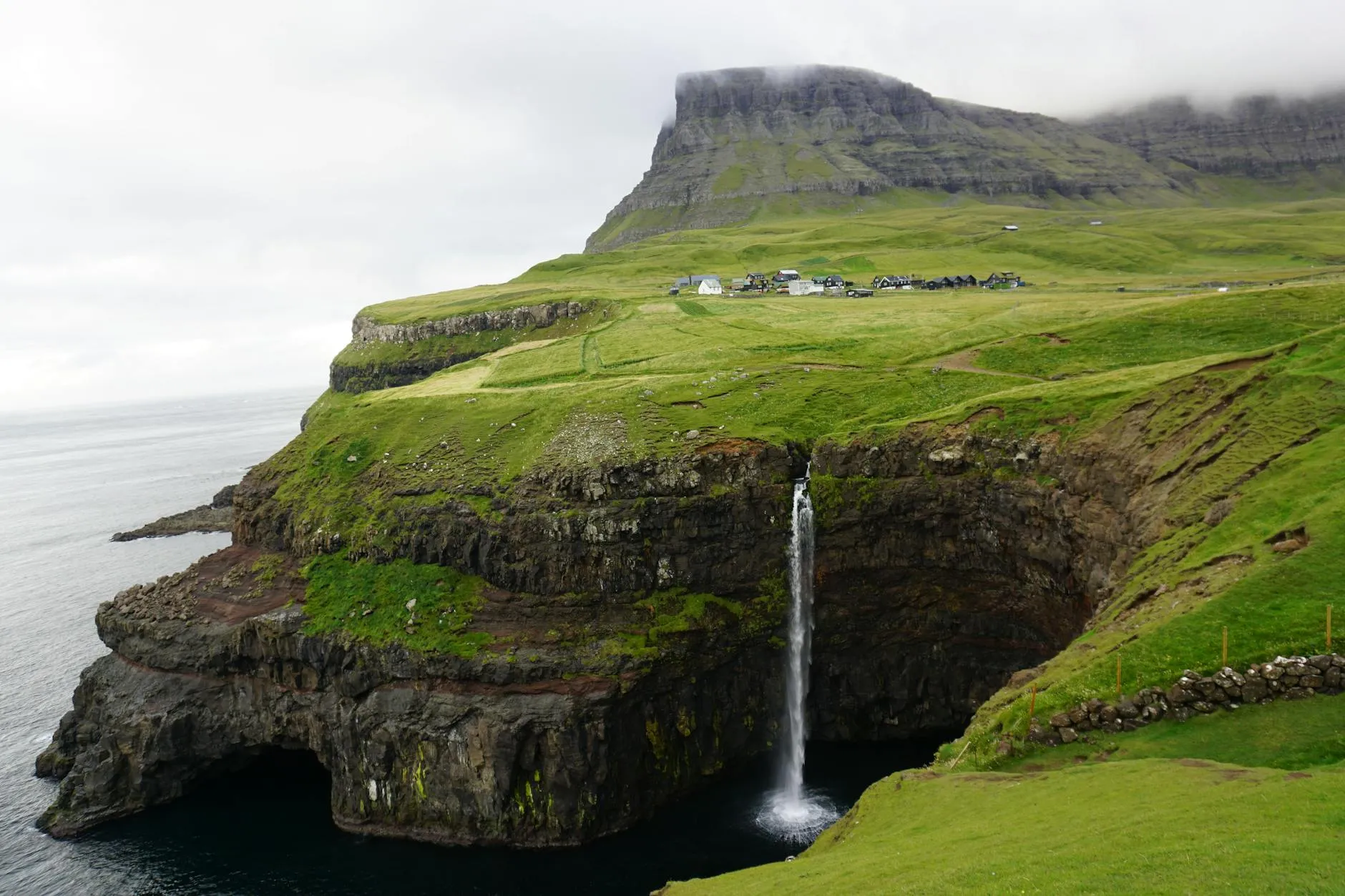
Múlafossur — the waterfall at the village of Gásadalur that drops straight off a cliff into the Atlantic, with sea stacks and mountains behind it — is about 11 km from the terminal, a 15-to-20-minute drive through the Gásadalur tunnel. It is one of the most photographed scenes in the North Atlantic, and it is closer to this terminal than many city centres are to their airports.
Lake Sørvágsvatn (also called Leitisvatn), the largest lake in the islands, ends at the Trælanípa sea cliffs in the optical illusion known as the “lake above the ocean.” The return hike from near Miðvágur takes roughly 1.5–2 hours.
🚶 Landowner access fees on Faroese trails
Several hikes — including routes around Lake Sørvágsvatn — cross private land and charge a landowner access fee. Check before you set out rather than at the trailhead.
The math:
With a hire car or pre-booked taxi and a window of three or more hours, you can drive to Múlafossur, photograph it, and be back through Vágar’s quick security with time in hand. The lake hike needs more like half a day once you add the walk to and from the trailhead. Tórshavn is a 45-minute tunnel run each way, which makes the capital a stay rather than a layover stop — the transit time alone eats most of a short gap.
🧭 Before You Go
- Bus 300 does not meet every flight and runs few times a day — check the SSL timetable against your arrival; if the timing misses, pre-book a taxi (~250 DKK).
- Schengen visa holders are not covered for the Faroes; visa-required nationalities need to apply for a Faroese visa through Danish authorities.
- Residence-permit holders (DK / Schengen): since March 2026, the permit suffices — no separate Faroese visa needed.
- Rental cars: the Vágar tunnel toll is ~€13 round trip, usually billed through the rental company — confirm before driving.
- Cash: the Faroes are card-first; carry little; spend any Faroese banknotes before leaving, as they won’t work abroad.
- Múlafossur: 15–20 minutes from the terminal — the one sight that works on a long layover; the lake hike needs half a day and may carry a landowner fee.
❓ Frequently Asked Questions
📊 At a glance — FAE 2026
| Feature | Details |
|---|---|
| Official name | Vágar Airport |
| IATA / ICAO | FAE / EKVG |
| Location | Vágar island; ~45 km west of Tórshavn via the Vágatunnilin sub-sea tunnel |
| To Tórshavn | Bus 300 (SSL) ~55 min, ~75–90 DKK (€10–12), does not meet every flight; taxi ~250 DKK (€33) fixed; rental car |
| Rail link | None — no railways in the Faroes |
| Currency | Danish krone / Faroese króna (DKK), ~7.5 = €1; card-first; Faroese notes not valid abroad |
| Border | Kingdom of Denmark, outside EU and Schengen; Nordic Passport Union |
| Visa | Visa-free ~90 days for most Western nationals; Schengen visa not valid; Faroese visa for visa-required nationalities; DK/Schengen residence permit sufficient from March 2026 |
| Lounge | None |
| Carriers | Atlantic Airways (based at Sørvágur), SAS, Widerøe |
| Year-round route | Copenhagen |
| 2026 seasonal routes | Edinburgh (twice weekly, into early December), London Gatwick, Paris, Keflavík, Aalborg |
| 2026 rule change | Third-country nationals with a DK or Schengen residence permit may enter without a separate Faroese visa (from March 2026) |
| Best layover move | Drive 15–20 min to Múlafossur at Gásadalur (3+ hr window); lake hike at Sørvágsvatn needs ~half a day |