Santiago de Compostela–Rosalía de Castro Airport (SCQ) — Airport Guide 2026
Ryanair closed its Santiago base in 2025–26 and cut capacity; Vueling absorbed the slack, expanding by roughly 15% and adding Zürich, London Heathrow and Paris — so the airline you actually fly here has probably changed since the last time you looked.
Quick Reference
Aeroporto de Santiago de Compostela–Rosalía de Castro (Lavacolla)
SCQ / LEST
~12 km east of Santiago de Compostela, Galicia
~3.6 million/year
1
Line 6A — €1.00, ~35 min to Praza de Galicia, every 20–30 min, 07:00–23:00
~€21–25, ~15–20 min (regulated airport-to-centre fare)
Euro (€)
Member; EES live since 10 Apr 2026; ETIAS pending
Santiago VIP Lounge (Priority Pass / Amex; ~05:30–23:00 summer — verify status)
Vueling, Iberia, Ryanair, easyJet, Air Europa
🏢 Terminal & Carrier Landscape
One terminal, built 2011, sized comfortably for 3.6 million passengers. The layout is simple: landside check-in and the bus stop, then security, then an airside zone with shops, bars and the lounge near gates 6–7. Traffic follows two peaks — summer, and the Camino season running roughly spring through autumn, when pilgrims fly in to start or finish the walk.
The carrier shift matters for anyone planning around low-cost routes. Ryanair no longer has a base here; it operates some routes but at reduced scale. Vueling is now the dominant carrier, having raised its presence by around 15% with routes including Zürich, London Heathrow and Paris. Iberia, easyJet and Air Europa round out about 29 destinations in seven countries. If you were routing through SCQ assuming Ryanair’s old frequency, check current schedules — the timetable has reshaped around a different airline.
The airport closed for approximately 35 days from late April to 27 May 2026 for runway and infrastructure works, with flights diverted to A Coruña, Vigo and Porto. Normal operations resumed after 27 May 2026.
⚠️ Warning: lounge status uncertain
The Santiago VIP Lounge near gates 6–7 has been reported intermittently closed, possibly in connection with the 2026 works. Confirm it is operating before relying on it for a long connection.
🛂 Border, EES & the Schengen Reality
Spain is in the Schengen Area. Flights arriving from within Schengen pass through with no passport control.
For non-EU arrivals, the Entry/Exit System (EES) became fully operational at Schengen external borders on 10 April 2026, following a phased rollout from October 2025. It replaces the manual passport stamp with a biometric record — facial image and fingerprints — used to enforce the 90-in-180-day short-stay limit. The first entry of a cycle takes a little longer while that record is created. UK passport holders are non-EU post-Brexit and subject to EES — worth knowing for the significant number of UK Camino pilgrims who fly into Santiago.
The European Travel Information and Authorisation System (ETIAS) is separate and not yet live, expected on a date that has not been announced. Once running, visa-exempt non-EU visitors — UK, US, Canadian, Australian and others — will need to apply online for a paid authorisation before flying. Until then, a valid passport is all that is required.
| Passport | Visa for short stay? | EES applies? | ETIAS once live? |
|---|---|---|---|
| EU / EEA / Swiss | No | No | No |
| UK | No (≤90/180 days) | Yes | Yes |
| USA / Canada / Australia / NZ | No (≤90/180 days) | Yes | Yes |
| Japan / South Korea / Singapore | No (≤90/180 days) | Yes | Yes |
| India / China / South Africa | Yes — Schengen visa required | Yes (recorded at entry) | N/A while visa required |
🛂 UK travellers: EES is live
Since 10 April 2026, UK passport holders get a biometric record created on first entry. Allow extra time at the border on your first trip in a new 180-day window. ETIAS — the separate pre-travel authorisation — is not yet required.
🚌 Getting Into the City
There is no railway at Lavacolla. Santiago’s train station is in the city, not at the airport. The rail option that older guides occasionally gesture toward does not exist — you are taking a bus or a taxi.
🚌 Line 6A — the right choice for almost everyone
The municipal Line 6A runs from outside the terminal to Praza de Galicia (the edge of the old town) in about 35 minutes, then continues to the Hórreo / railway-station stop in roughly 40 minutes. A single costs €1.00, paid to the driver in cash — though contactless is increasingly accepted. Reduced fares apply for under-18s. Frequency is every 20–30 minutes from about 07:00 to 23:00 daily. From Praza de Galicia, the cathedral and old town are a short uphill walk.
That €1.00 fare is among the cheapest airport buses in Spain. There is no meaningful argument for a private transfer on cost grounds.
⚠️ Empresa Freire is gone
Any guide — or a friend’s memory — that mentions Empresa Freire running the airport bus is out of date. Freire stopped operating the airport service at the end of 2020. The current route is the municipal Line 6A. If someone tells you to ask for Freire, ignore them.
🚕 Taxi
The rank outside arrivals charges a regulated fixed rate of approximately €21–25, with the journey taking 15–20 minutes. Ask for the fixed airport-to-centre rate before the driver starts the meter, and use the official rank rather than a tout approach inside arrivals.
🛋️ The Lounge
The Santiago VIP Lounge sits airside near gates 6–7 — past security, through the duty-free area, to the right. It accepts Priority Pass and is on the American Express network. Summer hours run approximately 05:30 to 23:00 (06:00 opening in winter), with entry permitted up to a few hours before departure.
Two restrictions to know: children are not admitted, and the lounge offers complimentary luggage storage inside. It is a quiet seat with drinks and a light buffet, not a restaurant — appropriate expectations are a glass of wine and somewhere to sit, not a full meal.
⚠️ Verify before you depend on it
The lounge has been reported intermittently closed. Given the airport’s 35-day shutdown in spring 2026, the operational status is worth confirming directly before building a connection around it.
🍽️ Galician Food Before You Fly
Galicia runs on the Atlantic, and the airport food is an accurate enough introduction if you pick carefully. The regional kitchen worth knowing before you leave:
Pulpo á feira — octopus boiled, sliced, and dressed with paprika, coarse salt and olive oil, served on a wooden board. The version in the city is usually better than at the airport, but the airport version is still worth ordering if you are hungry.
Empanada gallega — a flat savoury pie of tuna or meat. Travels well, holds at room temperature, reasonable for hand luggage if you find a good bakery before heading out to Lavacolla.
Pementos de Padrón — small fried green peppers, the Galician variety in which occasional ones are fiery. The local saying is that some bite and some don’t (uns pican e outros non).
The wines are the crisp Atlantic whites: Albariño from the Rías Baixas and Ribeiro. Worth a glass before flying if the connection allows.
🎂 Tarta de Santiago — the edible souvenir
The dense almond cake stencilled with the sugar-dusted Cross of Saint James is sold boxed across the city. It travels easily, clears EU customs without issue, and is a more honest souvenir than a scallop-shell keyring. A wedge of queixo de tetilla (the cone-shaped Galician cow’s-milk cheese) and sealed wine also clear EU customs fine.
💡 The Cathedral, the Camino & the Layover Maths
The name Lavacolla comes from the meadow where, by tradition, medieval pilgrims on the Camino de Santiago washed before making their final approach to the cathedral — so the runway you land on is, historically, the last stop before the end of the walk. The airport’s location is not accidental.
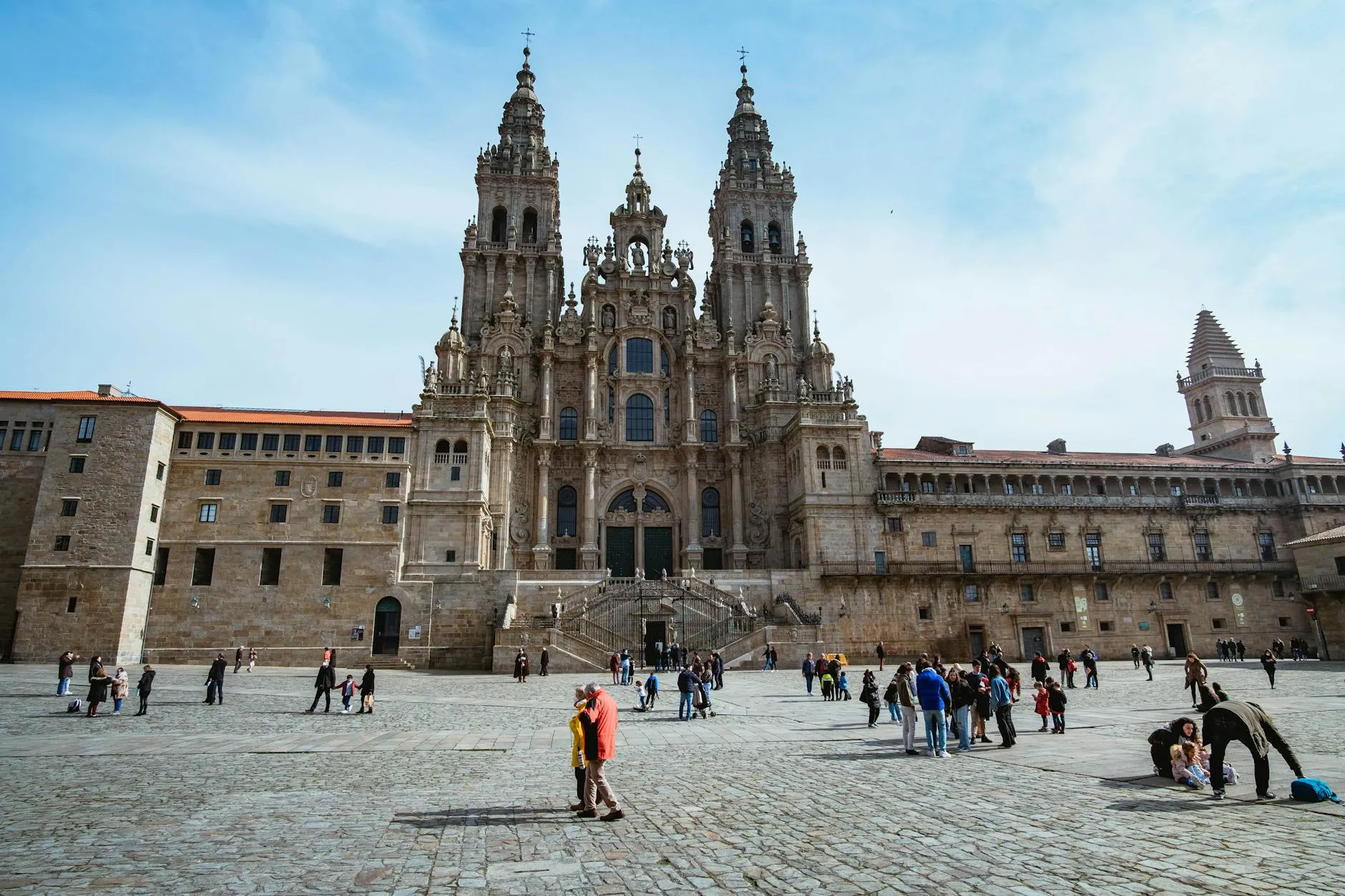
Praza do Obradoiro is where the Camino ends. Pilgrims finishing the walk drop their packs here and look up at the Baroque façade of the cathedral, under which the tradition holds that the tomb of the apostle Saint James lies. The old town around it is a UNESCO World Heritage site, compact, walkable, built in granite and arcade.
Inside the cathedral, the botafumeiro — a silver incense censer roughly the size of a person — is occasionally swung in a long arc across the transept by a team of robed tiraboleiros. It runs on a schedule and for special occasions, not at every Mass. Check the cathedral’s Mass schedule rather than counting on it being in motion when you arrive.
⏱️ Layover maths
The 6A bus is 35 minutes each way. From Praza de Galicia to the cathedral is a short uphill walk.
- 4.5–5 hours: realistic for Praza do Obradoiro, the cathedral interior, and a plate of pulpo, with a 90-minute return-security buffer.
- 4 hours: tight. Feasible for a fast look at the cathedral square if conditions are good; not for lingering inside.
- Under 4 hours: stay airside. Lavacolla is 12 km out — the margin for a missed bus or a queue at security is too thin.
The botafumeiro is a matter of timing, not just of having enough hours. If you specifically want to see it, look up the Misa del Peregrino schedule on the cathedral’s own website before you commit to the city trip.
🧭 Practical Notes
-
Carry a euro coin or small note for the 6A. The single fare is €1.00 paid to the driver. Contactless is increasingly accepted but cash is more reliable.
-
ATM over bureau de change. The airport exchange desk carries a heavy markup on rates. Draw euros from a bank ATM. Cards are accepted almost everywhere in Santiago.
-
Reduced-mobility assistance is free under EU rules but must be requested through your airline at least 48 hours before departure. The meeting point is signed in the terminal.
-
Pilgrim logistics. The Pilgrim’s Office where you collect the Compostela certificate is in the old town near the cathedral — not at the airport. If you are finishing the Camino, factor time in the city for the queue, which can run long in peak season.
❓ Frequently Asked Questions
📊 At a glance — SCQ 2026
| Feature | Current Data (2026) |
|---|---|
| Official name | Aeroporto de Santiago de Compostela–Rosalía de Castro (Lavacolla) |
| IATA / ICAO | SCQ / LEST |
| Location | ~12 km east of Santiago de Compostela, Galicia |
| Passengers | ~3.6 million/year |
| Terminals | 1 |
| Train to centre | None — no airport rail; 6A bus connects to the city’s train station |
| Bus to centre | Line 6A, €1.00, ~35 min to Praza de Galicia, every 20–30 min, 07:00–23:00 |
| Taxi to centre | ~€21–25, ~15–20 min (regulated fixed rate) |
| Currency | Euro (€) |
| Schengen status | Member; EES live 10 Apr 2026; ETIAS pending |
| Lounge | Santiago VIP Lounge (Priority Pass / Amex; ~05:30–23:00 summer — verify status) |
| Dominant carriers | Vueling, Iberia, Ryanair, easyJet, Air Europa |
| 2026 changes | Ryanair base closed; Vueling +15%; 35-day runway closure ended 27 May 2026 |
| Best layover move | 6A bus to cathedral / Praza do Obradoiro — needs 4.5–5 hr minimum |