Gaziantep Oğuzeli (GZT) Airport Guide 2026 — Türkiye’s Food Capital
Gaziantep Oğuzeli Airport is 20 km from the city centre in the Oğuzeli district, and it is the busiest airport in Southeastern Anatolia — 3,068,220 passengers in 2025. The terminal you fly through opened on 25 December 2021: one combined domestic-and-international building of 72,593 m², rated for six million passengers a year, with 50 check-in desks, six jet bridges and a 2,049-space multi-storey car park. Pegasus, AJet, SunExpress and Turkish Airlines carry the traffic, with a heavy German and Swiss diaspora network and trade routes to Erbil and Baghdad. Currency is the Turkish lira, and Türkiye runs its own entry system rather than the EU’s. You are landing in a UNESCO Creative City of Gastronomy — that is the reason to come.
Last verified: September 2026.
⚡ 2026 Quick Reference — Key Facts at a Glance
Gaziantep Oğuzeli (GZT / LTAJ) — DHMİ-operated, new terminal opened 25 Dec 2021
The service DHMİ itself points to. Timetable and route at havas.net
Gaziulaş line Eski Adliye ↔ Havalimanı. Card only — no cash accepted on board
Rural tariff: ₺84.00 (~€1.50) with a Gaziantep Kart, ₺89.70 (~€1.60) by contactless bank card
Taxi rank and ten rental firms at the terminal, all listed by DHMİ
20 km southeast of the centre, Oğuzeli district. No rail, tram or Gaziray link
Turkish lira (TRY) — inflation-volatile. Pay in lira, always decline DCC
DHMİ lists one VIP salon. Priority Pass does not list Gaziantep — plan on none
Türkiye’s own system — 90 days visa-free in any 180 for US, UK, EU, Gulf, Japan, Australia; e-Visa at evisa.gov.tr for everyone else
UNESCO Creative City of Gastronomy (2015) · Zeugma Mosaic Museum · EU-protected baklava
🏢 1. One Terminal, Opened 2021, and Room to Spare
Gaziantep is the rare Turkish regional airport where the building is comfortably ahead of the traffic. The current terminal entered service on 25 December 2021, replacing a structure that had been extended piecemeal since the airport opened in 1976 and reached international status in 2006.
DHMİ’s own specification is worth reading closely, because it tells you what your morning here will feel like. The İç-Dış Hatlar Terminal Binası — one building handling both domestic and international flights — covers 72,593 m² and is rated for 6,000,000 passengers a year. In 2025 it handled 3,068,220. That is barely half its design capacity, and it shows: 50 check-in counters and six passenger boarding bridges for an airport running about 28,500 aircraft movements a year. There is a 2,049-space multi-storey car park attached, which is more parking than most airports of this size have ever needed. Two aprons hold 18 aircraft.
The practical consequence: GZT is one of the least stressful airports in Türkiye. Queues are short outside the Friday-evening and Sunday-night German-diaspora peaks. Security is quick. You do not need the three hours the airline emails you about. Turn up ninety minutes before an international departure and you will be sitting at the gate with time to spare.
Domestic and international operations share the same building, which — unlike at Trabzon or several other Turkish regional airports — means a domestic-to-international self-connection here is a walk rather than an expedition. It is still not a sterile transfer through a common airside, so give yourself a genuine buffer, but the geography is on your side.
The runway is the other thing worth knowing. GZT has a single strip, 10R/28L, 3,000 m long and 48 m wide, certified CAT II. CAT II matters in this part of Türkiye: the Gaziantep plain gets genuine winter fog, and a CAT II approach is the difference between landing and diverting to Adana. Combined with 3,000 m of length, the airport can take aircraft considerably larger than the 737s and A320s that make up almost all of its schedule.
Who actually flies here. Pegasus runs the widest network — Istanbul–Sabiha Gökçen, Ankara, İzmir, Ercan, Erbil, plus Cologne/Bonn and Düsseldorf, with seasonal Berlin. AJet flies Ankara, Sabiha Gökçen, Ercan and Erbil, with seasonal Berlin. Turkish Airlines runs Istanbul. SunExpress is the one that makes GZT unusual: Antalya, İzmir, and then a genuinely broad European list — Berlin, Düsseldorf, Frankfurt, Munich, Stuttgart, Zurich and London–Stansted, with seasonal Basel/Mulhouse and Hannover. Corendon adds seasonal Hannover. Iraqi Airways flies Baghdad.
Two patterns explain that map. One is the Turkish community in Germany, Switzerland and Austria, a large share of which traces back to this region; the German routes are family traffic, not tourism, and they peak around school holidays and religious festivals rather than in August. The other is trade — Gaziantep is a manufacturing city, and the Erbil and Baghdad services are commercial links for a business travel market, not a leisure route.
If you are pricing a fare, check what the ticket includes before you compare: SunExpress, Pegasus and AJet all sell fares that carry nothing but a personal item. Our SunExpress, Pegasus and AJet baggage guides carry the current allowances, and the baggage checker puts them side by side.
🛂 2. Türkiye’s Entry System: Visa Exemption, e-Visa and the 60-Day Passport Rule
Türkiye is not a Schengen state and not an EU member, so none of the EU’s border apparatus applies at Gaziantep. Türkiye operates its own regime: a broad visa exemption, an electronic visa at evisa.gov.tr for everyone else, and a passport-validity rule that catches people out. Everything below is taken from the Ministry of Foreign Affairs country-by-country list at mfa.gov.tr, read this month.
Visa-free, 90 days in any 180 days. Ordinary passport holders from the United States, Canada, the United Kingdom, Australia, New Zealand, Japan, Israel and the EU/EEA states need no visa at all. Nor do Saudi Arabia, the UAE, Kuwait, Oman and Bahrain. Georgia, Azerbaijan, Kazakhstan, Kyrgyzstan, Ukraine, Moldova and Iran are also 90-day exempt. Chinese ordinary passport holders became visa-exempt for 90 days on 2 January 2026.
Read your own country’s line, not the general rule. The exemptions are not uniform. Russian ordinary passports get 60 days, not 90. Qatar, Jordan and Lebanon are written as 90 days within six months from first entry, which is a different calculation from a rolling 180-day window. Iraqi ordinary passport holders are exempt under 15 and over 50, but those aged 15–50 need a visa — and only qualify for the online e-Visa if they hold a valid Schengen, US, UK or Irish visa or residence permit. On a route map that includes Baghdad and Erbil, that distinction is not academic.
Who needs an e-Visa. Indian, Armenian and South African ordinary passport holders, among many others, need a visa in advance. For a large group of nationalities the e-Visa is conditional — issued only to applicants who already hold a valid Schengen, US, UK or Irish visa or residence permit, and sometimes with further conditions attached (Egyptian applicants aged 15–45 must also be flying with one of a named list of carriers). Apply only at evisa.gov.tr. The lookalike sites charge a service fee for the identical document. Fees vary by nationality and are revised, so take the number from the official portal rather than from any guide, this one included.
The passport rule. Since 1 January 2015 Türkiye has required your passport to be valid at least 60 days beyond the duration of stay granted by your visa, e-Visa or exemption. On a 90-day exemption that is 150 days of validity from the date you land — not six months. Airlines nonetheless apply a blanket six-month check at the desk, so the safe answer is six months and the legal floor is 150 days.
Money. Türkiye uses the Turkish lira (TRY), and the lira moves fast enough that publishing an exchange rate here would be publishing something false. Check the rate on the day. What is stable is the advice: pay in lira. When a card machine offers to bill you in euros, pounds or dollars, refuse — that is dynamic currency conversion and the margin goes to the acquirer, not to you. Withdraw from a bank-branded ATM (Ziraat, İş Bankası, Garanti, Yapı Kredi) rather than an independent exchange kiosk, and decline the ATM’s own conversion offer too. Carry some cash: Gaziantep’s best food is in small bakeries and kebab houses in the old city, and a few of them still prefer notes.
🚌 3. Havaş, the K16-1, and the 20 km You Have to Cross
Twenty kilometres is the defining transport fact at GZT. Oğuzeli is southeast of the city and there is no rail link of any kind — Gaziantep has a tram network and the Gaziray suburban railway, and neither of them comes near the airport. Every option is on rubber.
Havaş is the airport bus, and DHMİ points at it directly. The airport’s own transport page lists exactly four ways in: the Havaş passenger service, commercial taxi, rent-a-car, and your own vehicle. Havaş runs the shuttle between the terminal and the city, and DHMİ links straight to the Havaş timetable rather than publishing its own — so that is where to look for departure times and the current fare. Havaş prices are reset with inflation and I am not going to print a number that will be wrong by winter.
The municipal bus exists, and almost no visitor finds it. Gaziulaş, the metropolitan transport company, runs line K16-1 between Eski Adliye and Havalimanı — the old courthouse in the city and the airport terminal. This is a genuine, published municipal airport line, and it is the cheapest way in. Two catches, and both matter:
- It is card-only. Gaziulaş buses do not take cash. You need a Gaziantep Kart, bought and topped up at a card centre, or you tap a contactless bank card.
- The fare depends on which card you tap. Gaziulaş publishes its tariff, and the airport falls under the Belediye (Kırsal) — municipal rural — rate: ₺84.00 on a Gaziantep Kart against ₺89.70 on a contactless bank card. That is roughly €1.50 against €1.60 at the ECB reference rate of 4 September 2026 (€1 ≈ TRY 56.3), though the lira moves and the tariff is revised, so treat the euro figure as an order of magnitude rather than a price. Urban journeys inside the city are ₺39.50 and ₺42.25 respectively (about €0.70 and €0.75), and the tram is the same as an urban bus fare. Buying the local card pays for itself in about six rides.
It is also slower than Havaş, because it makes city stops all the way in. If you have luggage and a schedule, take Havaş or a taxi; if you have a rucksack and an afternoon, take the K16-1.
Taxis and rental cars. DHMİ publishes a taxi rank contact for the terminal and lists ten rent-a-car firms operating at the airport. Twenty kilometres of open road makes the taxi a real expense rather than a token one, so agree the meter is running before you set off. Renting is a genuinely sensible option here: Gaziantep is the base for Zeugma at Belkıs near Nizip, and the region rewards a car.
| Option | Route | Notes |
|---|---|---|
| Havaş shuttle | Airport ↔ city centre | The service DHMİ itself signposts. Times and fare at havas.net |
| Bus K16-1 | Havalimanı ↔ Eski Adliye | Gaziulaş municipal line. ₺84.00 (~€1.50) Gaziantep Kart / ₺89.70 (~€1.60) bank card. No cash |
| Taxi | Anywhere | Rank at the terminal, DHMİ-listed. 20 km — insist on the meter |
| Rent-a-car | — | Ten firms at the terminal. The right call for Zeugma and the Euphrates |
| Tram / Gaziray | City only | Neither reaches the airport. Urban tram fare ₺39.50 (~€0.70) with a Gaziantep Kart |
🛋️ 4. The Lounge Answer Is “No”
Say it plainly, because a lot of aggregator pages will not: there is no Priority Pass lounge at Gaziantep. Priority Pass’s own Turkish listing covers nine airports — Istanbul, Sabiha Gökçen, Ankara Esenboğa, Antalya, İzmir Adnan Menderes, Dalaman, Milas-Bodrum, Çukurova and Diyarbakır — and GZT is not on it. If you are carrying Priority Pass, LoungeKey or DragonPass, it buys you nothing here.
What DHMİ’s terminal specification does list is one VIP salon. In the Turkish state-airport model that is a protocol and paid-VIP facility rather than a card-access lounge, and it is not what a Priority Pass holder is looking for. If you want it, arrange it in advance; do not walk up expecting a lounge.
This is less of a loss than it sounds. The 2021 terminal is 72,593 m² running at about half its rated capacity, which means the ordinary landside and airside seating at GZT is better than the lounge at plenty of busier airports — quiet, modern, plenty of power, and rarely crowded. Buy a coffee and a plate of katmer and use the terminal. The one time to plan differently is a Sunday-evening German departure wave, when the international side fills up for a couple of hours.
For a longer wait, the honest advice is the same as at any airport 20 km from a great food city: do not spend it at the airport. Two hours buys you a round trip into the old city and a proper meal, and Gaziantep is one of the very few airports where that is unambiguously the right call.
🍽️ 5. Baklava with EU Legal Protection, Pistachios, and Katmer for Breakfast
Gaziantep joined the UNESCO Creative Cities Network as a City of Gastronomy in 2015. UNESCO’s own entry notes that gastronomy is the main driving force of the local economy, with around 60% of the working population employed in the food sector. That is not a tourist-board line; it is the structure of the city.
Antep baklava is legally protected. Antep Baklavası / Gaziantep Baklavası holds EU Protected Geographical Indication status, registered in 2013 — the first Turkish product ever granted an EU geographical indication. The registration specifies the ingredients: Antep pistachio, locally produced butter, and hand-rolled layers of pastry. Green baklava with a dense, resinous pistachio flavour and a dark green base is what the protection describes. If you have only eaten baklava elsewhere, this will not taste like the same dish, and the difference is mostly the pistachio and the butter.
Antep fıstığı — the pistachio — is the city’s other export. The name literally means “the Antep nut”. They are smaller and greener than Iranian or Californian pistachios and much more intensely flavoured. Buy them shelled and raw from a shop in the old city rather than in the terminal; they are the single best-value thing to carry out of Gaziantep.
Eat these, in roughly this order.
- Katmer — the breakfast to build a morning around. Paper-thin pastry folded around clotted cream and crushed pistachio, baked hard and fast, eaten immediately. It does not travel and it does not keep, so it has to be eaten in the city.
- Beyran — a lamb and rice soup with garlic and chilli, served for breakfast in the old city, traditionally before dawn. It is heavy, it is excellent, and it is the most local thing on this list.
- Lahmacun — Gaziantep’s version is thinner and spicier than the Istanbul default, and it is a snack, not a meal.
- Ali nazik — grilled lamb over smoked aubergine mashed with garlic yoghurt. Widely copied, invented here.
- Yuvalama — a yoghurt soup with tiny meatballs and chickpeas, a festival dish. Ask whether it is on before ordering.
- Menengiç kahvesi — a coffee-like drink made from terebinth berries, not coffee at all. Worth trying once; you will know within a sip whether you want a second.
- Künefe — shredded pastry over melting cheese in syrup, served hot. Strictly speaking a Hatay dish, but the Gaziantep version is everywhere and it is good.
What to take home. Baklava, packed in a tin by a shop that will tell you how long it keeps (it is days, not weeks — plan it as the last thing you buy). Raw pistachios. Copper, from the Bakırcılar Çarşısı, the coppersmiths’ bazaar in the old city, where the workshops still hammer to order. And spice — Gaziantep pepper flakes (pul biber) and sumac, sold loose in the bazaar for a fraction of what a jar costs at home. The airside shop at GZT carries baklava and pistachios at airport pricing; buy in the bazaar if you have the time.
💡 6. Zeugma, the Euphrates, and Why the Museum Is the Trip
The Zeugma Mosaic Museum is the reason to build a day around Gaziantep. It opened on 9 September 2011 and holds roughly 1,700 m² of Roman mosaic — described by Türkiye’s museum authorities as the largest mosaic museum in the world. The mosaics came out of Zeugma, a Roman frontier city on the Euphrates about 50 km east near Belkıs, which was substantially flooded by the Birecik Dam reservoir; the rescue excavation is why so much of it now sits under one roof in Gaziantep rather than under water.
The single most famous object is the “Gypsy Girl” (Çingene Kızı), a fragment of a 2nd-century floor showing a woman’s face — probably a maenad rather than any gypsy — displayed alone in a darkened room. It is a small piece and it is genuinely worth the trip. Ticket prices and hours for Turkish state museums are set by the Ministry of Culture and Tourism, revised annually, and sold through muze.gov.tr; check the current figure there rather than trusting a number from a blog. The MüzeKart annual pass covers state museums if you are eligible for one.
The old city is walkable and the bazaars are working ones. The Bakırcılar Çarşısı (coppersmiths) and the surrounding han courtyards are not restored-for-tourists arcades — people are making and selling things. The Emine Göğüş Culinary Museum, in a restored stone house, is small and takes half an hour, and it is the right context for everything you are about to eat.
Go east to the Euphrates. Gaziantep is close to the river, and the reservoir landscapes around Nizip and Halfeti are a striking half-day by car — steep-sided water where valleys used to be, and boat trips to Rumkale, a fortress on a bluff above the water. This is a rental-car or organised-tour trip; there is no convenient public transport.
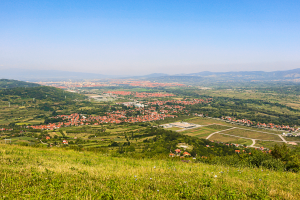
Timing. The Gaziantep plain is hot and dry in summer — genuinely hot, well above what the coast gets — and the winter brings fog, which is why the runway is CAT II certified. Spring and autumn are the right seasons, both for the weather and because the pistachio harvest lands in late summer and early autumn and the shops are at their freshest just after it.
One planning note on demand. GZT’s peaks are not the tourist calendar. They are the German and Swiss school holidays and the religious festivals, when the diaspora routes fill and fares roughly double. If your dates are flexible, run them through our price checker before you book — on this airport the difference between a festival week and the week after it is larger than the difference between airlines.
❓ Frequently Asked Questions
📊 2026 Summary Data Table
| Category | Detail |
|---|---|
| IATA / ICAO | GZT / LTAJ |
| Official name | Gaziantep Oğuzeli Airport (Gaziantep Oğuzeli Havalimanı) |
| Operator | DHMİ — General Directorate of State Airports Authority |
| Opened | 1976; international status 2006; current terminal 25 December 2021 |
| Location | Oğuzeli district, 20 km from the city centre. No rail, tram or Gaziray link |
| Terminal | One combined domestic/international building, 72,593 m² |
| Capacity | 6,000,000 passengers/year · 50 check-in counters · 6 jet bridges · 1 VIP salon |
| Car park | 2,049-space multi-storey |
| Runway | 10R/28L · 3,000 m × 48 m · CAT II · two aprons, 18 aircraft |
| 2025 passengers | 3,068,220 · 28,539 aircraft movements — busiest in Southeastern Anatolia |
| Main carriers | Pegasus, AJet, SunExpress, Turkish Airlines, Corendon, Iraqi Airways |
| Network shape | German/Swiss diaspora routes + Istanbul/Ankara feed + Erbil and Baghdad trade |
| Airport bus | Havaş — the operator DHMİ signposts; times and fare at havas.net |
| City bus | Gaziulaş K16-1 Eski Adliye ↔ Havalimanı · ₺84.00 (~€1.50) Gaziantep Kart / ₺89.70 (~€1.60) bank card · no cash |
| Urban fare comparison | City bus and tram ₺39.50 (~€0.70) with a Gaziantep Kart / ₺42.25 (~€0.75) by bank card. Rates at ECB 4 Sep 2026, €1 ≈ TRY 56.3 |
| Currency | Turkish lira (TRY) — volatile; decline DCC, use bank ATMs |
| Border regime | Türkiye’s own regime — not an EU or Schengen border. 90/180 visa-free for US/UK/EU/Gulf/JP/AU; e-Visa at evisa.gov.tr for others; passport valid 60 days beyond permitted stay |
| Lounge | No Priority Pass lounge. DHMİ lists one VIP salon |
| Food credentials | UNESCO Creative City of Gastronomy (2015) · Antep Baklavası EU PGI (2013) |
| Headline sight | Zeugma Mosaic Museum — opened 2011, ~1,700 m² of Roman mosaic, the “Gypsy Girl” |