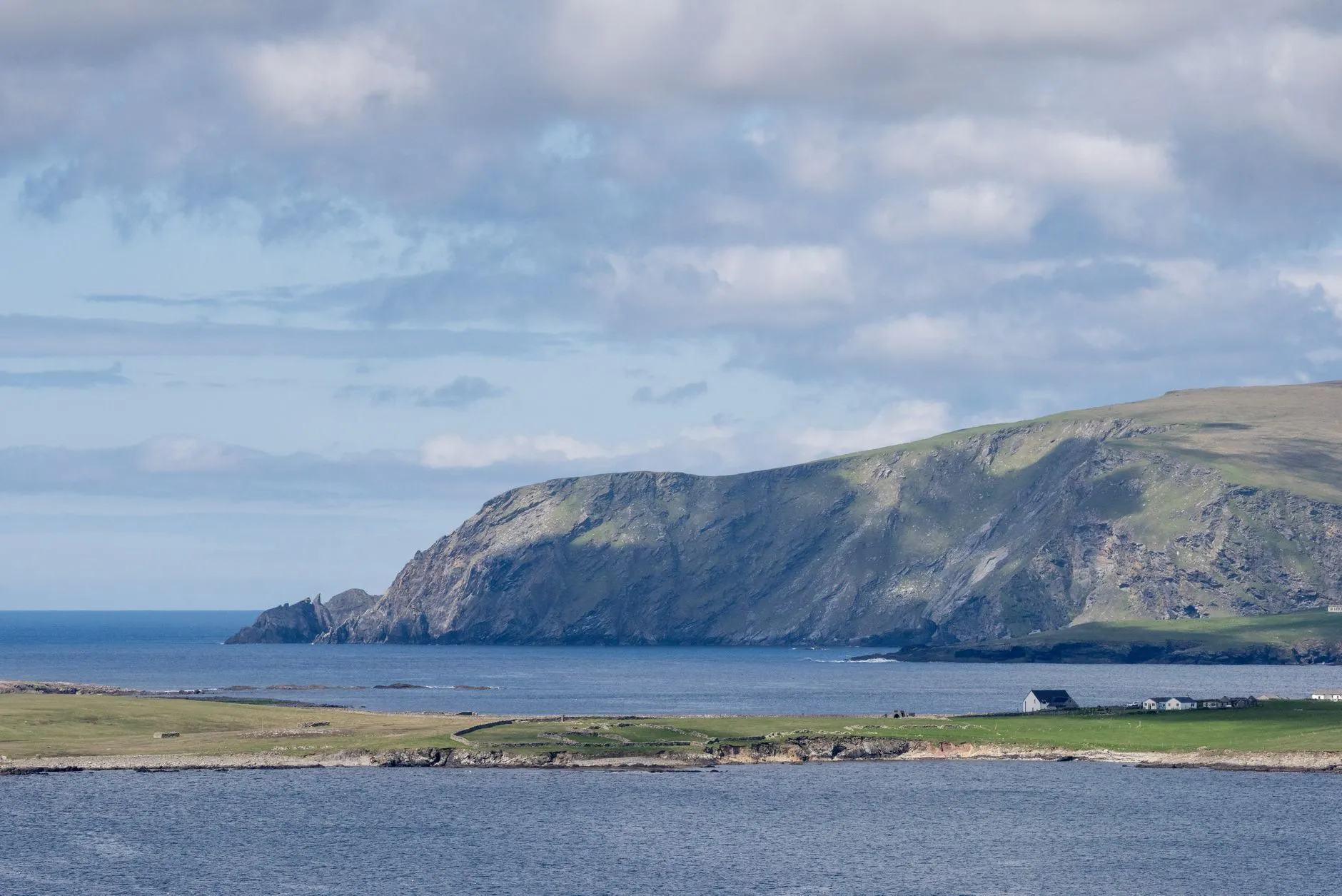
Sumburgh Airport, Shetland (LSI) Airport Guide 2026 — Where the Road Crosses the Runway
Sumburgh sits on the southern tip of the Shetland Mainland, nearly 25 miles south of Lerwick, and the public road to it crosses the live runway — barriers, red lights, staff waving you through. It handled 282,238 passengers in 2025, the UK’s 27th busiest airport and the second busiest in the Highlands and Islands group after Inverness. Loganair is the only scheduled airline here, and almost every flight is domestic, so most passengers never see a passport desk. Service 6 runs into Lerwick in about an hour for a capped £2. Currency is the pound sterling. Shetland is a UNESCO Global Geopark with 4,000 years of ruins at the airport gate.
Last verified: September 2026.
⚡ 2026 Quick Reference — Key Facts at a Glance
Service 6 (Mon–Sat) / 6S (Sun), operator J & DS Halcrow. Stop is across the road from the terminal door. About 58 minutes to Viking Bus Station. Single £2 (~€2.35) under the fare cap — standard fare is £3.60
Roughly hourly Mon–Sat from 05:30; Sunday only 5 round trips. Last bus to the airport arrives 19:58 every day; last bus from the airport leaves 20:00
Rank directly outside the terminal door. Fares are not published — agree the price or confirm the meter before you set off for the 25 miles to Lerwick
NorthLink, Aberdeen ↔ Lerwick nightly. Direct crossing 12h 30m northbound. Foot passenger single £29.00–£44.50 (~€34–€52); car under 6 m £117–£157. This is the only way to bring your own car
Free for the first 2 hours, then £3 per 24 hours (~€3.50). Ticketless and cashless — number-plate cameras, card only
Mon–Fri 06:30–20:15 · Sat 06:30–16:00 · Sun 10:15–20:00. It is not a 24-hour building — do not plan to sleep in it
Loganair only. Aberdeen, Edinburgh, Glasgow, Kirkwall year-round; Inverness set to return October 2026; seasonal Bergen, Dundee, Belfast City, Manchester and London Heathrow
100 ml, in a clear bag, taken out of your cabin bag. No two-litre scanner here — this is the old rule, strictly applied
None. There is one departure lounge and a sensory quiet room. No pay-in lounge, no airline lounge
Pound sterling (£). Scottish banknotes are legal money but any shop may refuse them — spend them before you leave Scotland
UK system. ETA £20 (~€23) for visa-free visitors, up to 6 months a visit; not needed on a British or Irish passport. Almost all Sumburgh flights are domestic and have no passport control at all
🏢 1. One Small Terminal, and a Runway You Drive Across
Sumburgh is a single-storey terminal at the end of the A970, postcode ZE3 9JP, on the last flat ground before the Shetland Mainland runs out into the Atlantic. Highlands and Islands Airports Limited (HIAL) runs it as one of eleven regional airports, and it is the second busiest of them: 282,238 passengers in 2025 against Inverness’s 821,139, on Civil Aviation Authority figures. That puts it 27th in the UK — behind Newquay, ahead of Teesside.
The first thing that will surprise you is the road. HIAL’s own arrival advice is unusually direct about it: the public road crosses the runway, and when the barriers come down you wait. Their instruction is to keep moving between the barriers once you are cleared — don’t stop, don’t deviate, follow the staff. If you are driving to catch a flight, build a few minutes in for a landing. If you are being collected, tell your driver, because a visitor who has never seen a level crossing for aircraft tends to hesitate at exactly the wrong moment.
Inside, it is small and it is flat. HIAL’s published accessibility document states there are no steps anywhere in the terminal, which tells you the scale of the place better than a floor plan would. Check-in, security, one departure lounge, gates. Special assistance works from Desk 8 in the main concourse, which also holds the five public wheelchairs and the Ramble Tags — an arm harness for guiding a passenger without linking arms, provided in partnership with Ability Shetland. There are two accessible toilets, one landside and one in departures, both alarmed, and a Changing Places facility in the main concourse. Boarding uses a stair climber or an ambulift depending on need. Assistance must be booked through Loganair at least 48 hours ahead; the airport’s own number for parking-bay help is 01950 460595.
Security here runs the old liquid rule, and that matters more than it sounds. HIAL states it plainly for its airports: liquids are limited to 100 ml containers, in a clear plastic bag, and you must take them out of your cabin bag for screening. Electronics may also need to come out. Several large UK airports have moved to next-generation scanners and a two-litre allowance; Sumburgh has not, and turning up with the habits you learned at a big hub costs you the bottle. Hand baggage larger than 56 × 45 × 25 cm will not go in the cabin — musical instruments excepted, and those need arranging with the airline first. Vapes, spare lithium batteries and power banks go in hand baggage, never in the hold.
Arrive an hour before a domestic departure, which is HIAL’s own recommendation, and two hours if you are on the Bergen flight. That is genuinely enough at Sumburgh; the queue is measured in people, not in switchbacks.
🛂 2. A Domestic Airport With One International Saturday
For almost everyone flying into Sumburgh, there is no border at all. Aberdeen, Edinburgh, Glasgow, Kirkwall, Inverness, Dundee, Manchester, Belfast City and London Heathrow are all internal UK flights. No passport control, no immigration desk, no arrival stamp. What you do still need is photo ID acceptable to the airline — Loganair, like every UK domestic carrier, sets its own rules and a supermarket loyalty card is not one of them. Take a passport or a photo driving licence and the question never arises.
The exception is Bergen. In summer there is a Saturday service to Norway, running from the end of May to late August, and that one is an international arrival and departure. Everything below applies to it, and to anyone connecting onward into the UK from abroad.
The UK’s system is the Electronic Travel Authorisation, and it has nothing European about it. GOV.UK, read this month, is the only source worth using. An ETA costs £20 — about €23 at the European Central Bank reference rate of 7 September 2026, €1 = £0.85894 — and it lets you travel to the UK, Jersey, Guernsey and the Isle of Man for up to six months. Most visitors from Europe, the USA, Australia and Canada need one rather than a visa. Every traveller needs their own, babies and children included, though one person can apply on behalf of others. Apply on GOV.UK or through the official UK ETA app and nowhere else: GOV.UK’s own warning is that other websites charge more, and that you should avoid sites imitating government services. An ETA authorises travel; it does not guarantee entry. Check your expiry date on GOV.UK rather than assuming how long yours runs.
Who does not need one: anyone with a British or Irish passport, and anyone with permission to live, work or study in the UK. If you are transiting a UK airport landside — passing through border control before your onward flight — you do need one; airside transit is different, and your airline can confirm which you are doing.
eGates, where you meet them, follow a fixed rule. GOV.UK’s conditions are that your passport carries the biometric symbol on the cover, you are 8 years old or over, and you are 120 cm (3 ft 11 in) or taller. Between 8 and 17 you must be accompanied by an adult. British and Irish citizens qualify, EU/EEA and Swiss citizens qualify with a valid digital immigration status, and the eligible non-European passports are Australia, Canada, Japan, New Zealand, Singapore, South Korea and the United States. You will not meet an eGate at Sumburgh — there is no routine immigration hall here — but you will at Aberdeen, Edinburgh or Heathrow on the way in.
One document trap catches European travellers. GOV.UK’s rule is that citizens of the EU, Switzerland, Norway, Iceland and Liechtenstein enter on a passport or an Irish passport card. A national identity card is accepted only in narrow cases: settled or pre-settled status under the EU Settlement Scheme (or the Jersey, Guernsey or Isle of Man equivalents), an EU Settlement Scheme family permit, or a Frontier Worker permit. If none of those is you, bring the passport.
Money. The currency is the pound sterling, not the euro, and Scotland is not a euro country. Shetland is served by Scottish-issued banknotes, which are perfectly good money — but they are not legal tender in England, and any retailer anywhere is free to decline them. Spend them before you fly south, or change them at a bank. Cards work everywhere on the islands, and if a card terminal offers to charge you in euros, decline: that is dynamic currency conversion and the exchange margin goes to the machine, not to you.
🚌 3. Service 6 to Lerwick, the £2 Cap, and the Ferry That Beats Flying
There is one bus and it is a good one. Service 6 runs Lerwick to Sumburgh Airport daytime Monday to Saturday, with Service 6S on Sundays, both operated by J & DS Halcrow under contract to ZetTrans, Shetland’s transport partnership. The stop is directly across the road from the terminal entrance — HIAL’s accessibility guide confirms the position, so there is no walk to speak of. The run to Viking Bus Station in Lerwick takes about 58 minutes; the printed timetable has departures at 05:30 arriving 06:28 and 16:15 arriving 17:13, and the pattern holds all day apart from a couple of school-time variants that detour through Fladdabister and add a quarter of an hour.
The fare is the good news. ZetTrans’s standard Lerwick–Sumburgh single is £3.60, but single adult and child fares across Shetland are capped at £2 under the Scottish Government’s £2 Bus Fare Cap Pilot, which began in the ZetTrans area on 30 January 2026 and runs until January 2027. Two pounds — about €2.35 — for 25 miles across the South Mainland is the cheapest airport transfer in the British Isles by a distance. Concessionary travel-card journeys are unaffected. Pay on board.
Read the timetable before you book a late flight. The last bus that reaches the airport arrives at 19:58, and the last bus leaving the airport goes at 20:00, every day of the week. Anything later is a taxi. Sunday is much thinner: five round trips, with buses reaching the airport at 10:13, 13:13, 15:13, 17:13 and 19:43 and leaving at 11:55, 13:55, 15:55, 17:55 and 20:00. Note the first Sunday arrival — 10:13, two minutes before the terminal opens at 10:15. It is not a problem; it is just not a building you want to arrive at early on a Sunday in February. The mirror image is Saturday, when the terminal closes at 16:00 while buses keep arriving until 19:58. Check the terminal hours against your flight, not against the bus.
Buses do not run on 25–26 December or 1–2 January, and a limited Service 6 only on the day after Lerwick Up Helly Aa — the Wednesday following the last Tuesday in January. Rural feeder routes in the South Mainland are Dial-a-Ride: bookable to 16:00 the day before travel (16:00 Friday for Monday travel) on 01595 745745. Disruption updates are on the ZetTrans voicebank, 01595 745744.
| Option | Journey time | Price | Notes |
|---|---|---|---|
| Bus Service 6 / 6S to Lerwick | ~58 min | £2 single (~€2.35) — capped to Jan 2027 from a £3.60 standard fare | Stop opposite the terminal door. ~Hourly Mon–Sat; 5 round trips Sunday. Last arrival 19:58, last departure 20:00 |
| Taxi to Lerwick | ~40 min for 25 miles | Not published — confirm before you travel | Rank directly outside the door; can also be booked ahead or phoned from the terminal |
| Car hire | — | Not published at the airport | Desks/collection at the airport; book ahead, the fleet on Shetland is finite |
| Parking | — | Free 2 hours, then £3 / 24 h | ANPR, ticketless, card only. Blue Badge and NHS patient travel exempt; free for outer-isles residents on application |
| NorthLink ferry, Aberdeen ↔ Lerwick | 12h 30m direct, 14h 30m via Kirkwall | £29.00 / £37.00 / £44.50 adult single by season | Nightly. Check-in opens 120 min before at Aberdeen and Lerwick, closes 30 min before. Cabins extra |
| NorthLink with a car | as above | £117 / £149 / £157 for a car under 6 m | Bicycles free. Motorcycle from £30.50. The only way to bring your own vehicle |
Is flying the only practical way to Shetland? No — and the ferry is a real choice, not a curiosity. NorthLink sails every night in both directions. Northbound, Aberdeen at 19:00 gets you to Lerwick at 07:30, twelve and a half hours, on the nights the ship runs direct; on the other nights it leaves at 17:00 and calls at Kirkwall, arriving Lerwick at the same 07:30. Southbound it is Lerwick 19:00 to Aberdeen 07:00 direct, or 17:30 via Kirkwall to the same 07:00. You sleep on it, you save a hotel night, and — the part that no flight can match — you bring your car. £117 to £157 for a car under six metres, with a bicycle carried free, against the price and administrative pain of hiring on the island. Concessions of 10% apply to over-60s, full-time students and disabled passengers on passenger and vehicle fares.
The flying case is time and weather. Aberdeen–Sumburgh is about an hour in the air against twelve and a half hours at sea, and Loganair’s fares often undercut a ferry crossing with a cabin. Run both before you commit: our flight price check will tell you what the air leg is actually doing on your dates, which is the number that decides it.
🛋️ 4. There Is No Lounge — What the Departure Lounge Actually Has
Sumburgh has no lounge. Not a pay-in one, not an airline one, not a card-access one. The basis for saying that flatly is HIAL’s own accessibility document, which walks through the terminal facility by facility — accessible toilets, Changing Places, quiet room, wheelchairs, assistance desk, screens — and never lists a lounge, because there is not one to list. There is a single departure lounge and you sit in it.
What it does have is better than you would expect for 282,000 passengers a year: the West Voe Quiet Room. It is in the departure lounge, and HIAL describes it as carrying sensory toy bags, adaptable lighting, comfortable seating, drinking water, a flight information screen and a television. It is designed for passengers with sensory needs, and the airport is explicit that using it does not transfer responsibility for hearing your boarding call — watch the screen, listen for the tannoy. If you are travelling with a child who finds airports hard, this is a genuinely useful room and most people flying through here do not know it exists.
The airport also participates in the Hidden Disabilities Sunflower Lanyard scheme, with lanyards available from staff at security, and works with NHS Shetland on a patient charter and patient passport — a reminder that a substantial share of the traffic through this terminal is people flying to hospital in Aberdeen, not tourists.
The practical planning point: with terminal hours of 06:30–20:15 on weekdays, 06:30–16:00 on Saturdays and 10:15–20:00 on Sundays, there is no all-night refuge here and no reason to arrive three hours early. One hour before a domestic flight is right.
🍽️ 5. Eat Before You Come, and Take the Right Things Home
Treat Sumburgh as an airport where you eat beforehand. HIAL publishes no catering list for the terminal, so the honest advice is to assume nothing airside, carry water and something to eat, and check on the day. Two things soften that. First, Loganair includes on-board refreshments in the fare on Shetland services, so you are not flying hungry. Second, the Sumburgh Hotel Gate bus stop is the stop before the airport on Service 6 — three minutes up the road — which means a sit-down meal is a short walk or one stop away rather than a taxi ride.
The food worth caring about is on the islands, not in the terminal. Shetland lamb carries Protected Designation of Origin status, the same legal protection as Parma ham; the native breed is smaller than mainland lamb, and flocks with access to the shore graze on seaweed, which is not a marketing line but a taste you can identify. Shetland Black potatoes — black-skinned, purple-marked in the flesh — are the island’s other signature crop. Mussels are rope-grown in the tidal streams with nothing added, salmon is farmed in the same waters and some of it to organic standards, and the fish landed here goes well past haddock and mackerel into ling, lythe, megrim and John Dory. There is island butter, island cheese and roadside eggs sold from honesty boxes, which is a habit worth respecting.
For the flight home, the two things to buy are wool and food. Shetland knitwear is the export that made the islands’ name, and Fair Isle patterning is a place, not a style. Butchers in Lerwick will wrap lamb or beef for travelling. Both go in the hold, and here is where the numbers matter: Loganair includes hold baggage in the ticket price, which is unusually generous and removes most of the reason to travel light. Our Loganair baggage guide carries the current allowance, and if you are connecting onto another carrier at Aberdeen, Edinburgh or Glasgow, the baggage checker will show you where the two allowances stop agreeing — which is the single most common way people get charged on a Shetland trip.
💡 6. Jarlshof at the Gate, Puffins Up the Hill, and What Shetland Is For
The best archaeological site in Scotland is at the end of the runway. Jarlshof, at Sumburgh, is a settlement stacked in layers from the Bronze Age through Iron Age wheelhouses to a Norse longhouse village and a laird’s house — four thousand years of continuous occupation on one site, run by Historic Environment Scotland with tickets bookable online. It is minutes from the terminal. If a Loganair delay hands you three hours, that is where they should go.
Sumburgh Head is the other one. HIAL’s own description of the airport calls Shetland’s puffin colony its most famous attribute, and says the birds roost at Sumburgh Head near the airport. The head carries a lighthouse and a visitor centre run by the Shetland Amenity Trust, restored and reopened in 2014, with RSPB Scotland involved in the wildlife side. Puffins are a seabird-season proposition — late spring into summer — so check before you build a day around them.
What Shetland is actually for: it is a UNESCO Global Geopark, and the whole archipelago is organised around that geology and the sea. It is Norse before it is Scottish; place names, dialect and the January fire festivals all point to Norway rather than Edinburgh, and Lerwick Up Helly Aa is a public holiday, held on the last Tuesday in January with the town shut down the following Wednesday. Bergen is a one-hour flight in summer, which is a fair summary of where these islands sit. Add the wildlife — seals, porpoises, dolphins and whales work the same waters that make the fishing good — and the walking, and you have a set of reasons that have nothing to do with a city break.
Two things islanders know that visitors do not. The first is the Air Discount Scheme: residents of Shetland, Orkney, the Western Isles, Islay, Jura, Colonsay, Caithness and parts of Sutherland get 50% off the core air fare on eligible services, and the Scottish Government has renewed the scheme from 1 April 2026 until at least 31 March 2027. It is not for you if you are visiting — business travel, NHS-funded trips, PSO flights and any journey paid for by a third party are all excluded — but it explains why the person beside you paid half what you did, and it is why these routes survive at all.
The second is the weather. Sumburgh is exposed, HIAL’s advice for adverse conditions is to check the airport’s Facebook page or your airline, and there is no alternative airport within reach on the island. If your onward connection at Aberdeen or Edinburgh is tight, and it is winter, put the ferry in your plan as a fallback rather than a fantasy — it is the only redundancy Shetland has. Check the current air fares on our price checker alongside the NorthLink timetable, and book the combination that survives a bad forecast.
❓ Frequently Asked Questions
📊 2026 Summary Data Table
| Category | Detail |
|---|---|
| IATA / ICAO | LSI / EGPB |
| Full name | Sumburgh Airport, Shetland Islands, Scotland |
| Operator | Highlands and Islands Airports Limited (HIAL) — one of 11 regional airports |
| Passengers 2025 | 282,238 (CAA) — 27th busiest UK airport, 2nd busiest in the HIAL group |
| Location | Southern tip of the Shetland Mainland, postcode ZE3 9JP, nearly 25 miles south of Lerwick |
| Terminals | One, single-storey, no steps anywhere in the building |
| Terminal hours | Mon–Fri 06:30–20:15 · Sat 06:30–16:00 · Sun 10:15–20:00 |
| Airlines | Loganair only — the sole scheduled operator |
| Routes | Aberdeen (~1 h), Edinburgh (~1 h 30), Glasgow (~1 h 30), Kirkwall (~40 min) year-round; Inverness set to return October 2026; seasonal Bergen, Dundee, Belfast City, Manchester, London Heathrow via Dundee |
| Bus to Lerwick | Service 6 / 6S, J & DS Halcrow, ~58 min, £2 single (capped from £3.60 to Jan 2027), stop opposite the terminal |
| Bus limits | Last arrival 19:58, last departure 20:00, daily. Sunday: 5 round trips only |
| Ferry alternative | NorthLink Aberdeen ↔ Lerwick nightly, 12h 30m direct; adult single £29.00–£44.50, car under 6 m £117–£157, bicycle free |
| Parking | Free 2 hours, then £3 per 24 h; ANPR, cashless |
| Lounge | None — one departure lounge plus the West Voe Quiet Room (sensory room, screen, water) |
| Security | 100 ml liquids in a clear bag, removed from your cabin bag. Cabin bag maximum 56 × 45 × 25 cm |
| Currency | Pound sterling (£) — not the euro. €1 = £0.85894 (ECB, 7 Sep 2026). Scottish notes may be refused outside Scotland |
| Border | UK ETA £20 (~€23), up to 6 months a visit, everyone needs their own; exempt on a British or Irish passport. Almost all Sumburgh flights are domestic — no passport control |
| eGates | Biometric passport, 8+ years, 120 cm minimum, 8–17 accompanied. Not present at Sumburgh; you meet them at your UK connecting airport |
| At the airport | Jarlshof (4,000 years of settlement, Historic Environment Scotland) and Sumburgh Head lighthouse, visitor centre and puffin colony, both minutes away |