Târgu Mureș Transilvania (TGM) Airport Guide 2026 — One Airline, Nine Counties
Târgu Mureș Transilvania Airport sits at Vidrasău, 14.5 km from the city on the Luduș road, and it is a Wizz Air airport in everything but name — the carrier’s blue tails fill the board, and the airport’s own site links to exactly one airline. Romania has been a full Schengen member since 1 January 2025, so most arrivals here walk straight out. The money is the Romanian leu, not the euro; those are two different sentences and Romania has only the first. The terminal was built for 800,000 passengers a year and does not carry them. What justifies the trip is the catchment: 3.9 million people across nine counties, and the whole of central Transylvania within ninety minutes’ drive.
Last verified: September 2026.
⚡ 2026 Quick Reference — Key Facts at a Glance
Duda Trans to the city centre, stop at Piața Trandafirilor × Strada Horea. Timetable follows the flights. Fare not published — call 0265-977, 0732-445577 or 0757-022021
12 licensed companies operate at the airport. No published tariff card — agree the fare or confirm the meter before you set off
14.5 km from Târgu Mureș, at Vidrasău on the Târgu Mureș–Luduș road
Romanian leu (RON), not the euro. ECB reference rate 7 September 2026: €1 ≈ 5.25 lei
Romania is a full member — since 1 January 2025. The Schengen area is now 29 countries
No walk-up lounge. There is a salon VIP and conference room bookable by phone on 0265 232738, and that is a different product
Effectively Wizz Air alone on scheduled services — both W6 and W4 flight numbers. Charter carriers cover the summer sun routes
Budapest. Everything else is a few times a week
4,182 m², 7 check-in desks, peak capacity 400 passengers an hour, design capacity ~800,000 a year
Bureau de change · ATM · duty-free · rent-a-car · 180 parking spaces
EES fully operational since 10 April 2026 — biometrics on first entry into the area, faster after
Not running. No applications are being collected. Fee fixed at €20. Nobody can sell you one today
The airport’s own notice states that since 25 February 2026 EU citizens need a UK ETA, applied for at least 3 days ahead. GOV.UK confirms EU nationals need one and puts the fee at £20, but does not publish that date
🏢 1. One Terminal, One Airline, and a Catchment Bigger Than the Traffic
Târgu Mureș Transilvania is a county-owned regional airport — it belongs to Mureș County Council — and it has the shape that ownership produces: solid infrastructure, modest traffic, and a route map that lives or dies on one airline’s planning decisions.
The physical plant is genuinely capable. The runway is 07/25, 2,000 m by 30 m with 15 m shoulders, at an elevation of 294 m. It was rebuilt in 2017–18 and reopened to international traffic on 25 June 2018, and the rebuild raised its bearing strength to PCN 70, which the airport’s own presentation says allows it to work medium-sized aircraft rather than the small stuff it used to be limited to. Category II lighting went in during 2021. This is not an airstrip; it is a properly equipped airport that happens to be quiet.
The terminal is 4,182 m² with seven check-in desks, rated for 400 passengers in a peak hour and an annual capacity of roughly 800,000. Put that against the traffic and you get the airport’s central tension. In 2014 it handled 343,521 passengers and was Romania’s fourth-busiest; on published annual figures the recent years have run well below that — around 261,000 in 2023, 213,000 in 2024 and 153,000 in 2025. Then, for the summer 2026 season, nine routes launched inside three days at the end of March. This is an airport that empties and refills according to what one carrier decides, and the honest version of that for a traveller is: check the route still exists before you build a trip on it.
On site you get a bureau de change, a cash machine, a duty-free shop, car hire desks and 180 parking spaces. That is the estate, and for a terminal this size it is enough.
Who flies here. In practice, Wizz Air. The airport’s own destination pages link to one airline and one only, and the live board carries both W6 (Wizz Air Hungary) and W4 (Wizz Air Malta) flight numbers. On the day I checked the schedule there were four rotations in the whole day — Rome Fiumicino twice, Paris Beauvais, Budapest and Basel — which is a fair picture of an ordinary day here.
The airport’s current destination panel lists ten scheduled routes plus three summer charters:
| Destination | Note |
|---|---|
| Budapest | Daily — the only daily route, and the one that makes this airport a connecting proposition |
| London–Luton | From 31 March 2026. UK route — see the ETA note below |
| Rome–Fiumicino | From 30 March 2026 |
| Paris–Beauvais | From 30 March 2026 |
| Milan–Bergamo | From 31 March 2026 |
| Brussels–Charleroi | From 29 March 2026 |
| Dortmund | From 29 March 2026 |
| Memmingen | From 31 March 2026 |
| Basel | From 30 March 2026 |
| Larnaca | From 29 March 2026. In the EU, but Cyprus is not in Schengen |
| (Karlsruhe/Baden-Baden) | Appears only on the airport’s older destination detail pages — pages that omit four routes which flew on the day I checked the board. Treat it as unconfirmed |
| Heraklion · Antalya · Hurghada | Summer charters, sold through tour operators |
Two things to take from that table. First, Budapest aside, those start dates all cluster on 29–31 March 2026, which is the start of the IATA summer season — so treat them as this summer’s programme and confirm before booking for winter, because the airport does not publish which of them run through. Second, Budapest is the useful one and it is under-appreciated. A daily hop to a full-service hub gives central Transylvania a genuine one-stop connection to the rest of the world, which none of the low-cost points offer.
The summer sun charters are flown by a rotating cast of operators — Aegean, Animawings, Corendon, HiSky, Sky Express, Tailwind, SkyUp, Southwind, Mavi Gök and Bees appear among the airport’s carrier links — and these are package products rather than seats you buy directly.
Everything scheduled here is a low-cost fare where the bag is the variable, and Wizz’s cabin-bag sizing is stricter than most people expect — our Wizz Air and Animawings guides carry the current allowances, and the baggage checker lines them up. Measure your cabin bag before you go to the airport, not at the gate, where the fee is worst.
🛂 2. Schengen Since 2025, Leu Not Euro, and a UK Rule Worth £20
Three separate things get muddled here constantly, so take them one at a time.
Romania is in the Schengen area, as a full member, since 1 January 2025. The European Commission’s own description of the area states that it “is composed of 29 countries: 25 EU Member States and 4 non-EU countries (Iceland, Norway, Switzerland and Liechtenstein),” with “Bulgaria and Romania being the last countries to join on 1 January 2025.” Air and sea controls had already gone; that date completed it at the land borders too.
What that means at this airport. Budapest, Rome, Milan, Paris, Brussels, Dortmund, Memmingen and Basel are all internal Schengen flights — no passport control at either end. That is most of the board, and it is why arrivals here are usually quick.
Two routes are the exception, and they are exceptions for different reasons. London–Luton is the United Kingdom, which is outside both the EU and Schengen. And Larnaca is in the European Union but Cyprus is not in the Schengen area — so that flight still meets a border check, even though nothing about customs or EU rights changes. People assume EU means Schengen. It does not, and this airport flies a route that proves it.
Romania is not in the eurozone. The currency is the Romanian leu (RON), and the ECB’s reference rate on 7 September 2026 put €1 at about 5.25 lei. Schengen membership and euro membership are separate memberships and Romania holds only the first — do not turn up with euros expecting to spend them. In practice cards work well in Târgu Mureș and in the larger towns, but carry lei in cash for the countryside: village guesthouses, the smaller salt-mine ticket offices, roadside producers and rural taxis often want cash. There is a bureau de change and an ATM in the terminal; take lei from a bank machine rather than an exchange desk, and refuse the “bill me in euros” prompt on any card terminal.
EES
The EU Entry/Exit System is fully operational: following a progressive rollout begun on 12 October 2025, the European Commission states that “as of 10 April 2026, the EES replaces the stamping of passports allowing the automatic detection of overstayers.” If you are a non-EU national on a short stay, your face, fingerprints and document data are captured on your first entry into the area and checked biometrically after that.
At Târgu Mureș this bites on precisely two arrivals — Luton and Larnaca — and on a terminal rated for 400 passengers an hour running a handful of flights a day, the queue is not the problem it is at a big airport. Land off a Wizz flight from Rome and you will be outside in minutes.
ETIAS: status, not a date
ETIAS is not running. The Commission’s wording is flat: it “is currently not in operation and no applications for travel authorisations are collected at this point,” and the launch date will be announced several months in advance. The fee is fixed at €20.
So: nobody can sell you a valid ETIAS today, because none exist. Any website charging you for a Romanian or European travel authorisation in 2026 is selling a form it cannot file.
The UK rule that does apply, and does cost money
This one is live, and the airport banners it on every page of its own website: the notice states that since 25 February 2026, EU citizens need a UK Electronic Travel Authorisation, and advises applying online at least three days before travel, at £20. GOV.UK confirms both the requirement — “you usually need an ETA rather than a visa if you’re from Europe” — and the £20 fee; the 25 February date is the airport’s own and is not stated on GOV.UK, so treat the requirement as certain and the date as the airport’s. If you are a Romanian, Hungarian or other EU passport holder booked on the Luton flight, that is a real requirement with a real cost and a real lead time — sort it when you book, not the night before.
Customs, which the airport publishes in useful detail. Arriving from another EU country, the indicative personal limits are generous: 800 cigarettes, 400 cigarillos, 200 cigars, 1 kg of smoking tobacco, 10 litres of spirits, 20 litres of intermediate products, 90 litres of wine and 110 litres of beer. Arriving from outside the EU — the Antalya and Hurghada charters — they are much tighter: 40 cigarettes, 100 cigarillos, 50 cigars or 250 g of tobacco; 1 litre of spirits over 22% or 2 litres under; 4 litres of still wine; 16 litres of beer; and other goods to a value of €430 per traveller. Note that 40-cigarette figure, because it is far lower than most people assume. Separately, cash of €10,000 or more must be declared in either direction.
🚌 3. A Bus Timed to the Flights, and Twelve Taxi Companies
The airport is 14.5 km from Târgu Mureș, out at Vidrasău on the road to Luduș. That is close enough to be cheap and far enough that you need a plan.
There is a scheduled airport transfer, and it is easy to miss because it is not branded like one. Since 1 July 2023 the connection between the airport and the city centre has been operated by Duda Trans, and the airport states that the regular service follows the flight schedule rather than running to a fixed frequency. In town, the stop is at a specific and easy corner: the intersection of Piața Trandafirilor and Strada Horea, which is the main square — you cannot really miss it, and it is walking distance from most of the city’s hotels.
What the airport does not publish is the fare or the timetable, and I am not going to invent either. Ring one of the numbers the airport gives — 0265-977, 0732-445577 or 0757-022021 — and get the departure time for your flight before you travel. On a schedule this thin, a service “timed to the flights” is genuinely reliable when it runs, and completely absent when it does not.
Taxis are plentiful, and unusually transparent in one way and not in another. The airport publishes a list of twelve licensed taxi companies authorised to work the rank, with a named operator and a mobile number for each — Liraurasdel, GSC Auto Travel, Cseresz Iceroad, Taxi Walker Tours, Viomir, Safe Taxi Office Tours, Tordai Csaba Travel, PYT Elsa Travel, Ferlev, and three sole traders. What it does not publish is a tariff card. Romanian taxi fares are metered and regulated by the local authority, so the correct move is to confirm the meter is running, or agree a price before you get in — and to have lei in cash as a fallback, since not every car takes a card.
There is also a private transfer market, which is worth using if you are arriving late or in a group; the airport lists Sissy Go among them, on 0752 967 891, with a booking app. For a family with luggage heading to Sighișoara or Sovata rather than into Târgu Mureș, a pre-booked private car is often the sensible answer and not much dearer than two taxis.
Hire a car if the trip is about the region rather than the city, and it usually is. Car hire desks are at the terminal, and the airport’s own pitch is its catchment: it serves Mureș, Harghita, Covasna, Alba, Bistrița, Brașov, Cluj, Suceava and Sibiu counties — around 3.9 million people — with Miercurea Ciuc, Brașov, Alba Iulia and Bistrița all within about 90 minutes’ drive. Everything worth seeing in this part of Transylvania is a village, a fortified church or a salt mine, and none of them are on a bus route that suits a visitor.
Parking is 180 spaces at the terminal, with a fare calculator on the airport’s website.
| Option | Where it goes | Time | Cost |
|---|---|---|---|
| Duda Trans transfer | Piața Trandafirilor × Strada Horea, city centre | Timed to the flights | Not published — call 0265-977 before you travel |
| Taxi | Anywhere | ~20 min to the centre | Metered; no published tariff — confirm the meter or agree the fare |
| Private transfer | Anywhere, incl. Sighișoara and Sovata | — | Pre-booked; sensible for groups and late arrivals |
| Hire car | The nine-county catchment | Brașov, Alba Iulia, Bistrița ~90 min (airport’s own figure) | Desks at the terminal — the right choice for the region |
| Parking | Terminal | — | 180 spaces; fare calculator on the airport site |
🛋️ 4. No Walk-Up Lounge — but There Is a Salon VIP
Get the distinction right, because the two answers here are both true and they are not the same.
There is no walk-up passenger lounge at Târgu Mureș. You cannot buy a pass at the door, and there is no contract lounge that a card scheme will admit you to. If that is what you are looking for, the answer is no.
But the airport does list a salon VIP alongside a conference room, among its services, with its own telephone number — 0265 232738. That is a bookable facility for meetings and for passengers who arrange it in advance, not a room you wander into with a boarding pass. If you are flying in on business, or moving a group through, it is worth a call; if you are one traveller with an hour to kill, it is not for you.
What you will actually use is the ordinary terminal: seven check-in desks, a floor rated for 400 passengers an hour that will rarely be holding anything like that, a duty-free shop, a bureau de change and a cash machine. Catering is arranged through the airport rather than as a strip of branded outlets, so do not plan a meal here — particularly on an early Wizz departure.
The practical advice for this airport is the opposite of the advice for a big one. Do not arrive absurdly early. Seven desks and a short security line at a terminal running four rotations a day means the standard two hours is generous, not tight. Eat in Târgu Mureș, take the transfer timed to your flight, and use the extra hour on the main square rather than in the departure hall.
🍽️ 5. Eat Székely, Buy Salt and Pálinka
The airport is not where you eat. The region very much is, and this corner of Transylvania cooks differently from the rest of Romania because roughly half of Mureș county is Hungarian-speaking — this is the edge of the Székely Land, and the kitchen follows.
What to order. Kürtőskalács, the chimney cake, is Székely and it is everywhere at markets, spit-roasted over coals and rolled in sugar or walnut — eat it hot, within about ninety seconds, or do not bother. Székely goulash — székelykáposzta — is pork with sauerkraut and sour cream, and it is the regional dish rather than a tourist one. Alongside it, Romanian staples done well: sarmale, cabbage rolls with pork and rice; mămăligă, the polenta that comes with everything; ciorbă de burtă, the sour tripe soup that is either a revelation or is not; and papanași, fried doughnuts with sour cream and sour-cherry jam, which is the dessert to order once.
What to drink. Pálinka — fruit brandy, usually plum or apricot, and in this region taken seriously and often homemade. Romanian țuică is its cousin. Wine is genuinely good and genuinely cheap: Târnave, just west of here, is one of Transylvania’s best white-wine areas, and a bottle of Fetească Regală costs a fraction of what its quality suggests.
What to buy. The obvious souvenir is salt — this is salt-mine country, and the shops at Turda and Praid sell it in every form including lamps and bath crystals. Better: a bottle of pálinka or Târnave white, and hand-painted ceramics from Corund, a Székely village of potters up in Harghita county whose work is sold along the roadside and is the real thing rather than an import. There is duty-free at the airport, but on a Schengen-internal departure there is no duty to save — buy in the market in town, where it is cheaper and better.
💡 6. Nine Counties, Two Salt Mines, and When to Fly Cluj Instead
Here is the honest case for and against this airport, and then what to do once you have landed.
Fly to TGM when your destination is central or eastern Transylvania. That is the whole argument, and it is a good one. Sighișoara, Sovata, the Székely Land, Praid, Biertan and the Târnave valley are all closer to here than to anywhere else with a runway, and you clear this terminal in minutes rather than the half-hour a real airport costs you.
Fly to Cluj-Napoca instead when the schedule does not fit. Cluj is Transylvania’s main airport — and Cluj county sits inside this airport’s own stated ~90-minute driving catchment — with many more airlines, far more destinations and daily frequencies on routes that here run twice a week. The test is simple: if TGM flies your route on the right day, take TGM; if it does not, do not contort your trip around four rotations a day. A cheap flight into Cluj plus a hire car beats a badly timed one into Târgu Mureș, and the drive is through good country anyway. The only drive time I will put a number on is the airport’s own: Miercurea Ciuc, Brașov, Alba Iulia and Bistrița are about 90 minutes away. Sibiu is the third option and is the better arrival if your trip is weighted to the south. Run all three through our price checker before you pick — the fare difference between them is often larger than the ground cost.
And use the Budapest flight deliberately. It is the only daily service, and Budapest is a hub with global reach. For anyone in these nine counties connecting to somewhere Wizz does not fly, TGM–Budapest is a genuinely better first leg than driving to Cluj — and it is also the reason to consider TGM as an inbound airport from outside Europe.
What the region is actually for.
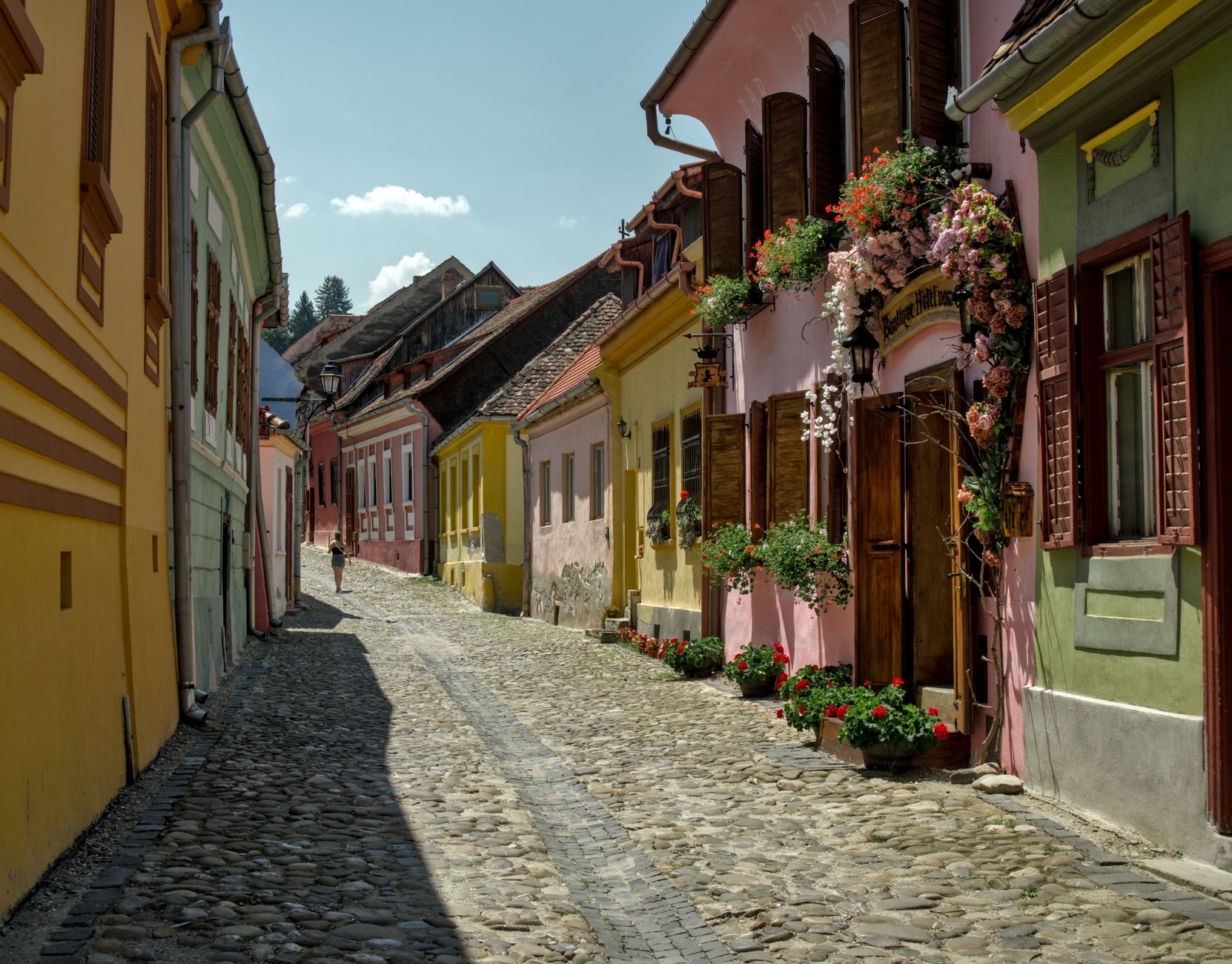
Sighișoara is the one unmissable thing and an easy drive west: a walled medieval citadel of coloured burgher houses and towers, still lived in rather than preserved as an exhibit, with a covered wooden stairway climbing to the church on the hill. Go early or stay the night — it fills with day-trippers by eleven.
The fortified churches are the region’s real signature, and Biertan is the greatest of them: a Saxon village church ringed by three defensive walls on a hill, with a door whose lock has fifteen bolts thrown by a single key. There are dozens of these across the Saxon lands and they are the physical record of eight centuries of German settlement in Transylvania. Drive between them; the roads are the point.
The salt mines are extraordinary and you should do one. Salina Turda, northwest towards Cluj, is a vast worked-out chamber fitted out with a Ferris wheel, an amphitheatre and a boating lake on the floor of the mine — genuinely strange and quite unlike anywhere else. Praid, east into Harghita county, is the other, larger and less theatrical, with a treatment centre where people spend hours in the salt air for their lungs. Turda is the spectacle; Praid is the more local experience. Take a jumper for either: it is cold down there year-round.
The Székely Land — Harghita and Covasna counties, east of here — is the Hungarian-speaking heart of Transylvania, with its own flags, its own cooking and a landscape of wooden gates and grassy hills. Sovata, east of the city, has Bear Lake, a heliothermal salt lake whose layered water traps heat so that the middle depths run far warmer than the surface. It is a spa town and a good soft landing after a week of driving.
Two last pieces of advice. Book the car before you book the flight in July and August, because the regional fleet is small and it sells out; and check that your route still operates on your dates, because the single most reliable fact about this airport is that its route map changes. Confirm, then book, then enjoy one of the least crowded good regions in Europe.
❓ Frequently Asked Questions
📊 2026 Summary Data Table
| Category | Detail |
|---|---|
| Airport | Aeroportul Internațional “Transilvania” Târgu Mureș (TGM / LRTM), Vidrasău, Mureș county |
| Owner | Mureș County Council; certified as an international airport in 2012 |
| Distance | 14.5 km from Târgu Mureș, on the Târgu Mureș–Luduș road. Elevation 294 m |
| Runway | 07/25, 2,000 × 30 m asphalt (+15 m shoulders), PCN 70 after the 2017–18 rebuild; reopened to international traffic 25 June 2018; CAT II lighting since 2021 |
| Terminal | 4,182 m², 7 check-in desks, 400 passengers/hour peak, design capacity ~800,000 a year |
| Traffic | 343,521 in 2014 (4th in Romania). Recent published annual totals run far below that — roughly 261k (2023), 213k (2024), 153k (2025) |
| Airlines | Scheduled: Wizz Air (both W6 and W4 flight numbers). Charter partners incl. Aegean, Animawings, Corendon, HiSky, Sky Express, Tailwind, SkyUp, Southwind, Mavi Gök, Bees |
| Scheduled routes | Budapest (daily) · London–Luton · Rome–Fiumicino · Paris–Beauvais · Milan–Bergamo · Brussels–Charleroi · Dortmund · Memmingen · Basel · Larnaca. (Karlsruhe/Baden-Baden appears only on the airport’s older detail pages — unconfirmed) |
| Season note | Budapest is daily and year-round; the other nine launched 29–31 March 2026, the start of the summer season — confirm winter operation before booking |
| Summer charters | Heraklion · Antalya · Hurghada, sold through tour operators |
| Catchment | Mureș, Harghita, Covasna, Alba, Bistrița, Brașov, Cluj, Suceava, Sibiu — ~3.9 million people; Brașov, Alba Iulia, Bistrița and Miercurea Ciuc within ~90 minutes |
| Airport bus | Duda Trans, since 1 July 2023, stop at Piața Trandafirilor × Strada Horea; timetable follows the flights; fare not published — 0265-977 / 0732-445577 / 0757-022021 |
| Taxi | 12 licensed companies listed by the airport; no published tariff card — confirm the meter or agree the fare |
| Parking | 180 spaces; fare calculator on the airport website |
| On site | Bureau de change · ATM · duty-free · rent-a-car |
| Lounge | No walk-up lounge. A salon VIP and conference room are bookable in advance on 0265 232738 |
| Currency | Romanian leu (RON) — not the euro. ECB 7 Sep 2026: €1 ≈ 5.25 lei. Cards fine in town; carry lei for the countryside |
| Schengen | Romania is a full member since 1 January 2025. The area is 29 countries — 25 EU states plus Iceland, Norway, Switzerland and Liechtenstein |
| Border exceptions | London–Luton (UK, outside EU and Schengen) and Larnaca (in the EU, but Cyprus is not in Schengen) |
| EES | Fully operational since 10 April 2026. Applies on the Luton and Larnaca arrivals; queues here are short |
| ETIAS | Not in operation; no applications collected. Fee fixed at €20. No launch date published — any seller is a scam |
| UK ETA | GOV.UK: EU nationals need an ETA, fee £20. The airport’s own notice adds a date of 25 February 2026 and advises applying at least 3 days ahead — that date is the airport’s, not GOV.UK’s |
| Customs from the EU | 800 cigarettes · 400 cigarillos · 200 cigars · 1 kg tobacco · 10 L spirits · 20 L intermediate · 90 L wine · 110 L beer |
| Customs from outside the EU | 40 cigarettes · 100 cigarillos · 50 cigars · 250 g tobacco · 1 L over 22% or 2 L under · 4 L still wine · 16 L beer · other goods to €430 |
| Cash rule | €10,000 or more must be declared entering or leaving |
| Alternatives | Cluj-Napoca — far more routes and daily frequencies, and inside the airport’s own ~90-minute catchment — and Sibiu for the south |
| Region | Sighișoara citadel · Biertan and the Saxon fortified churches · Salina Turda and Praid salt mines · the Székely Land · Sovata and Bear Lake · the Târnave wine country |
| Eat and drink | Kürtőskalács · székelykáposzta · sarmale · mămăligă · papanași · pálinka · Târnave white wine · Corund ceramics |