Trabzon (TZX) Airport Guide 2026 — Black Sea Coast, Two Terminals
Trabzon Airport sits on a narrow shelf of reclaimed shoreline about 5.5 km east of Meydan, the city’s central square, and is the largest airport on Türkiye’s Black Sea coast by a distance — 3,874,640 passengers in 2025 against 1.64 million at Samsun-Çarşamba, the next one along. It is a DHMİ state airport and a Pegasus operating base, with AJet and Turkish Airlines feeding Istanbul and Ankara and a heavy Gulf-carrier season every summer. Two separate terminal buildings, domestic and international, with no airside link between them — the single most important thing to know before you book a connection here. Currency is the Turkish lira, and Türkiye runs its own entry system — 90 days visa-free for most Western and Gulf passports, an e-Visa for the rest.
Last verified: September 2026.
⚡ 2026 Quick Reference — Key Facts at a Glance
Trabzon (TZX / LTCG) — DHMİ-operated, Pegasus operating base, opened 1957
Havaş runs the shuttle at Trabzon (
[email protected]); timings track flight arrivals — buy on board or at havas.netMunicipal AKUS network, coast-road services only — there is no branded airport line
Metered yellow taxis at both terminals; short hop into the centre. Insist on the meter
~5.5 km east of Meydan, Ortahisar district, right on the D010 coast road
Turkish lira (TRY) — inflation-volatile. Pay in lira, always decline DCC
One CIP lounge, domestic terminal only. Priority Pass does not list Trabzon
Türkiye’s own system — 90 days visa-free in any 180 for US, UK, EU, Gulf, Japan, Australia; e-Visa at evisa.gov.tr for everyone else
Must be valid 60 days beyond your permitted stay — 150 days for a 90-day exemption
Single 2,640 m strip with sea at one end; a sea-fill replacement has been announced
🏢 1. Two Terminals, No Airside Link
This is the fact that catches people out at Trabzon, so it goes first. TZX does not have one terminal with a domestic wing and an international wing. It has two physically separate buildings, built 24 years apart, and there is no airside connection between them.
The domestic terminal entered service in 2008. DHMİ puts it at 17,280 m² of built area, 8,080 m² usable, with a rated capacity of 2,000,000 passengers a year. Inside: 20 check-in desks, four X-ray lanes, six gates, two cafés, two baby-care rooms, and a 1,300 m² upper-level airside hall over an 850 m² lower level. Arrivals runs to 1,600 m² of baggage reclaim with four belts and — a genuinely useful detail if you are heading straight for the highlands — 14 car rental desks.
The international terminal is the older and much tighter building, in service since 1998: 9,590 m² built but only 3,245 m² usable, also rated at 2,000,000 passengers a year. It has 16 check-in desks, three X-ray lanes, three gates, and two baggage carousels. Landside there is a café-bar-restaurant, a prayer room, baggage wrapping, and a gift shop; airside there is a duty-free shop and not a great deal else. Arrivals has currency exchange, duty-free, three car rental firms and a lost-luggage office.
Three gates and 3,245 m² of usable floor is not much building to put a July Gulf wave through. Look at the summer route list further down — flynas, Gulf Air, Jazeera, Kuwait Airways, Oman Air, SalamAir, Qatar Airways, flydubai and Air Arabia all appear seasonally, on top of Pegasus’s own Middle East list — and it is obvious that three gates are being asked to do a lot. Arrive earlier than the airline tells you in July and August. In February, when the international side is running a handful of flights a day, you can walk in an hour before departure and be bored at the gate.
The connection trap. If you land domestic from Istanbul and fly out international, or the reverse, you must clear the first building, walk outside, and start again from the kerb at the second. There is no sterile transfer. Do not buy a self-connection at TZX with less than about two and a half hours between flights, and do not buy one at all on separate tickets — your bag will not follow you.
The runway. One asphalt strip, 11/29, 2,640 m long, at an elevation of 32 m, hemmed by the Black Sea on one side and the coastal mountains on the other. It is short by wide-body standards, which is why almost everything you see here is a 737 or an A320-family aircraft, and why the Gulf routes are flown by narrow-bodies rather than the bigger metal those carriers use elsewhere. Türkiye’s Ministry of Transport and Infrastructure has announced a replacement airport built on sea fill north of the current runway, with a 3,000 m runway and a terminal rated for 10 million passengers. Treat that as announced, not built: nothing about your 2026 trip changes.
Airlines you will actually see. Pegasus bases aircraft here and flies Istanbul–Sabiha Gökçen, İzmir, Antalya, Adana/Mersin and Ercan year-round, plus a long seasonal Middle East list. AJet covers Ankara, Bursa, Diyarbakır and Sabiha Gökçen. Turkish Airlines runs Istanbul, with seasonal Munich. SunExpress flies Antalya, İzmir, Düsseldorf and Muscat. The Gulf list in summer is remarkable for an airport this size — flynas, Gulf Air, Jazeera Airways, Kuwait Airways, Oman Air, SalamAir, Qatar Airways, flydubai and Air Arabia all appear seasonally, and Pegasus adds Amman, Bahrain, Dammam, Doha, Jeddah, Kuwait City, Medina and Riyadh on top. Central Asia is the quiet surprise: Centrum Air and Qanot Sharq to Tashkent, Somon Air to Dushanbe, Azerbaijan Airlines to Baku.
Before you book, check what your fare actually includes — Pegasus and AJet sell down to a personal-item-only fare, and the difference matters more than the headline price. Our Pegasus baggage guide, AJet guide and SunExpress guide have the current allowances, and the baggage checker compares them side by side.
🛂 2. Türkiye’s Entry Rules: 90/180, e-Visa and the 60-Day Passport Rule
Türkiye is not in the Schengen Area and is not an EU member. None of the EU border machinery applies here. Türkiye runs its own system: a straightforward visa exemption for most Western and Gulf passports, an electronic visa at evisa.gov.tr for the rest, and a passport-validity rule that is stricter than it looks. All of the below is from the Ministry of Foreign Affairs country list at mfa.gov.tr, checked this month.
Visa-free, 90 days in any 180. Ordinary passport holders from the United States, Canada, the United Kingdom, Australia, New Zealand, Japan, Israel and the EU/EEA states all enter without a visa. So do Saudi Arabia, the UAE, Kuwait, Oman and Bahrain — which is a large part of why the summer schedule looks the way it does. Qatar is also exempt for 90 days, but counted differently (see below). Georgia, Azerbaijan, Kazakhstan, Kyrgyzstan, Ukraine, Moldova and Iran are also visa-exempt for 90 days. Ordinary passport holders of the People’s Republic of China have been visa-exempt for 90 days since 2 January 2026.
Different clocks, same door. Not everyone gets 90 days. Russian ordinary passport holders are exempt for 60 days on tourist and business travel. Some exemptions run “90 days within six months from first entry” rather than a rolling 180 — Qatar, Jordan and Lebanon are written that way. If you are close to a limit, count against the wording on your own nationality’s line, not against a general rule.
Who needs an e-Visa. Armenian and Indian ordinary passport holders, South Africans, and a long tail of other nationalities need a visa in advance. Many of them qualify for an e-Visa only if they already hold a valid Schengen, US, UK or Irish visa or residence permit — that conditional is the part people miss. Iraqi nationals aged 15–50 fall into the same conditional category, while those under 15 and over 50 are visa-exempt. Egyptian applicants aged 15–45 face a conditional e-Visa that additionally requires flying with one of a named list of carriers. Apply at evisa.gov.tr and nowhere else; the site issues in minutes and the copycat agencies charge a markup for the same document. Fees are set per nationality and are revised, so read the price on the official portal rather than any figure quoted elsewhere.
The passport rule that actually bites. Since 1 January 2015, Türkiye requires your travel document to be valid at least 60 days beyond the “duration of stay” granted by your visa, e-Visa or exemption. For a 90-day exemption that means 150 days of validity from entry, not six months and not three. Airlines commonly enforce a blanket six months at check-in regardless, so treat six months as the practical bar and 150 days as the legal minimum.
Money, and the part everyone gets wrong. Türkiye uses the Turkish lira (TRY). The lira has been moving fast enough that any exchange rate printed in a guide is wrong by the time you read it — I am deliberately not giving you one. What does not change is the mechanism. Cards are accepted almost everywhere in Trabzon, including on buses and in taxis. When a card terminal offers to charge you in euros, dollars or riyals instead of lira, decline it — that is dynamic currency conversion and the rate is set by the acquirer, not your bank, and it is always worse. Withdraw from a bank-branded ATM in the terminal (Ziraat, İş Bankası, Garanti, Yapı Kredi) rather than the standalone exchange desk in international arrivals, and refuse the ATM’s own conversion offer for the same reason. Carry a modest amount of cash for village dolmuş fares and highland tea houses; everything else takes plastic.
🚌 3. Havaş, the Coast Road, and the Uzungöl Bus
Trabzon’s saving grace is that the airport is close. You are 5.5 km from Meydan on a flat coast road, not 40 km up a valley. Nothing here takes long.
Havaş runs the airport shuttle. Havaş — the national airport ground-handling and coach operator — lists Trabzon among its 17 bus locations and keeps a dedicated Trabzon desk. Its buses wait outside arrivals and depart in step with flight arrivals rather than on a clock timetable, which is the standard Havaş model across Türkiye. Fares are reset with inflation, so buy on board or through havas.net and check the current price there; I am not quoting a figure that will be wrong next quarter.
There is no municipal “airport bus”, and you should know that before you go looking for one. The Trabzon Büyükşehir Belediyesi published timetable has no line named for the airport. What it does have is a dense set of services along the eastern coast corridor that the terminal sits on — the 121 and 122 to Kaşüstü, the 139 family to Pelitli, the 601 to Yomra — all of which run the D010 past the airport junction between the city centre and the eastern suburbs. They are cheap and frequent and locals use them. They are also not designed for someone with two suitcases, and the stop is a walk from the terminal doors. Use the AKUS app to see live positions before committing.
Taxis and ride-hail. Yellow metered taxis queue at both terminals. The ride into Meydan is short. Insist the meter runs — this is the standard advice at every Turkish regional airport and it is standard for a reason. Trabzon is not an Uber city in the way Istanbul is; the taxi rank is the default. Fares are also revised with inflation, so agree that the meter is on rather than negotiating against a number you read online.
Two bus lines worth knowing about that are not airport services at all. The municipality publishes a 328 Uzungöl–Trabzon–Sahil Peron line and a 451 Maçka–Meydan–Sahil Peron line. Those are the two destinations most people fly to Trabzon for — Uzungöl directly, and Maçka as the road head for Sumela. Being able to reach both on a public municipal bus from the city’s central terminus, rather than only on a tour, is the most useful piece of local knowledge in this guide.
| Option | Where it goes | Notes |
|---|---|---|
| Havaş shuttle | Airport ↔ city | Departs after arrivals, not on a clock. Fare at havas.net — inflation-adjusted |
| AKUS city buses (121/122/139/601) | Coast-road corridor past the airport | No branded airport line. Cheap, frequent, not suitcase-friendly |
| Taxi | Anywhere | Metered, short run to Meydan. Insist on the meter |
| Car rental | 14 desks domestic, 3 international | The right call if Uzungöl and Sumela are the trip |
| Bus 328 | Sahil Peron ↔ Uzungöl | Municipal line, not an airport service — connect in the centre |
| Bus 451 | Sahil Peron ↔ Maçka | Road head for Sumela Monastery |
🛋️ 4. One CIP Lounge, and It’s on the Wrong Side
Be blunt about this: if you are flying internationally from Trabzon, there is no lounge for you.
DHMİ’s own terminal specification lists a 215 m² CIP lounge in the domestic terminal. The international terminal specification lists a café-bar-restaurant and a duty-free shop and no lounge at all. Since the two buildings have no airside connection, a domestic-side lounge is not reachable from an international boarding pass, and there is no way to talk your way across.
It is also worth knowing what Priority Pass actually covers in Türkiye. Their own country listing runs to nine Turkish airports — Istanbul, Sabiha Gökçen, Ankara Esenboğa, Antalya, İzmir Adnan Menderes, Dalaman, Milas-Bodrum, Çukurova and Diyarbakır — and Trabzon is not among them. If you are carrying Priority Pass, LoungeKey or DragonPass and expecting to use it here, plan on paying at the door instead, and only on the domestic side. Third-party aggregators quote walk-in prices for the Trabzon CIP lounge; they disagree with each other and with the lira, so ask at the desk.
For a domestic connection through Istanbul with status, the lounge you actually want is at the other end. Star Alliance Gold and Turkish Airlines business passengers are far better served at Istanbul Airport, and the sensible Trabzon plan is to treat the 215 m² room as a place to sit for an hour, not a reason to arrive early.
The practical alternative. The domestic airside hall is a 1,300 m² upper level with cafés, and the landside restaurant in the international building is perfectly serviceable. If you have three hours to fill at TZX, the better move is not to spend them at TZX — the airport is close enough to the city that a taxi to Meydan, a plate of food and a taxi back costs less time than most people assume.
🐟 5. Hamsi, Kuymak and Two-Thirds of the World’s Hazelnuts
Eastern Black Sea food is not Turkish food as most visitors know it. There are no kebabs to speak of. The staples are anchovies, maize flour, butter, stringy melting cheese, black cabbage and dairy — a wetter, greener, colder cuisine than anything in Anatolia.
Hamsi — Black Sea anchovy — is the regional obsession, and the season runs through the cold months. It is fried in cornmeal (hamsi tava), baked into rice (hamsili pilav), and occasionally turned into bread. In midsummer it is out of season and what you are served is frozen; eat something else and come back in November.
Kuymak, also called mıhlama, is cornmeal cooked in butter with young Trabzon cheese until it turns into a molten, stringy pool eaten straight from the pan with bread. It is the single most regional dish here and it is a breakfast, not a side. Every highland tea house between Maçka and Uzungöl does a version.
Akçaabat köftesi — hand-minced beef patties from the town of Akçaabat just west along the coast — is the meat dish worth ordering, and it is protected as a regional product. Vakfıkebir ekmeği, the enormous round sourdough loaf from the coast west of the city, is sold whole and shows up on airport shelves in vacuum packs.
Hazelnuts are the serious purchase. Türkiye grows roughly two-thirds of the world’s hazelnuts by FAO’s reckoning, and the provinces of Trabzon, Giresun and Ordu account for most of the country’s hazelnut land. Buying hazelnuts in Trabzon is not a souvenir gesture; it is buying at the source. Raw, roasted, or as fındık ezmesi (hazelnut paste) — the paste travels better than a box of chocolates and costs a fraction of the equivalent brand-name spread at home. Prices move with each harvest, so shop on the street rather than in the terminal.
Two more worth a bag: Trabzon butter (Trabzon tereyağı), which is a genuinely different product from supermarket butter, and tea from the neighbouring Rize hills, where essentially all of Türkiye’s tea is grown. The airside duty-free in the international terminal carries a small range at airport pricing. Buy in the city if you have an hour.
💡 6. What the Eastern Black Sea Is Actually For
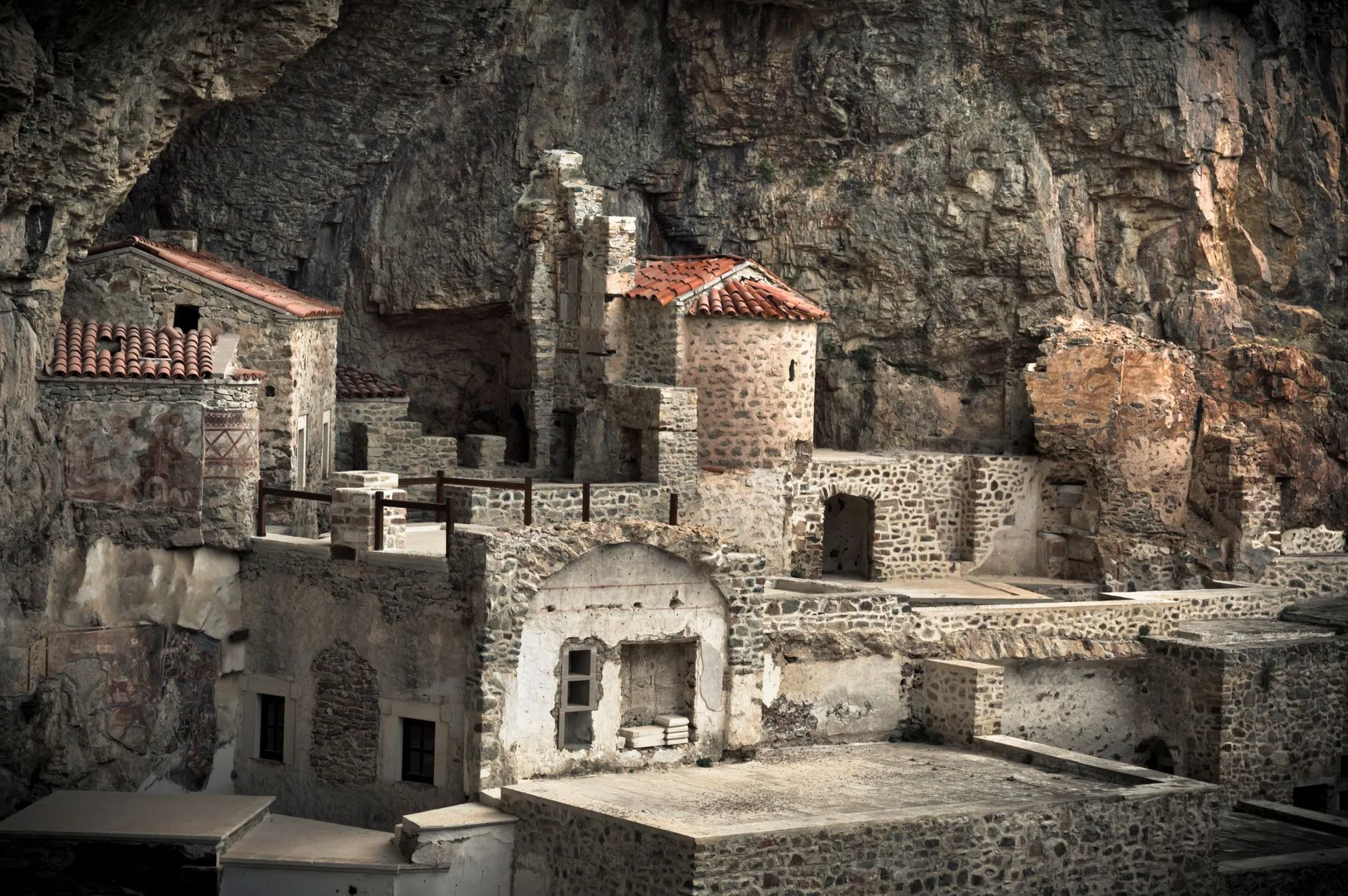
Sumela Monastery is the reason most first-time visitors come. It is a Byzantine foundation built onto a sheer cliff face in the Altındere valley above Maçka, reachable by road and then a climb. It is administered as a state site by the Ministry of Culture and Tourism and sold through muze.gov.tr. Ticket prices for state sites are revised annually and blogs contradict each other badly on this one — check the current figure on the ministry’s own site rather than trusting a number, mine included. If you hold a MüzeKart, check Sumela’s own listing there too: coverage varies by site. Practical planning: it is up a mountain valley, it is cold and wet when the coast is not, and the last admission is well before closing.
Uzungöl is the other magnet, and it is the one to be honest about. It is a small lake in a steep forested valley in the Çaykara district, and it has been developed hard for exactly the Gulf summer market that fills the international terminal — hotels, restaurants and shopfronts in Arabic. If you are picturing an empty alpine lake, that is not what is there in August. Go in late spring or autumn, on a weekday, and it is beautiful. Go in the second week of August and you will queue to park.
The highlands are the actual answer. What the eastern Black Sea does better than anywhere else in Türkiye is the yayla — summer pasture settlements at 1,800–2,500 m, reached on switchback roads, above the cloud line that keeps the coast grey. Pokut, Sal and Ayder are in the Rize hills east of Trabzon; the Maçka valleys are closer. This is a car or a dolmuş trip, not a bus tour, and it is the reason to rent from one of those 14 desks in domestic arrivals.
In the city itself, three things are worth your time. The Hagia Sophia of Trabzon (Ayasofya) is a 13th-century Byzantine church with surviving frescoes, on the western side of town. Boztepe is the hill directly above the city with the view down over the whole coastal strip — go at dusk. The Atatürk Köşkü, a white villa in the hills, is a short taxi ride and pleasant rather than essential.
Trabzonspor is not a footnote here. The club is one of the few genuine powers in Turkish football based outside Istanbul, and its ground — the Şenol Güneş Stadium, opened in December 2016 and currently carrying a sponsor’s name — is a short way along the coast from the centre. A home match is the most authentically local thing available to a visitor. Check the fixture list before you book.
Weather is the planning constraint nobody mentions. This is the wettest region in Türkiye. The mountains trap Black Sea moisture and it rains a lot, in every season, including in high summer. Pack a shell. And build slack into a tight connection out of Trabzon in winter: one runway, sea at one end, mountains behind, and low cloud is routine.
A last money note. If you are pricing a Trabzon trip against alternatives, the Istanbul feed is what sets the fare — TZX is a spoke, and both Istanbul airports serve it many times a day. Run the dates through our price checker before you commit to a specific week; the summer Gulf season and the domestic holiday peaks move Trabzon fares far more than they move most Turkish regional airports.
❓ Frequently Asked Questions
📊 2026 Summary Data Table
| Category | Detail |
|---|---|
| IATA / ICAO | TZX / LTCG |
| Official name | Trabzon Airport (Trabzon Havalimanı) |
| Operator | DHMİ — General Directorate of State Airports Authority |
| Opened | 1957 |
| Location | Ortahisar district, ~5.5 km east of Meydan on the D010 coast road |
| Terminals | Two separate buildings — domestic (2008) and international (1998), no airside link |
| Domestic terminal | 17,280 m² built · 2,000,000 capacity · 20 check-in desks · 6 gates · 215 m² CIP lounge |
| International terminal | 9,590 m² built, 3,245 m² usable · 2,000,000 capacity · 16 check-in desks · 3 gates · no lounge |
| Runway | Single 11/29 · 2,640 m asphalt · elevation 32 m |
| 2025 passengers | 3,874,640 total (3,029,171 domestic / 845,469 international) · 26,507 movements |
| Rated capacity | 4,000,000 per year |
| Main carriers | Pegasus (base), AJet, Turkish Airlines, SunExpress + a large seasonal Gulf list |
| Gulf season | flynas, Gulf Air, Jazeera, Kuwait Airways, Oman Air, SalamAir, Qatar Airways, flydubai, Air Arabia |
| Airport bus | Havaş — departs with arrivals, fare at havas.net |
| City buses | AKUS coast-road lines (121/122/139/601). No branded airport line |
| Currency | Turkish lira (TRY) — volatile; decline DCC, use bank ATMs |
| Border regime | Türkiye’s own regime — not an EU or Schengen border. 90/180 visa-free for US/UK/EU/Gulf/JP/AU; e-Visa at evisa.gov.tr for others; passport valid 60 days beyond permitted stay |
| Lounge | One CIP lounge, domestic terminal only. Priority Pass does not list Trabzon |
| Region | Sumela Monastery, Uzungöl, the Rize yayla highlands, hamsi and hazelnuts |
| Planned works | Sea-fill replacement airport announced — 3,000 m runway, 10M capacity. Not built |