Ostend-Bruges International (OST) Airport Guide 2026 — A Freight Airport That Sells Sunshine
Ostend-Bruges is a cargo airport with a holiday schedule bolted on, and knowing that before you book changes everything. It sits at Raversijde, 8 km from Ostend station and 34 km from the Markt in Bruges, on a single 3,200-metre concrete runway built for freighters. In 2025 it handled 404,076 passengers and 22,899 tonnes of cargo — and on the departure board we read this month, every scheduled passenger flight was a TUI fly Belgium charter to Spain or Greece. There is no airport rail link and no lounge. The bus outside the door is De Lijn line 60, a flat €3. Belgium is in Schengen and the eurozone.
Last verified: September 2026.
⚡ 2026 Quick Reference — Key Facts at a Glance
De Lijn line 60, and the stop is directly in front of the terminal — the only public transport that reaches the door. The airport describes it as running “very frequently” on the route Ostend – Airport – Nieuwpoort – Koksijde – Veurne. De Lijn charges one flat network fare, not a zone fare: single €3, return €6, 10-ride card €22 (€2.20 a ride), day ticket €9 for 12s and over or €4.50 for 6–11s, 3-day €18 / €9
There is no direct link. Take line 60 into Ostend, then the train: Ostend to Bruges is 13–14 minutes on NMBS InterCity services, several an hour. By road the airport is 34.2 km / about 36 minutes from the Markt
The Kusttram does not serve the airport. The nearest stop, Raversijde Middenlaan, is about 1.3 km away in a straight line — a walk, not a connection. Once you are on it, it runs every 10, 15 or 20 minutes by day and every 30 minutes in the evening
Airport taxi +32 (0)59 70 27 27. Four car parks open 24/7 — P1 260, P2 500, P3 550, P4 125 spaces (1,435 in all), camera-monitored, no reservations possible. Kiss & Fly is at P1 with 10 minutes free; the spaces in front of the terminal are for taxis and buses only
Ostend station 8.1 km / 19 min · Ostend centre 8.0 km / 20 min · Middelkerke 8.0 km / 15 min · Nieuwpoort 14.9 km / 24 min · Bruges station 33.2 km / 34 min · Bruges Markt 34.2 km / 36 min (routed and measured this run)
OST / EBOS, operated by Egis Airport Operation. One runway, 08/26, 3,200 × 45 m, concrete; aerodrome elevation 13 ft (4 m) — among the lowest in Europe. Published AIP data, AIRAC edition 3 September 2026
2025: 404,076 passengers · 22,899 tonnes of cargo · 22,571 aircraft movements — the first time above 400,000 passengers since 2019 (457,423). The airport was closed for two months in 2024 to renew the runway and taxiways
On the boards read for 7–8 September 2026, every scheduled passenger flight carried a TB flight number — TUI fly Belgium — to Malaga, Murcia, Ibiza, Alicante, Tenerife, Palma de Mallorca, Heraklion and Chania. The published schedule splits into a summer season (April–October) and a winter season (November–March), with extra flights during school holidays
There is none. The airport publishes no lounge of any kind, and Priority Pass lists only Brussels and Brussels South Charleroi in Belgium. There are three restaurants instead, one of them landside with a runway view
Euro, and Belgium is in the Schengen area. The EU Entry/Exit System became fully operational on 10 April 2026. ETIAS is not in operation and no applications are being collected; the fee is set at €20
🏢 1. A 3,200-Metre Runway With a Small Terminal Attached
Read the runway and the traffic figures together and the whole airport explains itself.
The published aerodrome data gives one runway, 08/26, 3,200 by 45 metres, concrete, at an aerodrome elevation of 13 feet (4 metres) above sea level — this is a North Sea polder airfield, and there are very few lower runways in Europe. Three point two kilometres of concrete is enough for a fully loaded widebody freighter, and that is precisely what it is for.
Now the traffic. In 2025 Ostend-Bruges handled 404,076 passengers, 22,899 tonnes of cargo and 22,571 aircraft movements. The passenger figure was the first time it had crossed 400,000 since 2019, when it carried 457,423. In 2024 it managed 352,662 — and the reason for that dip is on the airport’s own statistics page: the airport was closed for two months in 2024 while the runway and taxiways were renewed. So the concrete you land on is new.
The freight side, and why it matters to you
The cargo series is the more revealing one:
| Year | Passengers | Cargo (tonnes) |
|---|---|---|
| 2025 | 404,076 | 22,899 |
| 2024 | 352,662 | 18,124 |
| 2023 | 386,387 | 33,051 |
| 2022 | 369,363 | 51,191 |
| 2021 | 221,161 | 62,056 |
| 2020 | 111,499 | 52,659 |
| 2019 | 457,423 | 24,757 |
Cargo peaked in 2021 at 62,056 tonnes — nearly three times the 2025 figure — while passengers collapsed. The airport is, structurally, a freight operation that also does holidays, and it says so itself: it markets OST as “Europe’s fastest gateway to the UK, Northern France and Southern Netherlands”, with a 100,000 m² logistics zone and a further 200,000 m² under development, 24/7 customs presence, no slot restrictions, a dedicated cargo apron with multiple widebody stands, and 7,000 m² of refrigerated and freezer space for perishables. The Eurotunnel is 95 km away, about an hour’s drive. A Cargo Village project with Versluys Logistics will add 48,000 m² of warehousing; its first building — a 12,300 m² warehouse with 1,500 m² of offices — is finished and in use.
What that means for a passenger is genuinely useful and nobody writes it down: this is an uncongested airport with no slot constraints and a terminal built for a fraction of the aircraft it can handle. Queues here are a function of one charter departing at once, not of capacity. If two TUI flights leave at 06:00 and 06:20 you will meet a queue; the rest of the day the building is close to empty.
The terminal
There is one passenger building, and it is small. The airport’s own published facilities amount to a check-in hall, security, a departures area and three eating places — of which two are landside. There is no pier, no satellite, and no transfer function to speak of; almost everyone here is starting or ending a journey, not connecting.
Four car parks sit around it, all open 24 hours, with 1,435 spaces between them — P1 with 260, P2 with 500, P3 with 550 and P4 with 125 — all camera-monitored, and no reservation system, which for a leisure airport where families drive and park for a fortnight is a real planning point. Pay at the terminal at the entrance to P1, or at the one inside the building.
Sort the fare and the allowance before you go — TUI’s Belgian charter fares bundle baggage very differently from a scheduled ticket, and the aifly flight price checker and aifly baggage fee checker will show you what the package actually includes.
🛂 2. Schengen, the Euro, and the Belgian Kids-ID
Belgium is a founder member of both, so this is one of the simplest border sections in Europe — with one Belgian-specific trap that catches families every summer.
Belgium is in the Schengen area and in the eurozone. That means most people flying out of Ostend meet no border control at all, because the entire published passenger schedule is internal: Spain and Greece are both Schengen states. You will be asked for photo ID at the gate by the airline, which is a carrier requirement, not a border one.
The Kids-ID
Here is the local detail that matters, and the airport publishes it because it clearly has to. Young children and babies also need a valid passport or identity card — there is no “on a parent’s document” option. For Belgian children under 12 the relevant document is the Kids-ID, an electronic identity card applied for at your local authority.
It takes about three weeks to issue, and longer in busy periods. There is an accelerated procedure, but it costs more. If you are a Belgian family booking a February half-term charter in January, that timing is the thing to act on first.
More generally, the airport’s advice is right: check the entry conditions of your destination, not just your departure. Many countries require your identity card or passport to stay valid for a defined period beyond your return date, and a card that expires the week after you get home can end the trip at the check-in desk.
EES
The EU Entry/Exit System became fully operational on 10 April 2026. The European Commission’s wording is that “as of 10 April 2026, the EES replaces the stamping of passports allowing the automatic detection of overstayers”. The system started progressively on 12 October 2025 and registers non-EU nationals on short stays crossing the external border of the 29 participating countries, recording name, travel document data, biometrics — fingerprints and a facial image — and every entry and exit.
At Ostend this barely touches the passenger operation, because Malaga, Alicante, Ibiza, Palma, Tenerife, Murcia, Heraklion and Chania are all inside the same border zone. It matters here for the cargo and general-aviation traffic, and for you only if a future season adds a route outside it. If you are a non-EU passport holder connecting through Belgium from elsewhere, your first crossing since April will be the slow one; every crossing after that is quicker, because the biometrics are already on file.
ETIAS
ETIAS is not in operation. The Commission states that it “is currently not in operation and no applications for travel authorisations are collected at this point”, and that the EU “will inform about the specific date for the start of ETIAS several months prior to its launch.”
The fee has been set at €20, up from the €7 figure that circulated for years. There is nothing to apply for and nothing to pay. No website can sell you a valid ETIAS today — anything offering to is charging you for a form it cannot file.
Money
The euro, and Belgium is close to fully cashless in practice: cards work on De Lijn buses, on NMBS trains, in the airport restaurants and in Bruges. Bancontact is the domestic scheme and is universal; international Visa and Mastercard are accepted almost everywhere but a handful of very small Flemish businesses still prefer Bancontact or cash, so keep €20 in notes.
Decline any card terminal that offers to bill you in pounds or dollars instead of euro. That is dynamic currency conversion, the rate is set by the acquirer rather than your bank, and it is always worse.
🚌 3. One Bus, One Train Change, and the Tram That Does Not Come Here
This is the section that decides whether Ostend-Bruges works for your trip, and there is no way to make it sound better than it is: the ground transport here is thin, and it is designed around the car.
Bus 60, the only thing at the door
De Lijn line 60 stops directly in front of the terminal. The airport’s own description is that it “offers an excellent connection to and from our airport” and “runs very frequently”, on the route Ostend – Ostend Airport – Nieuwpoort – Koksijde – Veurne. That is the whole public-transport story at the kerb: one bus line, running along the coast road in both directions.
The fare is refreshingly simple because De Lijn charges a flat network fare with no zones:
| Ticket | Price |
|---|---|
| Single | €3 |
| Return | €6 |
| 10-ride card | €22 (€2.20 a ride) |
| 50-ride card | €95 (€1.90 a ride) |
| Day ticket, 12 and over | €9 |
| Day ticket, 6–11 | €4.50 |
| 3-day ticket, 12 and over | €18 |
| 3-day ticket, 6–11 | €9 |
Buy and activate before you board, through the De Lijn app or online, or pay contactless. If you are staying on the coast for a few days and intend to use the tram as well, the 3-day ticket at €18 pays for itself quickly — it covers De Lijn buses and trams alike.
Getting to Bruges — there is no direct route
Say it plainly: the airport is called Ostend-Bruges and there is no direct public transport to Bruges. What you do instead:
- Line 60 from the terminal into Ostend, for €3.
- NMBS train from Ostend to Bruges: 13 to 14 minutes. It is a busy line — in a sample seventy-minute window we counted six departures, all InterCity services, so roughly four an hour. NMBS fares are distance-based and were indexed on 1 February 2026, so buy from the machine, the app or belgiantrain.be on the day rather than budgeting a figure from an old guide.
Total, realistically, is under an hour door to door if the bus connection falls right, and closer to an hour and a quarter if it does not. By road it is 34.2 km and about 36 minutes, which is why a lot of people arriving here simply take a taxi or a pre-booked transfer to Bruges and accept the cost.
The Kusttram, honestly
The Belgian coast tram is one of the best public transport rides in Europe and it does not serve this airport. The nearest stop is Raversijde Middenlaan, roughly 1.3 kilometres from the terminal in a straight line — with luggage, on a coast road, that is a walk rather than a connection. Mariakerke Duinenkerkje is a similar distance.
Once you are on it, the Kusttram runs the length of the Belgian coast every 10, 15 or 20 minutes during the day, depending on the season, and every 30 minutes in the evening, and it is covered by the same flat De Lijn ticket as the bus. Get into Ostend on line 60 first, then use it — that is the sequence that works.
Taxis, driving and dropping off
The airport’s taxi number is +32 (0)59 70 27 27, and the rank is in front of the terminal. There is no published fixed airport tariff, so ask for an estimate rather than trusting a figure you read elsewhere.
If someone is dropping you off, you are obliged to use car park P1 for the Kiss & Fly zone — the spaces immediately in front of the passenger building are reserved for taxis and buses. P1 gives you 10 minutes free, after which the normal parking rates apply.
For anyone driving, the airport also has a fuel station and an electric fast-charging point on site — which, at an airport this size, is more than you get at several much larger ones.
🛋️ 4. There Is No Lounge
Plainly and without hedging: Ostend-Bruges Airport has no passenger lounge. Not a pay-in one, not a contract one, not an airline one.
The airport publishes no lounge anywhere in its services, and the cross-check confirms it — Priority Pass lists exactly two Belgian airports, Brussels and Brussels South Charleroi. Ostend is not on the network, and neither LoungeKey nor the other contract cards have anything to open here. If you hold a lounge card, it is worth nothing at this airport, and you should plan on that.
What you get instead is better than it sounds, because two of the three restaurants are landside and open to anyone, so you are not choosing between a lounge and a plastic seat — you are choosing between three sit-down restaurants and a plastic seat.
The practical shape of a departure here: arrive, eat properly at de Horizon or Belair in the terminal, then clear security late. The airside area is small and there is nothing in it worth arriving early for. At a 404,000-passenger airport with one charter leaving at a time, security is not a queue you need to build ninety minutes around — though on the 06:00 and 06:20 double departure, do.
🍽️ 5. Three Restaurants, Two of Them With a Runway View
For an airport this size, the catering is disproportionately good, and it is all about the view.
Belair is in the passenger building on the first floor, doing hot and cold drinks, hot and cold snacks and full meals, with — in the airport’s own words — “a splendid view on the runway”. Contact +32 (0)59 708 858.
Grand Café Restaurant de Horizon is in the terminal itself: coffee, lunch and dinner, and a “Grab & Fly” option if you are late.
Runway 26 = 08 is the outlier and the one worth a detour: a restaurant alongside the runway rather than inside the terminal, doing lunch, dinner and events, with a panoramic view down the strip. The airport’s description — “you can almost touch the planes” — is the sort of thing you would discount, except that this is a 3,200-metre runway used by widebody freighters, so the aircraft going past the window are considerably larger than the terminal deserves.
None of these require a boarding pass, which makes the airport a genuine local destination rather than a sealed box.
What to buy on the coast
There is no significant retail here, so buy in town. The West Flanders things worth carrying home:
- Ostend shrimp (Oostendse garnaal) — the tiny grey North Sea shrimp, hand-peeled, eaten in croquettes. Order garnaalkroketten in Ostend and you will understand why they cost what they do.
- Beer — Bruges and West Flanders cover the whole range from sour red-brown ales to Trappist. Buy from a specialist shop in Bruges, not the airport.
- Chocolate — Bruges has more chocolatiers per street than anywhere sensible. Buy from a shop that makes on the premises.
- Speculoos and Brugse kant (lace) are the tourist standards; the lace is worth it only if you buy real handmade work, which is expensive and rare.
💡 6. What the Flemish Coast Is Actually For
Be clear-eyed about the shape of this airport: almost everybody flying out of Ostend is a Belgian family going to the sun for a week. The board is Malaga, Alicante, Ibiza, Palma, Tenerife, Murcia, Heraklion and Chania, flown by one tour operator’s airline, in a summer season running April to October and a thinner winter one from November to March. Inbound tourism is not what this airport does at scale.
Which is a pity, because what it lands you next to is very good.
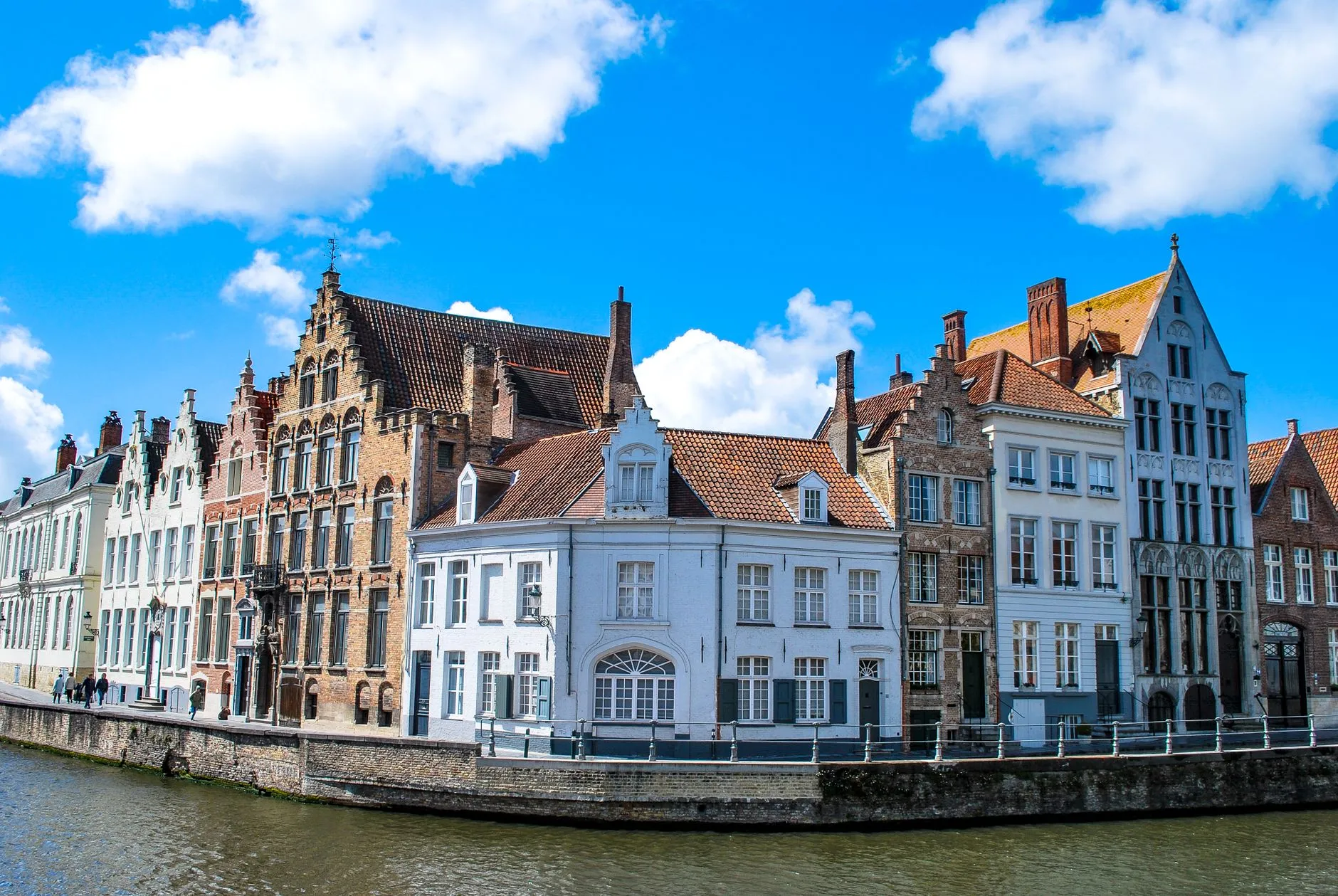
Bruges is the reason the airport carries the name, and its historic centre is on the UNESCO World Heritage List — a medieval trading city that kept its fabric, its canals and its Gothic core when its harbour silted up and the money left. It is thirty-four kilometres away and completely worth the awkward journey. Go early or stay overnight; the day-trip crowds from Brussels arrive mid-morning and leave by six, and Bruges after dark is a different and much better city.
Ostend is not Bruges and should not be judged against it. It is a working port and a Belgian seaside resort with a long beach, a promenade, and a serious art connection — James Ensor lived and painted here. It is where you eat shrimp croquettes and drink on a terrace, not where you photograph gables.
The coast itself is the underrated part, and the Kusttram is how you see it. The tram runs the entire Belgian coastline, and De Lijn scatters the Beaufort Sculpture Park — 53 artworks — along its stops. A day ticket at €9 and a tram every ten to twenty minutes is one of the best-value days out in northern Europe, and it costs less than a single airport transfer in most countries.
Nieuwpoort, Koksijde and Veurne are on your bus. Line 60 does not only go to Ostend — it runs west along the coast to the Westhoek, the quiet end of the Flemish coast. If you have hired a house on that side, you can reach it from the terminal for €3 without ever going into a city.
Practical judgements
Do not book Ostend expecting Bruges convenience. If Bruges is your actual destination and you are not flying TUI from Belgium, compare Brussels: on the timetable we read, Brussels Airport reaches Bruges in about 80 to 90 minutes — usually with one change, occasionally direct — from a station inside the terminal, against a bus-plus-train relay from Ostend. Price the whole journey, not the flight. Ostend wins on the coast; it does not win on Bruges. Before you settle on an airport, it is worth scanning what is actually leaving the country: aifly tracks current deals departing from Belgium across all four Belgian airports.
Check which season you are in before you plan anything. The airport publishes a summer schedule from April to October and a winter one from November to March, with extra flights during Belgian school holidays and the explicit caveat that travellers should confirm dates with the airline. A route that runs weekly in August may not exist in February.
Take the 3-day De Lijn ticket if you are staying on the coast. €18 for three days across buses and the Kusttram, against €3 a single ride, pays back in six journeys and removes every decision about tickets.
Arrive by car if you can, and expect no reservation. With 1,435 spaces across four 24-hour car parks and no booking system, parking here is first-come — which is fine on a normal day and worth thinking about on a Saturday in July when the whole week’s charters turn round at once.
And if you have an hour to kill, eat at Runway 26 = 08. A restaurant beside a 3,200-metre runway used by freighters is a better airport experience than most lounges, and it does not need a boarding pass.
❓ Frequently Asked Questions
📊 2026 Summary Data Table
| Category | Detail |
|---|---|
| Airport | Ostend-Bruges International Airport, Raversijde, Ostend |
| Codes | OST (IATA) · EBOS (ICAO) |
| Operator | Egis Airport Operation |
| Runway | One — 08/26, 3,200 × 45 m, concrete; aerodrome elevation 13 ft (4 m) |
| 2025 traffic | 404,076 passengers · 22,899 tonnes cargo · 22,571 movements — first year above 400,000 passengers since 2019 |
| Recent works | Closed for two months in 2024 to renew the runway and taxiways |
| Passenger airlines | On the boards for 7–8 September 2026, every scheduled passenger flight was TUI fly Belgium (TB) |
| Destinations seen | Malaga · Murcia · Ibiza · Alicante · Tenerife · Palma de Mallorca · Heraklion · Chania |
| Seasons | Summer schedule April–October, winter November–March; extra flights during school holidays |
| Cargo | 100,000 m² logistics zone (200,000 m² more in development) · 24/7 customs, no slot restrictions · widebody cargo apron · 7,000 m² refrigerated/freezer · Eurotunnel 95 km · Cargo Village 48,000 m² planned, first 12,300 m² warehouse in use |
| Bus | De Lijn line 60, stop in front of the terminal: Ostend – Airport – Nieuwpoort – Koksijde – Veurne |
| Bus fares | Single €3 · return €6 · 10 rides €22 · day €9 (12+) / €4.50 (6–11) · 3-day €18 / €9 — one flat network fare, no zones |
| To Bruges | No direct link. Line 60 into Ostend, then NMBS train Ostend–Bruges in 13–14 minutes, roughly four an hour. By road 34.2 km / 36 min |
| Coast tram | Does not serve the airport — nearest stop Raversijde Middenlaan, about 1.3 km away. Runs every 10–20 min by day, every 30 min in the evening |
| Road distances | Ostend station 8.1 km · Ostend centre 8.0 km · Middelkerke 8.0 km · Nieuwpoort 14.9 km · Bruges station 33.2 km · Bruges Markt 34.2 km |
| Taxi | +32 (0)59 70 27 27, rank in front of the terminal; no published fixed tariff |
| Parking | Four car parks, 24/7 — P1 260, P2 500, P3 550, P4 125 (1,435 spaces), camera-monitored, no reservations. Kiss & Fly at P1, 10 minutes free |
| Lounge | None. Priority Pass covers only Brussels and Brussels South Charleroi in Belgium |
| Food | Belair (1st floor, runway view) · Grand Café de Horizon (terminal, “Grab & Fly”) · Runway 26 = 08 (beside the runway) — all accessible without a boarding pass |
| Currency | Euro. Belgium is in Schengen and the eurozone; Bancontact is the domestic card scheme |
| Border | Schengen. EES fully operational 10 April 2026; nearly all passenger routes here are internal. ETIAS not in operation, fee set at €20. Belgian children under 12 need a Kids-ID — allow about three weeks to issue |