Blaise Diagne International Airport (DSS / DKR) — The Complete Master Guide 2026
Senegal’s gateway and West Africa’s rising hub on the Atlantic. Blaise Diagne International (DSS, often called DKR) replaced the old Leopold Sedar Senghor in 2017 and sits 47 km east of Dakar at Diass. Air Senegal hub, Air France, KLM, Brussels Airlines, Royal Air Maroc, Turkish, Iberia, Ethiopian, TAP and the Cape Verde-bound TACV all serve it. The visa-free 90 days for most Western nationalities, the West African CFA franc pegged to EUR, and the steady climate (Atlantic-cooled year-round) make DSS the smoother West African arrival than Lagos, Abidjan or Accra.
📍 47 km E of Dakar (Diass)
🚚 To CBD 60-90 min via TER
🛂 90-day visa-free entry
⚡ 2026 Quick Reference — Key Facts at a Glance
Opened 2017 · one departures hall · 3 million pax/year capacity
47 km via the Diass tollway and TER train · 60-90 min
West African CFA franc (XOF) · pegged 656 per EUR · EUR widely accepted
Yango app + taxis · TER train to Dakar · pre-booked transfer XOF 25,000
US, Canada, EU, UK, AU, NZ, Japan, ECOWAS · 6-month passport validity
Air Senegal (HC) · West Africa, Paris, Casablanca, Cape Verde, Bamako network
Avoid raw tap · bottled standard · hotels supply purified
Mandatory WHO yellow card on arrival · required for all visitors
🏢 1. The Single Terminal & the Diass Replacement Reality
Blaise Diagne International (DSS) opened December 2017 to replace Leopold Sedar Senghor (DKR), the old in-city airport which had become hopelessly overstretched. The relocation 47 km east to Diass added a serious commute but freed Dakar from the noise constraint that limited routings into the old field. The new terminal handles 3 million passengers per year with capacity for 10 million through phased expansion. The IATA code DSS is the official assignment, but the colloquial DKR (inherited from the old airport) is still widely used by airlines and travel sites — both work for booking.
✈️ The Modern DSS Layout
Single integrated terminal: 24 check-in counters, 14 boarding gates (10 air-bridges, 4 walk-out), modern security and biometric immigration. Departures upper level, arrivals ground floor with passport control, baggage claim, customs and a small but well-organised welcome-desk horseshoe for hotel meet-and-greet services. Designed by SAUDI BINLADIN GROUP at a cost around US$575M.
🏠 Carriers & Routes
Heavy hitters: Air Senegal (HC, the national flag), Air France CDG daily, Brussels Airlines (BRU 5x weekly), KLM AMS via CDG code-share, Royal Air Maroc CMN, Turkish IST 4x weekly, Iberia MAD, Ethiopian ADD, TAP LIS, South African Airways JNB, TACV PRA (Cape Verde), Asky Airlines (Lome hub) intra-West-Africa. The 4-runway-class facility handles A330-200/300 and 787 widebody operations.
🌍 The IATA Code Confusion
Officially the IATA assignment is DSS (Blaise Diagne replacement); the legacy DKR persists because Senghor (the old airport) closed but the code transferred informally. Most airlines list both. Always verify your boarding pass shows the correct destination code — some bookings cross-reference. The old Senghor field is now a military / general aviation airfield; do NOT show up there.
The old Senghor field was hemmed in by Dakar suburbs — no expansion possible, severe noise restrictions, no second runway. Diass is in open scrubland with room for two parallel runways, a passenger village, cargo handling, and onward growth to 10 million pax/year. The 47 km commute is the trade-off — mitigated by the TER train direct from terminal to central Dakar.
🛂 2. Visa-Free Entry, XOF Pegged to EUR & Yellow Fever
Senegal’s visa policy is one of the friendlier in West Africa: 90 days visa-free for US, Canadian, all EU/Schengen, UK, Australian, NZ, Japanese, Brazilian and ECOWAS member-state passports. The currency — West African CFA franc (XOF) — is pegged to the EUR at a fixed rate of 656 XOF per EUR, making exchange transparent. Yellow fever certificate is mandatory for all arrivals.
📄 The 90-Day Stamp
Passport with 6-month validity beyond entry, return ticket, accommodation proof. Border officers are professional but slow; allow 30-60 minutes through immigration depending on arrival wave. Children’s documentation straightforward (no SADC unabridged-birth-certificate rule). The 90-day stamp is renewable in country at the Direction de la Police de l’Air et des Frontieres in Dakar.
💰 CFA Franc, EUR-Pegged
West African CFA franc (XOF) is pegged to the EUR at 656 XOF per EUR (and converts to USD at ~600-620 depending on EUR/USD). ATMs at DSS (Ecobank, BICIS, Banque Atlantique, SGBS) dispense XOF at near-interbank rates with XOF 2,000-4,000 fees. Cards work at hotels and upmarket restaurants but not in markets, taxis or small shops. Carry XOF 50,000-100,000 cash for typical week of mixed spending.
🌍 Yellow Fever (MANDATORY)
Senegal requires the WHO yellow fever vaccination certificate for ALL international arrivals over 9 months old — not just those from YF risk countries, but everyone. Officials check the yellow card at passport control. No card means quarantine, refused entry or forced vaccination on the spot. Get the jab 10+ days before travel; certificate is valid for life under current WHO guidance.
📝 Other Health
Malaria seasonal risk especially July-November (rainy season); prophylaxis recommended for trips longer than a few days, especially upcountry to Saint-Louis or the Sine-Saloum delta. Hep A and typhoid jabs recommended. Standard precautions for “traveler’s tummy” — bottled water, peeled fruit, busy turnover restaurants. Cholera and meningitis less frequent concerns.
🚚 3. Transport: TER Train, Yango, Taxi, Pre-Booked Transfer
DSS is 47 km east of Dakar, served by the modern TER (Train Express Regional) since 2022 and the Diass tollway. Yango (Russia-based rideshare) operates locally with a similar interface to Uber, plus traditional metered taxis. Pre-booked hotel transfers are the upmarket default. Uber and Bolt do NOT operate in Senegal — Yango is the local equivalent.
🚅 TER Express Regional Train
The TER opened 2022 connecting DSS to central Dakar (Gare de Dakar) in 50-65 minutes. Trains every 30-60 minutes during the day, less at night. XOF 1,500-2,500 (US$2.50-4) for first class. Modern French-built trainsets, air-conditioned, free Wi-Fi. The TER station is a 5-minute walk from terminal arrivals via a covered walkway. The cleanest, cheapest and most reliable option for budget and mid-tier travellers.
📱 Yango App
Yango is the local rideshare equivalent of Uber. Download yango.app, register with phone and card, request from the airport pickup zone (well-signed). To Dakar XOF 12,000-18,000 (US$20-30), 60-90 min depending on traffic. Cars are clean, drivers professional, GPS reliable. Card payment supported. Yango is Russia-based but operates the same as Uber in user experience.
🚌 Airport Taxi
Licensed metered taxis (yellow body, black stripe, branded DSS Taxi) queue at arrivals. Fixed-rate to Dakar XOF 25,000-30,000 (US$40-50) for non-residents, 60-90 min. Pay in XOF or EUR; cards rare. Negotiate firmly — first-quote tends to be 30-50% over local rate. Friendly Senegalese hospitality means the negotiation is usually amicable.
🚚 Pre-Booked Hotel Transfer
Most upmarket Dakar hotels (Pullman, Radisson Blu, Terrou-Bi, King Fahd Palace) include or sell airport transfers; cost EUR 35-65 per person (XOF 25,000-45,000). The driver waits in the welcome-desk horseshoe with a name board. Mid-range hotels typically arrange on request for EUR 30-50. The CCBM Lodge near the corniche has its own shuttle.
DSS is genuinely far from central Dakar. Allow 60-90 minutes door-to-door including airport, transit and any in-city traffic. For very early or late flights, consider staying near the airport (Diass has a few business hotels) rather than commuting from central Dakar at 03:00.
🛍️ 4. Lounges: Pearl Lounge, Air Senegal, SkyTeam
DSS has two lounges in international departures — the Pearl Lounge (Priority Pass) and the Air Senegal Premier Lounge (Air Senegal Business + SkyTeam reciprocity for AF/KLM). Both are post-security, modest in size, well-equipped, with showers and good food. Capacity strained 22:00-01:00 European departure peak.
🍻 Pearl Lounge (Priority Pass)
Post-security in international departures. Hot Senegalese buffet (thieboudienne, yassa chicken, mafe, attieke), full bar with Gazelle and Flag local beers, two showers, business desks. Walk-in price US$45-55 if you have neither lounge access nor an airline card. Capacity strained on Sunday-Tuesday evening departures to Paris and Brussels.
🍸 Air Senegal Premier Lounge
Air Senegal Business Class, Air France & KLM SkyTeam Elite Plus reciprocity (Delta Diamond, KLM Platinum, AF Platinum). Smaller than Pearl, contemporary West African decor, full a-la-carte menu with gourmet thieboudienne, premium spirits, two showers, sleep room. Air Senegal joined the SkyTeam alliance discussion stages in 2024 but has not formally joined; reciprocity is via bilateral agreements.
✨ Airside Cafes
Beyond lounges, the airside food court has French-style boulangerie (Paul branch), Costa Coffee, a Senegalese restaurant serving thieboudienne and yassa, and a craft beer bar with Gazelle on tap. Coffee + pastry XOF 1,500-3,000, sit-down meal XOF 8,000-12,000. Free 60-min Wi-Fi airport-wide.
🥩 5. Food & Duty-Free: Thieboudienne, Bissap, Crafts
DSS’s duty-free showcases Senegalese strengths: thieboudienne (the national rice-and-fish dish, declared UNESCO Intangible Heritage in 2021), bissap (hibiscus tea), Bouye (baobab juice), Wolof art and craft, peanut paste (the Senegalese ingredient that influenced West African cooking globally). Don’t expect international franchise variety beyond Paul and Costa — this is a destination airport for travellers seeking Senegalese authenticity.
🍲 Thieboudienne & Yassa
Thieboudienne (rice and fish in spiced tomato sauce, the national dish, UNESCO heritage 2021) is the airport restaurant headliner. Yassa chicken (lemon-onion stew over rice) and mafe (peanut-tomato beef stew) are alternative classics. Sit-down meal XOF 6,000-12,000. The Pearl Lounge buffet is the airport’s best Senegalese food.
🥤 Bissap, Bouye, Cafe Touba
Bissap (hibiscus iced tea, sweet, deep red) is the daily Senegalese soft drink; sold canned and as dried hibiscus flowers in airside duty-free. Bouye (baobab juice, milky-tangy) is the connoisseur’s alternative. Cafe Touba (the Senegalese coffee with selim grains, brewed Sufi-tradition) sold ground in tins. Peanut paste (the famous Senegalese kind that defines West African cooking).
🎣 Wolof Art & Crafts
Senegalese craft is rich and varied: glass-paint reverse-paintings (sous-verre, the colorful narrative scenes that decorate Dakar walls), wax-print Bazin fabrics from Bamako tradition (sold by the metre, XOF 5,000-15,000), wooden masks and statues from Casamance, calabash water-gourd jewellery boxes, woven baskets. Airport prices premium; the Soumbedioune market in central Dakar is cheaper.
🍺 Gazelle, Flag, Senegalese Rum
Senegal’s local lagers Gazelle and Flag (both brewed by SOBOA in Dakar) are sold in airside duty-free at XOF 600-900 per bottle, US$10-15 for a six-pack. Senegalese sugarcane rum (Rhum Bama) is a niche choice. The standard 1L/2L spirits allowance applies. EUR-pegged duty-free pricing is moderate — no enormous savings vs European supermarket prices.
💡 6. Insider Tips: Goree, Pink Lake, Saint-Louis, Cape Verde
Senegal is one of the more accessible West African destinations: Dakar itself, the UNESCO Goree Island slave-trade memorial, the legendary Pink Lake (Lac Rose), the colonial town of Saint-Louis at the Mauritanian border, and Senegal’s Atlantic islands of Cape Verde reachable by direct flight. The classic 7-10 day itinerary covers Dakar + Goree + Pink Lake + Saint-Louis. Plan around the strengths.
🛵 Goree Island (UNESCO)
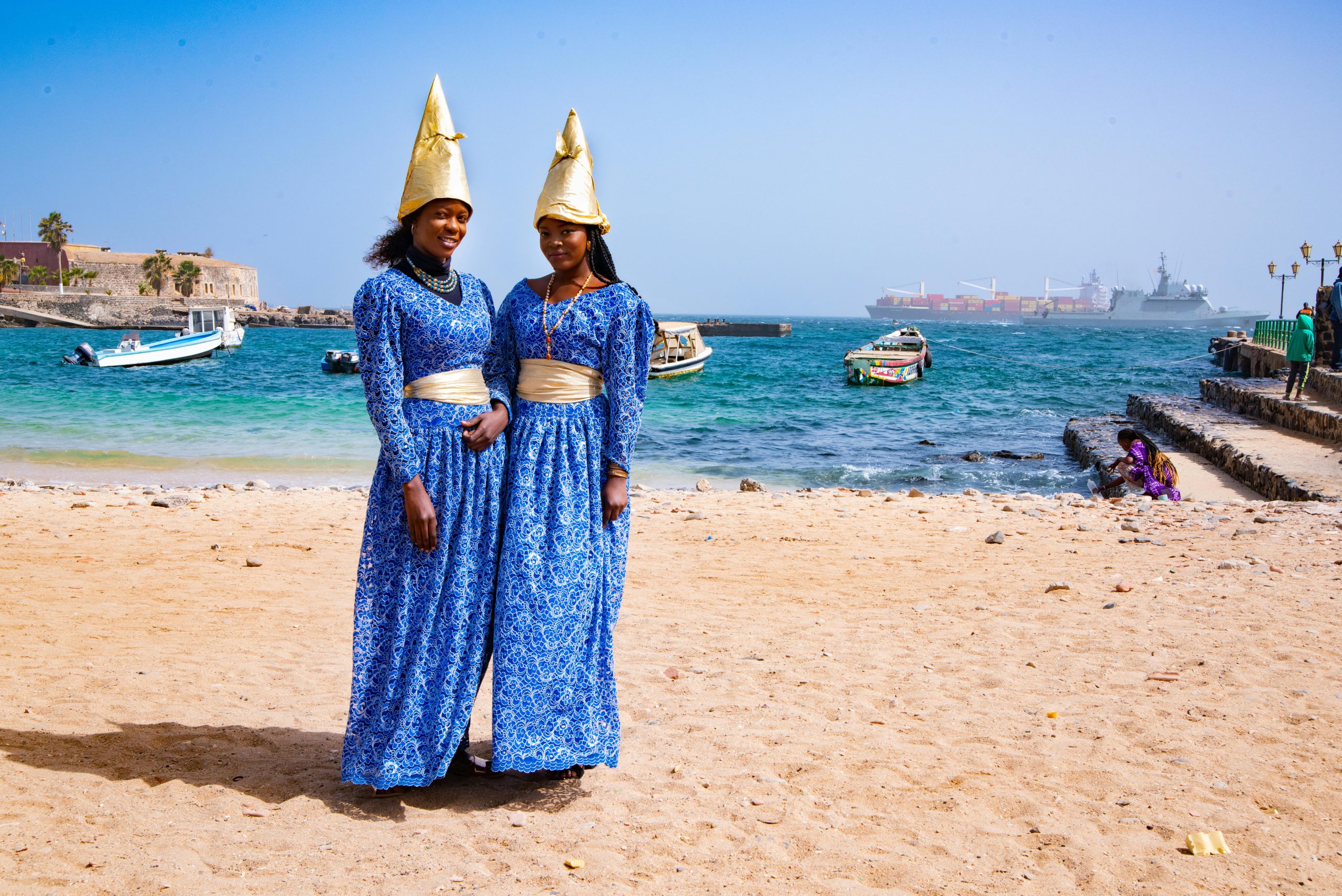
25-min ferry from Dakar central, Goree Island is the UNESCO-listed colonial-era port and centre of the Atlantic slave trade. The House of Slaves with the Door of No Return is a sobering visit. The island itself is small (900 m by 350 m), no cars, painted French colonial houses, fish lunch on the harbour. Ferry XOF 5,000 round-trip plus House of Slaves entry XOF 1,500. Half-day from Dakar.
🌍 Pink Lake (Lac Rose / Lac Retba)
35 km north of Dakar, Lac Retba turns pink-magenta in the dry season due to high salinity and Dunaliella salina algae. Famous as the finish line of the original Paris-Dakar Rally (1979-2007). Salt collectors work the lake harvesting from pirogues; visitors can take a salt-lake boat tour, swim in the saturated saline (you float effortlessly). Day-trip from Dakar XOF 30,000-50,000 with guide. Best dry season November-May.
🌍 Saint-Louis (UNESCO)
3-hour drive north of Dakar, Saint-Louis (founded 1659) is the UNESCO-listed former capital of French West Africa, on an island in the Senegal River near the Mauritanian border. Pastel-coloured colonial architecture, fishing boats lined up on the beach, jazz festival in May, pelican colonies on Langue de Barbarie. Stay 2 nights minimum at Hotel de la Poste or Auberge de la Langue de Barbarie.
🌏 Cape Verde Islands (TACV / Cabo Verde Air)
DSS is the natural mainland connection point to Cape Verde — TACV (Cabo Verde Airlines) and Air Senegal both fly to Praia (PRA) and Sal (SID). Cape Verde is technically Africa but feels like a Portuguese-influenced Atlantic island chain — Sal for beach resorts, Santo Antao for hiking, Boa Vista for kitesurf, Praia for the capital and music. 90 min flight from DSS. EUR is widely accepted in Cape Verde (CVE is the local currency, also EUR-pegged).
Dry season November-May is high season — cool, sunny, the Pink Lake at its pinkest, Saint-Louis comfortable. Rainy season July-October brings heat and humidity but lush green landscapes; Casamance south is best in shoulder seasons. December-January peak European-tourist; book 3-4 months ahead. Senegal is at the same latitude as Mexico City — warm year-round but Atlantic-cooled.
❓ Frequently Asked Questions
What’s the difference between DKR and DSS — which one do I fly to?
You fly to DSS (Blaise Diagne International, opened 2017) at Diass, 47 km east of Dakar. The old DKR (Leopold Sedar Senghor in central Dakar) closed for commercial flights in 2017. Both IATA codes still appear on bookings since the legacy DKR persists informally. If you booked DKR, your flight goes to DSS.
Do I need a visa for Senegal as a US, UK, EU, Canadian or Australian passport holder?
No. All these passports get 90 days visa-free on arrival. Passport must have 6-month validity beyond entry. You also MUST have a WHO yellow fever vaccination certificate — required for ALL international arrivals over 9 months old, not just from YF risk countries. No yellow card means refused entry.
How do I get from DSS airport to central Dakar?
Three main options. (1) TER train direct from terminal to Dakar Gare Centrale, 50-65 min, XOF 1,500-2,500 (US$2.50-4) — the budget and best-value option. (2) Yango app rideshare, XOF 12,000-18,000 (US$20-30), 60-90 min. (3) Pre-booked hotel transfer, EUR 35-65 (XOF 25,000-45,000), 60-90 min. Uber and Bolt do NOT operate in Senegal.
Why is yellow fever vaccination mandatory for everyone, not just YF country arrivals?
Senegal is itself a yellow fever risk country and the government requires the WHO yellow card for all arrivals as part of disease-control policy. Officials check the card at passport control. The certificate is valid for life under current WHO guidance (since 2016). Get the jab 10+ days before travel; it costs around US$50-100 in a US travel clinic.
What currency should I bring to Senegal?
EUR cash for upmarket hotels and emergency exchange (the West African CFA is pegged to EUR at 656). ATMs at DSS dispense XOF at near-interbank rates with XOF 2,000-4,000 fees. Cards work at hotels and upmarket restaurants but not in markets, taxis or small shops. Carry XOF 50,000-100,000 cash for typical week of mixed spending.
Is the tap water safe in Dakar?
No, avoid raw tap water. Hotels and restaurants serve bottled by default. Brushing teeth with bottled is the standard advice for first-time visitors; established travellers may risk it. The legendary West African “traveler’s tummy” from raw salads or untreated water remains the #1 health complaint. Stick with sealed bottles for drinking.
What is thieboudienne and where can I try it?
Thieboudienne is the Senegalese national dish — rice and fish in tomato sauce with vegetables, dried fish stock and the spice blend rof. UNESCO declared it Intangible Cultural Heritage in 2021. Available at the Pearl Lounge airside, the Senegalese restaurant in the airport food court, and at every traditional restaurant in Dakar (Le Lagon 1, Chez Loutcha, La Calebasse). Generous, satisfying, the must-try meal of any Senegal trip.
How long should I budget at DSS for an international departure?
Two and a half hours for international, especially for the 22:00-01:00 European departure waves to Paris (Air France) and Brussels. The TER schedule should be checked — if your departure is late and you’re in central Dakar, allow extra time as TER service thins after 22:00. Domestic and intra-Africa flights need only 75 minutes.
📊 2026 Summary Data Table
| Feature | Current Data (2026) |
|---|---|
| IATA Code | DSS (also widely used: DKR, the legacy code) |
| Terminal Layout | Single integrated terminal (opened 2017), 3M pax/yr capacity, expansion to 10M planned |
| Distance to Dakar | 47 km east at Diass, 60-90 min by road or TER train |
| Currency | West African CFA franc (XOF), pegged 656 per EUR; EUR widely accepted |
| Rideshare Apps | Yango (no Uber/Bolt); XOF 12,000-18,000 to Dakar |
| Metered Taxi (Dakar) | XOF 25,000-30,000 fixed-rate (US$40-50) |
| Public Transit to City | TER Express Regional train (XOF 1,500-2,500, 50-65 min, every 30-60 min) |
| Visa-Free Stay | 90 days for US/CA/EU/UK/AU/NZ/JP/BR and ECOWAS members |
| Yellow Fever | MANDATORY for all international arrivals (not just YF country origins) |
| Hub Airline | Air Senegal (HC); Air France, Brussels Airlines, Royal Air Maroc, Turkish, Iberia, TAP heavy |
| Spirit Airlines Status | Defunct since May 2026 (no Africa impact) |
| Lounges | Pearl Lounge (Priority Pass), Air Senegal Premier (SkyTeam Elite reciprocity) |
| Climate | Atlantic tropical — dry cool Nov-May, hot wet Jul-Oct, year-round 22-30°C |
| Tap Water | Avoid raw tap; bottled standard at restaurants and resorts |
| Onward Day-Trips | Goree Island (UNESCO half-day), Pink Lake (full day), Saint-Louis (3-day overnight), Cape Verde flight extension |
| Take-Home Buys | Dried bissap flowers, Cafe Touba, sous-verre glass paintings, Senegalese peanut paste, Gazelle beer |