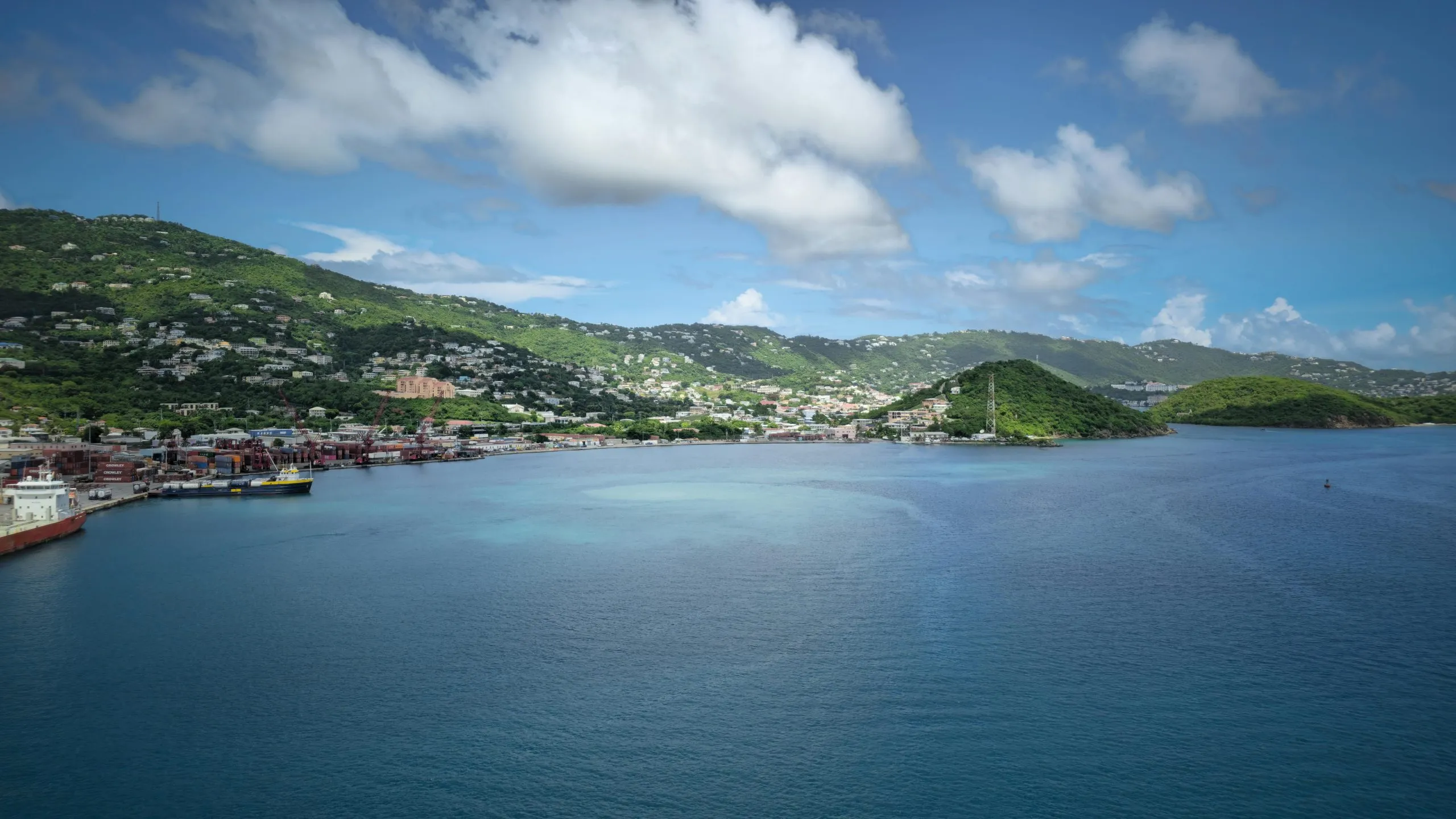
Cyril E. King Airport (STT) — The Complete Master Guide 2026
St Thomas runs USD as currency, English as language, FAA airspace, and US driver’s licenses for car rental — but drives on the LEFT thanks to Danish colonial inheritance. This guide covers entry, the 4-km transfer to Charlotte Amalie, ferries to St John, the Maria/Irma reconstruction, and the post-Spirit 2026 route map.
Quick Reference
Cyril E. King Airport sits 4 km west of Charlotte Amalie (the USVI capital and St Thomas’ main town) on the south coast of the island. The airport is small but punches above its weight on US carrier density: JetBlue runs daily from New York and Boston, Delta from JFK and Atlanta, American from Miami and multiple US gateways, United from Houston and Newark, plus regional Cape Air to San Juan and St Croix. The 2017 hurricane reconstruction (Irma + Maria back-to-back) wrapped up around 2020 and the terminal now operates at full capacity.
Table of Contents
🏢 1. Terminals & the Post-Hurricane Rebuild
Cyril E. King is named for the second governor of the US Virgin Islands (1969-1971). The terminal you see today is largely a product of the 2018–2022 reconstruction following the September 2017 dual-hit of Hurricanes Irma and Maria, which destroyed substantial portions of both the passenger building and the apron infrastructure. The current configuration: single terminal, four jet bridges, three hardstand positions for regional turboprops, single concourse running about 240 metres.
Single concourse and gate layout
Gates 1–2 handle US mainline (American, Delta, United). Gates 3–4 handle JetBlue and the smaller US carriers (Sun Country charter). Hardstand positions 5–7 serve Cape Air’s 9-seat Cessna routes to St Croix and San Juan, plus Air Sunshine’s 9-seat services to Tortola, Anguilla, and the BVI. Walking the concourse end-to-end takes about three minutes.
Arrivals — the no-immigration reality
If you arrive on a US-domestic flight (most arrivals here are domestic since USVI is US territory), there is no immigration at all — you walk straight to baggage claim. Foreign arrivals (rare; British Airways once ran a small St Thomas operation, no current longhaul) clear US Customs and Border Protection. Three baggage carousels handle widebody arrivals; smaller bag belt for regional turboprops. Customs is the standard US Customs & Agriculture green/red split — you fill out a US Customs Declaration on the plane.
Departures — check-in, security, REAL ID
Sixteen check-in counters split among the major US carriers. JetBlue and American run 4 counters each; Delta 3; United 3; the regional carriers 2. Bag-tag-it kiosks at all major airlines. TSA security has two lanes plus TSA PreCheck where available. From May 2025 forward, US adults need REAL-ID-compliant identification (state-issued REAL ID, US passport, or US passport card) for domestic flights — including USVI departures.
Family services, accessibility, the small-airport reality
One family room landside, one airside. No dedicated children’s play area — the duty-free corridor has seating and a TV. Wheelchair assistance via airline 48 hours pre-flight; walk-in lift assistance at busy hours has 15–30 minute wait. Lost-luggage office (BD-Air) on arrivals level. English-language service throughout (the only language).
Editor’s note — STT is functionally a US-mainland small-airport experience (think Burlington Vermont or Portland Maine in scale) with two unusual quirks: the runway is famously short (2,135 metres or 7,000 feet, limiting which widebodies can land — mostly 757s and below), and the approach is a winding U-turn over Brewers Bay that gives passengers a postcard view as the aircraft lines up. Plan 90 minutes door-to-gate and you’ll have time for a Caribbean burger at the airside cafe.
🛂 2. Visa, Currency & the No-Passport Reality
The US Virgin Islands are an unincorporated territory of the United States, like Puerto Rico, the Northern Mariana Islands, and Guam. They are NOT a US state and not part of the US for all purposes — but for visa, currency, and FAA airspace they are functionally treated as US-domestic. This produces three structural advantages: no passport for US citizens, USD currency, and English everywhere.
US citizens — no passport, but REAL ID required
US citizens travel to USVI as if to any US state — passport not required. From May 2025 forward, REAL ID-compliant ID is required for TSA security: state-issued REAL ID driver’s license (gold star in the corner), US passport, US passport card, US military ID, Global Entry card, or DHS-issued Trusted Traveler. This is a TSA requirement; airlines will check at the boarding gate. Plan ahead if your license isn’t REAL ID-compliant.
Foreign visitors — same rules as mainland US
Citizens of Visa Waiver Program countries (UK, EU, Canada, Australia, Japan, etc.) need ESTA (USD 21) and a valid passport to enter USVI. Citizens of non-VWP countries need a US visa. Same rules as entering New York or Miami. Tourist allowance: 90 days under VWP.
Currency — USD only, like the mainland
USVI uses the US Dollar exclusively. Every menu, every taxi, every dive trip is in USD. ATMs dispense USD. Cards (Visa, Mastercard, AMEX, Discover) accepted at all hotels, restaurants, dive shops. Tipping: 15–20% standard at restaurants (American convention). All-inclusive resorts (Frenchman’s Reef Marriott, Bolongo Bay) are less common; St Thomas leans toward independent boutique hotels and condo rentals.
Tax — the 12.5% accommodation rate
USVI has a 12.5% hotel tax (one of the highest in the Caribbean) on accommodation. This is added to your final bill. There is no separate departure tax at the airport — everything is bundled into the airline ticket. Sales tax on retail goods is generally 4% on St Thomas. Importantly: USVI duty-free allowance for US travelers returning to the mainland is generous — USD 1,600 vs USD 800 for non-US-territory Caribbean.
2026 anchor — REAL ID has been the #1 surprise for US travelers since the May 2025 deadline — many hadn’t updated their license. If you’re flying STT in 2026 and your driver’s license doesn’t have the gold star, get the US passport card (USD 32) before you go. The other 2026 anchor: the post-Spirit-collapse route reshuffle, which has actually improved US-STT direct frequency on JetBlue and American.
🚚 3. Transport — STT to Charlotte Amalie, Magens Bay & St John Ferry
St Thomas is small (75 sq km) and the airport is centrally located. Charlotte Amalie is 4 km east; Magens Bay (one of the world’s top-rated beaches) is 10 km north over Mountain Top; the Red Hook ferry pier (departure point for St John ferries) is 18 km east. There’s no Uber, no Lyft — only taxis and rental cars. But unlike most Caribbean destinations, you can use US driver’s license for car rental and there’s no temporary-permit fee.
Taxi — regulated rates from the airport
Government-regulated rates: STT to Charlotte Amalie 8–15 USD; STT to Frenchman’s Reef 12–18 USD; STT to Magens Bay 18–25 USD; STT to Red Hook (St John ferry) 25–35 USD; STT to Sapphire Beach Marriott 25–30 USD. Rates posted at the rank. Drivers accept USD cash readily; many accept card via Sumup or Square terminals (no surcharge typically).
Rental car — US license, US insurance, but LEFT-side
All major chains (Hertz, Avis, Budget, Enterprise) on-site at STT plus local outfits (Discount, Sun Cars). Economy from 45 USD/day, mid-size SUV 65–90 USD. Driving on the LEFT — a Danish colonial inheritance from 1672 that USVI never reverted (despite becoming US territory in 1917). All signage in English, fuel ~3.85 USD/gallon (gallons not litres — another US-quirk), no temporary-permit fee since you’re using your US license. Insurance: bring credit-card CDW or buy at counter.
Public transport — the Vitran bus and the Red Hook ferry
Vitran (Virgin Islands Transportation) operates an open-top safari-bus along the main coastal road. Fare 2 USD; runs roughly 06:00–19:00 weekdays, less frequent weekends. From the airport you can take a Vitran bus to Charlotte Amalie or to Red Hook for the St John ferry. Slow but cheap. The Red Hook to Cruz Bay (St John) ferry runs 09:00–midnight, every 30–60 minutes, 8.15 USD one-way for adults.
Sea-shuttle to St John, BVI, and beyond
Inter-island ferries from Red Hook (St Thomas) to Cruz Bay (St John): 8.15 USD per adult, 20-minute crossing, runs every 30–60 minutes 09:00–midnight. Inter-island ferries from Red Hook to West End (Tortola, BVI): 50 USD per adult, 45-minute crossing, requires passport since BVI is British territory. Direct ferries from Charlotte Amalie (downtown) to Cruz Bay: 13 USD per adult, less frequent, 45-minute crossing.
Practical — A typical St Thomas trip is base-on-St-Thomas with day-trips to St John’s national park beaches. Or base-on-St-John for the better beaches and use STT only for arrival and departure. Either works; the ferry is short and frequent. You don’t need a rental car if you’re resort-based with an included shuttle. Self-drivers should rent and brace for the LEFT-side reality — it’s manageable but takes 30 minutes to internalize.
🛍️ 4. Lounges — The No-Lounge Reality
STT has no membership or airline lounge. The Virgin Islands Port Authority concession list shows no Plaza Premium lounge, no Delta Sky Club and no American Admirals Club, and Priority Pass does not list the airport. What you get airside is a cluster of bars and cafes that double as the waiting area. Plan around that if you are used to a lounge on a long connection.
Airside bars and cafes — what STT actually has
In place of a lounge, STT has a cluster of airside food and drink spots that serve as the waiting area. Per the Virgin Islands Port Authority concession list these include the Cruzan Landing Bar, The Airport Bar and Rum Room, Hibiscus Cafe and Bar, The Galley Sandwich Bar and Island Grind VI. Cruzan rum features on the bar list — the distillery is on St Croix, a short Cape Air hop away.
No airline lounge — Delta, American, United, JetBlue
None of the carriers at STT operates a lounge here. There is no Delta Sky Club, no United Club and no JetBlue lounge, and premium-cabin or elite-status passengers are not directed to any members’ room — they wait in the general airside seating like everyone else. This is normal for a small US-territory airport flying mostly domestic routes.
No Priority Pass or credit-card lounge
Priority Pass does not list Cyril E. King Airport, so the usual credit-card route into a lounge (Chase Sapphire Reserve, Amex Platinum, LoungeKey) gets you nothing at STT. There is no pay-at-the-door lounge either. Budget for a bar or cafe seat rather than a lounge day pass.
Showers, prayer rooms, smoking
There are no lounge showers at STT, because there is no lounge. One single-stall multi-faith prayer room sits landside near departures check-in. No formal Christian chapel. Strict no-smoking inside the terminal; designated outdoor smoking areas outside arrivals doors. Vaping rules same as cigarettes — outside only.
Lounge math — There is nothing to work out at STT: the airport has no Plaza Premium, no Delta Sky Club and no Admirals Club, and Priority Pass does not list it. Whatever card or status you hold, your pre-flight base is one of the airside bars or cafes. If a lounge matters to you, it will be on your mainland connection, not here.
🥩 5. Food, Duty-Free & the Cruzan Rum Question
Airport food at STT is functional rather than memorable — the airside cafes and rum bars keep you fed, and the duty-free has Cruzan rum at decent prices. But the real eating happens 8 minutes away in Charlotte Amalie or 15 minutes away on Magens Bay. Plan accordingly.
Hibiscus Cafe and Bar — the airside sit-down option
Hibiscus Cafe and Bar and The Galley Sandwich Bar are the airside food stops, alongside Island Grind VI for coffee and quick bites (per the Virgin Islands Port Authority concession list). Expect Caribbean plates, sandwiches and cold drinks rather than fine dining; portions are honest and it is the reliable option once you are through security.
Cruzan Landing Bar & The Airport Bar and Rum Room
The airside bars are the Cruzan Landing Bar and The Airport Bar and Rum Room (per the Virgin Islands Port Authority concession list). Both pour Caribbean rum, including local Cruzan, alongside beer and small plates — a decent spot to spend the wait before boarding.
Local plates worth flying for — if you have time
Conch in butter sauce: USVI national-ish dish, served at most St Thomas waterfront restaurants. Pate (savory turnover): the breakfast snack, fish or saltfish filling. Kallaloo (callaloo): dasheen-leaf stew, vegetarian or with smoked meat. Dumb bread: dense yeast bread, eaten at breakfast. Available at airport but better-ised at any Charlotte Amalie waterfront restaurant. Worth a 12-minute taxi if your layover is 4+ hours.
Duty-free — Cruzan rum and the USD 1,600 allowance
Cruzan Rum (distilled on St Croix since 1760) is the headline duty-free buy. Cruzan Estate, Cruzan 9-Spiced, Cruzan Single Barrel, Cruzan 21-Year — 18–65 USD per 750ml. The USVI USD 1,600 duty-free allowance for US travelers returning to the mainland is the secret weapon: you can take 5 litres of liquor (vs 1 litre standard) and 1,000 cigarettes back without paying duty. Cigars: Dominican, 8–25 USD per stick.
Eat-and-fly — Don’t leave STT without a Caribbean plate airside, a Cruzan rum at The Airport Bar and Rum Room, and at least one bottle of Cruzan Single Barrel from duty-free. The USD 1,600 USVI duty-free allowance is the most generous in the Caribbean and doubles your effective shopping value — Cruzan single barrel for $28 is cheaper than the mainland US price for Bacardi 8.
💡 6. Insider Tips — St John, Magens Bay & the Reconstruction
Most first-time visitors stay on St Thomas and never set foot on St John (the smaller, less-developed sister island, 60% of which is the Virgin Islands National Park). That’s a missed opportunity — St John has the better beaches (Trunk Bay is consistently top-10 in world rankings) and the more pristine landscape. The Red Hook ferry runs every 30 minutes for 8.15 USD — a day trip is easy. Here’s what locals plan around.
Hurricane risk — Maria and Irma 2017, then nothing
USVI sits in the Atlantic hurricane belt at 18.3°N. The September 2017 dual-hit of Hurricane Irma (Category 5) and then Hurricane Maria (Category 5) just 12 days later was catastrophic — 90% of St Thomas structures damaged, airport reconstruction took until 2022. Since then, USVI has been remarkably fortunate — no significant direct hits 2018-2025. Hurricane Beryl 2024 passed south. Peak risk September-October. Trip insurance for hurricane-season travel runs 6–9% of trip cost.
Spirit Airlines collapsed — route reality
Spirit’s shutdown in May 2026 removed its Fort Lauderdale and Orlando service from the schedule. Other US carriers — JetBlue, American, United, Delta and Southwest — cover the main US gateways, and the routes Spirit dropped have largely been absorbed. Exact frequencies shift by season, so check the current schedule for your dates. Confirm the operating carrier on any booking that still shows Spirit.
St John day-trip — the Trunk Bay plan
Take the 09:00 Red Hook to Cruz Bay ferry (8.15 USD, 20 minutes). At Cruz Bay, hire a taxi-safari for 25 USD per person to Trunk Bay (the world-famous beach with the underwater snorkel trail). Beach 10:00–15:00. Return taxi-safari to Cruz Bay; 15:30 ferry back to Red Hook. Back at STT or Charlotte Amalie by 16:30. The whole day costs about 75 USD per person and delivers what is arguably the best Caribbean beach you can reach for that money.
Magens Bay — the on-island option
Magens Bay is on the north coast of St Thomas, 10 km from STT, 15 minutes by car. Listed in National Geographic’s top-10 beaches in the world for decades. Entry fee 5 USD per adult (cash, at the gate). Beach amenities: changing facilities, bar, restaurant, kayak rental. Open 08:00–17:00. Parking free. The 5-USD fee is genuinely worth paying — it keeps the beach clean and uncrowded.
The honest comparison — USVI versus Puerto Rico versus Dominican Republic: USVI wins on no-passport convenience for US travelers, USD-only currency simplicity, and English-only language. Puerto Rico wins on cosmopolitan San Juan plus El Yunque rainforest. Dominican Republic wins on price (much cheaper) and resort variety. For US travelers wanting a passport-free Caribbean experience with mainland-equivalent infrastructure, USVI is the simplest answer. St Thomas + St John together provides 4–7 days of options without leaving FAA airspace.
FAQ — Frequently Asked Questions
Eight questions US Virgin Islands first-timers ask most often, with current 2026 information.
Do I need a passport to visit USVI?
If you’re a US citizen: no. USVI is US territory, treated as US-domestic for travel purposes. From May 2025 forward, you need REAL ID-compliant identification (state-issued REAL ID with the gold star, US passport, US passport card, US military ID, or DHS-issued Trusted Traveler card) for TSA security. If you’re a foreign visitor: you need the same documentation as for entering mainland US — ESTA (USD 21) for VWP citizens, US tourist visa for non-VWP.
What currency does USVI use?
US Dollar (USD). USVI uses the US dollar exclusively as legal tender. There is no separate local currency. Every menu, every taxi, every dive trip is in USD. ATMs dispense USD. Cards (Visa, Mastercard, AMEX, Discover) accepted at all hotels, restaurants, dive shops. Tipping: 15–20% standard at restaurants (American convention). Apple Pay and Google Pay accepted nearly everywhere.
Is USVI safe in hurricane season (June-November)?
Hurricanes are a real risk, especially September-October. The September 2017 dual-hit of Hurricanes Irma (Cat 5) and Maria (Cat 5) was catastrophic; USVI infrastructure was rebuilt by 2022. Since then, USVI has been remarkably fortunate — no significant direct hits 2018-2025. Hurricane Beryl 2024 passed south. Trip insurance for hurricane-season travel runs 6–9% of trip cost. December-May is the safe window.
How do I get from STT airport to my hotel?
Three options: (1) Taxi from the airport rank — regulated rates, 8–35 USD depending on destination; (2) Pre-booked private transfer or hotel shuttle — many resorts offer included transfers, verify before paying separately; (3) Rental car — possible but disorienting due to LEFT-side driving. Uber and Lyft do not operate in USVI. Vitran open-top safari-bus runs the main coastal road for 2 USD — cheap but slow with luggage.
Are Uber and Lyft available in USVI?
No. Rideshare apps do not operate in the US Virgin Islands. Use the regulated taxi system (rate sheets posted at the rank), pre-booked private transfer through your hotel or independent operators, or rent a car. The Vitran open-top safari-bus is the public-transport alternative on the main coastal road. Inter-island ferry to St John (Cruz Bay) runs from Red Hook every 30–60 minutes for 8.15 USD.
Why does USVI drive on the left?
Danish colonial inheritance. The US Virgin Islands were Danish territory from 1672 to 1917, when the US purchased them for USD 25 million. The driving-on-left convention was Danish (and the Caribbean Danish standard at the time); when the US took over, the islands kept their Danish driving rules. The cars sold are still left-hand-drive (US-mainland cars), so you drive a US car on the LEFT side of the road. Confusing for the first 30 minutes; manageable after that.
Can I visit St John from St Thomas?
Yes — via Red Hook to Cruz Bay ferry, departing every 30–60 minutes, 09:00–midnight. Adult fare 8.15 USD one-way; 20-minute crossing. Cruz Bay is the main town on St John. From Cruz Bay, hire a taxi-safari (25 USD per person) to Trunk Bay (the world-famous beach with the snorkel trail) or to other Virgin Islands National Park beaches. A day trip is easy. For St John overnight stays: Caneel Bay (closed since 2017 hurricanes, gradually reopening), Lovango Beach Club, condo rentals.
What’s the difference between St Thomas and Puerto Rico?
St Thomas: USVI, US territory but not US state, 75 sq km, drives on LEFT, no passport for US citizens, USD currency, English only, FAA airspace. Puerto Rico: US territory, US Commonwealth, 9,100 sq km (much larger), drives on RIGHT, no passport for US citizens, USD currency, Spanish + English, FAA airspace. PR offers cosmopolitan San Juan + El Yunque rainforest. STT offers simpler beach destination at smaller scale. STT to PR is a 35-minute Cape Air or Seaborne flight.
2026 Summary Data Table
The full 2026 reference table for Cyril E. King Airport at a glance.
| Feature | Detail |
|---|---|
| IATA / ICAO | STT / TIST |
| Country / status | US Virgin Islands — unincorporated US territory |
| Capital city | Charlotte Amalie — 4 km from airport |
| Reconstruction | 2018–2022 — following Hurricanes Irma + Maria 2017 dual-hit |
| Annual passengers (2024) | ~1.4 million |
| Single runway | 10/28 — 2,135 m (7,000 ft) — one of the shortest int’l in Caribbean |
| Major airlines (2026) | JetBlue, Delta, American, United, Southwest, Cape Air |
| Currency | US Dollar (USD) — same as mainland US |
| Languages | English (official) |
| Visa status | US territory — no passport for US citizens, ESTA for VWP foreign visitors |
| Hotel tax | 12.5% — one of the highest in the Caribbean |
| US duty-free allowance | USD 1,600 — 4× the standard Caribbean rate |
| Hurricane risk | Severe historical — Maria + Irma 2017 dual-hit, fully rebuilt |
| Airport lounges | None — no Plaza Premium, Delta Sky Club or Admirals Club; Priority Pass not listed |
| Driving side | LEFT (Danish colonial inheritance) |
| Notable beach | Magens Bay (St Thomas) and Trunk Bay (St John, via Red Hook ferry) |
This guide is current as of May 2026 and reflects the post-Spirit-collapse North American route map, with JetBlue, American, United, Delta and Southwest covering the main US gateways after Spirit’s May 2026 shutdown. For weekly route updates and US Virgin Islands flight deals, follow our aifly.one main feed.