Aeropuerto Internacional de Carrasco “Gral. Cesáreo L. Berisso” (MVD) — Airport Guide 2026
Uruguay funnels almost every international flight through a single building 20 km east of Montevideo, and that building — Rafael Viñoly’s 365-metre curved-roof terminal, opened December 2009 — is the rare airport that actually rewards a second look rather than a sprint to the gate.
Quick Reference
MVD / SUMU
Aeropuerto Internacional de Carrasco “Gral. Cesáreo L. Berisso”
Ciudad de la Costa, Canelones Dept — ~20 km east of central Montevideo
Single integrated terminal, opened December 2009
Rafael Viñoly (1944–2023); 365 m curved roof, ~45,000 m²
~3 million passengers (design figure)
Uruguayan peso (UYU); ≈ 40/US$1, ≈ 46.8/€1 (September 2026)
Widely accepted in tourist zones; change returned in pesos
Visa-free 90 days, ~84 nationalities; passport stamp on arrival, no eVisa
Not required
~70–80 UYU (≈ US$2); every ~30 min; 30–40 min to Tres Cruces terminal
~1,650 UYU (US$25–30) to Centro; ~20–25 min off-peak
US$18–25 to central Montevideo
Aeropuertos VIP Club (Priority Pass / LoungeKey / DragonPass) — main space closed for renovation since 9 Feb 2026, new lounge due H2 2026; temporary space opposite Gates 7–8; walk-up US$90
0% on lodging and Tax-Free shopping year-round; 9% off restaurants/car-hire on a foreign card to 30 Sep 2026 (Decree 83/026), 5% from 1 Oct 2026
Madrid via Iberia and Air Europa, ~11h50
São Paulo; ~12 airlines serve 18 non-stop destinations
Safe to drink (OSE state utility)
🏢 The Terminal — One Building, the Viñoly Roof, and Why That Matters
The current terminal replaced a 1947 building that is still standing nearby, now used for general aviation and offices. The old one was fine. The new one is the work of the late Rafael Viñoly — Montevideo-born, died March 2023 — and it is the only completed airport in his portfolio and his largest project in Uruguay. The signature element is the roof: a single uninterrupted curved sweep over 365 metres, holding up a column-free departures hall that fills with natural light without feeling like a greenhouse. Arrivals come in on a glazed mezzanine overlooking the whole concourse before descending to baggage claim, which means you are oriented before you have done anything. It is a deliberate trick and it works. The aviation press and the architecture press both photographed the building on opening day, which is more than can be said for most terminals on this continent.
Practically, the layout is shallow and horizontal, which is a significant mercy. Check-in desks line the landside hall; security is a single screening point; airside you get duty-free, a row of cafés and shops, the lounge, and gates within a short flat walk of the central concourse. Wide-body flights to Madrid and São Paulo board via jet bridge; some regional turboprops and narrow-bodies use bus boarding. Allow the usual buffers — there is no economy fast-track, and the two daily Europe-bound waves (late morning and late evening) back up the single security line reliably. Off-peak and mid-week, kerb to gate in under 30 minutes is achievable; the December-to-February summer peak, when Argentine and Brazilian traffic to Punta del Este floods through, is the exception.
The terminal is designed for about 3 million passengers a year and rarely feels close to that ceiling outside the summer peak. The free wifi is genuinely usable. There is enough seating that a power outlet is not a competition. The airport’s formal name, “Gral. Cesáreo L. Berisso,” honours a Uruguayan aviation pioneer; nobody uses it. It is Carrasco, after the suburb, universally.
One architectural limitation worth stating plainly: the site is in the Ciudad de la Costa area of Canelones Department, technically just outside the Montevideo city boundary. This matters only because there is no rail link and no metro anywhere in Montevideo, which means every route in or out is a road route. That shapes everything that follows.
🛂 Border & Visa
Uruguay is one of the less troublesome countries to enter in South America. Holders of roughly 84 passports — including the United States, United Kingdom, all EU member states, Canada, Australia, New Zealand, Japan, South Korea, Brazil, Argentina, Chile and Mexico — receive visa-free entry for 90 days, extendable once for a further 90 by applying in person at the Dirección Nacional de Migración in Montevideo. There is no eVisa system and no electronic pre-registration; you receive a physical passport stamp at the immigration desk on arrival. Your passport should be valid for the length of your stay; six months’ validity is the safe convention.
Always verify your own nationality against the Migración list before booking. The visa-free roster changes occasionally and the list here is not exhaustive.
Yellow fever is not required. Uruguay has no yellow-fever risk and asks for no proof of vaccination, even if you have routed through Brazil or other endemic areas — unlike some of its neighbours, it does not demand the certificate at the desk. Standard routine vaccinations are all that is recommended; there is no malaria risk either.
⚠️ Caution: Verify Your Nationality Before You Book
The visa-free list covers ~84 passports but is not universal and does change. Check the Dirección Nacional de Migración list directly before buying a ticket if you hold a passport not on the examples above — “most nationalities” is not a substitute for a specific check.
💱 The Peso, USD in Practice, and the 2026 Tourist VAT Break
The currency. The Uruguayan peso — written “$” or “$U,” abbreviated UYU — trades at roughly 40 to the US dollar and about 46.8 to the euro in September 2026. The peso has been broadly stable over the past year, even firming slightly against the dollar; this is not a currency that slides a few percent while you are mid-trip. Notes run from 20 to 2,000 pesos; coins cover small change. There is no parallel exchange market of the Argentine kind — the official rate is the rate, and street money-changers are not an institution here.
USD in practice. Dollars are genuinely accepted across tourist Uruguay — Punta del Este real estate offices, many Montevideo supermarkets, hotels, and plenty of restaurants quote and take USD without drama. The catch: your change comes back in pesos at the venue’s own rate, which is rarely the official one and is sometimes meaningfully worse. Paying in dollars for small purchases quietly costs you. Cards and contactless work almost everywhere; carry a few hundred pesos for the COT bus, small kiosks, and tips. ATMs are plentiful on the Banred and Redbrou networks; the airport has them landside near arrivals. The airport’s currency-exchange desk gives the worst rate you will see — change only what you need for the bus there.
The tourist VAT break — the one worth knowing. Uruguay gives non-resident tourists three distinct tax benefits. Two of them — the 0% VAT on lodging and the Tax-Free shopping refund — run all year with no end date. The third, the reduction on restaurants and driverless car hire, is the one on a clock: Decree 83/026 holds it at 9 percentage points through 30 September 2026, and from 1 October 2026 the reduction drops to 5 percentage points (4.1% for IVA Mínimo taxpayers):
- Accommodation: show a foreign passport or ID at check-in and you pay 0% VAT on the hotel stay. Automatic at the hotel; you do nothing.
- Restaurants and driverless car hire: pay with a foreign-issued credit or debit card and the reduction is deducted from the bill automatically at gastronomic venues and on rental cars — 9 percentage points through 30 September 2026, 5 points from 1 October 2026. Automatic; you do nothing.
- Tax-Free shopping: a form-based VAT refund on eligible goods at participating shops. Fill in a Tax-Free form at purchase, validate it within 90 days — usually at the airport before departure.
The first two cost you no paperwork. Only the shopping refund requires forms, so leave time at the airport to validate it if you used it.
💳 The Restaurant Discount — No Effort Required
Pay with any foreign-issued card (credit or debit) at a restaurant, bar or café and the VAT reduction comes off automatically: 9 percentage points through 30 September 2026, then 5 points from 1 October 2026. The discount appears on the card charge; you do not fill in any form. The same applies to driverless car rental.
🚆 Getting Into the City
Carrasco is about 20 km from the centre of Montevideo. There is no train, no metro, no tram. Every option is by road, and the Avenida Italia and the Rambla corridor both clog at rush hour — a 25-minute ride can become 45 in the right (wrong) conditions. Pad departure timing accordingly. There is no toll between the airport and the city.
🚌 COT Bus — the cheap option
COT runs buses between the airport and the Tres Cruces terminal in central Montevideo, via the Tres Cruces bus station and shopping centre. A one-way ticket was around 68 pesos in early 2025; budget roughly 70–80 pesos (about US$2) for 2026 and verify the current fare before travel. Buses run approximately every 30 minutes; the trip takes 30–40 minutes depending on traffic. You are dropped at Tres Cruces, not your hotel — add a short onward taxi or local bus if you are staying in Ciudad Vieja or Pocitos. With luggage and a late arrival, the bus stops making sense. Travelling light in daylight to somewhere near Tres Cruces: the bus is unbeatable value.
🚌 COT Bus — ~70–80 UYU, every 30 minutes
The cheapest way in at around US$2. Runs to Tres Cruces bus terminal, not your hotel. Fine if you are travelling light in daylight; less practical with luggage at midnight.
🚕 Official Airport Taxi
The official taxi desk inside arrivals quotes fixed fares by zone: to the Centro, around 1,650 pesos (roughly US$25–30); to Pocitos and Punta Carretas, a little less; to Ciudad Vieja, about the same. The fare is fixed against a posted zone table — you are not negotiating. Journey time to the centre is about 20–25 minutes off-peak. This is the right call if you have no data connection and no app, and otherwise only marginally better than standing at the kerb in the rain.
📱 Uber and Cabify
Both apps operate at Carrasco and are typically cheaper than the official taxi — US$18–25 to central Montevideo. The in-app price is the price you pay. Cabify publishes airport meeting points; Uber follows the airport’s app-pickup signage. Ride-hailing sits in a legal grey zone in Uruguay rather than being fully sanctioned, but both apps operate openly at the airport and across the city without friction in practice.
You need a working data connection to book. Sort an eSIM before you fly, or use the airport wifi to order before you walk out the door.
📱 Sort Your Data Before You Land
You need connectivity to book Uber or Cabify at the kerb. An eSIM on Antel (broadest coverage), Movistar or Claro, activated before departure, costs less than a single taxi fare and means you walk out of arrivals already connected. The airport wifi works as a fallback but you want the app open before you reach the street.
🚗 Car Rental and Remises
Major car-rental firms have desks in arrivals. A car earns its keep if you are heading directly to the coast — Punta del Este, José Ignacio, the Rocha beaches — where public transport thins out. For a Montevideo-only trip, skip it: the city has paid street parking, the centre is walkable, and the apps are cheaper and less annoying. Remember the VAT reduction applies to driverless rentals paid on a foreign card — 9 percentage points through 30 September 2026, 5 points from 1 October 2026.
Pre-booked remise companies (private car) offer fixed door-to-door transfers, useful for late-night arrivals; expect around US$25–30 to central Montevideo, with some operators quoting overnight rates. Book ahead rather than expecting to find one on the spot.
Which to pick. Travelling light in daylight → COT bus. Luggage, night arrival, or door-to-door preference → Uber or Cabify. No data connection → official taxi desk. Heading straight to the coast → rental car.
🛋️ Lounges — What Is Actually Open in 2026
The lounge situation needs a current-status note, not a list, because it is mid-renovation.
🏛️ Aeropuertos VIP Club
This is the airside lounge and the only one at Carrasco. It is accessible on Priority Pass, LoungeKey, DragonPass, certain Diners Club and premium-card programmes, and on a walk-up paid basis. The main Aeropuertos VIP Club space has been closed for renovation since 9 February 2026, with access operating at a temporary lounge opposite boarding gates 7 and 8; the operator expects to open the new lounge in the second half of 2026. Verify the exact location when you arrive, and confirm that your membership is being honoured at the temporary space — Priority Pass listings have shown both the closure and the alternate, but temporary spaces sometimes pause third-party network access during building works. Walk-up entry is sold through AeroShop, the airport’s own online store, at US$90 for a single departures-lounge pass (the arrivals lounge is also US$90, and a six-person family pack US$180); confirm at the door, as pricing has been fluid during the renovation.
Historically, the VIP Club has run to hot and cold food, an open bar, soft seating, and washrooms. The temporary space is more modest. The wide-body departure waves (late morning and late evening for Madrid and Miami) are the busiest periods; arrive early if you want a seat.
⚠️ Warning: There Is No Carrier Lounge at Carrasco
There is no LATAM lounge, no Iberia Sala VIP, no Air Europa lounge, no American Admirals Club. Business-class passengers and oneworld/Star Alliance status holders on the Madrid, Miami, São Paulo and Panama flights are directed to the same single contract lounge as everyone else. If your home hub has a proper carrier lounge, adjust expectations before you arrive.
If the lounge is full or inaccessible during the renovation, the airside cafés are a serviceable fallback — see the next section.
🍽️ Food Before You Fly
Uruguayan food is meat-led and unreserved about it. The airport gives you an expensive, thinned-down version of it, so the correct strategy is to eat well in the city and board lightly — or, failing that, to know what the airport actually does acceptably.
🥩 What Uruguay Eats
The national centrepiece is asado — beef and offal grilled slowly over wood embers on a parrilla. The street staple is the chivito, a loaded steak sandwich with ham, cheese, egg, lettuce, tomato and mayonnaise that is essentially a meal inside a bread roll. Despite the name (literally “little goat”), there is no goat in it: the traditional account holds that it was improvised in Punta del Este in the 1940s for a customer who asked for goat meat, and the beef version stuck.
Dulce de leche (slow-cooked caramelised milk) goes into and onto most things — baked into pastries, spread thickly, filled into the alfajor, which is two biscuits sandwiching dulce de leche, usually coated in chocolate or meringue and sold as the default souvenir snack. Mate, the bitter yerba infusion drunk from a gourd through a metal straw, is less a beverage than a social ritual; you will see Uruguayans carrying a thermos and gourd everywhere, including through airport security, where the thermos is waved through without comment.
💰 Airport Pricing vs the City
A sit-down meal at the airside restaurants runs roughly US$15–25 for a main and a drink. The same chivito or parrilla plate at a Pocitos grill or a spot at the Mercado del Puerto costs noticeably less and is materially better. Eat in the city. If you are passing through without time in the city, the airport cafés cover coffee and an alfajor adequately; the full parrilla experience airside is overpriced and underwhelming.
🍷 Duty-Free — What to Actually Buy
The airside duty-free runs the standard international inventory: spirits, fragrance, tobacco, sunglasses. The genuinely Uruguayan options are: grappa miel (honeyed grappa), Tannat wine, dulce de leche, and boxed alfajores.
Tannat is Uruguay’s signature red grape — the country does the muscular, tannic style better than anyone, and producers like Bouza and Garzón turn out bottles that hold up against anything from Mendoza across the river. Tannat is hard to find outside South America and the duty-free markup at Carrasco is less savage on wine than on perfume. Spend the allowance there. Skip the generic global spirits you can buy anywhere.
If you want dulce de leche and alfajores at a reasonable price, buy them in a Montevideo supermarket before you fly; the airside markup on packaged food is steep.
🍷 Buy Tannat, Not Perfume
Uruguay’s Tannat — particularly from Bouza and Garzón — is the one duty-free purchase that is actually hard to find abroad and actually worth the price. Two bottles of Tannat beats six generic fragrance sets every time.
🌆 Layovers, Day-Trips, and the Honest Math
Carrasco’s position 20 km out of the city, with everything on roads, determines what is and is not physically doable on a stopover. The arithmetic is simple and does not bend for wishful thinking.
The buffer you cannot avoid. Plan 25–40 minutes each way to central Montevideo by taxi or app (longer in rush hour), plus a 2-hour international check-in and security buffer on return. That is a minimum of 1h45–2h20 of dead time before and after whatever you do in the city.
🏛️ Ciudad Vieja — The One Viable Layover
On a 5–6 hour layover, the old town is genuinely doable. Taxi in (about 25 minutes), walk the circuit, eat, taxi back with margin. Under 4.5 hours, stay airside — the round-trip transit and the security buffer eat the window.
The walk is compact and flat. Plaza Independencia is the hinge between the old town and the modern centre: at its middle stands a 17-metre, 30-tonne equestrian statue of José Artigas, the independence hero, with his mausoleum in a chamber directly below the square. On the plaza’s east side rises the Palacio Salvo — 105 metres, 27 storeys, built in 1928 by Italian architect Mario Palanti, briefly the tallest building in South America when completed. The tango “La Cumparsita,” the most-played tango in the world, was composed on the site; a small museum inside marks it. From the plaza, Sarandí runs west through Ciudad Vieja to the port and the Mercado del Puerto, a 19th-century iron market hall lined with parrilla grills. Estancia del Puerto, operating inside the market under its clock since 1975, is the long-running option — open daily, lunch into early evening, cards accepted, no reservations. Order the parrillada and try a medio y medio, the half-sparkling, half-still-white aperitif that originated in Montevideo. The Mercado del Puerto is touristy and reviews are variable, but it is the real, decades-old article.
If you have eaten parrilla already and want a less touristed food market, the Mercado Agrícola de Montevideo (MAM) in the Aguada district — a 1910s iron market hall reopened in 2013 after restoration — packs butchers, produce stalls, bakeries and counter restaurants under one roof. It is 10–15 minutes by taxi from the centre.
🏙️ Layover Math for Ciudad Vieja
25 minutes each way by taxi or app, plus a 2-hour security buffer on return. You need a minimum of around 4.5–5 hours clear to make it worthwhile; 5–6 hours is comfortable. The loop — Plaza Independencia, Palacio Salvo, Sarandí, Mercado del Puerto — is compact, flat, and takes about two hours at a reasonable pace.
🏖️ Punta del Este — Not a Layover Trip
Uruguay’s marquee beach resort is about 130 km east. By COT bus from Tres Cruces, roughly 2 hours 15 minutes each way; by car, a similar 2 hours. That is 4.5 hours of transit before you have seen a beach, entirely before the security buffer. It is an overnight destination. Fly in, rent a car or take the direct coach, and stay.
🏰 Colonia del Sacramento — Also Not a Layover Trip
The UNESCO-listed Portuguese-Spanish river town on the Río de la Plata is about 180 km west — roughly 2 hours 20 minutes by COT bus from Tres Cruces. Same verdict: a worthwhile full-day or overnight trip from Montevideo, not a layover excursion. Morning departures from Tres Cruces (around 07:45 and 09:30) make it a comfortable day-trip if you are staying in the city, often paired with the ferry onward to Buenos Aires.
⚠️ Caution: Punta del Este Is Not a Layover Destination
130 km east, 2h15 each way by bus — that is 4.5 hours of transit before the 2-hour security buffer. Book a night or skip it entirely on a connection.
🏘️ The Carrasco Suburb
The residential neighbourhood immediately around the airport — leafy, calm, with the Rambla beach a short drive away — is the only thing close enough to reach in under two hours. There is not a compelling reason to leave the terminal for it.
🌅 If You Are Staying in the City
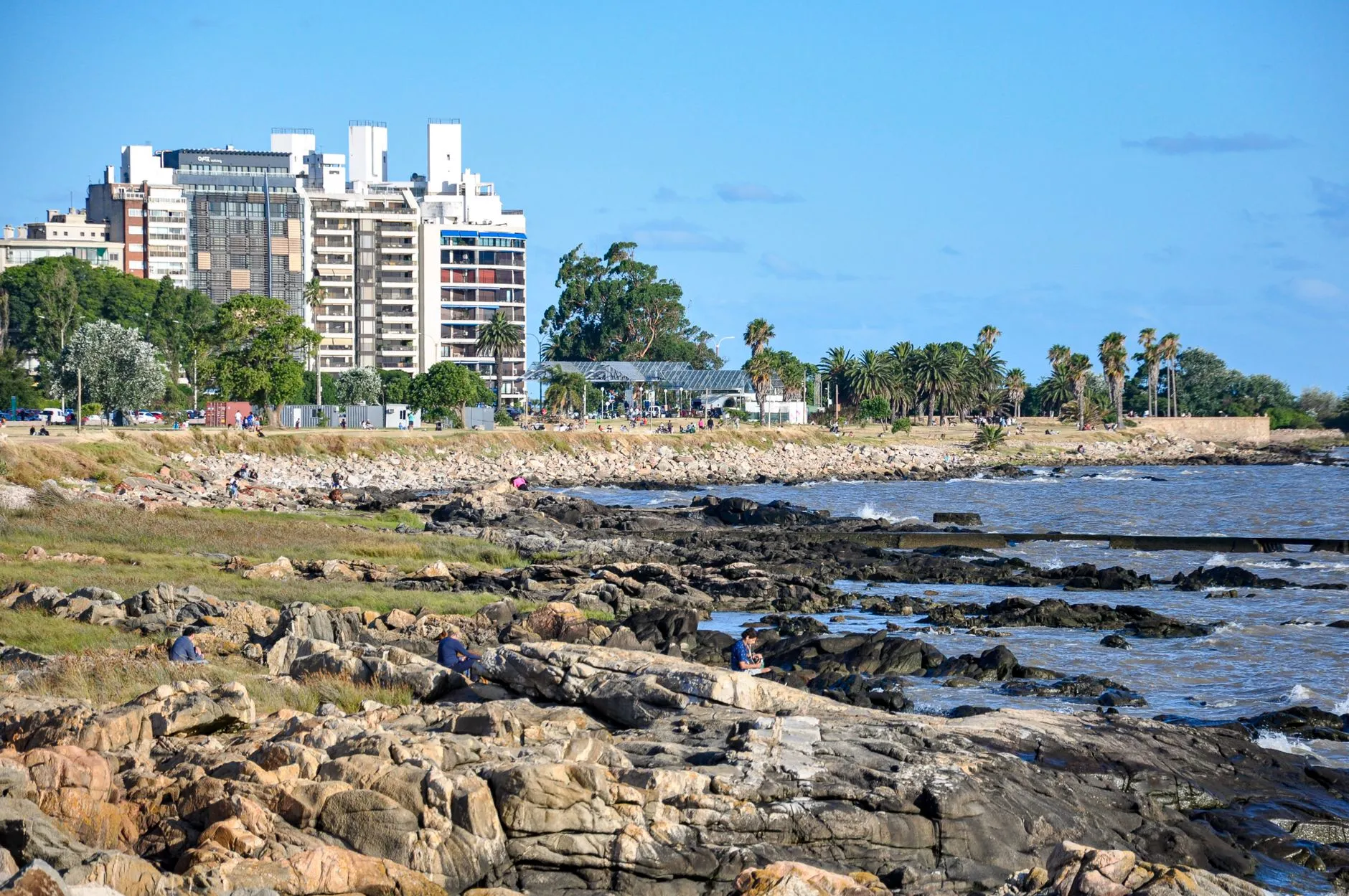
Two things worth planning around. The Rambla — Montevideo’s coastal promenade — runs roughly 22 km along the Río de la Plata from Ciudad Vieja east through Pocitos, with calm river-beaches (Pocitos, Ramírez, Malvín) strung along it. Locals walk, run, and drink mate on it at sunset; it is the most pleasant free activity in the city.
For wine, Bodega Bouza — a family winery about 15 km from the centre, built around a 1942 house with winemaking from 2002 — runs tours, tastings, and a full restaurant and is the easiest cellar-door visit from Montevideo. Bodega Garzón, the more celebrated estate, is out near Punta del Este and is a full day rather than an afternoon.
One date to know. Uruguay runs the longest carnival season in the world — roughly 30 January to 8 March in 2026 — with nightly murga and candombe shows at the Teatro de Verano and the Desfile de Llamadas, a candombe drum parade through the Barrio Sur and Palermo neighbourhoods, which are the heart of Afro-Uruguayan culture. It overlaps the summer-peak crowds; book accommodation well in advance.
The realistic read: under 4.5 hours, use the lounge or a café and stay put. Five hours or more, Ciudad Vieja and a parrilla lunch is the move. Everything else needs a night.
🔧 Practical Notes
📶 Connectivity
The terminal wifi is functional for booking a ride and checking in. For the trip itself, an eSIM is the cleanest option — Antel (the state operator, broadest national coverage), Movistar and Claro all run usable networks. Activate before you land. Physical tourist SIMs are sold at Antel shops in the city and at some airport points; the eSIM avoids the queue.
💵 Cash and Cards
Cards and contactless are accepted almost everywhere in Montevideo. Run the trip nearly cashless and keep a few hundred pesos for the COT bus, small kiosks, and tips. Airport ATMs (Banred/Redbrou) dispense pesos; some dispense dollars. Use city ATMs or an exchange bureau in town for the main cash withdrawal — the airport exchange desk rate is the worst you will encounter.
🍴 Tipping
A 10% tip is standard at restaurants and appreciated rather than expected. Many bills include a cubierto (cover charge) separately, which is not a tip. Round up for taxis.
🚰 Tap Water
Drinkable. Montevideo’s tap water is treated and regulated by OSE, the state water utility, and locals drink it from the tap. Bottled water is sold everywhere but is not a health necessity in the capital.
🛡️ Safety
Uruguay is among the safer countries in South America, and Montevideo is calm by regional standards. Petty crime has risen in recent years; the realistic risks are opportunistic. Watch for pickpocketing at Tres Cruces terminal, the Sunday Tristán Narvaja market, and busy downtown streets. Motochorro bag-snatching by riders on motorbikes occurs in some areas; keep bags close, keep phones out of sight on the street, and use app rides at night rather than flagging cars. The airport itself is orderly.
🏥 Health and Altitude
None of the altitude or tropical-disease concerns of the Andean countries apply here. Montevideo is at sea level; there is no yellow fever or malaria risk. Standard routine vaccinations are sufficient.
❓ Frequently Asked Questions
📊 At a Glance — MVD 2026
| Feature | Current Data |
|---|---|
| Airport | Carrasco Intl “Gral. Cesáreo L. Berisso” (MVD / SUMU) |
| Terminal | Single integrated terminal, opened December 2009 |
| Architect / design | Rafael Viñoly (1944–2023); 365 m curved roof, ~45,000 m² |
| Annual capacity | ~3 million passengers (design figure) |
| Distance to centre | ~20 km east of central Montevideo |
| COT bus | ~70–80 UYU (≈ US$2); every ~30 min; 30–40 min to Tres Cruces |
| Official taxi | ~1,650 UYU (US$25–30) to Centro; ~20–25 min off-peak |
| Uber / Cabify | US$18–25 to central Montevideo; both apps operate openly |
| Currency | Uruguayan peso (UYU); ≈ 40/US$1, ≈ 46.8/€1 (September 2026) |
| USD accepted | Yes in tourist zones; change given in pesos |
| Visa | Visa-free 90 days, ~84 nationalities; stamp on arrival, no eVisa |
| Yellow fever | Not required |
| Tourist VAT | 0% on lodging and Tax-Free shopping year-round; 9% off restaurants/car-hire on a foreign card to 30 Sep 2026 (Decree 83/026), 5% from 1 Oct 2026 |
| Lounge | Aeropuertos VIP Club (Priority Pass); main space closed for renovation since 9 Feb 2026, new lounge due H2 2026, temporary space opposite Gates 7–8; walk-up US$90; no carrier lounge |
| Longest route | Madrid (Iberia / Air Europa), ~11h50 |
| Busiest route | São Paulo; ~12 airlines, 18 non-stop destinations |
| Tap water | Safe to drink (OSE) |
| Tipping | ~10% at restaurants; round up taxis |
| Punta del Este | ~130 km / 2h15 by bus — overnight destination, not a layover |
| Colonia del Sacramento | ~180 km / 2h20 by bus — day-trip or overnight, not a layover |
| Carnaval 2026 | ~30 January – 8 March; longest carnival season in the world |