Turin Sandro Pertini Airport (TRN) — Airport Guide 2026
The reconnection of the Torino–Ceres railway to the national network finally gave Turin a proper city-centre rail link — the airport train now runs all the way through to Porta Susa for €3.70, replacing years of awkward travel to a peripheral terminus. It is the most significant operational change at TRN in a decade, and it makes a mid-size airport running 25 airlines to over a hundred destinations considerably less annoying to use.
Quick Reference
Aeroporto di Torino-Caselle “Sandro Pertini”
TRN / LIMF
~16 km north of Turin, Piedmont
Caselle Aeroporto → Torino Porta Susa (via Lingotto), ~30 min, ~€3.70, every ~30 min
SADEM/Arriva to Porta Nuova & Porta Susa, ~€7.50 (+€1 on board), ~37 min
~€35–40, ~25–30 min
Euro (€)
Member; EES live since 10 Apr 2026; ETIAS pending
Piemonte Lounge (airside, Priority Pass/Amex); Sala Sagat (landside)
Ryanair (base), Wizz Air, easyJet, ITA Airways, Iberia, KLM, Jet2
1
🏢 Terminal & Network
Turin runs a single passenger terminal at Caselle. The layout is direct: landside check-in halls with the Sala Sagat lounge, then security, then an airside zone with shops, bars, and the Piemonte Lounge near gates 6–9. No satellite buildings, no inter-terminal transfers.
Ryanair bases aircraft here and runs around 184 weekly departures across about 38 destinations — comfortably the dominant carrier. Wizz Air is next, with easyJet, ITA Airways, Iberia, KLM, and Jet2 making up a network of roughly 25 airlines to over a hundred airports. Winter adds ski traffic: TRN is the closest commercial airport to the Via Lattea and Sestriere resorts, which hosted the 2006 Winter Olympics.
🛂 Schengen, EES & ETIAS
Italy is a Schengen member, so flights arriving from within Schengen clear with no passport control. From outside Schengen, two parallel systems now apply.
The Entry/Exit System (EES) became fully operational at the Schengen external border on 10 April 2026, after a phased rollout from October 2025. It replaces the manual passport stamp with a biometric record — face and fingerprints — that tracks the 90-in-180-day short-stay limit. First-time Schengen entries take longer while the record is created; subsequent entries within a cycle are faster. Allow extra queue time.
The European Travel Information and Authorisation System (ETIAS) is separate and not yet live, with no announced launch date. Once running, visa-exempt non-EU nationals (US, UK, Canada, Australia, Japan, South Korea, Singapore, and similar) will need a paid online authorisation before flying. Until then, a valid passport is all that is required to land at Turin.
| Passport | Visa for short stay? | EES applies? | ETIAS once live? |
|---|---|---|---|
| EU / EEA / Swiss | No | No | No |
| UK | No (≤90/180) | Yes | Yes |
| USA / Canada / Australia / NZ | No (≤90/180) | Yes | Yes |
| Japan / South Korea / Singapore | No (≤90/180) | Yes | Yes |
| India / China / South Africa | Yes — Schengen visa required | Yes (recorded at entry) | N/A while visa required |
🛂 EES live since 10 April 2026 — first entries take longer
Non-EU arrivals crossing the Schengen external border at TRN have fingerprints and a facial scan recorded. Build extra time into any itinerary that crosses the Schengen boundary here during the adjustment period.
🚆 Getting Into the City
The Train — now the obvious choice
The Torino–Ceres line was reconnected to the national rail network and Trenitalia services now run from Caselle Aeroporto station through to Torino Porta Susa — the central station — in about 30 minutes, with a stop at Lingotto. Trains run roughly every 30 minutes, broadly between 05:00 and 21:25 on weekdays. The fare is about €3.70.
The old terminus at Torino Dora has been closed; the train now runs through to the centre. Any guide pointing you to Dora is out of date. From Porta Susa you are central, with the city’s metro and tram network accessible. Validate the ticket before boarding — an unvalidated ticket draws a fine.
🚆 Train to Porta Susa — €3.70, ~30 min, every ~30 min
The reconnected line is cheaper and comparably quick to the bus, with the added advantage of depositing you in the middle of the city rather than at a coach stop. The old Torino Dora terminus is closed.
The Bus — useful for gaps in the rail timetable
The SADEM/Arriva airport bus runs direct to both Porta Nuova and Porta Susa in about 37 minutes for €7.50 (€1 added if you pay the driver). It works when the train timetable has a gap, but at twice the price and no real time saving, it is the fallback rather than the first option.
Taxi
Taxis run about €35–40 to the centre, 25–30 minutes. Caselle is the furthest out of the northern Italian regional airports from its city — 16 km — which is why the taxi is both the most expensive and least necessary option for most passengers. Use the official rank outside the terminal.
⚠️ Taxi rank only — avoid kerb approaches
Unofficial drivers at TRN quote well above the metered rate. The official rank is signed outside the terminal exit; the going rate to the centre is €35–40.
🛋️ Lounges
Turin has two lounges, and the distinction matters because one is airside and one is not.
Piemonte Lounge — airside, upper floor, near gates 6–9, with runway views. Accepts Priority Pass and is on the Amex network. Italian coffee, a light buffet, quieter than the gate area. Pre-booking available for a small fee at peak times. This is the one to aim for.
Sala Sagat — landside, in the check-in area (zones C/D). Useful if you are arriving early or have a delay before security, but inaccessible once you have cleared. Not a substitute for the Piemonte if you are already airside.
🛋️ Piemonte Lounge — airside, gates 6–9, Priority Pass/Amex
Go through security first; the Sala Sagat is the landside fallback only. Pre-book at peak times to guarantee access.
🍽️ Food & Drink Before You Fly
Piedmont has one of Italy’s richer regional food traditions, which means the carry-on options from TRN are worth taking seriously.
To take home: Gianduiotto — the foil-wrapped ingot of chocolate blended with Piedmont hazelnuts — was invented in Turin and travels without any special handling. It is the most practical premium souvenir in the region. Turin vermouth is the other sensible carry-on: Antonio Benedetto Carpano first made the fortified, botanical wine here in the 18th century, and a good bottle clears EU customs without issue. Barolo and Barbaresco — the Nebbiolo reds from the Langhe hills south of the city — travel well but add weight.
To eat in the city: Agnolotti del plin are the regional pasta — small, pinched parcels. Grissini, the thin breadsticks Turin invented, appear on every table. Bagna càuda is a warm anchovy-and-garlic dip, a winter dish. For one drink before flying, a bicerin — the layered espresso, chocolate, and cream served in the historic cafés — is the right call. Chocolate, vermouth, and wine all clear EU customs without issue.
🍫 Gianduiotto: the one thing worth buying at the airport
The hazelnut-chocolate ingots are a Turin original and travel as hand luggage without any issue. Buy from a proper chocolatier in the city centre if time allows; the airport shelf is a fair fallback.
💡 Turin on a Layover
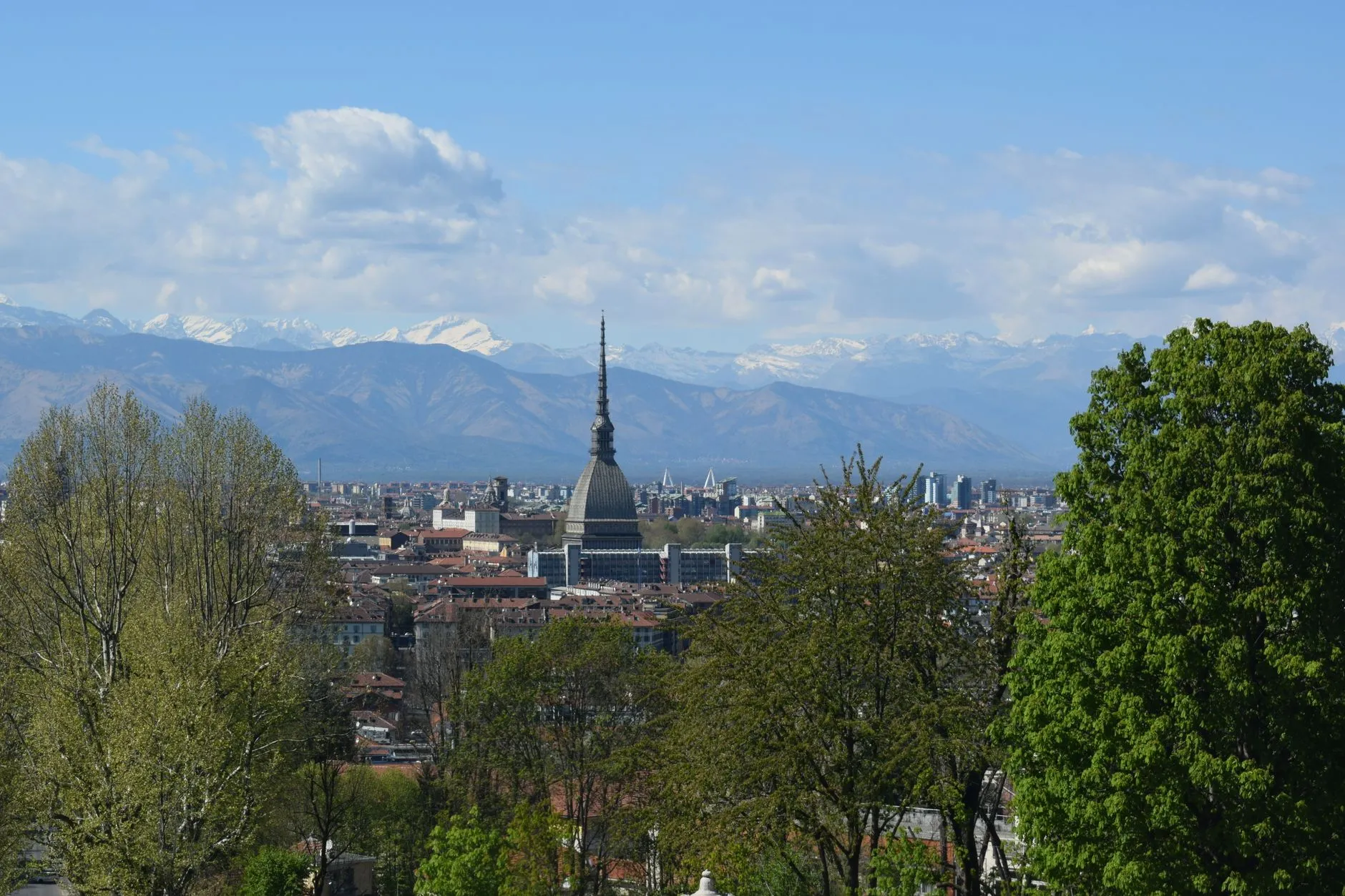
Turin is a planned, porticoed, monumental city — seat of the House of Savoy and Italy’s first capital from 1861 to 1865 — and it delivers more than its industrial reputation suggests. Two anchors are worth building a visit around.
The Museo Egizio (Egyptian Museum) holds one of the most important collections of Egyptian antiquities anywhere, ranked behind Cairo by most assessments. It is a real museum with serious depth: the collection is the reason to choose Turin over Milan or Venice for a layover day.
The Mole Antonelliana — the spire that defines the Turin skyline — houses the National Cinema Museum and a panoramic lift. The cinema museum makes the stronger case for the visit; the view is a supplement, not the point.
Beyond those two: the Savoy Royal Palace and the group of Savoy residences form a UNESCO World Heritage site. Lingotto, the former Fiat factory to the south of the centre, has the rooftop test track and the Pinacoteca Agnelli — worth the afternoon rather than a rushed stop.
The Layover Arithmetic
The train to Porta Susa is ~30 minutes each way at €3.70. Allow a 90-minute return-security buffer at minimum.
- 4.5–5 hours: Egyptian Museum or Mole Antonelliana, a bicerin in a historic café, and a comfortable return. This is the minimum for a proper visit.
- 4 hours: A walk through the central piazzas and one café stop. Not a museum.
- Under 4 hours: Stay airside. The distance from Caselle to the centre is real; a tight turn means a missed flight.
⏱️ Layover threshold: 4.5 hours minimum for a museum
Less than that and the Egyptian Museum is not realistic — 30 min each way plus a 90-minute security buffer leaves under two hours in the city. For shorter layovers, the Piemonte Lounge is the better decision.
🧭 Practical Notes
-
Validate your ticket. Train and SADEM bus tickets must be stamped before or on boarding. An unvalidated ticket is treated as no ticket and draws a fine if an inspector boards.
-
ATMs, not the exchange desk. Draw euro from a Bancomat (bank ATM) rather than the airport bureau de change. The spread at airport exchange desks is wide; cards work almost everywhere in the city centre.
-
Reduced-mobility assistance. Free under EU rules, but must be pre-booked through your airline at least 48 hours ahead. The meeting point is signed in the terminal.
-
Malpensa connection. A direct coach links Turin and Milan Malpensa (Arriva/Autostradale, from about €10), useful if a long-haul connection out of Malpensa is on the itinerary rather than from Caselle. TRN has on-site short- and long-stay parking for those driving in.
❓ FAQ
📊 At a glance — TRN 2026
| Feature | Current Data (2026) |
|---|---|
| Official name | Aeroporto di Torino-Caselle “Sandro Pertini” |
| IATA / ICAO | TRN / LIMF |
| Location | ~16 km north of Turin, Piedmont |
| Network | ~25 airlines to 100+ airports; Ryanair ~184 weekly departures |
| Terminals | 1 |
| Train to centre | Caselle Aeroporto → Porta Susa (via Lingotto), ~30 min, ~€3.70, every ~30 min |
| Bus to centre | SADEM/Arriva to Porta Nuova & Porta Susa, ~€7.50 (+€1 on board), ~37 min |
| Taxi to centre | ~€35–40, ~25–30 min |
| Currency | Euro (€) |
| Schengen status | Member; EES live 10 Apr 2026; ETIAS pending |
| Lounges | Piemonte Lounge (airside, Priority Pass/Amex); Sala Sagat (landside) |
| Dominant carriers | Ryanair (base), Wizz Air, easyJet, ITA Airways, Iberia, KLM, Jet2 |
| Key 2026 change | Torino–Ceres rail reconnected; airport train now runs to Porta Susa |
| Best layover move | Train to Porta Susa + Museo Egizio / Mole Antonelliana (4.5–5 hr+ layover) |