The Turkish Riviera — Complete Travel Guide 2026
The Turkish Riviera is two holidays sold under one name. There’s the eastern stretch — Belek, Side, Alanya, Lara — a wall of 5-star all-inclusive resorts where you can land, get a wristband, and not spend another lira for a week. Then there’s the west — Kemer, Olympos, Kaş, Kalkan — pine forests dropping into impossibly blue water, Roman theatres with nobody in them, and a slow boutique rhythm that has nothing to do with buffets. Pick the wrong end for your trip and you’ll spend the week wishing you were on the other one.
Quick Reference
Mediterranean (“Turquoise”) coast of southern Turkey, around Antalya
Antalya (AYT) — Turkey’s second-busiest airport
Turkish lira (TRY) — a soft, fast-moving currency; change money locally
Turkish (English, German and Russian widely spoken in resorts)
Visa-free for UK/EU/US/Canada (up to 90 days in 180); e-Visa for some nationalities
Late April–June and September–October; July–August is hot and packed
All-inclusive mega-resorts, turquoise sea, and world-class Roman ruins side by side
Antalya/Kaleiçi for culture, Belek for golf, Side for ruins+resort, Kaş/Kalkan for the boutique south
Editor’s Note — Read This Before You Book
Here’s the decision that matters more than anything else, and most people make it by accident: which way do you turn out of Antalya airport?
Turn east (Belek, Side, Alanya, Lara) and you get the Turkey of the brochures — colossal landscaped resorts, slick service, golden sand, and prices that make Greece and Spain look extortionate. It’s brilliant value and genuinely relaxing, but the towns themselves are often just a strip of identical hotels, and you’ll see more Russian and German than Turkish.
Turn west (Kemer, Çıralı, Kaş, Kalkan) and you get a wilder, prettier, more characterful coast — but it’s further, it’s hillier, the beaches are pebbly, and the boutique-villa end (Kaş, Kalkan) is genuinely expensive by Turkish standards.
Distances on this coast are brutal and people underestimate them. Belek is 30 minutes from the airport; Kaş is roughly 3 hours and Kalkan about 3.5 hours. If you book a “Turkish Riviera” villa in Kalkan imagining a quick airport hop, you’ve got a long mountain transfer at each end. Plan for it.
My honest steer: first-timers, families who want zero hassle, and golfers — go east, Belek or Side. Couples, divers, road-trippers, and anyone who finds all-inclusive wristbands depressing — go west, Kaş or Kalkan, and rent a car.
Should You Go? Who It’s For — and Isn’t
The Turkish Riviera is the best-value beach holiday in the Mediterranean in 2026, full stop. The weak lira means your euros and pounds stretch absurdly far on hotels, food and drink, while the standard of the big resorts genuinely rivals — and often beats — anything in the western Med at twice the price. Antalya welcomed 17.1 million tourists in 2025, a record, and the infrastructure is built for it: smooth transfers, English everywhere in the resort belt, flights from all over Europe.
It’s a near-perfect fit if you want a no-stress all-inclusive family week, a golf trip (Belek is world-class and runs all winter), a diving or boat-trip holiday (the west), or a beach-plus-ruins combination you can’t get in Spain.
It is a poor fit if you’re chasing an “authentic untouched” hidden Turkey — the resort belt is mass tourism done at industrial scale, and Kemer/Alanya in particular can feel like a theme park. If that’s your dealbreaker, base in Kaş or Antalya’s old town instead.
It’s also less ideal if you hate heat: July and August routinely top 35°C with sea temperatures around a bath-warm 29°C, and the inland ruins become an endurance test. And it’s not a budget-backpacker paradise the way it once was — inflation has caught up, and a fancy dinner in Kalkan now costs real money.
Getting There — Antalya Airport (AYT) & Transfers
Almost everyone flies into Antalya (AYT), a big, modern, efficient airport with two terminals and direct flights across Europe. (Kaş and Kalkan travellers sometimes fly into Dalaman to the west instead — it’s a shorter transfer for that end of the coast — but AYT is the main gateway and almost always has more flights and cheaper fares.) I won’t quote airfares here; they swing wildly by season and origin.
The thing to sort before you land is the transfer, because the distances vary enormously:
- Belek — ~32 km, ~35 minutes
- Lara — ~15 minutes (right next to the airport)
- Antalya city / Kaleiçi — ~20–30 minutes
- Kemer — ~60 km, ~1h 5m
- Side / Manavgat — ~66 km, ~1h 10m
- Alanya — ~125 km, ~1h 50m
- Kaş — ~190 km, ~3 hours
- Kalkan — ~215 km, ~3.5 hours
Most package holidays bundle a coach transfer, but it stops at multiple hotels and can add an hour. A private transfer is the sane choice for the longer runs (Side, Alanya, and especially Kaş/Kalkan, where shared shuttles barely exist) — it’s affordable here and saves a lot of pain with kids or after a long flight. For the airport-to-city run only, there’s now a genuinely useful budget option:
The AntRay tram reaches Antalya airport. If you’re basing in the city or Kaleiçi old town, the tram from the airport into town costs a few lira versus a taxi — a rare bit of cheap public transport on this coast. It runs roughly 06:00–23:00, every ~10 minutes. For the resort towns, though, there’s no tram or train; it’s a transfer or a bus.
Where to Base — the Coast Explained
This is the section that earns its keep. Each town is a different holiday.
Antalya city & Kaleiçi (old town) — Underrated as a base. Kaleiçi is a genuinely lovely walled old town of Ottoman houses, a Roman harbour, Hadrian’s Gate and boutique hotels, with the brilliant Antalya Archaeological Museum nearby and the long pebbly Konyaaltı and sandy Lara beaches at either end. You get real city life, restaurants that aren’t buffets, and easy tram/bus access. Best for culture-minded travellers and anyone who’d go stir-crazy inside a resort compound.
Belek — The luxury and golf capital. A purpose-built strip of huge, lavish 5-star resorts set in pine forest behind a long sandy beach, plus a cluster of championship golf courses. There’s almost no “town” to speak of — you come for the hotel and the fairways. Best for golfers, families wanting top-tier all-inclusive, and honeymooners who want polish.
Side — The smart middle option. A real ancient town — Roman theatre, the seafront Temple of Apollo, columns among the cafés — fused with a resort scene and Turkey’s second-longest sandy beach nearby. More character than Belek, more relaxed than Alanya. Best if you want ruins and a sun-lounger without choosing.
Alanya — Big, brash, great value, and the longest transfer (nearly 2 hours). Crowned by a dramatic medieval castle, with the famous (and famously busy) Cleopatra Beach, lively nightlife and the cheapest prices on the coast. Best for budget-minded sunseekers and groups who want buzz, not seclusion.
Kemer — West of the city, mountains plunging to the sea, pebbly coves and pine. Heavily geared to Russian and German all-inclusive package tourists, with big clubs and a slightly dated feel in parts, but the setting is gorgeous and it’s the gateway to Olympos and the Chimaera. Best for a scenic all-inclusive with nature on the doorstep.
Kaş & Kalkan — The nicest end of the coast, and everyone who’s been knows it. Kaş is a laid-back diving-and-boutique town with cobbled lanes, harbour restaurants, sea-kayaking over the sunken city, and a young, independent-traveller feel. Kalkan is its more polished, more expensive cousin — whitewashed houses tumbling down a hillside, infinity-pool villas, rooftop fine dining, and a small beach you mostly skip in favour of beach clubs and boat trips. Both are 3+ hours from AYT and almost villa-only; there’s no all-inclusive machine here. Best for couples, foodies, divers and repeat visitors.
Avoid the “I’ll do it all from one base” trap. Alanya to Kaş is a 4–5 hour drive — this is a long coast, not a compact one. If you want both the big-resort east and the boutique west, do a split: a few days in Side or Belek, then drive west to Kaş. Trying to day-trip across the whole Riviera will eat your holiday in the car.
The Beaches
The coast’s dirty secret: many of its famous beaches are pebble or shingle, not sand. That’s not a flaw — the water is clearer for it — but bring water shoes and adjust expectations.
- Konyaaltı (Antalya) — A long Blue Flag city beach below the mountains, mostly fine pebbles. Backed by cafés, bars and the Aqualand water park; great for a city-base day, busy in season.
- Lara (Antalya/airport side) — The genuine fine-golden-sand exception, a broad shallow bay backed by a wall of 5-star hotels. Family-friendly and calm; rammed in July–August, blissful in June or September.
- Patara — Turkey’s longest beach at ~18 km of soft white sand near the Lycian ruins, gloriously undeveloped (protected). It’s a loggerhead turtle nesting site (Caretta caretta), so sections are roped off June–August and it closes in the evenings — go in the morning.
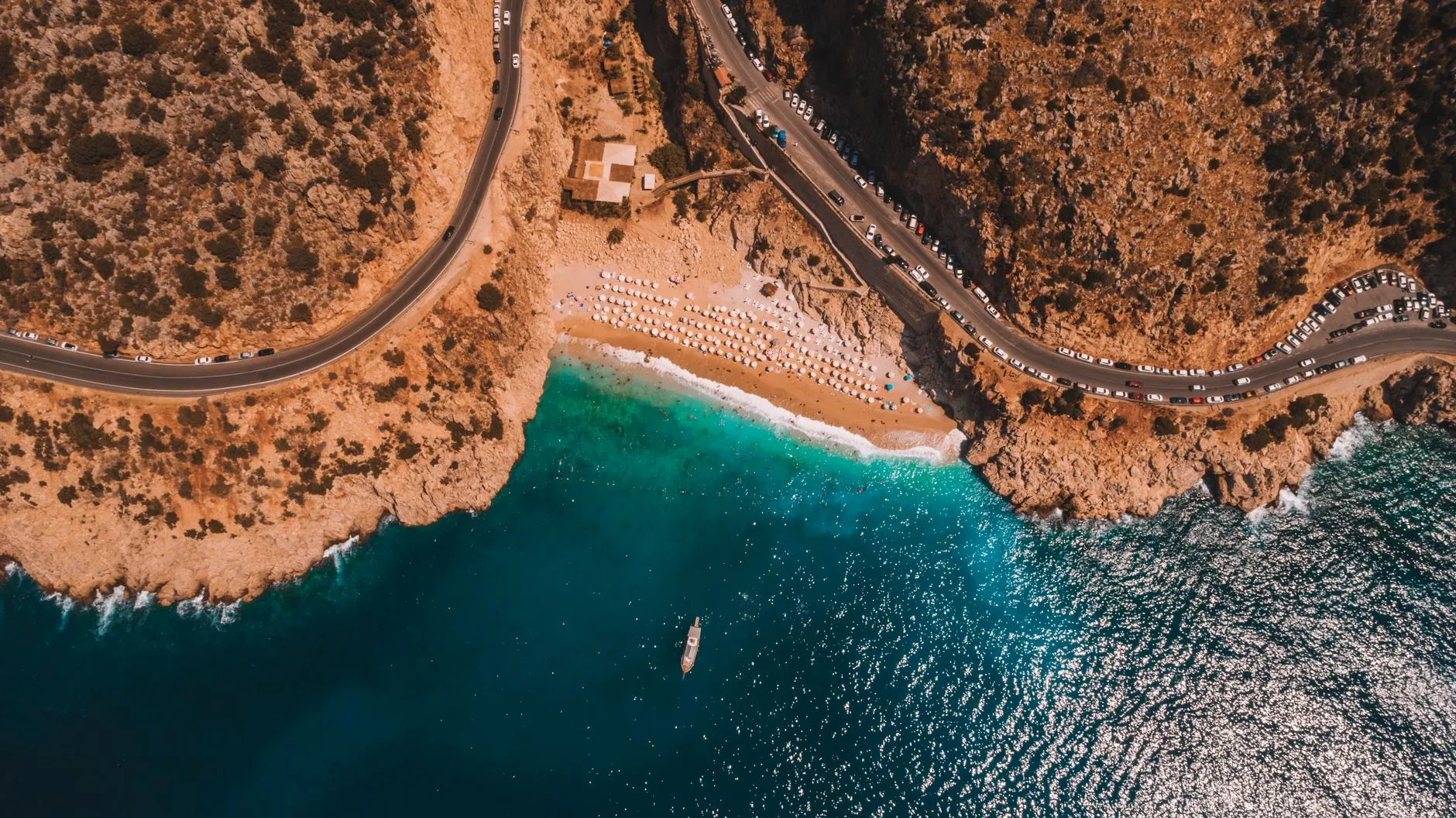
- Kaputaş — The Instagram one: a tiny turquoise cove at the foot of a canyon between Kaş and Kalkan. Staggering from the road above; ~170 steps down, no real facilities, and packed by midday. Get there early.
- Cleopatra Beach (Alanya) — Soft sand, clear water, a legend attached, and crowds to match. Free entry; lovely, but not a secret.
- Çıralı — A quiet pebble-and-sand strip below Olympos, turtle-nesting, low-key pensions, no high-rises. The antidote to the resort belt.
Ancient Sites & Beyond the Beach
This is what makes the Turkish Riviera special — you can pair a beach week with some of the best Roman ruins in the world, most within an hour or two of the resorts.
- Aspendos — The single best-preserved Roman theatre anywhere, a ~15,000–20,000-seat colossus built under Marcus Aurelius, acoustics still good enough to host concerts. An hour or so from Antalya/Side. Unmissable.
- Perge — A sprawling Roman city near Aksu (close to the airport): colonnaded main street, a huge stadium, baths and a theatre. Walkable and underrated.
- Termessos — The wild card. A Pisidian mountain fortress city 1,000 m up in the Taurus that even Alexander the Great couldn’t take. Half-ruined, half-swallowed by forest, with eagle’s-nest views — a steepish hike, but the most atmospheric site on the coast and gloriously uncrowded.
- Myra & Demre — Spectacular Lycian rock-cut tombs carved into a cliff face, a Roman theatre, and the church of St Nicholas — yes, the original Santa Claus was a local bishop here.
- Olympos & the Chimaera (Yanartaş) — Romantic overgrown ruins running down a valley to the beach, and up the hillside above Çıralı the Chimaera: natural flames that have burned out of the rock for millennia (methane, spontaneously igniting). Go after dark — it’s genuinely magical.
- Saklıkent Gorge — One of Europe’s deepest canyons, ~3 hours west; wade through icy mountain water between sheer walls. Bracingly cold even in August — pack a towel and shoes you can soak.
- Düden Waterfalls (Antalya) — The Lower Düden spills straight off a cliff into the sea on Antalya’s edge; you can see it best from a harbour boat trip.
- Kekova boat trips — From Kaş/Üçağız: glide over the sunken Lycian city of Simena (earthquake-swallowed, visible underwater, not reachable by land) and swim in silent bays. The signature day out of the western coast.
- Pamukkale — The famous white travertine terraces and Hierapolis ruins are doable as a long (~3-hour each way) day trip, but it’s a brutal there-and-back; consider an overnight.
When to Visit — Month by Month
The window you choose changes the whole trip. The sea here is swimmable from roughly late May to October.
- April — Spring. Warm days (low 20s°C), wildflowers, ruins at their most pleasant, but the sea is still cool (~18°C). Great for sightseeing, marginal for swimming.
- May — The sweet spot opens. Mid-20s°C, sea warming into the low 20s, resorts open and not yet full. Excellent all-round.
- June — Hot, sunny, sea around 24–26°C, long days, the best balance of warm water and bearable heat before the peak crush.
- July–August — Peak. 35°C+, sea a warm ~29°C, packed beaches, peak prices, and inland ruins that become genuinely punishing in the midday sun. Fine for a pool-and-buffet week; tough for sightseeing.
- September — Many regulars’ favourite. Still hot (high 20s–30s), the sea at its warmest after a summer of heating, crowds thinning. Ideal.
- October — The shoulder gem: pleasant 20s°C, sea still swimmable into the low-to-mid 20s, ruins comfortable, prices softening. Antalya had a record-breaking October in 2025.
- November–March — Mild and quiet (often 15–18°C), with rain — but this is golf season in Belek (22–25°C on the fairways, courses uncrowded, green fees lower) and a cheap, calm time for a city break in Antalya. Beach resorts largely shut.
Don’t book the inland ruins for a July afternoon. Termessos is a mountain hike and Perge/Aspendos are shadeless stone. In peak summer, do ruins at opening time or after 16:00, carry far more water than you think you need, and save the midday for the pool or sea.
What to Eat
Antalya is a real food city, and eating well here is cheap — if you leave the resort.
- Turkish breakfast (kahvaltı) — The event meal: a sprawling tray of cheeses, olives, tomatoes, cucumber, honey, clotted cream (kaymak), eggs, jams, fresh bread and endless tea. Do it properly at a Kaleiçi courtyard café at least once.
- Tandır kebap — Antalya’s signature: lamb slow-cooked for hours in an earthen pit until it falls apart, classically served with piyaz (white-bean salad with tahini) — a local twist you won’t find up in Istanbul.
- Gözleme — Thin hand-rolled flatbread griddled with spinach, cheese or minced meat; the perfect cheap lunch, best from a village-style place where a woman is rolling the dough at the door.
- Mezes & fresh fish — In the old harbours (Kaleiçi, Kaş, Kalkan) the move is a meyhane dinner: a spread of cold and hot mezes, then grilled fish, with rakı. Pricier in Kalkan, where the rooftop dining scene is genuinely excellent.
- Menemen, pide, lahmacun — Soft-scrambled eggs with tomato and pepper; boat-shaped Turkish “pizza”; thin spiced flatbread. Cheap, everywhere, reliably good.
The all-inclusive food caveat is real. A week of resort buffet is convenient but homogenises into the same lukewarm international spread fast. Even if you’re all-inclusive, break out for at least a couple of proper meals — a meyhane in town, a village gözleme stop, a fish dinner in the old harbour. It’s where the actual flavour of the coast is, and it costs very little.
Getting Around
Be honest with yourself about how mobile you want to be.
- AntRay tram (Antalya city) — Cheap, modern, runs ~06:00–23:00 every ~10 minutes, and now reaches the airport. Handy if you’re city-based; irrelevant out in the resorts.
- Dolmuş (shared minibuses) — The workhorse of the coast. Cash-only shared minibuses run constant routes between towns and beaches, hop-on/hop-off, dirt cheap. Excellent for short local hops (e.g. resort to a nearby beach or town); you flag them down and pay the driver.
- Intercity & suburban buses — From Antalya’s otogar (bus station, ~4 km out) frequent comfortable coaches and minibuses run to Side, Belek, Kemer, Manavgat and Alanya, and long-distance buses go everywhere. Good value and reliable, but slower than a transfer with luggage.
- Car hire — Essential for the western coast (Kaş, Kalkan, Olympos, the scenic D400 coast road, Saklıkent, Kekova). The east is so resort-and-transfer based you may not need a car at all, but the west rewards driving — the cliff road between Kaş and Kalkan past Kaputaş is one of the Med’s great drives. Roads are good; just respect the distances and the mountain switchbacks.
Don’t plan to “see the whole Riviera” on dolmuş and buses from one resort. It’s possible but punishing — for the west especially, hire a car for at least part of the trip or you’ll be stuck on the loungers.
Where to Stay — by Area & Budget
I won’t name specific hotels you should book sight-unseen, but the types and areas matter:
- All-inclusive 5-star (Belek, Lara, Side, Kemer) — The headline product. Vast resorts with multiple pools, à-la-carte restaurants, kids’ clubs and private beaches, often €100–250+ a night for a family room with everything thrown in. Outstanding value; just know you’re buying the hotel, not the town.
- Boutique / villa (Kaş, Kalkan, Çıralı) — Private villas with pools, small design hotels, harbour B&Bs. The opposite vibe: self-catering, restaurants out in town, no wristband. Kalkan villas in particular can be expensive in peak season; Kaş pensions are gentler.
- City hotels (Antalya / Kaleiçi) — Restored Ottoman-house boutiques and modern city hotels, year-round, walkable to old town, museums and beaches. The flexible, culture-first choice and good value off-season.
- Budget (Alanya, Antalya, Çıralı) — Alanya has the cheapest resort beds on the coast; Antalya and Çıralı have simple pensions. Good for backpackers and value-hunters.
A useful rule: east = book the resort; west = book the location.
Costs & Budget — the Lira Reality
The headline is great news for visitors and difficult news for locals. Turkey ran ~40%+ inflation through 2025, but the lira fell alongside it, so for someone spending euros, pounds or dollars the country is still 40–50% cheaper than Western Europe — and dramatically cheaper than the Greek islands or Spanish costas for a comparable beach week.
Rough on-the-ground 2026 ranges (everything moves fast, so treat as a guide, not gospel):
- Budget — ~€30–45/day: simple pension, street food, dolmuş, beaches.
- Mid-range — ~€55–90/day: good hotel or self-catering villa share, restaurant meals, the odd boat trip.
- All-inclusive — Often €60–100/pp/day with literally everything included — the reason the model dominates here.
- Luxury / Kalkan — €150–300+/day for villas, fine dining and beach clubs.
Because the lira moves so fast, prices printed in old guides are useless and even locals re-quote frequently. Don’t pre-convert your whole budget weeks ahead; check the rate near departure and again on arrival.
Practical Information
Entry & visa (2026). Rules are by nationality and they’re traveller-friendly: UK, Irish, US, Canadian and most EU citizens enter visa-free for up to 90 days in any 180. The US visa requirement was scrapped back in December 2023 — Americans no longer need an e-visa, so don’t pay a third-party site claiming otherwise. A handful of other nationalities still need an e-Visa (apply only at the official evisa.gov.tr, around €45–€55). Your passport should be valid well beyond your stay (6 months is the safe airline standard). When in doubt, check evisa.gov.tr or your foreign ministry for your specific passport.
Money. The currency is the Turkish lira (TRY), effectively a soft, somewhat closed currency — you can’t really get it abroad at a sensible rate, and you shouldn’t try. Cards are widely accepted in resorts and cities; carry some cash for dolmuş, markets, village cafés and tips. Change money in Turkey (exchange offices and ATMs beat airport kiosks and hotel desks), and don’t let merchants quote you in euros — paying in lira is almost always cheaper.
Scam watch: at the airport and in tourist-heavy spots, decline the “would you like to pay in your home currency?” card prompt (dynamic currency conversion costs you), avoid the worst airport exchange counters, and in Kalkan/Kaş check whether a menu is priced in lira or euros before you sit down — euro pricing in the smart restaurants is legal but adds up.
Safety & water. The Riviera is very safe for tourists — petty scams and overcharging are the main risk, not crime. Tap water is generally not drunk (locals use bottled/filtered); bottled water is cheap. Summer sun is fierce — the heat is the genuine hazard, so hydrate and seek shade midday.
Tipping. Modest tips are appreciated, not obligatory: round up taxis, ~5–10% in restaurants if service isn’t already added, a few lira for hotel and resort staff.
Connectivity. Resort and city Wi-Fi is good; a local eSIM or SIM is cheap and worth it for maps and dolmuş navigation. Note some VPN/streaming services can be patchy in Turkey.
Frequently Asked Questions
Cheapest Flights to The Turkish Riviera
We have tracked 2,723 fares to The Turkish Riviera from 116 cities. As of June 2026, here is what a good price looked like from each — the lowest fare we recorded, and a “great-deal” benchmark to judge a quote against. These are tracked observations, not live prices: by the time you read this they will have moved, so treat them as a yardstick, not a quote.
| From | Lowest fare we tracked | Great-deal benchmark |
|---|---|---|
| Bucharest (OTP) | €31 | €45 |
| Cluj-Napoca (CLJ) | €39 | €56 |
| Paderborn (PAD) | €51 | €73 |
| Bremen (BRE) | €53 | €76 |
| Sofia (SOF) | €53 | €76 |
| Memmingen (FMM) | €55 | €78 |
| Nuremberg (NUE) | €55 | €90 |
| Gothenburg (GOT) | €64 | €91 |
| Stuttgart (STR) | €64 | €92 |
| Stockholm (ARN) | €66 | €94 |
| Turin (TRN) | €76 | €109 |
| Cologne (CGN) | €78 | €112 |
| Geneva (GVA) | €79 | €114 |
| Treviso (TSF) | €80 | €114 |
Recent deals we have posted to The Turkish Riviera:
- Birmingham to Antalya, Turkey from £94
- Düsseldorf to Antalya, Turkey from €88
- Hamburg to Antalya, Turkey from €94
- Salzburg to Antalya, Turkey from €101
- Munich to Antalya, Turkey from €133
- Basel to Antalya, Turkey from CHF 89
- Düsseldorf to Antalya, Turkey from €114
- Vienna to Antalya, Turkey from €125
- Friedrichshafen to Antalya, Turkey from €122
- Hamburg to Antalya, Turkey from €123
These are fares aifly tracked to this destination, not live quotes — they have changed since and several of the deals above may have expired. Browse current flight deals →