Costa Rica — Complete Travel Guide 2026
Costa Rica packs cloud forests, an active-looking volcano, two completely different coastlines and more biodiversity than the entire United States into a country smaller than West Virginia — and then makes you earn it on winding mountain roads that turn a 90-mile hop into a four-hour grind. It is the most polished, easiest-to-navigate country in Central America, and the least cheap; in 2026, with a strong colón pushing dollar prices up, you come here for the wildlife and the well-run eco-tourism, not for a bargain beach week.
Quick Reference
Central America, between Nicaragua and Panama, with Pacific and Caribbean coasts
San José / Juan Santamaría (SJO) — the hub; Liberia / Guanacaste (LIR) — the northern Pacific beaches
Costa Rican colón (CRC); US dollars widely accepted, change given in colones
Spanish; English widely spoken in tourist areas (and on the Caribbean coast, a local Creole)
Visa-free for most Western tourists (US, Canada, UK, EU, AU/NZ) up to 180 days; onward/return ticket required
Pacific: Dec–April (dry). Caribbean: Feb–March & Sept–Oct (its own opposite pattern)
Volcanoes, cloud forest, surf, sloths & wildlife, national parks, coffee — “pura vida”
Move every few nights: Arenal + Monteverde + one coast is the classic loop
Editor’s Note: Read This First
Two decisions shape your whole trip, and most people get the first one wrong.
Decision one: SJO or LIR. San José (SJO), in the central valley, is the default — more flights, cheaper fares (often €190–€370 less per person), and the logical launch pad for the classic circuit: Arenal volcano, Monteverde cloud forest, the central Pacific (Manuel Antonio), the Caribbean, the south. Liberia (LIR) exists for one reason: it drops you an hour or less from the Guanacaste beaches (Tamarindo, the Papagayo resorts, Nosara, Sámara). If your trip is “fly in, beach, surf, fly out” in the northwest, LIR saves you a brutal first-day drive. If it’s anything broader, fly into SJO. And if you want both volcanoes-and-cloud-forest and Guanacaste beaches, the pro move is the open-jaw: into SJO, out of LIR (or vice versa), so you never backtrack.
Decision two: how far to spread. This is the trap. Costa Rica looks small, so people cram Arenal, Monteverde, Manuel Antonio, the Osa and the Caribbean into ten days and spend half of it in a car. Don’t. The roads are the real constraint — mountain switchbacks, gravel, river-fed potholes, and travel times that bear no relation to the distance. Pick two or three regions and go deep. A sane first-timer’s 10-day loop: 3 nights La Fortuna (Arenal), 2–3 nights Monteverde, 3–4 nights one beach. That’s it.
Drive times are the single biggest planning mistake. Distances lie here. San José to Monteverde is ~95 miles but takes 3+ hours; Monteverde to Manuel Antonio is another 3.5–4. Build a trip around how long the driving takes, not the map distance, or you’ll spend your holiday watching guardrails.
Should You Go? Who It’s For — and Who It Isn’t
Costa Rica is for you if you want to see things: a sloth hanging over a trail, scarlet macaws screaming across a beach, a volcano framing your hot-spring soak, turtles hauling up to nest by the thousand. It rewards the curious and the active — hikers, surfers, wildlife nerds, zip-line adrenaline-seekers, yoga-and-smoothie people. The infrastructure is genuinely good: certified guides, clean lodges, drinkable tap water in most of the country, a stable democracy with no standing army and a real conservation ethic (roughly a quarter of the land is protected).
It’s a poorer fit if you want a cheap, do-nothing beach lie-down. Mexico and the wider Caribbean do all-inclusive sun-and-sand better and cheaper. Costa Rica’s beaches are beautiful but often rugged, with strong currents; the magic is in the rainforest behind them, not a swim-up bar. It’s also not a budget backpacker steal anymore — see Costs below. Come for nature and adventure, and it’s one of the best trips on earth. Come expecting a cut-price Cancún and you’ll feel ripped off.
Getting There: SJO vs LIR & Your Transfers
San José (SJO / Juan Santamaría) is the country’s main gateway, ~20 minutes west of the capital in Alajuela. Most North American and European flights land here, and it’s the cheaper, better-connected option. From SJO you’re roughly 2.5–3 hours to La Fortuna/Arenal, 3+ to Monteverde, 3–3.5 to Manuel Antonio, and a long haul (with a boat at the end) to Tortuguero or the Osa.
Liberia (LIR / Daniel Oduber) in the northwest is smaller but modern — it got a runway and boarding-lounge expansion in 2025 — and it’s all about Guanacaste. You can be on a Tamarindo beach within an hour of clearing immigration. Worthless if you’re going anywhere but the north Pacific; perfect if you’re not.
For transfers, you have three real options: rental car (freedom, but read the Getting Around section before you book — the insurance math bites), a private or shared shuttle van (fixed price, English-speaking driver, door to door), or a SANSA domestic flight to skip a multi-hour drive. Don’t try to time a tight onward connection to a domestic SANSA flight on your arrival day; give yourself a buffer.
Don’t book a hotel “near the airport” in San José for your first night and then drive into the mountains exhausted. If you land late, sleep in Alajuela (5–10 min from SJO) and start fresh. Mountain roads at night, jet-lagged, is how rental cars meet ditches.
The Regions: Honest Character & Travel Times
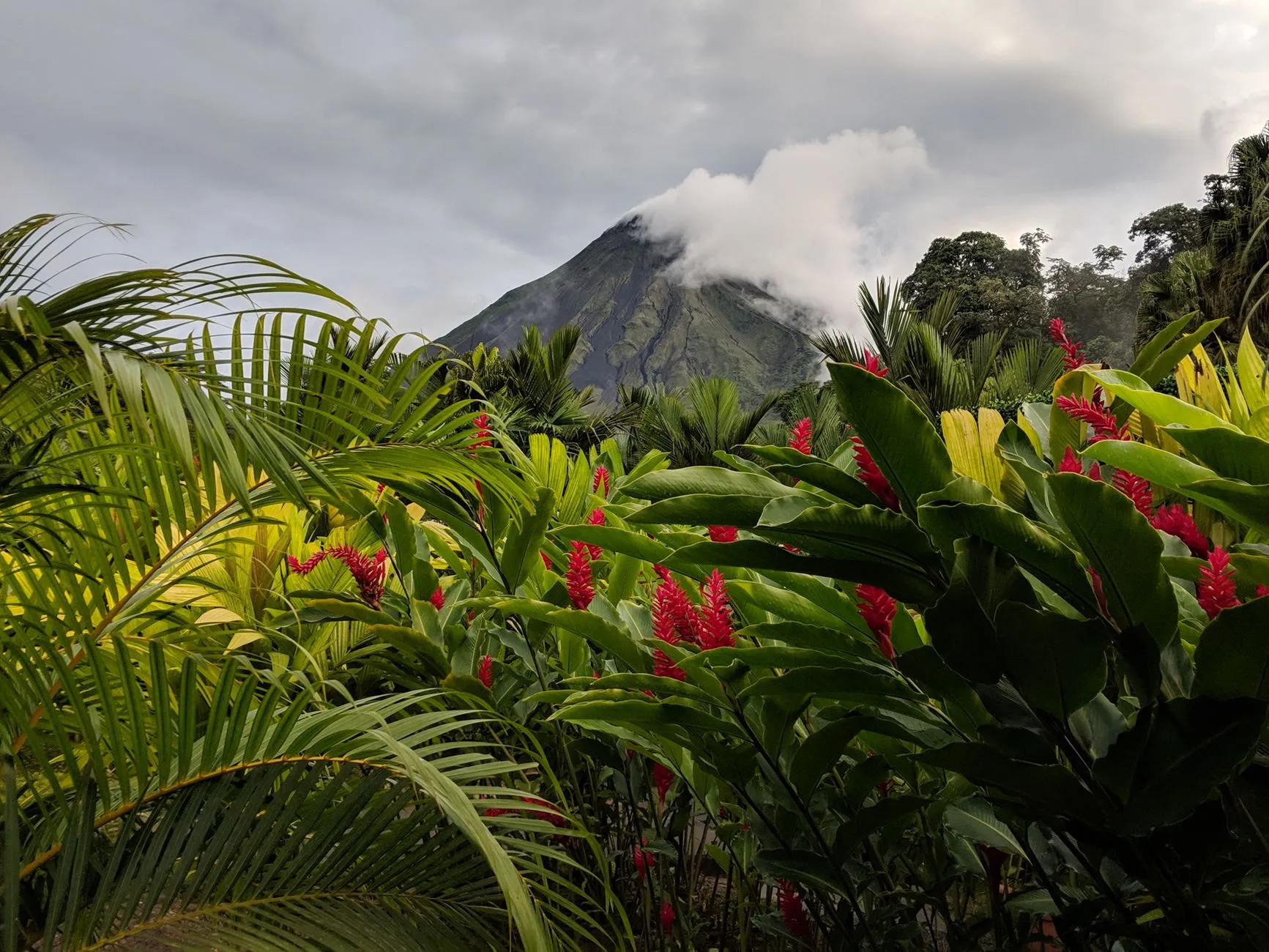
Arenal / La Fortuna — the easy headliner, and rightly popular. The near-perfect cone of Arenal Volcano (dormant since 2010 but still photogenic) presides over a town built for visitors: hot springs ranging from free riverside soaks to lavish resort complexes, the thundering La Fortuna Waterfall, hanging-bridge parks like Mistico (one of the best sloth-spotting walks anywhere), and Río Celeste’s Gatorade-blue river ~1.5 hours north. It’s the softest landing in the country — paved access, lots of English, easy wins. ~2.5–3 hrs from SJO.
Monteverde — the cloud forest. Cooler, mistier, otherworldly: hummingbirds, the resplendent quetzal if you’re lucky, and the original zip-line/canopy-tour scene (it was invented here). The catch is the access road — historically rough gravel, slow going, ~3+ hrs from SJO and ~3 hrs from Arenal (the classic shortcut is the “jeep-boat-jeep” across Lake Arenal). Worth the rattle; pack a light jacket because it can be genuinely chilly and wet.
Manuel Antonio — beach plus the most accessible wildlife park in the country. White-sand coves backed by jungle where squirrel monkeys, capuchins and sloths come close. It’s busy and a bit overdeveloped on the road into the park, but the payoff — wildlife this easy, on this nice a beach — is real. ~3–3.5 hrs from SJO. (Park logistics below; you can’t just walk up.)
Guanacaste & the Nicoya Peninsula — the Pacific dry-forest beaches, and Costa Rica’s beach-holiday heartland. Tamarindo is lively, surf-and-smoothie, easy to love or find too touristy. Nosara is the global surf-and-yoga hub, jungle-fringed, creative, more upscale. Santa Teresa is the bumpy-gravel-road, Land-Rover-and-surfboard scene, expat-heavy and pricey. Sámara is the mellow, family-friendly one. Nicoya is also one of the world’s five Blue Zones — a pocket of unusual longevity tied to diet, faith and community — which adds a nice layer to the longevity-tourism angle, even if you mostly came to surf. Closest to LIR (the whole reason LIR exists).
The Southern Pacific / Osa — the wild end. Corcovado National Park on the Osa Peninsula is, per the cliché that happens to be true, one of the most biodiverse places on the planet: tapirs, all four Costa Rican monkey species, scarlet macaws, the realistic chance of seeing more in a day than anywhere else. Uvita (gateway to Marino Ballena and the natural sandbar “Whale Tail,” plus whale-watching) sits to the north. This is multi-day, remote, often boat- or small-plane-accessed effort — not a casual day trip. The reward is the most untamed Costa Rica.
The Caribbean coast — a totally different country. Puerto Viejo and Cahuita run on Afro-Caribbean and Bribri culture, calypso and reggae, coconut-and-spice cooking, a slower Rasta rhythm and (usually) lower prices than the Pacific. Cahuita is the sleepy, soulful one with a lovely little national park; Puerto Viejo is the surf-and-digital-nomad hub. Crucially, the Caribbean runs on its own weather clock — see When to Visit.
Tortuguero — “the Amazon of Costa Rica,” a maze of jungle canals on the northern Caribbean reachable only by boat or small plane. You glide through waterways spotting caimans, monkeys and herons, and in season watch green turtles nest on the beach. No roads, no cars. A unique, rain-soaked, atmospheric add-on.
San José — the hub, not the highlight. Most people transit through. Worth a half-day for the Gold and Jade museums and a good meal, but no one’s Costa Rica memory is the capital.
Wildlife & National Parks: What You’ll Actually See
This is the reason to come. Sloths (two- and three-toed), howler/capuchin/spider/squirrel monkeys, toucans, scarlet macaws, morpho butterflies, caimans, poison-dart frogs, and — in the right place and season — nesting sea turtles. A good guide with a spotting scope is the difference between “nice walk” and “I saw a sloth, a toucan and an eyelash viper in an hour.” Hire one.
The flip side: ethical operators matter. It is illegal and stressful-to-the-animal to hold a sloth; reputable tours observe from a distance and never bait or handle wildlife. Skip anything that promises you can touch or pose with animals.
The park-reservation reality has tightened, and several headline parks now require booking ahead through the official SINAC system (reservations.sinac.go.cr):
- Manuel Antonio — advance online tickets are mandatory; it’s closed Tuesdays, open ~7am–3pm, with a strict daily cap (roughly 600 weekdays / 800 weekends). Book your date and time slot ahead, especially in high season.
- Corcovado — you cannot enter without a certified SINAC-registered guide; reservations are required and the popular Sirena sector caps numbers hard. Book 2–4 weeks out in dry season.
- Monteverde and the like are private reserves (~€19+ pp) — usually just turn up, but the popular cloud-forest reserves can fill on peak mornings.
Standard national-park entry for foreigners runs roughly €11–€19 per person; many parks now want payment online or by card.
Riptides kill more tourists in Costa Rica than anything else. Many beautiful Pacific beaches have vicious currents and no lifeguards. Ask locally which beaches are safe to swim, don’t fight a rip (swim parallel to shore), and respect that “stunning” and “swimmable” are not the same thing here.
The Beaches & Surf: Pacific vs Caribbean
Pacific is the surf engine. The biggest, most consistent swells actually arrive in the May–November green season, so surfers and sun-seekers want different months. Guanacaste/Nicoya (Tamarindo, Nosara, Santa Teresa) is the marquee surf-and-yoga zone; the central and southern Pacific add Jacó, Dominical and the Osa. Beaches skew golden-to-dark sand, dramatic, often with strong shore break.
Caribbean is mellower in feel and reef-fringed — better snorkeling, calmer in its dry windows, the warm turquoise-water postcard around Puerto Viejo and Cahuita (with Salsa Brava for experienced surfers). It’s also where the culture shifts hardest. Two coasts, two moods, two weather systems.
When to Visit: The Coast-by-Coast Nuance
Costa Rica’s seasons aren’t a single calendar — they’re two opposite ones, and missing that is the second-biggest planning error after drive times.
- Pacific dry season — roughly mid-December to April (locals call it verano, “summer”): hot, sunny, reliable. This is peak: best beach weather, highest prices, busiest parks. January–March is the sweet spot.
- Pacific green season — May to November (invierno): afternoon downpours, lush green everything, fewer crowds, 30–50% cheaper, and the best surf. September and October are the wettest on the Pacific.
- The Caribbean flips it. Its drier, sunnier windows are roughly February–March and September–October — meaning when the Pacific is drowning in September/October rain, Puerto Viejo, Cahuita and Tortuguero are often having their best weather.
So the savvy itinerary in the shoulder months pairs the right coast with the right calendar. Turtle timing is its own thing: Tortuguero’s green turtles nest roughly July to mid-October (peak Aug–Sept); leatherbacks earlier (Feb–April).
Green season is underrated, with a catch. May, June, September and October bring lower prices, lush scenery and elbow room — but in remote areas roads wash out and rivers rise. If you travel green season, build in slack, favor paved routes, and don’t plan a tight schedule across gravel mountain roads after a downpour.
What to Eat
Costa Rican food is hearty and unfussy rather than fireworks, and the place to eat it is a soda — a small, family-run local diner — not a tourist restaurant.
- Gallo pinto — the national breakfast: rice and beans (black on the Pacific side, often with a splash of Salsa Lizano), fried with onion and cilantro, served with eggs, plantain and a tortilla.
- Casado — the lunch workhorse (“married plate”): rice, beans, salad, sweet fried plantain, and a protein (often corvina/sea bass, or chicken, beef, pork). Filling and cheap at a soda — around €6–€9.
- Fresh fish — on both coasts, simply grilled corvina or the catch of the day; ceviche is everywhere.
- Caribbean cooking is its own delicious world — rice and beans cooked in coconut milk, rondón stew, and spicy, fragrant flavors you won’t find on the Pacific side.
- Coffee — this is one of the world’s great coffee origins, and it shows: even a roadside soda pours a properly good cup. Tour a Central Valley or Monteverde finca if you’re a fan, and buy beans to take home.
Eat where the locals eat. A casado at a soda is fresher, more authentic and a third of the price of the same plate at a beachfront tourist spot. The tourist restaurants will also stack a 13% tax + 10% service on the bill — see Costs.
Getting Around: The 4×4, Shuttle & SANSA Reality
Your three choices, honestly weighed:
Rental car gives you total freedom and is the best way to do a multi-region road trip — but the price you’re quoted online is rarely the price you pay. Costa Rican law requires a mandatory liability insurance that the cheap third-party booking sites leave out, so the total can jump by €11–€19+ a day at the counter, sometimes doubling a too-good rate. Many credit-card “rental coverage” benefits exclude 4WD, gravel and undercarriage damage — exactly the situations you’ll be in. A 4×4 is genuinely worth it for Monteverde, the Nicoya/Santa Teresa gravel, the Osa and anywhere in green season. And note: river crossings are flatly prohibited by every rental company and not covered — if water reaches the doors, turn around.
Shuttle vans are the stress-free middle ground: shared shuttles run roughly €37–€50 per person between major tourist hubs, with fixed prices, door-to-door service and English-speaking drivers; private vans cost more but suit families or groups. Great if you don’t want to drive the switchbacks.
Never leave anything visible in a parked rental car. Smash-and-grab break-ins at trailheads, beaches and viewpoints are the single most common crime against tourists. Take valuables with you, leave the glovebox open and empty, and don’t store bags in the trunk in front of a parking lot — thieves watch.
SANSA domestic flights (12-seat Cessna Caravans) buy back time on the long hauls. They serve a dozen domestic points — Tamarindo, Nosara, Quepos (for Manuel Antonio), Drake Bay, Tortuguero, La Fortuna, Liberia, Puerto Jiménez and more — but everything routes through San José; there are no point-to-point legs, so you backtrack to SJO to connect. Reckon roughly ~€95 per person per hop (typically €75–€110). For the Osa or Tortuguero, a flight that turns a brutal half-day drive-plus-boat into 45 minutes can be the best money you spend. The rough rule: under ~90 minutes from the airport, a shuttle usually beats a rental; three-plus far-flung stops, a car (or strategic flights) wins.
Where to Stay: By Region & Budget
Costa Rica’s lodging skews toward small eco-lodges and boutique hotels rather than mega-resorts (Guanacaste being the exception, with the Papagayo all-inclusives).
- Arenal/La Fortuna — from budget hostels in town to mid-range hotels with volcano views to hot-spring resorts; easy range, easy access.
- Monteverde — cozy cloud-forest lodges and B&Bs, often misty and rustic; bring layers.
- Manuel Antonio — jungle-view boutique hotels along the road to the park, plus cheaper digs in Quepos town; books out in dry season.
- Guanacaste/Nicoya — the broadest spread: surf hostels and yoga retreats in Nosara/Santa Teresa, family hotels in Sámara, and the big all-inclusive resorts around Papagayo.
- Caribbean (Puerto Viejo/Cahuita) — generally cheaper, more characterful guesthouses and small lodges.
- Osa & Tortuguero — remote eco-lodges, often package/meal-inclusive given there’s nowhere else to eat; book ahead.
Mid-range doubles average somewhere around €110–€200 depending on season; budget rooms exist but the genuinely cheap end is thinner than it used to be.
Book Osa and Tortuguero lodges early and expect meal-inclusive rates — there’s often nowhere else to eat. And don’t assume a “beachfront eco-lodge” has reliable power, hot water or wifi; in the remote southwest and the Caribbean canals, rustic is the point, so confirm the basics before you book if they matter to you.
Costs & Budget: Be Honest — It’s Not Cheap
Set expectations: Costa Rica is the priciest country in Central America, and a strong colón in 2026 has made it more expensive again for dollar-spenders.
Realistic per-day, per-person ballparks (excluding flights):
- Budget/backpacker: ~€70–€95/day (hostel dorm or basic room, sodas, a tour or two), dipping to ~€40–€70 in green season.
- Mid-range: ~€140–€160/day (nice hotel, a rental car or shuttles, daily tours, restaurant meals).
- Luxury: ~€190–€350+/day (high-end lodges, private transport, guided everything).
The line items that surprise people: tours and park-related activities add up fast (a guided park walk, a canopy tour, a hot-spring day each run real money), rental insurance inflates the car, and the 13% tax plus 10% service quietly tack 23% onto a sit-down restaurant bill. Sodas, local beer (an Imperial is ~€3–€4), public buses and shared shuttles are where you claw budget back. Costa Rica is worth the money — but go in knowing the money is real.
Practical Information
- Entry: Most Western tourists (US, Canada, UK, EU, Australia, NZ and ~60 others) enter visa-free for up to 180 days — but the stamped length is at the immigration officer’s discretion, and you must show proof of onward or return travel (a one-way ticket alone, or a return more than 90 days out, can get you turned back at check-in). Group-1 passports need only be valid on arrival, though many airlines still want 6 months; don’t cut it fine.
- Money: Costa Rican colón (CRC), ~₡450–455 to the dollar in mid-2026 and the colón has been strengthening (so your dollars buy fewer colones than a couple of years ago). USD is widely accepted, but you’ll often get a worse informal rate and your change in colones — pay in colones where you can, and use cards (Visa/Mastercard) freely; ATMs dispense both.
- Safety: Generally safe and welcoming, at a US Level 2 (“exercise increased caution”) advisory. The real risk is petty theft — pickpocketing and break-ins to parked rental cars. Never leave anything visible in a car; use hotel safes; stay aware in San José and crowded beach towns at night. Violent crime against tourists is uncommon.
- Water: Tap water is safe to drink in most of the country, including the main tourist areas — bring a refillable bottle. In remote rural/beach pockets, stick to filtered or bottled.
- Tipping: Restaurants auto-add a 10% service charge (plus 13% tax), so extra tipping isn’t expected — round up for great service. For guides and drivers, ~10–15% of the tour is the norm and genuinely appreciated.
- Connectivity: Good 4G/5G in towns and most tourist areas (patchy in the deep Osa and Tortuguero). A local Kölbi/Claro/Movistar SIM or an eSIM is cheap and easy.
- Driving: Drive on the right; headlights on after dark (legally required 6pm–6am); seatbelts mandatory; carry your home license and passport (with entry stamp). Roads can be unmarked, potholed and unlit — don’t drive the mountains at night if you can avoid it.
Frequently Asked Questions
Cheapest Flights to Costa Rica
We have tracked 948 fares to Costa Rica from 72 cities. As of June 2026, here is what a good price looked like from each — the lowest fare we recorded, and a “great-deal” benchmark to judge a quote against. These are tracked observations, not live prices: by the time you read this they will have moved, so treat them as a yardstick, not a quote.
| From | Lowest fare we tracked | Great-deal benchmark |
|---|---|---|
| Madrid (MAD) | €422 | €603 |
| Azores (PDL) | €450 | €643 |
| Dublin (DUB) | €458 | €654 |
| Amsterdam (AMS) | €462 | €660 |
| Brussels (BRU) | €462 | €660 |
| Athens (ATH) | €481 | €687 |
| Luxembourg (LUX) | €498 | €712 |
| Frankfurt (FRA) | €503 | €719 |
Recent deals we have posted to Costa Rica:
- Toronto to Liberia, Costa Rica from C$292
- Ottawa to Liberia, Costa Rica from C$447
- London to Monrovia, Liberia from £425
- Frankfurt to Monrovia, Liberia from €708
- Brussels to Monrovia, Liberia from €488
- Manchester to Monrovia, Liberia from £478
- Orlando, Florida to Liberia from $292
- Dallas, Texas to Liberia from $291
- Miami to Liberia, Costa Rica from $294
- New Orleans to Liberia, Costa Rica from $285
These are fares aifly tracked to this destination, not live quotes — they have changed since and several of the deals above may have expired. Browse current flight deals →