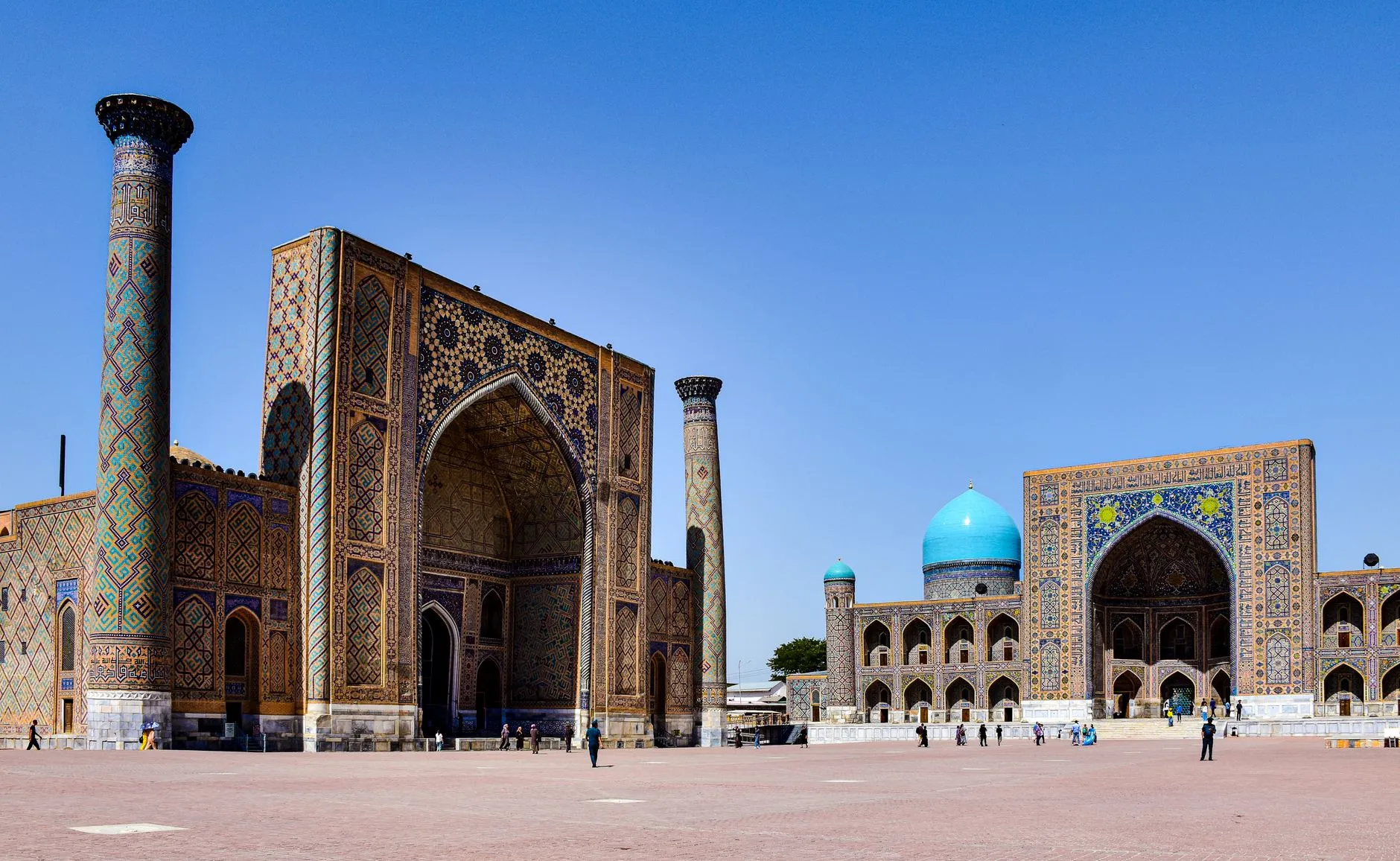
Uzbekistan — Complete Travel Guide 2026
Uzbekistan is the showpiece of the Silk Road, and for most of the last century almost nobody got to see it. Now they do. This is the country of Samarkand’s Registan — three colossal madrasas facing each other across a square, every surface a riot of turquoise and gold tilework — of Bukhara’s holy old city where a 47-metre brick minaret has watched over the same lanes for nine hundred years, and of Khiva, a mud-walled desert town so intact it feels like a film set nobody bothered to dismantle. It is a country of impossibly blue domes that, after decades as a Soviet backwater and then a closed, bureaucratic autocracy, has flung its doors open. You now arrive visa-free, glide between the great cities on a Spanish-built bullet train, sleep in a restored merchant’s house for the price of a European hostel dorm, and stand more or less alone in front of architecture that should have queues like the Taj Mahal. Go now.
Quick Reference
Central Asia — double-landlocked, the green heart of the ancient Silk Road, ringed by Kazakhstan, Kyrgyzstan, Tajikistan, Afghanistan and Turkmenistan
Tashkent (TAS) is the main hub; Samarkand (SKD) and Bukhara (BHK) take growing international and domestic traffic; Urgench (UGC) is the airport for Khiva
Uzbekistani som (UZS) — the big-number currency (≈ 13,500 to the euro); long a cash-only country, but cards are spreading fast in the tourist cities
Uzbek (official); Russian is the everyday lingua franca; English is growing fast in tourism
Visa-free for most Western tourists for 30 days — EU, UK, Australia and (since January 2026) the US enter with just a passport stamp; e-visa for nationalities not on the list
April–May and September–October are ideal; July–August is brutally hot; December–February is cold, clear and crowd-free
The greatest Silk Road architecture on earth — Samarkand’s Registan, Bukhara’s holy old city, Khiva’s walled museum-town, blue-tiled domes, plov and Timur (Tamerlane)
Hop the high-speed train: a night or two each in Tashkent, Samarkand and Bukhara, then fly or overnight-train west to Khiva — most people do exactly this line
Editor’s Note — go now, while it’s easy and still quiet
Here is the honest framing, because it changes how you should think about this trip: Uzbekistan is having a moment, and you have caught it in the narrow, perfect window.
A decade ago, travelling here was a genuine slog. You needed a visa with a letter of invitation, you registered with the police every few days and carried a fistful of paper slips, the currency was a black-market farce where you swapped a hundred-dollar bill for a literal brick of som, and the whole place ran on Soviet suspicion. People still went — the monuments were that good — but they earned it.
Then in 2018 the reformer president opened the place up, and it transformed almost overnight. The visa is gone for most of us. The currency is legal, stable, and you just use an ATM. The registration rule still technically exists but your hotel handles it without you lifting a finger. And the Afrosiyob high-speed train turned a country the size of Sweden into a hop-on, hop-off line of Silk Road cities. It is now one of the genuinely easy great trips on earth.
The catch is the other side of that coin: the tourists are coming, fast. Samarkand has a slick new airport and a purpose-built tourist quarter; Bukhara and Khiva are getting their first proper crowds. It’s still gloriously under-touristed by any sane standard — you’ll have whole madrasas to yourself — but the era of being almost alone here is closing. The sweet spot is right now: after the hard-travel decades, before the mass-tourism ones. The classic route hasn’t changed in a thousand years and it’s the right one — Tashkent → Samarkand → Bukhara → Khiva — strung together by train and a single short flight. Do that and you’ve seen the best of the Silk Road in a week to ten days, with very little friction.
💡 The window is the point. Uzbekistan combines the architecture of a bucket-list heavyweight with the crowds of a place nobody’s discovered yet. That combination has a shelf life. The infrastructure is ready; the crowds aren’t here yet. This is the visit-now country of the late 2020s.
Should You Go? Who it’s for — and isn’t
Uzbekistan is for the traveller who came for places, not poolside. If a square framed by three monumental madrasas, or a 12th-century minaret, or a covered medieval bazaar still selling carpets and knives makes the hair on your arms stand up, this is one of the most rewarding countries on the planet and you should book it immediately. It’s paradise for the architecture-and-history obsessive, the Silk Road romantic, the photographer (those tiles in low morning light are unreal), and the value traveller who wants a serious, exotic, far-flung trip without a backpacker’s budget or hassle.
It’s superb, too, for the cautious adventurous — somewhere genuinely off the standard track, “Central Asia,” a name that still raises eyebrows at dinner parties, but delivered with trains that run on time, safe streets, easy food and almost no real risk. You get the bragging rights of somewhere obscure with the logistics of somewhere developed. Solo travellers, including solo women, generally report Uzbekistan as one of the easier and safer countries in the region — the famous local hospitality is real, and harassment is low by global standards.
Who it’s not for: anyone who needs a beach (it’s double-landlocked, and the Aral Sea, tragically, has mostly dried up), anyone who needs a buzzing nightlife and a flowing bar scene (it’s a secular but Muslim country; drink is available and there are bars in Tashkent, but this is not a party destination), and anyone allergic to repetition — yes, you’ll look at a lot of madrasas, and by Bukhara some people are tiled out. Pace it, mix in bazaars and food and people, and that fatigue never sets in. Finally, the climate is continental and extreme, so the shoulder seasons matter more here than almost anywhere.
Getting There & Around — TAS, the Afrosiyob train & the western leg
Getting in. Almost everyone arrives at Tashkent (TAS), the main hub. The national carrier, Uzbekistan Airways, flies a wide network into Europe (London, Frankfurt, Paris, Milan and more) and across Asia and the Gulf. The game-changer for cost is Wizz Air, which has pushed budget service into the region — flying to Tashkent (and Samarkand) from Abu Dhabi and points in Europe, dragging the whole market’s fares down. Add Turkish Airlines (excellent connections via Istanbul, often the easiest one-stop from the West), FlyDubai and Air Arabia via the Gulf, Aeroflot and other CIS carriers, and Tashkent is far better connected than its remoteness suggests. Samarkand (SKD) now also takes a growing slate of direct international flights on its newer airport — flying straight in lets you skip Tashkent entirely if you’re tight on time.
Getting around — this is the joy. The spine of any Uzbekistan trip is the Afrosiyob high-speed train, a 250 km/h Spanish-built Talgo bullet connecting Tashkent → Samarkand → Bukhara along the old Silk Road. It is fast, comfortable, punctual and ridiculously good value — unambiguously the way to travel here. Tashkent to Samarkand takes about 2 hours 10 minutes; Samarkand on to Bukhara another two hours; Tashkent straight through to Bukhara, roughly four. Economy runs around €22–24 Tashkent–Samarkand and about €38 Tashkent–Bukhara; business and VIP cost more but are hardly necessary — economy is perfectly civilised, with a snack trolley and big windows onto the steppe.
⚠️ Book the Afrosiyob in advance. The fast trains sell out, especially in spring and autumn and around holidays. Buy as early as you can — online via the national railway (railway.uz) or the e-ticket apps, or have your hotel/guesthouse grab them for you. Turning up at the station hoping for a same-day seat on a busy day is how you end up in a shared taxi.
For the routes the bullet train doesn’t cover, fill the gaps with shared taxis — they leave from set stands when full, take no booking, and are cheap and quick. The western leg is the exception: Khiva sits far out in the desert near Urgench (UGC), beyond the Afrosiyob network. The smart move is to fly Bukhara or Tashkent to Urgench (cheap Uzbekistan Airways hops, under an hour, often €30–50), then taxi the 35 km into Khiva; an overnight sleeper train links them too, for the romantically minded. Within each city, taxis (use the Yandex Go app — it works countrywide and kills the haggling) and your feet do everything; the old towns are all walkable.
💡 Registan-to-Registan logistics, simplified. Land in Tashkent (or fly direct to Samarkand). Train down the line — Tashkent, Samarkand, Bukhara — at your own pace. Fly Bukhara→Urgench for Khiva. Fly Urgench→Tashkent home (or out from Samarkand). One short flight bookends a country crossed almost entirely by a single brilliant train.
Samarkand — the Registan and the ghost of Tamerlane
If you see one thing in Central Asia, it is the Registan, and it deserves every superlative. Three vast madrasas — the Ulugh Beg Madrasa (1420), the Sher-Dor with its roaring, sun-faced “tiger-lions” (a startling near-heresy on an Islamic building), and the gold-ceilinged Tilya-Kori — face each other across a single public square, portals soaring, every inch sheathed in turquoise, cobalt and gold mosaic. It is the greatest single ensemble of Islamic architecture in the world and it stops people physically in their tracks. Come at opening, again at golden hour, and after dark when it’s floodlit — it rewards every visit. Entry runs around €4–5.
But Samarkand is far more than its postcard. Gur-e-Amir, the mausoleum of Timur (Tamerlane) himself — the conqueror who built an empire from here and whose ambition created this whole skyline — is a jewel-box of a tomb under a ribbed turquoise dome, the model the Mughals later echoed at the Taj Mahal. The Bibi-Khanym Mosque, Timur’s colossal, over-reaching congregational mosque, is a half-ruined giant, awe-inspiring precisely because it strained at the limits of what the era could build. The Shah-i-Zinda necropolis is the quiet stunner that even tiled-out travellers fall for — a steep, narrow lane of royal tombs, each a different masterpiece of tilework, stacked up a hillside in a corridor of pure blue; go early and it can be almost empty and almost spiritual. And on the edge of town, the remains of Ulugh Beg’s Observatory mark where Timur’s astronomer-grandson built, in the 1420s, one of the most advanced observatories of the medieval world and measured the length of the year to within a minute — a reminder that this was a capital of science as well as conquest.
Give Samarkand serious room — two full days, three if you can. The grand sites can be ticked in a long day, but the city rewards a slower pace: the Siab Bazaar for melons and non, the leafy avenues, the long evenings on the Registan.
💡 Shah-i-Zinda first thing. The famous corridor of tombs is at its best — light, atmosphere, and far fewer people — within the first hour after opening. Do it before the Registan crowds wake up, then the big square as the sun gets high.
Bukhara — the living holy city
Where Samarkand is monumental, Bukhara is intimate — the most intact medieval city in Central Asia, a UNESCO-listed old town you live inside rather than tour. For a thousand years this was one of the great centres of Islamic learning, and its tangle of mud-brick lanes, trading domes and courtyards has survived in a way almost nowhere else has. You don’t visit Bukhara’s sights so much as wander into them.
The heart of it is the Po-i-Kalyan ensemble: the Kalyan Minaret, a 47-metre tower of intricate brickwork finished in 1127 that so impressed Genghis Khan he reportedly spared it when he flattened everything else — locals long knew it grimly as the “Tower of Death” for the executions thrown from its top — flanked by the great Kalyan Mosque and the still-functioning Mir-i-Arab Madrasa. Nearby, the Lyab-i-Hauz is the city’s social living room: a 17th-century stone pool shaded by ancient mulberry trees, ringed by madrasas and teahouses, where Bukharans and travellers sit out the evening over tea and plov. The trading domes — Toqi Zargaron, Toqi Telpak Furushon and the rest — are covered medieval bazaar crossroads, once specialised by trade and still full of carpets, miniatures and silk. And the Ark, the great mud fortress that was the emir’s citadel right up to the Soviet conquest, broods over the western edge of town — a brutal, fascinating relic with a dark history (this is where two British officers were imprisoned in a vermin pit and beheaded in 1842, during the Great Game).
Bukhara is where the country’s living texture is densest. Stay inside the old town in a restored merchant’s house, lose an afternoon in the lanes, and let the muezzin and the bazaar set the pace. Two nights, minimum.
Khiva — the walled desert museum-town
Far out in the western desert, near Urgench, Khiva is the most concentrated and atmospheric of the three great cities — and the most surreal. Its old town, Itchan Kala, is a complete walled city: a rectangle of towering mud-brick ramparts enclosing a dense maze of madrasas, minarets, mosques and palaces, almost all of it restored, much of it now a single open-air museum. Where Samarkand’s monuments are scattered through a modern city and Bukhara’s woven into a living town, Khiva is compact and entire — you can walk the whole walled town in an afternoon, climb the ramparts at sunset, and feel like you’ve stepped clean out of the present.
Its signature is the Kalta Minor, a fat, stubby, gloriously turquoise-and-green tiled minaret meant to be the tallest in the Islamic world before the khan who commissioned it died and it was left, abruptly, half-built — a perfect banded stump of glazed tile that’s become the city’s emblem. Add the Juma (Friday) Mosque with its forest of 200-odd carved wooden columns, the Tash-Hauli palace, the Islam Khoja minaret you can climb for the rooftop view, and the slave-market history that gives Khiva its sinister edge (this was the most notorious slaving khanate in Central Asia, raiding caravans well into the 19th century), and you have a place that’s half film-set, half time capsule.
Stay the night inside the walls if you can — the coaches come from Urgench by day, and the walled town belongs to its overnight guests in the early morning and evening, when it’s most magical and the light hits the tiles. One full day and a night is the right dose; it’s the smallest of the three but, for atmosphere, many travellers’ favourite.
💡 Sleep inside Itchan Kala. The walled town hollows out in the late afternoon when the coach tours leave. Sunrise and dusk on the empty ramparts, tiles glowing, is the Khiva you came for — and you only get it if you stay the night within the walls.
Tashkent — the launch pad
The capital surprises people. Tashkent is big, green, modern, sprawling and unmistakably Soviet-built — largely levelled by a massive earthquake in 1966 and rebuilt by the USSR into a showcase of wide boulevards, parks, fountains and grand public buildings. It isn’t a medieval marvel like the other three, and many treat it as a one-night launch pad, which is fair — but give it a half-day and it’s genuinely worth it.
The headline is the metro. Tashkent’s Soviet-era subway is one of the most beautiful in the world — palatial stations decorated like underground halls, with chandeliers, mosaics, carved marble and motifs from cosmonauts to cotton (photography, once banned, is now allowed). Ride it just to see it; the Kosmonavtlar and Alisher Navoi stations are showstoppers, and a ride costs a few cents. Above ground, the sprawling Chorsu Bazaar under its great turquoise dome is the real, roaring local market — mountains of melons and dried apricots, spice pyramids, the bread row, the meat hall — the best place to feel the city’s pulse and eat cheap. And the Khast Imam complex, the old religious heart, holds the trophy: the Uthman Quran, one of the oldest surviving Qurans in the world (8th century, by tradition stained with the blood of the murdered Caliph Uthman), kept in a small library museum amid the complex’s madrasas and mosque.
Tashkent is also where the country’s modern face is clearest — good restaurants, cafés, a few real bars — and it’s the natural arrival and departure point. One night on the way in, maybe another out, is plenty for most.
The Fergana Valley, the far west & the Aral Sea
Beyond the big-three-plus-Tashkent route, two very different detours reward travellers with more time.
East of Tashkent, the Fergana Valley is Uzbekistan’s fertile, densely-populated heartland and its craft engine — a lush bowl of cotton, fruit and silk ringed by mountains and shared, tensely, with Kyrgyzstan and Tajikistan. The draws are the artisan towns: Margilan is the centre of Uzbek silk, where the Yodgorlik factory still hand-weaves ikat (the blurry-edged, tie-dyed silk that’s become the country’s signature textile) by traditional methods you can watch and buy from; Rishtan is the home of Uzbek ceramics, its potters turning out distinctive blue-and-turquoise glazed bowls from local clay; and the valley’s bazaars (Kumtepa near Margilan especially) are among the most authentic and least touristed in the country. A worthwhile loop for craft lovers, though the going is slower — no Afrosiyob out here, just the mountain road over the Kamchik Pass.
In the opposite, far-flung direction lies one of Central Asia’s most sobering sights. The Aral Sea, once the world’s fourth-largest lake, has all but vanished — drained by Soviet cotton irrigation into a poisoned, salt-crusted desert where rusting ships sit stranded miles from any water, near the town of Moynaq. It’s a long, hard haul out to the western region of Karakalpakstan, but for the adventurous it’s an unforgettable, apocalyptic detour — and the regional capital, Nukus, holds an astonishing reward: the Savitsky Museum, home to one of the world’s great collections of banned Soviet avant-garde art, smuggled and saved out here by one obsessive collector while Moscow was destroying it. A surreal world-class gallery in the desert — well off the standard circuit, but a pilgrimage for those who know.
The Silk Road, Timur & a golden age — the history to understand
To get Uzbekistan, you need a quick grasp of why these cities are this spectacular — and it’s all the Silk Road. For well over a millennium, the great east–west caravan routes between China and the Mediterranean funnelled through here, and the oasis cities of Samarkand and Bukhara grew obscenely rich and learned as the hinges of that trade. This was not a backwater; for centuries it was a centre of the world.
It was also a powerhouse of the Islamic Golden Age. The scholars this region produced shaped global civilisation: al-Khwarizmi, the 9th-century mathematician from Khwarezm (near Khiva) whose work gave us algorithm (from his name) and algebra (from his book’s title); Avicenna (Ibn Sina), born near Bukhara, whose Canon of Medicine was the standard medical text across Europe and the Islamic world for six hundred years; and the astronomer-king Ulugh Beg, who in Samarkand pushed astronomy to heights Europe wouldn’t match for two centuries.
The architecture you’ll be staring at, though, owes most to one man: Timur (Tamerlane), the ferocious 14th-century conqueror who made Samarkand the capital of an empire stretching from Turkey to India. He was a butcher on a historic scale — his campaigns killed millions — and a connoisseur who dragged the finest craftsmen of the conquered world back to beautify his capital. The Registan, Gur-e-Amir and Bibi-Khanym are his legacy and his grandsons’; the whole Timurid style was carried by his descendants to Mughal India and echoes at the Taj Mahal. Then came the long decline: the sea routes killed the Silk Road, the region fragmented into the khanates of Bukhara, Khiva and Kokand, the Russians conquered it in the 19th-century Great Game, the Soviets absorbed it (built Tashkent, drained the Aral, suppressed the religion), and independence came in 1991. The culture you meet today is the sum of all of it — secular but deeply Muslim, Turkic and Persian-flavoured, Russified at the edges, and famously, overwhelmingly hospitable. The guest is sacred here; expect to be fed, helped and welcomed in a way that recalibrates your sense of how strangers can treat you.
What to Eat & Drink — plov, samsa and the chaikhana
Uzbek food is hearty, meaty, generous steppe-and-oasis cooking, built around bread, rice, lamb and the country’s legendary fruit — and the national obsession is plov (osh). This is the dish: rice slow-cooked in a giant cast-iron kazan with lamb, carrots, onions, cumin and often chickpeas, quince or whole garlic, until it’s rich, golden and unapologetically heavy. Every region has its own version, and Uzbeks take it deadly seriously — in Tashkent the great plov centres cook it by the cauldron in the mornings and it sells out by early afternoon; go for lunch, not dinner, and eat where the locals queue. A vast plate costs a couple of euros.
Around the plov orbit the rest: shashlik (skewered grilled meat), the universal Central Asian standby; samsa, flaky tandoor-baked pastries stuffed with meat and onion or pumpkin (the pumpkin one in autumn is a quiet glory); lagman, the hand-pulled noodle soup-stew that betrays the region’s Chinese-trade roots; manti (steamed dumplings); and shurpa, a clear lamb soup. Underpinning everything is non — the round, stamped, tandoor-baked bread that’s almost sacred (don’t bin it, don’t lay it upside down), each city with its own style; Samarkand’s dense, glossy loaves are famous nationwide. And then the fruit, especially the melons — Uzbek melons are mythically sweet, exported across the old Soviet world, and a summer market piled with them is a sight in itself, alongside the apricots, grapes, pomegranates and the dried-fruit mountains of every bazaar.
To drink: green tea (kok choy) is the constant, poured endlessly in the chaikhana (teahouse), the social hub of every town — the ritual of pouring it back into the pot three times, the handleless bowls, the long afternoons. Coffee culture is arriving in Tashkent but tea is the soul. Alcohol is available — local vodka, Uzbek wine and brandy (the country has a real wine tradition), beer in restaurants — and the culture is relaxed about it for a Muslim country, but it’s a backdrop, not the point.
💡 Eat plov where it’s made, at lunch. The famous Tashkent plov centres cook one enormous batch in the morning and it’s gone by mid-afternoon — turn up around noon, eat it standing or at a long communal table, and you’ll understand the national fixation. Dinner plov in a tourist restaurant is never the same thing.
Costs & Money — superb value, and the cash question
Uzbekistan is excellent value — one of the real joys of the trip is how far a euro stretches for a country this spectacular and this far away. You’re not getting backpacker-grim cheapness; you’re getting genuine quality at low prices.
A sense of on-the-ground costs (flights aside):
– A plov or shashlik lunch at a local spot: €2–4. A sit-down restaurant dinner with extras: €8–15.
– A guesthouse / restored-merchant’s-house room in Bukhara or Khiva, with a generous breakfast: roughly €25–45 a night; smart boutique hotels €60–100. You have to try hard to spend a lot.
– An Afrosiyob ticket, Tashkent–Samarkand economy: about €22–24; Tashkent–Bukhara about €38.
– A monument entry (Registan, a Khiva ticket, a Bukhara site): typically €3–6.
– A private guide for a day: commonly €25–45, worth it at least once in Samarkand.
– A domestic flight Bukhara/Tashkent to Urgench (for Khiva): often €30–50.
The cash question. Uzbekistan was for years a hard-cash-only country with a comically large currency (you’d pay for dinner with a fat wad of notes). That’s changing fast: ATMs are now plentiful and reliable in the tourist cities, and card payment has spread quickly — most hotels, mid-range restaurants and city shops in Tashkent, Samarkand and Bukhara now take Visa/Mastercard. But — bazaars, taxis, small towns, the Fergana Valley, the far west and most cheap eats are still cash, and rural ATMs are unreliable. Carry a healthy cushion of som in cash, withdraw in the bigger cities, and don’t assume your card works off the main tourist drag. Tipping is modest and a recent arrival — round up, ~5–10% in nicer restaurants; appreciated, not expected.
⚠️ Don’t get caught cashless outside the big cities. Cards work well in Tashkent, Samarkand and Bukhara now, but Khiva, the Fergana Valley, the western desert and every bazaar and taxi run on cash. Stock up on som before you leave the main cities, and keep small notes — breaking a big bill in a teahouse is a daily small struggle.
Practical Information
Entry & visa. Most Western tourists enter visa-free for 30 days — EU and UK citizens, Australians, Canadians, and (as of January 2026) US citizens, who simply get a passport stamp on arrival with no e-visa or advance paperwork. This is the headline of the post-2018 liberalisation that made the country travelable. Keep a few months’ passport validity beyond your stay to be safe. Other nationalities use a straightforward online e-visa. To stay longer than 30 days you’ll need a proper visa — and overstaying risks fines, so don’t.
The registration rule. You’ll read scary things about Uzbekistan’s old registration requirement — foreigners must be registered with the authorities within three days of arrival. In practice, in 2026, your hotel or licensed guesthouse does this automatically and hands you a small printed slip at check-in. Keep the slips in your passport until you leave — exit officers can occasionally ask for them. The only fiddly case is stringing together several unregistered nights (camping, a friend’s flat, informal homestays); the safe rule of thumb is a night in a registered hotel every few days so the chain of slips has no big gaps. For a normal hotel-to-hotel trip, you won’t even notice it.
Safety. Uzbekistan is very safe — violent crime against tourists is rare, streets feel calm at night, and it’s consistently rated one of the safer countries in Asia to travel, including for solo women. The caveats are minor: ordinary petty theft, the occasional overcharging scam (the Yandex Go app skips the haggling), and standard caution near the Afghan border in the far south (nowhere on a normal itinerary). Check your government’s current advisory, but for the classic route you’re on solid ground.
Dress & culture. Uzbekistan is secular and relatively relaxed — plenty of Western dress in the cities — but it’s a Muslim country and a little modesty goes a long way, especially at active mosques and shrines (cover shoulders and knees; women, carry a head scarf for religious sites). Dress more conservatively in the Fergana Valley. The hospitality is real and warm; accept the tea.
SIM & connectivity. Cheap local SIM cards (Beeline, Ucell, Uzmobile) with generous data are easy to buy with your passport at the airport or in town — far better than roaming, and useful for Yandex Go and train apps. Wi-Fi is standard in hotels; mobile data is the reliable workhorse on the move. Tap water is best avoided for drinking — bottled is cheap and everywhere; no special vaccinations are required for the standard trip.
When to Go
Uzbekistan has a sharply continental climate — fierce summers, cold winters — so the season you pick genuinely shapes the trip.
April–May: the prime window, and the most popular. The country is green and mild, the desert comfortable, the fruit trees in blossom, conditions perfect for the long days of monument-walking the trip demands. Book trains and rooms ahead — this is high season for a reason.
September–October: the equal-best window, arguably the finest of all. The summer heat has broken, the light turns golden on the tiles, and — crucially — it’s melon and grape harvest time, the bazaars at their groaning, glorious peak. Warm days, cool evenings, ideal for everything.
June–August: brutally hot. Samarkand and the desert cities routinely hit the high 30s and into the 40s Celsius, and tramping between un-shaded madrasas in that heat is an endurance test. Prices and crowds are lower, and it’s doable if you start at dawn and hide at midday — but it’s the worst time for this walking-heavy trip.
December–February: cold, clear and empty. Daytimes hover around or below freezing and it can snow — but the monuments under a dusting of snow are magical, the crowds vanish, and prices drop. Pack proper winter layers and you’ll have the Registan to yourself.
Navruz (the Persian/Central Asian new year, around 21 March) is a wonderful, festive time to visit — feasting, music and celebration nationwide — but it falls just before the prime spring window, when it can still be chilly. The country also marks the Islamic holidays; these are lower-key than in some Muslim countries but can shift hours and crowds.
Frequently Asked Questions
Cheapest Flights to Uzbekistan
We have tracked 81 fares to Uzbekistan from 40 cities. As of June 2026, here is what a good price looked like from each — the lowest fare we recorded, and a “great-deal” benchmark to judge a quote against. These are tracked observations, not live prices: by the time you read this they will have moved, so treat them as a yardstick, not a quote.
| From | Lowest fare we tracked | Great-deal benchmark |
|---|---|---|
| Zonguldak (ONQ) | €334 | €477 |
Recent deals we have posted to Uzbekistan:
- Vienna to Tashkent, Uzbekistan from €342
- Warsaw to Tashkent, Uzbekistan from €481
- Prague to Tashkent, Uzbekistan from €365
- Riga to Tashkent, Uzbekistan from €314
- Riga to Tashkent, Uzbekistan from €362
These are fares aifly tracked to this destination, not live quotes — they have changed since and several of the deals above may have expired. Browse current flight deals →