California — Complete Travel Guide 2026
California is the most over-promised, under-planned destination in the world: everyone arrives with a mental highlight reel — surf, redwoods, vineyards, the Golden Gate, Yosemite at golden hour — and almost everyone tries to do it from a single hotel in Los Angeles, which is the one mistake that guarantees you’ll spend your holiday on a motorway. The truth that no postcard tells you is that California is enormous, expensive, built entirely around the car, and at its best not in any city at all but on the open road between them — so the only question that matters before you book a flight is which route, and which season.
Quick Reference
US West Coast — 1,300 km of Pacific coastline, from Oregon to the Mexican border
LAX (Los Angeles), SFO (San Francisco), SAN (San Diego); plus OAK, SJC, BUR, SMF (Sacramento) and PSP (Palm Springs)
US dollar (USD); €1 ≈ $1.14 in mid-2026
English; Spanish very widely spoken
ESTA under the Visa Waiver Program — apply online (~€35 / $40.27), approved before you fly
September–October on the coast; April–May in the desert; July–August for the High Sierra — avoid late-summer wildfire smoke
Highway 1 and Big Sur, Yosemite, giant redwoods, Napa wine, the desert national parks, the road trip itself
Nowhere. California is not a base-and-day-trip destination — it’s a drive. Pick a route, not a hotel.
Editor’s Note: California Is a Road Trip, Not a City Break
I’ve driven this state end to end more times than I can count, and the single most useful thing I can tell a first-time European visitor is this: stop thinking of California as a place and start thinking of it as a journey. People book five nights in an LA hotel, plan a “day trip to San Francisco” (a six-hour drive each way — they do not do it), a “day trip to Yosemite” (four hours each way), a “quick look at the redwoods” (the good ones are nearly ten hours north), and then spend the week disappointed and stuck in traffic on the 405.
The state is roughly the length of the UK from end to end. Los Angeles to San Francisco is around 615 km by the inland motorway — a long, dull, six-hour haul through the agricultural Central Valley that you should never do unless you have to. San Diego to the redwoods is over 1,300 km. Yosemite, Napa, Big Sur, Joshua Tree and Lake Tahoe are not a cluster you can sample from one base; they are scattered across an area the size of a country, and the magic happens in the moving between them.
The mistake isn’t visiting the wrong place. It’s treating California as a hub-and-spoke holiday. There is no hub. Embrace the car, point it in one direction, and let the drive be the trip.
So this guide is organised around that reality. I’ll be brief about the cities — aifly already has full guides to Los Angeles and San Francisco, and you should read them — and I’ll spend the depth where it belongs: on the coast, the parks, the deserts, the wine country, and on helping you choose one honest, achievable route instead of trying to cram in all of them.
Should You Go? Who It’s For — and Who It Isn’t
California rewards a specific kind of traveller and quietly punishes another. Be honest with yourself before you book.
Go if you genuinely enjoy driving (you’ll do a lot of it — and on the right roads it’s the point); you want landscape over culture-on-a-plate; you can handle distances and the slight loneliness of an American road trip; and you have at least ten days. The minimum viable California trip is a one-way drive of about a week to ten days. Anything shorter and you’re choosing a single slice — which is fine, but choose it deliberately.
Think twice if you don’t drive, or won’t drive abroad. Public transport between regions is essentially non-existent (more on that below), and a non-driving California trip collapses to two or three cities and a lot of money on transfers. Think twice, too, if you want a cheap holiday: this is one of the most expensive corners of the developed world right now, and the gap between the sun-drenched Instagram California and the reality — visible homelessness in San Francisco and parts of LA, the eye-watering cost of a sandwich — surprises people who expected the dream unfiltered.
If you’re nervous about driving on the right, California is the gentlest place to learn: wide lanes, automatic cars, clear signage, and empty roads outside the cities. The exception is Los Angeles, where the traffic tests anyone — pick up your car somewhere calmer than LAX if you can. It is also not, despite the marketing, a great destination for very young children if your plan is the big-driving version — the distances are brutal in a car seat. Families do better picking one region (San Diego, or the Central Coast) and going slow.
Getting There & Around
Entry. California is in the United States, so most UK and EU travellers enter under the Visa Waiver Program with an ESTA — an online travel authorisation you must have approved before you board. As of 2026 it costs $40.27 (about €35), is valid for two years (or until your passport expires, whichever comes first) and allows stays of up to 90 days. You need a biometric “e-passport” valid for the duration of your stay. Apply at the official site, esta.cbp.dhs.gov, and ignore the lookalike sites that charge a markup. Approval is usually instant but can take up to 72 hours, so don’t leave it to the airport. An approved ESTA lets you request entry; the border officer still makes the final call.
Fly in and out of different airports. This is the most important practical tip in the whole guide. California road trips are linear, not circular, so book an open-jaw / multi-city ticket — fly into one end and out of the other, and drop the rental car one-way. The classic is into San Francisco (SFO), out of Los Angeles (LAX) (or the reverse), which lets you drive the coast without ever doubling back. San Diego (SAN), Sacramento (SMF) and Palm Springs (PSP) are all useful endpoints depending on your route. Paying a one-way car drop fee is almost always cheaper, in time and sanity, than backtracking 600 km.
Book the open-jaw flight and the one-way rental from day one. The instinct to fly round-trip into LA and “do a loop” is how people end up driving the boring inland motorway twice.
You need a car. Full stop. Outside San Francisco — which has a genuinely usable tram, bus and BART network — California was built for the automobile and assumes you have one. There is no fast train between LA and San Francisco (the long-promised high-speed line is years from finishing, and Brightline West, the Las Vegas–to–Southern-California bullet train, is under construction with service not expected until around 2029). Amtrak’s coastal trains are scenic but slow and infrequent. For everything this guide describes — the parks, Big Sur, wine country, the desert — a hire car isn’t a convenience, it’s the entire mechanism.
A few car realities: rentals run roughly €50–80 ($55–90) a day in 2026 before the inevitable extras; petrol is the most expensive in the US at around €1.15–1.30 a litre ($5+ a gallon); and you’ll want a navigation app that works offline, because mobile coverage drops out in Big Sur, the deserts and the high mountains. An automatic is standard and what you want here.
Pick Your Route: The Three Trips That Actually Work
Don’t try to see California. See one California. Here are the three routes I’d actually recommend, each built around a season.
1. The Coast (best: September–October). San Francisco → Highway 1 → Big Sur → the Central Coast (Carmel, Monterey, Santa Barbara) → Los Angeles, optionally on to San Diego. Seven to ten days. This is the iconic one, and rightly so. Add Napa and Sonoma at the start if you have a couple of spare days.
2. The Sierra Loop (best: July–September). San Francisco or Sacramento → Yosemite → over the Tioga Pass to the Eastern Sierra → Lake Tahoe → wine country and back. A high-country trip of granite, alpine lakes and giant trees. The mountain passes are only open in summer and early autumn — this is not a winter route unless you’re going to ski.
3. The Desert (best: March–April). Los Angeles or Palm Springs → Joshua Tree → Death Valley → the Mojave, possibly looping toward Las Vegas. A spring trip timed to the desert bloom and before the lethal summer heat. Utterly different California — emptier, stranger, cheaper.
If you only take one instruction from this guide, take this: choose a route and a season together. The coast in winter is grey and the parks are snowed in; the desert in July can kill you; the Sierra passes are shut half the year. The right trip is the right place at the right time, not the most stops.
You can stitch two of these together with more time, but resist doing all three in a fortnight. You’ll see car parks and petrol stations, not California.
Highway 1 & Big Sur
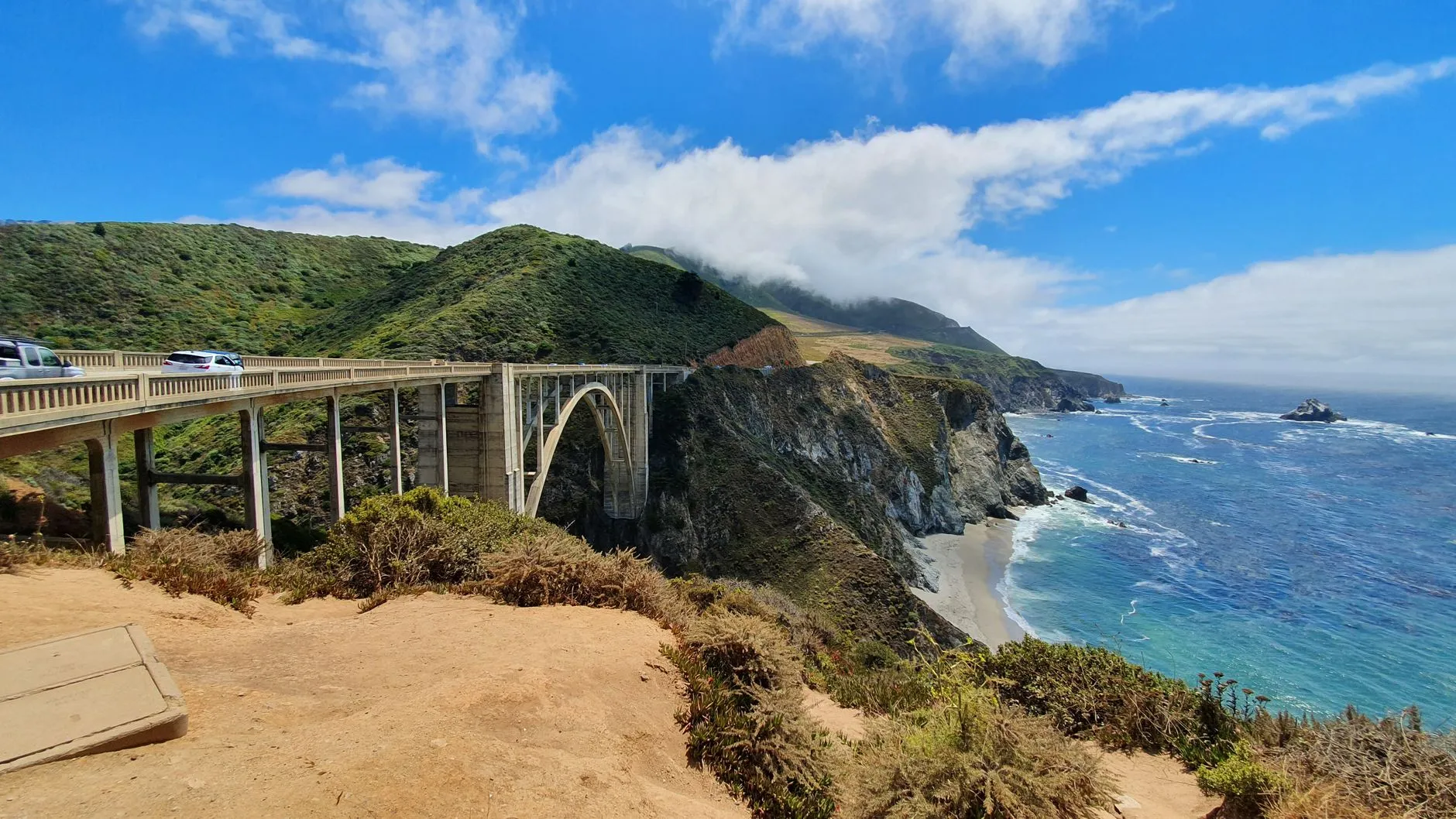
This is the reason to cross an ocean. The 145 km of Highway 1 between Carmel and San Simeon, hugging the cliffs of Big Sur, is one of the truly great drives on earth — the road carved into the side of the Santa Lucia Mountains, the Pacific smashing into rock far below, redwoods crowding the canyons, and not a chain store or billboard for the entire stretch. After three years of landslide closures, Highway 1 fully reopened in January 2026, and you can once again drive the whole coast uninterrupted between Carmel and Cambria for the first time since 2023.
But check before you go. This is the single most important caveat in the guide. The Big Sur coast is geologically unstable — it slides into the sea with grim regularity, and the road has closed, partially or fully, almost every year of the last decade. Before you set out, check the current status at the Big Sur Chamber of Commerce site or Caltrans, because a fresh slide can sever the route with no notice, and there is no quick detour — the inland alternative adds hours.
Drive it north to south if you can, so you’re in the lane nearest the ocean, and give it a full unhurried day, not a dash. The stops worth making: Bixby Creek Bridge (the famous one — go early, the pull-outs fill by mid-morning); Pfeiffer Beach, with its purple-tinged sand and keyhole rock (the unmarked turn-off is easy to miss — deliberately); McWay Falls, an 80-foot waterfall onto a cove beach at Julia Pfeiffer Burns State Park; and a sunset drink on the terrace at Nepenthe, overpriced and entirely worth it for the view.
Fuel and food in Big Sur are scarce and expensive, and there is essentially no mobile signal for 90 minutes of the drive. Fill the tank in Carmel or Cambria, download your maps, and tell someone your plan. This is the one stretch where “we’ll just find somewhere” doesn’t work.
A night actually in Big Sur — at one of the lodges tucked in the redwoods — is magical and brutally expensive (rooms routinely €350–600+ / $400–700). If that’s beyond budget, do it as a long day and sleep in Carmel or Cambria at either end. Either way, don’t treat Big Sur as a photo stop — it deserves the day.
Yosemite & the High Sierra
If Big Sur is the coast at its best, Yosemite is the mountains at theirs — and unlike almost everywhere else in this guide, it more than lives up to the hype. The Valley is a glacier-carved cathedral: El Capitan and Half Dome rising 900 metres of sheer granite, Yosemite Falls thundering in spring, meadows and the Merced River winding through the floor. The first time the Valley opens up in front of you through the tunnel viewpoint, you understand why John Muir spent his life defending it.
Good news for 2026: there is no entrance reservation system. After several years of timed-entry permits, Yosemite has dropped them for 2026 — you can drive in any day of the year without a reservation. You still pay the entrance fee of $35 per vehicle (about €31), valid seven days, by card only — the park takes no cash.
The trade-off for no reservations is crowds. Yosemite Valley in July is a victim of its own beauty: full car parks, shuttle queues, and tour buses by 10am. The fixes are old but they work — go on a weekday, arrive before 9am or after 4pm, and get out of the Valley floor onto the high country. Glacier Point (a road, not a hike) gives you the postcard view of Half Dome from across the canyon. Tioga Road, the high pass over the Sierra crest, is the secret: it climbs to alpine Tuolumne Meadows at 2,600 metres, far quieter than the Valley, and drops down the dramatic eastern escarpment toward Mono Lake. Crucially, Tioga Pass is only open roughly late May/June to October — it’s buried in snow the rest of the year, so a high-country Yosemite trip has to be summer or early autumn. Valley lodging books out months ahead and costs a fortune; the smart play is to stay just outside in Mariposa, Oakhurst or Groveland — or camp — and start your day at dawn, when the Valley is empty and silent rather than a car park with a waterfall.
Be aware of the new nonresident surcharge here (covered in the costs section below): Yosemite is one of the eleven parks where international visitors now pay an extra fee on top of the vehicle entrance. It changes the maths for a family, so read that section before you go.
Lake Tahoe & the Eastern Sierra
If you’ve come for the Sierra, don’t stop at Yosemite. Drive over Tioga Pass to the Eastern Sierra — the lesser-known, drier, more dramatic side of the range — and on up to Lake Tahoe, a vast alpine lake straddling the California–Nevada line, ringed by mountains and astonishingly, almost Caribbean blue at the shallows.
Tahoe is two destinations in one. The North and West Shores (Tahoe City, Emerald Bay) are the quieter, prettier side — Emerald Bay, with its tiny island, is the single best viewpoint. The South Shore is brasher, with Nevada casinos right on the state line. Summer is hiking, kayaking and swimming in cold clear water; winter is some of North America’s great skiing (Palisades Tahoe, Heavenly, Northstar). It’s worthwhile in its own right but a long way from the coast — fold it into a Sierra loop, not a coastal one.
On the way, the Eastern Sierra rewards the detour: Mono Lake, an eerie ancient soda lake studded with mineral towers (tufa); Bodie, a perfectly preserved gold-rush ghost town; and Mammoth Lakes, a high mountain resort. Further south, Mount Whitney (4,421 m, the highest peak in the lower 48) sits within a couple of hours’ drive of the lowest point in North America in Death Valley — a contrast California loves to point out. This is where you escape the crowds entirely: an afternoon at Mono Lake or Bodie, with the great wall of the Sierra at your back, is the quiet, strange California the coast-and-cities crowd never sees.
The Big Trees: Sequoia, Kings Canyon & the Redwoods
California has two completely different kinds of giant tree, and people constantly confuse them. Get this right and you’ll plan a better trip.
Sequoias are the world’s largest trees by volume — colossal, cinnamon-barked, growing only on the western slopes of the Sierra. Sequoia & Kings Canyon National Parks, a few hours south of Yosemite, hold them, including General Sherman, the single biggest living thing on the planet. Standing at the base of one is a genuinely humbling, slightly absurd experience — these trees were already ancient when Rome was founded. Entry is $35 per vehicle (about €31), and note that Sequoia is also on the nonresident surcharge list.
Coast redwoods are the world’s tallest trees — taller, thinner, growing in the foggy belt of the far north coast. The best of them, in Redwood National and State Parks and the Avenue of the Giants, are a serious commitment: nearly ten hours’ drive north of San Francisco, up beyond Mendocino and Eureka. They are spectacular — cathedral groves of 100-metre trees, ferns, silence, fog — but they are not a side trip from a coast-and-cities holiday. If you want redwoods without the marathon drive, the Muir Woods grove just north of San Francisco is a decent (if busy, and reservation-required for parking) taster.
Decide early: sequoias (the fat ones, near Yosemite, easy to bolt onto a Sierra trip) or coast redwoods (the tall ones, in the deep north, a destination in themselves). Trying to do both in one trip means a thousand kilometres of extra driving. Most people should pick the sequoias.
The Deserts: Death Valley, Joshua Tree & Palm Springs
The desert is the California that surprises people most — emptier, stranger, far cheaper, and genuinely otherworldly. It is also the most season-dependent region in the state.
Death Valley is the largest national park in the lower 48 and the hottest, lowest, driest place in North America — Badwater Basin sits 86 metres below sea level, and summer temperatures regularly top 50°C, which is not a figure of speech but a real and occasional killer. Go in winter or early spring (November to March), never in summer. The rewards are immense: the rippled dunes at Mesquite Flat, the polished rock of Golden Canyon, the surreal salt flats, and — in a wet year — a rare desert “superbloom.” Entry is $30 per vehicle (about €26), and Death Valley is not on the nonresident surcharge list. Fuel up before you enter; distances inside are vast and services minimal.
Joshua Tree, a few hours south, is the more accessible desert park: spiky, Dr-Seuss-shaped Joshua trees, giant boulder piles beloved of rock climbers, and some of the darkest night skies in Southern California. It’s an easy add-on from LA or Palm Springs, magical at sunset and after dark, and — usefully for budget-watchers — Joshua Tree is also exempt from the new nonresident surcharge.
Palm Springs is the desert’s playground: a mid-century-modern resort town of swimming pools, palm-lined streets, design hotels and a famous aerial tramway up to alpine forest on Mount San Jacinto. It’s where Angelenos go to lie by a pool, and it makes a comfortable, stylish base for the desert parks. Spring and autumn are perfect; midsummer is a furnace, which is exactly why the hotels are cheapest then if you don’t mind 45°C and air-conditioning.
Time the desert to spring. April brings wildflowers, bearable heat and the best light of the year. The same parks in July are not “hot” — they are genuinely dangerous, and people die in Death Valley most summers. This is the one part of California where the season isn’t a preference, it’s a safety call.
Wine Country: Napa & Sonoma
An hour or two north of San Francisco, Napa and Sonoma valleys produce some of the world’s most famous wine and one of California’s best lunches. The landscape — golden hills, rows of vines, oak trees — is genuinely beautiful, and a long, slow afternoon of tasting and eating here is one of the high points of any northern trip.
But manage expectations, and choose your valley. Napa is the glossy, expensive, famous one: world-class Cabernet, polished tasting rooms, and tasting fees that have crept to a frankly silly €45–90 ($50–100) per person, often requiring a reservation. Sonoma, next door, is the one I’d actually send you to — bigger, more rural, more relaxed, cheaper, with the same quality and a fraction of the pretension. The little town of Healdsburg is the perfect base.
The non-negotiable rule: do not drive yourself between tastings. US drink-driving limits are strict and enforced, and the point of wine country is to drink the wine. Either hire a driver/book a tour, base yourself in a town you can walk around, or designate a stone-cold-sober driver and accept they’re not really tasting. A two-night stay is plenty — wine country is a delicious pause, not a destination to build a whole trip around.
Skip Napa’s marquee estates with the €90 tastings and the coach parties; drive twenty minutes into rural Sonoma, find a small family winery, and have the long, unhurried lunch you actually came for. The wine is just as good and nobody’s rushing you to the gift shop.
The Central Coast & the Cities, Briefly
Between Big Sur and the big cities lies the Central Coast — the gentlest, most liveable stretch of California, and an easy place to slow down.
Monterey and neighbouring Carmel-by-the-Sea anchor the northern end, just south of the Big Sur drive. Monterey’s superb aquarium is worth the entry (it’s a genuine world-leader, not a tourist trap), and the 17-Mile Drive through Pebble Beach is pretty if you don’t mind paying a toll to look at golf courses and millionaires’ houses. Carmel is a chocolate-box village of galleries and cafés — charming for a wander, twee if you stay too long.
At the southern end, Santa Barbara is the one I’d linger in: a Spanish-Mediterranean town of red-tiled roofs, a clean beach, a walkable downtown on State Street, and a wine region (the Santa Ynez Valley, of Sideways fame) just inland. It makes a lovely, low-stress last stop before Los Angeles, or a relaxed base in its own right. The whole Central Coast is where the frantic edge of California softens — use it to recover from the driving.
As for the cities: read the dedicated guides for the depth — but here’s the honest shape of California’s big three and how they fit a road trip.
San Francisco is the most European and the most walkable, the only one with real public transport, and the natural northern start (or end) of a coastal trip. Two or three days: the Golden Gate, the cable cars, the fog, the food, Alcatraz. Be ready for the jarring contrast of great wealth and very visible street homelessness — it’s part of the city’s current reality, and pretending otherwise does visitors no favours. Fly into SFO and start driving south.
Los Angeles is the one that breaks first-timers — not a city so much as a hundred neighbourhoods loosely connected by motorway, with traffic that has to be experienced to be believed. It rewards a plan and a relaxed attitude (the beaches, the food, the museums, the canyons) and frustrates anyone expecting a compact, walkable centre. Give it focus, not a wishlist, and never schedule anything across town at rush hour.
San Diego (SAN), in the far south, is the easiest city in the state to simply enjoy — near-perfect weather year-round, excellent beaches, the world-class zoo and Balboa Park, the charm of La Jolla, and a short hop to the Mexican border. It makes a superb, low-stress endpoint to a southbound coastal trip, or a standalone family base if the big-driving version doesn’t appeal.
If you have to base in one city and refuse to road-trip, make it San Diego, not LA. The weather is reliable, it’s compact enough to enjoy, and you’re spared the worst of the traffic and the disappointment that comes from expecting Los Angeles to be a city in the European sense.
Eating in California
California is, quietly, the best place to eat in America — and it’s not the fancy restaurants that make it so. It’s the produce (this is the nation’s farm and fruit basket, so everything is ridiculously fresh), the Mexican food (closer and more authentic than anywhere outside Mexico), and a culture obsessed with quality ingredients and the outdoors.
Eat the tacos — from trucks, taquerías and roadside stands, especially in LA and San Diego, where a few dollars buys some of the best food of your trip. Try a California burrito (with chips inside — a San Diego invention), proper fish tacos, and the farmers’-market fruit at any Central Valley stand. In-N-Out Burger is the beloved fast-food rite of passage and genuinely good, cheap and fresh — order it “animal style” and don’t overthink it. San Francisco runs from Dungeness crab and sourdough to some of the best fine dining in the country; wine country is where you splurge on a long lunch.
The single best-value meal in California isn’t in a restaurant — it’s three tacos from a busy truck for the price of a coffee back home. Follow the queues of locals, not the reviews. American restaurant tipping (15–20% on top, and it’s not optional) makes sit-down meals pricier than they look, so balance the splurges with the street food.
What It Costs — and the New Nonresident Surcharge
Be honest with yourself: California in 2026 is expensive, often startlingly so for European visitors used to better value. This is not a budget destination, and the gap between the dream and the receipt catches people out.
Rough real-world numbers: a mid-range hotel runs €130–260 ($150–300) a night, more on the coast; Big Sur and Napa lodges top €450 ($500). A rental car is €50–80 a day plus petrol at €1.15+ a litre. A casual restaurant main is €18–26 ($20–30) before the mandatory 15–20% tip and a sales tax that isn’t shown on the menu. Even coffee, parking and a beer cost more than you expect. The price you see is never the price you pay: tax and tip are added on top.
The new national-park surcharge. This is the change that most affects 2026 visitors, and you need to know it. From 1 January 2026, the US introduced a $100-per-person nonresident surcharge at eleven of the most popular national parks — and that includes Yosemite and Sequoia & Kings Canyon, two of the headliners in this guide. That fee is on top of the standard vehicle entrance fee. For a couple visiting Yosemite, that’s an extra $200 (about €175) before you’ve paid the $35 vehicle fee.
Do the maths before you arrive. If your route hits two or more of the surcharge parks, the nonresident America the Beautiful annual pass at $250 (about €220) — which covers the surcharge at every park, for a year — can work out cheaper than paying per-park, per-person. And note the good news: Death Valley and Joshua Tree are exempt from the surcharge, which makes a desert trip notably cheaper than a Sierra one.
The standard US-resident annual pass remains $80 (about €70) but the nonresident version is the one most European visitors will need at the big parks. Buy passes digitally through Recreation.gov before you go.
When to Go & the Wildfire Problem
There is no single “best time” for California — it depends entirely on your route, because the state spans coast, high mountains and deep desert.
- Coast (SF, Big Sur, Central Coast): September and October are the secret season — warm, clear, and free of the summer fog that grey-blankets the coast in June and July (locals call it “June Gloom”). Spring is lovely too.
- High Sierra (Yosemite high country, Tahoe, Tioga Pass): July to September, the only window the mountain passes are reliably open and snow-free.
- Desert (Death Valley, Joshua Tree, Palm Springs): March to April for the bloom and bearable heat; November to February is fine too. Never summer.
And then there is the problem nobody puts on the postcards: wildfire season. California’s fire season has lengthened and worsened, and 2026 is forecast to be an above-average, prolonged season, with peak fire activity expected in July and August. Fires themselves rarely threaten travellers directly, but smoke can wreck a trip — it drifts hundreds of kilometres, turning skies orange, hazing out the views you came for, and making the air genuinely unhealthy for days. A late-summer Sierra or northern trip is the most exposed.
You can’t predict fires, but you can hedge. Favour late September and October over August for the coast and mountains; check air-quality maps (AirNow / PurpleAir) during your trip; and keep your itinerary loose enough to drive away from smoke. The desert and the far south are generally the safest bets in a bad fire year.
Winter is the quiet season everywhere but the ski resorts — cheaper, greener in the south, but with closed mountain passes, a wetter coast, and short days. It’s a fine time for the desert and the cities, a poor one for the high country.
Overrated: What to Skip
A good guide tells you what not to do. After many trips, here’s what I’d happily cut:
- The Hollywood Walk of Fame. The single most disappointing famous attraction in California — a grubby, crowded pavement of brass stars lined with costumed characters demanding tips. Look at it for ten minutes if you must, then leave. Hollywood is a working industry, not a theme park.
- Universal CityWalk (the free shopping-and-restaurant strip outside the theme park). A manufactured outdoor mall pretending to be an experience. The actual Universal Studios park is fine if you like theme parks; the CityWalk is a trap.
- Driving LA to SF on Interstate 5. Six hours of flat, dull Central Valley farmland. If you must cross between the two without the coast, fly — it’s an hour and often cheap. Save the driving for roads that earn it.
- Doing San Francisco as a “day trip” from LA. It is not a day trip. It’s a separate destination 600 km away. Plan it as one or don’t go.
- Over-paying for Napa’s marquee tastings when Sonoma next door offers the same quality, more relaxed, for less.
- The “see all of California in a week” itinerary. The most overrated plan of all. You’ll see the inside of a car. Pick a region. Go deep. Come back for the rest.
What’s genuinely transcendent and worth every euro and every hour of driving: Big Sur at sunset, Yosemite Valley at dawn, the silence of a sequoia grove, a long Sonoma lunch, and the desert in bloom. Chase those. Skip the rest.
Frequently Asked Questions
Cheapest Flights to California
We have tracked 603 fares to California from 87 cities. As of June 2026, here is what a good price looked like from each — the lowest fare we recorded, and a “great-deal” benchmark to judge a quote against. These are tracked observations, not live prices: by the time you read this they will have moved, so treat them as a yardstick, not a quote.
| From | Lowest fare we tracked | Great-deal benchmark |
|---|---|---|
| Hamburg (HAM) | €241 | €345 |
| Stockholm (ARN) | €309 | €442 |
| Budapest (BUD) | €321 | €459 |
| Vienna (VIE) | €322 | €531 |
| Prague (PRG) | €325 | €464 |
| Bologna (BLQ) | €326 | €466 |
| Dusseldorf (DUS) | €349 | €499 |
| Hanover (HAJ) | €372 | €531 |
| Seville (SVQ) | €387 | €553 |
| Nuremberg (NUE) | €394 | €563 |
| Frankfurt (FRA) | €405 | €579 |
| Ljubljana (LJU) | €414 | €592 |
| Toulouse (TLS) | €422 | €603 |
| Bremen (BRE) | €443 | €633 |
Recent deals we have posted to California:
- New York to Sacramento from $221
- Budapest to San Francisco, USA from €366
- Chicago to San Diego, USA from $219
- Boston to San Diego, USA from $222
- Vienna to Los Angeles, USA from €398
- Prague to Los Angeles, USA from €417
- London to Los Angeles, USA from £434
- Frankfurt to Los Angeles, USA from €482
- Bologna to Los Angeles, USA from €393
- Vilnius to Los Angeles, USA from €454
These are fares aifly tracked to this destination, not live quotes — they have changed since and several of the deals above may have expired. Browse current flight deals →