Nigeria — Complete Travel Guide 2026
Nigeria is Africa’s giant and its cultural engine: Lagos exports the music, the films and the swagger that define modern African pop culture, and it pulls a vast diaspora home every December. It is also one of the harder, more serious places a foreigner can choose to travel — not a casual holiday, not a beach break, but a country you go to with a reason, a plan, and ideally a local who has your back. This guide is for the people who actually go, and it tells you the truth about both halves of that sentence.
Quick Reference
West Africa, on the Gulf of Guinea — the continent’s most populous country (~230 million people)
Lagos — Murtala Muhammed (LOS); Abuja — Nnamdi Azikiwe (ABV); smaller hubs at Port Harcourt (PHC), Kano (KAN), Enugu (ENU), Calabar (CBQ)
Nigerian naira (NGN). Roughly €1 ≈ ₦1,500 in mid-2026 — but the rate moves, so check before you go
English (official), plus Yoruba, Hausa, Igbo and 500+ others; Nigerian Pidgin is the real lingua franca
Visa required for almost everyone. Online e-Visa since May 2025. **Yellow-fever certificate mandatory
November–February (the dry, cooler harmattan season; December is peak for events)
Afrobeats, Nollywood, jollof rice, Lagos’s electric energy, oil, and a diaspora that spans the globe
Lagos (the cultural engine) and Abuja (the calm capital) — and, sensibly, not much else
Editor’s Note: Read This First
Let me be straight with you before we go any further, because most “Nigeria travel guides” online are written by people who have never queued at the Murtala Muhammed arrivals hall, and it shows. They give you a cheerful listicle of “top 10 attractions” and bury the only thing that actually matters.
Here is the only thing that actually matters: Nigeria is not a casual tourist destination, and pretending otherwise is dangerous. As of 2026 the US State Department holds Nigeria at Level 3 — “Reconsider Travel” — and lists more than twenty of the country’s thirty-six states as flat-out “Do Not Travel.” In April 2026 Washington went further and authorised the voluntary departure of non-emergency embassy staff and their families from Abuja, citing a deteriorating security situation; gunmen had attacked villages roughly 250 km from the capital days earlier. The UK’s FCDO is blunter still: kidnapping for ransom, it says, is widespread and can happen anywhere in the country.
Read that paragraph twice. This is not a place you wander into off a cheap flight to “see what it’s like.” The casual-backpacker, wing-it, follow-your-nose approach that works in Thailand or Portugal can get you robbed, extorted or kidnapped here. I’m not saying don’t go. I’m saying go like a grown-up.
And yet — people go, in large numbers, and most have a wonderful, eye-opening time. The trick is that almost all of them stick to a narrow, sensible corridor: Lagos, Abuja, and a small handful of calmer spots, moving with trusted drivers and local contacts, not flagging down strangers or roaming border states. Do that, keep your wits about you, and Nigeria will give you something no amount of curated holiday ever will. Skip the homework and you’re rolling dice you don’t understand.
This guide is written for who actually comes: the diaspora returning to family, business travellers, music-and-culture pilgrims chasing the source of Afrobeats and Nollywood, and the small tribe of seasoned, switched-on adventurers who know what they’re walking into. If that’s you, read on. If you wanted a relaxing two-week sun holiday, this is the wrong country — and I’ll tell you the right ones at the end.
Should You Go? Who Nigeria Is For — and Who It Isn’t
Be honest with yourself about your category, because Nigeria rewards clarity and punishes the under-prepared.
Nigeria is for you if you are:
- Diaspora. This is the single biggest group of foreign arrivals — Nigerians and children of Nigerians coming home for weddings, funerals, Christmas, family. You’ll have people who know the terrain, who handle the airport, who tell you which roads not to take after dark. That local network is worth more than any guidebook, this one included.
- A business traveller. Lagos is the commercial capital of the continent’s largest economy; Abuja is the political one. Plenty of people fly in, do their meetings inside a managed bubble of hotels and drivers, and fly out. That bubble works.
- A culture-and-music pilgrim. If you came up on Burna Boy, Wizkid, Davido, Tems, Rema and Asake; if you’ve fallen down a Nollywood rabbit hole; if you want to stand in the city that exports all of it — Lagos is the source code, and there’s nothing else like being there during “Detty December.”
- A genuinely experienced, risk-literate traveller who has done hard places before, arranges security and logistics properly, and doesn’t confuse bravado with competence.
Nigeria is NOT for you if you are:
- A first-time long-haul traveller looking for an easy, relaxing trip.
- Someone who wants beaches, resorts and a low-effort holiday — go to Zanzibar, Cape Verde, the Gambia or Mauritius instead.
- A solo wanderer who likes to “see where the day takes me” with no fixed plan and no local contact.
The single best predictor of whether you’ll have a great trip or a miserable one is not your budget — it’s whether you have a trustworthy person on the ground. A cousin, a colleague, a fixer, a hotel that arranges everything. With that, Lagos opens up like a flower. Without it, you’ll spend the whole time tense, overcharged and one bad decision from trouble.
If you’re in the “for you” column, the rest of this guide is your operating manual.
The Visa, and the One Vaccine You Can’t Skip
Nigeria requires a visa from nearly every nationality, and in 2026 the process is finally, genuinely digital.
The e-Visa. On 1 May 2025 Nigeria scrapped its old, much-loathed Visa-on-Arrival mess and launched a proper online e-Visa system, covering 177 nationalities and applied for through the Nigeria Immigration Service portal (immigration.gov.ng). You fill in the form, upload your passport bio page, a photo, hotel booking and supporting documents, pay online, and most decisions come back by email within 48 hours (express within 24). The tourist visa is the F5A, single-entry, typically valid for a 30–90 day stay, and crucially it is non-extendable — sort your dates before you apply. Your passport must have at least six months’ validity beyond your entry date. Alongside the visa, Nigeria rolled out digital Landing and Exit cards you complete online before you fly, so keep the confirmations on your phone.
The cost is uneven and worth checking. Fees are set by nationality and reciprocity. As a rough 2026 guide, US citizens pay around the equivalent of €150–170, while EU, UK and Australian passport holders are charged noticeably more — roughly €270–300 — plus small biometric and service fees. Don’t take a flat number as gospel; pull up your own nationality on the official portal.
Apply through the official Nigeria Immigration Service site, not the swarm of look-alike “visa service” pages that crowd the search results and tack on fat markups. If a site is charging you triple and promising “guaranteed approval,” close the tab.
The yellow-fever certificate is not optional. This trips people up every year. A valid yellow-fever vaccination certificate (the Yellow Card) is legally required to enter Nigeria for everyone over nine months of age — and they do check, at the desk, on arrival. The jab must be given at least 10 days before you travel for the certificate to be valid; since 2016 the WHO has made the certificate valid for life, so if you were vaccinated years ago for another trip you’re almost certainly still covered. Infants under nine months and travellers over 60 are generally exempt. Carry the physical card. Some travellers are also asked for a polio vaccination record.
Beyond the legal requirement, Nigeria is a high-malaria country — take prophylaxis seriously, pack repellent with DEET, and talk to a travel clinic about routine boosters (hepatitis, typhoid, etc.) well before you fly. Medical care outside the best private Lagos and Abuja hospitals is thin, so comprehensive travel insurance that explicitly covers Nigeria and medical evacuation is non-negotiable.
Money: The Naira, the Float, and What Things Actually Cost
The Nigerian naira is one of the world’s more dramatic currencies, and understanding its recent history will save you both money and confusion.
In June 2023 the central bank abandoned its long-standing currency peg and let the naira float. It fell about 23% in a single day, and it has kept sliding since: from roughly ₦600 to the dollar before the float to around ₦1,377 to the US dollar by mid-2026 — call it ₦1,500 to the euro. The float was meant to bring transparency and lure investment, and it has done some of that, but the short-term cost has been brutal inflation: consumer prices were running near 16% in mid-2026, with food inflation closer to 18%, sharpened by a March 2026 fuel-price shock linked to conflict in the Middle East. For Nigerians this is genuine economic hardship. For a euro-earning visitor, the practical upshot is that Nigeria is cheap if you bring hard currency — but the rate moves week to week, so don’t memorise a number.
A few realities of handling money on the ground:
- Bring crisp, recent, large-denomination US dollars or euros to change. Old or marked notes get poor rates or refused. Change at a hotel or a reputable bureau de change, not the men shouting “change money” on the street.
- Cards work in the good places — upmarket hotels, malls, the better restaurants in Lagos and Abuja — but Nigeria still runs heavily on cash, and a 2023–24 cash-shortage crisis left people wary. Carry naira for markets, transport, suya and tips.
- ATMs exist but can be unreliable for foreign cards and often have low withdrawal limits; treat them as a backup, not a plan.
Roughly what things cost in 2026 (with the caveat that volatility makes any figure soft):
- A plate of jollof and protein at a local buka: €1.50–4.
- A stick of suya from a roadside mai-suya: well under €1.
- A drink in a mid-range Lagos bar: €3–6; in a flashy Lekki nightclub with bottle service, the sky is the limit.
- A night in a solid Victoria Island or Ikoyi business hotel: €90–200; the marquee names (Eko, the Wheatbaker, Lagos Continental) run higher.
- A reliable, vetted driver-with-car for a full day: €40–80, and the best money you’ll spend.
- A one-way domestic flight Lagos–Abuja: typically €60–120 depending on airline and how late you book.
Tip generously and in cash — the people doing the hard work of getting you around safely are operating in a brutal economy. A good driver who keeps you safe in Lagos traffic for a week deserves real money, not loose change.
Getting There & Around
Flying in. Most international arrivals land at Lagos — Murtala Muhammed International (LOS), the busiest airport in West Africa and the natural gateway for the culture-and-business crowd, or at Abuja — Nnamdi Azikiwe (ABV), calmer and the better entry point if the capital is your focus. There are direct connections from London, Paris, Frankfurt, Amsterdam, Istanbul, the Gulf hubs, Addis Ababa and Casablanca. Lagos arrivals can be chaotic — long immigration queues, hustlers offering “help” with your bags for a fee, touts steering you toward unofficial taxis. Have your yellow card and e-Visa printout ready, ignore anyone not in clear uniform, and — this is the important bit — arrange your pickup before you land.
Never, ever take a random taxi from outside Lagos airport, and never accept a “helpful” stranger’s offer to drive you. Your hotel, your host or a known ride app should have a named driver waiting. The airport-to-city transfer is the single highest-risk moment of a Lagos trip; treat it like one.
The traffic. Lagos’s “go-slow” is legendary and not exaggerated. A journey that’s 15 km on the map can take two hours in the wrong window. Build enormous buffers, avoid moving at rush hour, and accept that you will spend real chunks of your trip sitting in a car watching the city flow past — hawkers selling everything from plantain chips to phone chargers through the window. It’s part of the experience; it’s also exhausting.
Getting around the cities. Inside Lagos and Abuja, your options are a private driver (best), reputable ride-hailing apps (Bolt and Uber both operate, and give you a record of the trip — far safer than street taxis), and, for the brave and the local, the yellow danfo minibuses and keke tricycles that are cheap, atmospheric and not advisable for a visitor who doesn’t know the ropes. Okada motorcycle taxis are fast, dangerous and banned across large parts of Lagos — skip them.
Getting around the country. For any inter-city distance, fly, don’t drive. Nigeria’s intercity roads carry real risks — armed robbery and kidnapping on certain highways, plus genuinely poor surfaces and night-driving dangers. A decent domestic airline network connects the major cities: Air Peace, Ibom Air, United Nigeria, Green Africa and Arik among them. Ibom Air in particular has a reputation for punctuality that’s almost un-Nigerian. Book the morning flight (afternoon delays compound) and keep your plans flexible.
Lagos: Africa’s Cultural Superpower
If you go to one place in Nigeria, you go to Lagos — and you should understand that you are not visiting a tourist city. You are visiting the loudest, most ambitious, most creatively explosive city on the African continent, a place of some 20 million people that exports culture the way the Gulf exports oil.
This is the city that made Afrobeats a global genre. Wizkid, Davido, Burna Boy, Tems, Rema, Asake, Ayra Starr — they came up here, in the studios of the mainland and the clubs of the islands, and the sound that now headlines festivals from London to Coachella was forged in Lagos sweat. It’s also the engine of Nollywood, the most prolific film industry on earth by output, churning out a universe of films that the rest of Africa watches obsessively. And it’s a serious art and design city now, with galleries, the annual Art X Lagos fair (West Africa’s biggest), and a fashion scene that’s genuinely world-class.
Understand the geography, because it shapes everything. Lagos splits into two worlds. The Islands — Victoria Island, Ikoyi, and the booming reclaimed sprawl of Lekki — are where the money, the embassies, the good hotels, the galleries, the rooftop bars and most visitors live. The Mainland — Yaba, Surulere, Ikeja — is older, denser, grittier, and where much of the real cultural life and the best street food actually happens. Most visitors base on the islands and dip into the mainland with a guide. That’s a sensible split.
What’s genuinely worth your time:
- Nightlife and live music. This is Lagos’s superpower. The island clubs and lounges on Lekki and VI go hard, and during December the calendar fills with concerts and parties featuring the biggest names in African music. If you time it right and have someone who knows the scene, this is unforgettable.
- The New Afrika Shrine in Ikeja — the venue run by the Kuti family, keeping Fela’s Afrobeat legacy alive with live performances. Raw, sweaty, real; go with locals.
- Nike Art Gallery in Lekki — a vast, five-storey trove of Nigerian art run by the legendary Nike Davies-Okundaye. One of the easiest, most rewarding cultural stops in the city.
- Lekki Conservation Centre — a patch of preserved wetland with a long canopy walkway, a genuinely pleasant green half-day inside the megacity.
- The food, the markets, the street life — covered below, but the texture of ordinary Lagos, experienced safely with a guide, is the point.
Lagos is not a “sights” city. You don’t tick off monuments here. You come for the energy, the music, the food, the people and the sheer overwhelming scale of human ambition crammed onto a few islands and a lagoon. If you arrive expecting a checklist of attractions you’ll be disappointed; if you arrive ready to plug into the city’s pulse, it’ll rearrange your idea of what a city can be.
A word on the much-hyped beaches: Lagos’s beaches are mostly disappointing. Tarkwa Bay (reached by boat) and the private beach resorts toward Lekki and the Lekki–Epe corridor are the better bets, but the Atlantic here is rough, the public beaches can be unsafe and litter-strewn, and this is emphatically not a beach-holiday coast. Manage expectations.
Eating in Lagos: Jollof, Suya and the Buka
Here’s where Nigeria delivers an unambiguous, no-asterisks triumph: the food is sensational, and Lagos is one of the great eating cities of Africa.
Start with jollof rice — the smoky, tomato-and-pepper-stewed rice that is the heart of West African cooking and the subject of the continent’s most joyful, most ferocious culinary feud. The Jollof Wars between Nigeria and Ghana are real, are taken seriously, and you should have an opinion before you leave. (For the record: Nigerian jollof, cooked properly over wood fire until the bottom catches into smoky party-jollof crust, is the superior dish, and I will die on this hill. Ghanaians are wrong but charming about it.) Eat it at a wedding or a party if you possibly can — owambe party jollof, cooked in vast pots for a crowd, is the genre’s peak.
Then suya — thin skewers of beef (or offal, or chicken) coated in a fiery, nutty spice blend called yaji and grilled over coals by a mai-suya at a roadside stand, served with raw onions and more pepper. It is the perfect late-night street food and one of the world’s great grilled meats. Find a busy stand, watch it come off the fire, and don’t overthink the hygiene anxiety — turnover is your friend.
The rest of the canon is deep and worth exploring:
- Egusi soup (melon-seed, thick and rich) with pounded yam or eba — the comfort-food core of the cuisine.
- Pepper soup — a clear, ferociously spiced broth with catfish or goat; medicinal, restorative, addictive.
- Jollof’s cousins: fried rice, ofada rice with its pungent, funky ayamase pepper sauce — a Yoruba speciality worth seeking out.
- Puff-puff (sweet fried dough), akara (bean fritters), moi moi (steamed bean pudding), plantain in every form.
Where to eat: the buka (also called mama put) — the humble, often open-air local canteens where ordinary Lagosians eat — is where the real food lives, and a guide can steer you to a clean, busy one. At the other end, Lagos’s island restaurant scene is genuinely sophisticated, with serious modern-Nigerian kitchens and every international cuisine you’d want. Both are worth your time; the buka is the soul of it.
Drink bottled water, eat at busy places with high turnover, and don’t let a fear of “street food” rob you of the best part of Nigeria. The suya stand with a queue is safer than the empty fancy restaurant. Your stomach may protest the chillies — pace yourself with the pepper, because Nigerians do not joke about heat.
Abuja: The Calm, Planned Capital
If Lagos is the chaos, Abuja is the order — and for a lot of visitors, especially nervous first-timers, it’s the gentler way to meet Nigeria.
Built from scratch in the 1980s and 90s as a neutral, central capital to replace overcrowded Lagos, Abuja is spacious, planned, green and noticeably calmer, with wide boulevards, modern government districts and far less of Lagos’s sensory assault. The skyline is anchored by the gold-domed National Mosque and the National Christian Centre facing each other across the city — a deliberate statement about Nigeria’s Muslim-north, Christian-south balance. Aso Rock, the great granite monolith looming behind the presidential complex, gives the city its dramatic backdrop.
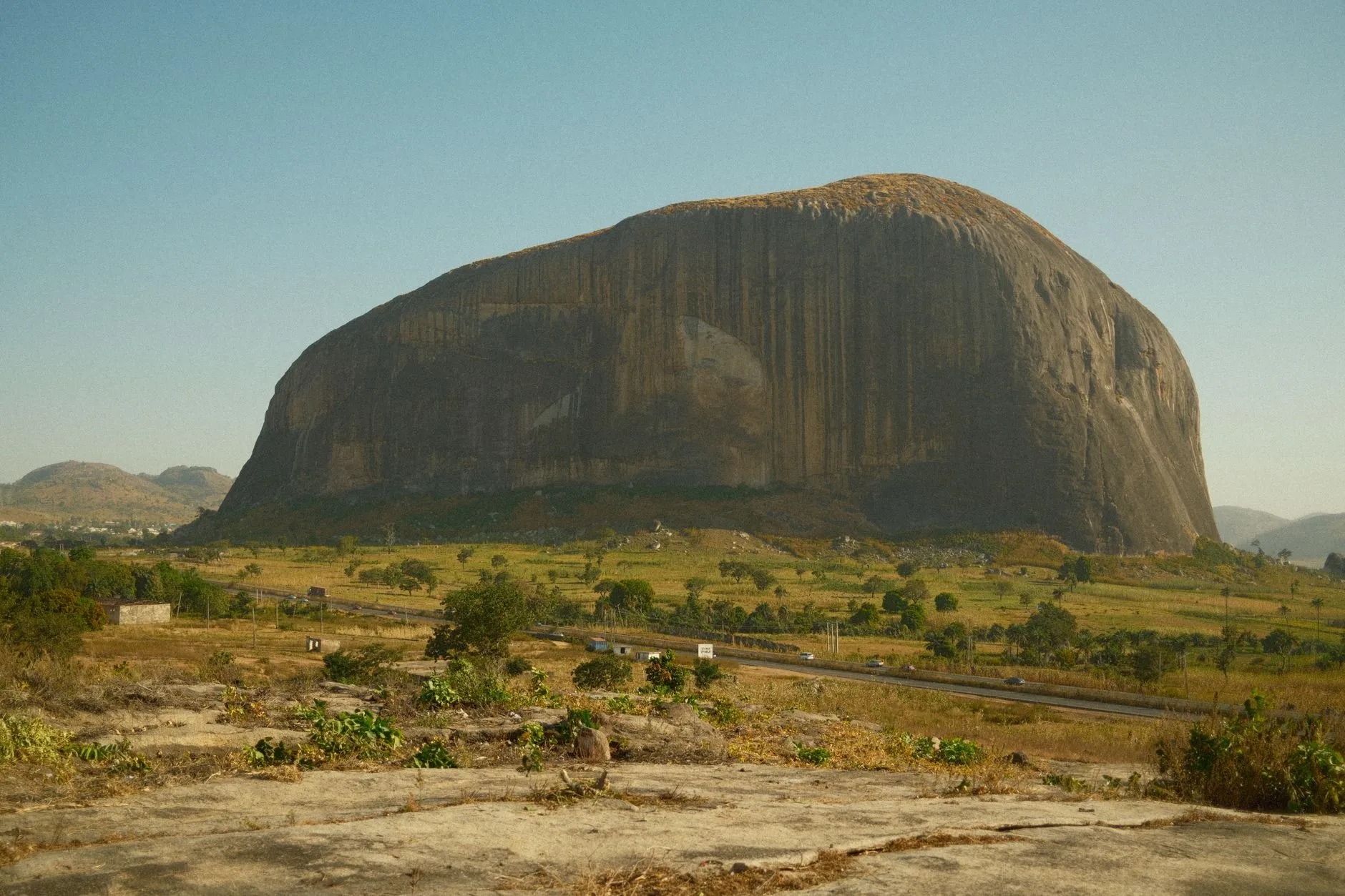
Just outside the city stands Zuma Rock, the colossal 725-metre monolith — bigger than it looks in photos — that you’ll have seen on the old ₦100 note. It rises straight out of the plain on the road toward Kaduna, and it’s the closest thing Abuja has to an unmissable natural landmark. A caution, though: the highway toward Kaduna and the wider northern approaches have a poor security record, so see Zuma Rock with a trusted local driver who knows current conditions, and don’t push further north on a whim.
Abuja itself offers the Millennium Park, the buzzing Jabi Lake waterfront with its mall and boat rides, the craft stalls of the Arts and Crafts Village, and a restaurant-and-lounge scene that’s smaller than Lagos’s but genuinely good. It is, frankly, an easier place to relax, sleep well, and exhale between the more intense parts of a Nigeria trip.
Use Abuja as your soft landing or your decompression. Many seasoned visitors fly into Abuja first to acclimatise, then take on Lagos. The capital won’t give you Lagos’s electricity — nothing will — but it’ll give you a calmer base, cleaner air, and a reminder that Nigeria contains multitudes.
Calabar and the Cleaner South-East
Down in the far south-east, on the Cross River near the Cameroon border, Calabar has long traded on a reputation as one of Nigeria’s cleanest, most orderly and most welcoming cities — a genuinely different texture from the rest of the country.
Its headline event is the Calabar Carnival, billed as “Africa’s biggest street party,” which takes over the city every December with a month-long festival of costumed bands, music and parades that draws performers and visitors from across the continent. If you’re already in Nigeria for Detty December and want something beyond the Lagos club circuit, the Carnival is a legitimate reason to fly down.
Calabar also offers real history and nature: the slave-trade heritage of this old port (the sobering museums and relics of the transatlantic trade), the Drill Ranch / Cercopan primate sanctuaries doing serious conservation work with endangered drills and monkeys, and access to the lush Cross River forests beyond.
A crucial caveat: Calabar sits in Cross River State, but several of its south-eastern neighbours — including parts of Rivers, Bayelsa, Delta, Imo, Anambra, Abia and Enugu — carry “Do Not Travel” advisories for kidnapping and unrest, and the wider Niger Delta has a long history of militancy. Calabar is the calmer exception, not the regional rule. Fly in and out, stay within the city and vetted excursions, and don’t road-trip casually around the south-east.
Wildlife and Nature: Manage Your Expectations
Let me save you a disappointment: Nigeria is not a safari country. If big-game wildlife is your dream, you want Kenya, Tanzania, Botswana or South Africa — Nigeria’s wildlife was hammered by decades of habitat loss and poaching, and what’s left is a fraction of what East and Southern Africa offer, much of it in regions you shouldn’t be travelling to anyway.
That said, for the visitor staying in the safer corridor, there are a few genuine green escapes:
- Obudu Mountain Resort (Cross River State) — a former cattle ranch high in the misty mountains near the Cameroon border, with a famous cable car, cool air, hiking and a hill-station calm that feels a world away from Lagos. It’s the country’s standout nature-and-relaxation destination, reached via Calabar.
- Yankari National Park (Bauchi State) — Nigeria’s best-known park, with elephants, baboons and the warm spring-fed Wikki Warm Springs. The catch is its location: Bauchi State carries security warnings, so this requires careful, current advice and is not a casual trip.
- Lekki Conservation Centre (Lagos) — the easy, safe, in-city dose of greenery and the canopy walkway, covered above.
- The Cross River forests and primate sanctuaries around Calabar — the most accessible serious-conservation experience.
Come to Nigeria for the culture, the music, the food and the human energy — not the animals. If a friend tells you they’re “going to Nigeria on safari,” gently redirect them. The wildlife that’s worth seeing here sits mostly inside the country’s red zones, and the bits that don’t (Obudu, Lekki) are about landscape and calm, not the Big Five.
Overrated / What to Skip
A guide that only tells you what to do is doing half its job. Here’s what I’d quietly drop from your itinerary:
- Lagos’s public beaches. As covered, the rough Atlantic, the safety issues and the litter make most of them a poor use of time. If you want sand, take a boat to Tarkwa Bay or use a private resort beach — and even then, keep your expectations modest.
- Long road trips “to see the country.” The romance of an overland Nigeria journey runs straight into the reality of highway robbery, kidnapping corridors and brutal road conditions. Fly between cities. The scenic-drive fantasy is not worth the risk.
- The northern cultural heavyweights — for now. Kano’s ancient dye pits and old city, the Durbar festivals, the historic emirates of the north — these are genuinely extraordinary, and in a calmer era they’d be the jewels of a Nigeria trip. In 2026, with the north-east and north-west under heavy security warnings, they are off-limits for all but the most specialised, professionally-secured travel. Acknowledge what you’re missing; don’t try to wing it.
- “Doing it all.” Nigeria tempts ambitious itineraries. Resist. A focused trip — Lagos deeply, Abuja as a base, maybe Calabar in December — beats a frantic sweep that puts you on dangerous roads chasing sights.
- Over-paying for a “guided tour” that’s really a fixer markup. Some operators charge eye-watering sums to do what a trusted local driver and a bit of homework would do for a fraction. Vet your operator; ask the diaspora.
Safety: The Honest, Region-by-Region Breakdown
This is the section that matters most, so I’m going to be specific rather than hand-wave. Nigeria’s security situation is serious, real, and highly regional — the difference between a Lagos island and a north-eastern border state is the difference between an ordinary big-city trip and a genuine warzone. Treat the country as a patchwork, not a monolith.
The official picture (2026). The US State Department rates Nigeria Level 3 — Reconsider Travel overall, and in April 2026 authorised the voluntary departure of non-emergency embassy staff from Abuja over deteriorating security. More than twenty states carry “Do Not Travel” designations. The UK FCDO warns that kidnapping for ransom is widespread and can occur anywhere, and that dual nationals (including diaspora visitors) are a particular target. Check your own government’s current advice immediately before you travel — this picture shifts.
The “Do Not Travel” red zones (do not go, full stop):
- The North-East — Borno, Yobe, northern Adamawa: the heartland of the Boko Haram / ISWAP insurgency. Active terrorism, no-go.
- The North-West and parts of the North-Central — Zamfara, Katsina, Sokoto, Kaduna, Kano, Bauchi, Gombe, plus Niger, Plateau, Kwara, Jigawa, Taraba, Kogi: rampant banditry, mass kidnappings and communal violence. The kidnapping highways run through here.
- Much of the South-East and Niger Delta — Abia, Anambra, Imo, Enugu, Bayelsa, Delta, Rivers (except Port Harcourt): kidnapping, militancy and unrest. Port Harcourt is the partial exception for managed business travel.
Where most visitors actually go — and the real-talk on it:
- Lagos is not on the “Do Not Travel” list, and millions visit safely. But it is a megacity with serious everyday crime — muggings, phone snatching, carjacking in traffic, elaborate scams, and the “419” fraud the city is infamous for. The risks are manageable with city sense: move with a known driver, don’t flash phones or cash, avoid the mainland and the bridges after dark, keep car doors locked and windows up in traffic, and never go anywhere with someone you’ve just met.
- Abuja is calmer and generally the lower-risk major city, but the embassy drawdown and attacks within a few hundred kilometres are a reminder that the capital is not hermetically sealed. Stay in the secure central districts; don’t road-trip into the surrounding states.
Practical rules that apply everywhere you go:
- Arrange trusted transport in advance — this is the recurring theme of this guide because it’s the recurring theme of staying safe.
- Keep a low profile. Don’t display wealth, expensive watches or wads of cash. Dress down.
- Avoid moving after dark between areas, and avoid intercity road travel entirely where you can.
- Have local contacts and a plan. Share your itinerary; keep your embassy’s number; carry copies of your documents.
- Beware the scams. Nigeria’s fraud reputation is earned at the small scale too — fake officials, “lost wallet” tales, romance and business cons, ATM skimming. Be politely sceptical of unsolicited help.
None of this means Nigeria is a place of constant danger for the careful visitor in the safe corridor — it isn’t, and the warmth, humour and hospitality of Nigerians is one of the trip’s great pleasures. It means the margin for error is small and the consequences of a mistake are larger here than almost anywhere else you might travel. Go switched-on, go with people, and respect the country enough to take its risks seriously.
When to Go
Nigeria sits just north of the equator, so it’s hot and humid year-round — but the calendar still matters a great deal.
November to February — the dry season — is the time to go. This is when the harmattan blows down from the Sahara: cooler, drier air that takes the edge off the heat (and brings a dusty haze that can affect flights and views). It’s the most comfortable window and, crucially, the most exciting — December is peak season, both for the vast diaspora homecoming and for “Detty December,” the month-long explosion of concerts, parties, weddings and events that turns Lagos into the most electric city on the continent. If you want the full Lagos experience, come in December — but book flights and hotels far ahead, because the diaspora floods in and prices spike.
December is also Calabar Carnival and the heart of the festival season nationwide.
March to October is hotter and wetter. The rains run roughly April to October, peaking mid-year, bringing flooding to parts of Lagos and grinding the city’s traffic to an even worse crawl. It’s cheaper and quieter, and perfectly doable for business, but it’s not the season you’d choose for a first cultural trip.
Plan a December trip the way you’d plan a major event: months ahead. The combination of diaspora homecoming and Detty December means flights from Europe sell out and Lagos hotel rates climb steeply. If your dates are flexible and you want the energy without the absolute peak crush, aim for late November or early January.
Frequently Asked Questions
Cheapest Flights to Nigeria
We have tracked 1,594 fares to Nigeria from 97 cities. As of June 2026, here is what a good price looked like from each — the lowest fare we recorded, and a “great-deal” benchmark to judge a quote against. These are tracked observations, not live prices: by the time you read this they will have moved, so treat them as a yardstick, not a quote.
| From | Lowest fare we tracked | Great-deal benchmark |
|---|---|---|
| Verona (VRN) | €337 | €482 |
| Bologna (BLQ) | €354 | €506 |
| Turin (TRN) | €381 | €544 |
| Sicily (CTA) | €390 | €557 |
| Naples (NAP) | €392 | €560 |
| Dublin (DUB) | €412 | €588 |
| Florence (FLR) | €421 | €601 |
| Malta (MLA) | €469 | €670 |
| Vienna (VIE) | €470 | €672 |
| Salzburg (SZG) | €484 | €692 |
| Amsterdam (AMS) | €489 | €698 |
| Stockholm (ARN) | €491 | €701 |
| Dusseldorf (DUS) | €494 | €706 |
| Cologne (CGN) | €499 | €713 |
Recent deals we have posted to Nigeria:
- Naples to Lagos, Nigeria from €454
- Hanover to Lagos, Nigeria from €659
- Riga to Lagos, Nigeria from €748
- Berlin to Lagos, Nigeria from €720
- Vienna to Lagos, Nigeria from €670
- Vienna to Abuja, Nigeria from €758
- Dublin to Lagos, Nigeria from €668
- Venice to Lagos, Nigeria from €524
- Riga to Abuja, Nigeria from €618
- Bari to Lagos, Nigeria from €573
These are fares aifly tracked to this destination, not live quotes — they have changed since and several of the deals above may have expired. Browse current flight deals →