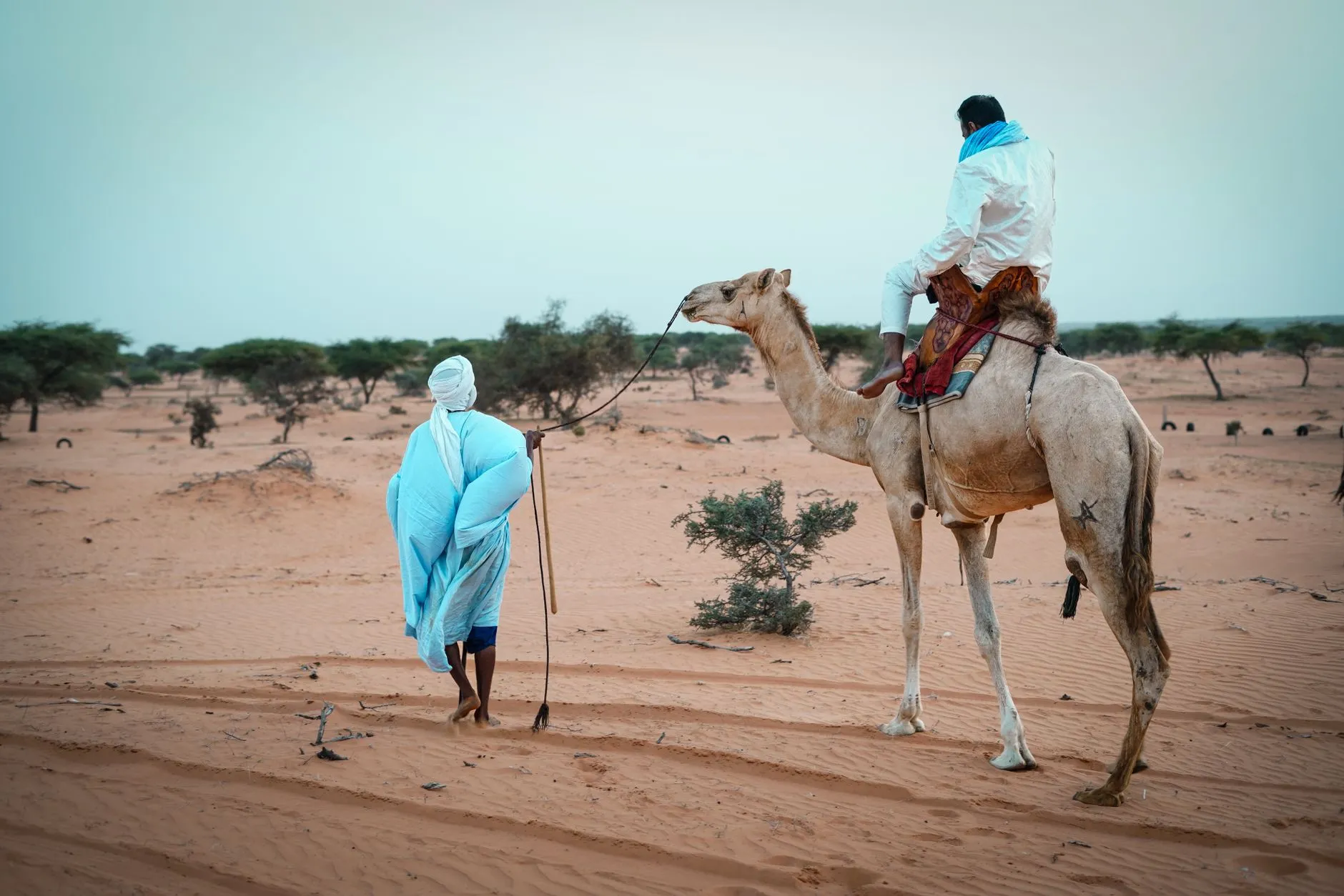
Mauritania — Complete Travel Guide 2026
Mauritania is the Sahara stripped of everything that makes the Sahara easy — no tour-bus circuits, no infinity pools over the dunes, no Instagram queue at the famous viewpoint, because there is no queue and barely a viewpoint sign. What it has instead is the real thing: a three-kilometre train of iron ore that you can ride on top of, across the desert, under a sky with no light pollution for 500 miles; medieval libraries of handwritten manuscripts still sitting in mud-brick rooms on the edge of advancing dunes; two million birds wintering on an empty Atlantic shore. It is one of the last genuinely unpackaged adventures left on earth — and it asks a great deal in return. This guide is honest about both halves of that bargain.
Quick Reference
Northwest Africa, on the Atlantic, where the Maghreb dissolves into the Sahel — bordered by Western Sahara, Algeria, Mali and Senegal
Nouakchott–Oumtounsy International (NKC); Nouadhibou International (NDB)
Mauritanian ouguiya (MRU) — a closed, cash-only currency you cannot get before you arrive (~€1 ≈ 40 MRU)
Arabic (official) and Hassaniya Arabic; French widely used in business and admin; Pulaar, Soninke and Wolof in the south. Very little English
Visa required for almost everyone; visa-on-arrival €55 at Nouakchott airport and the PK55 land border, plus an e-visa system — confirm the current rule before you fly. Yellow-fever certificate mandatory
November to March — the only sane window. Summer is 45°C of furnace heat
The iron-ore train (the world’s longest); the ancient caravan towns and manuscript libraries of Chinguetti and Ouadane; Banc d’Arguin’s millions of birds; raw, unpackaged Sahara
Nouakchott to land and resupply; Atar as the gateway to the Adrar; Nouadhibou for the train and the coast
Editor’s Note: Why I Keep Going Back to the Hardest Country in the Region
I’ll put my bias on the table. I think Mauritania is one of the most rewarding countries in Africa precisely because almost nobody goes. In a year when the famous Saharan destinations — Morocco’s dunes, Egypt’s deserts, the Jordanian wadis — are managing crowds and queue systems, Mauritania still hands you the desert the way travellers found it fifty years ago: enormous, silent, indifferent, and entirely yours.
But I am not going to romanticise it into a beach holiday, because it is the opposite of one. This is a conservative Islamic republic where alcohol is illegal and not sold, where the working languages are Arabic and French and English will get you a polite shrug, where your bank card is a useless rectangle of plastic and the only money that works is cash you carry in, and where a meaningful slice of the country’s map is a hard “do not go” — the eastern desert and the Mali border are an active security zone, not a frontier to push.
The single most useful thing I can tell you: Mauritania rewards the prepared and punishes the casual. Come with a plan, a local agency for the interior, euros in cash, and a flexible spine — and it is magnificent. Come expecting it to organise itself around you, and you will have a miserable, expensive, frightening week.
The travellers who fall in love with Mauritania are the ones who came for the friction. If you want the Sahara with the difficulty sanded off, go to Morocco — genuinely, no shame in it, it’s wonderful. If you want the Sahara with the difficulty left on, keep reading.
Should You Go? Who It’s For — and Who It Isn’t
Let me save you the cost of a hard lesson by being blunt about fit.
This trip is for you if you are a committed adventure traveller who has already done a few logistically awkward places and enjoyed them; if the phrase “no fixed schedule, the train leaves when it leaves” makes you grin rather than panic; if you can go a week without a drink, a working ATM, or a word of English without it ruining your mood; and if you’re willing to spend real money on a local guide or agency for the interior rather than treating that as an optional upsell. Photographers, desert obsessives, birders, rail romantics, and people who measure a trip by how unlike home it felt — this is your country.
This trip is not for you if you travel to relax, if you need predictability and comfort, if a language barrier stresses you, if you’d resent paying for a guide, or if you’d spend the week anxiously refreshing the security news. There is no shame in any of that. There are dozens of countries that will give you a softer, safer, simpler version of “exotic.” Mauritania is not trying to be one of them, and pretending otherwise leads to bad trips.
Be honest with yourself about the security map before you book, not after. The visitable core — Nouakchott, Nouadhibou, the coast, and the Adrar around Atar with a guide — is calm and genuinely rewarding. The east and the Mali border are off-limits, and that is non-negotiable, not a challenge. If you can accept those lines, you’ll have a superb trip inside them.
A note on going solo versus with an agency: independent travel in the safe core is possible — people do ride the train and reach Atar on their own — but for the Adrar interior, for permits north of Atar, for Banc d’Arguin, and for anything involving a 4×4 across unmarked piste, a reputable local operator isn’t a luxury, it’s the thing that makes the trip work and keeps it safe. Most first-timers, and most repeat visitors with sense, use one.
The Visa, the Vaccine, and the Money You Can’t Get Anywhere Else
These three logistics trip up more travellers than the desert ever does. Get them right before you leave home.
The visa. Almost every nationality needs one. The traditional route — and one that, as of early 2026, is still widely reported to work — is a visa-on-arrival at Nouakchott–Oumtounsy International Airport for €55, paid in cash, single-entry, valid for 30 days. The same biometric visa is issued at the PK55 land border post near Nouadhibou if you’re coming overland from Morocco/Western Sahara. However — and this is the important caveat — Mauritania has also rolled out an e-visa system, and some official and embassy channels now push travellers to obtain authorisation online before boarding (figure roughly €55–€60). The picture genuinely shifts, airlines sometimes ask for proof at check-in, and the rules have tightened in recent years.
Do not write your visa plan from a blog — including this one. Check your own government’s travel page and a Mauritanian consular source within a few weeks of departure, and if there’s any doubt, arrange the e-visa in advance. Carry €55–€60 in clean euro notes either way. The cost of getting this wrong is being turned around at check-in.
The vaccine. A yellow-fever vaccination certificate is mandatory, and unlike some countries that only ask if you’ve come from a risk zone, Mauritania takes it seriously — carry the yellow card and have it accessible at the airport. Get the jab well in advance (it needs ~10 days to be valid). Beyond that, talk to a travel clinic about the usual Sahel suite: typhoid, hepatitis, routine boosters, and malaria precautions for the south and the wet months. There’s no reliable Western-standard hospital outside Nouakchott, and even there, serious cases get evacuated — travel insurance with medical evacuation isn’t optional, it’s the whole point.
The money — read this twice. The Mauritanian ouguiya (MRU) is a closed currency: you cannot buy it before you arrive, you cannot reliably spend it after you leave, and you cannot count on an ATM or a card terminal once you’re off the few main streets of the capital. This is a cash economy, and the cash you bring in is euros (US dollars work too but euros are king here). Change what you need at a bank or licensed bureau in Nouakchott, carry the rest of your budget in euros, and assume your bank card will do nothing useful in the interior.
One more money trap that catches everyone: in 2018 the ouguiya was redenominated at 10-to-1, knocking a zero off everything, and the old MRO notes were fully demonetised in 2019. The problem is that the internet didn’t update. You will find prices online quoted in old ouguiya that look ten times too high, and you’ll occasionally hear older Mauritanians still quote prices in the old money out of habit. Roughly €1 ≈ 40 MRU in the new currency — sanity-check every number against that, and ask “new or old?” if a figure seems insane.
Getting There, and Getting Around
Flying in. Nearly everyone arrives at Nouakchott–Oumtounsy International (NKC), a modern airport northeast of the capital. The most useful connections are from Paris, Casablanca, and Istanbul, with Royal Air Maroc, Air France, Turkish, and Mauritania Airlines among the carriers; from Europe you’re usually one stop and a few hundred euros each way in the right season. Nouadhibou (NDB) in the north has more limited service and is most useful if you’re building a trip around the train and the coast.
The overland option. A trickle of overlanders still drive down the Atlantic route from Morocco through Western Sahara to the PK55 border and on to Nouadhibou — a serious, bureaucratic, multi-day undertaking with a no-man’s-land crossing that is not for the casual. If you’re flying, ignore it; if you’re an overlander, you already know the drill.
Getting around, honestly. There is effectively no tourist transport infrastructure in the sense you’re used to. The paved network is thin — a decent road links Nouakchott to Atar, another up the coast toward Nouadhibou — and beyond the tarmac you are on piste: unmarked desert track that requires a 4×4, a driver who knows it, and sand-driving skills you almost certainly don’t have. Shared bush taxis and minibuses connect the towns cheaply if uncomfortably, and they’re a real, characterful way to travel between Nouakchott and Atar. But the moment your plan involves leaving the few sealed roads — which is the moment Mauritania gets good — you need a vehicle and a guide.
Don’t try to self-drive the interior on a first visit. People with serious 4×4 experience do it, but the margin for error in a country with no roadside assistance, no signage, and vast empty quarters is brutal. Hire the desert; don’t fight it.
This is the practical reason the local-agency model dominates here. A good operator supplies the 4×4, the driver-guide, the cook, the permits, and the local knowledge of where the soft sand and the security lines are — and it transforms the Adrar from an ordeal into one of the great desert journeys.
The Iron-Ore Train: The Reason Half of You Are Reading This
Let’s talk about the thing that put Mauritania on the bucket list. Out of the iron mines at Zouérat, in the far north, a train runs roughly 700 kilometres across the desert to the port at Nouadhibou — over 200 wagons, up to two and a half or three kilometres long, hauling its tonnage of ore on a single track that pins the edge of the Sahara. It is routinely called the longest and heaviest train in the world, and riding it is one of the planet’s last genuinely free, genuinely wild journeys.
Here is the honest 2026 version, because the situation has shifted. There are two ways to ride. The first is the single passenger carriage that the railway operator (SNIM) attaches — a basic, dusty coach with seats, the official and sanctioned way to travel, cheap or nominal in cost. The second is the legendary one: climbing into the open ore wagons and riding on top of (or down inside) the iron, exposed to the desert, the wind, and a night sky that will ruin you for every other sky. Be clear-eyed: riding the open wagons is not officially authorised, and enforcement varies by place, by day, and by who’s on duty. It is also genuinely demanding and not without risk — there is iron-ore dust in everything, cold at night, brutal sun by day, no facilities, no safety net.
If you ride the wagons, you do it knowing it’s unsanctioned and that you are responsible for yourself. Bring far more than you think: a scarf or chèche to wrap your face against the dust, ski goggles, serious warm layers for the night, gloves, food, several litres of water, a headtorch, and a mat or cardboard to sit on. People romanticise the train; the ones who suffer are the ones who packed for a day trip.
Direction matters. Travelling north (Nouadhibou → Zouérat) the wagons run empty, so you ride inside the steel tub — sheltered, less spectacular. Travelling south (Zouérat → Nouadhibou) the wagons are loaded, and you ride on top of the ore, which is the iconic image — and the colder, harsher, more exposed one. Most travellers staging from the Adrar join or leave the train at Choum, the desert junction a few hours from Atar, rather than going all the way to the mines.
The schedule, such as it is, runs daily-ish in each direction, but it does not run to a timetable you’ll find printed anywhere — it leaves when it leaves, which can mean hours of waiting in the desert for a train you can hear long before you see. That uncertainty is the experience. The ride itself is something between 12 and 20 hours depending on stops, and you arrive at the far end black with ore dust, exhausted, and — if you’re the right kind of traveller — completely converted.
My one piece of editorialising: do the train as a deliberate centrepiece, not a stunt to tick off. The travellers who rush it, ride a couple of hours for the photo and bail, miss the point. The point is the duration — the slow hours of empty desert, the cold blue dawn over the dunes, the sheer indifferent scale of it. Give it a full leg.
The Adrar: Ancient Towns, Medieval Libraries, and the Best of Mauritania
If the train is the headline, the Adrar plateau is the heart — and for many travellers, including me, it’s the real reason to come. The gateway is Atar, a workaday market town a long day’s drive (or bush taxi) north of Nouakchott, where most desert trips assemble. From Atar, a handful of places justify the entire journey.
Chinguetti is the one you’ll have seen photographs of: a half-buried medieval town on the edge of the dunes, its 13th-century stone minaret still standing, sand drifting up against the walls of the old quarter. Its real treasure is its libraries — around a dozen family-held collections of handwritten Islamic, scientific and legal manuscripts, some dating back to the 12th and 13th centuries, when Chinguetti was a stop on the trans-Saharan caravan and pilgrimage routes and a centre of learning. The keepers will, for a modest fee, lift these fragile, un-digitised books from their cases and turn the pages for you. It is a genuinely moving thing — a thousand years of scholarship surviving in mud-brick rooms on the front line of the desert. Give it half a day, not half an hour.
Ouadane, further out, is the quieter, harder-to-reach, and to my eye more atmospheric of the two: a fortified stone caravan city, much of it intact, simply sitting in the desert above its palm valleys. Both towns belong to a UNESCO World Heritage listing (alongside Tichitt and Oualata in the deep interior) recognising the ancient ksour of Mauritania.
If you only have time for one ancient town, the lazy choice is Chinguetti for the libraries and the easy logistics — but if you can manage the extra drive, do Ouadane too. Standing in that abandoned stone city at sunset, with no one else there, is the single image I carry from Mauritania.
Between the towns lies the rest of the Adrar’s repertoire: the Terjit oasis, a palm-shaded canyon with a stream and natural pools that materialises out of the rock like a hallucination after hours of dust — touristy by Mauritanian standards, which means you might see another vehicle, but genuinely lovely and a perfect first night in the desert; prehistoric rock art; the dunes of the Amatlich and the great sand seas; and the kind of empty-quarter camping under the stars that the brochures promise and almost nowhere actually delivers.
A practical note: areas north of Atar require permits that your operator arranges in advance, and which checkpoints will ask for. This is one more reason the agency model isn’t optional out here.
Banc d’Arguin: Two Million Birds and the Last Sail Fishermen
On the Atlantic coast between Nouakchott and Nouadhibou lies a place that birders cross the planet for and almost no one else has heard of: Banc d’Arguin National Park, a UNESCO World Heritage Site since 1989 and one of the single most important sites on earth for migratory birds. Twelve thousand square kilometres of shallow tidal flats, dunes meeting sea, and low islands host upward of two million wintering shorebirds — flamingos, pelicans, terns, waders by the cloud — funnelled down the Atlantic flyway to feed on the richest mudflats in the region. If you have any interest in birds, this is a world-class, life-list pilgrimage; come in the winter months for the spectacle.
The park’s human story is just as rare. The Imraguen, a few hundred traditional fishers living in a handful of villages within the park, still work the water from lanches — beautiful lateen-sailed wooden boats — under a regime that bans motors inside the park’s waters. Their famous mullet harvest is, in season, assisted by wild dolphins that drive the fish toward the nets, one of the last places on earth where people and wild cetaceans hunt cooperatively. Visiting the Imraguen villages, eating their fish, watching the lanches go out under sail, is a quiet, unforgettable counterpoint to the desert.
Banc d’Arguin is not a drive-through. It needs a guide, a permit, and ideally an overnight in or near the park (Iwik is the usual base) to catch the birds at the tides — and it is emphatically a place for the patient. If you treat it as a photo stop, you’ll see mudflats. If you give it a dawn and a dusk, you’ll see one of the great wildlife shows on the planet.
Nouakchott: The Capital, and the Fish Market You Shouldn’t Miss
Don’t come to Mauritania for its capital — but don’t write it off either. Nouakchott is a young, sprawling, low-rise city of well over a million people that barely existed before independence, built on sand and growing faster than its infrastructure. Most of it is unremarkable, dusty and functional, and a day is plenty — but it has one genuinely great experience.
The Port de Pêche — the artisanal fish market and beach on the Atlantic edge of the city — is, at the late-afternoon return of the fleet, one of the best free spectacles in West Africa. Hundreds of brightly painted wooden pirogues come surfing in through the swell; crews of men haul the boats and the catch up the sand in human chains; the beach becomes a roaring, slithering, chaotic market of fish changing hands by the tonne. It’s loud, pungent, photogenic, and absolutely alive. Go at the right hour (late afternoon), be respectful with your camera, and it’ll be the thing you remember from the capital.
Beyond that, it’s a couple of markets, a moderate national museum, the camel market on the outskirts, and the city’s real job: the place where you change money, buy supplies, and arrange the interior — and where you wash off the desert before flying home.
Nouadhibou and the Coast: The Train’s End and a Ship Graveyard
At the northern tip, on a peninsula it half-shares with Western Sahara, Nouadhibou is the country’s second city, its main port, and the southern terminus of the iron-ore train. It’s a gritty, salt-bleached, working town rather than a sight in itself — but it’s the natural bookend to a train journey, the staging post for Banc d’Arguin from the north, and home to one of the world’s largest ship graveyards, decades of rusting hulls beached in the bay, eerie and strangely beautiful. If your trip is built around the railway and the coast, you’ll pass through here; build in a night and let the place be what it is.
Food: Simple, Hearty, Dry, and Better Than You Expect
Mauritanian cooking won’t win awards, but it’s honest, filling, and rooted in the desert and the sea. The national dish is thieboudienne (borrowed and adapted from neighbouring Senegal) — fish with rice and vegetables in a tomato base, generous and good. You’ll eat a lot of grilled or stewed mutton and goat, camel meat (genuinely tasty, leaner than you’d think), rice, couscous, and dates, and along the coast some of the freshest fish in West Africa, straight off those pirogues.
The real ritual, though, is tea. Mauritanian green tea — sugary, mint-laced, poured theatrically from height through three rounds, each a little different — is the social glue of the whole country, and being invited to sit through the three glasses is one of the warmest things that will happen to you here. Accept every time you can.
Two things to internalise about eating and drinking here. First: there is no alcohol — this is a dry Islamic republic, none is sold, and you should not try to bring or seek it. Second: hydration and stomach care are real concerns in this heat — stick to bottled or properly treated water, be sensible about uncooked food outside good kitchens, and carry rehydration salts. The desert dehydrates you faster than you’ll notice.
Budget travellers eat very cheaply at local eateries — a plate of rice and fish for a couple of euros — and on an organised desert trip your cook will feed you better than you’d manage yourself.
Money & Costs: What a Trip Actually Runs
Mauritania is not a cheap-feeling country, despite low local prices, and the reason is structural: the things worth doing — the 4×4, the driver-guide, the cook, the park and area permits, the desert logistics — cost real money, because you’re effectively chartering your own expedition. Independent shoestringing in the towns is genuinely cheap; the interior is not.
Rough, honest figures for 2026, all in euros and all cash:
- Visa: ~€55–€60.
- Local meals: €2–€5 at simple eateries; more at the few proper restaurants in Nouakchott.
- Basic town hotel/auberge: roughly €20–€50 a night; desert auberges and camps vary.
- The train: the passenger carriage is nominal (a few euros / very cheap); the open wagons are, of course, free — the cost is the gear you bring.
- A guided Adrar / desert trip with a local agency: this is the big line item — budget on the order of €80–€150+ per person per day all-in (4×4, fuel, driver, cook, food, permits, camping), depending on group size and standard. Smaller groups cost more per head.
- Banc d’Arguin: factor park fees, a guide, and transport on top.
The single best value move in Mauritania is to share the 4×4. Two or three other travellers in the vehicle roughly halves the per-person cost of the most expensive part of the trip. Solo desert travel here is wonderful and expensive; if you can buddy up — via an agency’s group departure or a hostel noticeboard in Nouakchott — do.
Carry your whole interior budget in euro cash, in a mix of denominations, well secured. There is no fallback if you run out in the desert.
When to Go: The Window Is Narrow, and It Matters
There is a right season and a wrong one, and ignoring it can genuinely endanger you.
Come November to March. These cooler months are the only comfortable — and for the desert, the only sensible — time to visit: daytime temperatures that are warm rather than lethal, cold desert nights (pack properly), and the peak of the Banc d’Arguin bird season. December and January are the sweet spot.
Avoid the summer (roughly May–September). Interior temperatures routinely top 45°C, the desert becomes a furnace that’s dangerous for the unacclimatised, and the southern strip gets a short, humid rainy season that turns piste to a problem. There is no version of a good summer desert trip here for a normal traveller. And pack genuine warm layers even for a winter trip — first-timers prepare for “Sahara = hot” and then freeze on the train and at desert camps, where night temperatures plunge. Daytime heat and nighttime cold in the same 24 hours is the desert’s signature trick.
Overrated, and What to Skip
A guide that only enthuses is useless, so here’s where I’d spend your limited time differently.
- Don’t over-invest in Nouakchott. It’s a logistics hub with one great fish market, not a city to “do.” A day is plenty; resist the urge to fill two. The Adrar is where your days belong.
- The train as a two-hour stunt is a waste. I’ve said it already and I’ll say it again — riding a short hop just for the photo is the most common Mauritania regret. Either commit to a proper leg or skip it; the half-measure gives you the discomfort without the payoff.
- Don’t chase the deep-interior “lost cities” (Tichitt, Oualata) on a first trip. Romantic on paper, but they sit far out toward sensitive, hard-to-reach country with punishing logistics and a delicate security calculus. The Adrar gives you the same ancient-Sahara magic far more safely.
- Skip the idea of a beach holiday. The coast is wild, cold-watered, fish-scented, and magnificent in a stark way — but it is not a swimming-and-sunbathing destination, and treating it as one will disappoint you.
- Don’t pad the itinerary. Mauritania rewards depth over breadth. Three or four places done slowly beats a frantic loop. The desert is not a checklist.
Health, Safety, and the Honest Regional Picture
I’ve threaded this through the whole guide because it’s the thing that most determines whether you have a great trip or a bad one — so here it is in one place, plainly.
The security split is real and it’s geographic. The visitable core is calm: Nouakchott, Nouadhibou, the Atlantic coast, and the Adrar region around Atar travelled with a guide are, by the consistent read of Western governments and the experience of the steady trickle of travellers, safe and welcoming. Mauritania has invested heavily in security and has been comparatively stable. The east and the Mali border are a different country. Western governments (the US holds Mauritania at a “reconsider travel” level overall; the UK FCDO advises against all travel to the eastern zone) draw a hard line — roughly, everything east of the Kankossa–Ghallaouia–Zouérat–Fdérik axis — beyond which armed groups operating out of the Sahel make travel genuinely dangerous. The Mauritanian government itself designates “no-movement zones” off-limits to foreigners and locals alike. These are not lines to test. Stay inside the safe core, take a reputable local operator who knows exactly where the lines are, and you remove the great majority of the risk.
Read your own government’s current advisory within days of departing, register with your embassy if it offers that, and believe the map. Almost every serious problem foreigners have had here came from being somewhere the advisories told them not to be. Inside the lines, the biggest dangers are the mundane ones — heat, dehydration, road accidents, soft sand — not terrorism.
Health and the practicalities. Carry the yellow-fever certificate (mandatory), take the malaria and stomach precautions for the season and region, and treat the desert’s heat with respect. Medical care outside Nouakchott is minimal, and serious cases mean evacuation — so comprehensive travel insurance with medical evacuation cover is mandatory, not optional. Drink treated water, carry rehydration salts, and don’t underestimate how fast the Sahara drains you.
Cultural respect. This is a conservative Muslim society. Dress modestly (especially women — long, loose clothing; a scarf is useful), ask before photographing people (and respect a no), learn a few words of French or Arabic, and accept the tea when it’s offered. Mauritanians are, in my experience, exceptionally hospitable to the few visitors who come — meet that with manners and you’ll be looked after.
Travel here with the right mindset, the right season, a local guide for the interior, euros in your pocket, and a clear-eyed respect for the security map, and Mauritania will give you something almost nowhere else can: the Sahara, raw and unpackaged, and very nearly to yourself.
Frequently Asked Questions
Cheapest Flights to Mauritania
We have tracked 3,474 fares to Mauritania from 93 cities. As of June 2026, here is what a good price looked like from each — the lowest fare we recorded, and a “great-deal” benchmark to judge a quote against. These are tracked observations, not live prices: by the time you read this they will have moved, so treat them as a yardstick, not a quote.
| From | Lowest fare we tracked | Great-deal benchmark |
|---|---|---|
| Mallorca (PMI) | €252 | €360 |
| Malaga (AGP) | €255 | €365 |
| Madrid (MAD) | €267 | €382 |
| Alicante (ALC) | €270 | €385 |
| Gran Canaria (LPA) | €277 | €396 |
| Charleroi (CRL) | €320 | €457 |
| Seville (SVQ) | €330 | €472 |
| Valencia (VLC) | €334 | €477 |
| Bilbao (BIO) | €346 | €495 |
| Nantes (NTE) | €350 | €500 |
| Brussels (BRU) | €354 | €505 |
| Nice (NCE) | €360 | €515 |
| Paris (ORY) | €369 | €527 |
| Lille (LIL) | €372 | €531 |
These are fares aifly tracked to this destination, not live quotes — they have changed since and several of the deals above may have expired. Browse current flight deals →