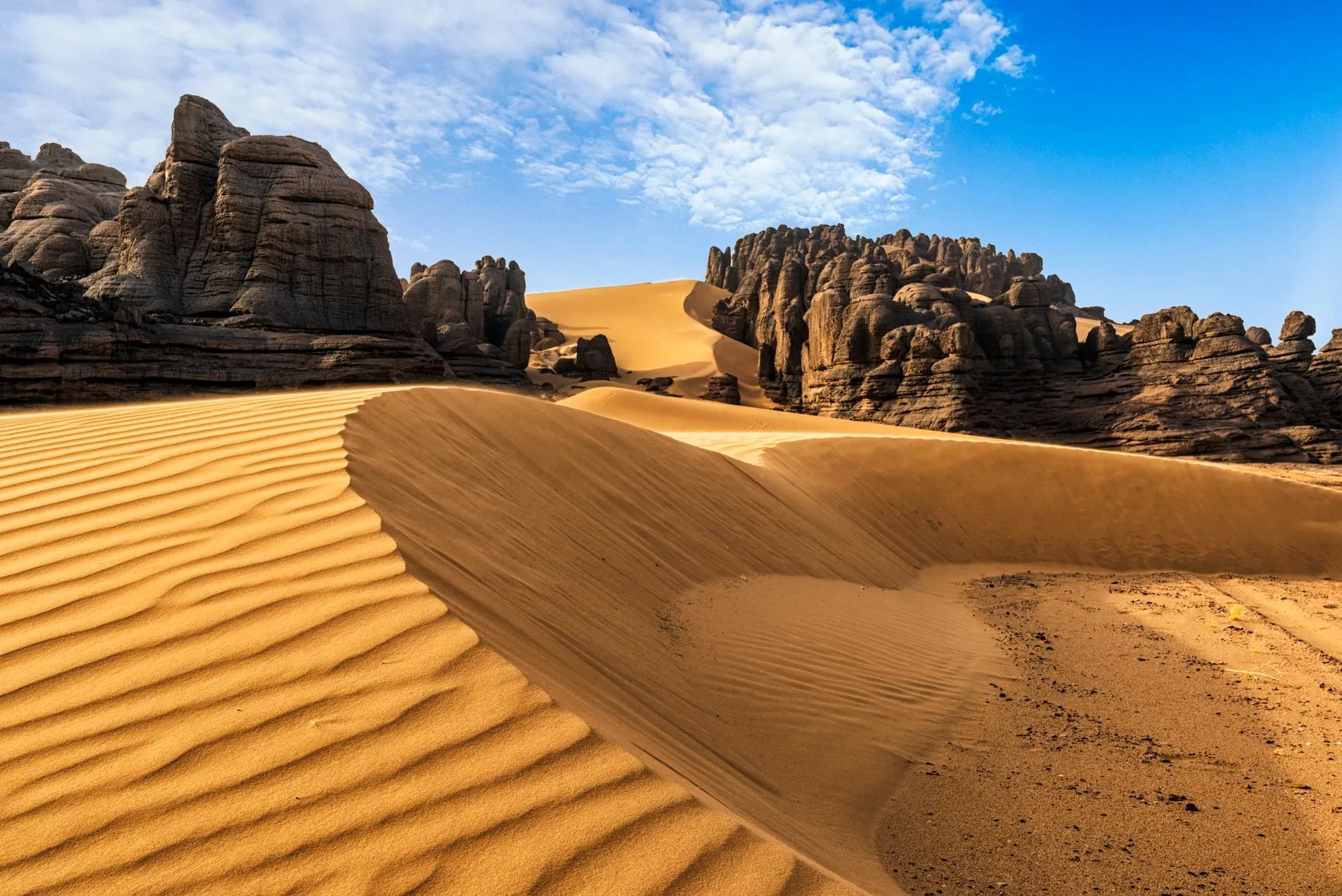
Algeria — Complete Travel Guide 2026
Algeria is the last great under-visited country on the Mediterranean: Roman cities grander and emptier than anything in Italy, a capital that climbs in white tiers above its bay, and a Saharan interior that ranks among the most spectacular landscapes on the planet — and it makes you earn every bit of it, with a real visa, a cash-only closed economy, almost no English, soldiers at every checkpoint, and genuine no-go zones along the deep southern borders. Come prepared and patient and you will have the ruins of Timgad entirely to yourself; come expecting Morocco-with-the-edges-sanded-off and you will be miserable by lunchtime.
Quick Reference
North Africa / the Maghreb; a long Mediterranean coast and the largest country in Africa
Algiers Houari Boumediene (ALG); Oran (ORN) and Constantine (CZL) in the north; Djanet (DJG) and Tamanrasset (TMR) for the Sahara
Algerian dinar (DZD) — a closed, cash-only currency; bring euros
Arabic and Tamazight (both official); French widely spoken; very little English
Visa required in advance for all Western tourists; visa-on-arrival only for organised Sahara tours
October–April for the coast and Roman cities; October–March for the desert
The emptiest great Roman ruins on earth, the Algiers casbah, and the Tassili Sahara
Algiers for the north; Djanet or Tamanrasset (on an organised tour) for the south
Editor’s Note: Why I Keep Coming Back to the Empty Ruins
I have stood in a lot of Roman ruins. I have queued behind a tour group’s umbrella at Pompeii, shuffled past the Forum in the heat, been hustled out of Ephesus at closing. None of it prepared me for walking into Timgad — Trajan’s perfectly gridded colonial city in the Aurès mountains, with its triumphal arch, its 3,500-seat theatre, its public library — and realising I was the only foreigner there. Not the only foreigner in that corner of it. The only one in the whole site. A caretaker waved me in, a few Algerian families picnicked near the arch, and the cardo stretched away under a hard blue sky with nobody on it.
That is the thesis of this guide, and the reason Algeria is worth the considerable trouble it asks of you. The country holds some of the finest Roman remains in the world — Timgad, Djémila, Tipaza — and you will share them with almost no one. Add a proud, layered capital, a desert of prehistoric rock art and black volcanic peaks, and warm, genuinely curious people who are not jaded by tourism because there barely is any, and you have one of the most rewarding trips in the wider Mediterranean.
Algeria is the anti-Morocco. There is no carpet-shop choreography, no faux-guides, no Instagram queue. There is also no tourism infrastructure to cushion you. Both of those facts are the same fact.
I am not going to pretend it’s easy or that everyone should go. It isn’t, and they shouldn’t. But for the right traveller, this is the best-value, least-crowded great destination in the region. Let’s talk honestly about who that traveller is — and then about the ruins.
Should You Go? Who Algeria Is For — and Who Isn’t
Be honest with yourself before you start filling in visa forms.
Algeria is for you if you have travelled independently in places that don’t run on tourist rails; you can roll with a plan changing because a road has a checkpoint or a guide is late; you have some French, or the patience to mime and point; you don’t need a cocktail at sunset or a working credit-card terminal; and you genuinely care about Roman history, deep-Sahara landscapes, or simply going where other people don’t. If a day of bureaucracy is a fair price for an empty UNESCO site, this is your country.
Algeria is not for you if you want a beach-and-resort holiday, a spontaneous backpack-and-wing-it trip with no advance paperwork, nightlife and alcohol, slick service, or the reassurance of seeing other tourists around. It’s also a hard sell for a first-ever trip outside Europe or North America — the friction will overwhelm the payoff.
The single best decision most first-timers make is to go through a local agency for at least the spine of the trip. It solves the visa, the checkpoints, the language, the long drives between sites and the lack of public information all at once. Independent travel is possible in the north and rewarding — I’ve done it — but it costs you days you’ll wish you’d spent at the ruins.
A practical middle path works well: book a licensed Algerian operator for the Roman-cities circuit and any desert leg, then add a few self-directed days in Algiers and Oran on either end. You get the hard parts handled and the soft parts free.
The Visa Is the Real First Hurdle — Take It Seriously
There is no way around this and no point pretending otherwise. Every Western tourist — US, UK, EU, Canadian, Australian — needs a visa obtained in advance from an Algerian embassy or consulate. There is no general visa-on-arrival and no e-visa for ordinary tourism in the north. (The one exception is the southern-Sahara scheme, below.)
For a standard tourist visa you submit, in person or by an accredited service, a passport valid at least six months, two photos, a completed application in duplicate, proof of travel and repatriation insurance, and — this is the crux — proof of where you’ll stay: a hotel reservation, a certificate of accommodation legalised by the local town hall in Algeria, or, by far the easiest, a certificate from a licensed Algerian travel agency setting out your itinerary. That agency letter is the key that turns a frustrating application into a routine one.
The timing rules are strict and asymmetric. Most consulates won’t accept an application more than about 60 days before your travel date, and won’t accept one submitted fewer than about 15 days before arrival. Aim for the sweet spot a few weeks out. If you apply through an organised tour with a proper letter of invitation, the consulate is supposed to issue the visa within roughly 48 hours of receiving a complete file — but the file-assembly (the agency arranging the invitation) typically takes one to three weeks, so start two to three months before you fly. Standard tourist visas usually allow a 90-day stay, with various validity lengths up to two years.
Don’t book non-refundable flights until your visa is in your passport. Consulate practice varies, requirements shift, and the one thing you cannot do is talk your way onto the plane without the sticker.
The southern shortcut. Algeria has deliberately made the Sahara easier than the rest of the country. If you travel on a tour run by an authorised agency with at least the bulk of the itinerary in the designated southern provinces — Djanet, Tamanrasset, Illizi and the rest of the deep south — you can get a visa on arrival, valid up to 30 days, at the desert airport. You still must book through a licensed operator, and the operator must have your authorisation letter approved at least 15 days ahead. It is, perversely, simpler to fly into Djanet for the Tassili than it is to visit Algiers. That tells you everything about where Algeria wants tourists to go.
Money: A Closed Economy, and Why You Bring a Brick of Euros
This is the second thing that trips people up, and it’s worth understanding before you arrive, because getting it wrong can roughly halve your spending power.
The dinar is a closed, non-convertible currency. You cannot buy meaningful amounts of it abroad, you cannot take it out, and there are two completely different exchange rates operating at once. The official bank rate in mid-2026 sits around 150–152 dinars to the euro. The parallel (“black market”) rate, which is what actual life runs on, is close to 270–280 dinars to the euro — nearly double. Change €100 at the airport bank and you get roughly half the dinars you’d get from the legendary money-changers at Square Port-Saïd in Algiers and their equivalents in every city.
What this means in practice:
- Bring euros in cash — clean, undamaged notes, more than you think you’ll need. Euros are the default; US dollars work but euros are easier. There are no second chances once you’ve spent it: you can’t reload from home.
- Foreign cards are nearly useless. Assume ATMs won’t dispense usefully against your card and that almost nowhere takes Visa or Mastercard. This is a cash society from top to bottom.
- Change money the way locals do. That practically means a trusted changer (your hotel, your guide, or the well-known street markets), not the bank counter. It is ubiquitous and openly tolerated, but it is technically informal — count your notes, change in daylight, and let your agency or hotel point you to a reliable person rather than approaching strangers cold.
The maths is brutal and simple: change at the official rate and Algeria feels mid-priced; change at the street rate and it becomes one of the cheapest countries you’ll ever travel. Same trip, double the value, entirely down to where you swap your euros.
Costs, at the rate you’ll actually use, are low. A hearty restaurant meal runs €3–8; a good mid-range hotel double €30–60; a strong coffee under a euro; a long shared-taxi or louage ride between towns a few euros; museum and ruins entry typically a euro or two. A fully organised multi-day tour with vehicle, driver, guide, permits and hotels is where the real money goes — a Sahara expedition is a four-figure euro commitment — but day-to-day life on the ground is cheap if you’ve changed money right.
Getting There & Around
Flying in. Most trips start at Algiers Houari Boumediene (ALG), the main international gateway, with Air Algérie plus a decent spread of European carriers — Air France, others via Paris, plus links to Istanbul, the Gulf and across the Maghreb. Oran (ORN) and Constantine (CZL) also take international flights and are useful if you want to skip the capital. For the desert you fly domestically to Djanet (DJG) for the Tassili or Tamanrasset (TMR) for the Hoggar; these connect through Algiers and are, by official advice, the only sensible way to reach the deep south — you do not drive there overland.
Getting around the north. Distances are real — this is the largest country in Africa — but the populated north is well served. Air Algérie runs frequent, cheap domestic hops between the big cities. There’s a functional rail network linking Algiers, Oran, Constantine and Annaba, comfortable enough for the main intercity runs. For shorter distances, louages (shared long-distance taxis) are the backbone of Algerian travel: fast, cheap, and they leave when full from a town’s taxi station. Self-driving is doable in the north but you’ll hit frequent military and police checkpoints; have your passport and paperwork to hand, be polite, and expect to explain yourself — it’s routine, not sinister.
Build slack into every itinerary. Checkpoints, paperwork, a closed road, a flight that shifts — none of it is a crisis, but all of it eats time. Two Roman cities a day, done well, beats four done in a panic.
Getting around the south. You don’t, independently. Saharan travel means a 4×4, a licensed operator and Tuareg guides who know the terrain, the wells and the permit situation. This isn’t a bureaucratic nicety — it’s both the legal requirement and basic desert sense.
Algiers: The Casbah and the White City
Algiers — Alger la Blanche, the white — earns its nickname the moment you see it from the bay: a city of bright buildings stacked up the hillside, French boulevards below, the old Ottoman medina clinging to the slope above. It’s a working capital, not a museum town, and it’s the better for it.
The headline is the Casbah, the UNESCO-listed Ottoman citadel-quarter, a vertical labyrinth of stepped alleys, crumbling palaces, hidden courtyards and laundry strung between centuries-old houses. It is raw — parts are dilapidated and some restoration is fitful — and it is unforgettable, the historic heart of the city’s revolutionary past and the setting of The Battle of Algiers. Go with a local guide. Partly because you’ll get lost (you will), but mainly because the Casbah is residential and a guide turns wary glances into invitations for tea.
Down in the French colonial city, walk the arcaded Rue Didouche Mourad and the seafront, take in the wedding-cake Grande Poste, and ride up to Notre-Dame d’Afrique, the basilica gazing across the Mediterranean (its inscription famously asks Our Lady to pray “for the Muslims too”). Across the bay, the soaring concrete Maqam Echahid (Martyrs’ Memorial) anchors the modern city and gives the best panorama in Algiers. The Bardo and the fine-arts museum are worth an hour for context.
Algiers rewards aimlessness more than ticking off sights. Its pleasure is a long coffee on a colonial terrace, the harbour light, the steepness of the Casbah, the absolute absence of a tour group. Give it two unhurried days.
Just west of the city, an easy half-day, sits Tipaza — which I’ll come to with the other Roman cities, but mention here because it’s the simplest world-class day trip from any Algerian base.
The Roman Cities: Tipaza, Djémila, Timgad — the Whole Reason to Come
If you read nothing else, read this. Algeria’s Roman heritage is the genuine, unrepeatable payoff, and it is criminally unknown.
Tipaza is the gateway, 70km west of Algiers on a gorgeous stretch of coast. A Phoenician trading post turned Roman town, its basilicas, baths and tombs tumble down to the sea, columns framing the blue Mediterranean. It is not the grandest of the three but it is the most beautiful, and being a short drive from the capital it’s the one most visitors actually see. Pair it with the nearby Royal Mausoleum of Mauretania, a vast circular tomb on the hillside.
Djémila — Roman Cuicul — is the connoisseur’s choice, set high in a green Kabylie valley with mountains all around. What makes it special is the setting and the completeness: a near-intact 3,000-seat theatre, two forums, temples, triumphal arches, and a small museum holding some of the finest Roman mosaics you’ll see anywhere, lifted from the houses on site. It is harder to reach than Tipaza — it pairs naturally with Constantine and Sétif — and you will very likely have it nearly to yourself.
Timgad is the one that undoes people. Founded by Trajan around AD 100 as a colony for veterans, it’s a textbook of Roman urban planning laid out on a perfect grid on the edge of the Aurès mountains — the cardo and decumanus, the forum, a 3,500-seat theatre, a library (one of the very few known Roman public libraries), bath complexes, and the magnificent Arch of Trajan standing alone against the hills. It’s been called the Pompeii of Africa, but Pompeii has six million visitors a year and Timgad has you and the caretaker. It’s deeper into the country, usually approached via Batna and the Aurès, and it is, in my flat opinion, one of the great archaeological experiences on earth.
Do not try to do all three in a rush. Tipaza is a day from Algiers; Djémila and Timgad belong to a separate eastern loop through Sétif, Constantine and Batna. Treat them as the centrepiece of the trip, not a box to tick between cities, and give the eastern circuit three or four days.
These sites have minimal infrastructure — basic signage, a small museum, a guardian, sometimes a guide loitering for a few euros. Bring water, a hat and good shoes, go early or late to dodge the heat and the flat midday light, and budget time simply to sit in the theatre and absorb the silence. That silence is the product.
Constantine: The City of Bridges
Constantine is unlike anywhere else in Algeria, or frankly anywhere. The old city sits on a sheer rock plateau split by the Rhumel Gorge, a chasm that drops hundreds of metres straight down, and the town is stitched together by a series of dramatic bridges spanning the void. The most famous, the Sidi M’Cid suspension bridge, opened in 1912 and hangs 175 metres above the river; walking it, with the gorge falling away and the houses clinging to the cliffs, is genuinely vertiginous.
Beyond the bridges there’s a dense, atmospheric medina, Ottoman palaces (the restored Palace of Ahmed Bey is the standout), and a strong sense of a proud regional city that doesn’t much care what tourists think. Constantine is the natural hub for the eastern Roman loop — Djémila and Timgad are both within striking distance — and it’s a city I’d happily spend two nights in for its own sake.
Constantine’s drama is all about the edge. Walk the bridges, ride the cable car across the gorge for the view back at the cliff-hung old town, and resist the urge to treat it only as a base for the ruins. It’s a destination.
Oran: Raï, the Sea, and Spanish Ghosts
Algeria’s second city has a different temperament from the capital — looser, more Mediterranean, more outward-looking, with Spanish layers from its long stretches under Spanish rule. This is the birthplace of raï music, the rebellious pop-folk sound that came out of Oran’s cabarets, and the city still carries a certain musical, slightly nostalgic swagger (Camus and the writers of French Algeria orbited it too).
Climb to Santa Cruz, the Spanish fort on the mountain above town, for the sweep of the bay; wander the faded colonial centre and the old Sidi El Houari quarter; and feel the sea-facing ease that the more buttoned-up capital lacks. Oran isn’t a heavyweight sights city — it’s a place to feel the rhythm of contemporary Algerian urban life and eat well by the water. Many travellers fly in or out here to bookend a trip.
The Sahara: Tassili n’Ajjer and the Hoggar — Organised, Escorted, and Worth It
Now the other Algeria — the one that fills the southern nine-tenths of the map and that, for many, is the real reason to come.
Tassili n’Ajjer, near Djanet in the far southeast, is a UNESCO-listed plateau of weather-sculpted sandstone “forests,” arches and canyons that holds one of the greatest concentrations of prehistoric art on the planet — more than 15,000 paintings and engravings, some up to 12,000 years old, recording a green Sahara of giraffes, cattle herders, hunters and swimmers from a time when this was savannah, not desert. Reaching the best of it means multi-day treks on foot (with pack animals) and nights under an absurd canopy of stars, led by Tuareg guides who are the custodians of both the land and the meaning of the art. It is hard, it is remote, and it is one of the most extraordinary places I have ever walked.
The Hoggar (Ahaggar) Mountains, around Tamanrasset further west, are a volcanic moonscape of black basalt peaks rising from the desert, including Mount Tahat, Algeria’s highest at nearly 2,900 metres. The classic objective is Assekrem, where the hermit-priest Charles de Foucauld built his retreat, and where travellers gather before dawn to watch the sun detonate across an ocean of jagged peaks — one of the legendary sunrises of Africa. Again: 4x4s, Tuareg guides, camps under the stars.
Here is the honest, load-bearing caveat. The deep Sahara sits inside the regions Western governments flag most heavily — the US keeps a “Do Not Travel” rating on the remote south and the border zones, the UK warns against the immediate frontiers. The answer is not to write the desert off; it’s to go the only correct way: on an organised, escorted trip with a licensed Algerian operator, flying in and out (never crossing borders overland), staying well inside the established tourism areas around Djanet and Tamanrasset, and following your guides’ routing without improvising toward the frontiers.
Done that way — which is also the way the visa-on-arrival scheme is built to encourage — the Tassili and the Hoggar are accessible, established Saharan tourism, run for decades by people who know exactly where the line is. The romance of “just heading off into the dunes” is precisely the thing you don’t do here.
Eating in Algeria
Algerian food is the warm, underrated cousin of the Maghreb table — French-influenced, Berber-rooted, Ottoman-touched, and almost entirely unknown abroad. Couscous is the national dish, traditionally Friday’s meal, steamed light and fluffy and served with a stew of lamb or chicken and vegetables. Chorba (a spiced soup, especially in Ramadan), chakhchoukha (torn flatbread in a rich tomato-and-lamb sauce, the signature of the Aurès around Timgad), and rechta (handmade noodles) are home-cooking staples worth seeking out.
Street food is the everyday joy: karantika (a baked chickpea-flour custard, an Oran institution), mhadjeb (stuffed semolina flatbread), grilled merguez, and brik-style pastries. The French legacy lives on in superb bread and a serious café culture — the coffee is strong, cheap and excellent, and watching a city over a long espresso is a national pastime. For dessert, sticky honey-and-almond pastries, makroud, and mint tea.
Two things to know. Algeria is a largely conservative, Muslim country and alcohol is low-key and not always available — some restaurants and hotels in the big cities serve it, much of the country doesn’t, and it’s not a drinking culture, so don’t plan your evenings around a bar. And outside hotels and tourist spots you’ll order in French or Arabic from menus with no English — point, smile, and trust the kitchen.
Overrated, and What I’d Skip
A short, opinionated list, because a good guide tells you where not to spend your limited energy.
- Trying to “see Algeria” in a week. It’s the biggest country in Africa. Pick a lane — the northern coast-and-Roman circuit or the Sahara — and do it properly. Stitching the Sahara onto a tight northern trip means a lot of expensive flying and not enough of either.
- The beaches. Algeria has a long, often lovely coast, but it is not a beach destination for foreign tourists — facilities are basic, and as a visitor (especially a solo woman) a resort-style beach day is more hassle than reward. Come for ruins, cities and desert, not sand-and-sea.
- Forcing the deep desert into a first, short, independent trip. The Sahara deserves its own dedicated, organised expedition. Half-doing it from the north is the worst of both worlds.
- Over-touring the cities. Algiers and Oran are for atmosphere, not a sights checklist. One museum each is plenty; the rest of the time, walk and sit.
- Expecting “discovered” hidden gems to be easy. The reward here is emptiness and authenticity, which is inseparable from the friction. If you fight the friction, you lose the reward.
Safety, Security, and the Honest Regional Picture
Let’s be grown-up about this, because the headlines and the reality diverge sharply.
The north is calm. Algiers, Oran, Constantine and the whole populated coastal-and-Tell band — where you’ll spend nearly all your time, including every Roman site — are stable and, by the everyday standards of solo travel, safe. Violent crime against tourists is rare; the bigger annoyances are petty theft in crowds and the universal hassles of an unfamiliar place. There is a heavy, visible security presence — checkpoints on intercity roads, police and military around, tourist-area escorts in some regions — which can feel jarring at first and is, in practice, reassuring and routine. Cooperate, carry your passport, and it’s a non-event.
The borders and the deep south are genuinely off-limits. This is the real line, and it’s not paranoia. Western governments are consistent: the US keeps a “Do Not Travel” rating on the remote southern and eastern regions and the border zones (broadly, rural areas within ~50km of the Tunisian border and ~250km of the Libyan, Nigerien, Malian and Mauritanian borders), citing terrorism and kidnapping; the UK advises against all travel within 30km of those frontiers. Al-Qaeda in the Islamic Maghreb and related groups remain active in the Sahel beyond. The country’s overall advisory (US Level 2, UK “high degree of caution”) is a “go, with eyes open” — not a “stay home.”
The reconciliation is the whole point of this guide: visit the calm, rewarding north freely with normal precautions; visit the Tassili and Hoggar only on organised, escorted, fly-in tours inside the established zones; and do not go near the southern land borders or attempt any overland Saharan crossing. Stay in that lane and Algeria is a sane, manageable trip.
A few practical notes: a local guide or agency smooths the security apparatus enormously; solo women travel here but dress conservatively and expect more attention than in Europe; and keep digital and paper copies of your visa, passport and insurance, which you’ll show repeatedly.
Health, Practicalities and Etiquette
Vaccinations. There’s no yellow fever risk in Algeria, but the country requires proof of yellow fever vaccination if you’re arriving from — or have transited more than 12 hours through — a country with yellow fever risk, so carry your certificate if your routing touches sub-Saharan Africa or parts of South America. Beyond that, make sure routine vaccinations are current and discuss hepatitis A and typhoid with a travel clinic; malaria risk is negligible. Tap water is best avoided — stick to bottled — and the desert demands serious sun protection and far more water than you think.
Connectivity. Get a local SIM (Djezzy, Mobilis or Ooredoo) on arrival for data; coverage is good in the north and patchy-to-nonexistent in the deep desert. Wi-Fi exists but is unreliable.
Language. Arabic and Tamazight are official; French is the de facto second language and the one that actually unlocks the country — even a little goes a very long way. English is rare. Download offline translation and maps before you go.
Etiquette. Dress modestly (covered shoulders and knees, more conservative for women); always ask before photographing people, and never photograph military, police, checkpoints or government buildings — this is taken seriously. Ramadan reshapes daily rhythms (daytime closures, late-night life); it’s a fascinating but logistically tricky time to visit. Algerians are, in my experience, exceptionally hospitable and genuinely curious about the rare foreign visitor — because so few outsiders come, you’re met with real warmth rather than a sales pitch. Accept the tea, return the warmth, and you’ll be looked after. It’s one of the quiet pleasures of travelling somewhere the world has overlooked.
When to Go
Timing matters more in Algeria than in most places, because the country spans the temperate Mediterranean and the extreme Sahara.
For the north — the coast, Algiers, the Roman cities — October to April is the window. Spring (March–May) and autumn (September–November) are ideal: mild, green, comfortable for walking ruins all day. Summer (June–August) on the coast is hot and busy with domestic holidaymakers, and the inland sites bake; the flat midday glare is also poor for photographing the ruins. Winter is cool and quiet, occasionally wet, and perfectly pleasant for city and site visits if you pack a jacket.
For the Sahara — Tassili, the Hoggar — October to March only. Daytime is warm and walkable; crucially, desert nights are genuinely cold, often near or below freezing in the Hoggar’s altitude, so pack real layers and a proper sleeping setup. Avoid the desert from late spring through summer entirely — temperatures become dangerous and most operators don’t run trips.
If you want the perfect compromise trip, aim for March–April or October–November: warm-but-not-baking in the north, cool-but-not-frozen in the south, and the desert season open. That’s when I’d go.
Frequently Asked Questions
Cheapest Flights to Algeria
We have tracked 1,300 fares to Algeria from 81 cities. As of June 2026, here is what a good price looked like from each — the lowest fare we recorded, and a “great-deal” benchmark to judge a quote against. These are tracked observations, not live prices: by the time you read this they will have moved, so treat them as a yardstick, not a quote.
| From | Lowest fare we tracked | Great-deal benchmark |
|---|---|---|
| Bordeaux (BOD) | €66 | €94 |
| Lyon (LYS) | €68 | €97 |
| Paris (ORY) | €71 | €102 |
| Nantes (NTE) | €76 | €109 |
| Istanbul (SAW) | €88 | €125 |
| Luxembourg (LUX) | €92 | €132 |
| Nice (NCE) | €108 | €155 |
| Salzburg (SZG) | €114 | €163 |
| Toulouse (TLS) | €124 | €177 |
| Paris (CDG) | €125 | €178 |
| Vienna (VIE) | €127 | €182 |
| Mallorca (PMI) | €129 | €184 |
| Basel (BSL) | €132 | €188 |
| Dalaman (DLM) | €136 | €195 |
Recent deals we have posted to Algeria:
- Barcelona to Algiers, Algeria from €46
- Madrid to Algiers, Algeria from €90
- Barcelona, Spain to Algiers from €44
- Boston to Algiers from $576
- Denver to Algiers from $660
- Houston, Texas to Algiers from $660
- Miami to Algiers, Algeria from $632
- Chicago to Algiers, Algeria from $576
- Seattle to Algiers, Algeria from $606
- London, UK to Algiers, Algeria from £162
These are fares aifly tracked to this destination, not live quotes — they have changed since and several of the deals above may have expired. Browse current flight deals →