The Balearic Islands — Complete Travel Guide 2026
Forget what you think you know. “Mallorca means Magaluf” and “Ibiza means clubbing” are the smallest, ugliest slices of two islands that are mostly mountains, stone villages, empty coves and farmland — and the four Balearics are not one destination but four completely separate holidays that happen to share a stretch of sea and a budget airline route. Pick the wrong island for who you are and you’ll spend a fortune being miserable in August; pick the right one in May or September and you’ll understand why people quietly keep coming back for thirty years.
Quick Reference
Western Mediterranean, ~150–300 km off Spain’s east coast (Valencia/Barcelona)
Palma de Mallorca (PMI), Ibiza (IBZ), Menorca-Maó (MAH); Formentera has no airport
Euro (€)
Catalan (in local form: Mallorquí, Menorquí, Eivissenc) and Spanish; English widely spoken in resorts
EU/Schengen Spain. EES biometric registration live since 10 April 2026 for non-EU visitors; ETIAS expected, date not announced
Mid-May to mid-June, and September to mid-October — warm sea, thin crowds, lower tax
Turquoise coves, the Serra de Tramuntana, superclubs, sobrassada and ensaïmada, prehistoric Menorca, barefoot Formentera
One island per trip — they are four different holidays (see below)
Editor’s Note: Four Islands, Four Holidays — Stop Treating Them as One
I’ll be blunt, because the brochures won’t: the single most common mistake travellers make here is treating “the Balearics” as a place. It isn’t. It’s an archipelago of four inhabited islands that have almost nothing in common except the airline that flies you in.
Mallorca is a substantial island — bigger than you imagine — with a real mountain range, a proper city, vineyards, almond groves and a couple of grim package-resort strips bolted onto one corner. Menorca is its quiet, green, low-rise cousin, obsessed with cheese, gin and Bronze Age stone towers, and it has actively chosen not to become Mallorca. Ibiza is the loud one, world-famous for two square kilometres of nightclub, and almost entirely misunderstood — the other 95% is pine forest, hippie markets and silent northern coves. And Formentera, the little one with no airport, is barely an island at all: a sandbar of impossible turquoise water reachable only by boat from Ibiza, and the most precious, fragile, expensive corner of the lot.
The single best decision you’ll make: one island per trip. Do not try to “see the Balearics” in a week. Island-hop only if you have two-plus weeks or you’re specifically chasing Formentera off the back of Ibiza. Spreading yourself across two ferries and three hire cars in seven days is how you see airports and car parks instead of islands.
This guide is the connective tissue. For the deep dives on the three biggest, I’ll send you to aifly’s dedicated island guides — Mallorca / Palma, Ibiza and Menorca — and keep those sections deliberately short. What you get here instead is the cross-island story: which island is for you, the ferry strategy, the food, the money, and Formentera in the depth it deserves, because nobody else writes it a guide of its own.
Should You Go? Who It’s For — and Who Should Skip It
Go if: you want warm, clear, swimmable Mediterranean from May to October; you’ll travel in shoulder season or you genuinely don’t mind crowds and heat; you like the idea of matching an island to your mood — hiking and culture, quiet beaches, nightlife, or barefoot do-nothing; and you’re happy to hire a car and explore an interior, not just lie on a single beach.
Think twice if: you can only travel in August, you’re on a tight budget, and you have rigid expectations. August in the Balearics is hot (mid-30s°C), expensive, and rammed — and the islands are, openly and increasingly, pushing back against exactly the kind of high-volume, low-spend, party-first tourism that built the worst of their reputation. You can still have a wonderful time; you just have to be deliberate about it.
Honestly skip it if: your dream holiday is a cheap all-inclusive bender. The Balearics spent 2025 and 2026 legislating people like that off the islands — six-drink limits, public-drinking fines, supermarket alcohol curfews. There are cheaper, more welcoming places to do that. The islands would rather you didn’t come, and they’ve stopped being shy about saying so.
A note on the welcome: locals are not hostile to travellers — they are hostile to a tourism model that has priced them out of their own neighbourhoods. Behave like a guest, spend in family-run places, learn “bon dia,” respect the residential streets, and you’ll meet the warmth the islands are famous for. The protests are about housing and water and dignity, not about you personally. Read on.
The Overtourism Reality: Caps, Taxes and a Region Pushing Back
This is the context that changes how you should plan a 2026 trip, so I’m putting it up front rather than burying it.
The Balearics took roughly 19 million visitors in 2025 onto islands that are home to about 1.2 million people. The strain — soaring rents, water shortages, gridlocked roads, beaches at capacity — boiled over into the largest anti-tourism protests Spain has seen, with marches through Palma and Ibiza Town under banners that translate to “the islands are not for sale.” The regional government has responded with a proposed annual cap of around 17.8 million arrivals (rolling the islands back to 2023 levels), staggered cruise-ship limits at Palma and Ibiza Town (fewer mega-ships docking at once, not an outright ban), and a “Decree for Responsible Tourism,” fully in force since 4 May 2026.
What the decree actually means for you on the ground:
- A six-drink-a-day limit for all-inclusive guests in the named party zones — Magaluf and Playa de Palma on Mallorca, Sant Antoni (San Antonio) on Ibiza — three with lunch, three with dinner.
- Fines of €500 to €3,000 for drinking in the street or on the beach in those zones.
- Off-licences and supermarkets in tourist areas stop selling alcohol at 21:30.
- Bans on the worst booze-cruise and pub-crawl operations.
None of this affects a normal trip. If you’re hiking the Tramuntana, eating in Sóller, swimming a Menorcan cala or watching the sunset in Ibiza’s north, you will never notice a single one of these rules. They are surgically aimed at the lager-funnel strips. The only practical takeaway for everyone else: buy your beach wine before 21:30, and don’t crack a tinnie on the sand in Magaluf.
The other big 2026 development is on Formentera (full detail below): the formentera.eco scheme caps visitor cars at 1,732 per day from 1 June to 30 September. You now have to apply for permission online before you book a ferry with a vehicle. It’s the single most concrete “we’re full” measure in the archipelago, and it’s the right one.
The Tourist Tax (Ecotasa / ITS): What You’ll Actually Pay in 2026
Every visitor over 16 pays the Impost del Turisme Sostenible (ITS) — the “ecotasa” — per person, per night, on top of your accommodation. The money is ring-fenced for a sustainable-tourism fund: beach restoration, water infrastructure, nature conservation. As taxes go, it’s one of the more defensible ones.
For 2026 the structure works like this:
- High season (1 May – 31 October): roughly €1.10 to €4.40 per person, per night, scaling by accommodation class — campsites and one-star places at the bottom, five-star hotels and luxury rentals at the top. All figures include 10% VAT.
- Low season: roughly €0.28 to €1.10 per night.
- Cruise passengers pay a flat per-day rate.
- Stays beyond the ninth night get a 50% discount on the tax for the extra nights.
- Under-16s are exempt.
The wrinkle to watch in 2026: the regional government has proposed steeper peak-summer rates — pushing the top hotel band toward €6 a night in June/July/August, and the cruise rate up sharply — while scrapping the tax entirely in January and February to spread visitors into the dead season. The exact summer figures were still being finalised at the time of writing, so treat anything above the €4.40 baseline as “possible, not yet confirmed.”
In real money: for two adults in a mid-range hotel for a week in peak season, the ecotasa is roughly €40–55 total — annoying, not trip-defining. It’s usually collected at check-out, often in cash. Budget for it and move on.
Getting There & Around: The Airports and the Ferry Reality
Flying in. Three airports, one per major island. Palma de Mallorca (PMI) is the giant — one of Spain’s busiest, with cheap direct flights from across the UK and northern Europe all summer, and the best year-round connectivity. Ibiza (IBZ) is summer-frantic and winter-quiet. Menorca-Maó (MAH) is the smallest and most seasonal — superb May–October links, much thinner the rest of the year. Formentera has no airport at all: you fly to Ibiza and take a boat. Always.
The ferry question. This is where people overplan and overspend. Yes, the islands are connected by ferry — but they are not a tidy hop-on-hop-off chain, and the crossings are longer and pricier than the map suggests.
- Ibiza ⇄ Formentera: the one everyone uses. ~30 minutes on a fast ferry, frequent all day, run by Baleària, Trasmapi, Aquabus and Formentera Lines. This is a genuine, easy day trip or short stay.
- Mallorca (Palma) ⇄ Ibiza: roughly 2 hours on Baleària’s fast ferry (the Eleanor Roosevelt) or Trasmed, several sailings daily in summer, vehicles allowed.
- Mallorca (Port d’Alcúdia) ⇄ Menorca (Ciutadella): about 1 hour 15 minutes, 3–4 fast crossings a day in high season.
- Menorca ⇄ Ibiza: essentially impractical as a direct hop — you route via Mallorca. Don’t try to do all three by sea in a short trip.
My ferry rule of thumb: ferries are for two things — (1) a Formentera day from Ibiza, full stop; and (2) deliberately twinning two islands on a 10-to-14-day trip (Mallorca + Menorca via Alcúdia–Ciutadella is the natural pairing; Mallorca + Ibiza the second). For a one-week holiday, fly to one island and stay put. The ferry between the big islands eats the best part of a day each way.
Getting around once you land. Hire a car. The Balearics reward it more than almost anywhere in the Med — the best beaches, villages and viewpoints are nowhere near the resorts, and bus networks, while decent on Mallorca, thin out fast elsewhere. Book the car months ahead for July/August — the islands genuinely run out, and Formentera caps incoming vehicles outright. On Formentera itself, rent a scooter or, better, a bike: it’s flat, tiny, and built for it.
Mallorca: The Big One — and It’s Mostly Mountains
I’ll keep this brief because aifly has a full Mallorca and Palma guide — but I won’t let the clichés stand.
Mallorca is the island people think they understand and almost universally underestimate. The Magaluf-and-lager image is a tiny, walled-off corner of the southwest. The real Mallorca is the Serra de Tramuntana — a UNESCO-listed mountain range of olive terraces, stone villages and switchback drives that ranks among the most beautiful coastlines in Europe. Drive the road to Sa Calobra, hike the dry-stone GR-221 between mountain hamlets, ride the wooden 1912 train from Palma to Sóller, eat in Deià and Valldemossa, and you will not believe you’re on the same island as the party strip.
Palma itself is a genuinely great small city — a soaring Gothic cathedral, a tangled old town of patios and tapas bars, a serious food and design scene. Spend at least two days there before you bolt for a beach. The island’s interior — wine country around Binissalem, the Wednesday market at Sineu, almond blossom in February — is where Mallorca quietly becomes the best of all four islands for a varied, do-everything holiday.
Mallorca is for: travellers who want one island that does it all — city, mountains, culture, food, family beaches, and yes, nightlife if you want it. It’s the only Balearic that genuinely fills two weeks without a ferry. Skip: Magaluf and Palma Nova unless cheap clubbing is precisely the point.
Menorca: The Quiet One That Chose Not to Become Mallorca
Brief, because there’s a dedicated Menorca guide — but understand what makes it different, because it’s a deliberate choice.
Menorca is a UNESCO Biosphere Reserve, low-rise by law, green where the others are arid, and gloriously short on nightlife. Its glory is its calas — the cove beaches, especially along the wild, undeveloped south coast: Cala Macarella, Cala Mitjana, Cala Turqueta, white sand against pine and turquoise, several reachable only on foot. Linking them all is the Camí de Cavalls (GR-223), a 185-km coastal path that loops the entire island — walk even a single stage of it and you’ll see a Menorca no resort tourist ever does.
Then there’s the prehistory: Menorca is studded with talaiotic stone monuments — taulas and talaiots, Bronze Age towers and T-shaped megaliths — and the Talaiotic Menorca sites carry UNESCO World Heritage status. The capital Maó (Mahón) has one of the world’s great natural harbours and a peculiar legacy of British rule (gin, sash windows, and, the locals will tell you, mayonnaise — salsa mahonesa). Ciutadella at the other end is the prettier town.
Menorca is for: couples, families and walkers who want the beauty without the noise — empty coves, slow villages, good food, early nights. It is not for: anyone whose holiday needs a club, a buzz, or a “scene.” That’s the whole point of it.
Ibiza: Far More Than the Clubs
Short section, full Ibiza guide here — but the cliché needs dismantling more than any other.
Yes, Ibiza has the superclubs — Pacha, Amnesia, Ushuaïa, [DC-10] and the rest — and yes, Sant Antoni‘s West End is a strip of cheap-shots bars now under the new alcohol crackdown. That is one loud corner. The rest of the island is pine-clad hills, white-washed villages, a UNESCO-listed old town (Dalt Vila, the walled citadel above Ibiza Town — genuinely stunning), hippie-market culture descended from the 1960s bohemians, and a north (Sant Joan, Santa Agnès, the coves around Portinatx and Benirràs) that is rural, quiet, and entirely about drumming sunsets and slow lunches.
Ibiza’s real magic is the sunset coves and the food — the island has one of the best restaurant scenes in the Med, from beach shacks serving bullit de peix to serious tables in the hills. You can have a chic, grown-up, club-free Ibiza holiday and many people do.
Ibiza is for: two very different tribes — the clubbers (know what you’re paying; entry and drinks are eye-watering) and the bohemian-luxe crowd who never set foot in a club and come for the north, the sunsets and the food. Skip: Sant Antoni’s West End unless that’s specifically your scene; base in the north or the hills instead.
Formentera: The Barefoot Fourth Island, In Full
Now the one with no guide of its own — and the one I’d send a first-timer to if they wanted to understand why people fall for the Balearics.
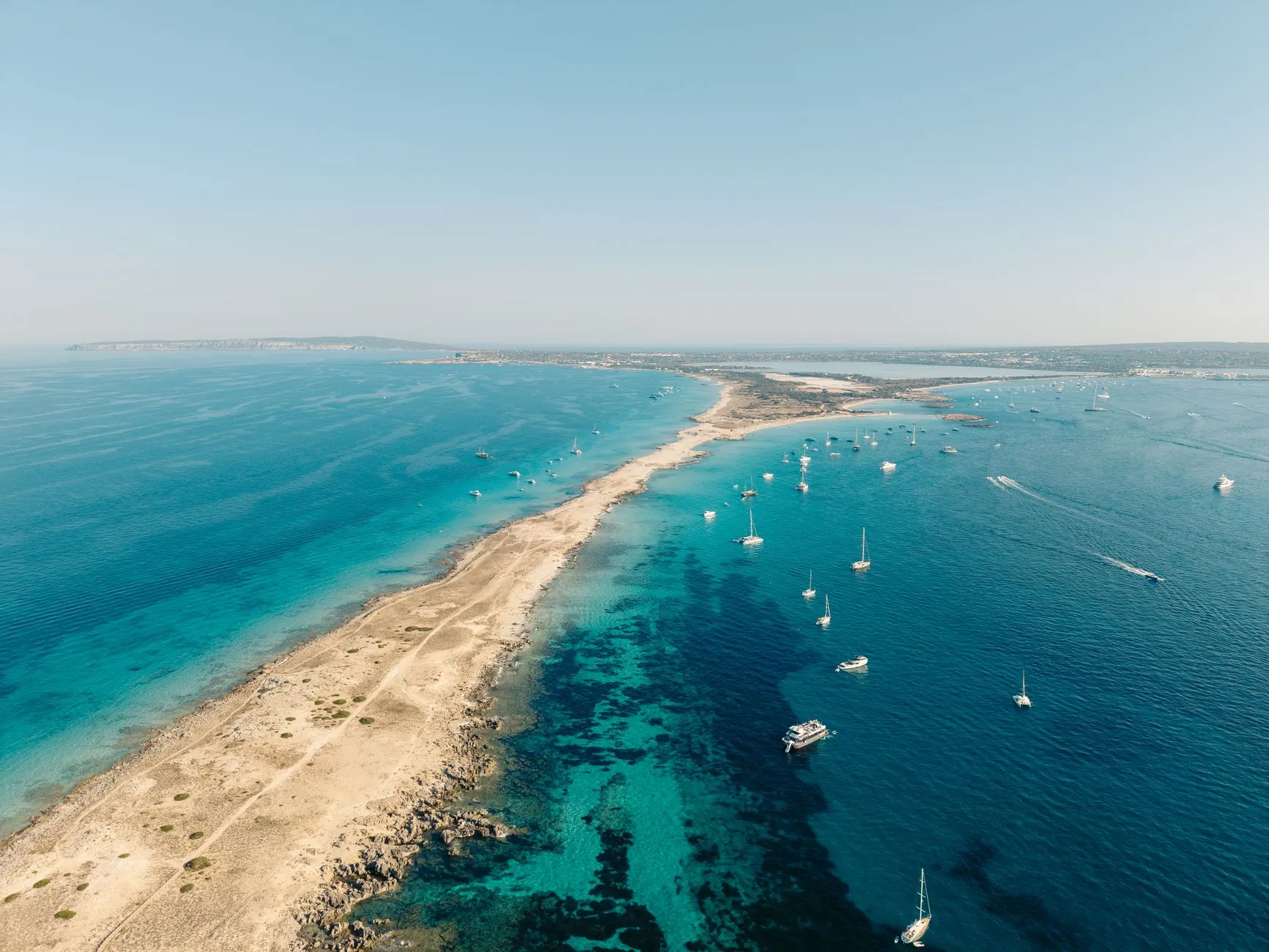
Formentera is tiny: about 19 km end to end, 12,000 residents, no airport, no traffic lights, no real towns to speak of. You can only reach it by boat from Ibiza — that ~30-minute fast ferry from Ibiza Town — and that single barrier is exactly what’s saved it. It is the closest thing the Mediterranean has to the Caribbean: Ses Illetes, the long sandbar beach on the northern spit (about 7 km from the La Savina ferry port), is regularly ranked among the best beaches in Europe, all blinding white sand and water so clear and shallow it looks fake in photographs and somehow better in person.
But Formentera is more than one beach. Platja de Migjorn is a 5-km sweep of open sand on the south coast with barefoot beach bars (the legendary sunset shacks); Cala Saona is a pine-fringed cove on the west; Es Caló de Sant Agustí is an old fishing harbour. Rent a bike or scooter at La Savina and the whole island opens up — the green-route cycle paths, the lighthouse at Cap de Barbaria (the road that runs to the literal end of the island, scrub and stone and nothing), the bohemian sundowner culture that has somehow survived the influencers.
The catch, and you must plan around it: Formentera is fragile and it is fighting to stay that way. The formentera.eco scheme runs 1 June to 30 September and caps visitor vehicles at 1,732 cars per day in 2026. You must apply for authorisation online at formentera.eco before you book a ferry with a car or scooter. Turn up without it in peak summer and you’ll be turned away or fined.
My strong advice: don’t bring a car to Formentera at all. It’s flat, small, and made for two wheels. Take the foot-passenger ferry from Ibiza, rent a bike or scooter on arrival at La Savina, and you skip the entire vehicle-cap headache. Cars are the problem the island is trying to solve — be part of the solution.
Day trip or stay? A day trip from Ibiza absolutely works — first fast ferry over, Ses Illetes or Migjorn, lunch, last ferry back. But Formentera at night, once the day-trippers have sailed home and the beach bars light up, is a different, quieter, more romantic island. If you possibly can, sleep there one or two nights. It’s expensive in summer and books out early — but it’s the closest the Med gets to perfect.
Formentera is for: anyone who wants to do, essentially, nothing — swim, cycle, eat fish, watch the sun go down — in the most beautiful water in Spain. It is not for clubbers, sightseers, or anyone who needs a “programme.” That emptiness is the entire product.
The Food: Sobrassada, Ensaïmada, Gin and Mahón Cheese
The Balearics eat far better than their reputation, and the food is one of the genuine threads connecting the islands. Eat your way through these and you’ve understood the place:
- Sobrassada — Mallorca’s soft, spreadable cured pork sausage, paprika-red, smeared on bread and often drizzled with honey. The island’s signature.
- Ensaïmada — the coiled, snail-shaped pastry dusted with icing sugar, made with saïm (lard); people carry boxes of them home in those distinctive octagonal containers. A Mallorcan institution.
- Mahón cheese (Formatge de Maó) — Menorca’s DOP cow’s-milk cheese, sharp and orange-rinded; the island is built on it.
- Gin de Menorca (Xoriguer) — a legacy of the British navy, distilled in Maó; the local serving is the pomada, gin with cloudy lemonade, drunk by the litre at the Sant Joan fiestas.
- Bullit de peix and arròs de matances — Ibiza and Formentera’s fishermen’s stews and rice dishes; flaó, the mint-and-cheese tart, for pudding.
- Pa amb oli — the everyday Balearic snack: country bread rubbed with tomato and oil, topped with cheese or cured meat. Order it everywhere.
Eat where the locals eat. The single best money-and-quality move across all four islands: get off the seafront. The harbourfront restaurants with photo menus and English-only signage are charging triple for half the quality. Walk two streets inland, find the place full of Spanish families, and order the menú del día at lunch — a three-course set menu with wine for €15–20 that’s often the best meal of the trip.
Money & Costs: What the Balearics Actually Cost in 2026
Honesty first: this is not a cheap destination in summer, and it’s getting less cheap on purpose. The islands are deliberately steering away from the budget-bucket market toward higher-spending, lower-volume visitors.
Rough 2026 reality, peak season:
- Mid-range hotel double: €150–300+ a night on Mallorca/Ibiza in July/August; Menorca a touch less; Formentera the most expensive of all for what you get.
- A beach-club sunbed-and-cocktail afternoon in fashionable Ibiza/Formentera spots: genuinely €100+ per person if you’re not careful. The bill for two loungers and a bottle at a name beach club can rival a flight.
- Superclub entry in Ibiza: often €40–80+, with drinks to match. Budget hard or skip.
- The sane money: a menú del día lunch (€15–20), a hire car split between a couple or family, a supermarket-and-cala beach day, an inland village base instead of a seafront resort. Done this way, the Balearics are no dearer than mainland Spain.
Where the money leaks: seafront restaurants, beach clubs, August dates, and last-minute hire cars. Where you save: shoulder season (cheaper and better), interior or village accommodation, lunch as your big meal, and a foot-passenger-plus-bike approach to Formentera. The difference between a careful and a careless Balearic week is enormous — easily double.
Practically: card is accepted nearly everywhere; carry some cash for small village bars, market stalls and the ecotasa at check-out. Tipping is light — round up or leave 5–10% for good service, no more.
When to Go: Why August Is the Wrong Answer
The calendar matters here more than almost anywhere. Get the timing right and the same island is transformed.
- Mid-May to mid-June — the sweet spot. Sea warm enough to swim, hillsides still green, calas uncrowded, lower-season tax, hotels affordable, everything open. This is the connoisseur’s window.
- September to mid-October — the other sweet spot. The sea is at its warmest after a summer of heating, the August crush has gone home, prices ease, light goes golden. Arguably the best month of all.
- July and August — the crush. Hot (mid-30s°C and humid), expensive, fully booked, beaches at capacity, roads jammed, and the moment the new caps and rules bite hardest. Go only if you must — and book everything, everything, months ahead.
- November to March — the quiet. Mallorca stays alive year-round (Palma is a lovely winter city; February brings almond blossom across the island and the planned scrapping of the off-season tax). Menorca, Ibiza and especially Formentera largely shut down — many hotels, ferries and restaurants close, and Formentera in winter is a beautiful near-ghost. Lovely for solitude, frustrating if you want things open.
If you take one thing from this guide: travel in late May/June or September. You get a better island, a warmer sea, smaller crowds, lower prices and a lighter tax bill, all at once. The people who insist the Balearics are “ruined” are, almost without exception, the people who only ever go in August.
Overrated, and What to Skip
Every honest guide needs this list. Save yourself the disappointment:
- Magaluf, Palma Nova, Sant Antoni’s West End — the lager strips. Not the islands; the opposite of them. Skip unless cheap clubbing is the entire purpose, and even then, know the new six-drink/curfew rules apply.
- Ses Illetes in peak August midday — sublime, but at high season noon it’s a parade. Go early morning or late afternoon, or in shoulder season, and it’s heaven again.
- Seafront photo-menu restaurants — covered above. Two streets inland, always.
- “Doing all four islands in a week.” You’ll see ferries and car parks. Pick one (or, with time, two).
- Booze cruises and pub crawls — increasingly banned, and rightly. The party-boat era is ending.
- Sa Calobra’s beach in midday August — the drive is the masterpiece; the tiny cove at the bottom is mobbed. Go for the road, not the sand.
- Renting a car on Formentera in summer — fighting the vehicle cap for an island you can cycle across. Don’t.
What’s underrated, conversely: the Tramuntana interior, Menorca’s Camí de Cavalls and prehistory, Ibiza’s silent north, the inland village markets everywhere, and the entire shoulder season.
Practical Essentials
- Language: Catalan and Spanish are both official; the local Catalan dialects (Mallorquí, Menorquí, Eivissenc) are what you’ll hear and see on signs. English is fine in resorts; a few words of Spanish or “bon dia” go a long way inland.
- Entry (non-EU): the Balearics are Schengen Spain. EES biometric registration has been live since 10 April 2026 — non-EU visitors (UK, US, Canada, Australia and others) are fingerprinted and photographed at the external Schengen border on first arrival, so allow extra time at PMI/IBZ/MAH passport control, especially at summer peaks. ETIAS — a separate pre-travel online authorisation — has no announced launch date and become mandatory around 2027; at the time of writing it is not yet required. EU/EEA/Swiss citizens are unaffected by both.
- Water: tap water is safe but often hard and unpleasant-tasting, especially on Ibiza/Formentera; most people drink bottled. Water scarcity is a real island issue — don’t waste it.
- Driving: drive on the right; mountain and cala roads are narrow and steep — take it slowly. Book hire cars far ahead for summer.
- Beaches: many of the best calas have no facilities — bring water, shade and food, and take your rubbish home. Respect any seasonal access or parking limits; they exist to protect the very thing you came for.
- Connectivity: EU roaming applies for EU SIMs; UK and other visitors should check roaming charges (no longer EU-capped for UK numbers post-Brexit).
Frequently Asked Questions
Cheapest Flights to The Balearic Islands
We have tracked 2,206 fares to The Balearic Islands from 87 cities. As of June 2026, here is what a good price looked like from each — the lowest fare we recorded, and a “great-deal” benchmark to judge a quote against. These are tracked observations, not live prices: by the time you read this they will have moved, so treat them as a yardstick, not a quote.
| From | Lowest fare we tracked | Great-deal benchmark |
|---|---|---|
| Bergamo (BGY) | €23 | €33 |
| Rome Ciampino (CIA) | €23 | €33 |
| Marseille (MRS) | €24 | €34 |
| Toulouse (TLS) | €24 | €34 |
| Bologna (BLQ) | €25 | €36 |
| Naples (NAP) | €26 | €37 |
| Rome (FCO) | €27 | €174 |
| Charleroi (CRL) | €27 | €39 |
| Gothenburg (GOT) | €28 | €40 |
| Milan (MXP) | €28 | €163 |
| Budapest (BUD) | €30 | €68 |
| Frankfurt Hahn (HHN) | €31 | €45 |
| Lübeck (LBC) | €31 | €45 |
| Paris (ORY) | €31 | €45 |
Recent deals we have posted to The Balearic Islands:
- Porto to Ibiza, Spain from €37
- Alicante to Ibiza, Spain from €29
- Eindhoven to Ibiza, Spain from €62
- Barcelona to Ibiza, Spain from €36
- Valencia to Ibiza, Spain from €33
- Munich to Ibiza, Spain from €98
- Paris to Ibiza, Spain from €47
- Toulouse to Ibiza, Spain from €40
- Valencia to Ibiza, Spain from €23
- Leeds to Ibiza, Spain from £38
These are fares aifly tracked to this destination, not live quotes — they have changed since and several of the deals above may have expired. Browse current flight deals →