Benin — Complete Travel Guide 2026
Benin is the cultural heart of West Africa, and almost nobody goes. This is the cradle of Vodun — a living, official religion, not a horror-movie prop — laced through with the powerful and painful history of the Dahomey kings and the Atlantic slave trade. It is compact, welcoming and astonishingly rewarding for the culturally curious traveller, provided you understand one thing before you book: the calm, the markets and the masterpieces are all in the south. The north, once the country’s wildlife draw, now sits under genuine do-not-travel warnings, and I won’t pretend otherwise.
Quick Reference
West Africa, on the Gulf of Guinea, wedged between Togo and Nigeria, with Burkina Faso and Niger to the north
Cotonou Cadjéhoun (COO) — the only commercial airport in the country
West African CFA franc (XOF), fixed-pegged to the euro at €1 = 655.957 CFA
French (official); Fon, Yoruba and dozens of others on the street
e-Visa in advance (from €50) + a mandatory yellow-fever certificate
Late November to February — dry, cooler, and the season of the January Vodun Days
The birthplace of Vodun; Ouidah’s Door of No Return; Ganvié’s stilt city; the royal kingdom of Dahomey
Cotonou for arrival and logistics; Ouidah for two unhurried days of history and ritual
Editor’s Note: The Most Important Country You’ve Never Considered
I’ll put my thesis up front, because Benin earns a strong one. If you care about history, faith and human stories more than infinity pools, this little sliver of coast delivers more per square kilometre than almost anywhere on the continent. In a single morning you can stand at the Door of No Return where enslaved Africans took their last steps off the land, watch a python loop calmly around a priest’s neck in a temple founded centuries ago, and eat the best grilled fish of your life under a tin roof for the price of a coffee back home.
What Benin is not is easy, polished or fast. There are no slick safari lodges in the accessible parts of the country, the heat is a daily negotiation, French is genuinely essential, and the roads will rearrange your spine on the secondary routes. You come here to engage, not to be served. That’s precisely the point. The travellers who fall hardest for Benin are the ones who came to learn something, and the ones who leave disappointed almost always arrived expecting a beach holiday with a museum bolted on.
My one-line verdict: Benin is the richest cultural three-day trip in West Africa — but treat it as an education, not a vacation, and keep your map firmly south of Parakou.
Two things have changed the calculus for 2026, and both push in your favour. The government’s long-running “Revealing Benin” (Révéler le Bénin) tourism push has poured real money into the south’s heritage sites: Ouidah’s Door of No Return has been fully restored, a replica of the slave ship L’Aurore and the long-awaited Abomey museum are coming online, and visa procedures are now entirely digital. The flip side: the security map has hardened, and the wildlife north that used to anchor a Benin itinerary is, for the foreseeable future, off the table. Plan around both realities and you’ll have a trip you talk about for years.
Should You Go? Who It’s For — and Who It Isn’t
Let me save you a wasted flight if Benin isn’t your country.
Go if you’re a history traveller, a student of religion and the African diaspora, a market-and-street-food obsessive, or simply someone who likes places that haven’t been smoothed into a brochure. Go if you can roll with imperfect infrastructure, speak or are willing to fumble in French, and find as much meaning in a conversation with a Vodun priest as in a checklist of sights. Diaspora travellers tracing the slave-trade story will find Ouidah and the coast almost unbearably moving — this is one of the most significant pilgrimage routes on earth, and it is finally being treated as one.
Don’t go if you need beach-resort comfort, reliable air-conditioning everywhere, English spoken on demand, or a wildlife safari — because the safari Benin used to offer is in the closed north. Don’t come in the rainy heart of the year expecting dry skies, and don’t come at all if you can’t make peace with the heat and humidity, which are relentless on the coast.
One more category worth naming: Benin pairs beautifully with Togo next door (Lomé is a four-hour drive from Cotonou) and is a serious option for travellers building a southern West Africa loop. As a standalone, three to five days in the south is the sweet spot — enough for Cotonou, Ganvié, Ouidah, Abomey and a breath in Porto-Novo without rushing.
The Visa and the Yellow Card: Getting In
Benin’s entry rules are refreshingly simple to state and unforgiving if you ignore them: two documents, both sorted before you fly. Get either wrong and your trip ends at the airport.
The e-Visa. Benin runs a fully online visa system, and you should use the official government portal only — evisa.gouv.bj (you’ll also see it referenced as evisa.bj). Apply, upload a passport scan and photo, pay by card, and you’ll typically have an approval emailed within three to five business days. Apply at least a week ahead to leave a margin. As of 2026 the tiers are roughly:
- 30-day single entry: about €50
- 30-day multiple entry: about €75
- 90-day multiple entry: about €100
Print your approval and carry it. ECOWAS (West African bloc) nationals enter visa-free; nearly everyone else needs the e-Visa. A blunt warning: a swarm of lookalike sites — beninevisa.com, evisabenin.com, benin-visa.com and others — will happily process your “visa” for a fat markup. They are middlemen, not the government. Go straight to evisa.gouv.bj and keep the difference.
Two documents, one rule: no e-Visa approval and no yellow card means no entry. Sort both before you leave home — neither is something you can reliably fix at the airport.
The yellow-fever certificate. This one is non-negotiable and they do check. Every traveller over nine months of age must show a valid International Certificate of Vaccination (the WHO “yellow card”) proving yellow-fever vaccination. The good news: since 2016 the certificate is valid for life — one jab, no boosters. Get vaccinated at least ten days before travel (that’s when it becomes valid), and carry the paper card physically, tucked with your passport. Arrive without it and you risk being vaccinated on the spot in conditions you won’t enjoy, or being turned away.
While you’re at the travel clinic, talk antimalarials — Benin is a year-round malaria zone and prophylaxis is strongly advised — but that’s a health conversation, not an entry requirement. More on that at the end.
Getting There & Around
Flying in. Everything funnels through Cotonou Cadjéhoun Airport (COO), a small, single-runway affair right in the city — convenient, if unglamorous. There are no direct long-haul flights from North America or much of Europe; you’ll connect. The most useful intercontinental links are to Paris (Air France to Charles de Gaulle, Corsair to Orly) and Brussels Airlines to Brussels. From farther afield you’ll route through an African hub — Addis Ababa, Casablanca, Lomé, Abidjan, Dakar or Lagos — on the likes of Ethiopian, Royal Air Maroc, ASKY, Air Sénégal or Kenya Airways. Build in a buffer; West African connections are not famous for punctuality.
The airport itself is functional. There’s a fixed-ish taxi system into town; agree the fare before you get in (budget roughly €8–15 to most central hotels) and have small CFA notes ready, because change is a recurring negotiation everywhere in Benin.
Getting around — the moto question. Cotonou moves on the back of a zemidjan, the yellow-shirted moto-taxi universally called a “zem.” They are everywhere, they are cheap (a short hop is well under €1), and they are the fastest way through the city’s molasses traffic. They are also, let me be straight with you, a real safety risk: helmets are rare, the driving is improvisational, and a foreign visitor perched on the back with a daypack is not in a low-risk position. For quick daytime hops I’ll take one; for anything longer, after dark, or with luggage, I won’t.
Hire a driver. Genuinely. A car with a local driver who knows the roads and speaks French costs around €50–80 a day. For the classic southern loop — Cotonou, Ganvié, Ouidah, Abomey, Porto-Novo — it’s not a luxury, it’s the difference between a smooth trip and a fraught one.
The roads. The main north–south artery (the paved RNIE corridor through Bohicon toward Parakou) is decent. Step off it onto secondary roads and you’re into potholes, dust and slow going. Distances look short and take twice as long as you’d guess. Within the southern triangle — Cotonou to Ouidah is about 40 km, to Abomey roughly two and a half hours — a driver makes the whole thing painless and lets you actually look out of the window, which in Benin is half the experience.
Cotonou: Your Loud, Useful Front Door
Don’t come to Benin for Cotonou — but you’ll start here, and it has its own grubby charm once you stop expecting beauty. It’s the economic capital (Porto-Novo holds the official title, more on that later), a sprawling, humid, motorbike-swarmed port city of two million-odd people, thick with commerce and noise.
The thing to do here is the Dantokpa Market — “Tokpa” to everyone — one of the largest open-air markets in West Africa, a labyrinth that sells literally everything from bolts of wax-print cloth to engine parts to the ingredients of the Vodun fetish market: dried chameleons, animal skulls, bundles of herbs. It is overwhelming, occasionally confronting, and completely real. Go with a guide or a local; go in the morning; keep your phone deep in a pocket and your wits about you. This is not a curated tourist bazaar, and that’s exactly why it’s worth seeing.
Tokpa is a contact sport. Petty theft is the genuine risk, not danger to you personally. Carry little, photograph nothing without asking (the fetish stalls especially), and let a guide steer the negotiations.
Beyond the market, Cotonou is logistics: a night either side of your travels, a good Lebanese or Beninese meal, money sorted at a bank, a SIM card bought. The Fondation Zinsou has shown serious contemporary African art and is worth checking if it’s exhibiting. The beachfront has been smartened up with the new Place de l’Amazone and its towering bronze statue of a Dahomey woman warrior — a striking, government-funded statement of national pride that’s become the city’s photo-stop. But treat Cotonou as the practical hub it is, do your two real days down the coast and inland, and don’t feel guilty about not lingering.
Ganvié: The Town That Floats
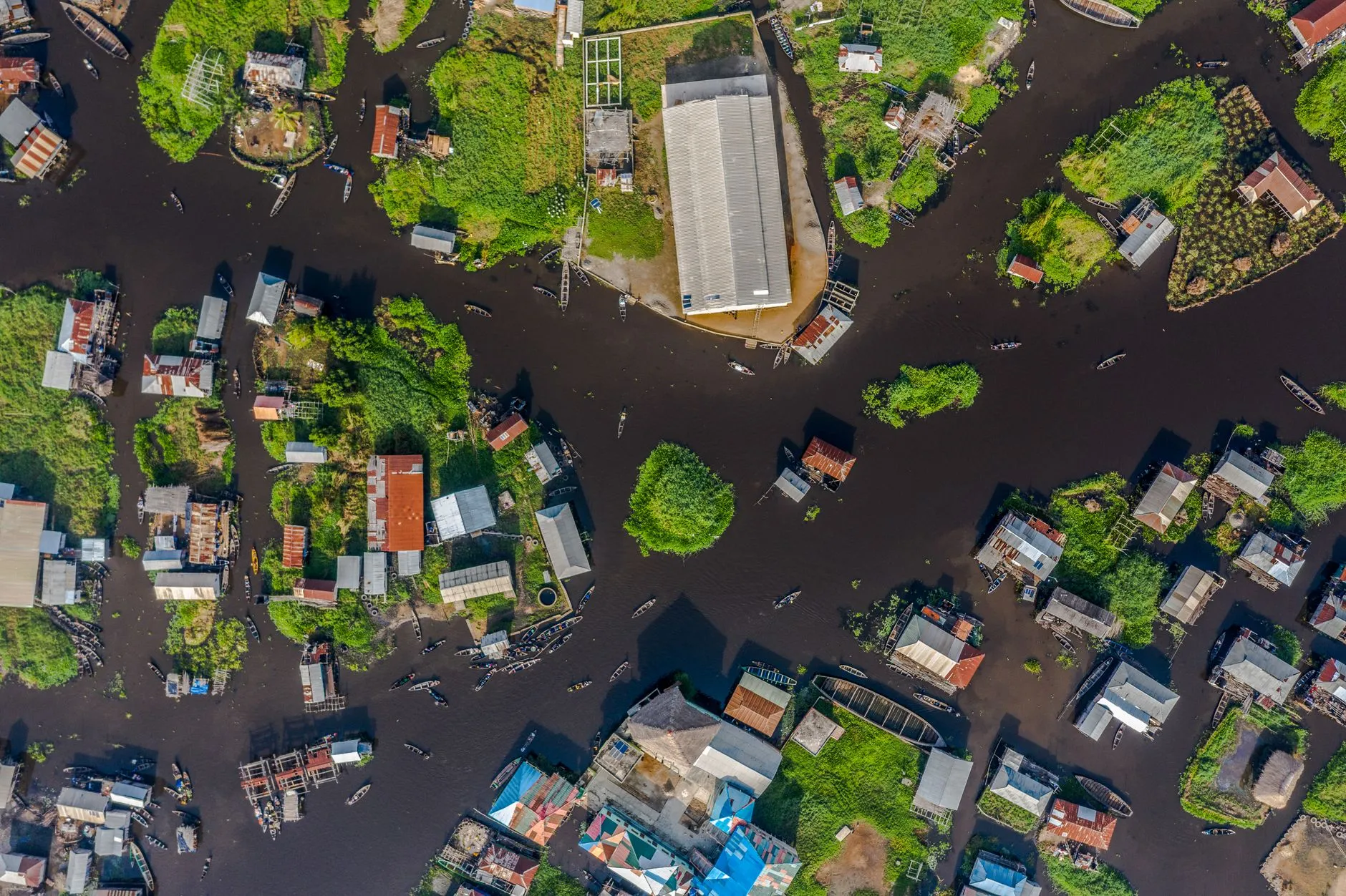
Here is the image that sells Benin, and for once the reality outruns the hype. Ganvié is a town of some 45,000 people built entirely on stilts over the shallow, brackish waters of Lake Nokoué — a true lake city of bamboo-and-tin houses, a floating market, a church, a school, all standing on poles above the water, reachable only by pirogue. They call it the “Venice of Africa,” which undersells it; Venice is a museum, Ganvié is a working, fishing, living place.
The history is the gut-punch that makes it more than a photo. The Tofinu people built Ganvié in the 17th and 18th centuries as a refuge — a sanctuary from the slave-raiding warriors of the Dahomey kingdom, whose religious code forbade them from attacking people living on water. A community founded to escape the slave trade, still floating three centuries later: there is no better single emblem of Beninese resilience.
Go early or don’t bother. Launch your boat by 8am, when the water is glassy, the light is soft, and the floating market is in full swing. By midday the lake is choppier, the heat is brutal on an open pirogue, and the magic thins.
You reach Ganvié from the embarcadère at Abomey-Calavi, about 45 minutes from central Cotonou. A guided private boat tour runs from around 15,000 CFA (roughly €23) and lasts two to three hours; a motorised pirogue is faster but a paddled one is quieter and far more in keeping with the place. Hire a certified local guide — they’ll narrate the floating market, the fish-farming acadja fences, and the etiquette of pointing a camera at people’s homes. And do mind that etiquette: Ganvié is somebody’s neighbourhood, not a theme park. Ask before you photograph, buy something at the floating market, and you’ll be welcomed. Treat it as a human zoo and you’ll deserve the cold shoulder you get.
Ouidah: The Door of No Return
If you do one thing in Benin, do Ouidah properly — and give it the gravity it demands. This small coastal town, 40 km west of Cotonou, was for nearly two centuries one of the busiest departure points of the transatlantic slave trade. More than a million enslaved Africans were marched from here onto ships bound for Brazil, the Caribbean and the American South. It is also, simultaneously, the spiritual capital of Vodun. The two histories are inseparable, and Ouidah carries both with a quiet dignity that has stayed with me longer than almost anywhere I’ve travelled.
The centrepiece is the Route des Esclaves (the Slave Route), a roughly four-kilometre path that traces the final walk from the old slave auction square down to the beach. You move past its stations slowly: the Tree of Forgetfulness (l’Arbre de l’Oubli), which captives were forced to circle in a brutal ritual meant to erase their memory and identity; the Zomaï, the holding pen of enforced darkness; the Tree of Return; and finally the Door of No Return (La Porte du Non-Retour), the memorial arch on the sand where the land ended and the ocean and bondage began. The monument has been fully restored under the government’s heritage push — its ochre-and-gold relief of chained figures stepping toward the water is now the defining image of Benin’s reckoning with its past.
This is a pilgrimage, not a sight. Walk the Route slowly, with a guide who tells the history straight, and leave the selfie energy at the gate. For diaspora travellers especially, this is sacred ground.
New for the next couple of years, as part of “Revealing Benin”: a full-size replica of L’Aurore, one of the last slave ships to sail from Ouidah, is being turned into an immersive museum of the trade, and the Chinese-backed La Marina Ouidah complex is reshaping the seafront into a heritage-tourism hub aimed at the African diaspora. Some will find the development tasteful; some will find it uneasy. Go and judge for yourself — but the underlying restoration of the memorial sites is real and overdue.
Ouidah’s other face is Vodun. The Temple of Pythons (Temple des Pythons) sits, with perfect Beninese symbolism, directly across from the town’s Catholic basilica — sacred royal pythons coiled in a small shrine, draped over visitors’ shoulders by the priests for those who want it. Nearby, the Sacred Forest of Kpassè holds carved deities among the trees, and the old Portuguese Fort now houses the Ouidah Museum of History. Stay a night here rather than day-tripping; the town at dusk, once the tour vans leave, is when it speaks.
Abomey: The Kingdom of Dahomey
Inland, about two and a half hours from the coast, lies the seat of one of West Africa’s great precolonial powers. Abomey was the capital of the Kingdom of Dahomey, the militarised, fearsomely organised state that dominated this region from the 17th century until the French conquest in the 1890s — and that, to be candid, grew rich in part on the very slave trade Ouidah memorialises. The Royal Palaces of Abomey are a UNESCO World Heritage Site: a vast walled compound of earthen palaces built by successive kings, their walls lined with the famous polychrome bas-reliefs that functioned as a kingdom’s history book, each symbol a battle, a king or a proverb.
The story here is extraordinary and worth a guide who can tell it. This was the kingdom of King Ghézo and King Béhanzin, the last independent ruler, who fought the French to the end. It was also the home of the Agojie — the all-female regiment of warriors Europeans called the “Dahomey Amazons,” recently dragged into pop-culture fame by the film The Woman King. The history is messier and more remarkable than any film: these women were an elite standing army, feared across the region.
The treasures came home. In 2021, France returned 26 royal artefacts looted from Abomey in 1892 — including the throne of King Béhanzin — and a major new museum at the palace site is being built to house them. Check before you go whether it has opened; seeing the throne back on its own soil is the point of the whole restitution.
A practical note: parts of the palace complex were damaged by fire and weather over the decades, and what you see is partly restored, partly atmospheric ruin. That’s fine — the bas-reliefs and the sense of a vanished power are the draw. Pair Abomey with a stop in nearby Bohicon (the rail and road junction) and you’ve got a full, rewarding day inland.
Porto-Novo: The Capital Nobody Visits
Here’s a Benin quirk to drop at dinner parties: the official capital isn’t the big city. Porto-Novo, a 30-km hop east of Cotonou toward the Nigerian border, is the constitutional capital, and it’s a low-key, leafy, faintly faded town that most visitors skip — wrongly, I think, if you have the half-day.
Its calling card is a delicious piece of architectural irony: the Grande Mosquée, a former church built in the flamboyant Afro-Brazilian “Baroque” style by returning formerly-enslaved Brazilians, all pastel curlicues and twin towers — it looks far more like a Bahian cathedral than a mosque. The town also holds the Musée Honmè (a royal palace), the small but charming Musée da Silva of Afro-Brazilian heritage, and a sleepy Jardin des Plantes. The Yoruba and Gun cultural threads here feel distinct from Fon-dominated Cotonou — Porto-Novo’s character leans east, toward Nigeria.
The North: Pendjari, Parc W, and an Honest Warning
I have to be straight with you, because this is where a lot of older guidebooks and dreamy blog posts will lead you wrong. For years, northern Benin was the country’s wildlife crown jewel: Pendjari National Park and the Beninese slice of the transboundary Parc W held some of the last West African lions, elephants, hippos and antelope, and a Pendjari safari was the natural second half of a Benin trip.
That trip is, for the foreseeable future, off the table. The jihadist insurgency that has engulfed the Sahel has spilled across Burkina Faso and Niger into northern Benin. Western tourists have been kidnapped inside Pendjari, attacks occur with little warning, and the major governments are unanimous and unambiguous: the US, UK, Canada and Australia all advise against all travel to Pendjari, to Parc W, to the Mékrou and Djona hunting zones, and to the broad band within roughly 50 km of the Burkina Faso and Niger borders. The US restricts even its own employees from the parks and the zone north of the Banikoara–Nigeria road.
Do not improvise this. No view, no animal and no “but a local said it’s fine” is worth a kidnapping or worse. The northern parks and the northern border are a hard no in 2026 — full stop.
I include all this not to frighten you off Benin, but to draw the line clearly. The cities and cultural sites of the south — Cotonou, Ouidah, Abomey, Ganvié, Porto-Novo, and the coastal belt generally — remain calm and very rewarding, and ordinary tourism there carries normal-precaution risk, not terrorism risk. The mistake to avoid is treating Benin as one undifferentiated “is it safe?” question. It isn’t one country, security-wise. The south is your trip. The far north is for a different, safer year.
If you specifically came to West Africa for wildlife, reroute: Benin’s south for culture, and look to safer safari countries elsewhere on the continent for the animals. Trying to force a Pendjari leg in 2026 is exactly the kind of decision that ends badly.
Vodun, Explained With Respect
Strip away the Hollywood nonsense — the pins, the dolls, the zombies. Vodun (you’ll also see “Vodoun” or “Voodoo”) is a genuine, sophisticated, organised religion, and Benin is its birthplace. It is recognised as an official religion here, with its own national public holiday, and an enormous share of the population practises it openly, frequently alongside Christianity or Islam without apparent contradiction. Everything you may think you know about “voodoo” came back to the Americas with enslaved Beninois and was warped through Hollywood; what you’ll meet in Benin is the real thing, dignified and complex.
At its core, Vodun is a worldview of intermediary spirits — the vodun — who stand between humans and a distant creator god, and who govern the forces of the world: the sea, the earth, smallpox, iron, thunder, the python. Priests, shrines, drumming, divination, offerings and elaborate masked ceremonies are the machinery of a faith that organises moral and social life. The Egungun and Zangbeto masquerades — the latter, the “night watchmen,” are whirling haystack-like figures believed to embody ancestral spirits and traditionally policed the community — are among the most arresting performances you can witness anywhere.
Watch, don’t gawk. You are welcome at much of this, but you are a guest at someone’s faith. Ask permission before photographing a ceremony or a shrine, follow your guide’s lead on where you may and may not go, and never treat a ritual as a spectacle laid on for you. Respect buys access; disrespect closes doors instantly.
The single best window into all of this is the Vodun Days festival (more under “When to Go”), but you don’t need the festival to encounter Vodun — it’s woven through daily life, in the roadside shrines, the fetish stalls of Dantokpa, the pythons of Ouidah, and the offerings left at sacred trees. Engage with it the way you’d engage with any deeply held belief that isn’t your own: with curiosity and manners, not with a smirk.
Eating in Benin
Beninese food is unfussy, deeply regional, and — if you eat where the locals eat — genuinely delicious. The national staple is pâte: a smooth, firm starch made from corn, cassava or yam flour, torn with the right hand and used to scoop up sauce. The version to seek out is amiwo, a reddish corn pâte cooked with tomato and pepper that has actual flavour built in, usually served with grilled chicken or fish.
The thing you’ll dream about afterwards is the poisson braisé — whole fish, scored and grilled over charcoal, slathered in a fiery, oniony, tomato moyo sauce, eaten with fried plantain or akassa (fermented corn dough). At a beach shack near Cotonou or Ouidah, with cold beer and your fingers, it’s one of the great cheap meals of the continent. Other things to chase: wagasi, the Fulani cow’s-milk cheese, fried golden and squeaky; atassi, a comforting beans-and-rice; the street-corner akara (black-eyed-pea fritters) and kuli-kuli (peanut sticks); and up-country, igname pilée, pounded yam with rich sauces. And do not leave without eating a Beninese pineapple — the Allada-region fruit is famous across West Africa for being absurdly sweet.
Eat where it’s busy. The plastic-chair maquis (open-air eatery) packed with locals at lunchtime will out-cook any hotel restaurant in the country, for a fifth of the price. Follow the crowd and the charcoal smoke.
To drink: La Béninoise is the workmanlike local lager; sodabi, a potent distilled palm spirit, is the firewater you’ll be offered in villages (respect it); and in the north, tchoukoutou, a cloudy millet beer, is the traditional brew. Bissap (hibiscus) and ginger juices are the soft refreshers. A full local meal runs you a few euros; a sit-down restaurant dinner in Cotonou with drinks, maybe €10–20.
Money, Costs and the CFA Peg
Benin uses the West African CFA franc (XOF), shared with seven neighbours, and here’s the traveller-friendly part: it is fixed-pegged to the euro at an unchanging 655.957 CFA = €1. No exchange-rate roulette, no guessing — if you think in euros, every price converts cleanly and stays put. (Round it to “1,000 CFA ≈ €1.50” in your head and you’ll never be far off.)
That said, Benin is overwhelmingly a cash economy, and getting cash is the recurring friction. Bring euros to exchange (they’re the natural currency to carry, given the peg) and rely on ATMs at the bigger banks — Ecobank, UBA, Bank of Africa — which most reliably accept foreign cards, with Visa working far better than Mastercard. Withdraw in town, in daylight, and carry a stash of small notes, because change for a large bill is forever a problem at markets, with zem drivers and at roadside stalls. Cards are accepted at upper-end Cotonou hotels and little else. Mobile money (MTN, Moov) runs the local economy but won’t help a foreign visitor much.
On budget: Benin is inexpensive by Western standards but not dirt-cheap by African ones, and decent accommodation is the line item that adds up. Reckon on €30–60 a night for a comfortable mid-range hotel in Cotonou or Ouidah, a few euros for street and maquis meals, €50–80 a day for a car and driver, and small change for zems and entrance fees. A culturally full week in the south, done sensibly with a driver, sits comfortably in the mid-budget bracket. Tipping is modest and appreciated rather than expected — round up, hand your guide something fair at the end.
When to Go — and the January Vodun Days
There is a clearly right answer here. Benin’s coast is hot and humid year-round, but the seasons split it cleanly. The long rains run roughly April to July, a shorter wet spell returns in September–October, and the dry season — late November through February — is when you want to be here: lower humidity, manageable heat, passable roads, and the harmattan haze drifting down from the Sahara. March and the rainy months are sweltering and sticky; come then only if you have no choice.
And if you can possibly time it, come for Vodun Days — the great annual celebration of Vodun, centred on Ouidah and anchored on the national holiday of 10 January. The government has rebranded and expanded the old festival into a multi-day event (in 2026 it ran 8–10 January), staged near the Door of No Return, on the beach and across Ouidah’s historic squares — sacred forest, the French Fort esplanade, the convents — with masked processions, ceremonies, drumming, and big-name concerts (recent editions drew Angélique Kidjo, Davido and international stars). It is loud, vivid, crowded and unforgettable, and it is the single best way to witness Vodun as living culture rather than museum display.
Book Vodun Days early. Ouidah’s modest stock of rooms vanishes for the festival, and prices jump. Lock in accommodation months ahead, or base in Cotonou and drive in for the day — the 40-km road is busy but manageable.
A word of expectation management: Vodun Days has become a genuine, partly-staged tourist event as well as a sacred one. The headline ceremonies are real; some of the surrounding programming is showcase. That’s not a criticism — it’s a country choosing to share its faith with the world — but go knowing it’s both at once.
What to Skip, and How to Stay Safe
For all my enthusiasm, not everything in Benin earns your time, and a few honest negatives will sharpen your trip.
Skip the beaches as a destination. The Gulf of Guinea coast around Cotonou and Ouidah looks the part — palms, surf, sand — but the currents are dangerous, the undertow has drowned the unwary, and the strands near the city can be litter-strewn and unswimmable. The beach is the backdrop to the Door of No Return and a place to eat grilled fish, not a swim-and-sunbathe affair. If you want a Gulf-of-Guinea beach holiday, this isn’t it.
Skip forcing the north, in any form. I’ve said it plainly already: Pendjari, Parc W and the northern border are out. No workaround, no “quiet route.” Don’t let a tour operator talk you into it.
Be realistic about Cotonou. It’s a means, not an end. A day of logistics and a market visit, then move on; don’t carve out three days expecting a charming city, because you won’t find one.
On staying safe in the parts you will visit: the southern cities carry ordinary urban-Africa precautions, not drama. Petty theft and bag-snatching — especially in Dantokpa market and on the back of a zem — are the real and manageable risks; carry little, keep your phone hidden, and don’t flash valuables. The genuine physical danger to your person, statistically, is the road — Benin’s traffic and moto culture are hazardous, so favour a vetted driver over a zem for anything beyond a short daytime hop. Take antimalarials, use repellent and a net, drink bottled or treated water, and pack for heat and sun. Learn even a handful of French phrases — bonjour, merci, combien? — and you’ll find Beninois warm and patient with visitors who try. Do all that, keep your itinerary in the calm south, and Benin gives you one of the most rewarding, least-touristed cultural journeys left in the world.
Frequently Asked Questions
Cheapest Flights to Benin
We have tracked 17 fares to Benin from 8 cities. As of June 2026, here is what a good price looked like from each — the lowest fare we recorded, and a “great-deal” benchmark to judge a quote against. These are tracked observations, not live prices: by the time you read this they will have moved, so treat them as a yardstick, not a quote.
| From | Lowest fare we tracked | Great-deal benchmark |
|---|---|---|
| LBV (LBV) | €349 | €499 |
| Douala (DLA) | €416 | €595 |
These are fares aifly tracked to this destination, not live quotes — they have changed since and several of the deals above may have expired. Browse current flight deals →