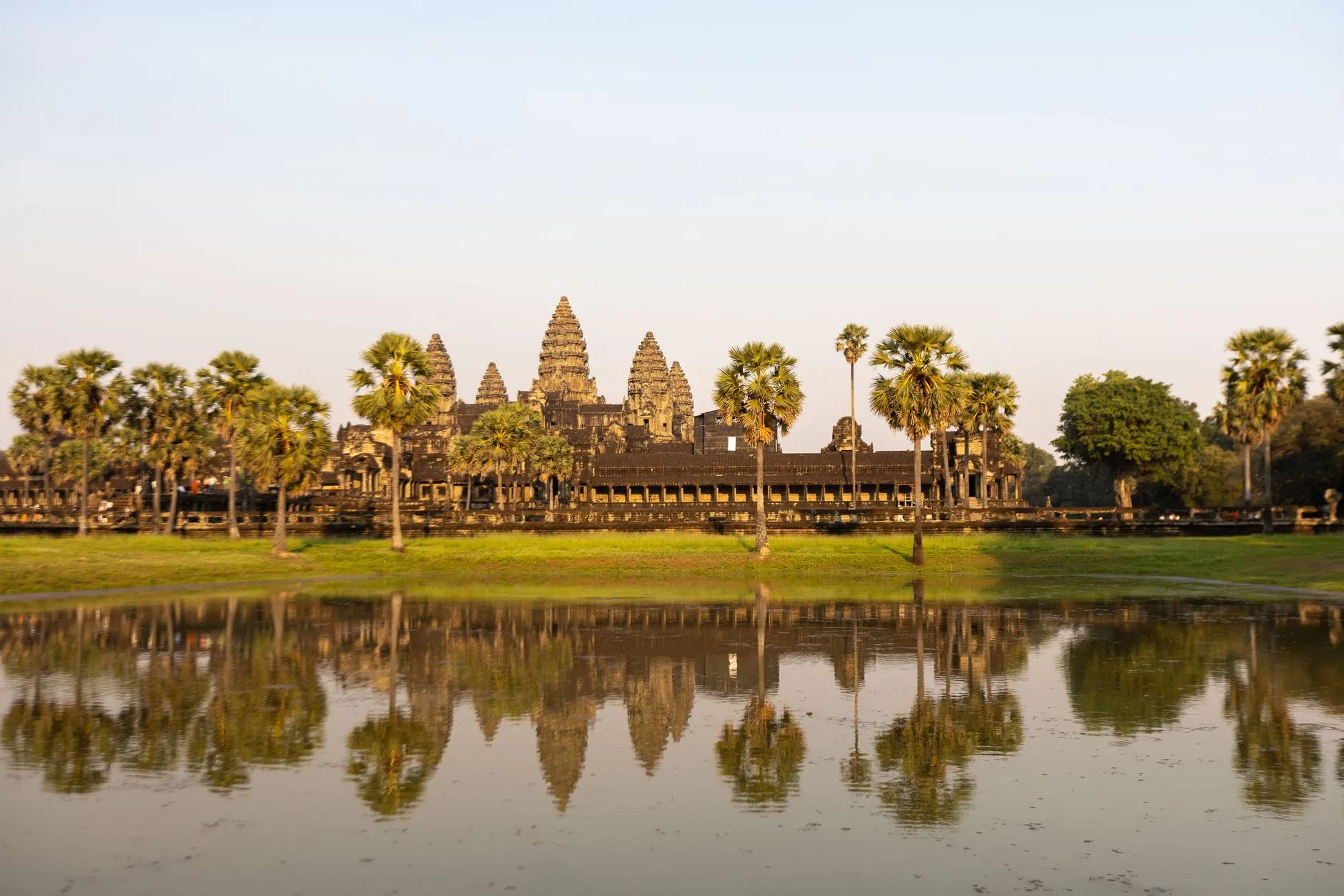
Cambodia — Complete Travel Guide 2026
Cambodia is the country people give three days and a sunrise photo, then leave — and that is a genuine mistake, even if the thing they came for is as overwhelming as everyone says. Angkor is not a temple. It is the surviving heart of an empire that ran half of Southeast Asia, and standing inside the Bayon at dawn as the faces emerge from the gloom is one of the great experiences travel still has to offer. But the same country also has a gentle island coast, the most underrated cuisine in the region, a French-colonial river capital, and a people who lived through one of the twentieth century’s worst horrors within living memory and will, with disarming openness, tell you about it. Come for Angkor. Stay for Cambodia.
Quick Reference
Mainland Southeast Asia, wedged between Thailand, Laos and Vietnam, with a Gulf of Thailand coastline to the southwest
Techo International (KTI) for Phnom Penh — brand-new, opened 2025; Siem Reap-Angkor International (SAI) for the temples — opened 2023; Sihanoukville (KOS) for the coast
Cambodian riel (KHR) on paper — but the US dollar is the everyday cash you’ll actually spend; budgets here are in € for clarity
Khmer (official); English is widely spoken across the tourism trade
e-Visa or visa-on-arrival ~US$30 / ≈ €28 for most visitors, 30 days; plus a free, mandatory e-Arrival card filed online before you land
November–March (dry, cool, the season); green and dramatic in the May–October wet; brutally hot in April
Angkor — the largest religious monument on Earth — plus a warm island coast, Kampot pepper, and a turbulent recent history reckoned with head-on
Siem Reap for Angkor; Phnom Penh for the capital; Kampot or Koh Rong for the south — most people do two of the three
Editor’s Note — three days is the mistake
Here’s the trap, and almost everyone falls into it. You fly into Siem Reap, you do Angkor over two or three days, you take the sunrise shot, and you fly out — Cambodia checked off, file under “did it.” And to be fair, Angkor is the reason to come, it genuinely is staggering, and if all you ever did was those temples you’d have seen something unforgettable. I won’t pretend the rest of the country competes with Angkor Wat for sheer wonder, because almost nothing on the planet does.
But Cambodia rewards the week most people don’t give it, and it does so cheaply and at a pace nowhere else in Southeast Asia can match. Add Phnom Penh and you get a real, complicated capital and the sobering, essential reckoning with the Khmer Rouge years — which changes how you understand everything else. Add the south and you get Kampot’s riverside pepper country and the backpacker-paradise islands off Sihanoukville. Add Battambang and you get the rural Cambodia of bamboo trains and colonial shophouses that nobody Instagrams. None of it is far, none of it is expensive, and the whole thing moves slower and friendlier than Thailand or Vietnam next door.
The sweet spot is seven to ten days: Angkor for the headline, Phnom Penh for the weight, and the south for the decompression. Do Angkor in three days and fly out and you’ve seen a wonder of the world. Stay the week and you’ve actually been to Cambodia.
⚠️ Don’t let Angkor be the whole trip. Three days of temples and an airport is the default itinerary, and it leaves the country’s soul — the capital’s history, the river, the islands — completely unseen. Block a week if you possibly can.
Should You Go? Who it’s for — and isn’t
Cambodia is for the traveller who wants Southeast Asia at its gentlest. It is, for many people, the friendliest country in the region — less hustle than Vietnam, less polish and crowding than Thailand, and a population that meets visitors with genuine warmth. It’s superb for first-time Asia travellers (English is widespread, the dollar economy is easy, the pace is forgiving), for temple and history obsessives (Angkor is the headliner of a lifetime), for budget travellers (few places stretch a euro further), and for anyone who wants beach-and-island time without the developed-world prices of the Thai islands.
It’s also, quietly, a country for the thoughtful traveller — one willing to sit with the Khmer Rouge history rather than around it. The reckoning at Tuol Sleng and Choeung Ek is harrowing and it is, in my view, the most important thing you can do in Phnom Penh.
Who it’s not for: anyone who needs everything fast, slick and on time — infrastructure is improving but roads are slow, things run late, and “Cambodia time” is real. Anyone expecting a wild party scene will find pockets of it (Pub Street, the islands) but it isn’t Thailand’s full-throttle nightlife. And anyone unwilling to engage even gently with a difficult history will find Cambodia hard to read — the genocide is not a museum exhibit here, it’s a thing that happened to the grandparents of the tuk-tuk driver taking you to the temples.
Getting There & Around — the new airports, overland, and tuk-tuks
First, throw out your old guidebook on the airports — this is the single most out-of-date thing in print about Cambodia, and it’ll send you to airports that no longer take commercial flights.
Phnom Penh now uses Techo International Airport (KTI), which opened in 2025 about 20 km south of the city in Kandal Province. It replaced the old Phnom Penh International Airport entirely for commercial flights — the old one is now a military base for domestic and private aircraft only. Techo is enormous, modern, built to grow to 30 million passengers, and far enough out that the transfer into town takes a real 45 minutes to an hour-plus in traffic — budget for it, and don’t assume the cheap, close-in airport ride the old guides promised.
Siem Reap — the gateway to Angkor — uses Siem Reap-Angkor International Airport (SAI), which opened in October 2023 about 40 km east of the temples. It too replaced the old in-town airport, shut partly because aircraft pollution was damaging Angkor’s stones. The upside: a smart new airport. The catch: where the old airport was minutes from the hotels, SAI is a 40-minute, roughly €12–18 taxi run into town — factor it in, and ignore any listing quoting the old airport’s distances.
For the coast, Sihanoukville (KOS) has its own airport with domestic and some regional flights, and it’s the jumping-off point for the islands.
Overland is half of how people arrive. Cambodia shares busy land borders with Thailand (the Poipet/Aranyaprathet crossing toward Bangkok, and quieter ones toward the coast) and Vietnam (the Bavet/Moc Bai crossing on the Phnom Penh–Ho Chi Minh City run, plus a scenic Mekong river crossing). Buses run all these routes cheaply; the Phnom Penh–Ho Chi Minh City bus is a classic, easy half-day. You can get the e-Visa or visa-on-arrival at the main land crossings — but Poipet in particular has a notorious history of visa scams and “extra fees,” so do the e-Visa online beforehand if you’re crossing there.
Getting around inside the country, the everyday ride is the tuk-tuk — Cambodia’s version comes in two flavours: the classic carriage towed behind a motorbike, and the newer “rickshaw”-style auto. Crucially, the ride-hailing apps PassApp and Grab work in Phnom Penh and Siem Reap and price the trip for you — use them and the haggling and the tourist-tax overcharging both disappear. A cross-town tuk-tuk is a euro or two; a full day with a driver to tour the Angkor temples runs roughly €15–22.
Between cities, long-distance buses (Giant Ibis is the reliable, traveller-favourite operator) link Phnom Penh, Siem Reap, Battambang, Kampot and Sihanoukville cheaply but slowly — Phnom Penh to Siem Reap is around six hours. Cheap domestic flights (Air Cambodia and others) connect Phnom Penh, Siem Reap and Sihanoukville in well under an hour if you want to skip the road. And on the water, Mekong and Tonlé Sap boats — the Siem Reap–Battambang river journey through floating villages, or the slow Mekong cruises — are a beautiful, if seasonal and weather-dependent, way to travel.
💡 Use PassApp or Grab, not the street price. In Phnom Penh and Siem Reap the apps set a fair, metered-style tuk-tuk fare and kill the haggle entirely. Off-app, always agree the price before you climb in.
Angkor & Siem Reap — the reason you came
This is the headline, and it deserves the room. Angkor was the capital of the Khmer Empire from roughly the 9th to the 15th century, and what survives is the largest religious monument complex on Earth — hundreds of temples scattered across a landscape, of which the famous ones are only the start.
Angkor Wat itself is the giant: a 12th-century temple-mountain the size of a small city, its five lotus-bud towers reflected in a moat, every surface carved with celestial dancers and a vast bas-relief of the Churning of the Sea of Milk. It’s the largest religious structure ever built, it’s on the national flag, and yes — you go at sunrise, when the towers blacken against a pink sky over the reflecting pool. Be honest with yourself about the crowds, though: you will not be alone. Hundreds of people line the pond for the same shot. It’s still worth it — there’s nothing else like that first light — but consider doing sunrise once and seeing the temple’s interior later in the day when the tour buses have moved on.
Angkor Thom, the walled royal city just north, holds the Bayon — and the Bayon may quietly be the better experience. Its towers are carved with more than two hundred enormous, serene, half-smiling stone faces that watch you from every angle as you move through the ruin; at dawn or late afternoon, with the light raking across them, it’s hypnotic and strange in a way Angkor Wat’s grandeur isn’t. Within Angkor Thom’s walls are also the Baphuon, the Terrace of the Elephants and the Terrace of the Leper King.
Ta Prohm is the jungle temple — the one Hollywood used for Tomb Raider — deliberately left in the grip of the forest, with giant silk-cotton and strangler-fig roots pouring over and through the collapsing galleries. It’s the most atmospheric ruin in Angkor and, again, the most crowded at the famous root-doorways; come early.
Further out, Banteay Srei — “the citadel of women” — is a small 10th-century temple of pink sandstone carved with a delicacy nothing else in Angkor matches; it’s about 25 km from the main cluster but the carving is worth the run. And there’s far more: Preah Khan, Neak Pean, the distant jungle pyramid of Beng Mealea, the early capital of Koh Ker.
The pass strategy matters. Angkor passes are sold at the official ticket centre (bring your passport; they take your photo) and the prices are in US dollars: 1-day US$37 / ≈ €34, 3-day US$62 / ≈ €57, and 7-day US$72 / ≈ €67. The one-day pass is a forced march and a mistake for most people — you’ll exhaust yourself and resent the temples. The three-day pass is the sweet spot: it’s valid across a 10-day window so you don’t have to use the days consecutively, which means you can do two hard temple days, take a rest day by the pool, and come back. Hire a tuk-tuk driver for the day (roughly €15–22) and a good local guide for at least your first day (the carvings tell stories you’ll never decode alone) — it transforms the visit.
Siem Reap is the base for all of it, and it’s a pleasant, walkable, increasingly polished town: leafy French-quarter streets, the riverside, a strong café and restaurant scene, spas, and the Angkor National Museum for context before you go. At its heart is Pub Street — a loud, neon, bucket-cocktail strip that’s either a fun night out or your idea of hell, depending; the surrounding lanes (the Lane, Kandal Village) are mellower and better. Three to four nights in Siem Reap is right for Angkor done properly.
💡 Buy the 3-day pass, not the 1-day. The 3-day Angkor pass is valid over a 10-day window, so you can spread the temples out, take a rest day, and avoid the death-march burnout the single day guarantees. It’s the difference between savouring Angkor and surviving it.
Phnom Penh — the capital and the reckoning
Phnom Penh is a real, raw, fast-changing river city — chaotic, energetic, building skyward, and far more rewarding than the day most people give it on the way to somewhere else. It sits where the Mekong, the Tonlé Sap and the Bassac rivers meet, and the riverfront promenade at dusk — locals exercising, food carts, families out — is the easiest way to feel the city’s pulse.
The set-piece sights are genuinely worth your time. The Royal Palace complex, with its gilded spires and the dazzling Silver Pagoda (its floor laid with five thousand silver tiles, housing an emerald Buddha and a life-size gold one), is the city’s showpiece — dress modestly, shoulders and knees covered, or you won’t get in. The National Museum, in a beautiful terracotta-red pavilion, holds the world’s finest collection of Khmer sculpture — the serene stone gods and kings that the Angkor temples were built to house. And the Central Market (Phsar Thmei), a striking Art Deco dome, and the markets and street life in between are the everyday city.
But Phnom Penh’s most important experience is a sombre one, and it is essential. Between 1975 and 1979 the Khmer Rouge regime emptied this city at gunpoint and set about murdering, by execution, starvation and overwork, somewhere around two million Cambodians — roughly a quarter of the entire population. Two sites in and near the capital bear witness, and they are not “attractions” — they are a genocide memorial, and they should be approached with that gravity.
Tuol Sleng (S-21) is a former high school the regime turned into a torture-and-interrogation prison. Walking its classrooms — the iron beds, the cells, the wall of photographs of the people who passed through and were killed — is devastating and unforgettable. The audio guide, narrated in part by survivors, is the right way to do it. Choeung Ek, the “Killing Fields” about 15 km outside the city, is where Tuol Sleng’s prisoners were taken to be killed; today it is a quiet field of grassed-over mass graves around a memorial stupa filled with the skulls of the dead, and the audio tour walks you through it with extraordinary restraint and humanity. People often visit both in a single, heavy half-day. Do not skip them because they’re hard. Understanding what happened here is the key to understanding modern Cambodia, and the openness with which Cambodians have chosen to remember it — rather than bury it — is itself something to honour.
⚠️ Tuol Sleng and Choeung Ek are genocide memorials, not sights. Dress respectfully, keep your voice down, think hard before you take photographs, and never pose smiling at the graves or the stupa. Take the audio guide. These places ask for your seriousness, and they earn it.
The South Coast & Islands — Koh Rong, Kampot, Kep
Cambodia’s southwest coast is the antidote to temple fatigue: warm Gulf-of-Thailand water, backpacker-paradise islands, a sleepy pepper-and-river scene, and a crab town — plus one cautionary tale of overdevelopment.
Koh Rong and Koh Rong Sanloem are the islands, reached by ferry (around €10–22 return) from Sihanoukville. Koh Rong is the bigger, louder, party-and-backpacker island — long white beaches, beach bars, bioluminescent plankton on night swims, and a hard-partying strip at Koh Touch alongside quieter bays. Koh Rong Sanloem is its calmer sibling — Saracen Bay’s curve of pale sand, bungalows over clear water, no roads, no rush — and the better pick if you want the desert-island idyll without the bass. Both are simpler and cheaper than Thailand’s islands, with patchier electricity and Wi-Fi that’s part of the charm; come for hammock time, not luxury.
Kampot is the traveller darling of the south — a laid-back riverside town of crumbling French-colonial shophouses, a beautiful slow river framed by the Bokor mountains, sunset boat cruises, and a genuinely cool café, bar and guesthouse scene that’s drawn a whole community of long-stayers. It’s the home of Kampot pepper, one of the world’s great peppercorns (geographically protected, like a fine wine) — you can tour the plantations in the surrounding countryside, and you’ll taste it in everything. Up the hill, Bokor National Park holds an eerie abandoned French hill station and casino in the mist. Kampot is where people come for two nights and stay a week.
Kep, just down the coast, is a faded former French seaside resort with a single, glorious reason to visit: the crab market, where you eat fresh Kep crab fried with — what else — Kampot green peppercorns, sitting at plastic tables by the water. It’s one of the best meals in the country and worth a day-trip from Kampot, with Rabbit Island (Koh Tonsay) a short boat hop offshore for a simple beach.
And then there’s Sihanoukville — and here’s the honest take. The coastal city that was once a scruffy, likeable backpacker beach town has been transformed, over the past several years, into a sprawl of Chinese-financed casinos and high-rise construction, much of it half-built, that wrecked the old charm. Most travellers now treat Sihanoukville as nothing more than the ferry port for the islands — get in, get the boat, get out — and that’s the right call. The beaches and the soul of this coast are on the islands, in Kampot and in Kep, not in the city itself.
💡 Treat Sihanoukville as a transit point. The casino boomtown isn’t where the coast’s charm lives anymore — head straight through it to the Koh Rong ferries, or skip it entirely for Kampot and Kep. The good stuff is offshore and just along the water.
Battambang & the Countryside — the Cambodia most people skip
Between the headline destinations lies the rural Cambodia that almost nobody on a one-week temple trip ever sees — and it’s worth carving out a couple of days for if you have them.
Battambang, Cambodia’s second city, is a slow, handsome riverside town of the country’s best-preserved French-colonial architecture — shophouses, a sleepy market, a growing arts and café scene — and almost no crowds. Its most famous quirk is the bamboo train (“norry”): a flat bamboo platform on wheels, driven by a small motor, that runs along old, warped railway tracks through the rice fields and palm groves at a surprising clip — when two meet head-on, the lighter one is simply lifted off the rails to let the other pass. It’s touristy and it’s tremendous fun. Around Battambang are the working countryside, hilltop temples like Phnom Sampeau (with its own dark Khmer Rouge “killing cave” history, and an extraordinary nightly exodus of millions of bats from a cliffside cave at dusk), and the kind of unhurried rural life — rice paddies, ox carts, stilt houses — that is the real texture of the country.
The Siem Reap–Battambang river boat through the floating and stilted villages of the Tonlé Sap and the Sangkae river is, when water levels allow, one of the most memorable journeys in Cambodia — a long, slow, intimate window onto a way of life lived entirely on the water.
This is the Cambodia of the other ninety percent: agricultural, gentle, profoundly poor in places, and welcoming in a way the tourist towns can’t quite match. A day or two here recalibrates the whole trip.
The History & Culture You Should Understand
You cannot read Cambodia without holding two things in your head at once: an empire of staggering achievement, and a genocide within living memory. Both are essential, and the second is not optional background.
For roughly six centuries the Khmer Empire was one of the most powerful states in Asia, ruling much of present-day Thailand, Laos and Vietnam from its capital at Angkor, mastering the hydraulic engineering — vast reservoirs and canals — that fed a population of perhaps a million when London was a town. Angkor is the physical proof of that golden age, and it is the wellspring of Cambodian national pride. The Khmer are an ancient, distinct people with their own language, script, classical dance (the apsara) and a deep-rooted Theravada Buddhism that shapes daily life — the saffron-robed monks, the village pagodas, the offerings.
And then there is 1975 to 1979. The Khmer Rouge, a Maoist movement led by Pol Pot, seized the country, abolished money, religion, schools, cities and the family, drove the entire urban population into forced agricultural labour, and set out to build a “pure” agrarian society by erasing everyone who stood in the way — the educated, the urban, the religious, ethnic minorities, anyone who wore glasses or spoke a foreign language. In under four years they killed around a quarter of the population, by execution and by engineered starvation and disease. The regime was driven out by a Vietnamese invasion in 1979, but civil conflict and Khmer Rouge holdouts dragged on into the 1990s. The arithmetic of this is the most important fact about Cambodia today: nearly everyone over fifty is a survivor, and an entire generation of teachers, doctors, artists and elders was simply wiped out. It explains the country’s youth, its poverty, its gentleness, and the quiet weight that sits beneath the warmth. Cambodians, remarkably, have chosen to remember rather than hide it — which is why Tuol Sleng and Choeung Ek exist as memorials, and why you should go.
One practical legacy worth knowing: Cambodia remains one of the most heavily landmined countries on Earth, a relic of decades of conflict. In the well-trodden tourist areas — Angkor, the cities, the coast, the established trails — this is not a concern; clearance has been extensive. But in remote rural and border regions, the rule is simple and absolute: stay on marked paths and roads, and never wander into fields or forest off the beaten track. Heed the red “danger mines” signs where you see them.
What to Eat & Drink
Cambodian food is the most underrated cuisine in Southeast Asia, and it’s quietly having its moment — milder and more subtle than Thai, less herb-forward than Vietnamese, built on fish, rice, fresh aromatics and the country’s astonishing pepper.
The dish to seek first is fish amok — freshwater fish in a fragrant, mousse-like coconut curry thickened with egg and scented with kroeung (the Khmer lemongrass-galangal-turmeric paste) and aromatic slok ngor leaves, traditionally steamed in a banana-leaf cup. It’s the national dish and, done well, it’s superb. Khmer red curry (milder and less fiery than its Thai cousin), lok lak (peppery stir-fried beef with a lime-and-black-pepper dipping sauce — and the pepper is the point), and bai sach chrouk (the great Cambodian breakfast: marinated grilled pork over broken rice with pickles) are everywhere and reliably good.
The star ingredient is Kampot pepper — a geographically protected peppercorn of remarkable complexity, used fresh and green in Kep’s famous crab, dried and black on everything else, and worth taking home. On the coast, eat the Kep crab fried with green Kampot pepper at least once; it’s one of the country’s best plates. And don’t skip the street food: noodle soups, grilled skewers, the fresh-fruit shakes, the palm sugar sweets, and — if you’re game — the crunchy fried tarantulas and crickets of Skuon, a genuine and unfeigned local snack.
To drink: Angkor and Cambodia beers are cheap and cold (a draught is often under a euro), local rice spirits are potent and best treated with caution, fresh sugarcane and fruit juices are everywhere, and the iced coffee — strong, sweet, often with condensed milk — is excellent. Prices are quoted in US dollars across the tourism trade, which makes everything legible: a street meal is a couple of euros, a sit-down restaurant dinner with a beer rarely more than €6–10.
Costs & Money — the dollar-and-riel reality
Here is the thing that confuses every first-timer, so let’s be clear: Cambodia runs on two currencies at once. The official currency is the Cambodian riel (KHR), but in practice the US dollar is the everyday cash — prices are quoted in dollars, ATMs dispense dollars, hotels and tour operators bill in dollars, and you’ll mostly pay in dollars. The riel functions as small change: when something costs, say, US$3.50 and you hand over four dollars, you’ll get your change back in riel (roughly 4,000 riel to the dollar). So you carry a wallet of US dollars and a pocket of riel coins-of-the-realm for the cents.
Two practical rules follow. First, carry clean, unripped US dollar bills — Cambodian vendors and even banks reject torn, marked or very worn notes, and a small tear can make a $20 worthless to them. Second, keep small denominations: paying for a €1 tuk-tuk with a $50 bill will defeat everyone. ATMs are widespread in cities and tourist towns, dispense US dollars, and charge a per-withdrawal fee (often US$4–6 / ≈ €4–5), so take out larger amounts less often.
And Cambodia is cheap — one of the best-value countries in Southeast Asia. A rough daily on-the-ground budget (excluding flights and the Angkor pass):
- Backpacker / budget: ~€20–30/day — dorms and simple guesthouses, street food and local restaurants, tuk-tuks and buses. You can eat very well for €5–8 a day.
- Mid-range: ~€45–80/day — comfortable hotels or boutique guesthouses, restaurant meals, a private tuk-tuk driver, the odd tour or spa.
- Comfortable: from ~€90/day up — smart hotels, private guides and transfers, the better island bungalows, fine dining (which, by Cambodian standards, is still a bargain).
Individual prices give the picture: a guesthouse double from €12–20; a street meal €2–3; a restaurant dinner with a beer €6–10; a draught Angkor under €1; a Koh Rong return ferry €10–22; a full day with a tuk-tuk driver around Angkor €15–22; a museum or sombre-site entry a few euros. Tipping isn’t traditional but is increasingly appreciated in tourism — round up, leave a dollar or two for good service, and tip your Angkor guide and driver well; their wages are low and your tip matters.
⚠️ Carry clean, small US dollar bills — and don’t accept torn ones. Cambodia’s dollar economy quietly rejects ripped, scribbled or very worn notes, and you’ll be stuck with them. Check the change you’re given, keep plenty of small denominations for tuk-tuks and street food, and let the riel be your loose change.
Practical Information
Entry & visa: most visitors need a visa, and it’s easy. The cheapest, simplest route is the e-Visa at the official government site evisa.gov.kh — a tourist visa costs US$30 / ≈ €28 (plus a small processing fee), grants 30 days, and arrives by email as a PDF you print and carry. Visa-on-arrival at the airports and main land borders costs the same US$30, but bring a passport photo and exact dollars, and at land crossings (Poipet especially) it’s where the “extra fee” scams happen — so the e-Visa is the safer choice overland. Separately and importantly, all air arrivals must complete the free, mandatory e-Arrival card online within 7 days before landing — it’s a digital immigration/customs form, not a visa, and it’s free; do it in advance to skip queues. Your passport needs at least six months’ validity. (Use only the official evisa.gov.kh — countless lookalike sites overcharge.)
Safety: Cambodia is, day to day, a safe and welcoming country for travellers — violent crime against tourists is rare. The real risks are petty: bag-snatching by passing motorbike (especially in Phnom Penh — wear bags across your body, away from the road, and don’t dangle a phone), tuk-tuk and tour overcharging (use the apps), and the visa/border scams noted above. The two structural cautions are landmines in remote off-trail areas (stay on marked paths) and ordinary road-safety on Cambodia’s chaotic, slow roads. Check your government’s current advisory, but a normal itinerary is on solid ground.
The heat: Cambodia is hot and humid year-round, and April is genuinely brutal — temperatures push past 40°C, and clambering over sun-baked Angkor in the dry-season peak is no joke. Drink far more water than feels necessary, start temple days at dawn and rest through the midday furnace, wear sun protection, and respect the heat — sunstroke at the temples is common and entirely avoidable.
Dress & culture: Cambodia is a Buddhist country and modest dress matters at sacred sites — at Angkor, the Royal Palace and any pagoda, shoulders and knees must be covered (Angkor Wat’s upper level and the Palace will turn you away otherwise), so carry a scarf or a light cover-up. Remove shoes and hats entering temples, never touch a monk if you’re a woman, never point your feet at a Buddha image, and don’t touch anyone’s head. A small bow with palms together (the sampeah) is the warm local greeting.
Connectivity: cheap local SIM cards (Cellcard, Smart, Metfone) with generous data are easy to buy at the airport or in town with your passport, and far better value than roaming — get one on arrival. Wi-Fi is standard in city and town accommodation (patchier on the islands, which is part of their charm).
When to Go
Cambodia has two seasons — dry and wet — plus a short, savage hot spell, and the calendar is simpler than most of the region.
November–March is the season: dry, with cooler, clearer air, comfortable temperatures (the December–January nights can be almost pleasant), and the best conditions for clambering over Angkor and lying on the islands alike. It’s peak — busiest and priciest, and the Angkor sunrise crowds are at their thickest — but it’s the easy answer, and December–January is the prime window.
April–early May is the hot season, and it is hot — pushing 40°C with heavy humidity, the hardest time to do the temples. It’s also Khmer New Year (mid-April), a joyful, water-throwing, family-focused holiday when much of the country effectively shuts down and travels — atmospheric, but plan around closures.
May–October is the green (wet) season — and don’t write it off. The rains usually come as short, dramatic afternoon downpours rather than all-day washouts, the countryside turns an electric green, the temples and islands empty out, prices drop, and the Tonlé Sap swells to its vast wet-season size, making the floating-village boat trips at their most spectacular. The downsides are humidity, the occasional flooded road or cancelled boat, and choppier seas to the islands. For temples-plus-value with thin crowds, the shoulder months of late October–November and May are an underrated sweet spot.
Frequently Asked Questions
Cheapest Flights to Cambodia
We have tracked 491 fares to Cambodia from 46 cities. As of June 2026, here is what a good price looked like from each — the lowest fare we recorded, and a “great-deal” benchmark to judge a quote against. These are tracked observations, not live prices: by the time you read this they will have moved, so treat them as a yardstick, not a quote.
| From | Lowest fare we tracked | Great-deal benchmark |
|---|---|---|
| Malaga (AGP) | €364 | €520 |
| Mallorca (PMI) | €366 | €523 |
| Dublin (DUB) | €374 | €534 |
| Brussels (BRU) | €389 | €556 |
| Amsterdam (AMS) | €393 | €561 |
| Paris (CDG) | €406 | €580 |
| Copenhagen (CPH) | €412 | €589 |
| Nice (NCE) | €414 | €591 |
| Budapest (BUD) | €475 | €678 |
| Lisbon (LIS) | €531 | €758 |
Recent deals we have posted to Cambodia:
- Cheap Flights Singapore to Siem Reap 2026 — From 300 EUR
- Cheap Flights Kuala Lumpur to Siem Reap 2026 — From 300 EUR
- Cheap Flights Ho Chi Minh City to Siem Reap 2026 — From 300 EUR
- Cheap Flights Bangkok to Siem Reap 2026 — From 300 EUR
These are fares aifly tracked to this destination, not live quotes — they have changed since and several of the deals above may have expired. Browse current flight deals →