Colombia — Complete Travel Guide 2026
Colombia is the trip your cautious friends will worry about and then quietly envy. It packs a Caribbean walled city, snow-dusted Andean peaks, wax palms taller than apartment blocks and a genuinely transformed Medellín into a single country where you can sweat through breakfast on the coast and need a jumper by dinner in Bogotá. The reputation lags the reality by about two decades — go now, while it still feels like a discovery.
Quick Reference
Northwestern South America, straddling the Caribbean, the Pacific, the Andes and the Amazon
BOG (Bogotá – El Dorado), CTG (Cartagena – Rafael Núñez), MDE (Medellín – Rionegro/José María Córdova)
Colombian peso (COP)
Spanish
Visa-free for most Western tourists (UK, EU, US, Canada, Australia), typically 90 days; onward ticket required
December–March (driest, country-wide); July–August a secondary dry window
Cartagena’s walled city, the Coffee Region, Medellín’s reinvention, Caribbean coast, coffee, salsa
Cartagena for the coast, Salento for the coffee, Medellín for the mountains — most people do all three
Editor’s Note: The Honest Pitch
Here’s the route that works, and almost everyone who plans Colombia well ends up doing some version of it: Cartagena and the Caribbean coast, the Coffee Region around Salento, and Medellín — three regions, three climates, roughly two weeks. Bogotá is the usual arrival point and worth a couple of days, but it’s the one most people would cut first if pushed. That coast-coffee-Medellín spine gives you the heat and history of the Caribbean, the green hush of the coffee fincas, and a city that’s become South America’s most-talked-about urban comeback.
The two things to internalise before you book. First, altitude and climate vary by region, not by month — Colombia sits on the equator, so what changes is how high you are, not the season. Bogotá is permanently cool (13–18°C), Medellín is permanently spring-like (22–25°C), Cartagena is permanently hot and humid. Pack for all three. Second, Colombia is far safer than its reputation but not uniformly safe — the cities, the coffee towns and the tourist coast are fine with ordinary urban sense, while specific rural departments still carry real “do not travel” advisories. The trick is knowing which is which, and this guide tells you plainly.
This is a do-and-eat-and-dance country, not a tick-box one. The welcome is the headline attraction — Colombians are, route for route, among the warmest hosts in the Americas.
Should You Go? Who It’s For — and Isn’t
Go if you want range in one trip: colonial heat, Andean cool, coffee-farm green, world-class coffee, salsa, and a food scene built on beans, corn and grilled meat. Go if you like cities with edge and reinvention, if you’ll happily take a 4×4 into a desert or a boat to a reef, and if you’re comfortable using your own judgment about where to be after dark.
Think twice if you need everything sanitised and signposted, if you won’t fly domestically (the country is big and the roads are slow and winding), or if any background-level risk is a dealbreaker. Colombia rewards travellers who engage — a little Spanish goes a very long way, and the difference between a smooth trip and a stressful one is mostly down to “no dar papaya” (more on that below).
This isn’t a luxury-beach destination in the Caribbean-resort sense — the best beaches are in the islands and national parks, not off the city malecóns. And it’s not a one-base trip; the magic is in moving between regions.
Getting There — BOG, CTG, MDE & Entry
Most Europeans arrive into Bogotá El Dorado (BOG), by far the biggest hub and the cheapest long-haul gateway, with direct service from Madrid, Paris, London (seasonal/connecting) and Istanbul. Cartagena (CTG) takes a growing number of direct and one-stop Caribbean and US connections and is the dream first-stop if you can swing it. Medellín (MDE), at Rionegro 45 minutes outside the city, is the third gateway and a superb base.
Flight times from Europe run roughly 10–12 hours to Bogotá, usually via Madrid or a US/Caribbean hub. From the US, Colombia is short-haul-ish — Miami to Cartagena is under three hours.
Entry for 2026. Tourists from the UK, EU, US, Canada and Australia get a visa-free stamp on arrival (the PIP), normally 90 days, extendable once at a Migración Colombia office up to a maximum of 180 days in a calendar year. You must be able to show an onward or return ticket within your permitted stay — airlines and immigration do check. Your passport should be valid for the duration of your trip.
Before you fly: the Check-Mig form. Every air passenger entering and leaving Colombia must complete the free online Check-Mig form via Migración Colombia, between 72 hours and 1 hour before each flight. It’s quick, it’s free, and skipping it can slow you down at the desk — do it for both your arrival and your departure.
Never pay a third-party “visa service” for entry — there’s no tourist visa to buy, and the Check-Mig form is free on the official Migración site.
Cartagena & the Walled City
Cartagena is the postcard, and it earns it. Inside the Ciudad Amurallada — 13 kilometres of 16th–17th-century Spanish fortifications wrapped around a UNESCO-listed old town — the streets are a tangle of bougainvillea-draped balconies, ochre and indigo colonial mansions, shaded plazas and 400-year-old churches that stay blessedly cool while the street outside cooks. This is the most photogenic urban core in South America, and also the most touristed: expect fruit-sellers in pollera dresses, emerald hawkers, and the gentle, relentless hustle of a place that knows exactly how beautiful it is.
Spend your time wandering rather than ticking off sights. Climb the walls near Café del Mar for sunset over the Caribbean. Visit the Castillo de San Felipe de Barajas, the great hilltop fortress, ideally early before the heat. Then cross into Getsemaní, just outside the walls — once rough, now the soul of the city: street art down every alley, salsa spilling out of bars on Plaza de la Trinidad, families playing dominoes, and the best cheap eating in town. It’s livelier, cheaper and more local than the walled city, and it’s where you should base yourself if you want atmosphere over polish.
The heat is the real obstacle, not the touts. Cartagena is hot and humid year-round, often 30°C+ with brutal humidity. Walk the old town early morning and after 4pm; retreat to a rooftop pool or a cool church in the worst of the midday. December–April is the dry season and the best window for beach days and walking.
For beaches, skip the gritty city-front strips and head to the water. Playa Blanca on Barú is the famous one (busy, day-trippable). Better: the Rosario Islands, an archipelago an hour out by boat from Muelle La Bodeguita — clear water, snorkelling off the dock, and quiet island stays if you overnight. Three to four days covers the walled city, Getsemaní and the forts; stretch to five to seven if you want island time.
Cartagena is Colombia’s priciest city — by a lot. Costs here run 40–60% above Bogotá or Medellín, and restaurants inside the walls are tourist-priced. Eat in Getsemaní, agree taxi fares before you get in, and treat the walled-city emerald and “free” cocktail offers with suspicion.
The Caribbean Coast — Tayrona, the Lost City & La Guajira
East of Cartagena, the coast gets wilder and the rewards bigger. Santa Marta, Colombia’s oldest city, is the gritty-but-useful launchpad for everything here. Just east lies Tayrona National Park, where jungle tumbles straight onto golden Caribbean beaches — Cabo San Juan is the iconic stretch. A note that matters for 2026: Tayrona was temporarily closed in February 2026 (17 Feb to 5 March) during a government operation against illegal constructions and criminal networks inside the park; it has reopened, but check its status before you build a trip around it, and be aware the park also runs periodic ecological closures.
Between Tayrona and the Guajira sits Palomino, a laid-back beach village built for tubing down the river and hammock afternoons — a soft landing after harder travel.
The big-ticket adventure on this coast is the Ciudad Perdida — the Lost City trek. This is a 4-to-5-day, 46–60km traverse through the Sierra Nevada de Santa Marta to a Tairona archaeological site older than Machu Picchu, reached by climbing 1,200 stone steps through cloud forest. You hike 6–8 hours a day, sleep in basic riverside camps run by local families and Indigenous communities, and you cannot do it independently — it’s a certified-operator-only route. Expect to pay around €470–520 (about 2,150,000 COP) for the standard shared 4- or 5-day trek, all-inclusive (transport, lodging, three meals, guide). It’s hot, muddy and genuinely tough.
Prep the Lost City trek properly. Bring broken-in boots, quick-dry layers, insect repellent (mosquitoes are constant), water-purification or cash for refills, and realistic fitness. The river crossings and steep, slick descents are where people get hurt — go slow, and book a reputable Santa Marta operator, not the cheapest desk you find.
Furthest east is La Guajira, Colombia’s desert peninsula — a 4×4 world of cactus, salt flats and turquoise bays where the Wayúu people live. A typical 3-to-4-day tour from Riohacha runs through the Manaure salt flats to Cabo de la Vela (sunset at the lighthouse, the Pilón de Azúcar viewpoint) and on to Punta Gallinas, the northernmost point of South America, with the Taroa dunes spilling into the sea. You sleep in chinchorro hammocks in Wayúu rancherías. It’s remote, raw and unforgettable.
La Guajira needs a guided tour and the right season. The desert is genuinely remote — go with a reputable operator, not solo by hire car. Land access to Punta Gallinas can be cut by rain (roughly May and Sept–Nov). The Venezuela-border zone carries security risk; stay on the established tourist circuit.
Medellín & Guatapé
Medellín is the comeback story everyone’s heard about, and it lives up to it. Once the most dangerous city on earth, the City of Eternal Spring (a permanent, glorious 22–25°C) is now a hilly, green, energetic place that exports its own urban-planning lessons. The Metrocable gondolas that lift you over the hillside barrios are public transport and a sightseeing ride in one; Comuna 13, once a no-go zone, is now a kinetic open-air gallery of murals, outdoor escalators and hip-hop, best seen on a tour that explains the history rather than just photographing the graffiti.
The classic day trip is Guatapé: the zócalo-painted lakeside town, plus El Peñol, a 220-metre monolith you climb via 740 steps for one of Colombia’s signature views over a maze of green islands and reservoir.
Keep Medellín brief here on purpose — it deserves its own deep dive. See our full Medellín city guide for neighbourhoods, the El Poblado-vs-Laureles debate, nightlife and the honest version of the city’s tourism boom.
The Coffee Region — Salento & Cocora
If you only add one region to the obvious coast-and-cities loop, make it the Zona Cafetera — the green, misty coffee axis across Quindío, Caldas and Risaralda, a UNESCO Coffee Cultural Landscape since 2011. It’s the prettiest, gentlest part of Colombia and the antidote to Cartagena’s heat.
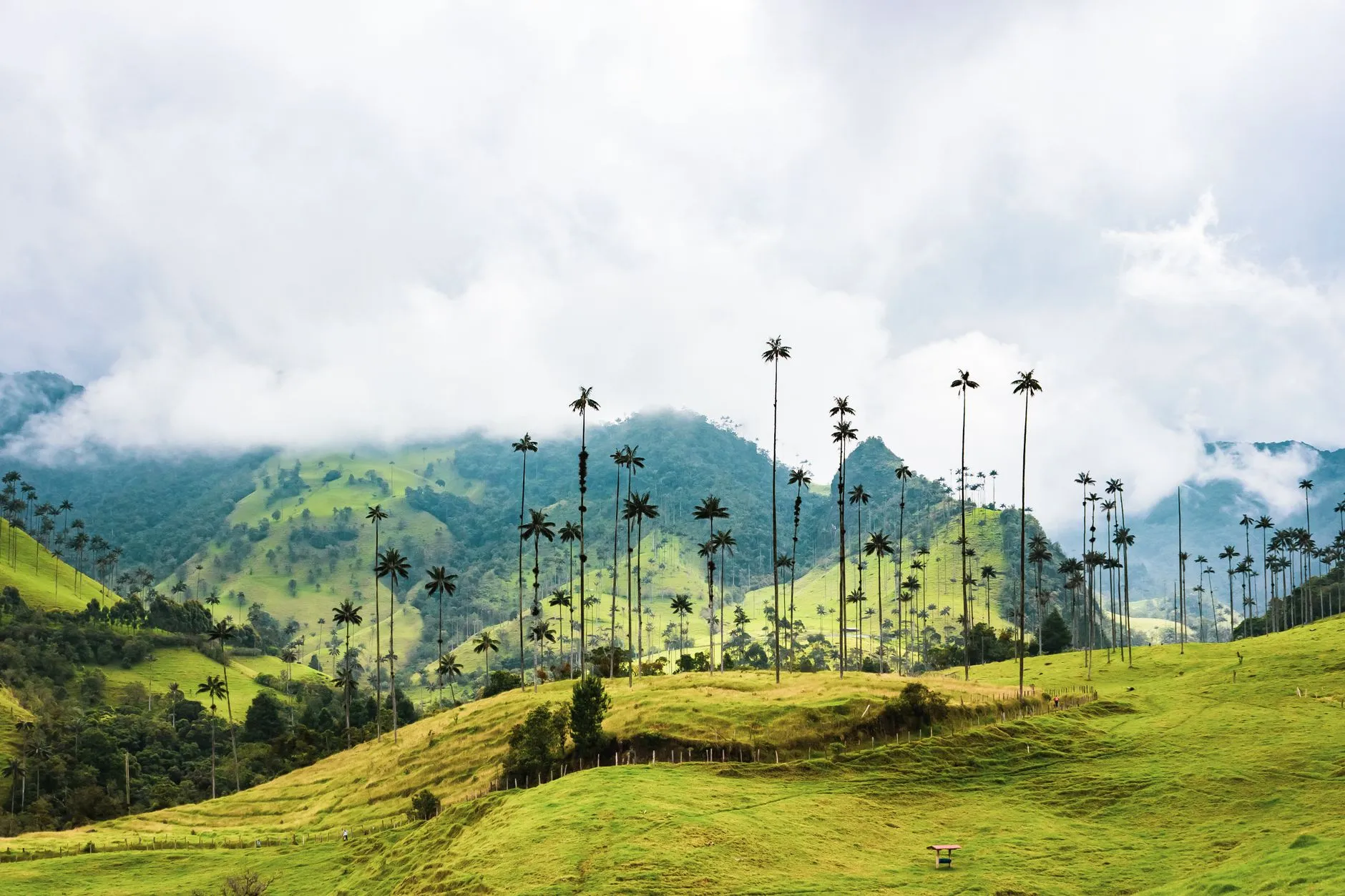
Base yourself in Salento, a bright little town of painted balconies, jeep stands (the iconic Willys jeeps) and good coffee. From here you do two things. First, you tour a coffee finca — Finca El Ocaso is the popular one — to walk the rows, pick and pulp, and finally drink a cup that has never tasted better than at its source. Second, you take a Willy to the Valle de Cocora, home of the Quindío wax palm, Colombia’s national tree and the tallest palm on earth — they reach 45–60 metres, surreal green spires poking through Andean cloud. The Cocora loop walk (4–5 hours through farmland, river crossings and a hummingbird reserve) is one of South America’s great half-day hikes.
Cocora is a microclimate — go early, expect mud. The valley clouds over and rains most afternoons; start the loop by mid-morning, wear shoes you don’t mind ruining, and bring a rain layer even on a sunny Salento morning. The wax palms photograph best in early light before the cloud rolls in.
For a quieter version, the nearby town of Filandia has the same coffee-country charm with a fraction of Salento’s crowds.
Bogotá
Colombia’s capital is a sprawling, high-altitude city of nine million at 2,640 metres — cool, often cloudy, and a place that grows on you rather than seducing you on arrival. The historic core, La Candelaria, is the reason to come: colonial streets, the Gold Museum (genuinely world-class), the Botero Museum, and steep lanes of street art and student cafés. Ride the cable car or funicular up Monserrate (3,150m) for the view over the endless city, and eat ajiaco, the capital’s signature chicken-and-three-potato soup.
Bogotá’s altitude is real. At 2,640m you may feel breathless or headachy for a day. Take it easy on arrival, go gently on alcohol the first night, and hydrate — especially if you’ve flown in from sea-level Cartagena.
Two days is plenty for most. For neighbourhoods, the Zona G and Usaquén food scenes, day trips to Zipaquirá’s salt cathedral, and the full safety briefing for the capital, see our full Bogotá city guide.
Cali, the Amazon & San Andrés
Three add-ons for travellers with more time:
Cali, in the Valle del Cauca, is the salsa capital of the world — not a metaphor, a way of life. Come for the dance clubs of Juanchito and Barrio Obrero and to take a class; the city itself is hotter, grittier and more local than the tourist trail, and worth a couple of nights if dancing is your thing. (Note the surrounding department carries advisory caveats — see safety below.)
Leticia, deep in the Amazon at the three-way Colombia–Peru–Brazil border, is reachable only by air from Bogotá. It’s the gateway to river lodges, pink-dolphin spotting, jungle walks and Indigenous communities — a genuine expedition bolt-on, not a day trip.
San Andrés (and quieter Providencia) are Colombia’s Caribbean islands, far closer to Nicaragua than the mainland, ringed by the famous “sea of seven colours.” It’s a flight from Bogotá, Medellín or Cartagena, popular with Colombian holidaymakers, and the easiest way to add proper white-sand island time.
When to Visit — Month by Month
Forget summer and winter — near the equator it’s all about rain and altitude. The country-wide sweet spot is the dry season, December to March, when the Caribbean coast is at its driest, the trails are firm and transport runs smoothly. A second, shorter dry window falls in July–August (also the peak domestic-holiday and festival season — Medellín’s Feria de las Flores, Cali’s salsa events).
Region by region:
– Caribbean coast (Cartagena, Santa Marta, La Guajira): dry and hot December–April; wetter and stickier May–November. Aim for the dry months.
– Andean cities (Bogotá, Medellín): driest December–March and July–August; rainier April–June and September–November. But Medellín’s eternal spring and Bogotá’s permanent cool mean you can visit year-round — rain comes in short afternoon bursts, not all-day downpours.
– Coffee Region: green and lush precisely because it rains often; the drier December–March window gives the clearest Cocora mornings.
Avoid the wettest shoulder months for the hard adventures. May and September–November can make the Lost City trek a mudbath and cut land access to Punta Gallinas. If those are on your list, target December–March.
What to Eat & Drink
Colombian food is honest, hearty and built on beans, corn, grilled meat and the world’s best coffee. It’s regional — what you eat in Medellín is not what you eat in Bogotá or on the coast.
- Bandeja paisa — the monster platter of the Antioquia/coffee region: red beans, rice, ground beef, chicharrón, fried egg, chorizo, sweet plantain, arepa and avocado on one plate. Order one, share it, and don’t plan to move much afterwards.
- Arepas — corn cakes eaten morning to night, plain, with cheese (con queso), or stuffed; the coastal arepa de huevo (fried with an egg inside) is a roadside classic.
- Ajiaco — Bogotá’s creamy chicken-and-three-potato soup with the herb guascas, served with rice, avocado and capers.
- Coastal seafood — ceviche, coconut rice and fried fish all along the Caribbean.
- Fruit — Colombia’s range is absurd: lulo, guanábana, maracuyá, granadilla, mangostino. Drink them as juices (jugos) everywhere.
To drink: Colombian coffee, obviously — and ask for it brewed properly, as the best beans were long exported. Aguardiente, the anise spirit drunk in cold shots at every party (Antioqueño is the Medellín brand), is the national party fuel, deceptively smooth. Local beers (Club Colombia, Águila) are cheap and everywhere.
Getting Around
Colombia is big and mountainous, and the roads are winding — so fly the long legs. Domestic flights on Avianca, LATAM and budget carriers like Wingo and the low-cost set are cheap and frequent, often from around €40–90 one-way (Bogotá–Cartagena, Bogotá–Medellín, Medellín–coast). For the Cartagena–coast-cities–coffee-region–Medellín spine, flying saves you days.
Long-distance buses are good value and connect everything (Bogotá–Medellín or Bogotá–Cartagena run roughly €15–40 for 6–12 hours), but the mountain roads make them slow and sometimes nauseating — fine for shorter hops, painful for the big ones. Overnight buses exist but fly where you can.
In the cities, Medellín’s metro and Metrocable are clean, cheap and a highlight in themselves; Bogotá relies on the TransMilenio bus rapid transit. For taxis, use apps (Uber, inDrive, Cabify and the official taxi apps) rather than hailing on the street, especially at night — it’s both safer and removes the fare argument.
Don’t hail random taxis after dark. Booked rides via app are the norm and the safe default in every Colombian city. Agree any unavoidable street-taxi fare before you get in.
Where to Stay — by Region & Budget
- Cartagena: Getsemaní for atmosphere and value (boutique hostels and guesthouses in restored colonial homes); inside the walls for romance and a premium; Bocagrande’s high-rises for resort-style stays (skip unless you want a city beach). It’s the country’s most expensive city — budget accordingly.
- Santa Marta / Caribbean coast: Santa Marta or Minca (cool mountain village above the city) as bases; Palomino for beach-hammock downtime; Tayrona has eco-camps for overnighting (when open).
- Coffee Region: Salento for the action, Filandia for quiet, or stay on a working coffee finca for the full experience — many take guests.
- Medellín: El Poblado (polished, walkable, nightlife — and increasingly touristy) or Laureles (more local, leafier, better value) — the guide covers the trade-off.
- Bogotá: La Candelaria for sights, Chapinero/Zona G for food and a safer, livelier evening base.
Costs & Budget
Colombia is excellent value outside Cartagena. A genuine backpacker can travel on €18–30 a day (hostel dorms, set-lunch menú del día, street food, limited paid activities). A comfortable mid-range trip — private rooms, restaurant dinners, the odd tour and domestic flight — runs more like €45–80 a day, and you’ll live well at the top of that.
Reality check on the regional spread: Cartagena costs 40–60% more than Bogotá, Medellín or Cali. The cities and the coffee region are where your money stretches; the Caribbean tourist coast and island add-ons are where it doesn’t. The set-lunch menú del día (soup, main, juice — often €3–5) is your budget superpower across the whole country.
Practical Information
Entry & documents. Visa-free stamp on arrival for most Western tourists (typically 90 days, extendable to 180 in a calendar year); onward ticket required; passport valid for your stay. Complete the free Check-Mig form online 72h–1h before both your arrival and departure flights.
Money. The Colombian peso (COP) — note the big numbers (thousands of pesos for everyday things). Cards are widely accepted in cities, hotels and bigger restaurants, but carry cash for taxis, street food, small towns, the coffee fincas and the Guajira/Lost City circuits. Use ATMs inside banks or malls, and withdraw by daylight.
Safety — the honest version. Colombia is far safer than its 1990s reputation, and the standard tourist trail — Cartagena, the coast resorts, the Coffee Region, Medellín, Bogotá’s core — is visited safely by huge numbers every year. The two things to get right are petty crime (phone-snatching, distraction theft, the occasional express kidnapping via unbooked taxis) and knowing the no-go regions. For the first, live by “no dar papaya” — literally “don’t give papaya,” meaning don’t make yourself an easy target: keep your phone away on the street, don’t flash cash or jewellery, use ride apps at night, don’t get blackout drunk, and don’t broadcast your live location.
For the second, the regional caveats are real. As of 2026, foreign governments advise against all/most travel to several rural departments — including Arauca, Cauca (outside Popayán), parts of Valle del Cauca (outside Cali), Norte de Santander, Chocó (outside Quibdó/Nuquí/Bahía Solano), parts of Caquetá, and the Venezuela-border zone (within ~10km) — due to armed groups, IEDs and kidnapping risk. There were terrorist attacks in Cauca and Valle del Cauca in April 2026. None of this is on the standard coast-coffee-Medellín route, but check your government’s current advisory before adding Cali, the Pacific or anywhere off the tourist map, and never go near the Venezuelan border.
No dar papaya — and check the advisory map. The tourist trail is safe with city sense; the danger is specific rural departments, not the country. Read your government’s live travel advice before booking any off-trail region, and stay on established tours in La Guajira and the Amazon.
Water. Tap water is safe to drink in Bogotá and Medellín. On the Caribbean coast, in small towns and rural areas, stick to bottled or filtered water. Carry a refill bottle and a filter for the Lost City and Guajira.
Tipping. A 10% propina voluntaria is usually added to restaurant bills — you’ll be asked if you want to include it (yes, normally). Round up taxis; tip tour guides and trek porters.
Connectivity. Mobile coverage is good in cities and towns; a local eSIM or SIM (Claro, Movistar, Tigo) is cheap and worth it. Coverage thins out in Tayrona, the Lost City and deep Guajira/Amazon — plan to be offline there.
Frequently Asked Questions
Cheapest Flights to Colombia
We have tracked 850 fares to Colombia from 77 cities. As of June 2026, here is what a good price looked like from each — the lowest fare we recorded, and a “great-deal” benchmark to judge a quote against. These are tracked observations, not live prices: by the time you read this they will have moved, so treat them as a yardstick, not a quote.
| From | Lowest fare we tracked | Great-deal benchmark |
|---|---|---|
| Zurich (ZRH) | €426 | €608 |
| Vienna (VIE) | €495 | €707 |
| Dusseldorf (DUS) | €510 | €728 |
| Paris (CDG) | €514 | €735 |
| Copenhagen (CPH) | €519 | €742 |
| Basel (BSL) | €537 | €767 |
| Athens (ATH) | €540 | €771 |
| Dublin (DUB) | €541 | €773 |
| Amsterdam (AMS) | €568 | €811 |
Recent deals we have posted to Colombia:
- Montreal to Bogota, Colombia from C$466
- Brussels to Bogota, Colombia from €641
- Houston to Medellin, Colombia from $349
- Atlanta to Medellin, Colombia from $307
- Boston to Medellin, Colombia from $317
- Paris to Bogota, Colombia from €581
- Fort Lauderdale to Medellin, Colombia from $325
- New York to Medellin, Colombia from $321
- Orlando to Medellin, Colombia from $282
- Baltimore to Medellin, Colombia from $347
These are fares aifly tracked to this destination, not live quotes — they have changed since and several of the deals above may have expired. Browse current flight deals →