Ethiopia — Complete Travel Guide 2026
Ethiopia is the most rewarding hard country in Africa, and one of the most misunderstood. It is not a safari-and-sundowners trip, not a beach (it has no coast at all), and not somewhere you wing it off a guidebook map. It is a 3,000-year-old Christian highland civilisation with its own alphabet, its own calendar that runs seven-plus years behind yours, its own clock that starts the day at dawn, its own church older than most of Europe’s, and a coffee ritual it invented. Get it right — fly the historic circuit, stand inside a church carved downward out of solid rock, watch a quarter-million white-robed pilgrims at Timkat — and nowhere else on the continent comes close. Get it wrong — or ignore where the conflict lines currently are — and it can be a genuinely difficult trip. This guide is about getting it right.
Quick Reference
The Horn of Africa — a landlocked highland nation, Africa’s oldest independent country, never colonised
Addis Ababa Bole (ADD) — the giant hub for the whole continent; domestic strips at Lalibela, Gondar, Bahir Dar, Axum, Mekelle, Arba Minch
Ethiopian birr (ETB) — a soft, tightly controlled currency you can’t get abroad; a large gap exists between the official bank rate and the parallel/street rate
Amharic (official, in its own Ge’ez script); 80-plus languages in all; English is the tourism/business second language and widely understood
e-visa required for almost everyone, applied online at evisa.gov.et before you fly; visa-on-arrival at Bole for some nationalities but the e-visa is the safe play; yellow-fever certificate needed only if arriving from an endemic country
October–March dry season; Timkat (~19 Jan) and Meskel (~27 Sept) are the unmissable festivals; avoid the heavy rains of late June–early September
The rock-hewn churches of Lalibela, the birthplace of coffee, “Lucy” and human origins, the Simien Mountains and gelada baboons, the alien Danakil Depression, injera, and Ethiopian Airlines
Addis Ababa as the unavoidable hub; then the historic-north towns — Lalibela, Gondar, Bahir Dar, Axum — strung together by short domestic flights
Editor’s Note — the high-reward, high-effort truth
Let’s be straight about what Ethiopia is, because half the disappointment here comes from expecting the wrong thing. This is a demanding destination. The altitude in Addis alone is 2,355 m and the northern towns sit higher; you’ll be short of breath the first days. Infrastructure is patchy, the internet gets switched off by the government during unrest, ATMs run dry, and “faranji” (foreigner) pricing means you’ll haggle for almost everything. There are no beaches and very little classic Big Five safari — go to Kenya or Tanzania for that. What Ethiopia gives back is depth: the single most extraordinary religious site in Africa, a living medieval Christianity, the deepest human-origins story on earth, and landscapes — the Simiens, the Danakil — that look like nowhere else.
And there’s a hard truth you must build your whole trip around: parts of Ethiopia have been at war, and still have active conflict and serious advisories. This isn’t the old “check the advisory before you go” boilerplate that applies to half the planet — it’s specific and it matters (see the next section). It doesn’t mean don’t go — the classic northern circuit runs, tourists fly it every week, Lalibela was reported calm through late 2025 — but it means you can’t improvise your route. You fly between the highlight towns rather than driving overland, you go with a reputable operator, and you check your government’s current advisory the week you book and the week you fly, because access shifts with the situation. Travel Ethiopia like that and it’s one of the great trips. Travel it casually and it can go wrong fast.
⚠️ Ethiopia is not a relax trip. No coast, thin-air altitude, real logistics, and a live security picture. If you want a country to switch off in, this isn’t it. If you want one of the most profound travel experiences in Africa, it absolutely is — but you have to engage with it.
Should You Go? Who it’s for — and the sober security reality
Ethiopia is for the traveller who wants substance over comfort: history obsessives, pilgrims and church-architecture nerds, serious trekkers, anyone fascinated by human origins, and the kind of person who’d rather stand inside a 12th-century church hewn out of bedrock than lie on any beach. It is superb for festival travel — Timkat and Meskel are among the most spectacular living religious spectacles anywhere on earth. It rewards repeat-Africa travellers who’ve “done” the safari circuit and want something with cultural weight. And it’s a coffee pilgrimage — this is literally where the bean comes from.
It’s not for first-time-anywhere travellers who want it easy, not for beach or pure-wildlife holidays, and not for anyone who needs a fully predictable, improvise-as-you-go trip. The plumbing-of-travel here takes effort.
Now the part you must read carefully and not gloss over. Ethiopia has had serious armed conflict in recent years, and several regions carry active “do not travel” advisories from Western governments. The 2020–22 Tigray war was devastating; since then there’s been fighting and unrest in Amhara and ongoing insurgency in Oromia, plus renewed clashes reported in Tigray into 2026. As of 2026 the US advisory for Ethiopia overall is “Reconsider Travel,” with “Do Not Travel” sub-warnings for Tigray, Amhara, parts of Oromia, the Somali region and border zones. Current concerns flagged by governments include kidnapping in parts of Oromia/Amhara, government-imposed internet and mobile shutdowns during unrest, and occasional exit bans on foreign nationals.
Here is the nuance the headlines miss. The classic tourist route — Addis → Bahir Dar → Gondar → Lalibela → Axum (the historic northern circuit) — is the normal way people see the country, and tourists fly it regularly. Crucially, Lalibela sits inside the Amhara region, which carries a regional advisory — yet the town itself has been reported calm and visited normally (it was safe when assessed in late 2025), and the standard, sensible practice is to fly in and out, not drive the overland roads, which is where the risk concentrates. That contradiction — a “don’t travel to the region” advisory over a tourist town that’s functioning normally — is exactly why you must read the detail of your own government’s advisory, not just the colour-coded headline, and go with an operator who tracks the situation daily.
⚠️ Check your own government’s current advisory the week you book and again the week you fly. Ethiopia’s security picture is regional and it moves. Flights, road access and which towns are open can change month to month. Sticking to the fly-in northern circuit with a reputable operator is the established safe approach — but verify it’s still established when you go.
Getting There & Around — Ethiopian Airlines runs this country
Here’s the single most useful fact about travelling Ethiopia: Ethiopian Airlines is the answer to almost every logistics question. It’s Africa’s largest and arguably best airline, a Star Alliance member since 2011, with a vast hub at Addis Ababa Bole (ADD) that has become the connecting heart of the whole continent — you can reach Addis nonstop from across Europe, the Americas, the Gulf, Asia and most of Africa. If you’ve flown long-haul to Africa in the last decade, there’s a good chance it was on the green-and-yellow tail.
Internationally, Ethiopian flies direct from London, Frankfurt, Brussels, Paris, Rome, Madrid, Stockholm, Vienna, Geneva and more in Europe; Washington, Newark, Toronto and beyond in North America; plus the entire Gulf and a dense African network. Other carriers (Lufthansa, Turkish, the Gulf three, Egyptair) connect onward too, but flying Ethiopian itself unlocks the trick below.
Domestically, Ethiopian is how you actually do the historic circuit. The northern highlight towns — Lalibela, Gondar, Bahir Dar, Axum — are linked to Addis and to each other by short daily flights (Addis–Lalibela is under an hour). Given the overland security picture and the sheer distances, flying the circuit isn’t a luxury, it’s the sensible standard. And the killer detail: if your international ticket into Ethiopia is on Ethiopian Airlines, you get a steep discount (around 40%) on Ethiopian domestic flights. Booked this way, a circuit hop can fall to roughly €60–90 instead of €110–150 — so plan your international and domestic legs together, on the same airline, and ask your agent or operator to apply the discount.
💡 Fly into Ethiopia on Ethiopian Airlines, then book the domestic circuit on Ethiopian too. The “flew in on ET” discount knocks ~40% off every internal hop and makes the whole northern loop dramatically cheaper. It’s the biggest single money-saver on an Ethiopia trip.
On the ground in towns, blue-and-white minibus taxis, Bajaj three-wheelers and (in Addis) ride-hailing apps like Feres and ZayRide handle short hops cheaply. For the Simiens, the Danakil and the southern Omo, you go with an organised tour and a guided 4WD — self-driving those regions is not a thing tourists do.
The Historic Northern Circuit — the core of any trip
This is the spine of Ethiopian travel and the reason most people come. Four towns, flown between, each a different facet of a Christian civilisation that’s been here since the 4th century.
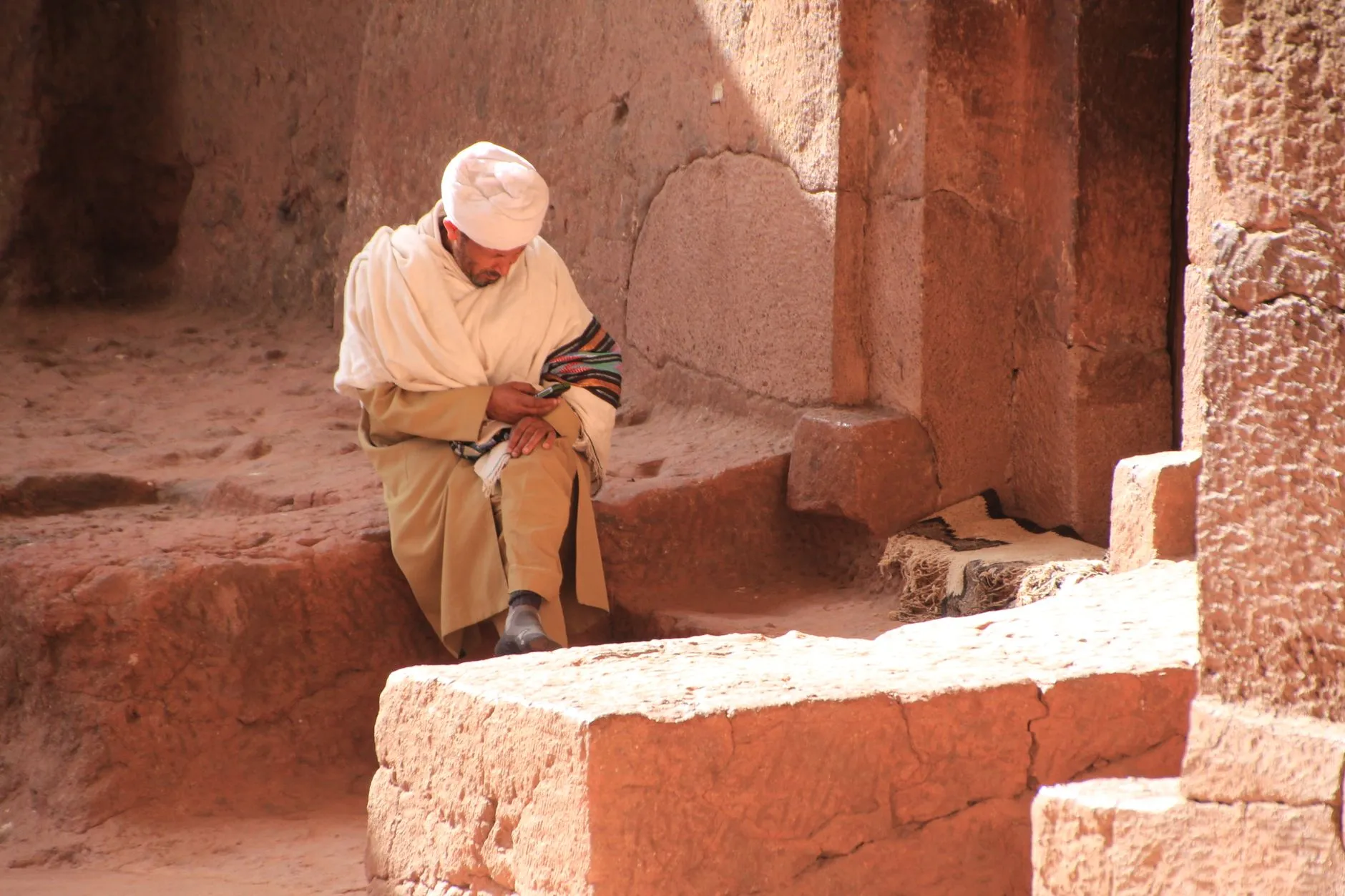
Lalibela is the headline, and it earns it. Eleven medieval churches carved downward out of solid volcanic rock — not built, but excavated, roof-first, so they sit below ground level connected by trenches and tunnels. The most famous, Bete Giyorgis (Church of St George), is a perfect cross hewn into the earth that you first see from above, looking down onto its roof. These aren’t ruins — they’re living churches, full of white-robed worshippers, incense and chant, and on Ethiopian Christmas and Easter the pilgrim crowds are immense. The site is a single ticket: as of 2026 entry is around $50 (≈ €46) for a multi-day pass covering all the churches, plus a mandatory local guide at roughly $25/day (≈ €23) — non-negotiable and genuinely worth it, because a good guide unlocks the symbolism you’d otherwise walk straight past. Give Lalibela two nights minimum.
Gondar is Ethiopia’s “Camelot” — a 17th-century imperial capital whose Royal Enclosure (Fasil Ghebbi), a UNESCO site, holds a cluster of genuine stone castles built by Emperor Fasilides and his successors, looking improbably European. Don’t miss Debre Berhan Selassie church, its ceiling famously covered in rows of winged angel faces, and Fasilides’ Bath, which is flooded and becomes the dramatic centrepiece of the Gondar Timkat celebrations.
Bahir Dar is the soft, green, lakeside one — the base for Lake Tana, the source of the Blue Nile, dotted with ancient island monasteries (some of which women cannot enter, an old monastic rule) reached by boat, their walls covered in vivid biblical murals. Nearby, the Blue Nile Falls (Tis Issat, “the smoking water”) thunder in the rainy season, though flow is reduced by an upstream hydro plant in the dry months — manage expectations and go for the boat trip and the monasteries as much as the falls.
Axum (Aksum) is the ancient one — the heart of the once-mighty Aksumite Empire, a UNESCO site of towering carved granite stelae (giant funerary obelisks, one of them the largest single piece of stone humans ever tried to erect), and the church Ethiopian Orthodox tradition holds to contain the Ark of the Covenant (no one but its single guardian monk may see it). Note that Axum is in Tigray, the region hardest hit by the war and carrying the most serious advisory — access has been disrupted and its status is the one to check most carefully before building it into your route.
The Simien Mountains — Africa’s most beautiful trek
If Lalibela is the cultural climax, the Simien Mountains are the natural one — a UNESCO World Heritage range of vertiginous escarpments, plunging gorges and jagged volcanic pinnacles often called the “Roof of Africa,” topped by Ras Dashen (4,550 m), Ethiopia’s highest peak and one of Africa’s tallest. You trek along the escarpment edge with thousand-metre drops to one side and, almost guaranteed, troops of gelada baboons — the world’s only grass-grazing monkey, found nowhere but the Ethiopian highlands, with their distinctive red “bleeding heart” chest patch — grazing utterly unbothered a few metres away. The endemic Walia ibex and the rare Ethiopian wolf also live here.
You reach the Simiens from Gondar, basing in or near the gateway town of Debark, where the national park headquarters sit. Trekking here is regulated: every group needs a park entry permit and a mandatory armed scout (a relic of the rules, costing a few euros a day), and most also hire a guide, cook and mules. You can do anything from a half-day taster to a multi-day traverse to Ras Dashen. Day permits and scout fees are modest — a few euros each — but a full multi-day trek with the crew, gear, transport and park fees runs into the low hundreds of euros all in. Nights are genuinely cold and the altitude is real: acclimatise in the highlands first and pack proper warm layers.
💡 Acclimatise before you trek. Addis is already 2,355 m and the Simiens go far higher. Spend your first days on the highland circuit (Gondar, Lalibela) before any serious hiking, drink water relentlessly, and treat the altitude with respect — it floors plenty of fit people who ignore it.
The South — Omo Valley, Bale Mountains & the Rift Lakes
Southern Ethiopia is a completely different country from the Christian north — and the most ethically complicated part of any trip. The Omo Valley, down near the Kenyan and South Sudanese borders, is home to a remarkable array of Indigenous peoples — the Hamer, Mursi (famous, and famously photographed, for women’s lip-plates), Karo, Daasanach and others — living with traditions distinct from anywhere else.
Be honest with yourself about what this kind of tourism is. The “tribal tourism” model in the Omo has a real problem: a transactional cycle where visitors pay per photograph, communities perform their identity for cameras, and the encounter can feel like a human zoo. If you go, go thoughtfully — choose an operator with genuine long-term relationships in the villages, agree photo etiquette and fair payment up front, ask before pointing a lens at anyone, spend real time rather than drive-by snapping, and treat people as people, not content. Done badly it’s exploitative; done respectfully it’s a meaningful exchange. Your choice of operator is the whole game.
Beyond the Omo, the south offers gentler rewards. The Bale Mountains National Park is the best place on earth to see the endangered Ethiopian wolf, across the high Afro-alpine Sanetti Plateau, plus the lush Harenna Forest and excellent endemic birding. The Rift Valley lakes — Langano (the one you can swim in, bilharzia-free), Hawassa, Ziway, Chamo and Abijatta-Shalla — string south from Addis and make an easier, birdlife-rich escape, with Lake Chamo’s giant Nile crocodiles a highlight near Arba Minch.
The Danakil Depression — the most alien place on earth
The Danakil Depression, in the far northeast Afar region, is one of the lowest (over 100 m below sea level), hottest (daily highs that can top 45°C, among the hottest inhabited places on the planet) and most geologically violent landscapes anywhere. It is bucket-list-grade strange. Two sights anchor it: Erta Ale, a shield volcano cradling one of only a handful of permanent lava lakes on earth — a churning, glowing cauldron of molten rock you hike to and camp beside overnight; and Dallol, a hydrothermal field of acid pools, salt towers and sulphur deposits in psychedelic yellows, greens and oranges that looks like a painter spilled the whole palette across a salt pan. You’ll also see the Afar salt caravans, camel trains hauling slabs of salt cut by hand exactly as they have for centuries.
This is organised-tour-only territory, full stop — you cannot do the Danakil independently. Tours run as 3–5 day 4WD expeditions, traditionally staging out of Mekelle (and sometimes Semera/Afar), with armed escorts, scouts, basic camps and a convoy. Budget roughly €350–550 for a multi-day group tour depending on length and operator. Two serious caveats: the heat and roughness make it a genuine endurance trip (open-air cots, no real facilities, relentless sun), and the security situation matters enormously here — parts of the route run near the volatile Eritrea border, the staging town of Mekelle is in Tigray (the most heavily advised-against region), and there have historically been incidents. Vet your operator hard, confirm current access and escort arrangements, and check advisories specifically for the Danakil/Afar and Tigray before committing.
⚠️ The Danakil is tour-only and security-sensitive. Never attempt it independently. Use an established operator, confirm the current security and escort situation for the Afar/Tigray route, and be ready for the access status to change. The reward is real; the caveats are equally real.
Addis Ababa — the highland capital
Most trips begin and end in Addis Ababa, and it deserves more than the airport-to-hotel dash most people give it. At 2,355 m it’s one of the highest capitals on earth, a sprawling, fast-changing, genuinely African metropolis of construction cranes, traffic, coffee houses and diaspora energy. Give it a full day.
The cultural must is the National Museum, home to “Lucy” (Dinkinesh) — the 3.2-million-year-old Australopithecus afarensis skeleton that rewrote the human-origins story, found in Ethiopia’s Afar region. This is the deepest “where we come from” experience travel offers, and it’s right here. Pair it with Holy Trinity Cathedral (the grand Ethiopian Orthodox cathedral and resting place of Emperor Haile Selassie), the chaotic, vast Merkato — one of Africa’s largest open-air markets, a sensory assault best visited with a local — and the Ethnological Museum in the old palace on the university grounds. For air, views and cool eucalyptus forest, head up Entoto, the mountain ridge above the city where Menelik II founded the capital, now with a slick new park.
But Addis’s real pleasure is eating and drinking coffee. This is the best place in the country to sit down to a proper coffee ceremony and a platter of injera with a dozen wats, and the live-music azmari bets and jazz bars of the Piazza and Kazanchis are an experience in themselves. Don’t treat Addis as a transit lounge.
Food & Coffee — injera, wat & the birthplace of the bean
Ethiopian food is unlike anything else in Africa, and once you get it, you crave it. The foundation is injera — a vast, soft, spongy, slightly sour flatbread made from fermented teff (a tiny native grain), which serves as plate, utensil and starch all at once. It comes spread under and around an array of wats (stews): fiery red doro wat (chicken in a deep berbere-spice sauce with a hard-boiled egg, the national celebration dish), key wat (beef), lentil and vegetable alichas and misir wat. You tear off injera with your right hand and scoop. The communal platter, shared, is the whole social ritual.
A few things to know. Ethiopian Orthodox Christianity has many fasting (tsom) days — including most Wednesdays and Fridays and long pre-Easter periods — when observant Ethiopians eat vegan, which makes Ethiopia one of the easiest places on earth to eat brilliantly as a vegetarian: ask for “beyaynetu,” a colourful sampler platter of lentil, chickpea, spinach, beetroot and vegetable dishes. At the other extreme is kitfo — minced raw beef warmed in spiced butter and mitmita chilli, a beloved delicacy (you can order it cooked, leb leb, if raw isn’t your thing) — and tere siga, raw meat eaten fresh; both carry the usual raw-meat caveats, so judge the venue.
And then there’s coffee. Ethiopia is the literal birthplace of coffee — the Coffea arabica bush is native to the southwestern highlands, and the legend of Kaldi and his dancing goats was born here. The coffee ceremony is sacred social ritual: green beans roasted over coals in front of you, ground by hand, brewed in a clay jebena pot, and served in three rounds (abol, tona, baraka) with incense burning and popcorn on the side. Accept all three rounds — leaving early is rude. It is, hands down, the best coffee experience on the planet, in the place that started it all.
💡 Order beyaynetu on a fasting day. On Wednesdays, Fridays and during Orthodox fasts, restaurants serve a spectacular all-vegan sampler platter — it’s cheap, healthy, and often the best meal you’ll have. Vegetarians eat like royalty in Ethiopia precisely because the church demands it.
Costs & Money — the birr, cash, and the parallel rate
Ethiopia is cheap on the ground for the daily stuff and surprisingly pricey for the marquee experiences — flights, park fees, organised tours. Budget accordingly.
A rough daily on-the-ground spend (excluding international flights, the domestic-circuit airfares, and big organised tours like the Danakil):
- Budget: ~€25–40/day — simple guesthouses, local injera joints, public minibuses, the cheaper site entries.
- Mid-range: ~€60–110/day — comfortable hotels, guides, restaurant meals, the major site tickets.
- Comfortable / guided: €130+/day once you fold in private guides, drivers and the lodges of the historic circuit.
Individual prices for orientation: a generous injera-and-wat platter runs €2–5; a coffee under €1; a mid-range Addis hotel room €40–80; the Lalibela churches pass ~€46 plus a ~€23/day guide; the Simien permit and scout a few euros a day each (the full multi-day trek with crew is low-hundreds of euros); a multi-day Danakil tour €350–550; a discounted domestic flight roughly €60–90. Tipping is expected and matters — guides, drivers, scouts and hotel staff rely on it; budget for it as a real line item, not an afterthought.
Now the money mechanics, which are genuinely awkward and you must plan for:
- The birr is a soft, controlled currency. You can’t buy it before you arrive and shouldn’t try to take it out.
- Carry cash — lots of it. Card acceptance is thin outside top Addis hotels, and foreign-card ATMs are unreliable — they cap low withdrawals, run out of cash and reject foreign cards often. Bring clean, newer-series euros or US dollars to change, and don’t rely on plastic off the Addis beaten track. The historic-circuit towns are largely cash economies.
- The parallel (“black market”) rate is the elephant in the room. After Ethiopia floated the birr, an official bank rate and a higher street rate coexist, and the gap can be substantial. Officially you change at banks and hotels; in practice travellers are often offered better street rates. The parallel market is unofficial and carries legal and scam risk — this guide isn’t telling you to use it, only that it exists, that the rate quoted online may not be what a bank gives you, and that you should change enough at a fair rate to avoid getting stuck.
⚠️ Bring cash and budget for ATM failure. Carry enough clean euros or dollars to change for your whole trip’s daily spending, because foreign-card ATMs frequently won’t work and the historic-circuit towns run on cash. Getting caught cashless in Lalibela is a real and avoidable problem.
Practicalities — the calendar, the clock, altitude & faranji life
Ethiopia runs on its own systems, and the quirks are part of the charm if you’re ready for them.
The Ethiopian calendar. Ethiopia uses its own Julian-derived calendar that runs about 7–8 years behind the Gregorian one and has 13 months — twelve of 30 days plus a short 13th month of five or six days. So Ethiopia celebrated its millennium in 2007 of the Western calendar, and the year you see on a local document will look “wrong.” New Year (Enkutatash) falls in mid-September. None of this affects your flights (booked in Gregorian dates) but it will appear on signs and in conversation — and “13 months of sunshine” is the genuine tourism-board slogan.
The Ethiopian clock. Ethiopians traditionally count hours from dawn, not from midnight — so 1 o’clock Ethiopian time is roughly 7 a.m. your time, and “6 o’clock” is around noon. Locals will often quote times this way. Always clarify “Ethiopian time or faranji (foreigner/international) time?” when arranging a pickup or a tour start, or you’ll be six hours off.
Altitude. Addis at 2,355 m, the northern towns and the Simiens far higher — expect breathlessness and possible mild altitude effects the first days. Hydrate, take it slow on arrival, and acclimatise in the highlands before trekking.
Faranji pricing & hassle. As a visible foreigner you’ll get quoted inflated “faranji prices” and attract persistent attention — kids asking for money or pens, would-be guides, vendors. It’s rarely threatening, just constant; a calm, friendly firmness and a sense of humour go a long way. Agree prices before any taxi, tour or photo.
Connectivity. Mobile data (Ethio Telecom, and now Safaricom as a second operator) is available and a local SIM is cheap with your passport — but be aware the government does periodically shut down internet and mobile networks during unrest, sometimes for extended periods, so don’t build your trip around constant connectivity.
Health & culture. No yellow-fever cert needed unless you’re arriving from an endemic country, but check standard vaccinations and malaria advice for lower-altitude regions (the highlands are largely malaria-free; the Omo, Rift lowlands and Danakil are not). Drink bottled or purified water only. Dress modestly at the many active churches and monasteries (cover shoulders and knees; remove shoes at church entrances), and ask before photographing people, especially in the south.
When to Go — dry season, Timkat & Meskel
Ethiopia’s weather splits into a long dry season and a heavy wet one, and two of the world’s great religious festivals anchor the calendar.
October–February is the prime window: dry, clear, comfortable highland days (cool nights — the highlands are never tropical), the best conditions for the historic circuit and for trekking. This is the heart of the tourist season for good reason.
March–May is the “small rains” shoulder — greener landscapes, building heat, occasional showers, still very doable and quieter.
Late June–early September is the main rainy season (kiremt) in the highlands. Roads turn to mud, trekking gets tough, some sites and flights are disrupted — but it’s also lush and dramatic (the Blue Nile Falls are at full roar), uncrowded and cheaper. The Danakil is at its most punishing in the hot months and best avoided at the absolute peak of summer heat. Plan around the rains rather than into them unless you’ve got a reason.
Two festivals are worth planning an entire trip around:
- Timkat (Ethiopian Epiphany), ~19 January — the spectacular celebration of Christ’s baptism, when tabots (replicas of the Ark) are paraded under canopies, vast crowds in white gather, and dawn brings a mass blessing and ritual immersion in water. Gondar (with its flooded Fasilides’ Bath) and Lalibela host the most dramatic celebrations. It is one of the greatest living religious spectacles on earth — book months ahead, accommodation fills.
- Meskel (Finding of the True Cross), ~27 September — a joyous festival marked by the lighting of huge bonfires (demera) topped with the Meskel daisy, biggest at Meskel Square in Addis, dancing, processions and yellow blooms everywhere after the rains. A UNESCO-recognised celebration and a wonderful, more accessible festival than Timkat.
Ethiopian Christmas (Gena, 7 January) and Easter (Fasika) also bring huge, moving pilgrim gatherings to Lalibela in particular — extraordinary to witness, but the town is packed and beds are scarce, so book far ahead.
💡 Build the trip around a festival if you can. Timkat in Gondar or Lalibela, or Meskel in Addis, turns a great trip into an unforgettable one — but these are the busiest, priciest weeks of the year. Lock in flights and rooms months out, not weeks.
Frequently Asked Questions
Cheapest Flights to Ethiopia
We have tracked 4,970 fares to Ethiopia from 153 cities. As of June 2026, here is what a good price looked like from each — the lowest fare we recorded, and a “great-deal” benchmark to judge a quote against. These are tracked observations, not live prices: by the time you read this they will have moved, so treat them as a yardstick, not a quote.
| From | Lowest fare we tracked | Great-deal benchmark |
|---|---|---|
| Brussels (BRU) | €266 | €380 |
| Athens (ATH) | €328 | €469 |
| Mallorca (PMI) | €340 | €486 |
| Munich (MUC) | €359 | €513 |
| Zurich (ZRH) | €361 | €591 |
| Vienna (VIE) | €362 | €596 |
| Barcelona (BCN) | €363 | €518 |
| Dusseldorf (DUS) | €363 | €518 |
| Milan (MXP) | €363 | €518 |
| Ljubljana (LJU) | €407 | €581 |
| Krakow (KRK) | €412 | €588 |
| Cologne (CGN) | €412 | €589 |
| Budapest (BUD) | €413 | €590 |
| Warsaw (WAW) | €414 | €592 |
Recent deals we have posted to Ethiopia:
- London to Addis Ababa, Ethiopia from £562
- Hanover to Addis Ababa, Ethiopia from €602
- Warsaw to Addis Ababa, Ethiopia from €624
- Madrid to Addis Ababa, Ethiopia from €478
- Frankfurt to Addis Ababa, Ethiopia from €496
- Amsterdam to Addis Ababa, Ethiopia from €462
- Berlin to Addis Ababa, Ethiopia from €604
- Rome to Addis Ababa, Ethiopia from €490
- Vienna to Addis Ababa, Ethiopia from €500
These are fares aifly tracked to this destination, not live quotes — they have changed since and several of the deals above may have expired. Browse current flight deals →