Iceland — Complete Travel Guide 2026
Iceland is a road trip more than a destination — a 1,300-km loop of waterfalls, lava fields, glacier tongues and steaming hillsides, with one small capital and barely 400,000 people on an island the size of Kentucky. It rewards you ferociously for going slow and punishes you for trying to “do it all” in four days. The catch: it’s one of the most expensive countries in Europe, the weather changes by the hour, and the single biggest decision — summer midnight sun or winter aurora — splits your trip into two completely different holidays.
Quick Reference
North Atlantic island, between Greenland and Norway, just south of the Arctic Circle
Keflavík (KEF), ~50 km southwest of Reykjavík
Icelandic króna (ISK) — not the euro; cards used everywhere
Icelandic (English spoken near-universally)
Schengen + EEA (not EU). EES live since 10 April 2026; ETIAS expected, date not announced
June–Aug for the midnight sun & Highlands; late Sept–March for the northern lights
Waterfalls, glaciers, volcanoes, geothermal lagoons, the Ring Road, the aurora
Reykjavík for a short trip; the Ring Road / car for a longer one
Editor’s Note: The Two Decisions That Make Your Trip
Before you book a single hotel, settle two things, because they cascade into everything else.
First: how much of the island?
People wildly overestimate what they can see. Iceland looks small on a map and feels enormous on the road — speed limits are 90 km/h on the open highway, lower on gravel, and you’ll stop constantly. If you have 4–6 days, do the South Coast (Golden Circle, the big waterfalls, Reynisfjara, ending at Jökulsárlón) and turn back. If you have 8–12 days, do the full Ring Road. Anything less than a week trying to circle the island means 5–6 hours of daily driving with rushed roadside stops — you’ll see Iceland through a windshield. Don’t.
Second: summer or winter?
These are two different countries. Summer (June–August) gives you near-24-hour daylight, every road open including the Highland F-roads, puffins, whales, and the warmest, most stable weather — but also the highest prices, the biggest crowds, and no northern lights (the sky never goes dark). Winter (roughly late September–March) gives you the aurora, ice caves, far fewer tourists and lower shoulder-season prices — but short days (4–5 hours of light in December), genuine winter driving, closed Highlands and a real chance of a road being shut when you wanted to be on it. There is no “best” — there’s the trip you want.
Third, the one nobody admits: self-drive or tours. Renting a car and driving yourself is how Iceland is meant to be done — total freedom, your own pace, stops the tour buses skip. But it’s not cheap and winter driving here is no joke. If you don’t want to drive in snow and wind, base in Reykjavík and take day tours. Both are valid; just decide honestly.
Should You Go? Who It’s For — and the Cost Reality
Iceland is for people who’d rather stand alone at a thundering waterfall than lie on a beach. It’s spectacular for road-trippers, photographers, hikers, geology nerds, and anyone who finds emptiness restorative. It’s a poor fit if you want nightlife beyond Reykjavík, guaranteed sunshine, cheap food, or a relaxing do-nothing holiday — Iceland is active, weather-buffeted and busy.
And now the part the brochures bury: Iceland is brutally expensive. It’s consistently among the priciest countries in Europe, and almost everything except the scenery costs money. A pint of beer runs €8–12 (1,200–1,750 ISK). A simple restaurant main is €25–40, and dinner for two at a mid-range place easily hits €85–125 (12,000–18,000 ISK). Rental cars in summer start around €70–100/day for a small 2WD and climb fast for a 4×4; fuel is roughly €1.30–1.65/litre. Realistic ground costs (car, fuel, lodging, food, a few activities) land around €120–250 per person per day mid-range, more in peak summer.
⚠️ Budget honestly or you’ll get a nasty shock. The flight is often the cheap part of an Iceland trip — it’s the ground costs that hurt. Two people on a week-long Ring Road campervan trip can realistically spend €1,700–3,000+ before flights.
Where you genuinely save: the tap water is among the cleanest on earth (never buy bottled), gas-station hot dogs and soup are cheap and good, self-catering from a Bónus or Krónan supermarket slashes the food bill, and prices drop noticeably the moment you leave Reykjavík.
Getting There: KEF and the Transfer
Almost everyone arrives at Keflavík International (KEF), on the Reykjanes peninsula about 50 km southwest of the capital — not Reykjavík’s small domestic airport (RKV). There is no train anywhere in Iceland, so from KEF you have three options.
The classic is the Flybus, the official airport coach, which meets flights and runs the ~45-minute trip to the BSÍ bus terminal in central Reykjavík from about 3,999 ISK (~€28) one way; the Flybus+ version (about 5,199 ISK / ~€36) continues to drop you near your hotel. There’s no public Strætó city bus to the airport, so the Flybus is the budget choice. A taxi to the city is eye-watering (think €120+) and rarely worth it.
If you’re driving the island, pick up your rental car at KEF and start from there — most travellers do. And here’s the move everyone talks about: the Blue Lagoon is roughly 20 minutes from KEF, on the way to (or from) the city. Soaking off the red-eye before you even reach Reykjavík — or on your last morning before a flight — is a genuinely good plan, if you pre-book a slot (more below).
💡 Don’t try to drive straight from a transatlantic red-eye onto the Ring Road. Sleep first, or at least spend your first night in or near Reykjavík. Fatigue plus unfamiliar roads, gravel and wind is how holidays go wrong.
The Regions: Where Each One Actually Takes You
The Golden Circle is the famous day loop from Reykjavík: Þingvellir (the rift valley where the North American and Eurasian plates pull apart, and the site of the old Viking parliament), Geysir (where the still-active Strokkur spout erupts every few minutes), and Gullfoss, a colossal two-tiered waterfall. It’s busy and a little touristy, but it earns the hype and it’s an easy, fully-paved day trip — no 4×4 needed.
The South Coast is the single best stretch of road in Iceland for first-timers: the walk-behind waterfall Seljalandsfoss, the broad curtain of Skógafoss, the black-sand beach Reynisfjara (gorgeous and genuinely lethal — see below), the village of Vík, and, further east, the otherworldly Jökulsárlón glacier lagoon with its drifting icebergs and the adjacent Diamond Beach, where chunks of ice wash up glittering on black sand. Jökulsárlón is ~380 km / a five-hour drive from Reykjavík — too far for a comfortable day trip, so most people overnight in Vík or Höfn.
The Ring Road (Route 1) is the ~1,300-km loop around the whole island — the great Iceland road trip. Beyond the south it threads the quiet East Fjords (sheep, fishing villages, reindeer), the volcanic North around Mývatn and Akureyri, and the dramatic west. Allow a week minimum, ideally 10 days.
Snæfellsnes — “Iceland in miniature” — is a peninsula a couple of hours north of Reykjavík that packs a glacier-topped volcano, the photogenic Kirkjufell mountain, lava fields, fishing hamlets and bird cliffs into a compact, paved day or two. The best-value add-on if you can’t do the full loop.
The North centres on Akureyri (Iceland’s second city, charming and walkable), Lake Mývatn (a geothermal wonderland of pseudocraters, mud pots and the lovely Mývatn Nature Baths), the elegant Goðafoss waterfall, and Húsavík, the country’s whale-watching capital.
The Westfjords are the remote, gnarled northwest — tortuous gravel roads, towering bird cliffs at Látrabjarg, the cascade Dynjandi, and almost no other tourists. Stunning, but a serious detour that adds days; skip it unless you have two weeks and want Iceland at its emptiest.
The Highlands are the volcanic interior — Landmannalaugar’s rhyolite mountains, Þórsmörk, Askja — reachable only in summer, only via F-roads, and only in a 4×4. This is wilderness-grade driving (more below). Worth it for the adventurous; off-limits to everyone else.
Waterfalls, Glaciers and Black Beaches
The greatest hits are real, but they’re not equal. Gullfoss, Seljalandsfoss, Skógafoss and Goðafoss are all genuinely worth stopping for. Dettifoss in the northeast is Europe’s most powerful waterfall and feels it. At Jökulsárlón, take the amphibious boat tour among the icebergs if you can — it’s one of the few paid activities that’s worth every króna — and don’t miss Diamond Beach right across the road.
⚠️ Reynisfjara’s sneaker waves kill people — this is not hyperbole. Sudden, far-reaching waves surge up the black sand with no warning; an undersea shelf adds a vicious pull. At least six people have died here in twenty years, including a nine-year-old in August 2025. Never turn your back on the ocean, never let kids near the water, and stay well up the beach. Watch the waves for several minutes before you approach. The view from a safe distance is just as good.
Glacier walks and ice-cave tours (mostly winter, on Vatnajökull) are spectacular but must be done with a licensed guide — glaciers have hidden crevasses and walking onto one alone is a way to die. Book a reputable operator; don’t freelance.
The Blue Lagoon and Iceland’s Hot Springs
Geothermal bathing is the national pastime, and you should do it. The Blue Lagoon — the famous milky-blue silica pool on the Reykjanes peninsula near KEF — is the icon. It is also expensive and uses dynamic pricing: published 2026 starting prices are about 11,990 ISK (~€83) Comfort, 14,990 ISK (~€103) Premium, 18,490 ISK (~€128) Signature, and they climb with demand.
💡 Book the Blue Lagoon weeks ahead — it sells out, and you cannot just turn up. Early-morning and late-evening slots are usually the cheapest. The smart play is a slot timed to your arrival or departure, since it’s 20 minutes from the airport.
If you’re based in Reykjavík and don’t want the drive, the Sky Lagoon is closer to the city, with a dramatic ocean-edge infinity pool and a seven-step bathing ritual — many travellers prefer it. And the cheapest, most local option is a municipal geothermal swimming pool (every town has one; entry is a few euros) — that, not the Blue Lagoon, is where Icelanders actually soak. The Mývatn Nature Baths in the north and Secret Lagoon on the Golden Circle are excellent lower-key alternatives.
The Northern Lights and the Midnight Sun
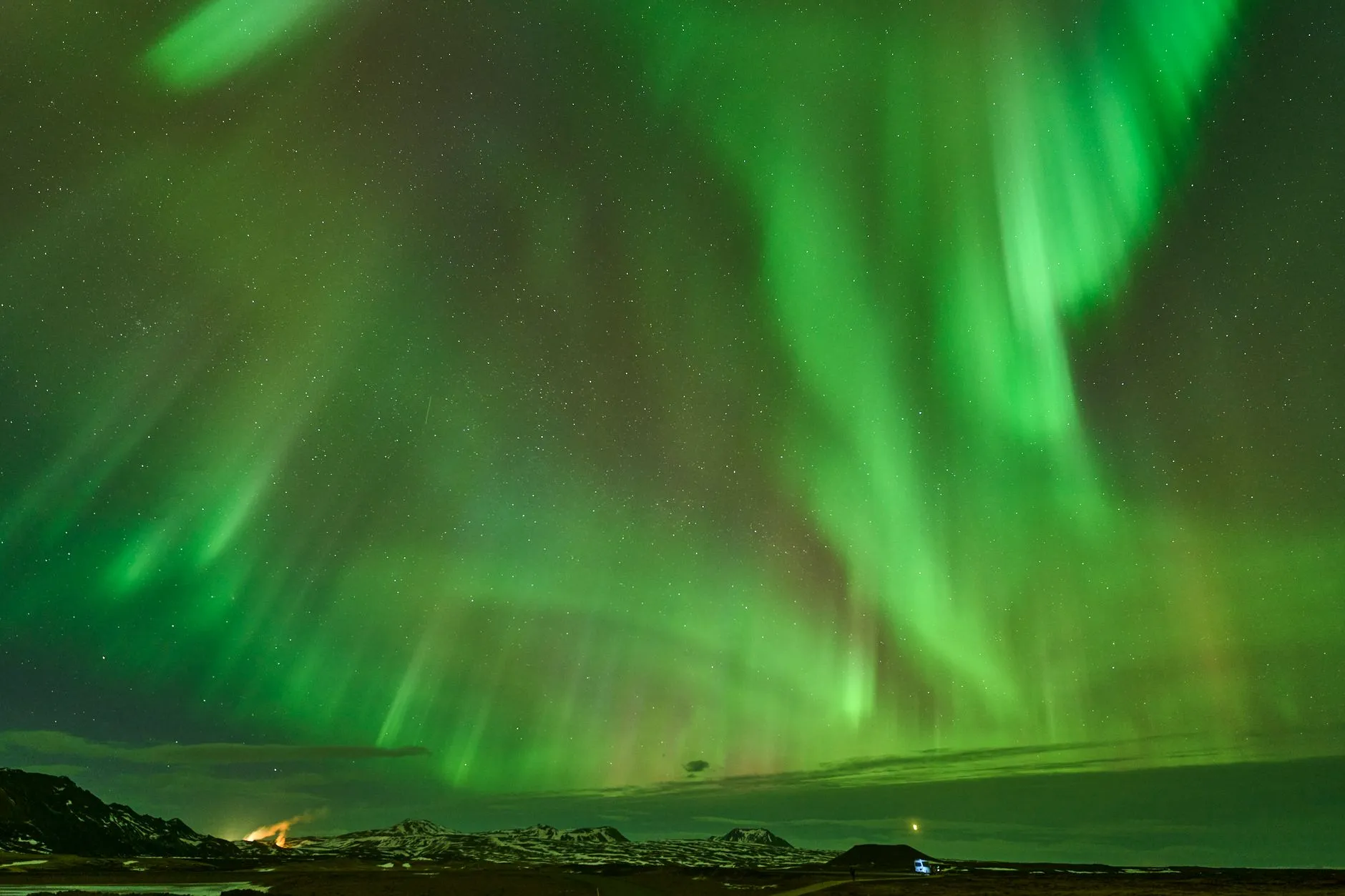
These two are mutually exclusive, and it’s worth being blunt about it. You cannot see the aurora in summer — from roughly late May to early August the midnight sun keeps the sky too bright. If the northern lights are your dream, you must come in the dark season, roughly late September to March/early April.
Even then, the aurora is never guaranteed — it needs darkness, clear skies and solar activity all at once. The deepest dark is November–January, but the clearest, most stable weather windows are often late September–October and late February–March, and the equinox months (September and March) statistically produce the best displays. Best viewing is usually 22:30–01:00, and you want to get away from Reykjavík’s light. Build in several nights and treat any sighting as a gift, not an entitlement.
In summer, the trade-off is the midnight sun: in June the sun barely sets, and you can hike, drive and photograph at 1 a.m. in golden light. It’s magical and a little disorienting — bring an eye mask for sleeping.
When to Visit: The Honest Month-by-Month
June–August — peak. Long days (up to ~21 hours of light), warmest weather (still only ~10–15°C), all roads and F-roads open, puffins and whales, the Highlands accessible. Also the priciest, busiest, and no aurora. June opens the Highlands; July–August are the warmest and most crowded.
September–October — the sweet spot for many. Crowds thin, prices ease, autumn colour appears, and the aurora season begins with often-decent weather. The Highlands start closing.
November–February — deep winter. Aurora at its darkest-sky best, ice caves open, lowest prices, almost no crowds — but only 4–5 hours of daylight in December, real snow-and-ice driving, frequent road closures and storms. For confident winter drivers and aurora-chasers only.
March–April — shoulder season and arguably underrated. Lengthening days, strong aurora odds at the equinox, lower prices, and the worst of winter easing. The Highlands are still shut.
⚠️ Iceland’s weather is genuinely dangerous and changes by the hour, in any season. Check vedur.is (weather) and road.is / umferdin.is (road conditions) every single morning, and never drive into a storm warning. “It’s only July” is not protection — summer storms close roads too.
What to Eat (and the Price Reality)
Icelandic food is better than its reputation and worse for your wallet than you fear. The genuine highlights: lamb (free-range, grass-fed, exceptional — order it roasted or in a hearty kjötsúpa meat soup), skyr (the thick, protein-rich cultured dairy that’s a national staple and a great cheap breakfast), and astonishingly fresh fish — cod, haddock, Arctic char, langoustine on the south coast.
The single best-value meal in the country is the Icelandic hot dog (pylsa) — lamb-and-pork, served “with everything” (raw and crispy onions, remoulade, ketchup, sweet mustard) at stands like Reykjavík’s famous Bæjarins Beztu for a few euros. It is a rite of passage. Gas-station grills across the island do cheap, decent hot dogs, soup and sandwiches — your friend on a road trip.
Sit-down restaurants are where the cost reality bites: expect €25–40 for a main, more for fish or lamb at a nice place, and €8–12 for a pint. The money-saving move every Iceland veteran uses: shop at Bónus or Krónan (the budget supermarkets) and self-cater breakfasts and some dinners — it can halve your food spend. You’ll find the famous “weird” foods (fermented shark, hákarl; sheep’s head, svið) mostly aimed at tourists now; try them if curious, but don’t feel obliged.
Getting Around: Self-Drive, Campervans, F-Roads and Tours
There’s no train, intercity buses are limited, and the island’s whole appeal is its scattered nature — so renting a car is the default, and a campervan is hugely popular (it rolls your transport and lodging into one and frees you from booking hotels). For the Ring Road and South Coast in summer, a 2WD is fine. You only need a 4×4 for the Highland F-roads or for winter driving.
⚠️ F-roads (the “F” prefix) are 4×4-only by law. Driving one in a 2WD voids your insurance entirely and can mean huge fines — and many involve unbridged river crossings you must assess on foot before driving. F-roads are summer-only, opening roughly mid-June to early July (Landmannalaugar’s F208 usually ~10–20 June) and closing with the first snows. Check umferdin.is the morning of any Highland drive.
A few hard rules of Icelandic driving: off-road driving is illegal and heavily fined (it scars the fragile moss for decades — always stay on marked roads); gravel roads and the wind are harder on cars than the asphalt suggests; and rental insurance here is a thing — gravel protection and sand-and-ash protection are worth it given chip-cracked windscreens and the odd ash storm. Headlights stay on 24/7 by law.
If you’d rather not drive — especially in winter — day tours from Reykjavík cover the Golden Circle, South Coast, aurora hunts, glacier walks and the lagoons, and multi-day guided trips circle the island. More expensive per day than self-driving, but zero stress.
Where to Stay: By Region and Budget
Reykjavík is the obvious base for a short trip or a no-car holiday — walkable, full of food and day-tour pickups (it has its own dedicated city guide; lean on that for the city itself). Lodging here is the most expensive in the country.
On a road trip, base-hop instead of returning to the capital: a night near Vík or Höfn to break up the South Coast and reach Jökulsárlón; Akureyri for the North; a fishing-village guesthouse in the East Fjords. Iceland’s accommodation runs from hostels and guesthouses (the best value, often with shared kitchens — use them) through farm stays and guesthouses to a handful of pricey design hotels and remote lodges. Campervans and campsites are the budget-and-freedom play in summer (campsites are inexpensive and plentiful). Book well ahead for June–August — the good-value places sell out months out.
Costs and Budget: Yes, It’s Expensive
There’s no sugar-coating it: Iceland is one of Europe’s most expensive countries, and you should budget in that frame.
- Daily ground budget (per person, excl. flights): roughly €120–250 mid-range, higher in peak summer; shoestring campervan-and-supermarket trips can dip toward €90–110/day.
- Car rental: from ~€70–100/day for a summer 2WD; 4x4s and winter rentals cost more. Fuel ~€1.30–1.65/litre; budget a tank or two for a road trip.
- Food: restaurant main €25–40; pint €8–12; supermarket self-catering cuts this dramatically. Gas-station hot dog/soup: a few euros.
- Activities: Blue Lagoon from ~€83; glacier walks, whale tours, lagoon boat trips €80–150 each.
- Flybus KEF↔Reykjavík ~€28–36 each way.
- Lodging tax: a small per-night accommodation tax applies (currently 800 ISK/night for hotels, 400 ISK for campsites, plus 11% VAT on lodging), and Iceland’s government has signalled it intends to raise tourist taxes following record visitor numbers — check the current rate when you book.
How to spend less without ruining it: come in shoulder season (Sept–Oct or March–April), self-cater from Bónus/Krónan, drink the (free, excellent) tap water, use guesthouses and campsites over hotels, and limit paid activities to the few that are genuinely unmissable.
Practical Information
Border & entry (2026): Iceland is not in the EU, but it is in the Schengen Area and the EEA — so the EU border systems apply here. The Entry/Exit System (EES) has been live since 10 April 2026: on first arrival, non-Schengen visitors (e.g. UK, US, Canadian travellers) register fingerprints and a facial photo at KEF — allow a little extra time at passport control while this beds in. ETIAS, the separate pre-travel online authorisation, is expected to launch on a date that has not been announced — check whether it’s required by your travel date. EU/EEA/Swiss travellers are unaffected by both. Standard Schengen 90-in-180-day rules apply to visa-exempt visitors.
Money: the currency is the Icelandic króna (ISK), not the euro — Iceland is not in the eurozone. You’ll barely touch cash: Iceland is overwhelmingly card-based (even gas pumps and remote guesthouses), so a contactless card is all you need. Tell your bank you’re travelling.
Safety: Iceland is one of the world’s safest countries for crime — the real dangers are natural. Respect weather warnings (vedur.is) and road closures (umferdin.is) without exception; mind sneaker waves at Reynisfjara and other black beaches; only walk on glaciers with a guide; and assess river crossings before driving F-roads. The current Reykjanes volcanic situation does not affect the rest of the island (see the FAQ).
Water & tipping: tap water is superb — refill a bottle and never pay for bottled. Tipping is not expected and not part of the culture; service is included.
Connectivity: mobile coverage is good around populated areas and the Ring Road (patchier in the Highlands/Westfjords); a local or eSIM data plan is cheap and useful for live weather and road checks.
Frequently Asked Questions
Cheapest Flights to Iceland
We have tracked 2,023 fares to Iceland from 55 cities. As of June 2026, here is what a good price looked like from each — the lowest fare we recorded, and a “great-deal” benchmark to judge a quote against. These are tracked observations, not live prices: by the time you read this they will have moved, so treat them as a yardstick, not a quote.
| From | Lowest fare we tracked | Great-deal benchmark |
|---|---|---|
| New York (JFK) | $304 | $435 |
| Washington (DCA) | $305 | $436 |
| New York (EWR) | $320 | $457 |
| Washington (IAD) | $340 | $490 |
| Pittsburgh (PIT) | $350 | $500 |
| Edmonton (YEG) | C$399 | C$570 |
| San Jose (SJC) | $408 | $583 |
| Phoenix (PHX) | $412 | $588 |
| San Diego (SAN) | $412 | $588 |
| Sacramento (SMF) | $412 | $588 |
| Las Vegas (LAS) | $412 | $589 |
| Winnipeg (YWG) | C$425 | C$607 |
| Nashville (BNA) | $437 | $624 |
| Philadelphia (PHL) | $442 | $632 |
Recent deals we have posted to Iceland:
- Chicago to Reykjavik, Iceland from $355
- Jacksonville to Reykjavik, Iceland from $677
- Kelowna to Reykjavik, Iceland from C$641
- Washington DC to Reykjavik, Iceland from $390
- Winnipeg to Reykjavik, Iceland from C$452
- New York to Reykjavik, Iceland from $353
- Nashville to Reykjavik, Iceland from $585
- Calgary to Reykjavik, Iceland from C$507
- Winnipeg to Reykjavik, Iceland from C$531
- Salt Lake City to Reykjavik, Iceland from $640
These are fares aifly tracked to this destination, not live quotes — they have changed since and several of the deals above may have expired. Browse current flight deals →