Indonesia — Complete Travel Guide 2026
Indonesia is not a country you visit so much as a subcontinent you take a slice of. It runs more than 5,000 km west to east — the distance from Lisbon to Moscow — across three time zones and 17,000 islands, and the single biggest mistake travellers make is treating “Indonesia” as a destination you can see in two weeks. You can’t. What you can do, brilliantly, is pick a region and go deep: Bali and the dragon islands east of it, or Java’s temples-and-volcanoes spine, or Sumatra’s orangutan jungle, or the diving paradises of Sulawesi and Raja Ampat. Choose well and you’ll have one of the great trips of your life. Choose to “do Indonesia” and you’ll spend it in airport queues.
Quick Reference
Southeast Asia — the world’s largest archipelago, 17,000-plus islands strung across three time zones, straddling the equator from Sumatra to Papua
Jakarta Soekarno-Hatta (CGK) is the main international hub; Bali Denpasar / Ngurah Rai (DPS) the tourist gateway; Yogyakarta (YIA/JOG) for Java’s heartland; Surabaya (SUB) for East Java and Bromo
Indonesian rupiah (IDR) — count your zeros; roughly 17,000 to €1, so everything has a comma in it
Bahasa Indonesia (official); hundreds of local languages; English widely understood in tourist areas, patchy elsewhere
Most Western tourists get visa-on-arrival or e-VOA (IDR 500,000 / ~€30), valid 30 days, extendable once; Bali arrivals also pay the IDR 150,000 (~€9) tourist levy
Dry season roughly April–October for most of the country; wet November–March — but it varies sharply by island (the Moluccas and Sulawesi run on different clocks)
Bali, Komodo dragons, Borobudur, surf, volcanoes, orangutans, world-class diving, rice terraces and the best street food in the region
You don’t base in Indonesia, you base in a region — Bali + the eastern islands, or Java’s Yogyakarta-and-volcanoes, or Sumatra’s jungle. Pick one or two, never the lot
Editor’s Note — Bali is not Indonesia
Here’s the hard truth nobody puts on the brochure: Bali is one small island, and it is wildly unrepresentative of the country it belongs to. Bali is Hindu, in a nation that’s the largest Muslim-majority country on earth. Bali is built for tourists, in a country where most islands barely see them. Bali is the size of a French département; Indonesia is bigger than the whole of Western Europe. Millions of people fly in, never leave the island, and go home believing they’ve “been to Indonesia.” They’ve been to Bali — which is lovely and worth it, but it’s a single, atypical fragment.
The second hard truth: the distances are enormous and the geography is water. There are no convenient overland loops here the way there are in Thailand or Vietnam. To get from Bali to the Komodo dragons, or from Java to the orangutans, or from anywhere to Raja Ampat, you fly — internal flights aren’t a luxury, they’re the only realistic way to move between regions. A “Sumatra-and-Bali-and-Komodo” two-week plan looks fine on a map and turns into a fortnight of LCC check-in desks and four-hour ferry crossings.
So the rule for planning Indonesia is brutal and simple: pick a maximum of two regions per trip. Bali plus the islands east of it (Lombok, the Gilis, Komodo/Flores) is the classic and the easiest — they’re a natural cluster off one hub. Java on its own — Yogyakarta, Borobudur, Bromo — is a complete trip. Sumatra is its own adventurous world. Sulawesi and Papua are for the committed. Two regions, well done, beats six regions glimpsed from a plane window every single time.
⚠️ “I’ve got two weeks, can I do Bali, Java, Lombok, Sumatra and Komodo?” No. That itinerary is four or five internal flights and several ferries, and you’ll spend the trip in transit. Cut it to two regions. The single most common Indonesia regret is over-scheduling a country the size of a continent.
Should You Go? Who it’s for — and isn’t
Indonesia is for the traveller who wants range — one trip can hold surf breaks, active volcanoes, ancient temples, world-class reefs, jungle wildlife and some of the best, cheapest food anywhere — and who’s relaxed about the friction of getting between them. It’s superb for divers and snorkellers (Komodo, Raja Ampat and the Lembeh Strait are genuinely among the planet’s best), for surfers (Bali, the Mentawais, Lombok, Sumbawa), for volcano-walkers (Bromo, Ijen’s blue fire, Rinjani), for wildlife people (orangutans in Sumatra, dragons on Komodo), and for culture travellers who’ll trade a beach week for Borobudur, the Yogyakarta kratons and Tana Toraja’s funeral houses.
It’s also for the value-conscious. Off Bali’s tourist strip, Indonesia is very cheap — a nasi goreng from a warung for a couple of euros, a guesthouse room for €15, a long-distance flight on Lion Air for the price of a Bali dinner.
Who it’s not for: anyone who wants a tidy, compact, do-it-all-by-train holiday — the geography simply won’t allow it. It’s a harder sell for travellers who hate flying or get seasick, because moving here means planes and boats. Strict party-tourists should know it’s a Muslim-majority country outside Bali, with alcohol restricted, expensive or absent across most islands. And anyone expecting a frictionless trip should recalibrate: cancelled ferries, volcanic ash closures, traffic that defies belief in Bali and Jakarta, and the occasional flight that simply doesn’t run are part of the deal. Come for the wonders, make peace with the chaos.
Getting There & Getting Around — CGK, DPS & the inter-island reality
Two airports define how you arrive. Jakarta Soekarno-Hatta (CGK) is the country’s main hub and the cheapest long-haul gateway — fly here if you’re doing Java, or connecting onward across the archipelago. Bali Denpasar / Ngurah Rai (DPS) is the tourist gateway, with a huge slate of direct flights from Australia, the Gulf, Asia’s hubs and seasonal European charters, and it’s the launchpad for everything east. From Europe there’s no avoiding a connection — through Singapore, Doha, Dubai, Istanbul, Kuala Lumpur or a Gulf hub — and a Europe–Bali trip is realistically 16–20 hours door to door. Yogyakarta (YIA) and Surabaya (SUB) matter if Java is your focus.
Once you’re in, the domestic network is the country’s lifeblood, and it’s vast. Flag carrier Garuda Indonesia is the full-service, reliable, pricier option (and its low-cost arm Citilink fills in). Lion Air and its sister Batik Air dominate the budget end and fly almost everywhere — cheap, frequent, and notorious for delays and last-minute schedule shuffles, so build slack into any connection. Wings Air (Lion’s turboprop arm) and Susi Air reach the small, remote strips — Labuan Bajo, the Mentawais, deep Papua. Book domestic flights through a local OTA (Traveloka, Tiket.com) for the best fares; foreign cards sometimes get rejected, so have a backup.
⚠️ Treat internal flights as the only inter-region transport — and pad your timing. Indonesian LCCs reschedule, delay and occasionally cancel with little notice, and a missed connection can cost you a day. Never book a same-day onward international flight off a domestic Lion/Wings leg; overnight in the hub instead.
Within a region, ferries and fast boats link the islands — Bali to the Gilis and Lombok, Flores’s island-hopping liveaboards, the Sumatran crossings. Fast boats are quick but weather-dependent and have a patchy safety record; pick an established operator, not the cheapest. On the ground, Gojek and Grab (the local super-apps) run cheap cars and motorbike taxis in cities and most of Bali, and are the single best tool you’ll have for getting around without haggling — download both before you arrive. Renting a scooter is the Bali default but the accident statistics are grim; a private driver for the day (~€35–45 in Bali) is cheap, sane and lets you see far more.
Bali — the island everyone means, honestly assessed
Bali earns its fame and suffers from it. The island genuinely has it all — emerald rice terraces, surf, clifftop temples, a Hindu culture woven into daily life, jungle, volcanoes and some of the best hospitality on earth — but it is also, in its hotspots, a victim of its own success. Canggu and Seminyak’s main roads are a near-permanent traffic crawl of scooters and SUVs; Kuta is a tired cautionary tale; the “secret” waterfalls have ticket booths and queues. The trick to a good Bali trip is geographic: base by personality, and get out of the south.
Canggu is the influencer-and-digital-nomad capital — beach clubs, brunch, surf, co-working, and traffic to match. Seminyak is its polished, pricier older sibling. Uluwatu and the Bukit peninsula to the south have the dramatic clifftop temples, the best surf and the splashy resorts. Ubud, inland, is the cultural and yoga heart — rice terraces, temples, the monkey forest, craft villages — beautiful but heavily touristed in its centre. The escape valves are the quiet east and north: Amed and Tulamben for diving and black-sand calm, Sidemen for the rice-terrace landscape Ubud used to be, Munduk and the central highlands for waterfalls and lakes, and the Nusa islands (Lembongan, Penida) off the southeast coast for cliffs and snorkelling. The cultural set-pieces — the Tanah Lot and Uluwatu sea temples at sunset, the Tegallalang and Jatiluwih rice terraces, the Kecak fire dance, the water temples — are worth the crowds if you time them early or late.
For the full breakdown of where to stay, eat, surf and find the quieter corners, see our dedicated Bali city guide — this country guide keeps Bali deliberately brief because the island deserves its own deep-dive, and because the rest of Indonesia gets short-changed when Bali eats the whole trip.
💡 Stay north or east, day-trip the south. If you want the Bali of the photos rather than the Bali of the traffic, base in Sidemen, Amed, Munduk or the Bukit and treat Canggu/Ubud as day excursions. Better still, use Bali as the hub it actually is and spend half your trip on the islands east of it.
Java — the heartland: Jakarta, Yogyakarta & the volcanoes
Java is where most of Indonesia actually lives — over 150 million people on one island — and it holds the country’s cultural and historical core. Jakarta, the sprawling capital, is a megacity of 30-million-plus in its greater region: chaotic, humid, traffic-choked, and far more a place of business, food and grit than tourism. Most travellers transit it rather than linger, though its museums, Kota Tua old town, street food and nightlife reward anyone who gives it a day or two — our Jakarta city guide covers how to make the megacity work for you.
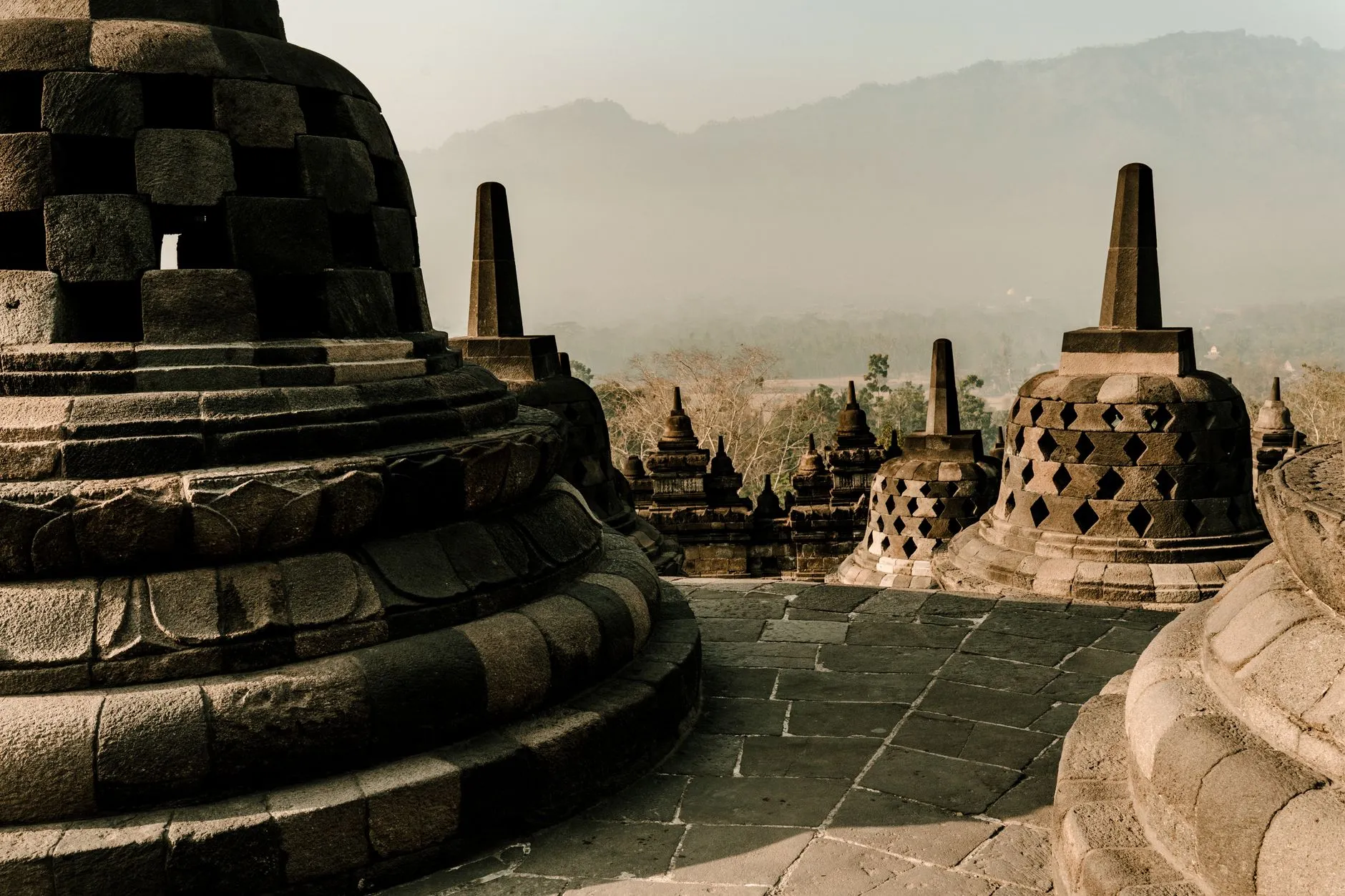
The real prize on Java is Yogyakarta (“Jogja”) — the cultural soul of the country, a graceful royal city of the sultan’s kraton, batik workshops, gamelan, student energy and the best base for the two greatest temples in Southeast Asia. Borobudur, an hour northwest, is the largest Buddhist monument on earth — a colossal 9th-century stepped mandala of stone reliefs and bell-shaped stupas, breathtaking at sunrise. Prambanan, just east of the city, is its Hindu counterpart, a soaring complex of spired temples to Shiva. The pair, plus Jogja itself, is a complete and unforgettable trip.
East Java is volcano country. Mount Bromo — a smoking cone in a vast sea of volcanic sand inside the Tengger caldera — delivers the most famous sunrise in Indonesia, the silhouettes-against-the-dawn shot you’ve seen a hundred times. Further east, Ijen offers a pre-dawn hike to a turquoise crater lake and the eerie electric-blue flames of burning sulphur, plus the miners who still carry loads up from the crater by hand. Both are doable as tough early-morning trips, often combined into a Bromo-Ijen-Bali overland run.
⚠️ Check volcano status before you commit. Indonesia is the most volcanically active country on earth, and several peaks are erupting at any given time — in 2026 Lewotobi (Flores), Semeru, Marapi and others have held high alert levels with exclusion zones and intermittent ash that grounds flights. Bromo is usually at a low “alert” level and routinely open, but conditions change weekly. Check the official PVMBG (Magma Indonesia) status and your tour operator before booking any volcano hike or a flight near an active cone.
Lombok & the Gili Islands — the Bali alternative
Just east of Bali, Lombok is what Bali was a generation ago — quieter, more rugged, predominantly Muslim, with empty white-sand beaches in the south around Kuta Lombok (not to be confused with Bali’s Kuta), a growing surf scene, and the looming bulk of Mount Rinjani, Indonesia’s second-highest volcano. The Rinjani trek — a tough two-to-three-day climb to a 3,726 m summit and a crater lake — is one of the great hikes in Southeast Asia, but it’s a serious undertaking with a guide, porters and real altitude and weather; it’s seasonal (the route typically closes in the wet months and during volcanic unrest), so confirm it’s open.
Between Bali and Lombok float the three Gili Islands — Trawangan, Meno and Air — tiny, car-free, ringed by coral and reachable by fast boat. Gili T is the party-and-snorkelling island (busier, with a backpacker scene), Gili Air the mellow middle, and Gili Meno the honeymoon-quiet one. No motor vehicles, just bicycles and cidomo pony carts, turtles in the shallows, and sunsets over Agung. They’re touristy and the snorkelling has taken a beating from years of visitors, but they remain a genuinely lovely, low-key contrast to Bali’s south.
💡 The Gili fast boats are the weak link. Crossings can be rough and the safety record across operators is mixed. Book a reputable company, check it includes proper life jackets, and don’t sail in bad weather to make a connection — wait it out.
Komodo & Flores — the dragons, the pink beaches & the boats
This is the trip that converts people. Komodo National Park, off the western tip of Flores, is home to the Komodo dragon — the largest lizard on earth, a three-metre apex predator you walk among (with a ranger and a forked stick) on Komodo and Rinca islands. But the dragons are only half of it: the park is a cluster of dry, sculpted islands ringed by some of the best reefs in Indonesia, with manta rays, sharks, turtles and the famous Pink Beach, its sand tinted rose by red coral. Padar Island‘s three-bay viewpoint is the most photographed panorama in the country.
The gateway is Labuan Bajo, a once-sleepy fishing town on Flores now boomed into a tourism hub with its own airport (direct from Bali, Jakarta and beyond). From here you do the park either as day trips by speedboat or, much better, on a liveaboard — a two-to-four-day boat cruise sleeping aboard, hitting the dragons, the dive sites, Padar and Pink Beach away from the day crowds. Liveaboards range from backpacker wooden phinisi boats (rough, cheap, occasionally with real safety concerns) to genuinely luxurious yachts; spend up a tier here, because the cheapest boats cut corners that matter at sea. Beyond the park, Flores itself is a spectacular, under-travelled island — the tri-coloured Kelimutu crater lakes, traditional villages, and a winding cross-island road for the adventurous.
💡 Do Komodo by liveaboard, not day trips. The day-trip boats arrive at the same sites at the same time as everyone else; a two-to-three-night liveaboard gets you Padar at dawn and the dive sites at slack tide with nobody around. Book a mid-tier operator with good reviews — this is one place where the bargain boat is a false economy.
Sumatra — orangutans, Lake Toba & jungle
Indonesia’s huge western island is for travellers who want wildness over polish. The headline is the orangutans of Bukit Lawang, a jungle village on the edge of Gunung Leuser National Park where you trek into the rainforest to see semi-wild Sumatran orangutans — one of only two places on earth (both in Indonesia) where you can — alongside gibbons, macaques, hornbills and, if you’re absurdly lucky, the ghost of a tiger. The trekking is hot, muddy and genuinely adventurous, and the wildlife encounters are the real thing, not a zoo.
Inland and to the north, Lake Toba is a staggering sight — the largest volcanic lake in the world, formed by a supervolcanic eruption 74,000 years ago that nearly wiped out humanity, with the island of Samosir (itself the size of Singapore) floating in its middle. It’s cool, calm, deeply scenic and the cultural home of the Batak people, and after the sweat of the jungle it’s the perfect decompression. Elsewhere Sumatra offers the surf-mecca Mentawai Islands off the west coast (serious wave country, reached by boat), Padang’s fiery cuisine, and the highland town of Bukittinggi. Sumatra is the least touristy of Indonesia’s big regions and the most logistically demanding — long road journeys, fewer English speakers, basic infrastructure — which is precisely why those who go love it.
Sulawesi, Raja Ampat & Papua — for the committed
These are the deep cuts, for travellers with time and intent. Sulawesi, the orchid-shaped island in the centre, holds Tana Toraja — a highland culture famous for its elaborate, days-long funeral ceremonies, cliff-carved graves with watching tau tau effigies, and soaring boat-shaped tongkonan houses. It is one of the most extraordinary living cultures in Asia, and reaching it (a long drive up from Makassar) is part of the commitment. Off Sulawesi’s northern tip, the Lembeh Strait is the world capital of “muck diving” — bizarre, tiny critters on black sand that obsess underwater photographers — while Bunaken offers classic reef walls.
And then there’s Raja Ampat, off the western tip of Papua — by broad consensus the most biodiverse marine environment on the planet, a scatter of jungle-topped karst islands over reefs of almost unreal richness. Getting there is a mission (fly to Sorong, then boat) and it is not cheap, but for divers it’s the holy grail, and the above-water scenery — the Wayag and Piaynemo karst lagoons — rivals anything in the country. Greater Papua beyond it, the Indonesian half of New Guinea, is the true frontier: the Baliem Valley’s Dani villages, deep jungle, and a level of remoteness that demands organisation, money and care (check government travel advice; parts have ongoing security issues). These regions reward the committed and frustrate the casual — go when Indonesia has already got under your skin.
What to Eat & Drink
Indonesian food is one of the world’s great underrated cuisines — built on rice, chilli, coconut, peanut, lime and a depth of spice that varies wildly island to island. The national staples you’ll meet everywhere: nasi goreng (fried rice with egg, often crowned with a fried egg and prawn crackers), mie goreng (its noodle twin), satay (grilled skewers with peanut sauce — chicken, beef, sometimes goat), gado-gado (a vegetable-and-egg salad in peanut sauce), and nasi campur (a plate of rice with a little of everything, the great cheap lunch). The dish to seek out is rendang — slow-cooked beef in coconut and spice from West Sumatra, frequently voted the best dish in the world and worth the hype — best eaten at a Padang restaurant, where a dozen pre-cooked dishes arrive at your table and you pay only for what you eat.
Beyond the staples, every region has its own table: Bali’s babi guling (suckling pig — a Hindu-island rarity in a Muslim country) and bebek betutu (slow-roasted duck), Java’s sweeter gudeg (jackfruit stew), Padang’s incendiary curries, Manado’s fierce Minahasan cooking, fresh grilled fish on every coast. The cheap eats are the soul of it: the warung (humble local eatery) and the street carts, where a full meal costs a euro or two. For drinks, fresh juices and young coconut everywhere; thick sweet kopi (coffee), and increasingly excellent single-origin beans from Sumatra, Java and Flores. Alcohol is the catch — it’s available and unremarkable in Bali and tourist zones (the local Bintang beer is the default), but elsewhere it’s restricted, taxed, sometimes hard to find, and rare in conservative areas. Avoid cheap local arak spirits of unknown provenance — methanol poisoning from bootleg arak is a real, occasionally fatal risk.
⚠️ Be careful with cheap arak and “free-flow” cocktails. Bootleg arak (palm spirit) cut with methanol has killed and blinded tourists in Bali and Lombok. Stick to sealed, branded bottles and reputable bars; treat suspiciously cheap “arak attack” cocktails and free-flow deals with caution.
Costs & Money
Indonesia spans a huge value range, and where you go decides your budget far more than how you travel. Off Bali’s tourist strip, the country is genuinely cheap: a warung meal for €1–3, a guesthouse room for €12–20, a Grab across town for a couple of euros, a domestic flight for €30–60. Bali’s tourist hotspots, by contrast, can run close to Western prices — a beach-club day, a Canggu brunch, a smart villa and a fancy dinner add up fast, and divers, surfers and resort-goers can spend serious money. The beauty is that both versions exist side by side.
A rough on-the-ground daily budget (excluding international flights):
- Backpacker / budget: ~€25–40/day — guesthouses and hostels, warung food, scooters and public transport, the odd entrance fee. Off Bali you can go lower.
- Mid-range: ~€60–110/day — nice guesthouses or mid hotels, a driver some days, restaurant meals, paid sites and a dive or two.
- Comfortable / Bali villa & diving: €150+/day — villas, beach clubs, liveaboards and resorts climb from here with no real ceiling.
Practical money notes: carry cash — much of the country, especially warungs, markets, small islands and rural areas, is cash-only, though Bali and the cities increasingly take cards and QR. ATMs are widespread in towns and Bali but scarce on small islands and in remote areas, so stock up before you go off-grid, and watch for skimming and the daily withdrawal cap (often ~IDR 2–3 million). Get used to the zeros — a “150” on a menu means 150,000 rupiah (~€9). Tipping isn’t traditional but is appreciated and increasingly expected in Bali’s tourist economy: round up taxis, leave ~10% where there’s no service charge, and tip trekking guides and porters properly (they earn little and work hard).
💡 Indonesia is two countries pricewise — choose which one you spend in. A €40-a-day backpacker trip through Java and Sumatra and a €200-a-day Bali-villa-and-liveaboard trip are both “Indonesia.” Decide which you’re doing before you book, because a Canggu beach club and a Flores warung are not the same economy.
When to Go — region by region
Indonesia straddles the equator, so there’s no winter — just a dry season and a wet season, and the timing shifts by island. As a broad rule, dry runs roughly April–October and wet November–March across most of the popular west — Bali, Java, Lombok, Sumatra — which makes April–June and September–October the sweet spots: dry, a touch less crowded and pricey than the July–August peak.
July–August is the high season — best weather, but the busiest and most expensive, with Bali, Komodo and the dive sites at their fullest. Australian and European school holidays pile in; book ahead. November–March is the wet season for the west: not a washout (rain often comes as intense afternoon storms, not all-day greyness), with greener landscapes and lower prices, but rougher seas (a real factor for Komodo liveaboards and the Gili boats) and a higher chance of disrupted plans.
The catch is that the seasons flip and scatter as you go east: the Moluccas and parts of Sulawesi have their wettest months around June–August, the opposite of Bali. So if you’re heading to a specific eastern region, check that island’s pattern rather than assuming the national rule. For the marquee experiences: Komodo diving is best in the dry (April–November); Bromo and Ijen are clearer and safer in the dry; Rinjani’s trek is dry-season only; and Bali surf works year-round with the west coast best in the dry and the east in the wet.
Practical Information
Entry & visa: Most Western tourists (UK, EU, US, Canada, Australia and ~90 other nationalities) use the visa-on-arrival / e-VOA — IDR 500,000 (~€30), single entry, valid 30 days, extendable once for another 30 days at an immigration office (you must apply in person about a week before it expires; online-only extensions ended in 2025). You can pay the e-VOA online before flying (via the official imigrasi.go.id portal) to skip the airport queue, or pay on arrival. Your passport must be valid at least six months beyond arrival, and you’ll need proof of onward/return travel. Always confirm the current rules for your nationality before flying — Indonesian visa policy changes often.
The Bali tourist levy: Every foreign visitor entering Bali pays a one-time IDR 150,000 (~€9) levy, separate from the visa. Pay it online before you fly via the official Love Bali portal (lovebali.baliprov.go.id — the only legitimate site; ignore the lookalikes) and save the QR voucher, or pay at the airport on arrival. It’s per trip, not per day, and it funds Bali’s environmental and cultural upkeep.
Connectivity: Buy a local SIM or eSIM — Telkomsel has the best coverage (essential off Bali/Java), with XL and Indosat cheaper in the cities. Buy at the airport or an official store with your passport (street SIMs can be unregistered and cut off). Data is cheap and coverage is good in populated areas, patchy to nonexistent in the remote east. Gojek and Grab are indispensable apps for transport and food — install both before arrival.
Health & safety: Indonesia is broadly safe for tourists, with the usual caveats. The biggest real risks are road accidents (especially scooters — wear a helmet, don’t ride drunk, and know that your travel insurance may void any motorbike claim if you’re unlicensed), the sea (rip currents on south-coast beaches drown people every year; heed the flags), natural hazards (active volcanoes, earthquakes and tsunami risk — Indonesia sits squarely on the Ring of Fire), and bootleg alcohol. Petty theft and bag-snatching occur in tourist areas; violent crime against tourists is rare. Check your government’s advisory for the specific eastern provinces (parts of Papua have security issues).
Health basics: No vaccines are mandatory for most arrivals, but consult a travel clinic (hepatitis A/typhoid, rabies if you’ll be near animals, malaria/dengue precautions in certain regions). Don’t drink the tap water — use bottled or filtered everywhere. “Bali belly” (traveller’s tummy) is common; eat at busy warungs with high turnover and you’ll usually be fine.
Culture & dress: Outside Bali’s beaches, this is a modest, Muslim-majority country. Cover shoulders and knees at temples and mosques (sarongs are provided or rented at temple gates, and required at Balinese temples), dress conservatively in non-tourist and conservative areas, and ask before photographing people or ceremonies. Use your right hand for giving and eating. During Ramadan, daytime eating and drinking is restrained outside tourist zones, and on Bali’s Nyepi (Day of Silence, in March — Saka New Year) the entire island shuts down for 24 hours: no flights, no going outside, no lights, even for tourists in their hotels. Plan around it.
⚠️ Bali’s Nyepi grounds the whole island for a day. On the Day of Silence (March), the airport closes, nobody may leave their accommodation, and lights stay off — a genuinely magical experience if you’re prepared and a ruined travel day if you’re not. Check the date before booking March flights.
Frequently Asked Questions
Cheapest Flights to Indonesia
We have tracked 2,855 fares to Indonesia from 128 cities. As of June 2026, here is what a good price looked like from each — the lowest fare we recorded, and a “great-deal” benchmark to judge a quote against. These are tracked observations, not live prices: by the time you read this they will have moved, so treat them as a yardstick, not a quote.
| From | Lowest fare we tracked | Great-deal benchmark |
|---|---|---|
| Mallorca (PMI) | €340 | €486 |
| Zurich (ZRH) | €350 | €500 |
| Athens (ATH) | €363 | €518 |
| Rome (FCO) | €363 | €519 |
| Milan (MXP) | €371 | €530 |
| Munich (MUC) | €374 | €534 |
| Vienna (VIE) | €382 | €546 |
| Paris (CDG) | €390 | €557 |
| Dublin (DUB) | €397 | €567 |
| Warsaw (WAW) | €406 | €614 |
| Geneva (GVA) | €408 | €583 |
| Budapest (BUD) | €409 | €585 |
| Malaga (AGP) | €411 | €587 |
| Nice (NCE) | €435 | €621 |
Recent deals we have posted to Indonesia:
- Athens to Bali, Indonesia from €547
- Prague to Bali, Indonesia from €671
- Amsterdam to Bali, Indonesia from €609
- Stockholm to Jakarta, Indonesia from €524
- Vancouver to Bali, Indonesia from C$967
- Vienna to Bali, Indonesia from €542
- Zürich to Surabaya, Indonesia from CHF 547
- Vancouver to Bali, Indonesia from C$794 [Archived]
- Budapest to Jakarta, Indonesia from €564
- Athens to Surabaya, Indonesia from €489
These are fares aifly tracked to this destination, not live quotes — they have changed since and several of the deals above may have expired. Browse current flight deals →