Kerala — Complete Travel Guide 2026
Kerala is the part of India that converts the sceptics — the travellers who found the north too loud, too fast, too much, and assumed all of India ran at that pitch. It moves at the speed of a houseboat drifting through a paddy field: green, slow, a little humid, quietly proud of itself. Come for two weeks, string Kochi to the hills to the backwaters to a beach, and you’ll understand why everyone who’s been keeps using the word “decompress.”
Quick Reference
India’s tropical southwest coast, between the Arabian Sea and the Western Ghats
Cochin / Kochi (COK) in the centre-north; Thiruvananthapuram / Trivandrum (TRV) in the south
Indian rupee (INR, ₹)
Malayalam; English widely understood in tourism
India e-Tourist Visa (apply online before you fly); 6-month passport validity
October–March (dry, lush, peak); June–September for monsoon Ayurveda
Backwater houseboats, tea-covered hills, Ayurveda, beaches, the sadya feast
Fort Kochi (heritage + start of the route), Alleppey/Kumarakom (backwaters), Munnar (tea hills), Varkala (cliff beach)
Editor’s Note: Don’t Rush It
The single most common Kerala mistake is treating it like a checklist. People land in Kochi, hire a car, and try to bag Munnar, Thekkady, Alleppey and Varkala in five days, spending half their holiday on switchback mountain roads. Kerala punishes that. The distances look small on a map and the roads are slow, twisting and frequently behind a tea-estate truck — Kochi to Munnar is 130 km but a solid four hours.
The classic loop is Kochi → Munnar → Thekkady (Periyar) → Alleppey backwaters → Varkala, and it’s classic for good reason: heritage town, high tea country, spice-and-wildlife hills, a night on the water, then a cliff-top beach to collapse on. Done properly that’s 8–10 days. Seven is the floor and it’ll feel brisk. If you only have five, cut it down — Kochi plus the backwaters plus one beach beats a blurred dash through all of it.
And about the houseboat: it is the postcard, and it is worth doing, but manage your expectations (more below). One night on the water is plenty. Two nights and you’ll have run out of canal and started counting mosquitoes.
Plan the route around the driving, not the sights. Kerala’s roads are the real itinerary constraint — beautiful, but slow and serpentine in the Ghats. Budget a half-day for every hill-to-hill transfer and you’ll arrive happy instead of carsick.
Should You Go? Who It’s For
Kerala is for travellers who want India dialled down a notch — gentler, greener, more navigable — without it ceasing to be India. It rewards slow travellers, honeymooners, families with kids, first-timers nervous about the subcontinent, food obsessives, birdwatchers, and anyone who’s ever idly wondered whether a week of medicated oil dripped onto their forehead might fix their back. The infrastructure is the easiest in India: clean-ish, literate (Kerala has India’s highest literacy rate), used to foreigners, and English-speaking in the places tourists go.
It is not for you if you want a party scene (Kerala is largely sober and early-to-bed), high-octane sightseeing (this is a landscape-and-mood destination, not a monuments one — no Taj, no forts on the scale of Rajasthan), or guaranteed beach weather year-round (the monsoon is no joke). Surf-and-cocktails hedonists should look at Goa; temple-and-palace history buffs at Tamil Nadu or the north. Kerala’s pleasures are quieter: a thali on a banana leaf, mist lifting off a tea slope, a kingfisher off the bow.
Getting There: COK vs TRV
Kerala has two international airports that matter, and which you choose shapes the trip.
Cochin / Kochi (COK) is the bigger, busier hub and the natural front door for the classic loop. It sits centre-north, near Fort Kochi, with the hills (Munnar, Thekkady) and the backwaters (Alleppey, Kumarakom) all within a half-day’s drive. If you’re doing the full Kochi-to-coast circuit, fly into COK. It also has a quietly impressive party trick: it was the world’s first fully solar-powered international airport.
Thiruvananthapuram / Trivandrum (TRV) is the southern airport, 15 km from Kovalam beach and close to Varkala. If your trip is beach-and-Ayurveda heavy and centred on the south, or if you want to end the loop on the coast and fly out from there, TRV is the smarter exit. The elegant move on a one-way loop is in to COK, out of TRV (or vice versa) — open-jaw, no backtracking.
Both are designated e-Visa entry airports, so you can clear immigration with the online visa at either. Most long-haul travellers connect through a Gulf hub (Dubai, Doha, Abu Dhabi), a major Indian metro (Bengaluru, Mumbai, Delhi, Chennai), or a Southeast Asian hub. There’s no need to route through Delhi just because it’s the capital — Kerala’s airports take plenty of international and domestic traffic directly.
The Regions: A Quick Lay of the Land
Kerala isn’t a city; it’s a strip of varied country you assemble into a route. The four building blocks:
Fort Kochi & the centre — colonial port town, Chinese fishing nets, spice warehouses, the easiest soft landing. Cultural rather than scenic. Half a day to two days.
The hill stations (the Ghats) — Munnar’s tea estates, Thekkady/Periyar’s spice plantations and wildlife, and (further north, off the loop) Wayanad. Cool, misty, 1,500 m up. The driving up is slow; the air at the top is a relief from the coastal humidity.
The backwaters — the lattice of canals, lagoons and lakes around Alleppey and Kumarakom, where the houseboats live. Flat, green, watery, unmistakably Kerala. One or two nights.
The beaches — Varkala’s cliff, Kovalam’s resort strip, Marari’s quiet sands, all on the southern coast. Where the trip exhales.
Travel times between them are the thing to internalise: Kochi–Munnar ~4 hrs, Munnar–Thekkady ~3 hrs, Thekkady–Alleppey ~4 hrs, Alleppey–Varkala ~3.5–4 hrs. None is far in kilometres; all are slow.
The Backwaters: Houseboats Done Right
This is the image that sells Kerala — a thatched kettuvallam (literally “tied-together boat,” originally a rice barge) gliding past palm-fringed canals while your cook fries a fish caught off the deck. It mostly lives up to it. Mostly.
Alleppey (Alappuzha) vs Kumarakom is the first decision. Alleppey is the houseboat capital — hundreds of boats, the dense network of narrow canals lined with villages, paddy fields and coir factories, real backwater life passing a metre from your gunwale. Kumarakom is wider, quieter, more upmarket: it opens onto the vast Vembanad Lake (one of Asia’s largest), has the bird sanctuary, and skews toward luxury resorts. Rule of thumb: Alleppey for character and village texture; Kumarakom for tranquillity, birds and a posher stay.
Overnight vs day cruise. An overnight (a two-day, one-night trip) is the classic: you board around midday, cruise the afternoon, moor for sunset, and wake to mist on the water. It’s lovely. But know that houseboats are required to anchor at night — you don’t drift while you sleep — and the engine, AC and generator all generate noise. A day cruise (6–8 hours) gets you the scenery without the moored night and the cost; for some that’s the smarter call. If you do overnight, one night is the sweet spot.
The dirty secret of the cheap houseboat: by night you’re parked on the big lake with a hundred other boats and a thrumming generator. The magic is the narrow canals, and the cheapest boats often spend most of their time on the wide open water where it’s least interesting. Pay a bit more for a smaller operator that routes into the genuine canal network, and ask specifically about the night mooring spot.
Caution: book the boat, not just the brochure. Houseboat quality varies wildly and photos lie. Use a Kerala-Tourism-approved operator, confirm the AC works (it matters in the heat), and ask whether the cruise actually enters the small canals or just circles Vembanad Lake. Off-season (monsoon) prices drop sharply but so does the scenery’s appeal under grey skies.
A cheaper, arguably more authentic alternative the touts won’t push: the public ferry between Alleppey and Kottayam, or a small shikara/canoe village tour through the narrow canals a houseboat can’t reach. A few rupees and a couple of hours, and you see the real working backwaters.
The Hills: Munnar & Periyar
When the coastal humidity gets oppressive, the Western Ghats are the antidote — cool, green, and about 10°C cooler.
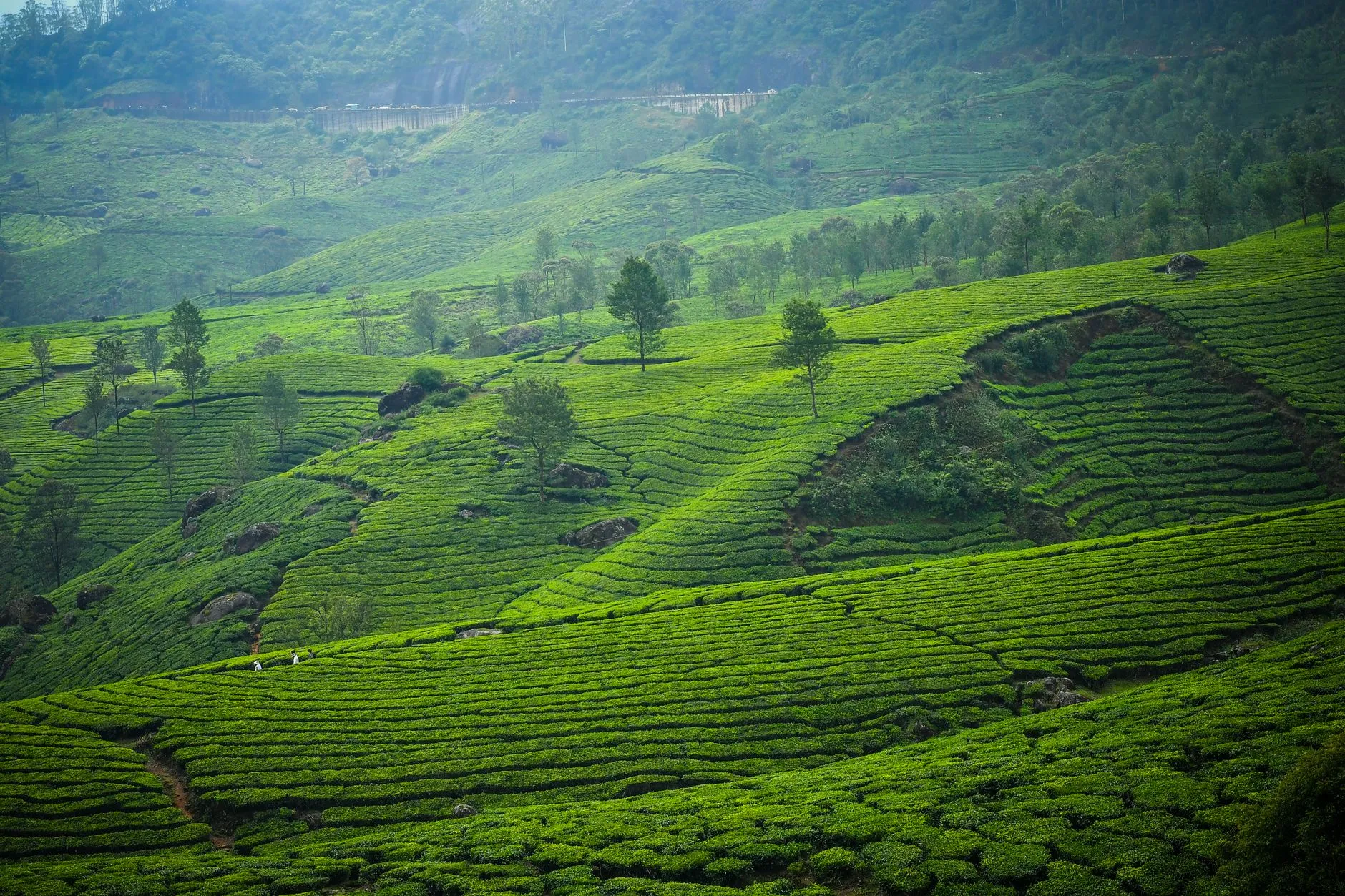
Munnar sits at ~1,600 m amid a sea of manicured tea slopes the British planted from the 1880s. The estates are genuinely beautiful — corduroy-green hillsides combed into rows, mist sitting in the valleys at dawn. Visit the Kannan Devan / Tata Tea Museum to understand the plantation history, and if you’re an early riser and don’t mind a rough jeep ride, Kolukkumalai (~35 km out, over 2,100 m) bills itself as the world’s highest tea estate and delivers a sunrise above the clouds. Munnar town itself is scruffy and traffic-clogged — stay outside it, on an estate or hillside, not in the centre.
Thekkady (Periyar), ~3 hours on, is spice-and-wildlife country. This is India’s cardamom heartland — Kerala grows the lion’s share of the country’s cardamom, and a guided spice plantation tour (pepper vines, cardamom, vanilla, cinnamon, nutmeg, cloves all growing on one slope) is genuinely interesting. The headline activity is the Periyar Lake boat ride — a 90-minute cruise on a reservoir where you might spot elephants, sambar deer, bison and abundant birds. Be honest with yourself: it’s a pleasant lake cruise with a chance of wildlife, not a Serengeti safari. For something better, book a guided nature walk, bamboo rafting or the “jungle patrol” with the forest department’s eco-tourism programme — small groups, real forest, far better odds of seeing animals than the crowded boat.
Skip the elephant rides and “elephant junctions.” The plantation spice tour and a forest-department guided trek are the worthwhile Thekkady experiences; the captive-elephant tourist stops are not, on either welfare or interest grounds.
If you have extra days and want a wilder, less-trodden hills experience, Wayanad (further north, off the classic loop) trades Munnar’s polish for forests, waterfalls, wildlife and caves — but it adds significant driving, so treat it as a deliberate add-on, not a casual detour.
The Beaches: Varkala, Kovalam, Marari
Kerala’s beaches are the trip’s full stop, all on the southern coast.
Varkala is the one with personality. Its USP is the cliff — a red laterite bluff with a paved path of cafés, yoga shacks and guesthouses running along the top, and the beach below. Eating grilled fish at a cliff-edge restaurant with the Arabian Sea crashing directly beneath you at sunset is a specific, unrepeatable Kerala experience. It’s backpacker-bohemian, more atmospheric and a bit less predictable than the alternatives, with a decent spread of food. It’s ~50 km from TRV airport.
Kovalam is the polished, convenient one — the classic curved beaches (Lighthouse, Hawa), resort comfort, the widest dining variety, water sports, and only ~15 km from Trivandrum airport, making it the easy first-or-last beach stop. The trade-off: in December–January it’s busy and not remotely peaceful.
Marari (Mararikulam), near Alleppey, is the quiet one — a long, broad, undeveloped fishing-village beach with serene resorts and the best Ayurveda stays, and it slots neatly onto the end of the backwaters leg without a long southward drive. Choose Marari if your priority is wellness and solitude over nightlife and dining.
Quick verdict: Varkala for atmosphere and the cliff sunset; Kovalam for convenience and resort polish; Marari for peace and Ayurveda.
Ayurveda & Wellness: Authentic vs the Spa Menu
Kerala is the home of authentic Ayurveda, and it’s one of the most genuine reasons to come — but you have to know what you’re buying, because there’s a chasm between the two things both called “Ayurveda.”
At one end is the resort spa: a beautiful hotel that has added a 60-minute “Ayurvedic massage” to its treatment menu. It’s pleasant, it’s relaxing, and it is essentially a spa with herbal oil. At the other end is the clinical Ayurveda hospital / traditional vaidyasala: a medical institution where Ayurveda is the system. There, a treatment doesn’t come as a pre-packaged “7-day detox” — it begins with a physician consultation that assesses your constitution (prakriti) and condition, and only then prescribes the therapies, internal medicines, diet and duration. Panchakarma (a multi-day cleansing protocol) is medicine, not a massage, and it leaves you feeling scoured rather than pampered.
If you’re serious, choose a centre with resident physicians and a multi-day program (a real Panchakarma needs 1–3 weeks); if you just want a relaxing rub with good oil, a reputable resort spa is fine — just don’t confuse the two or expect the menu massage to “cure” anything.
The monsoon-Ayurveda paradox. Most travellers come October–March for the dry weather; but the traditional season for serious treatment is the monsoon, specifically the Malayalam month of Karkidakam (in 2026, roughly 17 July–16 August). The reasoning isn’t marketing: in the cool, humid, overcast monsoon air the body’s pores open, the skin and tissues soften, and medicated oils penetrate deeper — therapies are held to work better then. It’s also low season, so it’s cheaper and quieter. The catch is that everything outside the treatment room is wet — so monsoon Ayurveda is a stay-put wellness retreat, not a sightseeing trip.
When to Visit: Month by Month
October–March — peak, and rightly so. The southwest monsoon has cleared, everything is freshly green, and the weather is warm-dry on the coast (roughly 18–32°C) and properly cool up in Munnar (down to ~10°C at night). December–February is the prime window — the most pleasant weather, the Biennale running in Kochi, and the Theyyam season in full swing up north. The flip side is crowds and peak prices, especially around Christmas/New Year and in Kovalam.
October–November is a sweet spot: post-monsoon lushness, waterfalls full, slightly fewer people than midwinter.
April–May — hot and humid on the coast and plains; the hill stations stay comfortable and quiet, so this is the time for a Munnar-focused tea-country trip if you don’t mind the lowlands sweating.
June–September — the southwest monsoon. Heavy, dramatic rain; the backwaters and waterfalls swell and the whole state turns electric green. Mainstream beach-and-sightseeing travel is a gamble (boat trips get cancelled, roads can flood), but it’s the best and most authentic time for Ayurveda, the cheapest time to travel, and genuinely beautiful if you accept the wet. Then a shorter northeast monsoon brushes through in October–November.
Don’t underestimate Kerala’s monsoon for road travel. Ghat roads to Munnar and Wayanad can be affected by heavy rain and the occasional landslide in peak monsoon. If you travel June–September, build slack into transfer days and don’t plan tight connections.
What to Eat
Kerala’s food alone justifies the flight — coconut, curry leaf, mustard seed and the sea, in endless combinations.
The headline is the sadya: a vegetarian feast of 20-plus dishes — parippu (dal), sambar, rasam, avial, thoran, olan, multiple pickles, crisp papadam and several payasam puddings — served on a banana leaf and eaten, properly, with your right hand. It’s the meal of the Onam festival but you can find a banana-leaf “meals” lunch almost anywhere. Order one even if you’re a committed carnivore; it’s a masterclass in vegetables.
Then the canon: appam with stew — soft, lacy, slightly fermented rice pancakes with a mild coconut-milk stew, the classic Kerala breakfast; karimeen pollichathu — the backwaters’ pearl-spot fish, marinated, wrapped in banana leaf and grilled, best eaten on or near the water; Malabar (Thalassery) biryani — made with short-grain kaima rice, fragrant and gentler than north-Indian biryanis; and Kerala beef fry (nadan beef ularthiyathu) — dark, intensely spiced slow-cooked beef with coconut slivers, a Christian-community speciality you won’t find in much of India.
For the full local experience, find a toddy shop (kallu shaap): rough-and-ready places serving fiery, salty curries alongside toddy, the naturally fermented sap of the coconut palm — sweet and mild when fresh in the morning, more potent and sour by afternoon. It’s an adventure as much as a drink. And eat the breakfast staples everywhere — puttu (steamed rice-and-coconut cylinders) with kadala curry, idiyappam (string hoppers), dosa.
Getting Around
Car-and-driver is the Kerala standard, and for most visitors it’s the right call. A car with driver runs roughly ₹2,500–3,500/day for a sedan (Dzire/Etios) and ₹3,500–5,500/day for an SUV (Innova/Ertiga), typically including fuel for ~80–100 km/day; over that you pay per kilometre. The driver handles the serpentine Ghat roads, the parking, and the navigation, and effectively becomes your fixer. For couples and families on the multi-region loop it’s good value and saves the slog of chaining buses through the hills.
Trains are the backpacker’s friend on the coastal corridor (Trivandrum–Kollam–Varkala–Alleppey–Ernakulam/Kochi). An overnight sleeper berth can be a few hundred rupees; 3AC (air-conditioned) a thousand-plus. Book ahead on IRCTC — popular trains sell out. Trains are cheap, scenic and don’t help you reach the hill stations (no rail up to Munnar/Thekkady — those need road).
Autorickshaws handle in-town hops. They should run on the meter, but in tourist zones many won’t — agree the fare before you get in, or use a ride-hailing app where it’s available. KSRTC state buses are dirt cheap and go everywhere if you have time and patience.
The novelty option in Kochi is the Kochi Water Metro — a fleet of hybrid-electric ferries linking the city’s islands, fares ~₹20–40, with the High Court–Fort Kochi route a genuinely scenic and cheap way to reach the old town across the water. It’s been expanding steadily and is a lovely, air-conditioned alternative to fighting Kochi’s road traffic.
Autorickshaw meters are theoretical in tourist areas — fix the price first. A driver who “forgets” the meter near Fort Kochi or Kovalam is angling for three times the rate. Either insist on the meter, agree a number before you climb in, or use an app.
Where to Stay: By Area & Budget
Kerala does atmospheric accommodation better than almost anywhere in India, and the mid-range is excellent value.
Fort Kochi — heritage homestays and boutique hotels in restored Dutch/Portuguese houses are the move; the old town is walkable and characterful. Budget guesthouses are plentiful too.
Backwaters — either a houseboat (one night) or a lakeside homestay/resort in Alleppey, or a luxury resort in Kumarakom. A homestay on a backwater village is a quieter, cheaper, more local alternative to the boat.
Hills — a tea-estate bungalow or hillside resort outside Munnar (not in the town); a plantation homestay or spice-farm stay near Thekkady. These hillside stays, with valley views and home cooking, are often the trip highlight.
Beaches — cliff-top guesthouses in Varkala (bohemian, all budgets), resorts in Kovalam (polished), wellness/Ayurveda resorts in Marari (quiet, often all-inclusive treatment packages).
Across all of these, homestays are Kerala’s secret weapon: family-run, home-cooked, often gorgeous, and a fraction of resort prices. Book the room, but invest in the location and character over the star rating.
Costs & Budget
Kerala is excellent value, and your money stretches across the whole spectrum.
A frugal backpacker can travel on roughly ₹2,500–3,500/day all-in (guesthouse dorm/budget room, local “meals” lunches at ₹100–200, trains and buses, the odd autorickshaw). Mid-range couples — characterful homestays/3-star hotels, a car-and-driver split between them, a houseboat night, restaurant meals — land around ₹6,000–12,000 per person/day. Luxury (heritage hotels, Kumarakom and Marari resorts, full Ayurveda packages) goes as high as you like.
The big-ticket items are the houseboat (a private overnight is the single priciest night for most trips) and the car-and-driver; everything else — food especially — is cheap. A superb banana-leaf lunch costs a couple of euros; a beer or a glass of toddy not much more. Carry cash for small vendors, autos, toddy shops and rural areas, where cards and even UPI apps may not reach, though Kerala is increasingly digital.
Practical Information
Entry — the India e-Tourist Visa. Almost all Western travellers need a visa, and the easy route is the e-Tourist Visa, applied for online before you fly at the official government site, indianvisaonline.gov.in. It comes in 30-day (double-entry), 1-year and 5-year (multiple-entry) tiers. The standard 30-day fee is around €23, but note the seasonal discount: it drops to about €9 for arrivals in April–June (a small bank charge is added on top). Apply at least 4 days before travel, and make sure your passport has at least six months’ validity and a blank page. Both COK and TRV are designated e-Visa arrival airports.
Warning: only use the official site, indianvisaonline.gov.in. A swarm of copycat third-party “India visa” sites charge hefty markups for the same e-Visa (or are outright scams). The official portal is the only place to apply, and the fee is what’s quoted above plus a small bank charge — not the inflated “service” prices elsewhere.
Money. Indian rupee (INR, ₹). ATMs are common in towns; carry cash for rural areas, autos and toddy shops. UPI digital payments are ubiquitous in cities but need an Indian bank link.
Alcohol. Kerala is comparatively dry and not a party state. Liquor is sold through state-run BEVCO shops and licensed bars/hotels, with occasional dry days (election days, certain religious occasions) when BEVCO outlets and standard bars close. A 2025 policy update eased some rules — three-star-plus hotels can serve at weddings/conferences even on dry days, and toddy is getting a tourism push at permitted resorts — but the safe assumption remains: bars are limited, beer at your hotel is the reliable option, and the toddy shop is the authentic (and legal) local drink.
Plastic. Kerala has tightened single-use-plastic rules — a ban in hilly tourist areas (Munnar, Wayanad) and around Fort Kochi beach took effect from 2 October 2025, covering plastic plates, cups, straws, sachets and the like. Bring a refillable water bottle (filter or buy large bottles to refill); it’s better for the hills and increasingly expected.
Water & health. Don’t drink the tap water — bottled or filtered only, and watch ice and salads outside good restaurants. Standard India precautions otherwise; consult a travel clinic about vaccinations and malaria/dengue (the latter a real monsoon-season risk).
Safety & etiquette. Kerala is one of India’s safer and most relaxed states for travellers, including solo women, though normal subcontinent caution applies. Dress modestly at temples and away from beaches; cover shoulders and knees. Tipping isn’t obligatory but is appreciated — round up restaurant bills, tip your driver a few hundred rupees a day, and reward houseboat crews and homestay families.
Connectivity. Mobile coverage is good in towns and patchy in the deep hills and far backwaters. A local eSIM or SIM (Jio/Airtel) is cheap and worth it; most homestays and hotels have Wi-Fi.
Frequently Asked Questions
Cheapest Flights to Kerala
We have tracked 751 fares to Kerala from 63 cities. As of June 2026, here is what a good price looked like from each — the lowest fare we recorded, and a “great-deal” benchmark to judge a quote against. These are tracked observations, not live prices: by the time you read this they will have moved, so treat them as a yardstick, not a quote.
| From | Lowest fare we tracked | Great-deal benchmark |
|---|---|---|
| Athens (ATH) | €301 | €430 |
| Vienna (VIE) | €307 | €439 |
| Malaga (AGP) | €321 | €459 |
| Zurich (ZRH) | €328 | €469 |
| Paris (CDG) | €340 | €485 |
| Brussels (BRU) | €349 | €499 |
| Nice (NCE) | €358 | €511 |
| Rome (FCO) | €360 | €514 |
| Geneva (GVA) | €364 | €521 |
| Munich (MUC) | €368 | €525 |
| Milan (MXP) | €384 | €548 |
| Copenhagen (CPH) | €390 | €557 |
| Amsterdam (AMS) | €405 | €578 |
| Lisbon (LIS) | €418 | €597 |
Recent deals we have posted to Kerala:
- Amsterdam to Kochi, India from €444
- Vienna to Kochi, India from €454
- Zürich to Kochi, India from CHF 469
- Zürich to Kochi, India from CHF 466
- Abu Dhabi to Kochi, India from $275
- Zürich to Kochi from CHF475
- Zürich to Kochi from CHF471
- Cheap Flights Mumbai to Kochi 2026 — From 300 EUR
- Cheap Flights London to Kochi 2026 — From 300 EUR
- Cheap Flights Dubai to Kochi 2026 — From 300 EUR
These are fares aifly tracked to this destination, not live quotes — they have changed since and several of the deals above may have expired. Browse current flight deals →