Laos — Complete Travel Guide 2026
Laos is the country Southeast Asia forgot to monetise, and that is its entire appeal. While Thailand built mega-resorts and Vietnam built a tourism machine, Laos stayed slow, gentle, under-developed and — let’s be honest — a little sleepy. You don’t come here to tick sights or chase nightlife; you come to decelerate. The headline is Luang Prabang, a UNESCO old town of gilded wats and saffron-robed monks at the confluence of two rivers, but the real Laos is the unhurried bit between the postcards: the Mekong sliding past at walking pace, a Beerlao at sunset, a karst valley with nobody in it. And then there’s the thing changing everything — a Chinese-built bullet train that now slices the country end to end. Go for the calm. Go before the train finishes the job.
Quick Reference
Landlocked Southeast Asia, strung along the Mekong between Thailand, Vietnam, Cambodia, China and Myanmar — the quiet, mountainous heart of the region
Vientiane-Wattay (VTE), the capital hub; Luang Prabang (LPQ) for the headline town; Pakse (PKZ) for the south
Lao kip (LAK) — brace for big numbers (€1 ≈ 23,500 kip); Thai baht and US dollars sometimes accepted in tourist zones
Lao (official); English in the tourism trade; a lingering French legacy in the architecture and the bread
Visa-on-arrival or e-visa for most tourists, ~€28–46 / 30 days, extendable once — be specific & current (see below)
November–February (cool, dry, perfect); March–May (punishingly hot); June–October (green, wet, lush, fewer people)
Luang Prabang’s golden temples and alms-giving monks, the slow Mekong, karst mountains, waterfalls, Beerlao, and a pace the rest of Southeast Asia lost
Luang Prabang for the soul, Vientiane for the rail hub, Vang Vieng for the karst, the 4000 Islands or Bolaven for the south — most people do two of the four
Editor’s Note — the antidote, not the convenience
Here’s the honest pitch: Laos is the antidote to the rest of Southeast Asia. After the scooter chaos of Hanoi, the full-moon hustle of Thailand, the tout gauntlet of Cambodia’s temples, Laos feels like someone turned the volume down. The monks still walk at dawn. The Mekong still moves at the speed of a river that’s never been in a hurry. People are gentle, unhassled, genuinely unbothered about selling you anything. It is the most relaxed country in the region, and for a certain kind of traveller — frazzled, over-touristed, in need of a week that asks nothing of you — it is exactly right.
But I’m not going to sell you a fantasy. Laos is also the least-developed country on the mainland, and it shows. Roads outside the rail corridor are slow, winding and rough. Power cuts happen. Wi-Fi wobbles. The food scene is thinner than Thailand’s or Vietnam’s. Some towns that look idyllic in photos are dustier and rougher in person. And the famous serenity comes with a flip side — there is very little to do in the Western, packed-itinerary sense. If you need constant stimulation, you’ll be bored by day three.
The other truth: the China–Laos railway (opened December 2021) is rewiring the country in real time. It has made Luang Prabang a two-hour day-trip from the capital and poured in a new wave of Chinese investment, package tourists and concrete. The Laos of legend — slow boats, dusty buses, days lost to the journey — is still here, but it’s receding. So the real advice is simple: come for the calm, not the convenience. Take the train when you want speed and take the slow boat when you want the old Laos, because the window on the second one is closing.
⚠️ Manage your expectations downward and you’ll love it. Laos rewards patience and punishes box-tickers. If your idea of a good trip is six sights a day and a buzzing bar at night, go to Thailand. If it’s a riverside hammock, a temple at dawn and nowhere to be, you’ve found your country.
Should You Go? Who it’s for — and isn’t
Laos is for the decompressor — the traveller who’s done the loud bits of Southeast Asia and wants a gentle, beautiful, slow week to recover. It’s superb for that. It’s also for the romantic who falls for old colonial towns, the photographer who wants golden temples and misty rivers, the cyclist and kayaker drawn to the karst, and the thoughtful traveller willing to sit with a heavy, important history (the Secret War — more on that below). Budget travellers and backpackers have loved Laos for decades; it’s cheap, easy-going and friendly, and the classic Luang Prabang–Vang Vieng–Vientiane loop has been a Southeast Asia rite of passage for a generation.
It’s a fine family destination too, if your family is the curious-and-relaxed kind rather than the theme-park kind — kids love the waterfalls, the river and the elephants, and the train makes the distances painless.
Who it’s not for: anyone chasing nightlife, beaches (Laos is landlocked — no coast, no islands-in-the-sea, just river islands) or a slick, high-infrastructure holiday. There’s a nationwide midnight-ish curfew culture — most of the country shuts early, and even Vang Vieng’s reinvented party scene is tame by Thai standards. It’s also not for travellers in a hurry: overland distances are real, mountain roads are slow, and even with the train, getting properly off the corridor takes time and patience. And it’s not for anyone unwilling to handle basic infrastructure — bumpy roads, simple guesthouses, the odd cold shower, cash-only everything.
Getting There — VTE, LPQ, PKZ & who flies
Three airports matter. Vientiane-Wattay (VTE) is the main international gateway, right beside the capital and the southern terminus of the railway — the widest flight choice and the logical entry for a north-to-south or rail-based trip. Luang Prabang (LPQ) is the one many people actually want, putting you straight into the headline town with no overland leg; it has grown a useful international network of its own. Pakse (PKZ) in the deep south serves the 4000 Islands and the Bolaven Plateau, and saves you a very long haul down from the capital.
There are no direct long-haul flights from Europe or North America — everybody connects, and the obvious hubs are Bangkok and Hanoi, with Kuala Lumpur, Singapore, Ho Chi Minh City and several Chinese cities also feeding in. National carrier Lao Airlines flies the domestic triangle (VTE–LPQ–PKZ) plus regional routes to Bangkok, Hanoi, Phnom Penh, Kunming and beyond. Thai Airways and Bangkok Airways run the Bangkok connections, Vietnam Airlines the Hanoi/HCMC links, and AirAsia is the budget workhorse from Bangkok and Kuala Lumpur into both VTE and LPQ. Practically, the cheapest way in is almost always a low-cost hop from Bangkok.
💡 Don’t overlook flying straight into Luang Prabang. A lot of itineraries waste a day getting from Vientiane up to LPQ when a direct flight (or train) drops you in the prettiest town in the country on arrival. If Luang Prabang is your priority, start there and work outward.
Getting Around — the train that changed everything, plus boats, buses & roads
The single biggest story in Lao travel is the China–Laos high-speed railway. Opened in December 2021, this Chinese-built line runs the spine of the country from Vientiane up through Vang Vieng and Luang Prabang to Boten on the Chinese border, where it connects onward to Kunming. The numbers are transformative: Vientiane to Luang Prabang in about 1 hour 50 minutes — a journey that was a grinding 8-to-11-hour bus ride over mountain switchbacks until 2021. The fare is tiny by Western standards: roughly €11–22 (about $12–25) for second class on that flagship leg, more for first. It has, frankly, rewritten the classic backpacker route and made a multi-stop trip through the centre of Laos genuinely easy for the first time ever.
The catch is the booking. Tickets are notoriously hard to grab — official sales open just three days before departure, second class sells out within minutes in the high season, and the stations are inconveniently far outside the towns they serve (Luang Prabang’s is about 15 minutes out, Vientiane’s a good 20+). Book through a local agency or the LCR app the moment the window opens, factor in a tuk-tuk to and from the station, and don’t assume walk-up availability in the December–February peak.
For everything off the rail corridor — and for the old soul of the place — you’re back to boats, buses and roads. The slow boats on the Mekong are the romantic classic: the two-day downriver run from Huay Xai (on the Thai border) to Luang Prabang via an overnight in Pakbeng is one of Southeast Asia’s great lazy journeys — wooden longboats, jungle banks, a beer and a book. Budget around €25–32 (roughly 600,000–750,000 kip in 2026) for the two-day ticket, more through an agency. Skip the deafening, dangerous speedboats. Elsewhere, buses and minivans connect everything the train doesn’t reach, but be realistic: Lao mountain roads are slow, twisty and tiring, a “four-hour” trip routinely becomes six, and the night buses are an experience best avoided if you value your spine. In the towns, tuk-tuks and ride-hail apps (LOCA, and Grab in places) handle the short hops, and renting a bicycle or scooter is the joy of Luang Prabang and Vang Vieng.
⚠️ Book the train days ahead — or don’t count on it. The railway is brilliant and the tickets are a scramble. Sales open exactly three days out, second class evaporates in minutes during the dry season, and the stations are well outside town. Use an agency or the LCR app, have a backup plan (flight or bus), and never leave it to the day.
Luang Prabang — the heart of it
If Laos has a soul, it lives in Luang Prabang, and it deserves the lion’s share of your trip. The whole peninsula — a tongue of land where the Nam Khan meets the Mekong — is a UNESCO World Heritage town, and it’s one of the most genuinely lovely places in Asia: a low-rise weave of gilded wats, French-colonial shophouses with shuttered balconies, frangipani-shaded lanes, and monks in saffron everywhere you look. It survived the 20th century almost untouched, and the result is a town that feels older, gentler and more dignified than anywhere else in the region. Give it three or four nights minimum; this is not a one-day stop.
The headline ritual is the dawn tak bat — the alms-giving procession, where lines of barefoot monks file silently through the streets at first light to collect sticky rice from kneeling locals. It is genuinely moving, and it has been somewhat ruined by tourists treating it as a photo-op — flash photography in monks’ faces, joining the giving for an Instagram shot, blocking the procession. If you watch, watch respectfully: stay across the street, sit or kneel below the monks, keep silent, no flash, and either participate sincerely (buy your rice from a proper market vendor, not the touts who overcharge and sell stale rice) or simply don’t. Done right, it’s the most affecting thing you’ll see in Laos.
The rest of the town earns its days. Climb Mount Phousi, the temple-topped hill in the centre, for sunset over the rivers (it gets crowded — go for the climb and the wats, not solitude). The Royal Palace Museum and the dazzling Wat Xieng Thong, the 16th-century royal temple with its sweeping low roofs and the famous “tree of life” mosaic, are the architectural musts. The nightly handicraft night market along the main street is one of the best in Southeast Asia — Hmong textiles, lanterns, silver, all under a canopy of stalls, with a brilliant cheap-eats alley behind it. And the French-Lao café culture is a genuine pleasure: proper coffee, real baguettes, riverside spots to lose an afternoon.
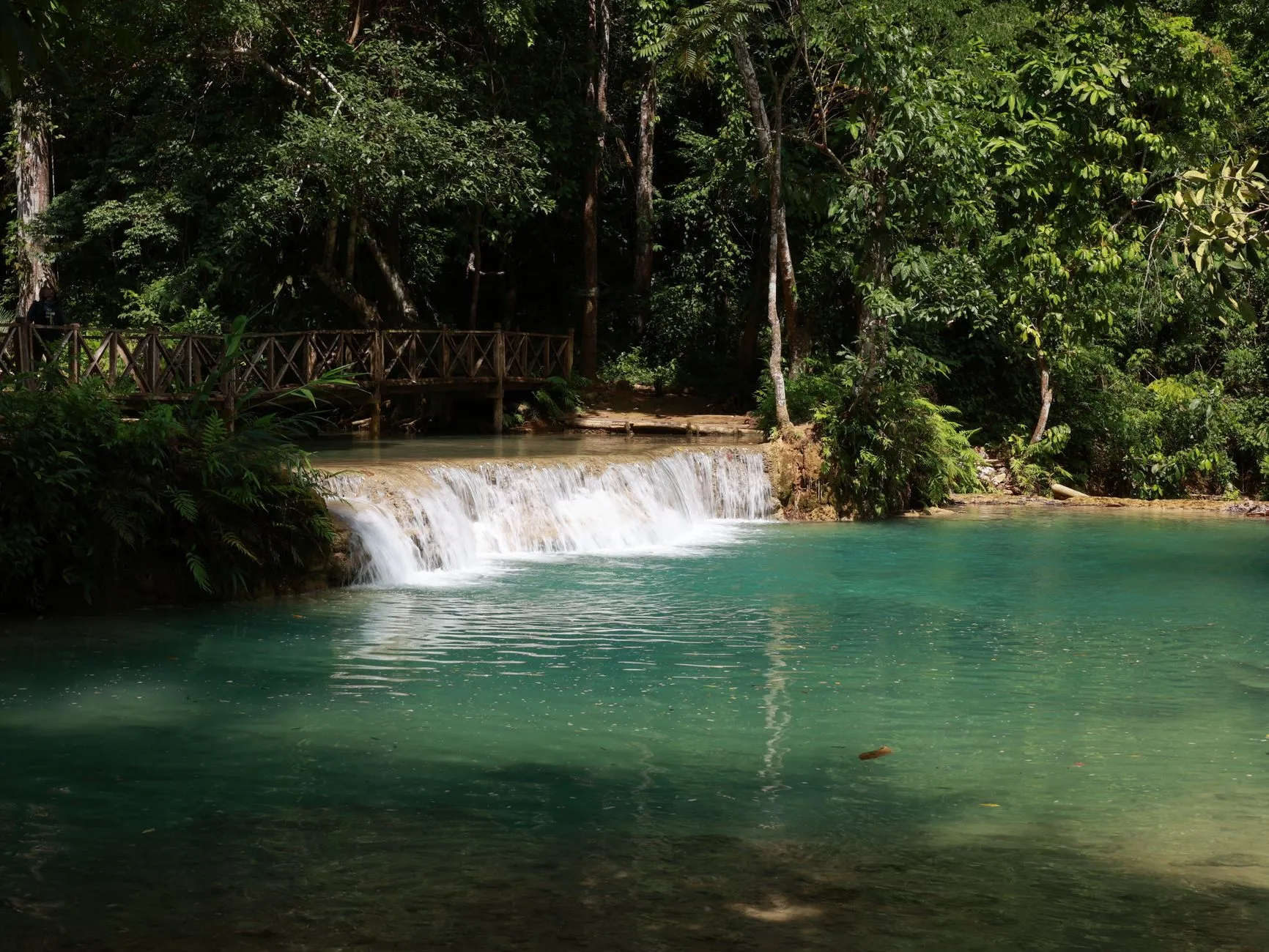
The unmissable day-trip is the Kuang Si Falls, about 45 minutes south — a tiered cascade of impossibly turquoise pools dropping through the jungle, with swimming holes and a bear-rescue sanctuary at the base. Entry is around 60,000 kip (~€2.50); go early to beat the tour buses, and a shared tuk-tuk or minivan from town is cheap. The lesser-visited Tad Sae falls and a Mekong sunset cruise round out the options.
💡 Watch the tak bat from across the street, or don’t watch at all. The alms-giving is a sacred daily devotion, not a show. Stay back, stay low, kill the flash, keep silent — and if you join, buy your rice from a real market vendor at dawn, not the touts flogging stale rice at marked-up prices kerbside.
Vientiane — the sleepiest capital in Asia
Vientiane is the most laid-back capital city you will ever visit — so quiet it barely feels like one. It sits right on the Mekong, looking across the water to Thailand, and most travellers treat it as a day or two of bookending: the rail hub, the launch pad, the place to sort a visa extension or a SIM. That’s fair, but it has real charm if you slow to its speed.
The big sights are walkable and modest. Pha That Luang, the great gold-covered stupa, is the national symbol and the holiest monument in the country — a glittering, slightly surreal golden spike on the city’s edge. Patuxai, the “Arc de Triomphe of Vientiane,” is a concrete victory monument built, famously, with American cement donated for an airport runway — climb it for the city view and the cheerful self-deprecation of the plaque that calls it a “monster of concrete.” Wat Si Saket, the oldest temple in the city, has cloisters lined with thousands of small Buddha images. And just out of town, the wonderfully weird Buddha Park (Xieng Khuan) is a riverside field of giant, surreal Hindu-Buddhist sculptures — a reclining Buddha the length of a bus, a hollow pumpkin-demon you climb through — built by an eccentric mystic in the 1950s. It’s kitsch, eerie and brilliant.
The real pleasure of Vientiane, though, is the riverfront at dusk: a long promenade, a night market, food stalls firing up, and a slow, golden Mekong sunset with a Beerlao in hand. Watch it, eat well, and don’t feel you need more than that.
Vang Vieng — the karst town that grew up
Vang Vieng is the redemption story of Lao tourism. Set among jagged limestone karst mountains along the Nam Song river — genuinely jaw-dropping scenery — it spent the 2000s and early 2010s as Southeast Asia’s most notorious party town, a strip of riverside bars where backpackers drank buckets and “tubed” down the river past rope swings and zip-lines, with a grim toll of drownings and drug deaths that became a regional scandal. The Lao government cracked down hard around 2012, bulldozed the riverside bars, and the town reinvented itself.
What it is now is an outdoor-adventure hub, and a good one. The hot-air ballooning at dawn over the karst is the signature experience — floating over mist-filled valleys and limestone spires at sunrise, genuinely spectacular and surprisingly affordable. There’s kayaking and (much tamer, more regulated) tubing on the river, caving in the honeycombed limestone, rock climbing, ziplines and a string of gorgeous blue lagoons — flooded swimming holes in the rock, of which the famous “Blue Lagoon 1” is now overrun and Lagoons 3, 4 and 5 are the quieter calls. The railway stops here, making it an easy add between Vientiane and Luang Prabang.
Be honest about the legacy, though: a partying scene still exists, lower-key than its heyday but present, and the river activities carry real risk — people still drown. Come for the dawn balloon over the karst — one of the best-value great experiences in Southeast Asia — do a guided kayak, enjoy the scenery, and treat the tubing-and-buckets thing with the caution its history demands. The scenery is the real draw, and it’s stunning.
The South — the 4000 Islands & the Bolaven Plateau
The deep south is where Laos slows down even further, and it’s the part most short trips skip — to their loss. Two very different worlds anchor it.
Si Phan Don — the “4000 Islands” — is the Mekong at its widest, fanning out near the Cambodian border into a maze of river islands, sandbars and channels. Don Det is the backpacker hangout (hammocks, river bungalows, sunsets, a gentle bohemian torpor); quieter Don Khon next door has the old French colonial railway relics, the thundering Khone Phapheng Falls (the largest by volume in Southeast Asia, a wall of brown water that, technically, makes the Mekong un-navigable from the sea), and the genuine chance to spot the critically endangered Irrawaddy dolphins in the channels near the Cambodian line. This is do-nothing Laos perfected: rent a bicycle, find a hammock, watch the river.
The Bolaven Plateau, inland and up, is the cool green highland that grows Laos’s excellent coffee. It’s a different climate entirely — misty, fertile, dotted with spectacular waterfalls (Tad Fane’s twin plunges, Tad Yuang, the cluster around Tad Lo) and small coffee-farm villages where you can taste single-origin Lao Arabica at the source. The classic way to do it is the “Bolaven Loop” by rented motorbike out of Pakse, a 1-to-3-day circuit of falls, coffee and cool air. Pakse itself is the regional hub and gateway, with the airport (PKZ) and bus connections. Don’t miss Wat Phou nearby — a haunting pre-Angkorian Khmer temple ruin tumbling down a sacred hillside, a UNESCO site and one of the country’s great underrated sights, far quieter than its famous cousin across the border in Cambodia.
The North — Nong Khiaw & the mountains
If Luang Prabang is too polished for you, go further north. Nong Khiaw, a few hours upriver, is one of the most dramatically set villages in Southeast Asia — a cluster of bungalows on the Nam Ou river, hemmed in by sheer limestone cliffs that glow at sunset, with a famous (and steep) viewpoint hike up to a panorama that’s all the reward you need. From here the river runs on to even sleepier Muang Ngoi, reachable only by boat, where there’s no agenda beyond hammocks, caves and walks to ethnic-minority villages.
This is the off-grid Laos: the trekking is the real draw, multi-day walks through the mountains to overnight homestays in Hmong, Khmu and other ethnic-minority villages, a window into hill cultures living much as they have for generations. It’s harder to reach, the infrastructure is basic, the roads are rough — and that’s the entire point. The far north (Luang Namtha, the Nam Ha protected area, Phongsali) takes the remoteness further still, with some of the best community-based trekking in the country. Come up here when you want the Laos that the train hasn’t reached yet.
The History You Should Understand — the Secret War & UXO
You cannot honestly understand Laos without this, and every visitor should give it an hour. Between 1964 and 1973, during the Vietnam War, the United States ran a covert bombing campaign over Laos — the “Secret War” — to cut the Ho Chi Minh Trail and fight the communist Pathet Lao. The scale is almost incomprehensible: the US dropped more than two million tons of ordnance on this small, neutral, largely rural country across 580,000 bombing missions — the equivalent of a planeload of bombs every eight minutes, around the clock, for nine years. It made Laos, per capita, the most heavily bombed country in the history of the world, and it was kept hidden from the American public at the time.
The horror didn’t end in 1973. Up to a third of the ordnance failed to explode, including some 80 million unexploded cluster “bombies” that still litter the countryside. Since the war ended, over 20,000 people have been killed or maimed by this unexploded ordnance (UXO) — and roughly half the victims are children, who mistake the tennis-ball-sized bombies for toys. Vast areas of eastern and northern Laos remain contaminated; farmers still die ploughing their own fields; clearance, painfully slow and underfunded, will take generations.
In Vientiane, the COPE Visitor Centre is the essential, free, and quietly devastating place to grasp this. Run by the non-profit that makes prosthetic limbs for UXO survivors, it tells the story through the bombs themselves, survivor accounts and the artificial limbs forged — sometimes — from scrap shrapnel. It is not a fun stop, but it is the most important thing you can do to understand the gentle, deeply Buddhist, communist country you’re travelling through, and where it came from. Go.
⚠️ In rural Laos, stay on marked paths — the UXO threat is real, not historical. Tens of thousands of unexploded bombs remain in the ground across the east and north. Never wander off established trails, never pick up unidentified metal objects, and take local guidance seriously when trekking off the tourist corridor. People still die from this every year.
Food & Drink — sticky rice, laap & the baguette legacy
Lao food is one of Southeast Asia’s least-known cuisines and one of its most likeable — earthier, herbier and a touch milder than Thai, though it can still bring real heat. The staple, the thing that defines Lao eating, is sticky rice (khao niaw) — glutinous rice steamed and eaten by hand, rolled into balls and dipped into everything. Laos eats more of it than anywhere on earth, and it’s the carb that anchors every meal.
The national dish is laap (larb) — a zingy minced-meat salad (chicken, pork, beef, fish or duck) tossed with herbs, lime, chilli, fish sauce and toasted ground rice. It is fresh, fierce and addictive, and the Lao version is the original. Alongside it, tam mak hoong — the green-papaya salad (Laos’s take on the dish Thailand calls som tam) — is pounded fresh, pungent with fermented fish sauce and lime, and properly spicy. Look also for or lam (a Luang Prabang herb-and-buffalo stew), grilled river fish from the Mekong, khao soi (the northern Lao noodle soup, distinct from the Thai one), and khao piak sen, the comforting chicken noodle soup that’s the great cheap breakfast.
The French legacy lives gloriously in the bread. The colonial-era baguette (khao jii) survives across the country, most famously as a stuffed sandwich — pâté, herbs, vegetables, chilli sauce — sold from street carts, a brilliant cheap snack and a genuine point of difference from Laos’s neighbours. And the drink is, simply, Beerlao — the excellent, cheap, slightly sweet national lager that’s a point of patriotic pride and the perfect Mekong-sunset companion. Lao coffee (especially the Bolaven Arabica) is superb; lao-lao, the fierce rice whisky, is the local firewater best approached with caution.
Costs & Money — the kip, the cash & the big numbers
Laos is cheap — one of the best-value countries in Southeast Asia, and a core reason backpackers have loved it for decades. Your euro stretches a very long way, and the on-the-ground costs are low across the board.
A rough daily budget, excluding flights:
- Backpacker / budget: ~€18–28/day — guesthouses, local restaurants, sticky rice and noodle soups, public transport and the train. You can eat for €5–8 a day if you stick to markets and noodle stalls.
- Mid-range: ~€35–65/day — comfortable boutique guesthouses (Luang Prabang has lovely ones), restaurant meals, the odd tour, a scooter or guided day.
- Comfortable: €80+/day — the best heritage hotels in Luang Prabang, private guides, river cruises, flights between regions.
A sense of individual prices: a bowl of noodle soup or a stuffed baguette is €1–2; a sit-down restaurant meal €4–8; a Beerlao €1–1.50; a Luang Prabang mid-range guesthouse €20–40 a night (simple ones less, the boutiques more); the Vientiane–Luang Prabang train €11–22; Kuang Si entry ~€2.50; the two-day slow boat €25–32. Tipping isn’t traditional but is appreciated and increasingly expected in tourist restaurants — round up, or 10% in nicer places.
⚠️ Laos runs on cash, and the kip comes in eye-watering numbers. €1 is roughly 23,500 kip, so a meal can be “100,000 kip” — get used to the zeros. ATMs are common in the main towns but cap withdrawals low (often around €50–100 a transaction) and charge a fee each time, so factor that in. Carry cash everywhere; rural areas, the slow boat and small guesthouses are cash-only, and US dollars or Thai baht are sometimes accepted as a fallback in tourist zones.
Practical Information
Entry & visa: most tourists need a visa, but it’s straightforward. The visa-on-arrival (at major airports and main land borders) costs roughly $30–46 (~€28–43) depending on nationality — US citizens around $35, UK around $30, Canadians higher (~$42) — for a 30-day stay, paid in cash (USD preferred) with a passport photo. Alternatively, the official e-visa (laoevisa.gov.la) is around $50 (~€46) for most nationalities, applied for a few days ahead, with the QR approval emailed to you. Both can be extended once for another 30 days at any immigration office inside the country. Use the official government e-visa site only — there are many lookalike middleman sites that overcharge. A few ASEAN nationalities enter visa-free; confirm your own passport’s terms before flying, as fees and rules shift.
UXO safety: as above — in rural areas, stay on marked paths, never touch unidentified metal, and heed local and guide advice when trekking off the tourist trail. The threat is real in the east and north.
Pace & patience: the great Lao skill is letting go of the schedule. Things run late, roads are slow, “bor pen nyang” (no worries / never mind) is the national philosophy, and fighting it just makes you miserable. Build in slack, don’t over-plan, and let the country set the tempo.
The railway, again: book train tickets the moment the 3-day window opens (via an agency or the LCR app), build in transfer time to the out-of-town stations, and have a flight or bus as a backup in peak season.
SIM & connectivity: cheap local SIMs (Unitel, Lao Telecom) with generous data are easy to buy at the airport or in town with your passport — far better than roaming. Wi-Fi is standard in hotels and cafés but can be slow and patchy off the main corridor; download offline maps before heading north or south.
Seasons: November–February is the cool, dry, ideal window (and the busiest — book ahead). March–May is brutally hot and, in March–April, hazy with agricultural burning that can grey out the views for weeks. June–October is the green/wet season — lush, dramatic, fewer tourists, cheaper, with waterfalls at their fullest, though river travel and rough roads can be disrupted by rain. Pi Mai (Lao New Year) in mid-April is a joyous, soaking, nationwide water festival — fun, but everything books up and shuts down for it.
Health & water: don’t drink the tap water — bottled is cheap and everywhere. Standard Southeast Asia precautions apply; medical facilities are basic, and for anything serious the move is to cross to Thailand (Udon Thani is the usual go-to, an easy hop from Vientiane).
When to Go — month by month
November–February: the prime season. Cool, dry, clear — daytime warmth, cooler nights (genuinely chilly in the northern mountains and on a balloon at dawn), no rain, the rivers and rice terraces still green from the wet season. This is the best window for the whole country, and accordingly the busiest and priciest — book the train and the best Luang Prabang guesthouses ahead.
March–May: the hot season, and increasingly the smoke season. Temperatures climb past 35–40°C, and through March and April the slash-and-burn agricultural haze can blanket the north (Luang Prabang especially) in smog for weeks, greying out the views and the air quality. Avoid these months if you can; if you can’t, head for the cooler Bolaven Plateau or the far south.
June–October: the green/wet season. Lush, dramatic, far fewer tourists, and cheaper. Rain tends to come in heavy afternoon bursts rather than all-day deluges, the waterfalls (Kuang Si, the Bolaven falls) are at their thundering best, and the landscape is at its most beautiful. The trade-offs: humidity, the odd road or river route washed out, and the south at its muddiest. A fine, underrated time to come if you don’t mind getting wet.
The one window to actively dodge is March–April: the northern burning season turns the famous misty-mountain panoramas into a flat grey haze and the heat is punishing. November–February is the dream; June–October is the wet, green, crowd-free alternative — but the hot, smoky shoulder is the one to skip.
Frequently Asked Questions
Cheapest Flights to Laos
We have tracked 35 fares to Laos from 14 cities. As of June 2026, here is what a good price looked like from each — the lowest fare we recorded, and a “great-deal” benchmark to judge a quote against. These are tracked observations, not live prices: by the time you read this they will have moved, so treat them as a yardstick, not a quote.
| From | Lowest fare we tracked | Great-deal benchmark |
|---|---|---|
| Wuhan (WUH) | €180 | €257 |
| Chiang Mai (CNX) | €196 | €280 |
| ENH (ENH) | €252 | €360 |
These are fares aifly tracked to this destination, not live quotes — they have changed since and several of the deals above may have expired. Browse current flight deals →