Madagascar — Complete Travel Guide 2026
Madagascar broke away from the African mainland around 160 million years ago and from the Indian subcontinent some 90 million years ago, and then it just kept its own counsel. Cut off in the middle of the ocean, its plants and animals evolved into things that exist nowhere else: a hundred-odd species of lemur, two-thirds of the world’s chameleons, baobabs like upturned roots against the sky, an entire forest of limestone needles you can climb through. Roughly 90% of its wildlife is endemic — found on this one island and nowhere else on the planet. It is, biologically, one of the most extraordinary places a person can stand. It is also one of the poorest countries on earth, with some of the worst roads, and getting around it is slow, expensive and frequently maddening. That trade-off — singular wonder for genuine effort — is the whole story of a Madagascar trip, and you should understand it before you book a thing.
Quick Reference
A giant island in the Indian Ocean off the southeast coast of Africa — the world’s fourth-largest island, and a biodiversity world unto itself
Antananarivo Ivato (TNR) is the only real international hub; Nosy Be Fascene (NOS) takes some direct beach charters and regional flights
Malagasy ariary (MGA) — a soft, cash-first currency; carry notes, ATMs only in towns
Malagasy and French (both official); English is limited outside upmarket lodges and guides
Visa required for almost everyone — a tourist e-Visa or visa-on-arrival, around €35–45 for 30 days; passport valid 6 months
April–November (the dry season); July–September for humpback whales; avoid the January–March cyclone season
Lemurs, baobabs, chameleons and a wildlife found nowhere else on earth; the Avenue of the Baobabs; the Tsingy stone forests
Tana for arrival and the highlands; Andasibe + the RN7 corridor for wildlife; Morondava for the baobabs; Nosy Be for the beach
Editor’s Note — the hard truth first
Let me save you a disappointment. Madagascar is not a quick or easy holiday, and anyone selling it to you as a breezy “Africa plus a beach” is misleading you. It is one of the most logistically demanding mainstream destinations on the planet, and that difficulty is inseparable from why it’s so rewarding.
Here is what that means in practice. The roads are appalling — not “developing-world bumpy” but genuinely broken, with the legendary RN5 in the northeast taking days to cover a couple of hundred kilometres, and even the “good” RN7 highway turning a map-short hop into a full day of switchbacks, potholes and zebu carts. Distances are huge: the island is over 1,500 km top to bottom, the size of France and Belgium combined, and almost nothing moves fast across it. The country is, by most measures, among the world’s ten poorest, which shapes everything — the infrastructure, the power cuts, the visible hardship, the way money matters. And the alternative to the roads — domestic flights — is run by a single struggling national carrier whose schedule is a suggestion, not a promise.
So you need three things Madagascar does not forgive the absence of: time (two weeks is a sensible minimum; one is barely an arrival), patience (with delays, cancellations, breakdowns, and a pace that is not yours), and money (because doing it well means internal flights or a private 4×4-and-driver, neither of which is cheap, on top of mandatory park guides). Do all that, and you’ll see lemurs leap through rainforest at dawn and stand under thousand-year-old baobabs at sunset and understand exactly why people give this island their hearts. Cut corners on any of the three and you’ll spend your holiday inside a Land Cruiser, frustrated. Choose accordingly.
⚠️ This is the antithesis of a beach break. If your ideal trip is short, smooth and predictable, Madagascar will break your heart. The uniqueness is real, but so is the friction — bad roads, slow days, unreliable flights, real poverty. Come for the wildlife and the wildness, with realistic expectations, and it’s the trip of a lifetime. Come expecting Mauritius or the Seychelles and you’ll hate it.
Should You Go? Who it’s for — and isn’t
Madagascar is for the wildlife-obsessed above all — anyone who has watched a lemur documentary and felt a pull, who wants to see chameleons and frogs and orchids and baobabs in the actual ecosystems that produced them rather than behind glass. If natural history is the reason you travel, there is no substitute for this island; it will be among the best trips you ever take.
It’s for the adventurous — people who are energised, not defeated, by the prospect of a long 4×4 day on a terrible road, a 4am start for a forest walk, a guesthouse with intermittent hot water, a meal that’s rice again. It’s for the patient — those who can shrug at a cancelled flight and a six-hour delay and treat the friction as part of the texture. And it’s for travellers willing to spend, because Madagascar punishes false economy: the people who try to do it cheap end up doing it badly.
Who it is emphatically not for: the time-poor (a week is not enough to do more than scratch one corner — don’t try to “see Madagascar” on a short trip), the comfort-dependent (this is not a place for travellers who need reliable luxury, smooth logistics and predictable days), the squeamish about poverty (you will see real hardship up close and it can be confronting), and the pure beach-seeker. There is excellent beach here, but it’s the reward at the end of effort, not the point of the trip.
Getting There & Around — TNR, the roads, and Tsaradia reality
Antananarivo Ivato (TNR) is the gateway for essentially everyone, and getting there is itself a commitment — Madagascar sits a long way from anywhere. Air France is the only carrier flying non-stop between Europe and Tana, with a year-round Paris (CDG) service, so most European travellers connect through Paris or come via an African or Gulf hub. Ethiopian Airlines routes through Addis Ababa (the broadest African connections, including good links to North America), Kenya Airways via Nairobi, and Turkish Airlines via Istanbul — these four are the workhorses. Add seasonal and regional links via Mauritius (Air Mauritius), Réunion, Johannesburg and the Gulf, and you have your options. There is no cheap way in: this is a genuine long-haul to a genuinely remote place, and fares reflect it.
Then comes the real challenge — moving within the island, where two bad choices fight it out.
Overland is the authentic, scenery-rich, deeply slow option. The roads are the central fact of Malagasy travel: the paved national routes (RN — route nationale) are the good ones and even they are slow; everything off them is dirt, and in the wet season much of it is impassable. The famous RN7 from Tana to the south is the one most travellers do, and it’s gorgeous — but budget a full day, every day, between stops, with average speeds that would embarrass a bicycle in places. The notorious northeastern RN5 can take several days to cover a stretch you’d drive in two hours at home. The honest takeaway: do not look at a map and plan a route by distance. Plan it by time, and assume everything takes far longer than it should.
Domestic flights — operated by Madagascar Airlines under its domestic Tsaradia brand — are the way to skip the worst of the roads and reach far-flung corners (Nosy Be, Diego Suarez, Toliara, Fort Dauphin). They are also the single most unreliable part of trip-planning here: the carrier runs at roughly 60–65% on-time, delays of half an hour to an hour are routine, and same-day cancellations and rescheduling happen several times a month. Book domestic flights as early as you can, pay for them on a card you can dispute, and — critically — never schedule a domestic flight to connect directly with your international flight home. Leave a buffer night in Tana. People miss expensive long-haul flights every year because they trusted a Tsaradia connection.
The practical upshot of all this is one rule that governs every good Madagascar itinerary: pick two or three regions and go deep, do not try to circle the island. A realistic first trip is something like the RN7 corridor (Tana → Antsirabe → Ranomafana → Isalo) plus one flight-in region (the baobabs of the west, or Nosy Be in the north). Trying to “do it all” in one visit is how you end up seeing only the inside of a vehicle.
⚠️ Build in a buffer night in Tana before any international departure. Tsaradia’s reliability is genuinely poor — cancellations and reschedules are common, especially in the cyclone months. A domestic flight that lands the same day your long-haul leaves is a gamble you will eventually lose. Always sleep a night in the capital before flying home.
The Wildlife — Lemurs, Chameleons & the National Parks
This is why you come. Madagascar’s wildlife is the headline act, the reason the difficulty is worth it, and it deserves the most room in any honest guide. Around 90% of the species here live nowhere else, and the flagship among them is the lemur — over a hundred species and subspecies, from the teddy-bear indri to the wide-eyed mouse lemur (among the smallest primates alive) to the gremlin-like aye-aye. You will not see lemurs by accident; you see them in the parks, on foot, with a guide, usually at dawn.
Andasibe-Mantadia, an easy half-day from Tana on the (relatively) good road east, is the classic first stop and the home of the indri — the largest living lemur, a panda-faced, tailless animal whose eerie, whale-song-like wail carries kilometres through the rainforest. Hearing an indri family call at first light is one of the great wildlife experiences anywhere on earth, and Andasibe is the most reliable place to do it. Its proximity to the capital makes it the single most popular park, and rightly so — most people see indri, diademed sifaka, and a parade of chameleons and frogs on a morning walk.
Ranomafana, on the RN7 in the southeastern highlands, is rainforest of a different, mistier, denser kind — steep, dripping, and rich, with golden bamboo lemurs (the species whose discovery helped found the park), red-bellied lemurs, and a famous density of reptiles and amphibians. It’s harder walking than Andasibe and all the better for it.
Isalo, further down the RN7, is a complete change of register — not rainforest but a dramatic eroded sandstone massif of canyons, natural pools and palm-fringed oases, where ring-tailed lemurs (the Madagascar movie kind) and Verreaux’s sifaka (the “dancing” lemur that pronks sideways across open ground) live among spectacular hiking terrain. It’s the most scenic park and a hiker’s favourite.
Then there are the chameleons and reptiles, which deserve billing of their own. Madagascar holds roughly two-thirds of all the world’s chameleon species — from the cat-sized Parson’s chameleon to the Brookesia leaf chameleons barely longer than a fingernail, some of the smallest reptiles on earth. Add tomato frogs, leaf-tailed geckos that vanish against bark, and the bizarre aye-aye (a nocturnal lemur with a witchy elongated middle finger for fishing grubs out of wood), and the small stuff rivals the big. Bring a guide with a good eye and a torch for the night walks — half the magic here is nocturnal.
Two practical truths. First, guides are mandatory in the national parks — you cannot walk most of them alone, you pay a park entry fee plus a separate guide fee, and a good guide is worth every ariary (they find the animals you’d never spot and read the forest for you). Second, the conservation picture is grim and getting grimmer: deforestation from slash-and-burn farming and the charcoal trade is eating the forests at a frightening rate, and many lemur species are critically endangered. Seeing this wildlife now, and supporting the parks and communities that protect it, is part of the point.
💡 Hire the park guide, and tip well. You can’t enter most parks without one anyway, but beyond the rules a sharp local guide is the difference between “we walked in a forest” and “we watched a family of indri at six metres for an hour.” They earn a fraction of your trip’s cost and they make the experience — pay the park fee, the guide fee, and a generous tip on top.
The Avenue of the Baobabs & the Wild West
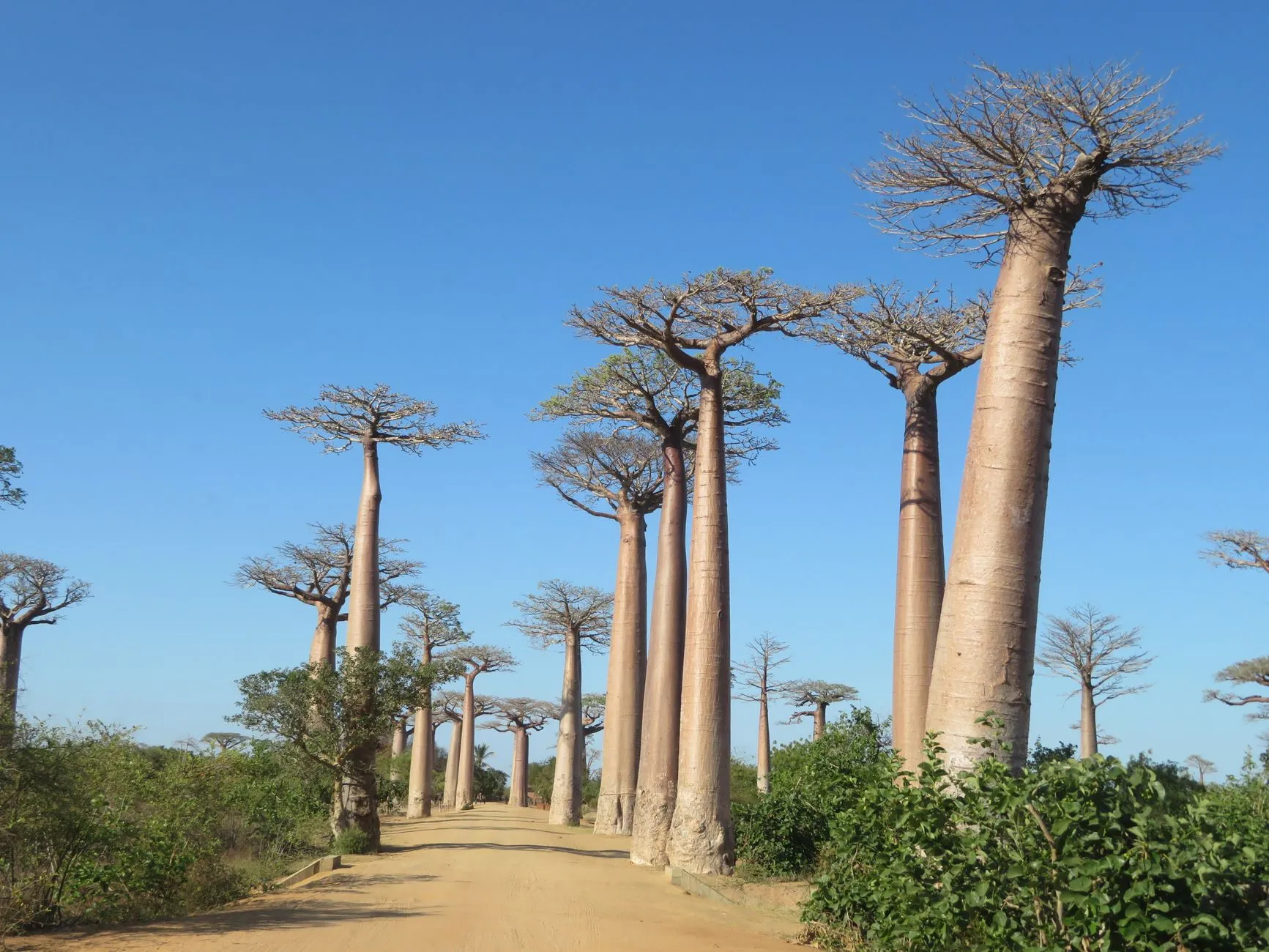
If the lemurs are Madagascar’s living wonder, the Avenue of the Baobabs is its iconic image — and it earns the cliché. Just outside Morondava on the dry west coast, a dirt track runs between a colonnade of towering Adansonia grandidieri baobabs, the giant endemic species, their fat trunks rising twenty-plus metres to a ragged crown of branches. At sunset the light turns the bark to bronze, the silhouettes go black against a burning sky, and ox-carts and villagers pass between the trees on their way home. It is one of the most photographed scenes in Africa for a reason. Go at both sunrise and sunset if you can — sunset for the colour and crowd, sunrise for the quiet — and don’t miss the nearby pair of intertwined “lovers’ baobabs.”
Reaching it is the catch, and a good illustration of Madagascar’s geography problem: Morondava is most sensibly reached by a (you guessed it) unreliable Tsaradia flight from Tana, because the overland route is long and rough. Many people build a few days here purely for the baobabs and the dry-deciduous landscape around them.
The bolder reward of the west is the Tsingy de Bemaraha — a UNESCO World Heritage site north of Morondava that is unlike anywhere else: a vast forest of razor-sharp limestone pinnacles, eroded into a grey stone labyrinth of needles and chasms that you traverse on fixed ladders, cables and rope bridges via ferrata-style routes. Tsingy means roughly “where one cannot walk barefoot,” and you’ll understand why. It is genuinely thrilling and genuinely hard to get to — the access road from Morondava is brutal and only open in the dry season (roughly April–November), with river ferries that don’t run in the rains. Getting to the Tsingy is a multi-day commitment in itself; it’s for the adventurous, and it’s spectacular.
The dry west more broadly — sparse, hot, fringed by mangroves and quiet beaches around Morondava and Belo-sur-Mer — feels like a different country from the green highlands, and seeing both is part of grasping how varied this one island is.
The RN7 Route — Tana to the South
If there’s one self-contained journey that captures Madagascar without a single domestic flight, it’s the RN7: the paved national road running roughly 950 km southwest from Antananarivo toward the coast at Toliara, and the spine of nearly every classic itinerary. It’s slow — count on a week or more to do it properly, with full driving days between stops — but it’s the most reliable road in the country and it threads together an astonishing sequence of landscapes and parks. This is the trip to do if you want depth over breadth and you’d rather drive than fly.
Heading south out of the capital, the road first reaches Antsirabe, a faded highland spa town of colonial-era grandeur, thermal baths, and a famous fleet of brightly painted hand-pulled rickshaws (pousse-pousse) — a pleasant, cool-climate stop and a centre for gemstone trading and craft workshops. The landscape here is the photogenic highland heartland: emerald rice terraces, red-earth villages, and the tall, narrow brick houses of the Merina and Betsileo peoples.
Further on lies Fianarantsoa, the cultured highland capital of the Betsileo, with a steep old town and access to the legendary (and gloriously slow, frequently broken-down) FCE railway down to the east-coast jungle at Manakara — a cult experience for those with the time and patience for it. Near here the road passes the turnoff for Ranomafana national park (see the wildlife section — it’s a highlight of the route).
The RN7 then climbs out of the highlands into drier, stranger country: the Isalo massif with its canyons and ring-tailed lemurs, the spiny forest of endemic succulents and octopus trees as you near the south, and finally the descent toward the hot southwest coast and Toliara (Tuléar), gateway to the reef-fringed beaches of Ifaty and Anakao. Watching the country shift from misty rainforest to red highland to spiny desert to coral coast over the course of a week, all on one road, is the RN7’s quiet magic — and the most accessible way to feel Madagascar’s variety without trusting an aeroplane.
💡 Hire a car with a driver, not a self-drive, for the RN7. This is the rare place I’d never recommend driving yourself: the road hazards (carts, livestock, pedestrians, potholes, night driving you should never do), the lack of signage, and the value of a local driver-guide who knows the stops, the safe places to eat and the language make a private 4×4-and-driver the obvious choice. It’s a major cost, but it’s the backbone of a good trip.
Nosy Be & the Islands — the turquoise contrast
After the dust and effort of the interior, Nosy Be is the deep exhale: an island off the northwest coast that is Madagascar’s established beach-and-resort destination, with the warm, calm, turquoise Indian Ocean the wild interior never delivers. It’s the most developed tourist zone in the country — a string of beach hotels and resorts, seafood restaurants, ylang-ylang plantations (the island perfumes the air), and an easy, low-effort holiday rhythm that’s the opposite of everywhere else here. Crucially, Nosy Be takes some direct international charter flights and regional connections, so it can be done as a beach add-on or even a standalone with minimal overland pain.
The water is the draw. Diving and snorkelling around Nosy Be and its satellites are excellent, and the headline act is seasonal: from roughly July to September, humpback whales migrate through these waters (the channel near Île Sainte-Marie on the east coast is the more famous whale spot, but the northwest sees them too), and whale sharks appear off Nosy Be itself around September–December — snorkelling alongside the world’s largest fish is a genuine bucket-list experience here.
Beyond the main island, the quieter satellites are the real prize: tiny Nosy Iranja with its sandbar at low tide, Nosy Komba (“lemur island,” with habituated black lemurs and a relaxed village), and Nosy Tanikely, a protected marine reserve that’s superb for snorkelling. Over on the east coast, Île Sainte-Marie (Nosy Boraha) is the other beach option — a long, palmy, pirate-history island that’s the prime whale-watching base in season, reached by a short flight or a long road-and-ferry slog.
A word of honesty: Nosy Be is lovely, but it is not why Madagascar is special. If beach is your priority, cheaper and easier islands exist all over the Indian Ocean. Treat Nosy Be as the relaxing coda to a wildlife trip — a few days of recovery, diving and whales after the hard miles — rather than the main event, and it’s perfect.
Antananarivo & the Highlands
You’ll start and probably end in Antananarivo — “Tana” to everyone — and it deserves more than the night most people give it. The capital sprawls across a dozen steep hills in the cool central highlands (it sits at around 1,300 m, so it’s genuinely chilly in the evenings and can feel a world away from tropical), a dense, chaotic, atmospheric city of stairways, balconied colonial-era houses, choking traffic and tumbling markets. It’s a lot on arrival — overwhelming, visibly poor, and not conventionally pretty — but it has real texture if you give it a day.
The landmark is the Rova, the hilltop royal palace of the Merina monarchs who once ruled the island from here, perched on the highest hill with sweeping views over the city (much of it was gutted by fire in 1995 and has been undergoing restoration — check its current state before you climb). Below, the Analakely district and the sprawling market scene (the old Zoma market’s descendants) are the city’s beating commercial heart, good for crafts, vanilla, spices and the famous embroidered tablecloths. The Andafiavaratra Palace museum holds salvaged royal treasures, and the lakeside Lake Anosy with its jacaranda blooms (purple in October–November) is a pretty pause.
The wider highlands around Tana are the cultural homeland of the Merina, the dominant highland people, and the landscape is unforgettable: endless terraced rice paddies in every shade of green, worked by hand and ox; red-brick villages; and a cool, almost European-feeling climate of pine and eucalyptus. Spend a day on the road around Tana — to the old royal hill-town of Ambohimanga (a UNESCO site, the spiritual home of the Merina kingdom) or out among the rice terraces — and the highlands reveal a gentler, more cultivated Madagascar that’s a world apart from the wild parks.
The Culture & the Realities
The Malagasy are not, ethnically or culturally, simply “African” — and this is one of the most fascinating things about the place. The island was settled relatively recently in human terms, around 1,500–2,000 years ago, by Austronesian seafarers who crossed thousands of kilometres of open ocean from what is now Indonesia and Borneo, later mixed with Bantu African, Arab and other arrivals. The result is a genuinely unique people: a language (Malagasy) that is Austronesian in root — its closest relatives are spoken in Borneo, not on the African mainland — layered with a culture, cuisine and rice-farming tradition that feel as much Southeast Asian as African. You feel it everywhere, from the staple of rice at every meal to the faces to the music.
The most striking cultural tradition is the famadihana, the “turning of the bones” — a periodic reburial ceremony, practised mainly among the highland Merina and Betsileo, in which families exhume the remains of ancestors from the family tomb, rewrap them in fresh silk shrouds, and dance with them joyfully before returning them. It is not morbid in the local understanding but a profound expression of love and connection to ancestors (razana), who remain central to Malagasy spiritual life. It typically happens in the dry winter months (roughly July–September). If you are ever invited to one, it is a deep honour and should be approached with the utmost respect — these are real family events, not spectacles; ask your guide about etiquette, never treat it as a photo opportunity, and follow local lead entirely.
And then the hard realities, which an honest guide cannot skip. Madagascar is one of the poorest countries in the world — a majority of the population lives in deep poverty, infrastructure is threadbare, power and water are unreliable even in the capital, and the visible hardship can be confronting for travellers from wealthy countries. Two crises shape the country’s future: deforestation, as slash-and-burn agriculture (tavy) and the charcoal economy strip the forests that hold the endemic wildlife, threatening the very thing tourists come to see; and the vanilla economy, where the world’s leading producer of natural vanilla rides wild price swings that bring boom and bust (and, in the boom years, theft and violence in the growing regions) to some of the country’s poorest farmers. Travelling here responsibly — using local guides, paying fair prices, supporting community-run lodges and park projects, and not haggling the very poorest down to nothing — is not optional good manners; it’s the least you owe a place this fragile and this generous.
Food — Rice, Romazava, Zebu & Vanilla
Malagasy food is built on one immovable foundation: rice, eaten three times a day, in quantities that startle outsiders. Vary (rice) is not a side here — it is the meal, and everything else is the laoka, the accompaniment that flavours it. Lean into it; the rice is good, and the dishes around it are quietly delicious.
The closest thing to a national dish is romazava, a brothy beef-and-leafy-greens stew (traditionally with anamalao, a peppery leaf that gives a mild tingling) ladled over rice — humble, herbal and comforting. Its frequent companion is ravitoto, pounded cassava leaves stewed with pork and often coconut, an earthy, rich plateful that’s a national favourite. Meat means zebu — the humped cattle that are central to Malagasy life, wealth and ceremony — usually grilled or stewed, lean and flavourful, and a zebu steak (hena omby) is the carnivore’s go-to. On the coasts, the story shifts to the sea: superb, cheap seafood — lobster, prawns, crab, grilled fish, often in coconut sauce or au gingembre — especially around Nosy Be, Île Sainte-Marie and the southwest reefs.
Beyond the plates, two things define the food. Vanilla — Madagascar grows the bulk of the world’s natural vanilla, and the real thing here, in ice cream, in sauces, in the air around the markets of the northeast, is a revelation if you’ve only known the synthetic version; buying a bundle of pods straight from source is the classic edible souvenir. And the street food: cheap and excellent, from mofo gasy (slightly sweet rice-flour breakfast cakes cooked in moulds at roadside stalls), koba (a peanut, rice and banana cake sliced from a log), grilled brochettes, samosa-like sambos, and romazava spooned from a market pot for the price of a coffee. Wash it down with locally grown coffee, fresh tropical juice, THB (Three Horses Beer) — the ubiquitous, perfectly decent national lager — or the local rum, often infused with vanilla and spices as rhum arrangé.
Costs & Money
Madagascar has a deceptive economic shape that catches people out. On the ground, daily life is cheap — a local meal for €2–4, a beer for around €1, a guesthouse room for €10–25, market vanilla and crafts for a song. By the standards of where you’ve flown from, the day-to-day costs almost nothing. But the big-ticket logistics are where the real money goes, and they’re unavoidable if you want to actually see the island.
A realistic sense of 2026 prices:
- A mid-range hotel in Tana or a tourist town: roughly €30–60 a night; simple guesthouses €10–25; the upmarket lodges and Nosy Be resorts €100–300+.
- A restaurant meal: €2–5 for a hearty local plate; €10–20 for a proper sit-down dinner with wine in a tourist restaurant or lodge.
- A national park: entry around €10–18 per person per day, plus a separate guide fee of roughly €15–35 depending on the walk and park — budget €30–50 a day per pair to do a park properly.
- A domestic Tsaradia flight (e.g. Tana–Nosy Be or Tana–Morondava): commonly €150–300 one-way, and prices climb with demand and short notice — the single biggest line item after international airfare.
- A private 4×4 with driver: the backbone of a serious trip, typically €80–150 a day all-in (vehicle, fuel, driver), more for the rough western tracks to the Tsingy. Over a two-week RN7-plus-baobabs trip this is where most of your in-country budget goes.
- A Nosy Be beach resort: anywhere from €60 a night for a simple beach hotel to €300+ for the polished places.
The currency is the ariary (MGA), and it’s a soft one — cash is king. ATMs exist only in cities and larger towns (and have low withdrawal limits and occasional outages), card payment is reliable only at upmarket hotels, restaurants and some tour operators, and the moment you leave a town you are in a cash-only world. Carry plenty of ariary, in a mix of denominations, and top up whenever you hit a town with a working ATM. Tipping matters here and is genuinely meaningful given the poverty: tip park guides generously (they earn little and make your trip), round up for drivers and hotel staff, and don’t begrudge it — a fair tip is a small fortune locally and the right thing to do.
⚠️ Carry far more cash than you think, and get it in town. Outside Tana, Nosy Be and the bigger towns, ATMs are scarce, unreliable, and capped at low limits — and almost everything off the tourist track is cash-only. Withdraw ariary at every opportunity in a town, keep a buffer for the inevitable cancelled-flight or breakdown improvisation, and never assume the next place will have a working machine.
Practical Information
Entry & visa: almost every visitor needs a tourist visa, and the good news is it’s easy. You can apply online for an e-Visa in advance via the official portal, or get a visa on arrival at Ivato (TNR) airport — both routes are available, both are straightforward, and the 30-day tourist visa costs around €35–45 (about US$40–50). Bring the fee in cash (euros or US dollars) as a backstop for the on-arrival route, have proof of onward travel, and make sure your passport is valid for at least six months beyond your stay. Note that fees nudged upward in 2026 (the short 15-day e-Visa in particular was hiked), so apply through the official site and confirm the current price for your length of stay before you travel — avoid the third-party “visa” sites that add a markup.
Health & malaria: Madagascar is a malaria-risk country — antimalarial prophylaxis is strongly advised for most regions (consult a travel clinic; the coasts and lowlands carry more risk than the cool highlands). See a travel doctor well ahead for malaria pills and routine/recommended vaccinations, bring serious mosquito repellent and cover up at dusk, and budget for comprehensive travel insurance that covers medical evacuation — healthcare is very limited outside the capital.
Guides: you’ll need a local guide for the national parks (it’s mandatory) and you’ll want one — or a driver-guide — for much of the trip. A good guide unlocks the wildlife, navigates the logistics and language, and is the best money you’ll spend.
Safety: Madagascar is generally welcoming and most trips pass without incident, but it’s a very poor country and petty crime (pickpocketing, bag-snatching, occasional muggings after dark) occurs, especially in Antananarivo and crowded areas — keep valuables low-key, avoid walking city streets alone at night, and use registered taxis and reputable operators. The bigger backdrop is political: Gen Z-led protests over chronic water and power cuts swept the country in late 2025 and culminated in a military takeover that ousted President Rajoelina, with a transitional administration now leading the country through 2026 — and the African Union suspended Madagascar over the unconstitutional change of power. The wildlife regions and parks have been unaffected, but demonstrations can still flare in the capital, so check your government’s current travel advisory before and during your trip, avoid any protests, and keep your itinerary flexible.
Cyclones: the January–March cyclone season is real and dangerous, not a formality — the 2026 season was severe, with cyclones causing dozens of deaths and major damage. Storms flood roads, ground flights, cut power and isolate regions. Travel in the dry season (April–November) and you avoid almost all of it; travel January–March and you accept the risk of a trip seriously disrupted or worse.
Connectivity: local SIM cards (Telma, Orange, Airtel) are cheap and easy to buy with your passport in Tana and the towns, with decent data in populated areas — far better than roaming — but coverage thins out fast in the remote parks and the deep interior, where you should simply expect to be offline. Power cuts are frequent; carry a power bank.
When to Go
Madagascar runs on a single clear seasonal rule: come in the dry season, roughly April to November. Within that, the timing fine-tunes around what you most want to see.
April–May is a lovely shoulder window — the landscape is still green from the rains, the weather is settling into dry-season clarity, the parks are lush, and the crowds are thinner. A strong all-round choice as the cyclone risk recedes.
June–August is peak dry-season travel: cool, clear, reliable weather across most of the island (genuinely cold at night in the highlands — pack layers), the best road conditions, and the safest bet for the western tracks to the Tsingy. It’s also whale season building toward its July–September peak, and the season of the famadihana ceremonies in the highlands. The trade-off is that this is the busiest, priciest stretch, so book ahead.
September–November is many people’s secret favourite — still dry and warming up, the humpback whales lingering into September (and whale sharks off Nosy Be from September), the jacarandas blooming purple around Tana in October–November, and a sweet spot of good conditions before the rains return. Late November starts to feel humid and hot in the lowlands as the wet season approaches.
December–March is the wet season, and January–March is cyclone season — the part of the year to avoid. The rains turn dirt roads to mud and bog (the Tsingy and much of the west become inaccessible), heat and humidity spike in the lowlands, and the cyclones that batter the island between January and March bring real danger and trip-wrecking disruption. There are reasons a specialist might go (lush landscapes, baby lemurs, low prices, fewer tourists), but for a first trip and for anyone wanting reliable access to the parks and roads, steer well clear of the January–March window.
Frequently Asked Questions
Cheapest Flights to Madagascar
We have tracked 252 fares to Madagascar from 41 cities. As of June 2026, here is what a good price looked like from each — the lowest fare we recorded, and a “great-deal” benchmark to judge a quote against. These are tracked observations, not live prices: by the time you read this they will have moved, so treat them as a yardstick, not a quote.
| From | Lowest fare we tracked | Great-deal benchmark |
|---|---|---|
| Nuremberg (NUE) | €589 | €841 |
| Cologne (CGN) | €591 | €844 |
| Stuttgart (STR) | €606 | €865 |
Recent deals we have posted to Madagascar:
These are fares aifly tracked to this destination, not live quotes — they have changed since and several of the deals above may have expired. Browse current flight deals →