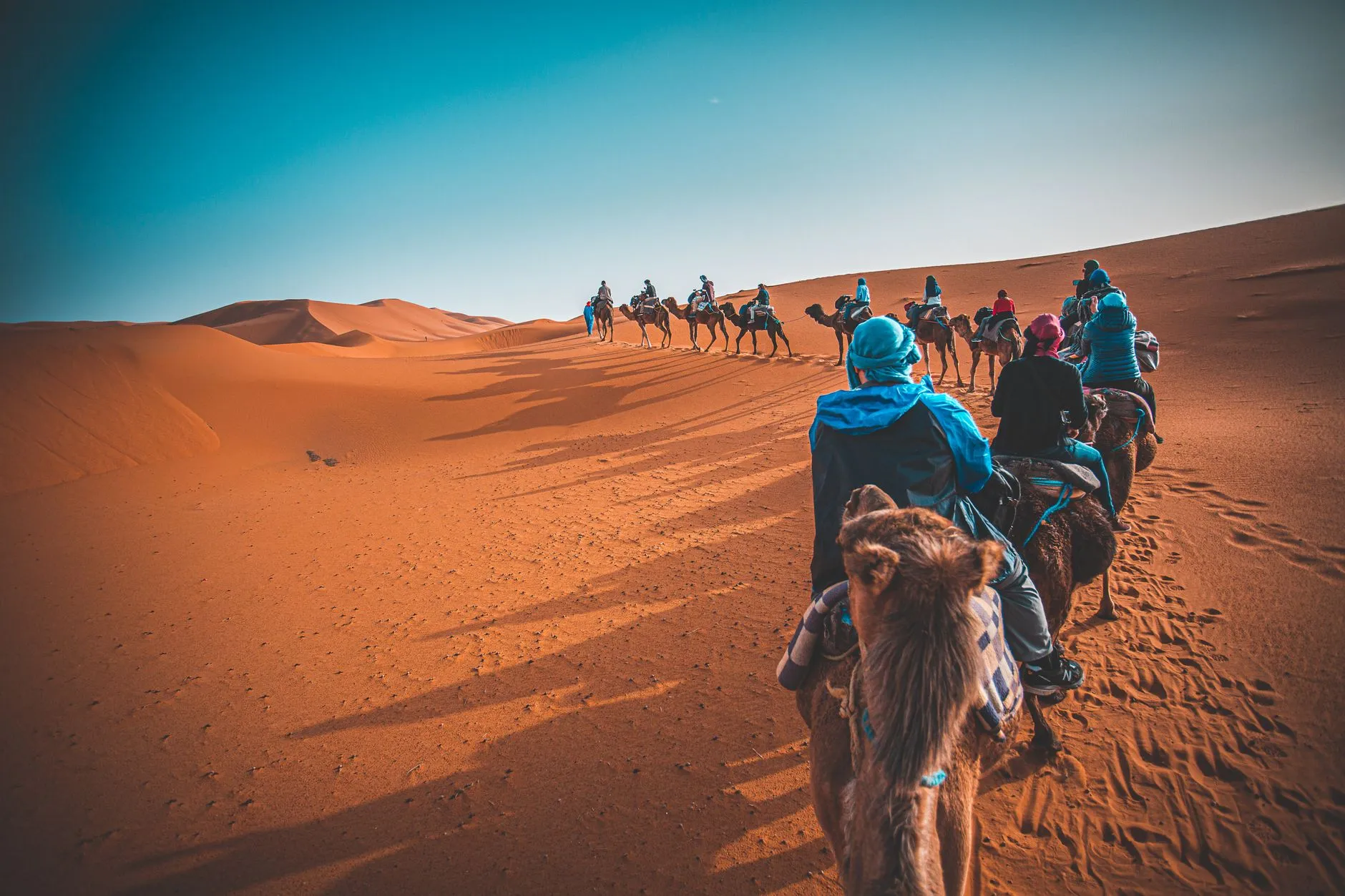
Morocco — Complete Travel Guide 2026
Morocco is the rare country where you can be lost in a thousand-year-old labyrinth at breakfast, crossing a 2,000-metre mountain pass by lunch, and watching the sun drop behind 150-metre Saharan dunes by dinner — all in a day’s drive. It rewards travellers who pick a thread and pull it hard rather than trying to “do” the whole country in a week; the distances are real and the inland heat is no joke. Come in spring or autumn, accept that the medina hustle is part of the deal rather than a personal affront, and Morocco will give you the most sensory trip you’ll take this side of India.
Quick Reference
Northwest Africa, facing both the Atlantic and the Mediterranean, with the High Atlas down the middle and the Sahara to the south
RAK Marrakech-Ménara, CMN Casablanca Mohammed V (the long-haul hub), FEZ Fes-Saïss, AGA Agadir, RBA Rabat-Salé, TNG Tangier Ibn Battouta
Moroccan dirham (MAD) — a closed currency you change locally, not before you fly
Arabic and Amazigh (Berber) official; French everywhere in business and signage; Spanish in the north; English common in tourism
Visa-free for most Western tourists (UK, EU, US, Canada, Australia) up to 90 days; passport valid 6 months
March–May and September–November — the sweet spots. Avoid the 45 °C inland summer
Fes and Marrakech medinas, the Sahara dunes, the High Atlas, blue Chefchaouen, mint tea, tagine, riads
Marrakech for the south and the desert; Fes for the imperial north and Chefchaouen; the coast (Essaouira/Agadir) for cooler air
Editor’s Note: How to Read This Country
The single biggest mistake first-timers make is treating Morocco like a city break with day trips. It isn’t. Marrakech to the Merzouga dunes is a nine- to ten-hour drive each way; Fes to Chefchaouen is four hours; the High Atlas passes are slow and switchbacked. You have to choose a shape for your trip, and the three main ones barely overlap.
The imperial cities loop (Casablanca–Rabat–Meknès–Fes, sometimes with Chefchaouen tacked on) is the history-and-medina trip, mostly doable by fast train and bus — no car needed. The desert run is the road-trip classic: Marrakech over the Tizi n’Tichka pass, down the Route of the Kasbahs to Aït Benhaddou and the gorges, out to the dunes, and either back to Marrakech or onward to Fes. The coast (Essaouira, Agadir, Taghazout) is the cooler, slower, beach-and-surf alternative when the interior is roasting.
My honest steer: if you have only a week and want the desert, fly into Marrakech, do the south, and skip Fes this trip. If you have a week and care about history and atmosphere over dunes, fly the imperial-cities loop and skip the Sahara — a rushed three-day desert sprint is a lot of bus-seat for one night on sand. Ten days lets you join the desert run from Marrakech to Fes and end in the imperial north, which is the best single itinerary in the country. And whatever you do, build the trip around spring or autumn — the summer turns the inland cities into ovens.
Don’t try to see everything. Two regions done well beats five regions seen from a car window. Morocco’s distances and switchback roads eat days you didn’t budget for.
Should You Go? Who It’s For — and Who It Isn’t
Morocco was Africa’s most-visited country in 2025 with a record 19.8 million arrivals, and it earns the crowds: extraordinary medieval cities, genuinely world-class landscape variety, a deep food culture, and prices that still feel fair against Europe. It’s a brilliant first big trip into a very different culture — close to Europe (three hours from London or Paris), broadly safe, and set up for visitors.
It is for you if you like sensory overload, can roll with a bit of chaos and hard selling, and want desert, mountains and ancient cities without a long-haul flight. It’s not for you if you need everything calm, predictable and hassle-free, or if street touting and being constantly offered “help” will ruin your mood rather than wash over you.
That hassle is the thing to be honest about. In the big medinas — Marrakech and Fes especially — you will be approached. Self-appointed “guides,” kids offering to walk you somewhere, shopkeepers calling you in, the man who insists the square is “this way” (it isn’t, it’s toward his cousin’s shop). None of it is dangerous; almost all of it is a low-grade commercial nuisance that thins out enormously the moment you stop looking lost and learn to say la, shukran (no, thanks) and keep walking. Female travellers report more unwanted attention than in Europe, but solo women travel Morocco constantly; dressing modestly and projecting that you know where you’re going cuts most of it.
The faux-guide playbook, so it doesn’t catch you: a friendly, well-dressed “student” strikes up a chat, warns you the way ahead is “closed” or “a dead end,” and offers to show you a shortcut — which ends at a carpet shop where he takes a commission on whatever you buy. Just decline and walk on. Official guides wear a badge and are booked through your riad or a licensed agency.
Getting There — Which Airport for Which Trip
Morocco has six airports worth knowing, and picking the right entry point saves you a wasted travel day.
- Marrakech (RAK) — the tourist gateway for the south, the desert and the Atlas. Busy, well-connected to Europe, 10.2 million passengers in 2025. Fly here for the desert run, the mountains and Essaouira.
- Casablanca (CMN) — the country’s biggest airport and its only real long-haul hub (Royal Air Maroc’s base). Functional rather than charming. Best if you’re connecting from North America or starting the imperial-cities loop, since it sits on the fast train line.
- Fes (FEZ) — the smart entry for the imperial north: the Fes medina, Meknès, Volubilis and Chefchaouen are all close. Underrated and far less frantic than landing in Marrakech.
- Agadir (AGA) — the beach-and-surf airport, for Taghazout, Agadir’s promenade and a winter-sun trip.
- Tangier (TNG) — the northern gateway, handy for Chefchaouen and the Tangier–Casablanca high-speed line.
- Rabat (RBA) — small, calm, near the capital; fine if a cheap fare lands here, but most visitors use CMN or RAK.
A pro move for the best ten-day itinerary: fly into Marrakech and out of Fes (or vice versa), so you cross the country once on the desert run instead of doubling back.
Entry is straightforward. Citizens of the UK, EU, US, Canada and Australia get up to 90 days visa-free — you simply get a stamp on arrival, with no fee, no landing card charge and no pre-arranged visa. Your passport should be valid for at least six months. Get the stamp; keep the entry slip if you’re given one.
The Imperial Cities — and Why Fes May Beat Marrakech
Morocco has four historic imperial capitals — Marrakech, Fes, Meknès and Rabat — and the contrast between them is the heart of a culture trip.
Marrakech is the one everyone knows: the Jemaa el-Fna square at dusk with its smoke and snake-charmers and orange-juice carts, the souks, the Majorelle garden, the Koutoubia minaret. It’s thrilling and it’s exhausting, the hardest-selling medina in the country, and it’s where most package trips start and stop. Keep it short here — a day or two of the square, the souks, a riad rooftop and a hammam — and read our full Marrakech city guide for the deep version. The point of this guide is to get you beyond it.
Fes is the one I’d send a first-timer who cares about authenticity. Fes el-Bali, its old medina, is the largest car-free urban area on earth — a genuinely medieval city of some 9,000 alleys, donkey carts, fondouks and 150,000 people still living their lives inside the walls. It’s the most intact imperial city in Morocco, less polished and less performed than Marrakech: you turn a corner and find a thousand-year-old Quranic school or a blind alley of brass-beaters. The set-piece is the Chouara tannery, where men stand waist-deep in stone vats of natural dye exactly as they have for a millennium — you view it from a leather-shop balcony (they hand you a sprig of mint for the smell; tip a few dirhams, don’t feel obliged to buy a jacket). Don’t miss the Bou Inania madrasa, a jewel-box of carved cedar and zellige tilework. Hire a licensed guide for your first half-day in Fes — this medina genuinely defeats a map, and a good guide turns confusion into context.
In Fes, getting lost is guaranteed, not a failure. The medina has no logical grid and signal drops out. Drop a pin on your riad, note a landmark gate (Bab Boujloud, the blue gate), and accept that you’ll pay a kid 10–20 dirhams to walk you out at least once. That’s the system working, not a scam.
Meknès is the quiet imperial city most people skip, and it’s all the better for it — Sultan Moulay Ismaïl’s monumental gates, granaries and stables, with a fraction of Fes’s crowds, an hour away. Pair it with Volubilis, the best-preserved Roman ruins in North Africa (mosaics, a triumphal arch, columns standing in open farmland near Mount Zerhoun), about 30 km north — a half-day from Fes or Meknès that few first-timers plan and almost everyone loves.
Rabat, the modern capital, is the calm counterweight to all the chaos: well-policed, easy, with the blue-and-white Kasbah des Oudayas above the river mouth, the Hassan Tower, and Andalusian gardens. It’s not a headline destination, but it’s a genuinely pleasant day on the fast-train route and one of the most relaxed places in the country to walk a medina without being hustled.
The Sahara — The Desert Run Done Right
This is the trip people fly to Morocco for, and it’s also the one most commonly botched. The first thing to understand is that there are two very different deserts, and the cheaper one is usually the wrong one.
Erg Chebbi, near Merzouga, is the postcard Sahara: a sea of towering orange dunes up to about 150 metres, the kind you imagine. It’s a long way — roughly nine to ten hours’ drive from Marrakech — so it needs a minimum of three days, ideally four. Erg Chigaga, near Zagora/M’Hamid, is closer (about six hours from Marrakech) and so it’s what budget two-day tours sell — but the Zagora end is mostly flat, rocky, small-duned scrub, not the dunes of your imagination, and you spend the whole second day driving back. If your dream is the cinematic dune-sea, do Merzouga and give it the time. (True Erg Chigaga itself — deep beyond M’Hamid, reached by 4×4 — is gorgeous and remote, but that’s a committed multi-day trip, not the quick Zagora overnight.)
The two-day “Sahara from Marrakech” tour is a trap. It takes you to Zagora’s modest dunes, not the great Merzouga ergs, and burns most of both days on the road. If you only have two days, do the Atlas instead and save the real desert for a trip with three or four days to spare.
Done properly, the desert run from Marrakech is one of the world’s great road trips. Day one climbs the Tizi n’Tichka pass over the High Atlas and drops to Aït Benhaddou (more on that below) and Ouarzazate. Day two runs the Route of the Kasbahs through Skoura, the Dadès Valley and the gorges. Late on the dune day you swap the car or minibus for a camel at the edge of Erg Chebbi, ride out as the light goes gold, and sleep in a desert camp under a sky thick with stars — the silence and the cold-clear night are the whole point. Camps range from basic Berber tents to “luxury” canvas suites with proper beds and en-suites; the mid-range ones are excellent value.
Two practical truths: bring warm layers — desert nights are far colder than the days, near freezing in winter and chilly even in spring and autumn — and a private driver beats a group minibus if there are two or more of you, for the freedom to stop and the comfort over those hours. The same route also runs Marrakech to Fes (or reverse) as a three-day crossing, which is the smartest way to link the desert with the imperial north and not backtrack.
The Atlas Mountains & the Kasbah Route
The High Atlas is Morocco’s spine and its best antidote to medina fatigue — cool air, walnut-shaded valleys, terraced Amazigh (Berber) villages, and North Africa’s highest peak.
Imlil, about 90 minutes from Marrakech, is the trailhead for Jebel Toubkal (4,167 m). The classic ascent is a two-day trek — a long uphill day to a mountain refuge, a pre-dawn summit push, and down — and in summer it’s a hard walk rather than a technical climb, though you’ll want a guide and, in winter, crampons and real mountaineering kit. Even if you never summit, Imlil and the surrounding valleys make a superb day or overnight: mule trails, village guesthouses, mint tea on a terrace with the peaks above you.
Closer to Marrakech, the Ourika Valley is the easy day-trip into the foothills — green meadows, a Berber market, the Setti Fatma waterfalls — popular and a bit touristy but a genuine breath of cool air. North-east of Marrakech, the Ouzoud Waterfalls drop in tiers through a gorge full of wild macaques, one of the prettiest natural sights in the country and an easy day from the city.
On the desert run you’ll thread the Route of the Kasbahs and its two great canyons: the Dadès Gorge, with its switchback “road of a thousand kasbahs,” and the Todra Gorge, a slot of sheer 300-metre limestone walls beloved of rock climbers. And the star of the route is Aït Benhaddou — the fortified mud-brick ksar rising from the river, a UNESCO site and the most-filmed location in Morocco (Gladiator, Game of Thrones and a dozen others). Go early or late to dodge the coach crowds and the harsh midday glare; climb to the granary at the top for the view back over the valley.
Chefchaouen & the North
Tucked into the Rif Mountains, Chefchaouen is the blue city — a whole hillside medina washed in shades of cobalt and powder blue, every wall and staircase and door a slightly different shade. It’s smaller, gentler and far less hassly than Fes or Marrakech, which is exactly why people fall for it. There’s not a long list of “sights” — the town itself is the sight. Wander, climb to the Spanish Mosque above town for sunset over the blue rooftops, drink mint tea in the Plaza Uta el-Hammam, and buy the goat’s-cheese and woollens the Rif is known for.
It’s a detour, not a hub: budget an overnight rather than a day trip if you can. The easiest approach is by CTM bus — about four hours and roughly 90–100 dirhams from Fes (five or six departures a day), or a little over two hours from Tangier. Book CTM ahead in high season; the buses fill. A grand taxi or private transfer is the faster, pricier alternative.
The Coast — Essaouira, Agadir & Taghazout
When the interior bakes, the Atlantic coast is Morocco’s release valve — a different, breezier, more laid-back country.
Essaouira is the one I’d send almost anyone: a walled, whitewashed-and-blue fishing port with ramparts straight out of Game of Thrones (it played Astapor), a relaxed medina you can actually navigate, fresh grilled sardines on the harbour, art galleries, and a deep Gnaoua music heritage. It’s famously windy — which makes it world-class for kitesurfing and windsurfing but means the beach is for walking and watersports, not lounging in still air. It’s a brilliant, low-stress two- or three-hour day trip or overnight from Marrakech. The Gnaoua World Music Festival (25–27 June 2026) is its big annual blowout — superb if you want it, but book accommodation months ahead and expect crowds.
Agadir is the package-resort coast: a long sandy beach, a palm-lined promenade, big hotels, and reliable sun. It was rebuilt after a 1960 earthquake, so it has little old-town character — come for a straightforward beach holiday and winter warmth, not for “Morocco” in the cultural sense.
Taghazout, just up the coast from Agadir, is the surf capital — a once-sleepy fishing village turned global surf town, with consistent right-hand point breaks (Anchor Point is the legend), surf camps, yoga, smoothie cafés and a young, easy crowd. If you surf, or want to learn, this is the spot. Nearby Imsouane has one of the longest, mellowest waves in the country, ideal for beginners and longboarders.
When to Visit — Month by Month
Get the timing right and Morocco is glorious; get it wrong and the inland cities are punishing.
- Spring (March–May) is the sweet spot: 22–28 °C in Marrakech and Fes, wildflowers and the Rose Festival in the Dadès, snow still capping the Atlas. The best all-rounder, and the desert is comfortable.
- Autumn (September–November) rivals spring — October especially. The summer heat breaks, the light turns golden, harvest season is on, and crowds and prices ease off the summer peak. Arguably the most photogenic time to come.
- Summer (June–August) is brutal inland: Marrakech and Fes routinely top 40 °C, and the Sahara and Ouarzazate can hit 45 °C. If you must come in summer, head for the coast (Essaouira, Agadir, Taghazout), where the Atlantic breeze keeps it pleasant, or the Atlas, where the altitude helps.
- Winter (December–February) is mild and sunny by day in Marrakech and on the coast, and the medinas are blissfully quieter — but desert nights drop to near freezing, and the High Atlas has real snow and passes that can close. Pack layers for the desert and the mountains.
The desert is a winter night, not a winter day. Merzouga can be a warm 20 °C in the afternoon and 0–5 °C after dark in December and January. A camp with no insulation and a thin blanket plus desert cold is a miserable combination — bring a proper warm layer and a hat whatever the season.
One date to plan around: Ramadan runs from roughly 17 February to 18 March 2026 (subject to the moon sighting). It’s a fascinating, atmospheric time — the medinas come alive at the iftar break each evening — but daytime is slower: many restaurants close until dusk, alcohol is harder to find, hours shift, and locals are fasting. It’s not a reason to avoid Morocco, but go in knowing the rhythm changes.
What to Eat & Drink
Moroccan food is one of the great cuisines, built on slow cooking, warm spice (cumin, saffron, ginger, ras el hanout) and a genius for sweet-savoury combinations.
Tagine is the staple — the conical clay pot and the stew cooked in it, anything from lamb with prunes and almonds to chicken with preserved lemon and olives, or the fragrant kefta (meatball) version with eggs cracked in at the end. Couscous is traditionally the Friday dish — hand-rolled semolina steamed over a vegetable-and-meat broth, a proper family ritual rather than a side. The showstopper is pastilla (bastilla): a flaky pie, classically pigeon (now usually chicken), dusted with cinnamon and icing sugar — savoury, sweet and crunchy at once. On the coast, eat the grilled fish straight off the boats in Essaouira. And everywhere, street food: harira soup, bowls of snails, grilled skewers, bessara (broad-bean soup) for breakfast, and from the Jemaa el-Fna food stalls at night.
Then there’s mint tea — green tea, fresh mint, and a frankly heroic amount of sugar, poured from height to aerate it. It’s not just a drink; it’s the ritual of hospitality, offered constantly, and refusing it outright reads as rude. Accept the glass, sip, and you’ve done the dance.
The “free” tea has a price tag in the souk. When a carpet or argan-oil shop sits you down with tea and trays of goods, that’s a sales ritual, and a long one. It’s fine to enjoy it — but go in knowing you’ll be expected to negotiate hard and, ideally, buy. If you don’t want to buy, don’t sit down.
Morocco is Muslim and alcohol is low-key: available in tourist restaurants, riads, hotels and licensed shops, but not in most local eateries and not in the conservative deep south. Don’t expect a bar scene outside Marrakech, Casablanca and the resort coast. The argan oil and the dates and the spices, on the other hand, are everywhere and genuinely worth bringing home — just buy from a fixed-price cooperative if you want to skip the haggling.
Getting Around — The Honest Version
Morocco’s transport is better than its reputation, if you match the mode to the route.
Trains (ONCF) are the comfortable backbone of the north and the populous coastal corridor. The headline is Al Boraq, Africa’s first high-speed line, which links Tangier–Kenitra–Rabat–Casablanca at up to 320 km/h — Tangier to Casablanca in about 2h10. Standard intercity trains continue the network down to Marrakech and across to Fes, so the whole imperial-cities loop (Marrakech–Casablanca–Rabat–Fes–Tangier) is rail-linked and genuinely pleasant in first class. Note: the high-speed line does not yet reach Marrakech — the extension south is under construction and not expected until around 2030, so for now Marrakech is served by the conventional (and slower) train.
Buses fill the gaps the train doesn’t reach — Chefchaouen, the south, the smaller towns. Stick to the two reputable companies: CTM (the national operator, broad coverage) and Supratours (run by the railway to extend the network by road, and the natural choice when you’re combining bus and train). Both are modern, air-conditioned, assigned-seat and bookable online. Avoid the cheap local “souk buses” for long hauls.
Grand taxis are shared long-distance cars (usually old Mercedes) running fixed routes between towns for a set per-seat price — cheap and local, but cramped (six passengers crammed in is normal) and a haggle if you don’t know the going rate. Petit taxis work inside cities and are metered — insist on the meter; the “meter’s broken, that’ll be five times the fare” line is the single most common tourist sting. Ride-hailing apps (inDrive, Careem) work in the big cities and dodge the haggling entirely.
Car hire is where the south opens up. For the Route of the Kasbahs, the gorges and the Atlas, a rental car (or, better for most, a private driver) gives you the freedom organised tours don’t — stopping where you like, leaving when you like. Roads are generally good but mountain passes are slow and twisty, police speed-checks are frequent (obey the limits — they fine on the spot), and few people self-drive all the way to the deep desert. For the dunes themselves, an organised tour or private driver-guide is the standard and sensible choice; for the imperial cities, you don’t need a car at all.
Demand the meter, every petit taxi, every time. “The meter is broken” means the meter works fine and the driver wants to charge a tourist three to five times the real fare. Either insist, agree a price before you get in, or use an app.
Where to Stay — Riads & By Region
The defining Moroccan stay is the riad — a traditional house built inward around a tiled courtyard, often with a plunge pool, a rooftop terrace and a handful of rooms. Even modest riads feel like a sanctuary: you step off a loud alley into cool quiet. They’re concentrated in the medinas of Marrakech, Fes, Essaouira and Chefchaouen, and they’re where you should sleep at least part of the trip.
By type and budget (in euros): dorm beds run roughly €7–17; a private room in a budget riad around €18–40, often with breakfast, a terrace and a host who knows the city; mid-range riads about €45–110 for beautifully restored courtyards in prime medina spots; and boutique and luxury climbs from there into the gorgeous (palmeraie hideaways outside Marrakech, design riads, desert “luxury camps”).
Where to base: Marrakech for the south, the Atlas and Essaouira; Fes for the imperial north, Meknès and Volubilis; Chefchaouen as a one- or two-night detour; the coast when you want sea air and a slower pace; and a desert camp for the one unmissable night on the dunes. A practical tip: a riad in the medina means atmosphere but also that taxis can’t reach your door — you’ll walk the last stretch through the alleys, so pack light and arrange a porter or pickup for arrival.
Costs & Budget
Morocco is still good value against Europe, though no longer dirt-cheap. With €1 ≈ 11 dirhams, here’s the rough daily shape (per person, in euros):
- Backpacker: ~€30–45/day — hostel dorms or cheap riads, local tagine-and-bread meals, buses and grand taxis, the odd entry fee.
- Mid-range: ~€65–110/day — a nice riad, a mix of local and tourist restaurants, the occasional private driver or guided day, first-class train.
- Comfort/luxury: €180+/day — boutique riads and luxury desert camps, private drivers, fine dining, hammam-and-spa days.
A full local restaurant meal — tagine or couscous, bread, mint tea — runs about €5–10. A first-class train seat across the country is a few tens of euros; a 3-day private desert tour from Marrakech ranges widely with comfort but is one of the best-value experiences in the country split between two or more. Budget extra for the things that add up: ATM fees (most charge €2–4 a withdrawal, so take out larger sums), tips (small and frequent here), and the souk — where you should haggle, hard but good-naturedly, and expect to pay perhaps a third to half of the opening price.
Practical Information
Entry & passport. Visa-free up to 90 days for UK, EU, US, Canadian and Australian tourists — a free stamp on arrival, no advance visa. Passport valid six months. Keep any entry slip you’re handed.
Money & the closed dirham. The dirham is a closed currency: you generally can’t buy meaningful amounts outside Morocco, and you shouldn’t try to take large amounts out. Change money or — easier — use ATMs once you arrive (airport, then in town); they’re widespread in cities and dispense dirhams directly. Carry cash, because medinas, souks, street food, petit taxis and small shops are cash-only; cards work in mid-range and up restaurants, hotels and supermarkets. Change leftover dirhams back before you fly home.
Safety & the hassle. Morocco is broadly safe for tourists — violent crime against visitors is rare. The real “threats” are commercial: faux guides, the metered-taxi dodge, painted “fossils” and “amethyst geodes” sold as the real thing near Erfoud and Agadir, and high-pressure souk selling. Watch your bag in crowds and the Jemaa el-Fna at night, keep your wits in dark medina alleys late, and treat the touting as background noise to be politely deflected. A firm, friendly la, shukran and steady walking solve 90% of it.
Water. Don’t drink the tap water — stick to bottled (cheap and everywhere), and skip ice and raw salads outside good establishments if your stomach is sensitive. A reusable bottle with a filter is a sustainable workaround.
Tipping. Expected and woven into daily life: a few dirhams for the café, the guy who watches your parked car, the porter, the petrol attendant; round up taxis; 10% in a sit-down restaurant. Keep small notes and coins handy.
Dress & cultural respect. Morocco is conservative but used to tourists; you don’t need to cover head-to-toe, but covering shoulders and knees — for men and women — shows respect and reduces unwanted attention, especially in the medinas, rural areas and the south, and is required in mosques. Of the country’s many mosques, the Hassan II Mosque in Casablanca is one of the few open to non-Muslims, by guided tour (shoulders, chest and knees covered, no shorts). During Ramadan, don’t eat, drink or smoke openly in public in daylight out of courtesy.
Never photograph people — especially the Jemaa el-Fna performers, water-sellers and tanners — without asking. Snap a snake-charmer or a water-seller and you’ll be chased for money, sometimes aggressively. Ask first, agree a small tip, or shoot wide and discreet. The same goes for women and rural villagers, where a camera in the face is genuinely offensive.
Connectivity. Buy a local SIM or eSIM on arrival (Maroc Telecom, Orange, inwi) — cheap data, easy at the airport. Wi-Fi is standard in riads and cafés. French and Arabic dominate; a few words of either, and a smile, go a long way.
Frequently Asked Questions
Cheapest Flights to Morocco
We have tracked 15,172 fares to Morocco from 187 cities. As of June 2026, here is what a good price looked like from each — the lowest fare we recorded, and a “great-deal” benchmark to judge a quote against. These are tracked observations, not live prices: by the time you read this they will have moved, so treat them as a yardstick, not a quote.
| From | Lowest fare we tracked | Great-deal benchmark |
|---|---|---|
| La Rochelle (LRH) | €18 | €25 |
| Lanzarote (ACE) | €22 | €31 |
| Malaga (AGP) | €22 | €31 |
| Marseille (MRS) | €22 | €38 |
| Faro (FAO) | €22 | €32 |
| Alicante (ALC) | €22 | €32 |
| Barcelona (BCN) | €22 | €32 |
| Porto (OPO) | €22 | €32 |
| Valencia (VLC) | €22 | €32 |
| Lisbon (LIS) | €23 | €33 |
| Gran Canaria (LPA) | €23 | €33 |
| Carcassonne (CCF) | €26 | €37 |
| Bologna (BLQ) | €26 | €37 |
| Karlsruhe/Baden Baden (FKB) | €27 | €38 |
Recent deals we have posted to Morocco:
- Miami to Casablanca, Morocco from $739
- Manchester to Rabat, Morocco from £39
- Madrid to Tangier, Morocco from €44
- Manchester to Rabat, Morocco from £22
- Seville to Rabat, Morocco from €32
- Geneva to Rabat, Morocco from CHF 87
- Düsseldorf to Rabat, Morocco from €193
- Stockholm to Rabat, Morocco from kr 1849
- Vienna to Rabat, Morocco from €185
- Oslo to Rabat from kr 1109
These are fares aifly tracked to this destination, not live quotes — they have changed since and several of the deals above may have expired. Browse current flight deals →