Oman — Complete Travel Guide 2026
Oman is the country people fly to when they’ve seen Dubai and wanted something real. There are no fake palm islands and no race to build the tallest anything — instead you get turquoise mountain pools, a desert you can sleep in, a fjord coastline that genuinely earns the “Norway of Arabia” tag, and a capital where buildings are still capped below the height of a minaret. It’s the Gulf at its most scenic and most welcoming, and it rewards travellers who’ll rent a car and drive themselves into it.
Quick Reference
Southeast corner of the Arabian Peninsula, on the Gulf of Oman and Arabian Sea
Muscat International (MCT)
Omani rial (OMR) — one of the world’s highest-valued currencies (≈ €2.20 to 1 OMR)
Arabic (English widely spoken in tourism, shops and signage)
14-day visa-free entry for 100+ nationalities incl. most of Europe, UK, US, Canada, Australia; 10/30-day e-visa for everyone else
October to April (cool, dry) — except Salalah, which is greenest in the Khareef monsoon, roughly late June to mid-September
Wadis, deserts, fjords, forts and frankincense — Arabia without the glitz
Muscat for the north; a road-trip loop for the interior; Salalah separately for the south
Editor’s Note: The Anti-Dubai
Let’s be honest about what Oman is and isn’t. It is one of the most beautiful, most relaxed, and most genuinely friendly countries in the Arab world. It is not a party destination, a beach-club destination, or a shopping destination. If you arrive expecting Dubai with cheaper hotels, you’ll be confused. If you arrive wanting empty roads through the Hajar Mountains, a night under the dunes, and a country that still feels like itself, you’ll fall hard for it.
Three decisions shape every Oman trip, so make them up front. First, the route. The classic is a loop out of Muscat: south down the coast to the wadis and the Wahiba Sands, inland to Nizwa and the mountains, and back. A week does the north comfortably; ten days does it well. Second, the car. Oman is a self-drive country — the roads are superb, fuel is nearly free, and there is essentially no useful public transport for tourists. Third, the season. October to April is the sweet spot for almost the entire country. The summer is brutal — except for the one place where it’s the whole point.
That place is Salalah, 1,000 km south in Dhofar. While the north bakes at 45°C in July and August, the Khareef monsoon drapes the southern hills in fog and turns them Irish green, and Gulf families pour in. Salalah-in-summer is a different trip on a different schedule — fly there, don’t drive — and we’ll treat it as its own country, because in travel terms it is.
Don’t try to “do” Oman in three days. The distances are real and the best of it is spread out. Muscat plus one overnight in the desert or mountains is the bare minimum that justifies the flight; a week is when it starts to make sense.
Should You Go? Who It’s For — and Isn’t
Oman is made for a particular traveller. If you love landscape — desert, gorges, peaks, coastline — and you want it without queues, this is close to ideal. If you like the idea of the Middle East but are nervous about it, Oman is the gentle introduction: famously safe, politically calm, low-hassle, and warm toward visitors in a way that doesn’t feel transactional. Road-trippers, hikers, photographers, divers, and culture-curious couples and families all do brilliantly here. Solo women travellers consistently rate it among the easiest countries in the region.
It is a poor fit if your holiday revolves around nightlife, bar-hopping, or a packed beach scene — alcohol is restricted to licensed hotels, public drunkenness is an actual offence, and “going out” Western-style barely exists outside a few Muscat hotels. It’s also not a budget backpacker paradise: there’s no real hostel-and-bus circuit, and the self-drive model means you’re paying for a car. And it’s not a city break — Muscat is lovely but low-key, and the country’s magic is in the spaces between towns, not in any single downtown.
Go for the scenery, the silence, the road, and the culture. Don’t go for the cocktails.
Getting There — MCT, Visas and the Dubai Combo
Almost everyone arrives through Muscat International (MCT), a modern, easy airport about 30–40 minutes northwest of the old centre. It’s well connected to European and Gulf hubs; Oman Air is the flag carrier, and the big Gulf airlines feed it constantly via Doha, Dubai and Abu Dhabi. (Flight prices swing with season — we won’t quote fares.) Salalah (SLL) in the south has its own airport with domestic links from Muscat plus seasonal Gulf flights, which matters enormously in Khareef season.
On entry, most travellers have it easy. More than 100 nationalities — including most of Europe, the UK, US, Canada, Australia and Japan — get visa-free entry for stays up to 14 days, no paperwork, no fee, just a passport valid six months. If you’re staying longer than 14 days, or your nationality isn’t on the visa-free list, you use the Royal Oman Police e-visa portal: a 10-day tourist e-visa runs 5 OMR (≈ €11) and the 30-day single-entry e-visa is 20 OMR (≈ €44). Note the 10-day e-visa can’t be extended; the 30-day one can.
The Dubai combo is real and useful. If you’re already in the UAE on a valid visa or residence, you can often enter Oman — especially the Musandam peninsula — visa-free on that basis, and many travellers tack Musandam onto a UAE trip by road. But the rules shift; confirm your exact nationality’s terms on the official ROP e-visa site before you bank on it.
A passport with six months’ validity and a return ticket is the baseline. There’s no exit fanfare and no departure tax drama.
The Regions: A Map of Oman
Oman is bigger and more varied than first-timers expect. Here’s how the country actually breaks down, with honest drive times so you can plan.
Muscat (the base). The capital strings along the coast for 40-odd kilometres — old Muscat and Mutrah at one end, newer districts and the airport at the other. Low-rise, white, hemmed by dark mountains and blue sea. Your arrival, gateway and one or two genuine sights.
The Sharqiya coast & wadis (1.5–3 hrs south of Muscat). The Muscat–Sur road delivers the headline natural sights: Wadi Shab, Wadi Tiwi, the turtle beaches near Ras al Jinz, and the old shipbuilding town of Sur. This is the easiest, most rewarding day-two and day-three of any trip.
The Wahiba Sands / Sharqiya desert (≈2.5–3 hrs south of Muscat). Proper Arabian dunes, Bedouin camps, dune-bashing and the clearest stars you’ll ever see. Usually an overnight, paired with Wadi Bani Khalid on the way in.
Nizwa & the interior mountains (≈1.5 hrs from Muscat, then up). The old capital, the great fort, the Friday goat market — and above it the Hajar Mountains: Jebel Akhdar (the “Green Mountain”) and Jebel Shams (Oman’s Grand Canyon). The cultural and mountain heart of the country.
Musandam (separate, via the UAE). The detached northern peninsula, cut off from the rest of Oman by UAE territory. Reached by driving up through Dubai/Ras al Khaimah to Khasab. The fjords and dhow cruises. A trip in its own right.
Salalah & Dhofar (south, ~1,000 km / a 10-hr drive or a 1.5-hr flight). Frankincense country, deserted beaches, and the green Khareef. Effectively a separate holiday — fly down, don’t drive, unless you specifically want the empty desert highway.
Muscat: The Low-Rise Capital
Muscat is not a city that shouts, and that’s the point. After Gulf neighbours that compete on spectacle, the Omani capital feels almost demure — white buildings, a royal decree keeping the skyline low, and the sea and mountains doing the dramatic work.
The one unmissable sight is the Sultan Qaboos Grand Mosque. It’s open to non-Muslim visitors Saturday to Thursday, roughly 8–11am only (closed Friday mornings), and it’s worth setting an alarm for. The main prayer hall holds a single hand-woven Iranian carpet covering over 4,000 square metres — for years the largest in the world — under a chandelier to match. Dress is strict here: women must cover hair, arms and legs (bring a scarf), men wear long trousers.
The other half of a Muscat day is Mutrah. Walk the corniche along the harbour at golden hour, then dive into the Mutrah Souq, one of the oldest markets in the Arab world — frankincense, silver, pashminas, antiques and the inevitable made-in-elsewhere souvenirs, all under a carved wooden roof. Haggle gently; it’s expected but never aggressive. Above it sits Mutrah Fort for the view. For an evening, the Royal Opera House Muscat is a genuine surprise — a beautiful venue with a real programme of opera, ballet and concerts; check what’s on and dress smartly.
Photograph people only with permission, and be especially careful around women and at the mosque. Oman is relaxed, but it’s still conservative, and a smile and a question go a long way.
Two days in Muscat is plenty for most; many travellers do one and get on the road.
The Desert & the Wadis
This is the stuff that sells Oman, and it lives mostly along and just inland of the Sur road.
Wadi Shab is the headline, and it deserves it. From the car park you take a one-minute boat across a still, lily-fringed pool (about 1 OMR / ≈ €2.20 per person, return), then walk roughly 45 minutes along a flat-then-bouldery path past a string of date palms and clear pools. The reward at the end: you swim through a series of turquoise pools and finally squeeze through a narrow gap in the rock into a hidden cave with a waterfall thundering inside it. Allow 3–4 hours so you can actually swim, not just march. Wear shoes you can hike and swim in, and a dry-bag for your phone.
Nearby Wadi Tiwi is the quieter, greener sibling — a palm-lined gorge of villages and pools; the lower section is fine in a normal car, the upper end wants a 4×4. Further inland on the desert run, Wadi Bani Khalid is the most accessible of all: emerald pools a five-minute stroll from the car park, family-friendly, busier, and a good cool-off before the dunes.
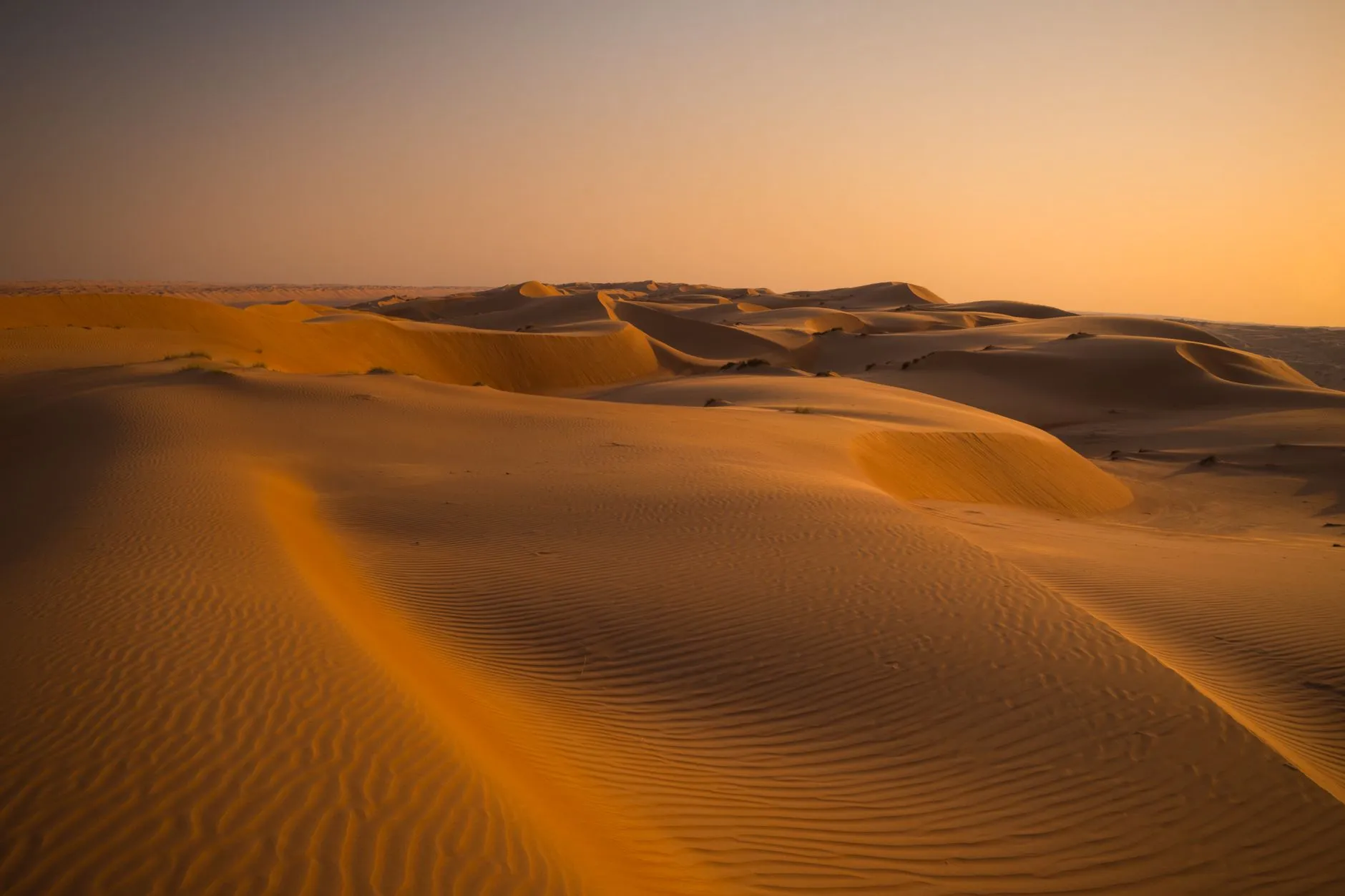
Then the Wahiba Sands (Sharqiya Sands). These are the real Arabian dunes — rolling apricot ridges that turn pink at dusk. You sleep at a desert camp, from simple Bedouin-style tents to genuinely plush ones with air-conditioning and pools; expect roughly €90–150 a night at the mid-range and €250-plus at the luxury camps, usually with dinner, a 4×4 transfer and activities thrown in. Do the sunset dune-bashing, the camel ride if you must, and above all stay up for the stargazing — with zero light pollution the Milky Way is absurd. Camps will collect you in a 4×4 from a meeting point near Bidiyah (around 20 OMR / ≈ €44 return), which is cheaper and saner than driving a hired 4×4 over soft sand yourself if you’re inexperienced.
Flash floods kill people in Oman’s wadis. A dry gorge can fill with deep, fast water in 20 minutes after rain you can’t even see upstream. Never camp in a wadi bed, never drive into flowing water across a road no matter how shallow it looks, and if rain is forecast in the mountains, stay out of the canyons. This is the single most important safety rule in the country.
The Mountains & Forts: Nizwa and the Interior
Inland Oman is the cultural core, and Nizwa is its old heart. The 17th-century Nizwa Fort — with its vast round tower built to repel cannon — is one of the country’s great buildings, and the adjoining souk is the best place to buy frankincense, silver khanjar daggers, pottery and dates. Time your trip so a Friday morning falls here: the Nizwa goat market is unmissable theatre, with owners parading livestock in a circle from about 7am while buyers bid from all sides. It’s loud, real, and free.
Above Nizwa rise the two great mountains. Jebel Akhdar — the “Green Mountain” — climbs to a high plateau where the cool altitude lets villages grow roses, pomegranates and apricots in terraces clinging to the slopes. The famous rose harvest is in spring. There’s a police checkpoint on the access road that turns back any vehicle that isn’t a 4×4, full stop — this is enforced, so don’t try it in a saloon car. Up top sit luxury cliff-edge resorts and the terraced villages of the Saiq plateau, plus gentle walks between abandoned hamlets.
Jebel Shams is the other beast — Oman’s highest peak at around 3,000 m and the rim of Wadi Ghul, the “Grand Canyon of Arabia,” with sheer drops of a kilometre. The signature hike is the W6 “Balcony Walk,” a roughly 6 km out-and-back trail carved into the cliff face with that vertiginous void beside you, ending at an abandoned village. The drive up from Nizwa takes around 90 minutes through Al Hamra, and the final 10 km or so is rough unpaved track best done in a 4×4.
While you’re here, detour to Misfat al Abriyeen, a 400-year-old mud-brick mountain village threaded with falaj irrigation channels and date plantations — wander the lanes and the oasis paths. And Bahla, with its huge UNESCO-listed mud fort, is an easy add-on. Birkat al Mauz, at the foot of Jebel Akhdar, is a lovely free sunset stop among palm groves and falaj channels.
Musandam & Salalah: The Two “Other Omans”
These two regions don’t fit a single trip with the rest, and that’s why they’re special.
Musandam is the peninsula at the very tip of Arabia, cut off from mainland Oman by the UAE — you reach it by driving north through Dubai and Ras al Khaimah to Khasab, not from Muscat. The draw is the fjords: limestone cliffs plunging straight into calm turquoise water, the kind of landscape that earned the “Norway of Arabia” nickname. The classic experience is a traditional dhow cruise — a wooden boat strung with carpets and cushions, usually a full day (around 10am–4pm) gliding through Khor Ash Sham, stopping to swim and snorkel at Telegraph Island, watching dolphins ride the bow, and lunching on Omani food aboard. Day cruises start from roughly €25–30 per person shared; half-days and private boats cost more. Many people do Musandam as a one-or-two-night add-on from Dubai rather than as part of an Oman loop.
Salalah and Dhofar are the deep south, and the headline is the Khareef — the only place in Arabia touched by the Indian Ocean monsoon. Roughly from late June through mid-September (officially around 21 June to 21 September in 2026), fog rolls in, waterfalls appear on cliffs that are bone-dry the rest of the year, and the hills turn an improbable, mist-soaked green. It is genuinely cool — low 20s°C — while the north hits the mid-40s, and it’s when Gulf tourists flood in for a structured festival season with scores of events. The greenest, most atmospheric weeks are mid-July to mid-August. Outside Khareef, Salalah is a hot but gorgeous winter beach-and-frankincense destination: Dhofar is the historic home of the frankincense trade (the ruins of the old port at Al Baleed and the frankincense trees of Wadi Dawkah are UNESCO sites), with empty white beaches and the dramatic edge of the Empty Quarter desert just inland.
Book Salalah early for Khareef. July–August is peak; flights and hotels sell out and prices spike, because half the Gulf has the same idea. And know what you’re signing up for: it’s drizzle, fog and mist, not blue sky — that’s the appeal, but it surprises people.
The Turtles at Ras al Jinz
On the easternmost point of the Arabian mainland, the Ras al Jinz Turtle Reserve protects the most important green-turtle nesting beach in the Indian Ocean — and it’s the only place in Oman where you can legally watch the turtles. Females haul ashore at night to dig nests and lay; at the right time of year you may also see hatchlings scrambling to the sea.
Visits are strictly by guided tour only, in two nightly sessions (around 9pm and 11pm), each capped at about 25 people. As of 2026 it’s roughly 7 OMR (≈ €15) per adult, less for children. Book ahead — sessions fill weeks in advance in peak nesting season (broadly summer, with a long window May–September) and on weekends year-round. There’s on-site accommodation in eco-tents and rooms that bundles the turtle viewing, which is the easy way to do it. Bring no flash photography — it disorients the turtles, and the guides enforce it.
It pairs naturally with the wadi-and-coast leg: many people do Wadi Shab, overnight near Sur or at the reserve, see the turtles, then head inland to the Wahiba Sands.
When to Visit: Month by Month
October to April is the answer for almost the whole country. Days are warm and sunny (mid-20s to mid-30s°C), nights are pleasant, rain is rare, and the wadis, mountains and desert are all comfortable. This is high season, and February is especially busy thanks to the Muscat Festival.
November to March is the prime window for hiking and wadi-swimming in the north — Wadi Shab and Jebel Shams are at their best. December and January nights get genuinely cold up on Jebel Akhdar and Jebel Shams, so pack a fleece for the mountains even though you’re in Arabia.
April and May are warm shoulder months — still fine for sightseeing, hot by midday, fewer crowds.
June to September is when the northern interior and desert become punishing — 40–48°C, with midday hiking flatly inadvisable. This is exactly when you flip the map and go south: it’s Khareef season in Salalah, the one time the deep south is the best place in the country to be. So summer isn’t a write-off — it just means Salalah, not Muscat.
Ramadan changes the rhythm. During the holy month (dates shift each year on the lunar calendar), eating, drinking and smoking in public during daylight is off-limits even for non-Muslims, many restaurants close until sunset, and alcohol service pauses. Travel is perfectly doable and the evenings are atmospheric — just plan around the daytime fast and dress extra-conservatively.
What to Eat & Drink
Omani food is gentle, fragrant and built around shared platters rather than fireworks. The dish to seek out is shuwa — lamb or goat marinated in a spice paste, wrapped in palm or banana leaves and slow-cooked in an underground pit for up to a day or two. It’s a celebration food (think Eid), so it’s not always on menus, but it’s the real thing when you find it. Everyday eating means majboos (Oman’s spiced, saffron-scented rice with chicken, lamb or fish — the Gulf cousin of kabsa), grilled fish on the coast, and mountains of fresh khubz flatbread with hummus and salad.
Two things you cannot leave without trying. Omani halwa is a sticky, almost translucent confection of date syrup or brown sugar, rosewater, saffron, ghee and nuts — dense, sweet and offered everywhere as a gesture of welcome. And kahwa, the cardamom-and-saffron coffee, always served with dates — the ritual of coffee-and-dates is the country’s handshake. Accept it; refusing is a small rudeness.
On alcohol: it’s legal but restricted. You’ll find it in licensed hotel bars and a handful of restaurants, but not in ordinary cafés or shops, and drinking in public is an offence — public drunkenness can mean a fine or even jail. Bring duty-free if you want a drink in your room, drink discreetly, and don’t expect a bar scene outside Muscat’s hotels. Tap water is generally safe in Muscat but most travellers stick to bottled, especially out in the regions.
Getting Around: The 4×4 Self-Drive Reality
Here’s the truth that shapes your whole trip: Oman is a self-drive country and there is no meaningful public transport for tourists. There are some intercity buses, but they don’t reach the wadis, the camps, the mountains or the trailheads. To see the country you either drive yourself or book private tours — and driving yourself is, for most people, the joy of an Oman trip. The highways are excellent and new, drivers are calm, signage is bilingual, and fuel is almost free — petrol runs around 0.23 OMR (≈ €0.50) a litre.
The real question is 2WD or 4×4. The honest answer: most of the greatest hits — Muscat, the Sur coast, Wadi Shab, Wadi Bani Khalid, Nizwa, Bahla, the Wahiba camp meeting points — are reachable in an ordinary 2WD car, which is roughly a third of the price of a 4×4 (think ≈ €35–45/day vs ≈ €65–75/day). A 4×4 becomes mandatory for a few specific places: Jebel Akhdar (enforced at the checkpoint), the rough final stretch up Jebel Shams, soft-sand driving inside the Wahiba Sands, and upper Wadi Tiwi.
The smart play for many travellers: hire a 2WD for the trip and pay for local 4×4 transfers to the handful of off-road spots — Wahiba camp transfers (~20 OMR), Wadi Tiwi (~10 OMR), Balad Sayt from Al Hamra (~25 OMR each way). It’s cheaper than a 4×4 for two weeks and you skip the stress of off-roading you’re not trained for. If you genuinely want to free-camp in the dunes and tackle the mountain tracks yourself, hire the 4×4 — but only if you’re a confident off-road driver, and never drive on soft sand alone without deflating tyres.
Carry water, fuel up early, and download offline maps. Distances between towns are long, stretches are empty, and while Oman’s 24-hour stations are surprisingly widespread, you don’t want to test the gap on the desert highway to Salalah. Always top up the tank when you can, keep several litres of drinking water in the car, and don’t rely on phone signal in the mountains.
Where to Stay — by Region & Budget
Match your bed to the region; this isn’t a one-hotel-fits-all country.
Muscat has the full range — international business hotels, characterful boutique guesthouses in the old town, and beach resorts west of the centre. Budget rooms start around €35–50, comfortable mid-range hotels sit around €80–130, and the headline resorts run well north of €200. One or two nights here is normal.
The Wahiba Sands is all about the desert camps, and a night here is a trip highlight — sleep in a Bedouin-style tent among the dunes, eat dinner under the stars, and wake to silence. Simple camps start around €60–90 per person; the polished ones with pools and air-conditioning run €150–250-plus, usually including dinner, breakfast, the 4×4 transfer and activities.
The interior mountains offer everything from modest hotels in Nizwa and Al Hamra to cliff-edge luxury resorts on Jebel Akhdar with infinity pools hanging over the canyon. Jebel Shams has a cluster of simple but well-placed mountain camps near the rim. Misfat al Abriyeen has charming village guesthouses.
The coast and turtles: stay at or near the Ras al Jinz reserve (which bundles the turtle tour) or in the old town of Sur. Musandam centres on Khasab; Salalah has its own beach hotels and resorts, which spike hard in price during Khareef.
Costs & Budget
Oman isn’t cheap, but it’s not Dubai-extravagant either — most of the spend is the car and the camps, not daily life.
- Budget-conscious (2WD car, simple guesthouses, local restaurants, self-guided wadis): roughly €55–80 per person per day.
- Mid-range (rental car, comfortable hotels, a desert camp, the odd guided tour): around €150–300 per day — the bracket most independent travellers land in.
- Luxury (4×4, cliff resorts, top desert camps, private guiding): €350+ per day.
Hotels average roughly €65 low-season and €120–135 peak. A rental car is your biggest fixed cost; a desert-camp night is the splurge worth keeping. Food is reasonable if you eat local — a meal at a simple Omani or Indian restaurant is a few euros — and fuel is so cheap it barely registers. Entry fees are small and humane: the wadis are a euro or two, Ras al Jinz around €15, museums modest. The one thing that can blow a budget is Salalah in Khareef, when flights and hotels surge with Gulf demand.
Practical Information
Entry & visa. 14-day visa-free for 100+ nationalities (most of Europe, UK, US, Canada, Australia, Japan); otherwise the ROP e-visa — 10-day for 5 OMR (≈ €11), 30-day for 20 OMR (≈ €44). Passport valid six months. Confirm your nationality’s exact terms on the official Royal Oman Police e-visa portal before travelling; the Dubai/UAE shared-entry route for Musandam in particular has its own conditions.
Money. The Omani rial (OMR) is one of the planet’s strongest currencies — about €2.20 to one rial, and it divides into 1,000 baisa, which trips people up. Cards work in cities and hotels; carry cash for wadis, souks, fuel and rural areas. ATMs are common in towns, scarce in the deep countryside.
Safety. Oman is exceptionally safe — low crime, stable, and consistently rated one of the easiest Gulf countries for solo and female travellers. The genuine dangers are environmental: flash floods in wadis, heat in summer, and off-road driving beyond your skill. Drive defensively, respect the weather, and you’ll be fine.
Dress & cultural respect. There’s no legal dress code for tourists, but modesty is expected and appreciated: shoulders and knees covered in towns, markets and villages. Women don’t need to cover their hair except in mosques (where hair, arms and legs must be covered — bring a scarf). Beachwear is fine at hotel pools and private beaches, not in public areas. Public displays of affection, loud behaviour and public drinking are frowned on and can draw fines.
Water & health. Tap water is generally safe in Muscat; bottled is the norm elsewhere. No special vaccinations beyond the routine. Travel insurance covering hiking and driving is sensible.
Tipping. Not obligatory but appreciated — round up taxis, leave 10% at restaurants that don’t add service, and tip guides and camp staff.
Connectivity. Buy a local Omani SIM (Omantel or Ooredoo) at the airport for cheap data — useful for offline maps and bookings. Coverage is good on highways and in towns, patchy in the mountains and deep desert.
Frequently Asked Questions
Cheapest Flights to Oman
We have tracked 149 fares to Oman from 43 cities. As of June 2026, here is what a good price looked like from each — the lowest fare we recorded, and a “great-deal” benchmark to judge a quote against. These are tracked observations, not live prices: by the time you read this they will have moved, so treat them as a yardstick, not a quote.
| From | Lowest fare we tracked | Great-deal benchmark |
|---|---|---|
| Bergamo (BGY) | €382 | €546 |
Recent deals we have posted to Oman:
These are fares aifly tracked to this destination, not live quotes — they have changed since and several of the deals above may have expired. Browse current flight deals →