The Red Sea — Complete Travel Guide 2026
Egypt’s mainland Red Sea coast is the cheapest place on Earth to fall in love with a coral reef — a strip of desert where 28°C summer water, a 365-day sun guarantee and a glut of all-inclusive beds collide. Get the area right and you get house-reef diving off your own jetty and dugongs grazing in seagrass; get it wrong and you get a beige buffet behind a wall, two hours by boat from anything worth seeing. The difference is entirely about where you point the taxi.
Quick Reference
Egypt’s Red Sea Riviera — the mainland coast, NOT Sinai/Sharm el-Sheikh
Hurghada (HRG) for the northern resorts; Marsa Alam (RMF) for the south
Egyptian pound (EGP), ~50 to the US dollar after the 2024 float
Arabic; English, German and Russian widely spoken in resorts
Egypt tourist visa — e-Visa (~€23) or visa-on-arrival sticker (€28)
March–May and September–November (warm sea, bearable heat, calm)
Year-round sun, some of the world’s best shore-and-reef diving, all-inclusive value
Hurghada/Makadi for value, El Gouna for polish, Sahl Hasheesh for quiet luxury, Marsa Alam for the reefs
Editor’s Note: One Decision Matters More Than the Rest
Forget the brochures’ endless resort names. The only choice that shapes your trip is north (fly HRG) or south (fly RMF) — and within that, whether you came to dive or to lie down.
The north — Hurghada and its satellites — is the lively, cheap, anything-goes hub: a real (scruffy) Egyptian town, hundreds of hotels, the best nightlife, the best value, and the most boats heading to the best-known sites. The catch is that the headline reefs (the Giftun islands, the El Gouna wrecks) are a boat ride away; the shoreline directly off many northern resorts is sandy and reef-poor, sometimes with a built jetty walking you out over dead ground.
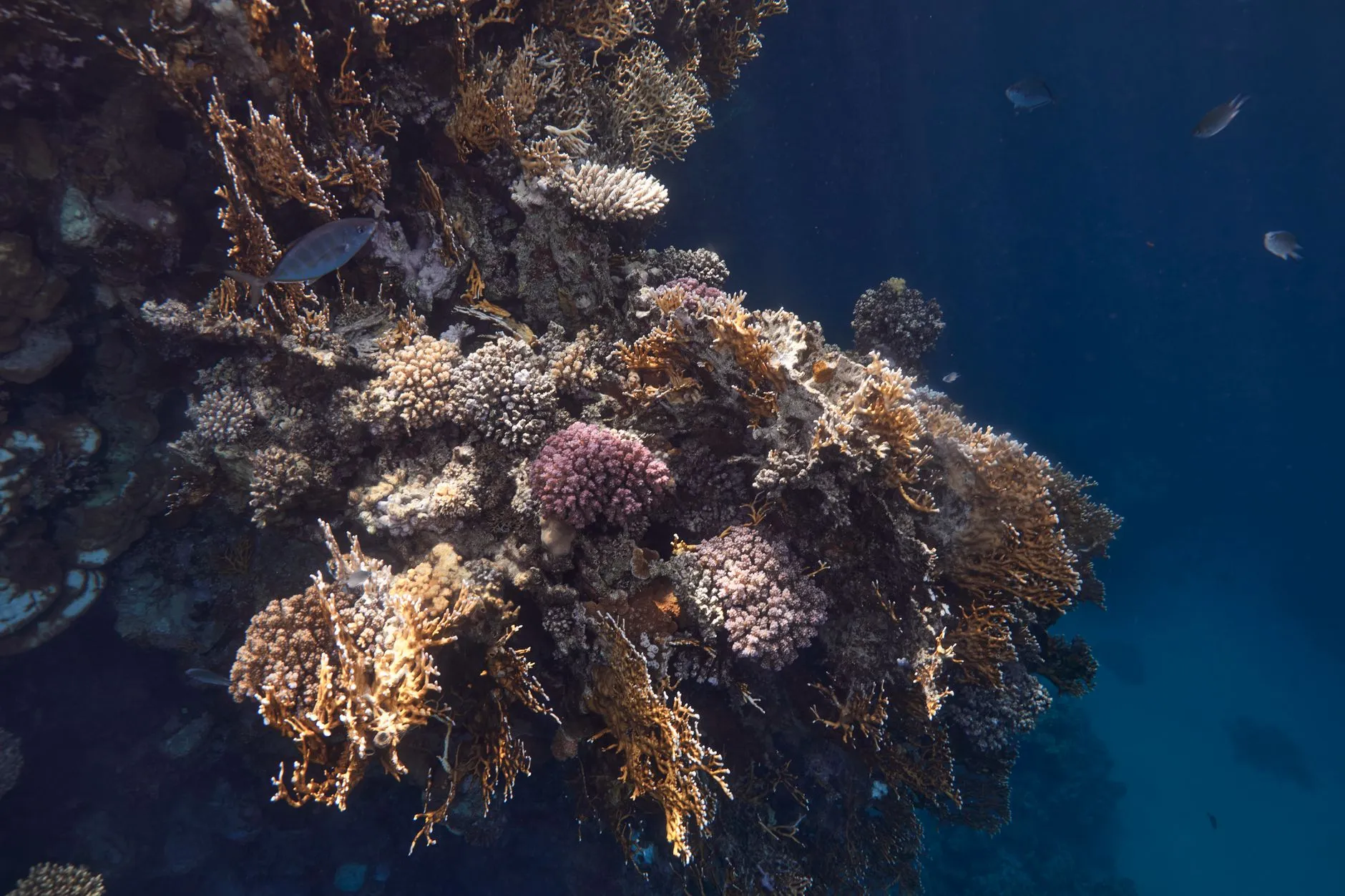
The south — Marsa Alam — is newer, emptier, more expensive per night, and built around one thing: reef you can walk into. The best southern resorts sit on their own pristine house reef, so your “dive site” is the end of the jetty. This is where independent divers and dive-club regulars go, and where the marine life is visibly healthier because fewer fins have churned it.
So: want a buzzy, bargain beach holiday with diving as a bonus → Hurghada/Makadi/Soma. Want polish and a lagoon-town vibe → El Gouna. Want quiet luxury on a good reef → Sahl Hasheesh. Came primarily to dive → Marsa Alam, full stop. Pick the wrong one and no amount of buffet will fix it.
The all-inclusive trap: most people book a Red Sea all-inclusive and never leave the gate. That’s fine for a week of pool-and-sea decompression — but you’ll eat industrial buffet food, snorkel a tired beach reef, and miss the actual Red Sea. Budget at least two days outside the wristband: one diving/snorkelling trip to a real reef, one excursion. Otherwise you flew to Egypt for a swim-up bar.
Should You Go? Who It’s For — and Who It Isn’t
Go if: you want guaranteed sun on a tight budget; you dive or snorkel, or want to learn cheaply; you want a winter-sun week where the sea is still swimmable; you have kids and want a fenced, sorted, food-included resort; you kitesurf (Soma Bay and El Gouna are world-class).
Think twice if: you’re a culture-first traveller. The Red Sea coast is a string of purpose-built resorts in the desert — there is no old town, no ruins, no soul beyond what you bring. Egypt’s history is 200km inland at Luxor, doable as a brutal long day trip but not as a base. If antiquities are why you’re flying to Egypt, the Red Sea is a bolt-on to a Nile/Cairo trip, not the trip itself.
Also reconsider if you need slick, Western-grade infrastructure: power blips, plumbing quirks, hard-sell touts and chaotic taxis are part of the deal. And if you loathe being upsold, the constant gentle hustle (excursions, tips, “special price my friend”) will wear on you.
Honest expectation: this is a tan-and-reef coast, not a cultural one. Manage your own expectations and it’s superb value. Arrive expecting Egyptian atmosphere and you’ll be staring at a swim-up bar wondering where the pyramids went.
Getting There: HRG vs RMF and the Transfer Reality
Two airports, and the right one depends entirely on your base.
Hurghada (HRG) is the big, busy gateway — direct charters and scheduled flights from across Europe, and the airport for Hurghada itself (15–20 min), El Gouna (~30–40 min north), Sahl Hasheesh, Makadi Bay and Soma Bay (all 20–60 min south). It’s the cheaper, higher-frequency airport.
Marsa Alam (RMF) is the small southern airport, ~60km north of Marsa Alam town. Port Ghalib — the purpose-built marina resort cluster — is barely 5–10 min away; most southern dive resorts are a 20–60 min transfer, and the deep-south house-reef villages (Marsa Shagra, Abu Dabbab) run 30–60 min. RMF has fewer flights and can be pricier to reach, but it puts you on the good reefs without a long northern transfer.
Don’t fly into HRG for a Marsa Alam resort: it’s a 3–4 hour drive south. Match the airport to the area or you’ll spend your first afternoon in a minibus.
Book the transfer in advance. There is no Uber-grade arrivals system and no useful airport bus to the resorts. Pre-book a transfer through your hotel or a reputable transfer company, or you’ll negotiate with airport taxi drivers at a disadvantage with luggage and jet lag. A pre-booked private car removes the single most common arrival headache.
(Flight fares swing wildly by season and source — check current prices rather than trusting any quoted figure.)
Where to Base: An Honest Area-by-Area
Hurghada (north). The original, the biggest, the cheapest, the liveliest. A genuine working town (El Dahar is the old quarter, Sekalla/Marina the touristy strip) wrapped in resort sprawl. Best for nightlife, cheap eats, shopping, value, and the most excursion choice. Downsides: scruffy in parts, hard-sell touts, and many beachfront reefs are mediocre — the good diving is by boat. Best for first-timers, budget travellers, groups who want a buzz.
El Gouna (north, ~20km up the coast). The polished one — a privately developed lagoon town of villas, marinas and bridges, nicknamed the “Venice of the Red Sea.” Clean, walkable, low-hassle (no touts inside the town), with real restaurants, bars and a marina scene. It feels more like a stylish European resort than Egypt, for better and worse. Pricier, but the upscale-without-stuffy sweet spot. Best for couples, families wanting calm, and kitesurfers (Mangroovy Beach).
Sahl Hasheesh (north-south, ~20min south of HRG). Quiet luxury in a big horseshoe bay: refined 5-star resorts, the area’s best shore-accessible reefs, manicured promenade. Less to do outside the hotels — this is a switch-off-and-stay bay, not a town. Best for couples and anyone who wants the best reef-and-beach combo without compromise, and doesn’t need nightlife.
Makadi Bay (south of HRG). A self-contained cluster of mid-to-large all-inclusives on a good bay — solid family value, decent house reefs at the better properties, but nothing outside the resort gates. You come for the wristband, the pool, and a reef off the beach. Best for families chasing price-per-night.
Soma Bay (further south). A luxury peninsula built around watersports and a championship golf course — and one of the planet’s premier kite/windsurf spots thanks to its consistent wind. Higher-end and isolated (you stay put). Best for kitesurfers, golfers and sporty luxury.
Marsa Alam (the south). Newer, quieter, lower-rise, reef-first. Port Ghalib is the marina hub with restaurants and dive-boat desks; further south, dedicated dive villages (Marsa Shagra, Abu Dabbab) put you on a house reef so good your “dive trip” is the jetty. Fewer crowds, healthier coral, the dugong-and-turtle sites (Marsa Mubarak, Abu Dabbab), and the springboard to the legendary offshore reefs. The trade-off: less nightlife, fewer non-diving distractions, and beach entries that can be awkward in swell. Best for divers, snorkellers, and anyone who’d rather see a turtle than a foam party.
Diving and Snorkelling: The Real Reason to Come
This coast is one of diving’s great bargains — warm, clear, biodiverse, and cheap. A two-dive boat day runs from roughly €45–75; a 7-day package can drop the per-dive cost under €18; an open-water course is a fraction of Caribbean or Asian prices.
Hurghada / El Gouna (north). Beginner-friendly territory: dozens of sheltered reefs in shallow, calm bays, plus the famous Sha’ab Abu Nuhas wreck cluster (four cargo ships on one reef) and the El Gouna wrecks for the more advanced. The downside is volume — popular sites see a lot of boats and a lot of fins.
The Giftun islands. Hurghada’s marine national park (Egypt’s first, established 1986) — 14km² of protected reef, Orange Bay’s postcard sandbar, and the standard day-trip snorkel/dive destination from the north. Beautiful, but busy; go on a smaller, earlier boat if you can.
Marsa Alam (south). The serious reef coast: pristine house reefs you walk into, wall dives with current and big-fish potential, and the marquee offshore sites. Elphinstone — a sheer reef pinnacle with sharks and dramatic drop-offs — is the day-boat icon (advanced, current-sensitive). For the truly remote stuff (the Brothers, Daedalus, Fury Shoals), you need a liveaboard.
Liveaboards. The Red Sea is a liveaboard heartland. The classic “Deep South / Shark Golden Triangle” route (Brothers, Daedalus, Elphinstone) departs Marsa Alam, often weekly, from around €750 for the week including most fees — the only way to reach the offshore reefs and the best chance at hammerheads, oceanic whitetips and thresher sharks. Wreck-focused northern routes (Thistlegorm, Abu Nuhas) run from Hurghada.
Snorkellers and freedivers are well served: house reefs, Giftun, and especially Abu Dabbab near Marsa Alam — a shallow seagrass bay that’s one of the best places on Earth to snorkel with dugongs and green turtles. Marsa Mubarak adds more turtle-and-dugong odds.
Marine-park fees are cash, and they went up. Offshore sites (Elphinstone, the Brothers, Daedalus) carry park fees of roughly €9–€23 per dive/day, and on 13 June 2026 the Red Sea environmental dive fees rose again (around €9/day for day diving). Operators collect this in cash (USD or EUR) at the marina and rarely include it in the web price. Bring small cash dollars/euros for fees and tips — don’t assume the headline package covers everything.
Don’t touch the coral, and ditch the chemical sunscreen. A single careless fin-kick or hand-steady on the reef kills decades of growth, and oxybenzone sunscreens bleach coral. Use a reef-safe (mineral) sunscreen or, better, cover up with a rash vest. The Red Sea’s reefs are recovering from years of mass tourism — be the diver who leaves them alone.
The Beaches and the Sea
The selling point is the water: warm, startlingly clear, and a colour scale from turquoise to deep blue that genuinely lives up to the photos. The beaches themselves are man-made or man-improved sand in front of the resorts — pleasant, not wild — and the magic is what’s under the surface a few metres out.
Quality varies hugely by area. Sahl Hasheesh and the better Marsa Alam resorts have genuine living reef straight off the beach. Much of central Hurghada and Makadi is sandy with the reef reached by boat or by a long built jetty out to a reef edge. El Gouna‘s lagoons are calm and family-perfect but reef-light at the town beaches.
Two practical notes: this is not a Caribbean/Mexico coast — there’s no sargassum seaweed problem here. And winter (Dec–Feb) brings stronger wind and choppier seas, especially around Hurghada, which can cancel boat trips and chill the (still-swimmable) water. Seasonal jellyfish blooms occasionally appear; check locally and wear a rash vest if they’re around.
Beyond the Resort: Desert and the Luxor Day Trip
The desert. Behind the coast is the Eastern Desert and the Bedouin excursion circuit: quad bikes, camel rides, a “Bedouin village” dinner, stargazing. These are touristy and stage-managed — fun for kids and first-timers, kitsch for everyone else — but the desert sunset is real and worth one evening.
Luxor — the big one. The single excursion worth real effort. Luxor (the Valley of the Kings, Karnak, Hatshepsut’s temple) is the densest concentration of ancient Egypt on Earth, and it’s ~290km / 4–5 hours each way from the Hurghada area. That means a 4–5am pickup and a 14–16 hour day, much of it in a bus. It is genuinely worth it if you’ll otherwise never see ancient Egypt — but go in with eyes open: it’s long, hot, and rushed, and a single day barely scratches Luxor.
If antiquities matter to you, don’t do Luxor as a day trip — go properly. Far better to fly into the Red Sea and spend two nights in Luxor (or pair the coast with a separate Nile/Cairo leg) than to compress the greatest open-air museum in the world into a sweaty 16-hour coach marathon. The day trip is a “better than nothing” compromise, not the right way to see it.
When to Visit: Month by Month
The headline: sun is guaranteed every month. What changes is heat, wind, and sea temperature.
March–May (spring — prime): the sweet spot. Air in the high-20s/low-30s°C, sea warming from ~22°C to ~26°C, calm-ish seas, fewer crowds, good prices. The best all-round window for diving and lounging.
June–August (summer — brutal): very hot — Hurghada regularly hits 38–40°C+, Marsa Alam a touch milder. The sea is at its warmest (28–30°C, bath-like and brilliant for long water days), but midday on land is punishing. Great for water-obsessed travellers and divers who don’t care about beach lounging; hard if you wilt in heat. Marsa Alam’s slightly lower extremes and warmer sea make it the better summer pick.
September–November (autumn — also prime): arguably the best of all. The land heat eases, the sea is still warm (~28°C falling to ~25°C), seas are calm and crowds thin. October is many regulars’ favourite month.
December–February (winter — sun, but bring a layer): the winter-sun season. Days are pleasant (low-20s°C) and sunny, but evenings are genuinely cool, the wind picks up (especially Hurghada), seas get choppy enough to cancel boats, and the sea cools to ~22°C — swimmable but bracing. Marsa Alam runs slightly warmer and calmer; it’s the better winter base. Pack a fleece for the evenings — the desert night surprises people.
What to Eat
Here’s the honest bit: most visitors eat all-inclusive buffet, and most all-inclusive buffet is fine-but-forgettable — high-volume international catering tuned for German, Russian and British palates. The food Egypt eats is outside the gate.
Go find the real stuff. Koshari — the national dish, a carby riot of rice, lentils, chickpeas, macaroni, crispy fried onions and a tangy tomato-vinegar-garlic sauce — costs €1–2 a bowl in a town koshari shop and is genuinely delicious. Ful medames (slow-cooked fava beans) and ta’ameya (Egyptian falafel) are the breakfast staples. And given where you are: fresh Red Sea seafood — grouper, snapper, calamari, shrimp, mullet — grilled simply, is the meal to seek out.
For real food: El Dahar (downtown Hurghada) for cheap authentic Egyptian; the Marina and old fishing-port areas for seafood you pick off the ice. El Gouna has a genuinely good independent restaurant scene (the one place on the coast where dining out is a pleasure rather than a hunt). A local meal runs €5–10; mid-range €15–25; street food €1–3.
Pick your seafood off the ice. At the fish places in Dahar and the marinas you choose your fish from the display and they grill it on the spot — fresh, cheap, and the best meal you’ll eat all week. Avoid anywhere that won’t show you the catch.
Getting Around
This is the coast’s weak spot: there is no cheap public transport worth using. No metro, no useful tourist bus network between resorts, no Uber-equivalent you can rely on for hops. You move by:
- Resort transfers — pre-booked, airport-to-hotel, the sane default.
- Taxis — plentiful but unmetered; you must agree the fare before getting in, and the opening price is always inflated. Haggle to roughly half the first quote.
- Excursion buses — the way you’ll reach Luxor, Giftun, the desert: booked through your hotel or an operator, door-to-door.
- Hotel shuttles — some larger complexes run internal buggies/shuttles; between resorts, you’re back to taxis.
In El Gouna you can walk and use the town’s tuk-tuks/shuttles; everywhere else, distances and desert heat make walking a non-starter beyond the resort strip.
Agree every taxi fare before you sit down. Meters don’t exist in practice and the first quote is a tourist price. Settle the number first, in EGP, and have small notes ready — drivers “never have change” for a big bill. If it feels wrong, walk; there’s always another taxi.
Where to Stay: By Area and Budget
The Red Sea is the land of the all-inclusive, and the tiers are clear:
- Budget all-inclusive (Hurghada, Makadi): big 4-star complexes at remarkable per-night prices — pool, beach, buffet, animation team. Cheerful and cheap; don’t expect culinary or design finesse.
- Mid/upper all-inclusive (Sahl Hasheesh, Soma Bay, Makadi 5-stars): better food, nicer beaches, real reef, more space. The value sweet spot for couples and families who want comfort without splurging.
- Luxury (Sahl Hasheesh, Soma Bay, El Gouna): genuine 5-star resorts and the El Gouna boutiques — design-led, à la carte dining, top reef and spa. Still cheap by European luxury standards.
- Dive resorts (Marsa Alam): the specialist play — house-reef villages (Marsa Shagra and the deep-south camps) and dive-focused hotels where the package is built around unlimited shore diving, not the buffet. Simpler rooms, serious reef.
- El Gouna boutique/villa: the coast’s most stylish independent stays, in a walkable town with real restaurants — the antidote to the all-inclusive wristband.
Match the property to the area’s character: a luxury label in central Hurghada still sits in a scruffy, hassly town; a simple dive camp in Marsa Alam sits on a world-class reef. Location beats star rating here.
Costs and Budget
The Red Sea is cheap, and the 2024 pound float made it cheaper still for foreign-currency visitors (see Practical Info). A week’s all-inclusive can be staggeringly good value; once there, your spending is excursions, diving, tips and the odd meal out.
Rough on-the-ground costs: a koshari bowl €1–2; a local sit-down meal €5–10; a mid-range dinner €15–25; a beer €2–4; a two-dive boat day €45–75; a Luxor day trip from ~€40–60pp; marine-park fees €9–€23 cash per offshore dive. Excursions and diving are where the money goes — the holiday itself is bargain-priced.
Baksheesh is not optional — it’s the system. Tipping (baksheesh) oils everything in Egypt: small notes for the porter, the housekeeper, the toilet attendant, the boat crew, the guide; ~10–12% in restaurants that don’t add service. Wages are low and tips are expected income, not a bonus. Arrive with a thick wad of small EGP notes and budget for daily tipping — it’s modest money and it transforms the service. Refusing to tip marks you as the difficult tourist.
Practical Information
Entry — visa. Most visitors (UK, EU, US, Canada, Australia and many more) need a tourist visa. Two routes: the e-Visa at the official portal visa2egypt.gov.eg (single-entry ~€23, valid 3 months, 30-day stay; apply ~a week ahead, processes in a few business days), or the visa-on-arrival sticker bought from an airport bank kiosk before the immigration desk — note this was raised to €28 on 1 March 2026. Your passport must be valid 6+ months. Important distinction: the free 15-day “Sinai-only” permit applies to Sharm el-Sheikh/Dahab on the Sinai peninsula — NOT the Hurghada/Marsa Alam mainland coast, where you need the full visa. (Always confirm current rules for your nationality before flying.)
Money — the EGP situation. Egypt floated the pound in 2024; it lost a huge share of its value and now trades around 49–54 to the US dollar (roughly 50 in mid-2026) after stabilising. For foreign-currency visitors that means Egypt is cheaper than it’s been in years. Carry cash USD or EUR for visa fees, marine-park fees and tips; use EGP for taxis, shops and town meals. Cards work in resorts and bigger places but cash rules everywhere else; ATMs are available but can run dry or cap withdrawals.
Safety. The Red Sea resorts are heavily policed and statistically safe; the usual risks are road accidents, hard-sell touts, and water/boat safety, not crime. Follow government travel advice (some inland desert/border zones carry warnings) and stick to organised excursions for the long inland trips.
Water. Don’t drink the tap water. Bottled water only — and it’s dirt cheap. Resorts provide it; carry a bottle for excursions. Be wary of ice and raw salads outside reputable places to avoid the classic upset stomach.
Tipping/baksheesh. As above — it’s woven into daily life. Budget for it; carry small notes.
Connectivity. Resort and town Wi-Fi is widespread (variable speed). For reliable data, a local eSIM or SIM (Vodafone, Orange, Etisalat) is cheap and easy — handy for maps, transfers and the inevitable “where’s our boat” moments.
Health. No mandatory vaccinations for most travellers, but check current advice; bring sun protection (the sun is fierce year-round), motion-sickness tablets for boat days, and your own medications.
Frequently Asked Questions
Cheapest Flights to The Red Sea
We have tracked 313 fares to The Red Sea from 39 cities. As of June 2026, here is what a good price looked like from each — the lowest fare we recorded, and a “great-deal” benchmark to judge a quote against. These are tracked observations, not live prices: by the time you read this they will have moved, so treat them as a yardstick, not a quote.
| From | Lowest fare we tracked | Great-deal benchmark |
|---|---|---|
| Naples (NAP) | €60 | €86 |
| Nuremberg (NUE) | €72 | €103 |
| Istanbul (SAW) | €90 | €128 |
| Kayseri (ASR) | €102 | €146 |
| Tallinn (TLL) | €110 | €157 |
| Brno (BRQ) | €113 | €162 |
| Hanover (HAJ) | €116 | €166 |
| Salzburg (SZG) | €127 | €181 |
| Prague (PRG) | €133 | €190 |
| Larnaca (LCA) | €151 | €216 |
| Konya (KYA) | €151 | €216 |
| Dalaman (DLM) | €158 | €226 |
| Helsinki (HEL) | €160 | €228 |
| Hamburg (HAM) | €167 | €312 |
Recent deals we have posted to The Red Sea:
- Katowice / Poznan / Warsaw to Marsa Alam, Egypt from €176
- Washington DC to Hurghada, Egypt from $548
These are fares aifly tracked to this destination, not live quotes — they have changed since and several of the deals above may have expired. Browse current flight deals →