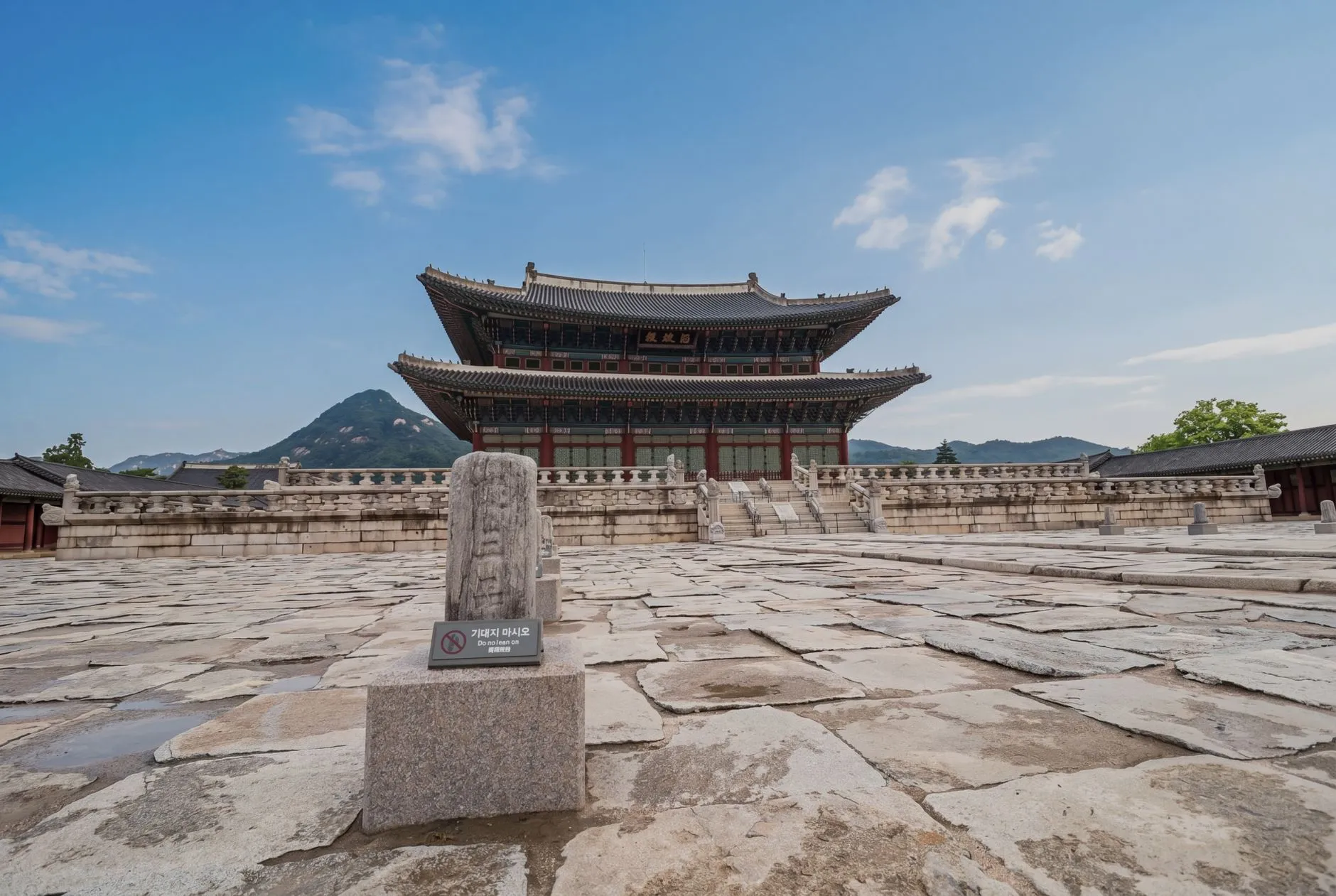
South Korea — Complete Travel Guide 2026
South Korea is the most underrated major destination in Asia, and the reason is simple: it spent thirty years standing next to Japan and getting compared unfavourably to it, when in fact it is louder, cheaper, spicier, friendlier and — once you leave Seoul — far stranger and more rewarding than first-timers expect. The mistake almost everyone makes is treating the country as a Seoul city-break with maybe a day-trip to the border. Do that and you’ll have a perfectly good time and miss the actual country. This guide is an argument for getting on the train.
Quick Reference
East Asia, a mountainous peninsula south of the DMZ, between the Yellow Sea and the Sea of Japan
Incheon (ICN) — the big international gateway; Gimpo (GMP) — Seoul’s domestic + short-haul hub; Busan Gimhae (PUS); Jeju (CJU)
South Korean won (KRW). Roughly €1 ≈ ₩1,750 in mid-2026
Korean. English is decent in Seoul and Busan tourist zones and thin to nonexistent elsewhere
Visa-free for 67 nationalities; K-ETA exemption extended through 31 Dec 2026; mandatory e-Arrival Card from Jan 2026; Jeju has its own separate 30-day visa-free rule
Late March–April (cherry blossom) and October–early November (autumn foliage). Avoid the July monsoon
Korean food, 24-hour cities, K-everything, temple stays, Silla tombs, hiking, the world’s tensest border
Seoul first, then split your nights between Busan and at least one of Gyeongju, Jeonju or Jeju — don’t make Seoul your whole trip
Editor’s Note: Stop Comparing It to Japan
I’ve lost count of how many travellers have told me, before a first trip, that they were “doing Korea instead of Japan” or “as well as Japan” — as if it were the understudy. It isn’t, and the comparison does Korea a disservice. Japan rewards quiet reverence; Korea rewards appetite. Korea is a country that eats late, drinks hard, hikes in full North Face regalia at seventy, and rebuilds its cities every fifteen years. It is brasher and more emotional and, frankly, more fun.
It is also genuinely cheaper. A bowl of food that costs you €12 in Tokyo costs €6 in Jeonju. A bullet train the length of the country is around €34, not €100-plus. And because Korea is a fraction of the size — you can cross it by train in under three hours — you can actually see several distinct places in ten days without the constant packing-and-unpacking that a Japan itinerary demands.
The catch, and I’ll be honest about it throughout, is that Korea makes you work a little harder. English drops off a cliff the moment you leave the capital and Busan. The famous DMZ tour is sobering homework, not a spectacle. The summer is a hot, wet, mildewy monsoon that will make you regret a July booking. And Seoul’s gravity is so strong that most visitors never escape it. The whole point of this guide is to get you past those frictions, because on the other side is one of the most distinctive countries you can fly to.
💡 The single best decision you can make is to give Seoul three or four nights — not seven — and spend the rest of your trip somewhere else. The travellers who come back raving about Korea are almost always the ones who left the capital.
Should You Go? Who It’s For — and Who It Isn’t
Go if you love food above almost everything, if you like cities with energy and grit, if you want history that is genuinely ancient (the Silla tombs at Gyeongju predate most of what survives in Europe), if you enjoy mountains and hot baths and night markets, and if a language barrier reads to you as an adventure rather than a stress. Go if you’re a hiker — Korea is 70% mountains and the trail culture is a religion. Go if you’re a K-drama or K-pop person and want to see where it all actually happens, but build a real trip around it.
Think twice if you need beach-resort ease and English everywhere — that’s not Korea outside a couple of pockets. Think twice if you can only travel in July or August, because you’ll be fighting monsoon rain and 90% humidity. And think twice if your idea of a great holiday is total quiet and minimalism; Korea is rarely quiet, and that’s the joy of it for some people and the deal-breaker for others.
It works brilliantly for solo travellers (it is one of the safest countries on earth, and eating alone is normal here in a way it isn’t in much of Asia), for couples, and for friends who want to drink and eat their way through a city. It is a harder sell for very young kids over a long trip — the distances are short but the pace is urban and intense.
The Entry Maze: K-ETA, the e-Arrival Card, and Jeju’s Loophole
Korea changed its entry rules in ways that confuse almost everyone in 2026, so read this carefully — it’s the one part of the trip you genuinely cannot wing.
The K-ETA waiver still stands. South Korea has temporarily suspended its K-ETA (Korea Electronic Travel Authorisation) requirement for 67 visa-free nationalities — including the UK, every EU country, Australia, New Zealand, the US, Canada and Singapore — and that suspension has been extended through 31 December 2026. So for most readers of this guide, you do not need to apply for a K-ETA in 2026. The waiver is currently set to lapse at the end of 2026, after which the K-ETA returns, so check again if you’re travelling in 2027.
But the e-Arrival Card is now mandatory. As of 1 January 2026, Korea replaced the old paper disembarkation card with a digital e-Arrival Card that every foreign visitor must complete online, within three days before arrival, via the official portal (e-arrivalcard.go.kr). It takes a few minutes — passport details, your first night’s accommodation address, your dates — and you’ll want to do it before you fly so you’re not hunting for hotel addresses in the arrivals hall.
Here’s the wrinkle worth knowing: if you voluntarily hold a valid K-ETA, you’re exempt from the e-Arrival Card. The K-ETA costs ₩10,000 (about €6) and is valid for multiple entries over several years. So if you visit Korea often, paying for the optional K-ETA can be the more convenient long-game move — one application, no per-trip arrival form. For a one-off trip, just do the free e-Arrival Card and move on.
⚠️ Do not confuse the e-Arrival Card with the old “Q-code” health declaration — that COVID-era requirement is gone for general tourists. The thing you must fill in now is the e-Arrival Card, and only if you don’t hold a K-ETA. Fill it in the day before you fly.
Jeju is its own country, entry-wise. Jeju Island runs a separate, far more generous visa-free regime: most nationalities — over 100 of them, including many that would normally need a Korean visa — can enter Jeju visa-free for up to 30 days. The crucial condition is that you arrive on a direct international flight into Jeju (CJU) with no stopover on the mainland, and that the waiver covers Jeju only — fly onward to Seoul or Busan and you’re back under mainland rules. For most Western travellers this is academic (you’re visa-exempt anyway), but it’s why you’ll see Jeju marketed so heavily to nationalities who can’t easily get into mainland Korea.
Bring a passport with six months’ validity, an onward ticket, and you’re set.
Getting There and Around: The KTX Changes Everything
Almost everyone flies into Incheon (ICN), regularly rated the world’s best airport and a genuinely pleasant place to land. It sits west of Seoul, and the cleanest way into the city is the AREX airport railroad: the all-stop train to Seoul Station runs about €4 and takes roughly an hour; the express is faster and a little dearer. A taxi into central Seoul will run €55–70 and take longer in traffic — skip it unless you land at 3am. Korea’s other Seoul airport, Gimpo (GMP), handles domestic flights and a handful of short-haul international routes and is much closer to the city; if you’re connecting onward to Jeju or Busan you may well use it.
Once you’re in, the thing to understand is that the KTX bullet train makes the whole country a series of day-or-two trips from each other. Seoul to Busan, end to end, is about 2 hours 40 minutes for roughly €34. Seoul to Gyeongju (Singyeongju station) is around two hours. Jeonju is under two hours. This is the structural fact that should shape your itinerary: you do not need to “base everywhere,” because nothing is far. Book KTX seats a day or two ahead in peak season via the Korail app or at any station machine.
In the cities, get a T-money card the moment you land — buy one at any convenience store or station machine for a couple of euros, load it with cash, and it pays for every subway, bus and most taxis nationwide. Seoul and Busan have superb, cheap, clean metros (a single ride is about €0.85). Taxis are inexpensive and honest; hail them with the Kakao T app, which works even with zero Korean.
💡 One absolutely essential bit of prep: Google Maps does not work properly for walking or transit directions in South Korea — the government restricts mapping data. Download Naver Map or KakaoMap before you arrive and use them for everything. This single tip will save you more frustration than anything else in this guide.
For Jeju, you fly — the Gimpo–Jeju air route is one of the busiest in the world, with budget carriers running it like a bus service for €30–60 one way and about an hour in the air. There are also overnight ferries, but the flight is so cheap and quick that the ferry is for people who specifically want the slow sea crossing.
Seoul, Briefly — Then Get Out
I’m going to keep this deliberately short, because aifly has a full Seoul city guide and because the entire thesis of this guide is that Seoul should be the start of your trip, not the whole of it.
Give it three or four nights. Do the obvious-but-genuinely-worth-it things: Gyeongbokgung palace (go at the 10am or 1pm guard-changing ceremony, and rent a hanbok to get in free), the Bukchon Hanok Village lanes early before the crowds, the markets at Gwangjang (eat the mung-bean pancakes and the seaweed-rolled “mayak” gimbap), a night out in Hongdae or the quieter wine-and-jazz bars of Euljiro, and the view from Bukhansan or Namsan at dusk. Hit one palace, one market, one mountain, one night district, and you’ve got the measure of the place.
What I’d push back on is the instinct to spend a week ticking off every Seoul neighbourhood. The city is endless and you could, but you’d be trading away Gyeongju’s tombs and Busan’s seafood and Jeonju’s makgeolli alleys for your fourth department-store food hall. Seoul is the prologue. The rest of the country is the book.
Busan: The Case for Korea’s Second City
If you do one thing this guide convinces you of, make it Busan. Korea’s second city is everything Seoul is — dense, fast, brilliant to eat in — wrapped around a coastline, with a salt-air looseness the capital doesn’t have. It’s where Koreans themselves go on holiday, and that tells you something.
The postcard is Gamcheon Culture Village, a hillside of painted houses tumbling toward the sea — undeniably pretty, undeniably Instagrammed to death, and worth an early-morning hour before the tour buses. But the real Busan is elsewhere: the staggering sprawl of Jagalchi Fish Market, Korea’s largest, where you pick your seafood downstairs and have it cooked upstairs; the temple of Haedong Yonggungsa clinging to the rocks above the waves (rare for a Korean temple, which usually hide in mountains); and the beaches at Haeundae and the more local Gwangalli, where the night view of the illuminated Diamond Bridge over a plate of grilled shellfish and a bottle of soju is one of the great cheap pleasures of Korean travel.
Busan also has the country’s best raw-fish culture (hoe), a thriving specialty-coffee scene around Jeonpo, and the slightly faded glamour of being the host of Asia’s biggest film festival. It’s two hours forty from Seoul and an entirely different mood. Two nights minimum; three if you can.
💡 Time a Busan trip for the Jagalchi area at dusk and eat dinner at the market: choose a fish, agree a price, and have it sliced for sashimi or grilled at one of the upstairs stalls. It’s theatre and a great meal for around €15–20 a head.
Gyeongju: The Museum Without Walls
Gyeongju is the single most under-visited great destination in Korea, and I’d put it near the top of any first itinerary. For nearly a thousand years it was the capital of the Silla kingdom, and the result is a small, low-rise city where you cycle between grassy royal burial mounds the size of hills, sitting incongruously between coffee shops and car parks. The locals call it “the museum without walls,” and for once the marketing is right — history here isn’t fenced off, it’s the landscape.
The unmissables: the Daereungwon tomb complex, where you can walk among (and into one of) the great Silla mounds; Cheomseongdae, a stubby stone tower that is the oldest surviving astronomical observatory in East Asia; and the lily-padded pond and reconstructed pavilions of Donggung Palace and Wolji (the old Anapji), which are floodlit and reflected in the water after dark — go at night, it’s the best free sight in the country. Out of town, the UNESCO double-act of Bulguksa temple and the Seokguram grotto Buddha repays the trip up the mountain.
Gyeongju is flat, compact and made for a rented bike, and the food-and-café strip of Hwangnidan-gil has given it a young energy it didn’t have a decade ago. Two nights here, slow-paced, is one of the most rewarding things you can do in Korea — and almost no first-timer does it.
Jeonju: Hanok Roofs and the Food Capital
Jeonju is where you go to eat. It is Korea’s officially designated City of Gastronomy, the birthplace of bibimbap, and home to the country’s largest preserved hanok village — some 800 traditional tiled-roof houses, many of them now guesthouses, tea rooms and restaurants. Stay the night inside the village in a hanok (€50–120 depending on grade) for the full effect: sleeping on a heated ondol floor, sliding-paper doors, a courtyard.
The bibimbap here is the real thing — a brass bowl of rice, raw beef or vegetables, a slick of chili paste and a raw egg, all mixed at the table — and you should eat it where it was perfected. But Jeonju’s deeper pleasure is its makgeolli alleys, where you order a kettle of the cloudy rice wine and an avalanche of free side dishes arrives to soak it up; the more kettles you order, the more lavish the food. It is one of the great-value nights out in Asia. Add the fermented-food culture (Jeonju is serious about its jang — the soybean pastes that underpin Korean cooking), the street snacks around the village (the PNB choco pie is a local cult), and you have a city you visit principally with your mouth.
Jeonju is an easy detour off the Seoul–Busan spine and pairs naturally with Gyeongju if you want a couple of days of slower, deeper Korea between the two big cities.
Jeju: Korea’s Hawaii, Honestly Assessed
Jeju gets billed as Korea’s Hawaii, and I want to be straight with you about it, because it’s the destination most likely to under- or over-deliver depending on what you expect.
The good: it’s a genuinely beautiful volcanic island. Hallasan, a shield volcano and South Korea’s highest peak at 1,947m, anchors the centre; the sunrise crater of Seongsan Ilchulbong rises out of the sea on the east coast; the Olle walking trails thread the entire coastline; and the island’s haenyeo — the elderly women free-divers who harvest seafood by breath-hold, a UNESCO-listed culture — are the real, vanishing soul of the place. The food is a highlight in its own right: black pork barbecue from the island’s heritage pigs, and abalone and sea urchin straight from the haenyeo.
The honest part: Jeju is Korea’s domestic honeymoon-and-package island, and large stretches of it are heavily developed — theme parks, “love land,” coach-tour gift complexes, traffic. It can feel tacky in the centre and the resort strips, and the weather is famously fickle (it can be socked in with cloud when the mainland is glorious). Jeju rewards a car and a plan: rent a vehicle (you’ll want an International Driving Permit), base yourself away from the package zones, walk an Olle trail, climb to a crater, eat the black pork, and skip the manufactured attractions. Done that way it’s wonderful. Done as a tour-bus tick-list, it’s the most disappointing place in Korea. Three or four nights if you commit to it; skip it entirely on a first ten-day trip if your time is tight — the mainland is more distinctive.
⚠️ Don’t bolt Jeju onto a short trip just because it sounds exotic. A rushed two nights of package-Jeju is worse than a third night in Gyeongju. Either give it the time and a rental car, or leave it for next time.
The Slow Country: Andong, Hahoe, and a Night in a Temple
This is the Korea that almost no foreign visitor sees, and it’s the most quietly memorable. Inland from the cities, the country slows to a Confucian hush.
Andong is the keeper of Korea’s traditional soul: the home of the country’s most famous soju (here it’s a strong, clear distilled spirit, not the cheap green-bottle stuff), of the addictive braised-chicken dish jjimdak, and of the UNESCO-listed Hahoe Folk Village — a still-inhabited riverside village of thatched and tiled houses inside a loop of the Nakdong River, where the old mask-dance drama is still performed. Nearby, the Confucian academy of Dosan Seowon sits among pines as it has for five centuries. It’s a place to slow down, eat heartily, and feel how recently — and how thinly — modernity arrived in the Korean countryside.
And then there’s the temple stay, which I think is one of the best experiences the country offers and one I push on every traveller who’ll listen. Through the national templestay programme, well over a hundred working Buddhist temples host overnight guests for roughly €30–50: you sleep in monks’ quarters, eat the famous vegetarian temple cuisine, learn a little meditation, and wake for the pre-dawn chanting and the great bronze bell. The mountain temples are the ones to choose — Haeinsa, which guards the Tripitaka Koreana, the world’s most complete set of Buddhist woodblock scriptures, or any of the head temples set deep in a national park. A single night reframes the whole trip. Book ahead in foliage season — the popular temples fill.
The Mountains, and Why Koreans Worship Them
Korea is around 70% mountains, and hiking isn’t a niche hobby here — it’s a national pastime bordering on identity. Watch a trailhead on a Sunday morning: retirees in head-to-toe technical gear, hiking poles, a flask of makgeolli for the summit. Join them.
In Seoul itself, Bukhansan National Park rises straight out of the suburbs — granite peaks and Buddhist hermitages reachable by metro, with city-and-skyline views that few capitals can match. For the marquee experience, Seoraksan, in the northeast near the coast, is the country’s most celebrated park: jagged ridgelines, suspension-bridge gorges, and — in autumn — the most famous fall foliage in Korea. The crowds in October are real, but so is the spectacle. Down south, Jirisan offers Korea’s classic multi-day ridge walk for serious hikers, and the temple-and-peak combinations are endless.
You don’t need to be hardcore. Plenty of the best Korean mountains have cable cars, gentle valley walks and a temple at the base, so even a casual half-day delivers the experience. What you should not do is skip the mountains entirely — they’re not a side dish here, they’re half the meal.
The DMZ: Sobering, Not Spectacular
Let me set expectations honestly, because the DMZ is the thing first-timers most often over-imagine. The Demilitarized Zone — the 4km-wide buffer that has separated North and South since 1953 — is the most heavily fortified border on earth, and visiting it is genuinely moving. But it is sobering history, not a thrill ride, and you can only see it on an organised, guided tour: you cannot drive up and look across.
The standard tour from Seoul (half or full day, roughly €35–75) takes in Imjingak park with its rusting train and ribbons of remembrance, the Third Infiltration Tunnel — a North Korean invasion tunnel you descend into — the Dora Observatory, where you peer through binoculars at North Korean territory and a propaganda village, and Dorasan Station, a forlornly hopeful railway terminus built for a reunification that never came. It’s quiet, it’s reflective, and the power of it is in the standing-still-at-a-frozen-conflict feeling, not in any single dramatic view.
The famous part — the Joint Security Area (JSA) at Panmunjom, the blue huts where you can technically step into North Korea — has been on-and-off-limits since a 2023 incident, with access suspended and partially resumed at various points. Don’t build your trip around it; check the current status close to your dates and treat JSA access as a bonus, not a given. Either way, book through a licensed operator days in advance — passports are checked and dress codes apply.
⚠️ Tours run on fixed days and sell out, and the border zone closes with no notice for military reasons. Book early, bring your passport, and don’t plan anything tight for the rest of that day.
The Food: The Real Reason to Come
If you take nothing else from this guide: come hungry. Korean food is the headline act, and it is dramatically better and more varied at the source than the bibimbap-and-bulgogi version that’s gone global.
Start with the rituals. A Korean meal arrives with a small wall of banchan — kimchi, pickled radish, marinated greens, fishcakes — all free and endlessly refilled. Korean barbecue is the social centrepiece: thick belts of pork belly (samgyeopsal) or marinated beef (galbi) grilled at your own table, wrapped in lettuce with garlic, raw chili and fermented bean paste, for around €9–14 a head. Bibimbap is best in Jeonju; bossam (boiled pork with salted shrimp and cabbage) is a winter comfort; naengmyeon (icy buckwheat noodles in cold broth) is the great summer dish that sounds wrong and tastes perfect at 35°C.
Then there’s the street and the night. Tteokbokki (chewy rice cakes in fierce red sauce) and hotteok (griddled sweet-syrup pancakes) at any market; gimbap for €2 when you need a quick lunch; Korean fried chicken — double-fried, glazed, eaten with beer in the ritual called chimaek — that has rightly conquered the world. Drink the local way: soju is everywhere and cheap (a restaurant bottle is around €2–3), makgeolli is the cloudy farmhouse rice wine that goes with savoury pancakes, and the green-tent pojangmacha street bars are where the night ends. Regional specialties reward the traveller who leaves Seoul: Andong jjimdak, Jeju black pork, Chuncheon’s stir-fried dakgalbi, Busan’s seafood. And the convenience stores — CU, GS25, 7-Eleven — are a genuine cuisine of their own, with €3–5 hot meals you’ll find yourself oddly excited about.
💡 Eating alone is completely normal in Korea, which makes it one of the best countries on earth for solo food travel. That said, barbecue and the kettle-of-makgeolli experience scale better with company — it’s why these are social meals.
Money and What Things Actually Cost
Korea is mid-priced — noticeably cheaper than Japan and Western Europe, a little dearer than Southeast Asia. In mid-2026 the won is trading around ₩1,750 to the euro, so the mental shortcut is: knock three zeros off a won price and divide by roughly 1.75 to get euros (₩10,000 ≈ €5.70).
Rough daily reckoning, per person:
- Subway/bus ride: about €0.85 with a T-money card
- KTX, Seoul–Busan: ~€34, ~2h40m
- Hostel dorm bed: €15–25; mid-range hotel: €60–100; hanok stay: €50–120; temple stay: €30–50
- A market or convenience-store meal: €3–6
- Korean BBQ, sit-down: €9–14 a head before drinks
- Restaurant bottle of soju: €2–3; specialty coffee: €3–5
- DMZ tour: €35–75; museum/palace entry: often €1.50–3, and free if you wear a hanbok at the palaces
A frugal traveller can do Korea comfortably on €60–80 a day (dorms, market food, trains, public transport); a mid-range trip lands around €120–180 with private rooms and sit-down dinners. Korea is overwhelmingly card-friendly — contactless works almost everywhere, including taxis and the metro via T-money — but carry a little cash for traditional markets and the small countryside places. Tipping is not a thing; don’t do it, you’ll only cause confusion.
When to Go: Blossoms, Fire, and the Monsoon to Dodge
Korea has four sharp seasons, and two of them are glorious while one is genuinely miserable. Get this right and it shapes the whole trip.
Spring (late March to May) is cherry-blossom season and the busiest tourist window for a reason. For 2026 the forecast is for blooms 3 to 8 days earlier than usual across the country: expect the first flowers in Jeju and Busan around 25 March, Gangneung around 1 April, and Seoul around 3 April, rolling north over a week or so. Blossom is a moving target — if you want it, target the first ten days of April and be ready to chase it south or north by a couple of days.
Autumn (October to mid-November) is, for my money, the best time to visit — clear skies, crisp air, and the famous foliage. The colour starts high and early at Seoraksan in the northeast (first turning around late September, peak around 23 October) and works down and south, with Seoul peaking through late October, and the national window running roughly mid-October to mid-November. The mountain parks in mid-to-late October are spectacular and packed; book trains and temple stays well ahead.
Summer (late June through August) is the one to be wary of: a hot, humid monsoon (jangma) brings heavy rain through July and pushes temperatures and humidity to sticky, draining levels, with a typhoon risk into late summer. It’s not a write-off — the beaches are alive and the cities still hum — but if you have a choice, don’t make summer your first Korea trip. Winter (December–February) is bitterly cold and dry, especially in the north, but it’s ski season, the cities are atmospheric, and it’s the cheapest, least-crowded time if you can handle the chill.
Korea also draws record crowds now — 2025 set an all-time high of roughly 18.9 million foreign visitors, blowing past the pre-pandemic record, with the country openly targeting 30 million a year by 2030. Translation: the peak blossom and foliage weekends are busy. Book the headline sights and intercity trains in advance, and consider travelling midweek.
Overrated to Skip — and the Etiquette Nobody Warns You About
A few honest cuts. Nami Island, the K-drama pilgrimage spot, is pretty but underwhelms most non-fans and eats a whole day for a small payoff — skip it unless the drama is the point. Much of central Jeju’s manufactured attractions (the theme parks, the “trick-eye” museums, the curated love-and-teddy-bear complexes) are tour-bus filler; the island’s nature is the reason to go, not its gift shops. In Seoul, you do not need to climb both Namsan and the Lotte World Tower observation deck — pick one view. And the all-you-can-eat tourist BBQ joints near the big stations are a pale version of a neighbourhood grill house; walk ten minutes off the tourist drag and eat where the office workers do.
Now the etiquette, because Korea has unwritten rules that catch visitors out. Two hands for giving and receiving — money, a business card, a poured drink — especially with anyone older. When you pour someone a drink (and you pour for others, not yourself), use two hands; when an elder pours for you, hold your glass with two and turn slightly away to sip. Take your shoes off at guesthouses, temple stays, many traditional restaurants and any home. Don’t stick chopsticks upright in rice (funeral imagery). Keep your voice down on public transport — Koreans do, and it’s noticeable when foreigners don’t. And age structures everything here, far more than in the West; you’ll be asked your age early in any conversation, and it’s not rudeness, it’s how Korean social grammar locates you.
💡 Learn exactly four words and you’ll travel twice as well: annyeonghaseyo (hello), gamsahamnida (thank you), juseyo (please give me, point-and-say at any food stall), and eolmayeyo (how much?). Download Papago — Korea’s own translation app, better than Google Translate for Korean — and you’ll get through anywhere outside the English-speaking zones.
Frequently Asked Questions
Cheapest Flights to South Korea
We have tracked 11,017 fares to South Korea from 286 cities. As of June 2026, here is what a good price looked like from each — the lowest fare we recorded, and a “great-deal” benchmark to judge a quote against. These are tracked observations, not live prices: by the time you read this they will have moved, so treat them as a yardstick, not a quote.
| From | Lowest fare we tracked | Great-deal benchmark |
|---|---|---|
| Palermo (PMO) | €322 | €460 |
| Tbilisi (TBS) | €378 | €540 |
| Paris (BVA) | €380 | €543 |
| Radom (RDO) | €384 | €549 |
| Budapest (BUD) | €390 | €557 |
| Yerevan (EVN) | €410 | €586 |
| Florence (FLR) | €421 | €602 |
| Geneva (GVA) | €430 | €615 |
| Venice (VCE) | €447 | €639 |
| Strasbourg (SXB) | €469 | €670 |
| Kos (KGS) | €469 | €670 |
| Weeze (NRN) | €484 | €739 |
| Faro (FAO) | €498 | €712 |
| Paris (CDG) | €499 | €713 |
Recent deals we have posted to South Korea:
- Edinburgh to Seoul, South Korea from £517
- Birmingham to Seoul, South Korea from £467
- Manchester to Seoul, South Korea from £517
- Sydney to Seoul, South Korea from A$621
- Brisbane to Seoul, South Korea from A$624
- Kelowna to Seoul, South Korea from C$888
- Calgary to Seoul, South Korea from C$856
- Geneva to Seoul, South Korea from CHF 470
- Perth to Seoul, South Korea from A$742
- Adelaide to Seoul, South Korea from A$873
These are fares aifly tracked to this destination, not live quotes — they have changed since and several of the deals above may have expired. Browse current flight deals →