Taiwan — Complete Travel Guide 2026
Taiwan is the single most underrated destination in East Asia — a food-and-mountains island that the crowds chasing Japan and Thailand skip straight over, and that is precisely the reason to go now. It has bullet trains and bubble tea, marble gorges and misty tea farms, and a night-market food culture that quietly outguns most of the region, all wrapped in a society that is calm, courteous and almost absurdly easy to travel. You will spend less than you expect, queue behind fewer tourists than anywhere comparable, and come home wondering why nobody told you.
Quick Reference
An island off the southeast coast of China, across the Taiwan Strait; about 180 km of water separates the two. Roughly the size of the Netherlands, but most of it is mountains.
Taoyuan International (TPE), the main gateway, ~40 km west of Taipei; Taipei Songshan (TSA) for regional/domestic; Kaohsiung (KHH) in the south; Taichung (RMQ) in the centre.
New Taiwan dollar (TWD / NT$). Roughly NT$36 to €1 — so NT$100 ≈ €2.80.
Mandarin Chinese, plus Taiwanese Hokkien and Hakka. English is patchy outside Taipei — friendlier than fluent.
Visa-free 90 days for UK, EU, US, Canada, Australia, NZ and most Western passports. Since 1 October 2025 you must file the free online Taiwan Arrival Card (TWAC) before you land.
October–November (the sweet spot) and March–April. Avoid the July–September typhoon peak if you can.
Night markets, beef noodle soup and bubble tea; high-speed rail; Taroko Gorge; hot springs; some of the warmest hospitality in Asia.
Taipei north, Tainan or Kaohsiung south, Hualien or Taitung east. You’ll move; nobody does Taiwan from one hotel.
Editor’s Note: The Most Underrated Island in East Asia
I’ll put my thesis on the table before anything else, because everything in this guide follows from it: Taiwan is what a lot of people imagine Japan was twenty years ago — meticulous, safe, deeply food-obsessed, and not yet drowning in its own popularity. In 2025 Taiwan welcomed about 8.57 million foreign visitors, up roughly 9 percent on the year. That sounds like a lot until you remember Japan now pulls in north of 36 million and Thailand around 35 million. Taiwan, an island with comparable infrastructure and arguably better street food, gets a fraction of the traffic. You feel that the moment you arrive. The temples aren’t elbow-to-elbow. The famous night markets are busy with locals, not tour groups holding numbered flags.
So why does nobody come? Partly geography — Taiwan isn’t on the way to anywhere, the way a Bangkok or a Singapore is. Partly the name confusion and the vague, headline-fed worry that it might be a flashpoint (we’ll deal with that head-on below). And partly because Taiwan has never marketed itself the way Thailand or South Korea have. The result is a destination that punches enormously above its reputation. My honest advice: go before the rest of the world catches up, which — given how good it is — won’t take forever.
If you’ve done Japan and loved the order, the trains and the food but found it expensive and crowded, Taiwan is your next trip. It scratches the same itch for a third of the price and a tenth of the queues.
Should You Go? Who It’s For — and Who It Isn’t
Taiwan is for the traveller who eats with curiosity, walks a lot, and doesn’t need a beach resort to feel they’re on holiday. It’s brilliant for solo travellers (it ranks among the safest places in Asia for women travelling alone), for first-time Asia visitors who want a soft landing, and for anyone who finds joy in a perfect bowl of noodles eaten on a plastic stool. It’s a hikers’ island disguised as a foodie one — two-thirds of it is mountain, some of it serious alpine terrain over 3,000 metres. And it’s a wonderful rail trip: you can circle the whole island by train, which is my favourite way to see it.
It’s not for you if you came for white-sand beaches and turquoise water — Taiwan has beaches (Kenting in the deep south, Green Island, the surf at Dulan) but they’re not why anyone comes, and they don’t compare to the Philippines or Thailand. It’s not ideal if you need everyone to speak fluent English; you’ll manage easily, but you’ll be pointing at menus and using translation apps in smaller towns. And it’s a poor fit if you want a single-base, do-nothing trip — Taiwan rewards movement. The good stuff is spread around the ring of the island, and the journeys between are part of the pleasure.
“Is It Safe?” The China Question, Answered Plainly
This is the question I get asked more than any other, so let me answer it without hedging. Day-to-day travel in Taiwan is calm, completely normal and extremely safe. The geopolitical tension you read about in the news — China’s claims over the island, the military exercises, the diplomatic noise — is real, but it has essentially zero bearing on your trip. Life on the ground is one of the most orderly, low-crime, switched-on experiences you’ll have anywhere. People leave laptops on café tables to go to the bathroom. Lost wallets get handed in. Convenience stores hum 24 hours. Nobody is bracing for anything.
The flashpoints make headlines precisely because the underlying reality is stable; a status quo that has held, in one form or another, for decades. Tensions ebb and flow, occasionally there’s a burst of saber-rattling around an election or a high-profile visit, and Taiwanese life carries on completely unbothered. I have never once felt unsafe here in that sense, and I’ve never met a traveller who has. The far more likely “danger” on your trip is a summer typhoon scrambling your transport plans or a scooter clipping you because you stepped off the kerb without looking — ordinary travel stuff, not great-power politics.
Practical reassurance: keep an eye on your government’s travel advice (the UK, US and EU all currently rate Taiwan as a normal, go-ahead destination), buy travel insurance as you would anywhere, and otherwise put it out of your mind. Crime against tourists is rare and petty. Solo women travellers consistently report Taiwan as one of the easiest, least-hassled countries in Asia. Worry about the weather, not the geopolitics.
Treat the “is it safe?” worry the way you’d treat asking whether it’s safe to visit Japan or South Korea, both of which have their own regional tensions. The honest answer is the same: yes, very. Go.
Getting There & Getting Around the Island
Almost everyone flies into Taoyuan International (TPE), about 40 minutes from central Taipei. The cleanest way into the city is the Taoyuan Airport MRT, a clean, cheap metro line that drops you at Taipei Main Station — and a small genius touch, on the way in you can pre-check your luggage for some departing airlines at the in-town station. There’s also a southern gateway at Kaohsiung (KHH), which is worth considering: fly into one end of the island and out the other and you save yourself backtracking.
The thing that makes Taiwan such a joy to travel is its rail. There are two systems and you want to understand both:
The High Speed Rail (THSR) is the spine of the west coast — a Japanese-built bullet train running from Taipei down through Taichung and Tainan to Kaohsiung’s Zuoying station, twelve stations in all. It is fast, punctual and a genuine pleasure. Taipei to Kaohsiung takes roughly 90 minutes to under two hours depending on how many stops, for a standard fare around NT$1,490 (about €41). Book a few days ahead on the THSR app or website and you’ll often find early-bird discounts of 10–35 percent. This single line collapses the whole west coast into day-trip distances; you can eat breakfast in Taipei and dinner in Tainan with hours to spare.
The slower Taiwan Railways (TRA) network is the one that matters for the rest of the island — crucially the entire east coast, which the bullet train doesn’t reach. TRA trains hug the Pacific cliffs from Taipei down through Hualien and Taitung and around the bottom, and that ride is one of the great scenic train journeys in Asia. For the east, TRA is your only rail option, so book the express Tze-Chiang and Puyuma services ahead — they sell out, especially around weekends and holidays.
Then there’s the EasyCard, the contactless card you’ll tap for almost everything: city metros in Taipei and Kaohsiung, buses, most local TRA trains, the YouBike share bikes, and even purchases at 7-Eleven and FamilyMart. Grab one at any metro station or convenience store, load it with cash, and stop thinking about coins. One catch worth knowing: EasyCard does not work on the High Speed Rail — you buy HSR tickets separately. For everything else in town, it’s your passport to the city.
Rent a scooter only if you’re confident and going somewhere rural — the east coast, Kenting, the outer islands. Taiwan’s traffic is fast and the scooter-swarm at city junctions is real. In the cities, the metros, buses and YouBikes will get you everywhere, and you won’t have to navigate a left-turn box at a Taipei intersection.
For the cities and short hops there are also cheap, comfortable intercity buses (Kuo-Kuang and others), useful for places off the rail line like Sun Moon Lake and Alishan. And taxis and Uber are plentiful and metered-honest. You will rarely wait long for anything in Taiwan.
How to Loop Taiwan: Shaping Your Trip
The clearest mental model for Taiwan is a ring. The cities string down the flat, developed west coast on the bullet train; the wild, mountainous, soulful stuff is on the east. The best trips go around the loop rather than darting in and out from Taipei.
Here’s how I’d shape it depending on time:
Five to six days (a first taste): Taipei (2 days) → bullet train to Tainan (2 days, mostly for the food) → Kaohsiung (1 day) → fly or train back. You’ll skip the east, which is a real loss, but you’ll eat extraordinarily well and get the rhythm of the place.
Ten days (the proper introduction): Taipei (2) → Taroko/Hualien on the east coast (2) → down the Pacific coast to Taitung (1–2) → over or around to Tainan (2) → Kaohsiung (1) → back to Taipei by bullet train. This is the classic anticlockwise loop and it’s the one I’d push you toward. It balances city and mountain, west and east.
Two weeks (do it justice): add Sun Moon Lake and Alishan in the central mountains, a couple of nights in Jiufen or the northeast coast, and breathing room everywhere. Two weeks is when Taiwan stops feeling like a checklist and starts feeling like a place you live in for a fortnight.
Taipei: Brilliant — but Keep It Brief
I’m going to do something slightly heretical for a country guide and tell you to spend less time in the capital than your instinct says. Taipei is genuinely excellent — a green, walkable, hyper-convenient city of temples, night markets, mountain trails on the doorstep and a metro that shames most of Europe’s. The big hitters are the right ones: the dizzying view from Taipei 101, the staggering Chinese imperial treasures in the National Palace Museum (the world’s finest collection of Chinese art, smuggled over in 1949), the lantern-lit alleys of Raohe and Shilin night markets, and the easy escape up Elephant Mountain at dusk for the skyline shot everyone wants. Soak in Beitou’s hot springs on the city’s northern edge. Eat soup dumplings until you can’t.
But — and this is the point of a country guide that complements a city guide — Taipei is not Taiwan. Too many visitors do three or four days in the capital and fly home thinking they’ve “done” the island, when they’ve barely left the airport’s gravitational pull. Give Taipei two days, maybe three, then get on a train. The deeper magic is elsewhere.
For the full city deep-dive — neighbourhoods, the specific dumpling houses, the museum logistics — read our dedicated Taipei city guide. This guide is about everything beyond it.
The West-Coast String: Taichung & Kaohsiung
The bullet train makes the west coast a single, fluid corridor. Between Taipei and Tainan sits Taichung, Taiwan’s second-largest city and its most relaxed — flatter, sunnier and lower-key than the capital. It’s the jumping-off point for Sun Moon Lake and Alishan, but it earns a stop in its own right for the National Taichung Theater (a genuinely wild Toyo Ito building of curving, cave-like concrete), the breakfast institution that is Fengjia Night Market (the biggest in Taiwan), and the easy day out to the Rainbow Village. Taichung is also the home of bubble tea — both Chun Shui Tang and Hanlin claim to have invented it here in the 1980s, and you can drink a pilgrimage tapioca milk tea at the source.
At the bottom of the line, Kaohsiung is the south’s big port city and a completely different mood from Taipei — sub-tropical, slower, lit up at night along the Love River, and increasingly handsome since the harbour was reborn as the arty Pier-2 Art Center. Don’t miss the Dragon and Tiger Pagodas at Lotus Pond, the absurdly beautiful Formosa Boulevard metro station (its “Dome of Light” is one of the most photographed underground halls on earth), and the cable car or ferry over to Cijin Island for seafood by the water. Kaohsiung also makes the natural base for a run down to Kenting National Park at the island’s southern tip, Taiwan’s nearest thing to a beach-resort scene — pleasant, palm-fringed, and honestly more about the road trip and the surf than world-class sand.
Kaohsiung is the right place to fly home from. Ending your loop in the warm, easy south and flying out of KHH saves you a long backtrack north — and it’s a gentler airport than Taoyuan.
Tainan: The Old Capital and the Best Eating in Taiwan
If I could send you to one city in Taiwan for food, it would not be Taipei. It would be Tainan. This is the island’s oldest city, its capital for two hundred years under the Dutch and the Qing, and it wears that history in a dense, walkable old town of temples, lanes and shophouses. But the real reason to come is that Tainan is, by quiet local consensus, the food capital of Taiwan — the place where many of the island’s signature dishes were born and where they’re still made best.
Eat your way through it slowly. Danzai noodles (担仔麵) — small bowls of springy noodles in a savoury shrimp-and-pork broth — were invented here. So was coffin bread (棺材板), a deep-fried hollowed-out toast filled with chowder, far better than it sounds. Hunt down milkfish (虱目魚) congee for breakfast, shrimp rolls, beef soup so fresh the meat is still rosy when the boiling broth hits it, and danbing egg crêpes from a street cart. Many of Tainan’s best stalls are generations-old, open only in the mornings, and sell out by lunch — chase them early.
Between meals, wander the Anping district, where the old Dutch fort (Fort Zeelandia) and the tree-swallowed Anping Tree House sit near the water, drift through the Shennong Street lane of restored old houses and craft bars, and visit the Confucius Temple, Taiwan’s first. Tainan is compact enough to do on foot and bike, and the whole place runs at an unhurried, old-city pace that’s a welcome change from the capital’s hum.
Come to Tainan hungry and stay at least two nights. The food here is destination-grade, the kind serious eaters cross continents for, and the old-town atmosphere is the most characterful in Taiwan. If you only deepen one stop beyond Taipei, make it this one.
The East Coast Is the Soul of the Place
Here’s where I get evangelical. The west coast is where Taiwan works — the cities, the factories, the bullet train, the eating. The east coast is where Taiwan is beautiful, and it is the soul of the island. The moment the train rounds the headland south of Taipei and the Pacific opens up beside the tracks, with green mountains crashing almost straight down into the sea, you understand why the Portuguese sailors called the island Ilha Formosa — “beautiful island.” Far fewer travellers make it over here. Their loss is your reward.
Hualien is the gateway, a friendly mid-sized town that’s the base for the east’s headline act, Taroko Gorge — and here I have to be straight with you, because a lot of guides still aren’t. On 3 April 2024 a magnitude-7.2 earthquake struck off Hualien and did serious damage inside Taroko National Park, and two years of follow-on typhoons and rockfalls made it worse. As of 2026 the park is only partially open. The visitor centre, the Tiansiang area and several trails (the Taroko Terrace, Chongde, Dali-Datong and others) have reopened — but the iconic, must-see trails most people picture are still closed for reconstruction: the Shakadang Trail, the Swallow Grotto (Yanzikou), the famous Tunnel of Nine Turns (Jiuqudong), the vertiginous Zhuilu Old Road, and the Baiyang Trail. The main gorge road (Highway 8) runs on a time-restricted schedule, opening only at a few fixed windows a day, and the deepest tunnel repairs aren’t due until 2028.
So: should you still go? Yes — but go with right-sized expectations. The marble walls of the lower gorge are still staggering even from the reopened sections, and seeing it now, raw and half-rebuilt, is its own kind of moving. Just check the official Taroko National Park website for the current open list before you commit a day to it, and don’t build your whole trip around walking the Tunnel of Nine Turns — you can’t yet.
Crucially, the east coast is far more than Taroko. Keep going south from Hualien and the Pacific Coast Highway and the parallel East Rift Valley are the real prize: rice terraces, hot-air-balloon country around Luye, the surf-and-art village of Dulan, the laid-back town of Taitung, and the ferry out to Green Island and Orchid Island (Lanyu), the latter home to the indigenous Tao people and one of the most distinctive places in all of Taiwan. This coast is slower, wilder, more Pacific, more Austronesian — Taiwan’s indigenous heart — and it is where I’d spend my extra days without hesitation.
Do not let Taroko’s partial closure put you off the east coast. The gorge is one attraction; the coast and the rift valley behind it are a whole world, and they’re completely open. Hualien and Taitung are the trip’s most beautiful stretch — give them more time than you think you need.
Mountains and Mist: Sun Moon Lake & Alishan
In the centre of the island the land rises into serious mountains, and two destinations up here are worth the detour off the rail spine. Sun Moon Lake, Taiwan’s largest, sits at about 750 metres in the central highlands — a calm, jade-green lake ringed by temples, a lakeside cycle path that genuinely is one of the prettiest in the world, and a leisurely rhythm of ferry-hopping, tea-drinking and bike-riding. It’s a beloved domestic-holiday spot, which means it can get busy with weekend crowds and the lakeside hotels aren’t cheap, but a midweek visit is serene. Reach it by bus from Taichung.
Higher and wilder is Alishan, a mountain forest-recreation area famous for two things: the antique narrow-gauge forest railway that creaks up through the cloud-belt, and the dawn ritual of catching the sea of clouds sunrise from Zhushan, where you ride a little train in the dark to watch the sun crack over a rolling ocean of mist with the peak of Yushan — Taiwan’s highest, at 3,952 m — floating beyond. It’s touristy, yes, and you’ll be sharing the platform, but it earns it. Stay a night up the mountain to do the sunrise properly; day-tripping it from the lowlands is a brutal pre-dawn slog. This is also Taiwan’s prime high-mountain oolong tea country — buy some at the source.
The central mountains are a commitment of a day or two each, off the bullet-train line. If you’re tight on time, choose one: Sun Moon Lake for serenity and cycling, Alishan for the sunrise and the forest train. Doing both in a rushed loop is how you end up exhausted on a bus.
Jiufen, Beitou and the Hot-Spring Habit
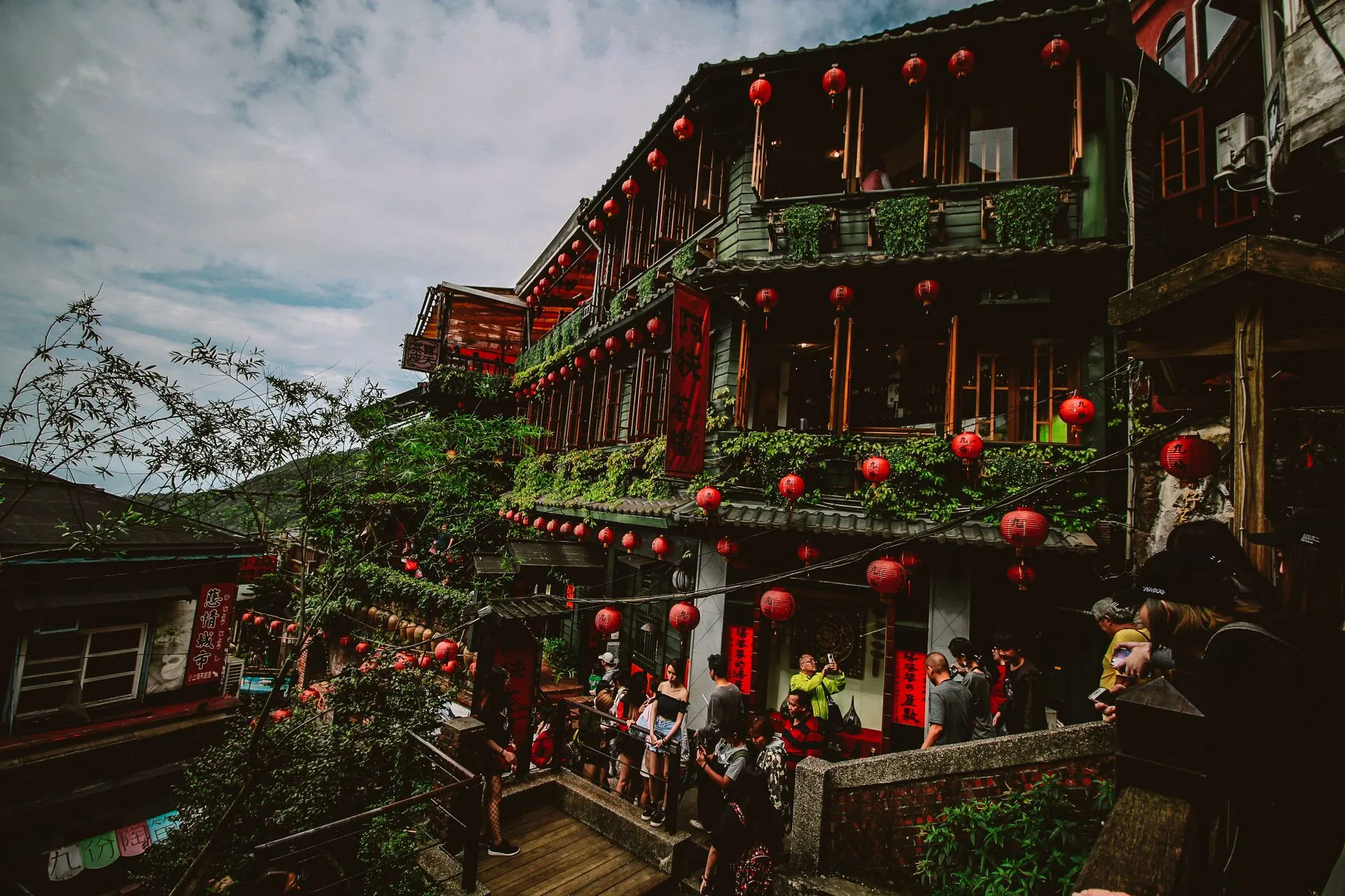
Two easy escapes from Taipei deserve their own note. Jiufen, an hour northeast of the capital, is a former gold-mining town of steep stone stairways, red lanterns and tea houses clinging to a hillside above the sea — atmospheric, photogenic, and reputedly an inspiration for the bathhouse in Spirited Away (Studio Ghibli has politely denied it, but the resemblance sells a lot of tea). My honest steer: Jiufen at midday on a weekend is a crush of selfie sticks. Go on a weekday, late afternoon into evening, when the day-trippers thin out and the lanterns come on and the place recovers its magic. Pair it with the nearby Shifen waterfall and sky-lantern village, and the dramatic Yehliu rock formations on the north coast.
The other habit Taiwan will teach you is hot springs. The island sits on a volatile volcanic seam, and soaking is a serious local pastime. Beitou, at the end of a Taipei metro line, is the most convenient — a whole valley of steaming, sulphurous public baths and private spa hotels, where you can soak in the municipal hot spring for a couple of euros or book a private room in a fancier ryokan-style place. Beyond Beitou there’s Jiaoxi on the northeast (easy by train), the wild riverside springs near Taroko, and Guanziling‘s rare mud springs in the south. After a long day on your feet, a hot-spring soak is the most civilised thing you can do in Taiwan, and it’s cheap.
Hot-spring etiquette is Japanese-style: you generally bathe naked in single-sex public pools (scrub and rinse fully before getting in), or book a private room if you’d rather wear a swimsuit and share with your travel partner. Tattoos are far less of an issue here than in Japan, but a quick check at the door never hurts.
A Night-Market Education
If you take one thing from this guide, take this: Taiwan’s night markets are the main event, not a sideshow. This is where the island’s food culture lives — not in white-tablecloth restaurants but in a roar of sizzle, steam and neon, where you wander with a paper cup of something and graze your way down a lane of stalls, most dishes costing NT$50–100 (€1.40–2.80). It is one of the great eating experiences anywhere on earth, and it is gloriously cheap.
Learn the canon. Beef noodle soup (牛肉麵) is the unofficial national dish — slow-braised shin in a deep, star-anise-scented broth, and Taiwan even runs an annual championship to crown the best bowl. Xiaolongbao, the soup dumplings perfected by the global juggernaut Din Tai Fung (which started here as a humble Taipei shop), are worth every queue. Then the street stuff: gua bao (the fluffy steamed-bun “Taiwanese hamburger” of braised pork belly and pickles), oyster omelette (蚵仔煎), scallion pancakes, pepper buns baked in a tandoor-like oven, lu rou fan (braised pork over rice — comfort food perfection), fried chicken cutlets the size of your face, grilled squid, and shaved-ice mountains drowned in mango in summer.
And then there is stinky tofu (臭豆腐), the fermented bean curd whose smell hits you from thirty metres and divides every visitor. My advice: try it once, deep-fried with pickled cabbage, before you decide. Plenty of people who arrive certain they’ll hate it leave converts. Wash everything down with bubble tea — invented here, and infinitely better at the source than the watery export version. The great markets to graze: Raohe and Shilin in Taipei, Fengjia in Taichung, Liuhe in Kaohsiung, and the morning-and-evening food stalls of Tainan, which are a category of their own.
Money, Costs and How Far Your Euro Goes
Taiwan is one of the best-value developed destinations in the world, and the single happiest surprise of most trips is the bill. The currency is the New Taiwan dollar (NT$), hovering around NT$36 to €1, so a quick mental shortcut is to knock two zeros off and round — NT$1,000 is roughly €28.
To give you real anchors: a hostel dorm bed runs about NT$500–800 (€14–22); a clean mid-range hotel double about NT$2,000–3,500 (€55–95). A night-market dinner that leaves you full costs NT$150–250 (€4–7). A proper beef noodle soup is NT$150–250. A bubble tea, NT$50–70 (under €2). The bullet train end to end is your single biggest in-country expense at around €41, and most journeys are far less. A metro ride is a euro or two. A hot-spring soak in a public pool, a couple of euros. You can travel Taiwan very comfortably on €60–90 a day, and live like royalty on €120.
Cards are accepted in hotels, department stores, the bullet train and chain restaurants, but cash is still king at night markets, small eateries, temples and rural areas — and it’s the one country where I’d say carry more cash than feels modern. The good news: 7-Eleven and FamilyMart are everywhere (Taiwan has one of the highest convenience-store densities on the planet), most have ATMs that take foreign cards, and they double as your bill-payment, ticket-collection, snack and emergency-everything hub. Tipping is not expected anywhere — no restaurant tips, no taxi tips. A 10 percent service charge appears on some sit-down restaurant bills and that’s the end of it.
Pull cash from a 7-Eleven or bank ATM rather than the airport exchange counter, and load a chunk of it onto your EasyCard. Between the card and a stash of small notes, you’ll glide through a country that quietly still runs on cash at the street level.
When to Go — and the Honest Truth About Typhoons
Timing matters in Taiwan more than in most places, because of one thing: typhoon season runs roughly June through October, with the real danger window July to September, and the east coast — Hualien, Taitung, Taroko — takes the worst of it, facing straight out at the Pacific. A direct typhoon hit means a “typhoon day” (schools and offices close, trains stop, flights cancel) and it can pin you in a hotel for a day or scramble your itinerary entirely. It doesn’t happen every week, and a near-miss is often just a day of dramatic rain, but if you travel in the peak you should build slack into your plans and watch the forecast.
The sweet spot is October and November — typhoon risk fading, skies clearing, temperatures easing into the pleasant low-to-mid-20s°C, and the autumn light beautiful. March and April are the other strong choice: cool, dry-ish spring before the heat arrives. Winter (December–February) is mild and bright in the south but grey, damp and surprisingly chilly in the north — Taipei in January is a clammy 12–16°C and the mountains genuinely cold. And a sneaky one to know: the “Plum Rain” season in May and early June brings weeks of persistent drizzle before the typhoons proper, so it’s not the easy shoulder-month it looks on a calendar.
If you must travel in summer, don’t panic — millions do, the heat is the bigger daily nuisance (it’s hot and very humid), and a typhoon is a roll of the dice, not a certainty. Just keep your last few days flexible, don’t book a non-refundable east-coast hike for late August and assume it’ll happen, and download a weather app that tracks Pacific storms.
The single best month to visit Taiwan is November: the typhoons have mostly gone, the air is clear, the food is as good as ever and the crowds are thin. If your dates are flexible, aim there.
Overrated, and a Few Practical Things That’ll Save You Grief
Time for some honest editing. A few things in Taiwan get more hype than they deserve. Jiufen at peak times is genuinely lovely but it’s the most over-touristed spot on the island — go off-peak or skip it. Kenting in the deep south is sold as a beach paradise and it simply isn’t on a Southeast-Asian scale; it’s a fine road-trip end-point, not a reason to fly across the world. The Maokong gondola tea-hills above Taipei is pleasant but skippable if time is tight. And Taipei 101’s observation deck, while a rite of passage, gives you a near-identical (and free) view from the Elephant Mountain trail at sunset — your call which you’d rather pay for. None of these are bad; they’re just where I’d cut first if your days are precious.
A handful of practical notes that matter:
File your TWAC. Since 1 October 2025, every visa-exempt visitor must complete the free online Taiwan Arrival Card at the official immigration portal (twac.immigration.gov.tw) in the days before you fly — the old paper card on the plane is gone. It takes minutes, costs nothing, and there’s no card to print; immigration pulls it up when they scan your passport. Don’t skip it. And make sure your passport is valid for at least six months beyond your trip.
Download the right apps. Google Maps works well for transit. Get the THSR app for bullet-train booking, a translation app with camera mode for menus, and consider an eSIM or a cheap local SIM at the airport — data is fast, cheap and ubiquitous, and you’ll lean on it for maps and translation.
Convenience stores are your friend. 7-Eleven and FamilyMart sell tickets, take parcels, have clean toilets, brew decent coffee, and stock everything from umbrellas to phone chargers. Treat them as infrastructure.
Mind the scooters and the bins. Cross at lights, look twice — the scooter swarm is constant. And Taiwan is famously, fanatically clean despite having almost no public bins; you’ll often carry rubbish until you find one (or a convenience store).
Frequently Asked Questions
Cheapest Flights to Taiwan
We have tracked 979 fares to Taiwan from 87 cities. As of June 2026, here is what a good price looked like from each — the lowest fare we recorded, and a “great-deal” benchmark to judge a quote against. These are tracked observations, not live prices: by the time you read this they will have moved, so treat them as a yardstick, not a quote.
| From | Lowest fare we tracked | Great-deal benchmark |
|---|---|---|
| Barcelona (BCN) | €344 | €491 |
| Dublin (DUB) | €358 | €511 |
| Stockholm (ARN) | €370 | €528 |
| Geneva (GVA) | €382 | €545 |
| Copenhagen (CPH) | €384 | €548 |
| Warsaw (WAW) | €386 | €552 |
| Nice (NCE) | €388 | €555 |
| Frankfurt (FRA) | €391 | €559 |
| Munich (MUC) | €392 | €560 |
| Vienna (VIE) | €396 | €565 |
| Venice (VCE) | €400 | €571 |
| Amsterdam (AMS) | €402 | €574 |
| Athens (ATH) | €405 | €578 |
| Paris (CDG) | €418 | €597 |
Recent deals we have posted to Taiwan:
- Barcelona to Taipei, Taiwan from €452
- Phoenix to Taipei, Taiwan from $816
- London to Taipei, Taiwan from £294
- Seattle to Taipei, Taiwan from $814
- London to Taipei, Taiwan from £488
- Phoenix to Taipei, Taiwan from $873
- Munich to Taipei, Taiwan from €557
- Cheap Flights Berlin to Taipei 2026 — From 300 EUR
- Cheap Flights Munich to Taipei 2026 — From 300 EUR
These are fares aifly tracked to this destination, not live quotes — they have changed since and several of the deals above may have expired. Browse current flight deals →