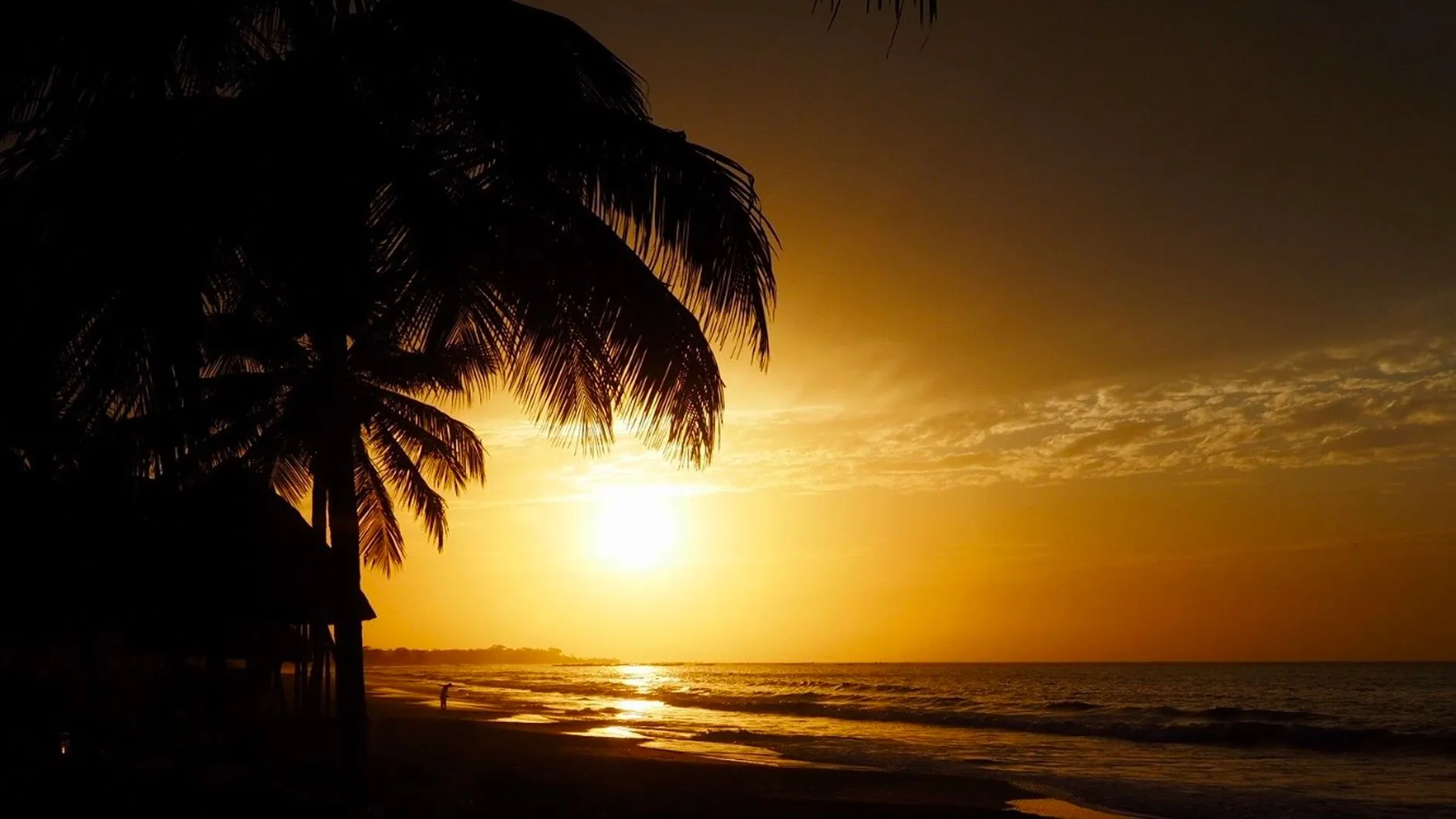
The Gambia — Complete Travel Guide 2026
The Gambia is a 48-km-wide ribbon of country that exists almost entirely because of one river, and for most visitors it shrinks to a six-kilometre run of beach hotels where it’s warm in February, the locals speak English, and there’s no time difference with London. That strip is genuinely pleasant — but the Gambia that’s worth the flight is the one a short drive inland: the mangrove creeks, the bird-thick river, the fish markets, and a slave-trade history that reached every corner of the Atlantic world.
Quick Reference
West Africa — a thin sliver of country wrapped around the River Gambia, almost entirely surrounded by Senegal, on the Atlantic coast
Banjul (BJL), Yundum — ~20–30 min from the Kololi/Kotu resort strip
Gambian dalasi (GMD) — roughly D72 to US$1 / ~D78 to €1 in 2026
English (official); Mandinka, Wolof, Fula and others spoken daily
Visa-free arrival for UK/EU/US/Canada/Australia (28-day stamp); €19 airport security fee each way
November–February (dry, warm, ~28–32°C). Avoid July–September (heavy rains, humid, much closed)
Winter-sun beaches, 580+ bird species, the River Gambia, Kunta Kinteh Island & the Roots story, the “Smiling Coast”
The coastal strip: Kololi/Senegambia (lively), Kotu (calmer), Cape Point/Bakau (local), Bijilo (quiet)
Editor’s Note
Here’s the single most useful thing to understand before you book: The Gambia sells itself as a beach destination, and it works perfectly well as one — but the beach is the least interesting thing about it. The Senegambia strip is a competent, slightly tired package-holiday zone you could find a version of in a dozen warm countries. What you can’t find elsewhere is fifteen minutes up a creek in a pirogue with kingfishers diving around you, or standing in Juffureh where Alex Haley traced his ancestry, or watching the Tanji boats land their catch at dusk.
So treat the resort as a base camp, not a destination. Plan two or three real excursions — a river/creek trip, the Roots tour to Kunta Kinteh Island, and a birding morning at Abuko or a day at Makasutu — and the trip transforms from “cheap winter sun” into something you’ll actually remember. People who fly home disappointed are almost always the ones who never left the hotel sun-lounger and the strip’s bars.
Insider tip: The Gambia runs on GMT year-round — same time as the UK — and it’s only about a six-hour flight from London or Brussels. No jet lag, mid-30s°C in February, and English as the official language. For a winter-sun trip from northern Europe, that combination is hard to beat.
Should You Go? Who It’s For — and Isn’t
The Gambia is for you if you want guaranteed warmth in the depths of the European winter without a long-haul slog or a time-zone hangover, and you’re curious enough to do a couple of trips beyond the pool. It’s brilliant for birders (this is one of the most accessible birding countries on earth — you’ll rack up species from your hotel garden), for travellers who like a place where they can actually talk to locals, and for anyone who wants real Africa-on-a-budget without needing a 4×4 expedition.
It’s a poorer fit if you expect a polished, glossy resort experience — the hotels are mostly functional rather than luxurious, the infrastructure is patchy, and power and water can be intermittent. It’s also a hard sell if you bristle at being approached: the “bumster” hustle on the beach and the strip is persistent, and some visitors find it wearing (more on managing that below). And it is not a wildlife-safari destination in the big-game sense — there are no lions or elephants; the wildlife here is birds, monkeys, hippos, crocodiles and a single chimpanzee rehabilitation project you view from a boat.
Be honest with yourself about the strip: if a basic-but-warm beach hotel with a few decent restaurants and persistent vendors is your idea of a holiday low, look elsewhere. If it’s a launchpad for creeks and river trips, you’ll love it.
Getting There — Banjul Airport & the Transfer Reality
Banjul International Airport (BJL), at Yundum, is small, single-terminal and overwhelmingly a charter operation in the winter season. From November to April the schedule fills with package flights — TUI from the UK, Holland and Belgium, plus various charter and scheduled services — and the airport can go quiet between waves. Most visitors arrive on a tour-operator package with a coach or minibus transfer to their hotel already arranged; in arrivals you simply look for the rep holding your operator’s sign.
If you’re travelling independently, the transfer is genuinely easy. The resort strip (Kotu, Kololi, Bakau, Cape Point) is only about 15–25 km away — roughly a 20–40 minute drive depending on the area and traffic. There are official green tourist taxis lined up outside arrivals; agree the fare before you get in (expect roughly €15–25 / around D1,000–1,800 to the strip, more for Cape Point). Pre-booking a transfer through your hotel is worth the small premium for a late-night arrival.
Two unavoidable bits of admin: you pay a €19 airport security fee on arrival and again on departure — payable in dollars, euros, pounds or dalasi, so keep some hard cash handy and don’t put your last notes in the donation box. And don’t change all your money at the airport kiosks; their rates are poor. Grab just enough dalasi for the taxi and tips, then use the bureaux de change or ATMs on the strip.
Warning: Touts and unofficial “helpers” work the arrivals area and will grab your bag for a tip or steer you to an overpriced taxi. Use the official green taxi rank or your pre-booked transfer, keep a firm grip on your luggage, and don’t accept “help” you didn’t ask for.
Where to Base — The Resort Strip Explained
Almost all tourist accommodation clusters in a short coastal run south of Banjul, and the four main areas have distinct personalities. Get this choice right and the trip improves enormously.
Kololi / Senegambia is the epicentre — the famous “Senegambia Strip” of bars, clubs, restaurants, craft markets and the biggest hotels. It’s where the action and the nightlife are, and where the hustle is most concentrated. Base here if you want everything on your doorstep and don’t mind the bustle; avoid it if you want calm.
Kotu is Kololi’s quieter, more relaxed sibling — a wide, clean beach, a cluster of hotels and restaurants, and the celebrated Kotu Creek right behind the beach (a birding hotspot you can walk to). It’s an easy short hop to the Senegambia nightlife but lets you sleep somewhere calmer. For many first-timers this is the sweet spot.
Cape Point and Bakau, closer to Banjul, trade nightlife for a stronger sense of everyday Gambian life. Cape Point has a lovely, more spread-out beach (and an east-facing aspect, so you can catch the sunrise); Bakau has the botanical gardens and the famous Kachikally sacred crocodile pool. Choose this end for culture and local texture rather than bars.
Bijilo is the quiet option — just minutes south of Kololi but with almost nothing in the way of bars or restaurants, a peaceful wide beach, fewer touts, and the Bijilo Forest Park (Monkey Park) on the doorstep. Ideal if you want a tranquil base but still want Senegambia’s restaurants a five-minute taxi away.
Insider tip: Don’t over-commit to a single area for two weeks. The strip is small — a few dalasi or a short green-taxi hop links it all — so a quiet base in Kotu or Bijilo plus easy evening runs to Senegambia gives you the best of both.
The Beaches
The coast here is a long stretch of Atlantic sand, golden to greyish, backed in the resort areas by beach bars and palm-thatch. The beaches at Kotu, Kololi and Cape Point are the most developed and the easiest to enjoy — wide, walkable, with bars and grilled-fish shacks for a long lunch. Bijilo’s beach is the quiet one, good for a stroll without much hassle.
A few honest caveats. This is the open Atlantic, not a sheltered turquoise lagoon — the water can be cool and the surf can pull, so respect any flag warnings and don’t assume conditions are gentle. The beaches are working beaches in places: you’ll share them with fishermen, the occasional cow, and the bumsters. They’re best enjoyed in the cooler parts of the day. And for a sense of the real coast, take a drive south to the fishing village of Tanji and its raucous fish market, or further to Sanyang (“Paradise Beach”) and laid-back Kartong near the Senegal border, where the beaches are wilder and the vibe more local.
Beyond the Beach — The River Gambia, Birding & Wildlife
This is the part of the trip that earns the air miles. The Gambia is one of the world’s great accessible birding destinations — over 580 species recorded in a country you can drive across in a day — and you don’t need to be a hardcore birder to be wowed. Bee-eaters, kingfishers, hornbills, rollers and raptors are everywhere, often in your hotel garden.
The easiest serious wildlife is on the creeks and the river. A morning pirogue (dugout) trip through the mangroves of Kotu Creek, Tanbi Wetlands or up to Lamin Lodge delivers kingfishers, herons, fiddler crabs and absolute calm for a modest price. Abuko Nature Reserve, a short drive from the strip, is the country’s oldest protected area — shaded forest trails, hundreds of bird species, vervet and red colobus monkeys, and a small predator/reptile section. It’s a half-day at most and one of the best-value outings in the country.
For something more atmospheric, Makasutu Culture Forest (“Holy Forest” in Mandinka) bundles a guided walk, a mangrove pirogue glide and a cultural show into a polished day trip; the upmarket Mandina Lodges sit within it if you want to stay over.
Going further upriver gets you to the real wild Gambia: the River Gambia National Park (Baboon Islands), home to a long-running chimpanzee rehabilitation project (you view the chimps from the boat — landing isn’t permitted), plus hippos and crocodiles. It’s usually visited as part of an overnight or multi-day trip based around Janjanbureh (Georgetown), often combined with the Wassu Stone Circles, a UNESCO-listed megalithic site sometimes called “the Gambian Stonehenge.”
Insider tip: Book birding and creek trips through a registered guide — the Gambia has an excellent network of trained bird guides, and a good one transforms the experience. Your hotel or a reputable local operator can arrange one; agree the price, the duration and exactly what’s included up front.
History & Roots — Kunta Kinteh Island & Juffureh
The Gambia’s most powerful excursion isn’t about wildlife at all. About 25 km upriver from Banjul sit the linked sites of Albreda, Juffureh and Kunta Kinteh Island — collectively a UNESCO World Heritage Site documenting the transatlantic slave trade, through which the river served as a highway for centuries of human trafficking.
Kunta Kinteh Island (long known as James Island, and renamed for the figure Alex Haley made world-famous in Roots) holds the ruins of a fort that changed hands repeatedly between European powers; erosion has shrunk it dramatically over the years. In Juffureh you can visit the small museum and, depending on the day, meet people who present themselves as descendants of the Kinte family. It is a sobering, important half-day — and it deserves to be approached as history, not a photo-op. Go with a guide who can give it proper context, be respectful, and expect to be asked for donations and tips at several points.
Caution: The “Roots” tour is heavily commercialised and the descendant-meeting element divides opinion — some find it moving, others staged. It’s still worth doing for the history and the river journey; just go in with realistic expectations and a clear sense of what you’re paying for.
When to Visit — Month by Month
The Gambia has two seasons, and for a holiday only one of them really works.
November–February is the prime window: dry, warm but not brutal (daytime highs around 28–32°C, cooler nights), low humidity, and the full tourism machine running. December and January are the most comfortable; February starts to heat up. From December to March the dusty harmattan wind can occasionally blow off the Sahara, veiling the sun and hazing the air for a day or two — harmless but worth knowing.
March–May stays dry but gets progressively hotter; inland temperatures can hit the high 30s. Still very doable on the coast, where the sea breeze takes the edge off, and quieter than peak season.
June–October is the rainy season. The serious rains fall July to September, with August the wettest — heavy downpours, high humidity, and sweltering heat. The upside is lush green landscapes and excellent birding (it’s breeding season); the downsides are that many strip hotels, restaurants and excursions scale back or close, upriver roads turn difficult, and it’s genuinely uncomfortable. Unless you’re a dedicated birder or budget-hunter, come in the dry season.
Insider tip: Birders, take note — the early dry season (November) and the green rainy season offer different species and behaviours. Peak human season (Dec–Feb) is the comfortable choice, but if you want the river and the bush at their most alive and don’t mind heat and downpours, the shoulders reward you.
What to Eat
Gambian food is West African comfort cooking — rich, peanut-and-rice-based, built around the day’s fish. The “holy trinity” of dishes is worth seeking out beyond the hotel buffet.
Domoda, the national dish, is a deep groundnut (peanut) stew with onion, tomato and sweet potato, served over rice with chicken, beef or lamb — rich, slightly sweet, hugely satisfying. Benachin (“one pot,” the ancestor of Senegalese thieboudienne and a relative of jollof) is rice cooked together with tomato, vegetables and fish or meat. Yassa — usually chicken or fish — is marinated in lemon, mustard, garlic and onion, then grilled and returned to its tangy sauce; fish yassa with fresh-landed catch is a highlight.
For the best eating, get off the strip. The fresh fish at Tanji and the grilled-fish shacks along the coast beat most hotel kitchens, and street afra (spiced grilled meat) is cheap and excellent. To drink, the local JulBrew lager is everywhere and very cheap, and you should accept at least one round of attaya — the slow, sweet, ritualised green tea brewed and poured (the foamier the better) over long social hours. It’s less a drink than an invitation to sit and talk.
Insider tip: Ask your hotel or guide to point you to a proper local restaurant for domoda or benachin — a plate that costs a few hundred dalasi will be tastier and a fraction of the price of the “international” menu at the resort.
Getting Around
Outside your hotel transfers, you have several options and they suit different jobs.
Green tourist taxis are the go-to for visitors: they wait at the strip’s tourist zones and at hotels, and the fare is negotiated up front (always agree it before you set off). They’re more expensive than local transport but reliable and used to tourists. Yellow taxis are the general town taxis (a yellow taxi can drop you in the tourist zones but green ones hold the pick-up rights there).
The cheapest way to move is the gelli-gelli (bush taxi) — battered minibuses and vans that run fixed routes between towns, leaving only when full, for a handful of dalasi. They’re an adventure and authentically local, but cramped, slow and not really geared to tourists with luggage.
For day trips and anything inland, the standard arrangement is a car with a driver for an agreed daily rate (plus fuel and, for overnights, the driver’s expenses). This is by far the most sensible way to do the river, Tanji, the Roots tour or an upriver run — you get a guide-driver, no navigation stress, and a fixed price. Self-drive hire exists but the combination of poor, potholed roads, weak night lighting and unfamiliar conditions means most people happily pay for the driver.
For crossing the river itself, the Banjul–Barra ferry links the capital to the north bank (foot passengers a token fare, vehicles more); it got new vessels recently but still runs to “African time,” so build in a buffer.
Warning: Driving standards are poor, roads are badly potholed, and after dark both road and vehicle lighting are minimal. Avoid driving yourself at night, don’t rush inland journeys, and budget far more time than the map distance suggests.
Where to Stay — by Area & Budget
Accommodation in The Gambia runs from cheap guesthouses to a handful of genuinely characterful lodges, but be realistic: even the “big” resort hotels are mid-range by international standards, and luxury here means a good pool, AC and a beach, not five-star polish.
On the strip, the larger beach hotels cluster in Kololi/Senegambia (most central, most nightlife), Kotu (calmer, beach-and-creek) and Cape Point/Bakau (quieter, more local). These are where the package operators put most guests; expect comfortable rooms, pools and beach access, with the occasional power or water hiccup. Budget guesthouses across the resort areas and inland towns can run as low as the equivalent of €15–25 a night; mid-range beach hotels sit roughly in the €50–90 range; the smartest beachfront options push past €120–150.
For something with more soul, look inland and up-river: eco-lodges like those at Makasutu (Mandina Lodges), Lamin Lodge for creek atmosphere, simpler community-run places around Gunjur, Kartong and Janjanbureh, and the long-running ethical Footsteps-style eco-lodges. These trade beach convenience for genuine immersion and are where the most memorable nights are spent.
Insider tip: For a two-week trip, split your stay — most of it on the coast for the easy beach days, then two or three nights at a creek or up-river lodge. The contrast (and the night sounds away from the strip) is the whole point.
Costs & Budget
The Gambia is genuinely cheap once you’re there, which is much of its appeal — the cost is the flight and the package, not the daily spend. Local food and transport cost very little; the dalasi (around D72 to the dollar in 2026) goes a long way.
Ballpark daily on-the-ground costs: a local plate of domoda or benachin runs a few hundred dalasi (a couple of euros); a JulBrew lager is around D50–60 (under a euro) locally, much more in resort bars; a green-taxi hop along the strip is a few hundred dalasi; a full day with a car and driver for an excursion is typically in the €30–60 range depending on distance. Budget travellers can live comfortably on €40–60 a day excluding accommodation; mid-range visitors who eat out and take a couple of organised excursions will spend more but still find it inexpensive by European standards.
The big practical point is cash. The economy runs on dalasi notes. ATMs exist on the strip and in Serekunda/Banjul but are sparse and unreliable elsewhere, and card acceptance is limited to bigger hotels and a few restaurants. Carry enough dalasi cash for anything off the strip, use the bureaux de change (better rates than the airport), and keep small notes for tips and taxis.
Practical Information
Entry & visa: UK, EU, US, Canadian and Australian tourists do not need a visa in advance — you get a stamp on arrival. UK passport holders are stamped in for 28 days, extendable twice (28 days each) at the Immigration Office in Banjul or a tourist police station. (Some nationalities outside the visa-free list need an e-visa arranged in advance — check your own status before booking.) Have an onward/return ticket and a passport valid for the length of your stay. There’s a €19 airport security fee on both arrival and departure, payable in major currencies or dalasi.
Money: Gambian dalasi (GMD), roughly D72/US$1 and ~D78/€1 in 2026. Cash is king — see Costs above.
The “bumster” reality + safety: Young men known as bumsters work the beaches and the strip, offering “guiding,” friendship or romance and later pressing for money or gifts. They target solo women in particular. The way to handle it is consistent and undramatic: be polite but firm, say a clear “no thank you,” don’t engage in long conversation, and don’t accept “free” help or favours — there’s usually a bill later. Never let one take you on an unofficial “tour into Senegal,” which can land you in immigration trouble. More broadly, The Gambia is one of West Africa’s safer destinations and the FCDO does not advise against travel to any part of it, but petty theft happens in tourist areas and markets, so don’t flash valuables. Avoid isolated beaches and walking alone after dark (especially women), steer clear of any demonstrations, and use registered guides and official taxis.
Health: Malaria is present countrywide — take antimalarial tablets (start before you arrive, per your travel clinic), use repellent and cover up at dusk. A yellow fever certificate is required if you’re arriving from a country with risk of transmission (and is often recommended/needed for onward regional travel), so check whether your routing triggers it. Make sure routine jabs are up to date and consider hepatitis A and typhoid. Do not drink the tap water — stick to bottled or properly treated water, and be careful with ice and salads outside good establishments. Bring any medication you need and good travel insurance, because medical facilities are limited.
Tipping & connectivity: Small tips are appreciated and expected for guides, drivers and good service (round up, or 5–10% in tourist restaurants). Local SIM cards (Africell, QCell, etc.) are cheap and easy to buy with your passport and give decent coverage on the coast — far better value than roaming for a longer stay. Power and water can be intermittent even at good hotels, so a power bank and a relaxed attitude help.
Insider tip: Buy a local SIM in the first day or two — data is cheap, it makes arranging taxis and guides far easier, and coverage on the coast is fine. Bring a power bank for the inevitable power cut.
Frequently Asked Questions
Cheapest Flights to The Gambia
We have tracked 7,951 fares to The Gambia from 145 cities. As of June 2026, here is what a good price looked like from each — the lowest fare we recorded, and a “great-deal” benchmark to judge a quote against. These are tracked observations, not live prices: by the time you read this they will have moved, so treat them as a yardstick, not a quote.
| From | Lowest fare we tracked | Great-deal benchmark |
|---|---|---|
| Bergamo (BGY) | €174 | €248 |
| Milan (MXP) | €184 | €263 |
| Mallorca (PMI) | €185 | €264 |
| Venice (VCE) | €186 | €265 |
| Geneva (GVA) | €187 | €267 |
| Turin (TRN) | €188 | €268 |
| Bilbao (BIO) | €190 | €272 |
| Basel (BSL) | €193 | €275 |
| Alicante (ALC) | €193 | €276 |
| Porto (OPO) | €194 | €277 |
| Rome Ciampino (CIA) | €194 | €277 |
| Bologna (BLQ) | €195 | €278 |
| Malta (MLA) | €196 | €280 |
| Rome (FCO) | €197 | €282 |
These are fares aifly tracked to this destination, not live quotes — they have changed since and several of the deals above may have expired. Browse current flight deals →