Lagos Murtala Muhammed (LOS) — The Complete 2026 Airport Guide
Two things trip up first-timers at Lagos. First, the airport is really two separate airports a few kilometres apart — the international side (Murtala Muhammed International) and the domestic side (MMA2 and GAT) — and a taxi driver who takes you to the wrong one has just cost you an hour in Lagos traffic. Second, your entry paperwork changed in 2025: there is no visa on arrival any more, you file a digital landing card before you fly, and your yellow fever card is checked the moment you land. Get those two things right before you leave home and Lagos is manageable. Get them wrong and the day starts badly.
Last verified: July 2026. Visa rules, terminal assignments and — above all — Lagos transport fares in naira change fast; confirm the specifics on your ticket, on the official immigration portal, and at the counter before you commit.
Quick reference
| Detail | What you need to know |
|---|---|
| Airport | Murtala Muhammed International Airport, IATA LOS / ICAO DNMM — Nigeria’s main gateway and one of West Africa’s principal international hubs |
| Location | In Ikeja, on the mainland — about 22 km northwest of Lagos Island. The business and hotel districts (Victoria Island, Ikoyi, Lekki) are further still, across the lagoon |
| The split | International side = the new International Terminal (foreign carriers) plus the old Terminal 1. Domestic side = MMA2 and GAT, a separate complex a few km away. Don’t confuse “Terminal 2” (international) with MMA2 (domestic) |
| Into the city | Pre-booked transfer or official airport taxi to Victoria Island ~₦25,000–45,000 (~$16–29); Bolt/Uber cheaper but pickup less reliable at the airport. Budget 45 min to 2.5 hours for traffic |
| Entry | Most nationalities need a visa in advance — the e-Visa (visa on arrival was scrapped in 2025). Plus an online Landing/Exit Card and a yellow fever certificate, checked on arrival |
| Watch out for | Arrival touts · agreeing a fare before you get in · going to the wrong complex for a domestic connection · rush-hour gridlock (roughly 07:00–10:00 and 16:00–20:00) |
The trap: “Terminal 2” is not the domestic terminal
This is the single most confusing thing about Lagos, and it catches people every week. There are two terminal complexes with almost identical-sounding names, and they are not next to each other.
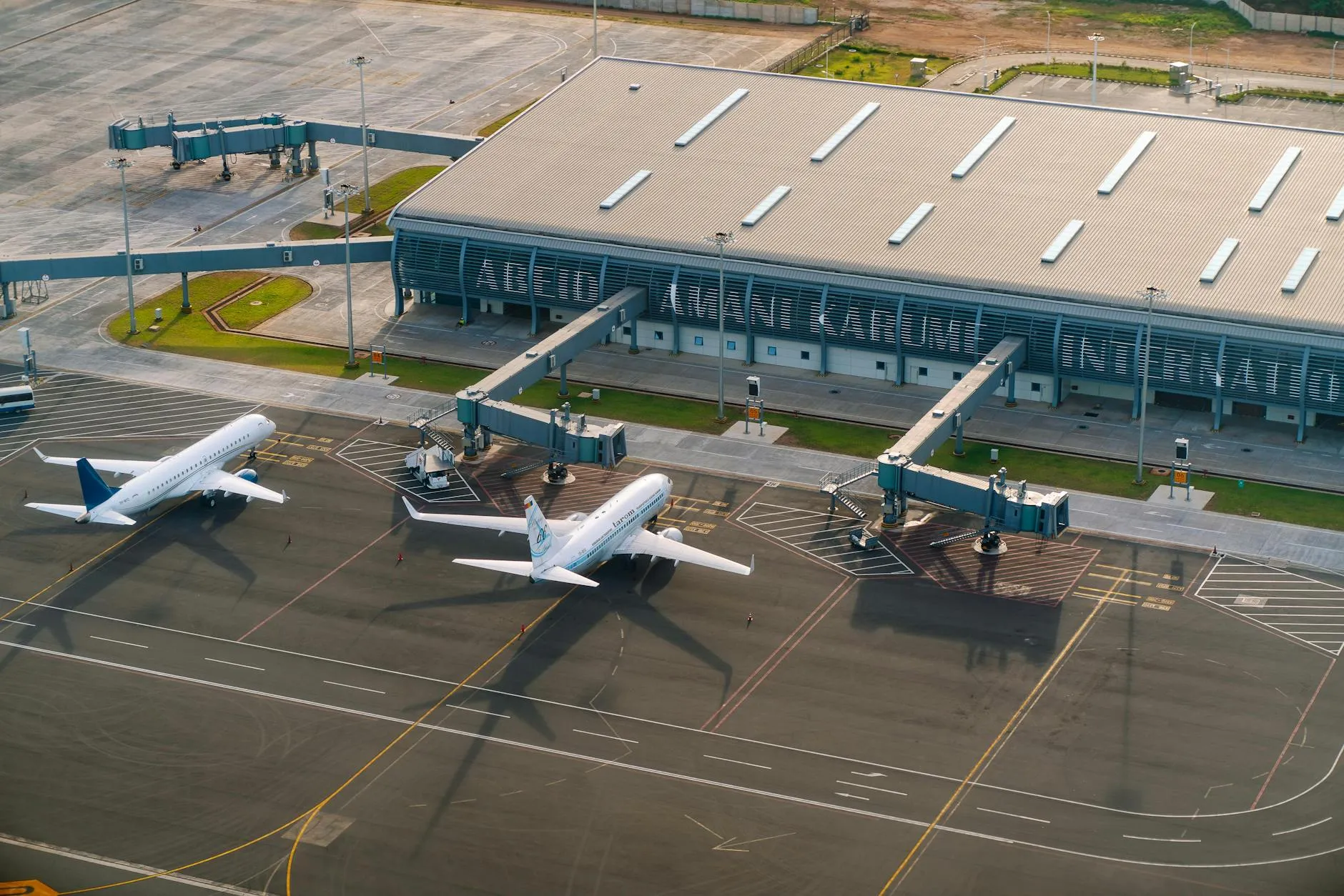
The international complex is Murtala Muhammed International Airport (MMIA). Its centrepiece is the new International Terminal, built by CCECC and opened in 2022, with a capacity of around 14 million passengers a year — this is where the large majority of foreign airlines now arrive and depart (British Airways, Virgin Atlantic, Delta, United, Lufthansa, KLM, Air France, Emirates, Qatar Airways and the rest). Alongside it stands the original 1970s Terminal 1. Because the newer international hall is informally called “Terminal 2” on some signage, travellers assume it is the same thing as MMA2. It is not.
MMA2 is a completely separate, privately run domestic terminal (operated by Bi-Courtney), sitting a few kilometres away with the older General Aviation Terminal (GAT). Together they handle Nigeria’s domestic carriers — Air Peace, Arik, Aero, Dana, Overland, United Nigeria and others — on routes to Abuja, Port Harcourt, Kano and beyond. There is no airside walkway between the international and domestic complexes; getting from one to the other means leaving the building and taking a short road transfer.
One live caveat for 2026: the aviation authority (FAAN) announced that the ageing Terminal 1 would close from around March 2026 for a roughly 22-month rehabilitation, with a temporary hall handling a handful of the affected international departures while arrivals and cargo carry on elsewhere. Because that is a rolling construction project, treat the exact terminal for any smaller or regional carrier as something to reconfirm on your booking — the big foreign airlines are in the new International Terminal regardless.
Getting into Lagos
Here is the honest truth about Lagos: the distance to the city is short, but the traffic — locally, “go-slow” — is the whole story. The same trip to Victoria Island can take 45 minutes at 6am on a Sunday or two and a half hours on a weekday evening. Plan around the road, not the map.
| Option | Rough cost to Victoria Island | Notes |
|---|---|---|
| Pre-booked transfer | ₦25,000–45,000 (~$16–29 / €15–27) | Driver meets you by name, fixed price agreed in advance — skips the whole tout gauntlet. The lowest-stress choice |
| Official airport taxi | ₦20,000–40,000 (~$13–26) | Book at the official counter inside arrivals; there are no meters, so agree the fare first |
| Bolt / Uber | ₦10,000–25,000 (~$6–16) | Cheapest when it works; Bolt is the more common app in Lagos. Airport pickup is less reliable than around town — see below |
| Red Line rail (via Ikeja) | Low train fare + a road hop | Fixed timing, beats the gridlock — but you must first reach Ikeja station by taxi, and it serves the mainland, not the islands. See below |
Prices are in Nigerian naira, which has been volatile — the dollar and euro figures above are approximate and drift with the exchange rate, so treat them as a guide, not a quote. Carry some small naira for tips and tolls; card acceptance is patchy at the kerb.
Touts, and how to not get caught
The arrivals hall and car park are worked by touts and unofficial “drivers” who will offer to carry your bag and find you a car. Be polite but firm. The safe pattern is simple: arrange your ride before you land (hotel transfer or a booked driver), or use the official taxi counter inside the terminal and agree the price before you get in. Don’t accept a lift from someone who approaches you in the lobby or car park, don’t hand your bag to anyone unbidden, and don’t flash cash or phones while you sort out the ride.
Ride-hailing — fine in town, fiddly at the airport
Uber and Bolt both operate across Lagos and are genuinely useful once you’re in the city. At the airport itself, pickups are more awkward: access and parking rules, plus the tout ecosystem, mean drivers often can’t or won’t wait at the door, and you may be directed to a pickup point away from arrivals. For a first arrival — jet-lagged, unfamiliar, likely at night — a pre-booked transfer or the official counter taxi is worth the extra money. Save the apps for getting around once you’ve found your feet.
The Red Line rail — real, but not a door-to-door airport train yet
Lagos opened the first phase of its Red Line commuter rail (Agbado–Oyingbo, through Ikeja) in late 2024, and it is a legitimate way to beat the evening gridlock on the mainland. The catch for arriving flyers is that there is no station inside the airport yet — the nearest is Ikeja, which you still reach by taxi through the same traffic, and the line runs up the mainland rather than to the island hotels. A dedicated airport rail link is under construction but not something to count on for this trip. For most visitors headed to Victoria Island or Lekki, road transport remains the realistic option; the Red Line is worth knowing if you’re staying near a mainland station.
Entry: e-Visa, the digital landing card and yellow fever
Nigeria overhauled its entry system in 2025, and the changes matter — arriving without the right paperwork can mean being turned around. Sort all three of these before you fly.
- You need a visa in advance — visa on arrival is gone. Nigeria phased out visa on arrival in 2025 and replaced it with an online e-Visa. Most nationalities (with narrow exceptions such as fellow ECOWAS/West African citizens) must apply and be approved before travelling. Apply only through the official Nigeria Immigration Service portal — immigration.gov.ng / the e-Visa site — not a lookalike agency site, of which there are many. Approvals are commonly issued within a couple of days, but don’t leave it to the last minute.
- Cost varies by nationality. A short-visit e-Visa is broadly in the region of $160 for many applicants, but the exact fee depends on your passport and visa type, so check the official portal for your figure. A single-entry visitor visa is typically valid for a limited window with a capped stay — read the conditions on your approval.
- File the digital Landing & Exit Card before you board. Paper arrival/departure cards have been replaced by an online Landing Card you complete before your inbound flight (and an Exit Card on the way out), on the immigration service’s dedicated portal. Do it in advance and keep the confirmation; you may be asked for it at the desk.
- Yellow fever certificate is mandatory and actually checked. Nigeria requires proof of yellow fever vaccination, and unlike some countries it genuinely inspects the yellow card on arrival. The shot must have been given at least 10 days before you land to be valid. No certificate can mean no entry — carry the physical card, not just a photo.
- e-Gates are live at Lagos. Automated immigration e-gates have been installed at Lagos (and Abuja). Availability for foreign visitors can vary, so be ready to use a staffed desk; either way, have your e-Visa approval, passport and yellow card in hand.
Connecting to a domestic flight
If your journey continues to Abuja, Port Harcourt, Kano or another Nigerian city, understand that this is not an airside connection. Domestic flights leave from MMA2 or GAT, in the separate domestic complex a few kilometres from the international terminal. In practice that means: clear immigration, collect your checked bags, exit the international terminal, take a road transfer to the domestic side, and check in again from scratch.
Because that road hop runs through Lagos traffic and involves a full re-check, don’t book a tight self-connection. Give yourself a generous buffer — several hours rather than the 60–90 minutes you might risk at a single-terminal airport — and treat separate-ticket connections as needing even more margin, since no airline is protecting the link if traffic eats your cushion. Where possible, book the whole itinerary on one ticket with a Nigerian carrier or a partner so your bags and connection are handled for you.
Lounges
The international terminal has a decent spread of pay-in or Priority Pass lounges — genuinely worth it here, because they trade the crowded, warm public gate areas for reliable air-conditioning, real Wi-Fi and a hot Nigerian buffet (think jollof rice, suya, puff-puff). Access is usually via a business-class ticket, a Priority Pass, or a walk-in fee.
- Priority Pass lounges — several in the international terminal accept Priority Pass, including options such as the Oasis Lounge and other branded lounges. Check the current list in your Priority Pass app before you fly, as the exact roster and terminal locations change.
- Aspire Lounge — in the international terminal, typically open 05:00–23:00, with seating, food and drink (including alcohol), Wi-Fi and charging points.
- Walk-in access at the pay-in lounges runs in the region of ₦85,000 (~$55) — worth confirming at the door, as fares move with the naira.
On the domestic side, MMA2 also has its own lounge; if you’re connecting through the local airport it can be a calmer place to wait.
Money, SIMs and practicalities
Money: Nigeria runs largely on cash for small transactions, and the naira is volatile — check the rate the day you travel. Use bank ATMs in the terminal rather than exchange kiosks where you can, and if an ATM offers to bill you in your home currency, decline and choose naira. Keep some small notes for tips, tolls and the taxi.
SIM & data: local SIMs (MTN, Glo, Airtel) are cheap but require registration with ID, which can be slow at the airport; an eSIM bought before you land is the least-hassle way to have data the moment you arrive — useful for calling your driver or a Bolt.
On the ground: Wi-Fi in the terminals is variable, so don’t rely on it for anything time-critical. Power is 230V with UK-style three-pin plugs, but bring a battery pack — mains supply can be inconsistent. And build slack into everything: this is an airport where the queue, the traffic and the paperwork all take longer than you expect, and rushing is how mistakes happen.
Frequently asked questions
Is “Terminal 2” at Lagos the same as MMA2?+
No — and this trips people up constantly. The new International Terminal (built by CCECC, opened 2022) is on the international side and is sometimes signed “Terminal 2”; it handles most foreign airlines. MMA2 is a separate, privately run domestic terminal a few kilometres away, alongside the older GAT. If you’re flying internationally, ask for the International Terminal; if you’re flying domestically, name MMA2 or GAT specifically.
Do I need a visa to fly into Lagos in 2026?+
For most nationalities, yes, and you must get it before you travel — Nigeria scrapped visa on arrival in 2025 and now uses an online e-Visa. Apply only through the official Nigeria Immigration Service portal (immigration.gov.ng), not a lookalike site. A short-visit e-Visa is broadly around $160 for many applicants, but the fee varies by passport, so check the portal for your figure.
Is a yellow fever certificate really required for Nigeria?+
Yes, and it is genuinely checked on arrival at Lagos. You need proof of yellow fever vaccination given at least 10 days before you land. Carry the physical yellow card — without it you can be refused entry. It’s one of the easiest things to overlook and one of the most consistently enforced.
What is the Landing Card and when do I fill it in?+
Nigeria replaced paper arrival/departure cards with a digital Landing & Exit Card completed online before your flight, via the immigration service’s portal. Fill in the Landing Card before you board your inbound flight and keep the confirmation, as you may be asked for it at the immigration desk.
How do I get from Lagos airport to Victoria Island safely?+
The lowest-stress options are a pre-booked hotel/private transfer (~₦25,000–45,000) or the official airport taxi counter inside arrivals (~₦20,000–40,000; agree the fare first, there are no meters). Bolt and Uber are cheaper but airport pickup is fiddly. Whatever you choose, arrange it before you leave the terminal and don’t accept lifts from touts in the lobby or car park. Budget 45 minutes to 2.5 hours for traffic.
Can I use Uber or Bolt at Murtala Muhammed Airport?+
They work across Lagos and are handy once you’re in the city, but airport pickups are less reliable — access rules and the tout scene mean drivers often can’t wait at arrivals and you may be sent to a separate pickup point. For your first arrival, a pre-booked transfer or the official counter taxi is the safer call; use the apps for getting around afterwards.
I have a connecting domestic flight — how much time do I need?+
Plenty. Domestic flights leave from MMA2/GAT, a separate complex a few kilometres from the international terminal, so it’s not an airside connection: you clear immigration, collect bags, transfer by road, and check in again. Give yourself several hours, and more if you’re on separate tickets — no one is protecting a self-connection if traffic eats your buffer.
Does the Lagos Red Line rail go to the airport?+
Not directly, yet. The Red Line’s first phase (opened late 2024) runs up the mainland through Ikeja, which is the nearest station to the airport — you still reach it by taxi through traffic. A dedicated airport rail link is under construction but not operational as a door-to-door service. For the island hotels, road transport is still the realistic choice.
At a glance
| Codes | LOS / DNMM — Murtala Muhammed International Airport, Lagos |
| International | New International Terminal (opened 2022) — most foreign carriers · plus older Terminal 1 (rehabilitation announced from 2026) |
| Domestic | MMA2 (Bi-Courtney) and GAT — a separate complex a few km away |
| To the city | ~22 km to Lagos Island; islands (Victoria Island/Ikoyi/Lekki) further. 45 min–2.5 hr by road depending on traffic |
| Best into-city choice | Pre-booked transfer or official counter taxi; agree the fare first |
| Visa | e-Visa in advance for most (no visa on arrival since 2025); apply on immigration.gov.ng only |
| Must carry | Yellow fever certificate (checked on arrival) · online Landing Card confirmation |
| Currency | Nigerian naira (₦) — volatile; carry small cash, use bank ATMs |
Before you fly
- 📊 Check what a good fare to Lagos looks like — our price-check tool shows the typical deal range so you know a bargain when you see one.
- 🧳 Baggage checker — confirm your airline’s carry-on and checked allowance before you pack.
- 🌍 Nigeria travel guide — safety, regions, when to go and how to plan a trip that goes smoothly.
🌍 Planning the trip? Read our Nigeria travel guide — safety, regions, best time to go and how to get around.