Foz do Iguaçu/Cataratas International Airport (IGU) — Airport Guide 2026
The national-park entrance is 11 km from IGU’s terminal — closer than downtown — which settles the airport’s entire logic: you pick transport to the falls first, the city second, and you probably don’t need a taxi at all.
Quick Reference
IGU / SBFI
Foz do Iguaçu/Cataratas International Airport
Foz do Iguaçu, Paraná, Brazil
13 km southeast (~20–30 min)
~11 km (~12–15 min by car, ~35 min on bus 120)
Motiva (ex-CCR Aeroportos); ASUR acquisition pending regulatory approval as of early 2026
1 passenger terminal
Single, 15/33, 2,705 m asphalt
~2.27 million (~23% year-on-year increase)
Azul, Gol, LATAM Brasil, JetSmart (seasonal Santiago)
None — connect via São Paulo GRU, Rio, or Belo Horizonte CNF
Brazilian real (BRL, R$); ~R$5.04/US$1, ~R$5.9/€1
E-visa mandatory since 1 Jan 2026; US$80.90; apply at brazil.vfsevisa.com
Visa-free, 90 days
Vaccination strongly recommended for Paraná; not required for air entry
Line 120, ~R$4.40, ~35 min to park entrance
~R$80 regulated; Uber / 99 ~R$41
Advantage VIP (Gate 1) + The Lounge Cataratas (Gate 4); both Priority Pass / LoungeKey; pay-in ~R$180
~R$131 foreign / ~R$118 Mercosur citizens; under-6 free
Yes, terminal-wide
🏢 Terminal, Layout, and Who Runs It
IGU is a single-terminal airport and its simplicity is its main virtue. Domestic and international flows share one building; arrivals downstairs, departures upstairs, and the walk from kerb to farthest gate takes a few minutes rather than a cross-concourse hike. The terminal was remodelled under the current concession — the departures hall is bright, air-conditioned, and rarely chaotic outside the early-morning São Paulo and Rio departure bank.
The runway is a single 2,705-metre strip, long enough for the narrowbody domestic fleet — Azul’s Embraer and Airbus aircraft, Gol’s 737s, LATAM’s A320 family — and for JetSmart’s seasonal service south to Santiago. There is no widebody long-haul service here. If you’re arriving from Europe or North America, you’ll connect through São Paulo Guarulhos (GRU), Galeão or Santos Dumont in Rio, or Confins (CNF) in Belo Horizonte, then take a roughly two-hour domestic hop to IGU.
The passenger numbers tell the post-pandemic recovery plainly: around 2.27 million in 2025, up roughly 23% year-on-year, with aircraft movements up about 15%. For a city of fewer than 300,000 people, almost all that traffic is tourism — the falls are the engine.
On the corporate side, IGU runs under a 30-year federal concession won by CCR (now operating as Motiva) in April 2021. The genuine 2026 development: Motiva’s airport portfolio — IGU included — is being sold to the Mexican operator ASUR, announced in late 2025 and still pending regulatory approval as of early 2026. For a passenger, nothing changes day-to-day, but signage, branding, and the names on lounge and concession contracts may shift. Confirm operator-branded details on the ground rather than from older material.
One layout note that matters for tight connections: there is no airside domestic-to-international transit zone because the building is unified. International arrivals (chiefly the JetSmart Santiago flight) clear immigration in the same hall everyone else uses. Budget time for the queue — short on a single international arrival, but not instant.
⚠️ Early-morning departure pinch point
The wave of flights pushing back to São Paulo and Rio between roughly 06:00 and 08:00 is the one genuine bottleneck of the day. Security and check-in lines that are empty by mid-morning can stack badly before dawn. If you’re in that window, arrive with margin.
🛂 Border & Visa
🇺🇸 The rule that changed on 1 January 2026
As of 1 January 2026, Brazil requires an electronic visa (e-visa) for ordinary-passport holders from the United States, Canada, and Australia — three nationalities that were visa-free for years. The requirement is enforced at boarding: airlines validate the e-visa code before issuing a boarding pass, so there is no sorting it out on arrival. Apply in advance.
The application runs through the official VFS Global portal at brazil.vfsevisa.com — the only authorised channel. A thicket of lookalike third-party sites charge markups for the same government form; ignore them. The fee is US$80.90 for all three nationalities. Validity differs by passport: US citizens receive a visa valid up to 10 years, Canadians and Australians up to 5 years, each permitting stays of up to 90 days per visit and 180 days in any 12-month period. Most approvals come through in roughly 72 hours — apply with a week or more of margin and carry the QR-coded approval (printed or on your phone) to the airport.
Holders of UK, Irish, most EU, and New Zealand passports remain visa-free for tourism up to 90 days. Confirm your own nationality against the official portal before booking; the 2026 changes moved several countries.
🛂 E-visa: apply early, carry the QR code
The US$80.90 fee and ~72-hour approval window are non-negotiable. Airlines deny boarding without a validated e-visa code, and there is no walk-up counter at the airport to fix a missed application.
🌡️ Yellow Fever — Take This Seriously
Paraná and the falls area are a yellow-fever zone, and Brazil has reported elevated activity since late 2025, with human cases in Paraná, Santa Catarina, and São Paulo states — including areas previously considered low-risk. Health authorities recommend vaccination for all travellers aged nine months and over visiting the region.
Proof of vaccination is not required to enter Brazil by air for most arrivals, but it is checked at some land borders — relevant if you plan to cross into Argentina or Paraguay and return. Vaccination is a single dose and confers lifelong protection, but must be given at least 10 days before travel to take effect. Get it well ahead of the trip; it cannot be arranged at the airport.
⚠️ Yellow fever — not a formality here
Paraná has seen elevated cases since late 2025. Get vaccinated at least 10 days before travel and carry your certificate if you’re crossing any land border. You cannot fix this at IGU.
💴 Currency & Money
Brazil uses the real (plural reais, symbol R$, code BRL). At publication: roughly R$5.04 to US$1 and R$5.9 to €1 — one real is worth about 20 US cents. Notes run R$2, 5, 10, 20, 50, 100, and 200; coins from 5 centavos to R$1. The real has a turbulent history — it replaced the cruzeiro real in 1994 — and it still moves, having weakened past R$5 against the dollar through May 2026.
Card acceptance is near-universal in Foz do Iguaçu. Pix, Brazil’s instant bank-transfer system, is everywhere but generally requires a Brazilian bank account, so a contactless card is your everyday tool. ATMs at the airport and in town dispense reais; prefer bank-branded machines — Banco do Brasil, Bradesco, Itaú — over standalone Banco24Horas units, which charge stiffer withdrawal fees.
If you cross into Paraguay, vendors in Ciudad del Este take US dollars, reais, and Paraguayan guaraníes, often at poor street rates. Use cards where you can. On the Argentine side, the peso situation is its own moving target — read up on current payment realities before you cross.
🚆 Getting to the Falls and the City
The defining fact: the national-park entrance is closer to the airport than downtown is. Decide first where you’re going — falls or city — because the cheapest route to one is not the cheapest route to the other.
🚌 City Bus, Line 120
This is the local workhorse and the budget answer. Line 120 (“Parque Nacional / Aeroporto / Centro”) runs the corridor linking the airport, the Urban Transport Terminal (TTU) in the city centre, and — crucially — the Iguaçu National Park visitor centre, all on one line. From the airport stop to the park entrance is roughly 35 minutes; continuing to the city-centre TTU takes longer with stops in between. The fare is a flat ~R$4.40 (about US$0.90). Service runs roughly 05:40 to past 19:40. Confirm the last departure if you land late.
The trade-off: it’s a stopping local bus with tight luggage space at peak times and it’s slower than a car. For a falls-first arrival travelling light, it’s hard to beat.
🚌 Line 120 — R$4.40 to the falls
Flat city-bus fare, roughly 35 minutes to the park entrance. Runs ~05:40 to past 19:40. Luggage space is limited at peak times. Best option if you’re travelling light and heading straight to the park.
🚗 Uber and 99
Both ride-hail apps operate at IGU, and for two or more people they’re usually the sweet spot of price and convenience. Airport to city centre runs around R$41 and takes about 20 minutes; fares to the national park or the falls-road hotel strip are in a similar band. 99 (now part of DiDi) is at least as widely used locally as Uber and often slightly cheaper — install both. Confirm the app pickup point at the terminal; ride-hail collection is sometimes routed to a designated kerb rather than the taxi rank.
🚕 Official Airport Taxi
The taxi rank sits outside arrivals with a regulated tariff. City centre: around R$80 (~US$16), 20–30 minutes door-to-door. Pricier than the apps but removes the pickup-point fuss and is the simplest option late at night or with heavy bags. Agree or confirm the fare before setting off.
🚐 Private Transfers and Shuttles
Hotels along the falls road and tour operators sell pre-booked transfers — sometimes shared — which can undercut a solo taxi. Useful if you’ve booked a falls tour anyway, since operators often bundle the airport leg. Compare against the app fare before committing.
🚙 Car Rental
The major agencies have desks at the airport. A car makes sense only if you intend to range across the tri-border — Itaipu, multiple park visits, the Paraguay or Argentina sides — over several days. For a single falls day-trip it’s overkill. Note that taking a Brazilian rental across the international bridges requires specific paperwork and insurance; arrange it with the agency in advance.
💡 The last leg is always the park bus
Whichever way you reach the park entrance, you then transfer to the park’s own double-decker internal shuttle — included in the entry ticket — to reach the trailheads and the panoramic walkway. You cannot taxi or drive to the waterfall viewpoints directly.
🛋️ Lounges
For a regional airport, IGU is reasonably served — two pay-or-membership lounges airside, both reachable on common programmes.
Advantage VIP Lounge is near Gate 1, open roughly 03:40 to 20:20 daily — hours wide enough to cover the early-morning hub departures. Access via Priority Pass and LoungeKey, or walk-in from around R$180 (~US$36). It’s the larger of the two, with hot and cold food, and wine and sparkling wine among the drinks. For an early Azul or Gol departure to São Paulo, a genuine step up from gate seating.
The Lounge Cataratas is near Gate 4, with broad daily hours. It accepts a wider net of programmes — Priority Pass, LoungeKey, DragonPass, Diners Club, and Visa Airport Companion — plus walk-in from around R$180. If your card runs DragonPass or Visa Airport Companion rather than Priority Pass, this is your lounge.
There is no airline flagship or premium-class lounge. LATAM, Azul, and Gol reserve their branded lounges for their major bases; at a spoke like IGU you get the two contract options above. On a short turnaround the pay-in isn’t worth it; on a long morning wait with a Priority Pass card, it’s an easy call.
⚠️ Lounge prices may shift with ownership change
The R$180 walk-in figure is a recent reference. Lounge contracts and pay-in prices are exactly the kind of detail that can move when an airport changes hands — the ASUR acquisition is still pending. Confirm at the desk.
🍽️ Food Before You Fly
Airport food at IGU is what you’d expect of a Brazilian regional terminal: a handful of cafés, a padaria-style bakery counter, and fast-casual outlets landside and airside. It’s fine, it’s overpriced relative to town, and it is not the reason to come to Foz do Iguaçu.
The price gap is the usual airport tax. A coffee that costs R$6–8 at a city padaria runs closer to R$12–18 airside; a pão de queijo (cheese bread) snack that’s a few reais in town is marked up two to three times at the gate. A sit-down churrasco rodízio in Foz — all-you-can-eat beef cuts carved at the table, typically R$80–140 a head depending on the house — does not exist in any recognisable form at IGU, only its fast-food shadow.
The regional food scene is shaped by the tri-border. Foz’s large Lebanese and Arab community — a legacy of immigration through the border trade — means esfiha, kibe, and shawarma are genuinely good and cheap in the city: a fast, satisfying lunch for well under R$40. From the Paraguayan side bleed in chipa (dense cassava-and-cheese bread, eaten warm), and from Argentina the parrilla grill and dulce de leche in everything. A prato feito — a plated city-lunch of rice, beans, a protein, and salad — runs well under R$40 at a downtown counter and will carry you through an afternoon of walking.
Eat properly in town and treat the airport as a coffee-and-snack stop.
🍖 Eat in town, not at the park
The park’s own restaurant and snack outlets charge captive-audience prices. If you’re heading straight from the airport to the falls, grab a cheap bakery lunch in town first or carry snacks — Brazilian portions at a city lunch counter are generous and the price difference is real.
Duty-free at IGU is limited — most departures are domestic, where it doesn’t apply. The serious cross-border shopping story here is Ciudad del Este in Paraguay, not the airport terminal. For airport buying, expect a modest selection of Brazilian coffee, cachaça, and confectionery.
Airport-terminal concessions rotate with the concession contract, so specific outlet names are a poor guide. Scan what’s open at your gate and set expectations accordingly.
💡 Attractions and Day-Trips
🌊 Iguaçu Falls — Brazilian Side (Parque Nacional do Iguaçu)
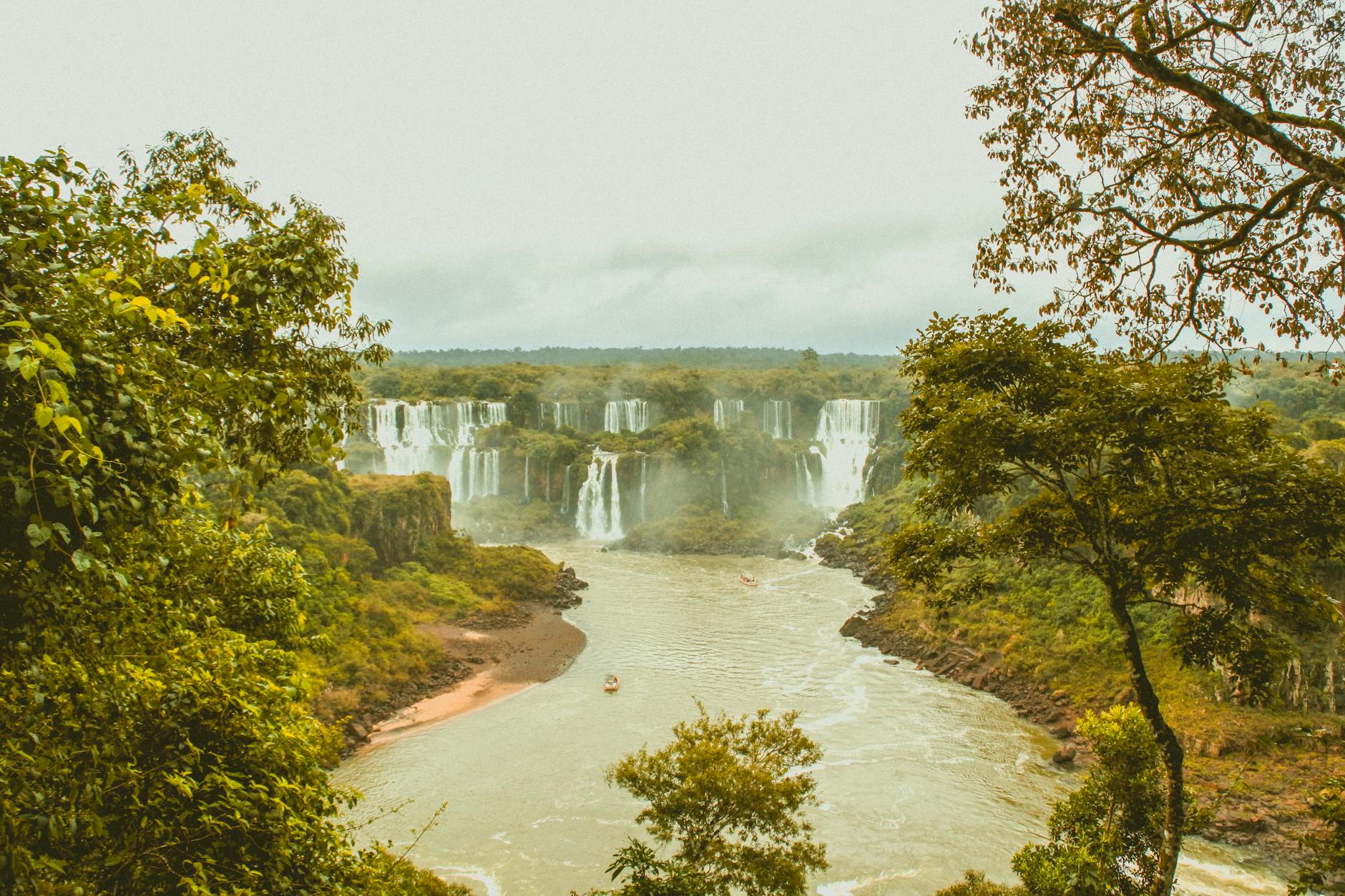
The park entrance is roughly 11 km from the terminal, 12–15 minutes by car or about 35 minutes on the Line 120 bus. The Brazilian side delivers the panoramic, face-on view across the full sweep of the falls — the wide-angle perspective to Argentina’s close-up. The main trail is a 1.2-km walkway ending at a platform beneath the Garganta del Diablo (Devil’s Throat) spray.
Entry as of early 2026: ~R$131 for foreign visitors, ~R$118 for Brazil and Mercosur citizens, under-6 free. Buy tickets online to skip the entrance queue. Allow three to four hours inside the park, including the internal shuttle ride from the entrance to the trailhead.
Layover math: Park entrance is ~15 minutes from the terminal by car. You need roughly 2.5 to 3 hours inside to make the visit worthwhile. Add your return security and boarding buffer back at IGU. Realistically, you need a 5-to-6-hour gap between flights to attempt it without anxiety. Below that, stay airside.
⏱️ Layover to the Brazilian falls: minimum 5–6 hours
~15 min to the park by car + ~2.5–3 h inside + return transit + security buffer. Below a 5-hour connection, the math doesn’t work. The Argentine side is a full day (border crossing 1.5–2 h each way) and is not a layover option at any connection length.
⚡ Itaipu Dam
One of the largest hydroelectric dams on earth by generating capacity, on the Paraná River about 20 km north of the airport, jointly operated by Brazil and Paraguay. Guided tours run daily in two formats: a panoramic tour along the crest and viewpoints, and a technical (special) tour inside the structure to the generating galleries. The complex also runs the Itaipu Iluminada nighttime light-and-sound show on Friday and Saturday evenings — confirm the current schedule before booking. A half-day on its own and a strong contrast to the falls — engineering rather than nature. Not layover-friendly given the distance and fixed tour scheduling, but an easy add for anyone staying a night or more. Book the technical tour ahead; it has limited daily slots and ID requirements.
🦜 Parque das Aves (Bird Park)
A privately run aviary directly across the road from the national-park entrance, roughly 11 km from the airport, with walk-through enclosures of toucans, macaws, and rescued raptors. It pairs naturally with a Brazilian-side falls visit — most people do both in one outing since they share the same road. A reasonable rain-day or with-children option. Entry is ticketed separately from the national park.
🏳️ The Tri-Border (Marco das Três Fronteiras)
Foz sits at the Tríplice Fronteira where Brazil, Argentina, and Paraguay meet across the Iguaçu and Paraná rivers. The Brazilian-side landmark — an obelisk-marked viewpoint — looks across to the matching markers in the other two countries. Quick, free, and in the city.
🛍️ Crossing into Paraguay — Ciudad del Este
The Friendship Bridge (Ponte da Amizade) links Foz directly to Ciudad del Este, about 10 minutes from the city by road. Ciudad del Este is South America’s great duty-light shopping bazaar — electronics, perfume, the lot.
Do not treat this as a casual layover side-trip. It involves a real international border, the bridge congests badly (heaviest into Paraguay 07:00–09:00 and back into Brazil 16:00–18:00), and immigration formalities apply if you stay beyond the local-traffic zone. This is a day-trip for people staying in Foz, not a between-flights errand.
🌿 Crossing into Argentina — Puerto Iguazú and the Argentine Falls
The Argentine side of the falls (Parque Nacional Iguazú) is the closer-up, more immersive experience — different park, different ticket, different country. Reaching it from Foz means crossing the Tancredo Neves Bridge over the Iguaçu River: budget 1.5 to 2 hours each way depending on border control. Combined with a separate park entry and several hours inside, the Argentine side is a full day minimum. If you want both sides, plan two days. Carry your yellow-fever certificate for the land crossing.
🔧 Practical Notes
Wi-Fi and SIM. The terminal offers free Wi-Fi across the building — adequate for messaging and boarding passes, less reliable for heavy use at peak. For a local SIM or eSIM, the major Brazilian carriers are Vivo, Claro, and TIM. An eSIM bought before arrival avoids the CPF tax-number registration that physical-SIM purchases can require. Coverage across the falls area and the tri-border is generally solid.
Money on the ground. Cards work nearly everywhere in Foz; carry some cash in small reais notes for the city bus, market stalls, and tips. Pix is ubiquitous but needs a Brazilian bank account — a contactless card is the practical daily tool.
Tipping. A 10% service charge (serviço) is usually added to restaurant bills in Brazil and is effectively expected. Beyond that, rounding up is normal but not obligatory. No tip is expected for taxis beyond rounding the fare.
Tap water. Foz’s municipal supply is treated and broadly considered potable, but most visitors drink bottled or filtered water. Bottled water is cheap in town and marked up airside.
Safety. The falls area is well policed, but Foz is a busy border town with the petty-crime profile that comes with it. Watch belongings at the bus terminal (TTU) and in crowded market areas, don’t flash electronics near the Friendship Bridge, and keep valuables out of sight. After dark, use a ride-hail app rather than walking unfamiliar streets near the border crossings. The airport and national park are secure and unremarkable for incidents.
❓ Frequently Asked Questions
📊 At a Glance — IGU 2026
| Feature | Detail |
|---|---|
| IATA / ICAO | IGU / SBFI |
| Full name | Foz do Iguaçu/Cataratas International Airport |
| City / state | Foz do Iguaçu, Paraná, Brazil |
| Distance to city centre | 13 km southeast (~20–30 min) |
| Distance to national-park entrance | ~11 km (~12–15 min by car, ~35 min on bus 120) |
| Operator | Motiva (ex-CCR); ASUR acquisition pending approval |
| Terminals | 1 passenger terminal |
| Runway | Single, 15/33, 2,705 m asphalt |
| 2025 passengers | ~2.27 million (~23% up year-on-year) |
| Carriers | Azul, Gol, LATAM Brasil, JetSmart (seasonal Santiago) |
| Long-haul | None; connect via GRU / Rio / CNF |
| Currency | Brazilian real (BRL); ~R$5.04/US$1, ~R$5.9/€1 |
| Visa — US / CA / AU | E-visa mandatory since 1 Jan 2026; US$80.90; brazil.vfsevisa.com |
| Visa — most other Western nationals | Visa-free, 90 days |
| Yellow fever | Strongly recommended (Paraná zone); not required for air entry |
| Bus to falls / city | Line 120, ~R$4.40, ~35 min to park entrance |
| Taxi to city centre | ~R$80 regulated; Uber / 99 ~R$41, ~20 min |
| Lounges | Advantage VIP (Gate 1, 03:40–20:20) + The Lounge Cataratas (Gate 4); Priority Pass / LoungeKey; pay-in ~R$180 |
| Brazilian-side park entry | ~R$131 foreigner / ~R$118 Mercosur; under-6 free |
| Layover to falls | Brazilian side viable on a 5–6 h connection; Argentine side not viable |
| Tri-border crossings | Friendship Bridge → Ciudad del Este (PY) ~10 min; Tancredo Neves Bridge → Puerto Iguazú (AR) 1.5–2 h each way |
| Tap water | Treated / potable; most visitors drink bottled |
| Free Wi-Fi | Yes, terminal-wide |