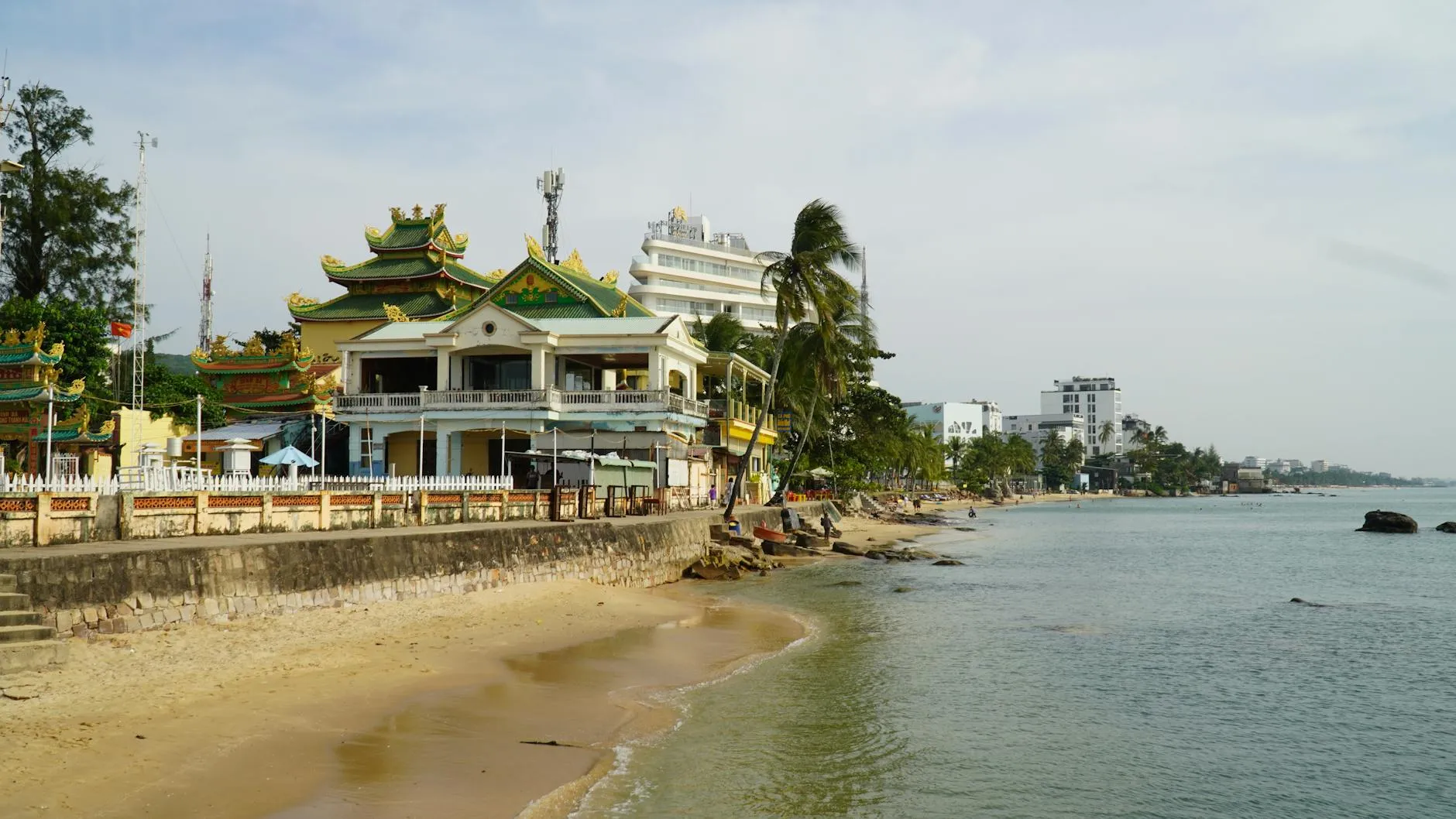
Phu Quoc International Airport (PQC) — Airport Guide 2026
Phu Quoc International Airport is the sole commercial airport on Vietnam’s largest island, and it comes with a border rule that exists nowhere else in the country: a 30-day visa exemption that any nationality can use — provided the island is the whole trip.
Quick Reference
Phu Quoc International Airport
PQC / VVPQ
Southern Phu Quoc Island, Kien Giang Province, ~10 km from Duong Dong town
One terminal, ~24,000 m², two floors — ground = arrivals/immigration/customs, first = departures/check-in/security
Vietnamese dong (VND); 1 USD ≈ 26,300 VND, 1 EUR ≈ 30,800 VND (late May 2026)
Phu Quoc 30-day visa exemption — all nationalities (Decision No. 80/2013/QD-TTg, in force since 10 March 2014)
National visa exemption (selected nationalities) or e-visa ($25 single / $50 multiple, up to 90 days, all nationalities)
Public bus 25,000 VND / metered taxi ~180,000–220,000 VND / GrabCar ~120,000–200,000 VND; 20–30 min
The SENS Leisure Lounge (international, near Gate 7, Priority Pass); SH Premium Lounge (domestic, Priority Pass)
Vietnam Airlines, Vietjet Air, Vietravel Airlines
Vietjet Air, Korean Air, Thai Airways; others seasonal
Vietnamese; English in tourist areas and at the airport
🛫 The Terminal
PQC is a single terminal of roughly 24,000 square metres on two floors. Arrivals, baggage claim, immigration and customs are on the ground floor; check-in, departures, security and the lounges are upstairs. Domestic and international flights share the building, with international processing in its own zone. The scale is manageable — gate to check-in is minutes, not a tram ride — which is the only architectural feature worth noting.
Domestic flights carry the volume. Vietnam Airlines, Vietjet Air and Vietravel Airlines run the routes that connect Phu Quoc to Ho Chi Minh City, Hanoi and the secondary mainland cities. If you are coming from the mainland, you are almost certainly on one of those three carriers.
International service is thin and seasonal. As of May 2026, scheduled international routes connect the island with Hong Kong, Beijing, Bangkok, Busan and Seoul, operated by Vietjet Air, Korean Air and Thai Airways. The charter and seasonal market here is volatile — a route that runs in peak season may not exist in the shoulder months. Confirm your specific connection before booking.
🛂 Border & Visa
This is where PQC diverges from every other airport in Vietnam. There are three distinct legal routes in, and the one that applies depends entirely on what you plan to do after you land.
🏝️ The Phu Quoc 30-day island exemption
In force since Decision No. 80/2013/QD-TTg took effect on 10 March 2014, this exemption applies to all nationalities with no country list. The conditions are what catch people out:
- You must arrive directly through Phu Quoc — either PQC airport or the island seaport. Connecting through Ho Chi Minh City or another mainland airport is fine only if you remain airside in the international transit zone and do not clear immigration. If you pass through mainland immigration, the island exemption is gone.
- You must stay on Phu Quoc Island for the duration. This exemption does not permit onward travel to the Vietnamese mainland.
- You must hold a return or onward ticket departing Phu Quoc within 30 days, to a destination outside Vietnam. Immigration can and does ask to see it.
- The stay is up to 30 consecutive days. There is no extension mechanism on the island.
⚠️ Overstay fine — ~1,250,000 VND per day
There is no grace period and no way to extend on the island. The fine accrues daily. Book your outbound ticket before you arrive, not when you feel like leaving.
⚠️ The most common border mistake at PQC
Arriving on the island exemption and then trying to fly to Ho Chi Minh City or Hanoi. The exemption is island-only. To continue to the mainland, you need a visa you do not have. Buy an e-visa before you travel if there is any possibility your plans extend beyond Phu Quoc.
If your entire trip is a Phu Quoc beach holiday flown in and out of PQC, the island exemption is the route you want. No application, no fee, no portal.
🗺️ The national unilateral visa exemption
If you are going to the mainland and your nationality is covered, this is the relevant route:
- 45-day stay — UK, Germany, France, Italy, Spain, Russia, Japan, South Korea, Denmark, Sweden, Norway, Finland. Valid through 14 March 2028.
- 45-day stay — Belgium, Bulgaria, Croatia, Czech Republic, Switzerland, Luxembourg, Hungary, Netherlands, Poland, Romania, Slovakia, Slovenia. Valid from 15 August 2025 through 14 August 2028.
- 30-day stay — ASEAN neighbours: Brunei, Cambodia, Indonesia, Laos, Malaysia, Myanmar, Philippines, Singapore, Thailand. Also Chile and Panama.
You need a passport with at least two blank pages. These windows are set by decree and have been revised before — confirm your nationality’s current status closer to travel.
🌐 The e-visa
Open to all nationalities since August 2023. Allows up to 90 days, single- or multiple-entry. Official government fees: $25 for single entry, $50 for multiple entry. Apply through the official Vietnamese e-visa portal before you fly — processing typically takes several working days.
💡 E-visa: official portal only
Searching “Vietnam e-visa” surfaces a wall of third-party agents who charge a markup on top of the government fee. The official government portal charges the $25/$50 directly. Use it.
One thing that is not relevant here: Phu Quoc is Vietnamese territory. No European or American pre-travel authorisation system has any bearing on entry. Vietnam runs its own regime entirely.
🚌 Getting to Town
The airport sits about 10 km from Duong Dong, the main town. The road is 20–30 minutes depending on traffic.
🚌 Public bus — 25,000 VND
The cheapest option by a large margin. Runs roughly every 20 minutes between about 06:00 and 18:00. Useless for most international arrivals, which tend to land outside that window.
🚗 Metered taxi — 180,000–220,000 VND
Reputable companies operating at PQC include Xanh SM, Mai Linh and Vinasun. Insist on the meter; if the driver proposes a “fixed” price, insist or walk to the next cab.
📱 Grab — 120,000–200,000 VND
Usually cheaper than a metered taxi and the price is fixed in the app before you get in. The constraint: you need a working data connection at the moment you book. Sort out an eSIM or local SIM before you land.
Hotel transfers cost more than a taxi but include a guaranteed seat and a meet-and-greet, which is worth something after a long international arrival.
⚠️ The tout trap at arrivals
Touts in the arrivals hall quote “fixed” prices of 400,000–500,000 VND for a ride the meter puts at roughly half that. The defence is simple: use the metered taxi rank outside, or book in the Grab app before you exit. Do not negotiate a hand-shaken price for an unmarked car. The same applies to “shuttle” upsells pitched as a per-head deal — they are not deals.
🛋️ Lounges
PQC has lounge access on both sides of the terminal, and both are reachable on Priority Pass.
🛋️ The SENS Leisure Lounge — international terminal
Airside in international departures, second floor, near Gate 7. Open 05:30–23:30 daily, three-hour maximum stay per visit. Priority Pass accepted. This is the relevant lounge for an international departure or a long international connection.
SH Premium Lounge Phu Quoc is on the domestic side and is also Priority Pass accessible — the option if you are continuing to a mainland Vietnamese city.
DragonPass and LoungeKey often access Priority Pass lounges, but per-lounge acceptance is not guaranteed and changes. Check your provider’s app before you count on getting in. Walk-up paid entry is generally available; confirm the rate at the desk.
🍜 Food Before You Fly
The airside dining at PQC is not a reason to arrive early. You will find Vietnamese coffee, noodle and rice counters, Western fast-food options and convenience kiosks in the departures area. Prices carry the standard airport markup; a bowl of phở or a bánh mì here is still far cheaper than comparable airport food in Europe or East Asia, but cheaper than at the airport is a low bar.
🌿 Eat in town, not at the terminal
Duong Dong’s night market and the seafood places along the coast are a different category of meal from anything available airside. If you have time before your flight, go there. Phu Quoc’s fish sauce (nước mắm) has been produced on the island for generations; buy it at source, not in a terminal gift shop.
Duty-free in international departures carries the standard liquor, tobacco, fragrance and confectionery assortment, plus local products: fish sauce, Phu Quoc black pepper (a genuine local crop), and sim wine made from the island’s rose-myrtle berry. None of it warrants arriving early, but the pepper and fish sauce are honest souvenirs if you have dong left before boarding.
⏱️ Layover Feasibility
A layover at PQC is unusual enough to need an honest framing. A true airside transit only exists on the rare itinerary that keeps you in the international zone without clearing immigration. For most travellers, a “layover” means you have actually entered the island — and once you clear PQC immigration under the 30-day exemption, you are on Phu Quoc, not in transit.
With that understood, here is the math for a stop into Duong Dong:
The drive is 20–30 minutes each way — 40–60 minutes of road time round-trip. Add a 60–90-minute buffer to be back at the airport for international departure, and your fixed overhead before you see anything is roughly 1 hour 45 minutes to 2 hours 30 minutes.
- 3-hour window — not viable. The transport overhead consumes most of it. Stay at the airport.
- 4–5-hour window — tight. Roughly one to two hours on the ground, enough for a walk around Duong Dong or a sit on Long Beach (Bãi Trường) just south of town. Keep a hard eye on the clock and budget for traffic.
- 6-hour-plus window — comfortable. A proper meal in town and a beach hour without stress.
Sights further out do not fit a short stop. The Phu Quoc United Center and Grand World complex in the north, and the Hon Thom cable car — one of the longest over-sea cable cars in the world — at the southern tip, are half-day excursions that each require a long road transfer on top of the visit. VinBus runs free shuttle routes from the airport to the United Center and Grand World area, but this is a landside service for people who have cleared immigration, not an airside transit option.
💡 Practical Notes
Connectivity. The airport has Wi-Fi. The more reliable move is to arrive with a Vietnamese eSIM already active — Viettel, Vinaphone and Mobifone all cover Phu Quoc well. You want data working the moment you exit arrivals, both to book a Grab and to confirm anything on your e-visa or onward ticket.
Cash and ATMs. Vietnam runs largely on cash once you leave the larger resorts. The dong comes in large denominations — get comfortable counting zeros. Use the ATMs in the terminal rather than the currency-exchange counters; bureau-de-change rates at airports carry a meaningful markup, and an ATM withdrawal at the interbank rate is almost always better value. Carry small notes for the bus and street food — a 500,000 VND note is awkward for a 25,000 VND fare. Cards work at hotels, larger restaurants and supermarkets; the night market, local cafés and the public bus do not take cards.
At the immigration desk. Whichever entry route applies, have your paperwork accessible before you reach the desk. For the island exemption: a return or onward ticket departing Phu Quoc within 30 days and a passport with at least six months’ validity and two blank pages. For an e-visa: the printed or saved approval. The rules are not complicated, but showing up at the desk needing to scroll through a cluttered inbox is slower for everyone.
❓ FAQ
📊 At a glance — PQC 2026
| Item | Detail |
|---|---|
| Airport name | Phu Quoc International Airport |
| IATA / ICAO | PQC / VVPQ |
| Location | Southern Phu Quoc Island, Kien Giang Province |
| Distance to Duong Dong | ~10 km, 20–30 min by road |
| Terminal | One terminal, two floors; domestic + international |
| Public bus fare | 25,000 VND, ~every 20 min, ~06:00–18:00 |
| Metered taxi to town | ~180,000–220,000 VND |
| GrabCar to town | ~120,000–200,000 VND |
| Island entry | Phu Quoc 30-day exemption, all nationalities (Decision 80/2013/QD-TTg, effective 10 March 2014) |
| Mainland entry | National exemption (selected nationalities) or e-visa |
| E-visa | $25 single / $50 multiple, up to 90 days, all nationalities |
| Passport requirement | 6 months’ validity, 2 blank pages |
| Overstay fine | ~1,250,000 VND/day |
| International lounge | The SENS Leisure Lounge, near Gate 7, 05:30–23:30, Priority Pass |
| Domestic lounge | SH Premium Lounge, Priority Pass |
| Domestic carriers | Vietnam Airlines, Vietjet Air, Vietravel Airlines |
| International carriers | Vietjet Air, Korean Air, Thai Airways, others (seasonal) |
| Currency | Vietnamese dong (VND); 1 USD ≈ 26,300, 1 EUR ≈ 30,800 (late May 2026) |
| Cash strategy | Terminal ATMs over exchange counters |
| Connectivity | Buy a local eSIM/SIM (Viettel, Vinaphone, Mobifone) before arrival |
🌍 Planning the trip? Read our Vietnam travel guide — best time to go, where to stay, and how to get around.