Vietnam — Complete Travel Guide 2026
Vietnam is not a destination you “do” from one hotel — it’s a 1,650 km transect through three climates, three cuisines and a thousand years of competing history, and the single most useful thing to understand before you book is that the north, centre and south are never all at their best on the same date. Get the route, the direction and the timing right and it’s one of the most rewarding, best-value trips in Asia; get them wrong and you’ll spend half of it under typhoon cloud or in 38°C smog. This guide is about getting them right.
Quick Reference
Southeast Asia, the long S-shaped country on the South China Sea, ~1,650 km north to south
Hanoi (HAN), Ho Chi Minh City / Saigon (SGN), Da Nang (DAD); plus Nha Trang/Cam Ranh (CXR) and Phu Quoc (PQC)
Vietnamese dong (VND); ~26,000–28,000 VND to €1
Vietnamese; English widely understood in tourist zones, patchy in the countryside
90-day e-visa online for most nationalities; 45-day visa-free for many Europeans through Aug 2028
No single best month for the whole country — the three regions peak at different times (see below)
Halong Bay karst, Hoi An’s lanterns, Sapa’s rice terraces, the world’s biggest caves, pho and street food, motorbikes
You don’t base — you move. Hanoi or Saigon as bookends; Hoi An as the central anchor
Editor’s Note: Read This First
Three decisions shape your whole trip, and almost everyone gets at least one of them wrong.
Decision one: the route. Vietnam is a line, not a hub. Nearly everyone runs it end to end — Hanoi and the north, then the imperial centre, then Saigon and the south (or the reverse). The classic question is which direction. There’s no wrong answer, but there’s a logic: fly into Hanoi and out of Saigon (or vice versa) so you never backtrack the length of the country. An “open-jaw” ticket — in to HAN, out of SGN — costs about the same as a return and saves you a wasted 1,700 km. Pick your direction by season, not preference (more below).
Decision two: how long. The honest minimum to see the north, centre and south without it becoming a transit marathon is two weeks, and even that is brisk. Three weeks is the sweet spot. Ten days forces a brutal choice — do the north properly, or the centre, but not both with any depth. Don’t try to “see Vietnam” in a week; pick one region and go deep instead.
Decision three: when. This is the trap. There is no month when Hanoi, Hoi An and the Mekong are all at their best. The north is glorious in autumn (Sep–Nov) and spring (Mar–Apr) but cold and grey December–February. The centre’s beach season (Hoi An, Da Nang, Hue) is roughly Feb–Aug and gets battered by typhoons Sep–Nov. The south is dry and lovely Nov–April. The least-bad all-rounders are March–April and October, when most of the country is workable at once — but you will still compromise somewhere.
Warning — the no-single-season trap: Do not pick “October” because a blog said it’s “the best time to visit Vietnam.” October is wonderful in the north and the south and is peak typhoon risk in the centre — exactly when Hoi An floods and Da Nang’s flights get cancelled. Plan around your most important region, then accept the others will be second-best.
Should You Go? Who It’s For — and Who It Isn’t
Vietnam rewards travellers who like movement, food, history and a bit of friction. You’ll be on overnight trains, in karst-fringed boats, on the back of a motorbike, eating from a plastic stool on a kerb where the broth beats anything in a restaurant back home. It’s astonishing value — €40 a day buys a comfortable trip, €80 a genuinely good one.
It’s not a flop-and-drop beach holiday (Phu Quoc aside, and even that’s better as a coda than the whole trip), and not for travellers who need everything calm and predictable — the cities are loud, the traffic is a wall of scooters, and the hard-sell in the tourist hubs grates. Nor is it a place to be lazy about logistics: the geography is long, the weather is regional, and a great trip versus a frustrating one is almost entirely in the planning. But if you want one country with mountains, world-class caves, an imperial citadel, a UNESCO old town, the planet’s best street food and a beach island — and you’ll keep moving to get them — Vietnam is hard to beat.
Getting There — Which Airport, the E-Visa, and the Route Logic
From Europe, you’ll fly into one of three gateways, and which one you pick is really a route decision. Hanoi (HAN) is the door to the north; Ho Chi Minh City / Saigon (SGN) is the door to the south; Da Nang (DAD) drops you straight into the centre and is the smart choice if you only have time for Hoi An/Hue. Most long-haul Europeans connect via a Gulf or East/Southeast Asian hub; there are also a handful of direct services. Book an open-jaw — in to one end, out of the other — and run the country in between. (Don’t fixate on a specific fare here; just price HAN-in/SGN-out against the reverse and let season decide.)
The e-visa. This is the one bit of admin and it’s genuinely easy in 2026. Vietnam’s electronic visa is now a 90-day visa, single- or multiple-entry, applied for online at the official government portal evisa.gov.vn (use the real one — the top Google results are paid middlemen who charge a markup for the same thing). The fee is about €25 for single-entry and €50 for multiple-entry, paid by card, with the visa typically issued in 3–5 working days (apply at least a week out). Your passport needs 6 months’ validity and a blank page.
Better still, many European nationalities don’t need it at all for shorter trips. Citizens of Germany, France, Italy, Spain, the UK and several other European countries get 45 days visa-free under a scheme running August 2025 through August 2028 — enough for most two-to-three-week trips. Check your own nationality and the current day-count before you book; if you’re staying longer than the exemption, do the 90-day e-visa anyway for headroom. And a useful quirk: if Phu Quoc is your first stop in Vietnam, the island has its own 30-day visa exemption for all nationalities as long as you don’t leave it.
Tip: Apply for the e-visa on the official portal even if you think you’re visa-exempt and your stay is borderline (say, 40-something days). The exemption clock is unforgiving at the border, and a 90-day e-visa removes the maths entirely.
The North — Mountains, Karst and the Capital
Hanoi (keep it brief)
Hanoi is the characterful, chaotic, deeply atmospheric capital — a city of lake-side mornings, French-colonial bones, egg coffee balconies and an Old Quarter that hasn’t decided which century it’s in. It’s the best food city in the country and the launchpad for everything in the north, but it deserves its own treatment rather than a paragraph squeezed into a country guide. Give it two or three days at the start (or end) of your trip and read our full Hanoi city guide for the detail.
Halong Bay & the quieter Lan Ha Bay
The emerald seascape of limestone towers rising out of the Gulf of Tonkin is the image of Vietnam, and it earns the hype — but the experience depends entirely on the boat and the bay you pick. Halong Bay proper is spectacular and very busy: hundreds of cruise boats and a “floating-hotel” scale to the bigger ships. Lan Ha Bay, just south around Cat Ba Island, has the same drowned-karst scenery (arguably denser), cleaner water, far fewer boats, and smaller cruises of 20–40 passengers where the staff learn your name. Want the legend and the grandest caves? Do Halong. Want the quieter, more intimate version? Do Lan Ha — the choice most repeat visitors make.
The standard is an overnight cruise (one night, two days) from around €100–160 per person for a decent mid-range boat, climbing to €200+ for genuine luxury — and this is the one part of the trip where it is worth spending up a tier. There are also two-night options that reach the empty corners.
Warning — cheap cruises are a false economy: The bottom-end €40–60 “Halong day trip” and the cheapest overnight boats are where the horror stories live — tired cabins, rushed itineraries, the most crowded spots, and engines that drone all night. On a bay this beautiful, pay the extra €40–50 for a reputable mid-range boat. Read recent reviews, not the brochure.
Ninh Binh / Tam Coc — “Halong Bay on land”
Two hours south of Hanoi, the same karst geology erupts out of flooded rice paddies instead of the sea, and you glide through it in a small wooden sampan rowed by a local’s feet — a genuinely surreal sight. The Trang An complex (UNESCO-listed, with cave-tunnels and the Kong: Skull Island film backdrop) is the bigger, more dramatic boat route; Tam Coc is the classic three-cave river run, best in the golden weeks before the May–June harvest. Ninh Binh is calmer and far less hassled than the coastal bay, and a great alternative if Halong’s logistics put you off. A day trip works, but an overnight lets you cycle the paddies and climb the Mua Caves viewpoint at a civilised hour.
Sapa — rice terraces and the Hmong villages
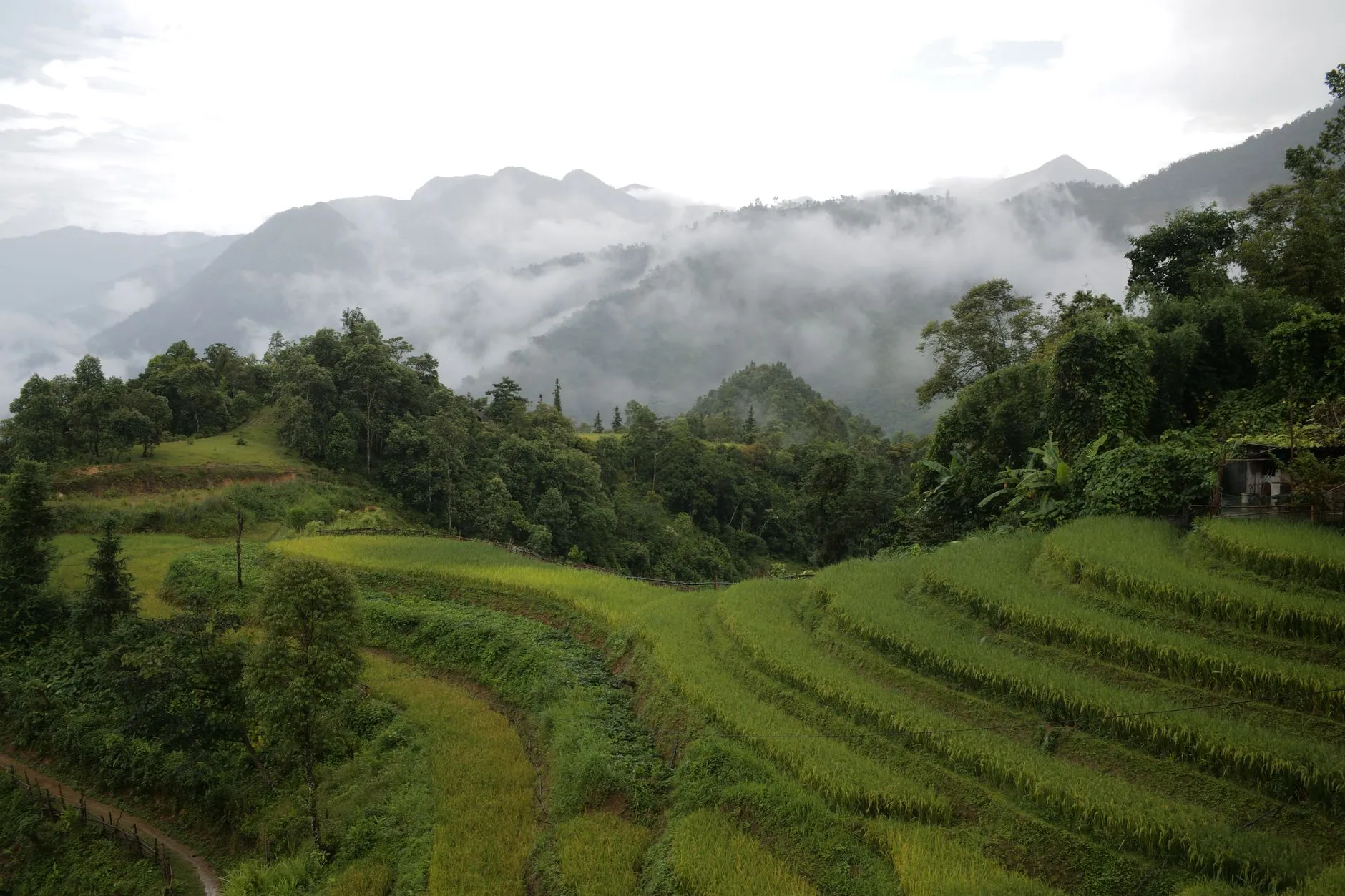
Up near the Chinese border, Sapa is the rice-terrace heartland: vast amphitheatres of green-then-gold paddy carved into the mountains, threaded with the trails of the Black Hmong, Red Dao and other ethnic-minority communities. The single best window is early-to-mid September, when the terraces turn gold for the harvest — a short, glorious few weeks — with the May–June “water-pouring” season (mirror-flooded fields) a close second. The town itself has become over-built and touristy; the magic is out in the Muong Hoa Valley on a guided village-to-village trek, ideally with a homestay night.
Getting there is half the appeal: the overnight train to Lao Cai then a transfer van up the mountain, or a faster expressway bus straight from Hanoi (~5–6 hours). For the summit of Fansipan — at 3,143 m, the highest peak in Indochina — a cable car does in 15 minutes what used to be a two-day climb; go October–November for the clearest skies. Cat Cat village, 2 km from town, is the easy walkable taster; the real rewards are deeper in.
The Ha Giang Loop — the epic northern motorbike route
For many travellers this is now the northern Vietnam experience: a roughly 400 km, 3-to-4-day loop through the wildest, most vertical scenery in the country — limestone plateaus, switchback passes, the Nho Que river gorge, remote Hmong, Tay and Dao villages, homestays and the flag tower at the country’s northern tip. You can ride it yourself if you’re confident and licensed, but the overwhelmingly popular (and far safer) option is to go as a passenger behind a local “easy rider” — you sit on the back, they handle the terrain, and it costs surprisingly little.
Caution — the 2026 Ha Giang permit: From 1 June 2026, all foreign visitors entering the border areas of the Ha Giang Loop must hold a Border Area Entry Permit. Reputable easy-rider tour operators arrange it for you, but if you’re riding independently, sort it before you go — being turned back at a checkpoint mid-loop is a real risk now.
Caution — self-riding risk: If you’re tempted to ride the Loop yourself, know that this is genuinely demanding mountain riding, that travel insurers routinely refuse motorbike claims if you don’t hold the correct licence, and that the medical infrastructure up here is thin. If you’re not an experienced rider, take the easy-rider option — it’s the smart call, not the soft one.
The Centre — Old Towns, Emperors and the Biggest Caves on Earth
This is where I’d spend the most time, and where the country’s best single base sits.
Hoi An — the lantern town, tailors and the cooking
Hoi An is the postcard: a perfectly preserved 15th-century trading port of mustard-yellow shophouses, a wooden Japanese covered bridge, and silk lanterns that turn the riverfront into something out of a dream after dark. It’s also a working town with three more reasons to linger — the tailors, the beach and the food. The Old Town is touristy and you’ll pay a small entrance ticket to wander it, but it earns the fuss; come back at night when the day-trippers leave and the lanterns come on.
The tailoring is a Hoi An institution — there are 400-plus tailor shops that will run you up a suit, dress, coat or shirt in 24–72 hours. To get something good, allow at least two or three full days (you want a first fitting and a second adjustment), bring a reference garment or clear photos, and don’t book your made-to-measure on your last morning.
Caution — Hoi An tailors are a lottery: Quality ranges from genuinely excellent to fast-fashion that falls apart by the time you’re home. The cheapest “suit in 4 hours” deals are exactly the ones to avoid. Use a shop with a real track record, insist on more than one fitting, check the seams and lining yourself, and never accept a same-day rush job on anything you actually care about.
Three kilometres away, An Bang beach is the easy reward, and Hoi An is one of the best places in the country to take a cooking class — many start with a market tour and a basket-boat ride. Try cao lau (the local pork-and-noodle dish, made — so the story goes — only with water from a particular ancient well) and white rose dumplings before you leave.
Hue — the imperial citadel and the royal tombs
A few hours up the coast, Hue was the seat of the Nguyen dynasty, Vietnam’s last imperial line, and its walled Citadel — with the Forbidden Purple City at its heart — is the grandest historical site in the country. War damage means it’s part ruin, part restoration, but the scale, the blood-red corridors and the throne hall are genuinely moving. Spread out along the Perfume River are the elaborate royal tombs of the emperors, each one a landscaped complex worth a half-day by bike or boat. Hue’s food is its own reward — this is the home of bun bo Hue, the fiery beef-and-lemongrass noodle soup, and of an entire refined court cuisine. Give it a full day, two if you love history.
The Hai Van Pass between Hue and Da Nang is one of the great coastal drives — take the slow road (by car, motorbike or the Top Gear-famous easy-rider transfer) rather than the tunnel.
Da Nang — the beach city and the Golden Bridge
Da Nang is modern, clean, and the centre’s transport hub (its airport, DAD, is the one to use if you’re only doing the centre). It’s got a long city beach, a buzzing food and café scene, and it makes a comfortable, well-connected base. The headline sight is up in the hills at Ba Na Hills: the Golden Bridge (Cau Vang), a ~150 m walkway held aloft by two giant stone hands, reached by one of the world’s longest cable cars. It’s photogenic and undeniably a spectacle — but be clear-eyed: Ba Na Hills is a heavily commercialised theme park (a faux-French village, fairground rides, big crowds), and the bridge itself is a quick photo. Go early to beat the queues, and treat it as a half-day novelty, not a highlight.
Phong Nha — the world’s biggest caves
North of Hue, Phong Nha-Ke Bang National Park holds the most extraordinary cave systems on the planet, and it’s still far less crowded than Vietnam’s marquee sights. The crown is Son Doong, the largest cave in the world — big enough to hold a city block and its own jungle and weather — but visiting it is a serious commitment: only one operator (Oxalis) is licensed, expeditions are multi-day, permits sell out a year ahead, and it costs around €2,500–3,000 per person. For everyone else, the park is still a knockout on a normal budget: Paradise Cave is a vast, easily-walked dry cavern (entry roughly €8–10), and Phong Nha Cave, the Dark Cave and a clutch of others fill out two or three quietly spectacular days. If you like the karst scenery of Ninh Binh but want it wilder and emptier, this is your place.
The South — the Frenetic Hub, the River and the Island
Ho Chi Minh City / Saigon (keep it brief)
Saigon is Vietnam at full throttle: a hot, fast, commercial southern metropolis of motorbike rivers, rooftop bars, war history and the country’s most cosmopolitan food scene. It’s the gateway to the Mekong, the Cu Chi Tunnels and the southern beaches, and most trips begin or end here. Like Hanoi, it’s too big and too good for a country-guide paragraph — give it two or three days and read our full Ho Chi Minh City guide for what’s actually worth your time.
The Mekong Delta — floating markets and the boats
South and west of Saigon, the great river fans out into a green maze of channels, paddies, orchards and stilt-house villages — the “rice bowl of Vietnam.” The classic draw is the Cai Rang floating market near Can Tho, the delta’s largest wholesale market, where boats laden with produce trade from before dawn. Here’s the honest version: a single-day group tour from Saigon is too rushed to be worth it — you spend more time on the bus than the boat. To actually feel the delta, stay overnight in Can Tho (or a homestay) and take a small boat out at first light (the market is best before 7am and winds down by mid-morning), then cycle the back-lanes. The delta is about slow river life, not a checklist — give it a night, not a morning.
The Cu Chi Tunnels
An easy half-day from Saigon, the Cu Chi Tunnels are the claustrophobic underground network the Viet Cong used during the war — a sobering, fascinating, slightly theme-park-ish site where you can crawl through a (widened) section of tunnel and see the booby traps and living quarters. It pairs naturally with the war history in Saigon itself and is often bundled with a Mekong day trip — though doing both in one day is a long, shallow slog. Worth it for the history; go in the morning.
Phu Quoc — the southern beach island
Off the southwest coast (closer to Cambodia than to Saigon), Phu Quoc is Vietnam’s beach-island finale — white sand, warm sea, sunset on Long Beach, and a fast-growing resort scene that made it the symbolic landing point for Vietnam’s 20-millionth international visitor in December 2025. It has its own international airport (PQC) with growing direct connections, that handy 30-day visa-free entry if you fly in first, and a dry season (roughly Nov–April) that’s the inverse of the central coast’s. It’s developed quickly and the north of the island is being heavily built up, so manage expectations — but as a few days of decompression at the end of a long overland trip, it does the job nicely. As a whole holiday in itself, it’s beatable elsewhere in Asia.
The Classic Route — How Long It Really Takes
The full Hanoi-to-Saigon (or reverse) run is the spine of a Vietnam trip, and people consistently underestimate it. The distance is roughly 1,650 km, ~1,726 km by rail, and the realistic schedule looks like this:
- North (Hanoi + Halong/Sapa/Ninh Binh): 4–6 days
- Centre (Hue + Hoi An + Da Nang, maybe Phong Nha): 4–6 days
- South (Saigon + Mekong + maybe Phu Quoc): 3–5 days
That’s two weeks minimum for the highlights, three weeks to do it without rushing, and longer if you add the Ha Giang Loop (a 4-day detour from the north) or serious time on the island. Trying to compress the whole country into ten days means living on overnight transport and seeing things through a bus window — better to drop a region than to skim all three.
When to Visit — Month by Month, Region by Region
Internalise this and you’ve solved the hardest part of planning Vietnam: the three regions have three different best seasons, and they rarely line up.
Northern Vietnam (Hanoi, Halong, Sapa, Ninh Binh, Ha Giang): best in spring (Mar–Apr) and autumn (Sep–Nov) — warm, dry, clear, with the Sapa terraces golden in September. Winter (Dec–Feb) is cold, grey and drizzly (Sapa can hit near-freezing); the heart of summer is hot and humid with downpours.
Central Vietnam (Hue, Hoi An, Da Nang, Phong Nha): the dry beach season runs roughly February to August. February–May is the sweet spot (warm, not yet brutal); June–August is intensely hot. The killer is September–November, the typhoon season, when Hoi An genuinely floods and Da Nang’s flights get delayed or cancelled — the 2026 season is forecast to run strong from late summer into October.
Southern Vietnam (Saigon, Mekong, Phu Quoc): two simple seasons — dry (Nov–April), which is the time to go, and wet (May–Oct), with daily tropical downpours (usually short, but heavy). Temperatures stay hot year-round.
The compromise months: March–April and October are the closest things to a country-wide green light — most of the country is workable, though October still carries central-coast typhoon risk. Pick the region that matters most to you and optimise for that, then accept the others will be a notch off peak. If the centre is your priority, lean spring; if the north’s rice terraces are the dream, lean September.
What to Eat & Drink
Vietnamese food is reason enough to come, and the best of it is eaten on a plastic stool on the pavement, not in a restaurant. The cuisine changes as you travel — northern cooking is subtle, clean-broth and restrained; central cooking (the old imperial court) is the spiciest and most intricate; southern food is sweeter, herb-heavy and bolder.
- Pho — the national soup, and it’s regional: the Hanoi version is clear, clean and minimal; the southern version is sweeter, with a pile of fresh herbs and bean sprouts on the side. Eat it for breakfast, like the locals.
- Banh mi — the perfect French-colonial hybrid: a crackly baguette stuffed with pâté, pickled veg, chilli, coriander and cold cuts. The best ones come from a cart, not a café, and cost about a euro.
- Bun cha — Hanoi’s signature: grilled pork patties and belly in a sweet-sour dipping broth with noodles and herbs on the side. This is the dish to seek out in the north.
- Cao lau (Hoi An’s pork-and-noodle bowl), bun bo Hue (the fiery Hue beef noodle), banh xeo (the crispy southern sizzling crepe) and com tam (Saigon’s broken-rice plate) — eat the regional specialities where they belong.
- Egg coffee (ca phe trung) — Hanoi’s invention from the 1940s: strong coffee under a whipped, custardy egg-yolk-and-condensed-milk cloud. It sounds wrong and tastes like tiramisu. Vietnamese coffee in general — fierce, dark, often iced with condensed milk (ca phe sua da) — is a national obsession.
Tip: The street stall with the crowd, the single dish and the turnover is almost always better (and safer) than the tourist restaurant with the laminated photo menu. Follow the locals, eat where it’s busy, and don’t be put off by plastic stools.
Getting Around
Vietnam’s length makes internal transport a core part of the trip, and you’ll mix several modes.
Domestic flights are the time-saver for the big hops — Hanoi–Saigon is about two hours and often cheap. Three airlines dominate: Vietnam Airlines (most punctual, includes a 23 kg bag and a meal in the base fare), VietJet (cheapest headline fares but charges for everything — bags, seats, even a printed boarding pass) and Bamboo Airways (now a much smaller operation). Book direct on the airline’s site, and read VietJet’s fare rules before you celebrate the price.
The Reunification Express — the storied (if unofficially named) north–south railway — is the romantic option. End to end Hanoi–Saigon is roughly 32–36 hours over single-track meter-gauge line, with 4–5 trains a day; a soft-sleeper berth (4-bunk, air-con, fresh linen) runs about €60–80 for the full run. Most people don’t do the whole thing in one go — the magic is in the shorter legs, especially the Hue–Da Nang coastal stretch around the Hai Van Pass, which is one of the world’s great train rides. Book sleepers ahead in high season.
Sleeper buses are the budget backbone — lie-flat berths, cheap, and they cover routes the train doesn’t (Hanoi–Sapa, Saigon–Mekong, Da Nang–Hoi An). Comfort and driving standards vary; they’re fine for a leg or two but wearing as a way of life.
Grab (the Southeast Asian Uber) is your friend in every city — for both cars and motorbike taxis (GrabBike), which weave through traffic faster than any car. It’s cheap, the price is fixed in-app, and it removes all the haggling.
Warning — the motorbike-vs-not call: Hiring your own motorbike to ride between cities is romantic and, for most visitors, a bad idea. Vietnamese traffic is relentless, road rules are aspirational, your travel insurance almost certainly won’t cover you without the correct licence (an International Driving Permit with a motorbike endorsement plus a valid licence), and serious accidents involving tourists are common. By all means hop on the back of an easy-rider with a pro at the controls — but think very hard before you take the bars yourself.
Where to Stay — by Region & Budget
Vietnam’s accommodation is one of the great bargains in travel: clean, comfortable rooms cost a fraction of what they would in Europe, and a few extra euros buys a real step up.
- North: In Hanoi, base in or near the Old Quarter for the chaos and the food. For Sapa, the experience is a valley homestay out among the terraces, not a town hotel. For Halong, the “stay” is the cruise boat itself.
- Centre: Hoi An is the country’s best place to splurge a little — boutique hotels and garden resorts between the Old Town and An Bang beach are excellent value. Da Nang has the bigger beach resorts and a modern hotel scene; Hue is more functional.
- South: Saigon runs from backpacker dives in Pham Ngu Lao to slick District 1 towers. Phu Quoc is all resorts, concentrated along Long Beach and the developing north.
Rough nightly numbers: hostel dorm €6–12; a good budget double €15–30; a smart mid-range or boutique room €35–70; genuine luxury €100+. Even the top tier is a relative steal.
Costs & Budget
Vietnam is exceptional value, and that’s a big part of why people fall for it.
- Backpacker: roughly €25–45 a day — dorm bed, street food, local transport, the occasional ticket.
- Mid-range (the comfortable sweet spot): €50–90 a day — a nice private room, mixing street food with restaurants, the odd domestic flight and a paid activity.
- Comfort/upmarket: €150+ a day — boutique hotels, private transfers, a luxury Halong cruise.
Street food runs €0.50–2 a dish; a sit-down local restaurant meal €2–5; a domestic flight often €25–60; a soft-sleeper across the country €60–80; a good overnight Halong cruise €100–160. A two-week mid-range trip lands somewhere around €700–1,500 on the ground (excluding international flights) — and you’ll eat extraordinarily well doing it.
Practical Information
Entry: the 90-day e-visa via the official evisa.gov.vn (~€25 single / €50 multiple, 3–5 working days), or 45-day visa-free for many European nationalities through Aug 2028. Passport valid 6+ months with a blank page. Always use the official portal — the lookalike sites are middlemen.
Currency: the Vietnamese dong (VND), around 26,000–28,000 to the euro — which means you’ll be a casual millionaire and counting a lot of zeros. Cash still rules at street stalls and markets; cards work in hotels, smarter restaurants and chains. ATMs are everywhere in towns; withdraw a sensible amount to limit per-transaction fees. Don’t default to thinking in dollars — Vietnam runs on dong.
Water: don’t drink the tap water. Stick to bottled or filtered water, skip ice you’re unsure about in rougher spots (most tourist-area ice is factory-made and fine), and a refillable bottle with a filter saves money and plastic.
Tipping: not traditionally expected and not built into the culture, though it’s increasingly appreciated in tourist-facing service — round up, leave small change for great service, and tip your easy-rider, guide or homestay host, but don’t feel obliged to the Western 15–20%.
Warning — crossing the road: This is the single most disorienting thing for first-timers. At a busy junction the scooters never stop, and waiting for a gap is futile. The technique locals use and that actually works: step off the kerb slowly and steadily, keep a constant predictable pace, and let the traffic flow around you. Do not stop, do not sprint, do not panic-reverse — sudden moves are what cause accidents. It feels insane the first time and second nature by day three.
Connectivity: get a local eSIM or SIM (Viettel has the widest coverage; Mobifone and Vinaphone also fine) — either activate an eSIM before you fly or buy at an official airport counter on arrival. Data is cheap and you’ll want it the moment you land for Grab, maps and your e-visa confirmation. Wi-Fi is near-universal in cafés and hotels.
Safety: Vietnam is generally very safe — violent crime against tourists is rare. The real risks are traffic (above), petty theft (bag-snatching from motorbikes in Saigon — keep your phone off the café table and your bag on the inside) and opportunistic overcharging in the tourist hubs (agree prices up front, use Grab’s fixed fares, walk away from the hard sell).
Frequently Asked Questions
Cheapest Flights to Vietnam
We have tracked 2,772 fares to Vietnam from 166 cities. As of June 2026, here is what a good price looked like from each — the lowest fare we recorded, and a “great-deal” benchmark to judge a quote against. These are tracked observations, not live prices: by the time you read this they will have moved, so treat them as a yardstick, not a quote.
| From | Lowest fare we tracked | Great-deal benchmark |
|---|---|---|
| Milan (MXP) | €327 | €467 |
| Stockholm (ARN) | €347 | €496 |
| Prague (PRG) | €349 | €498 |
| Copenhagen (CPH) | €365 | €521 |
| Malaga (AGP) | €376 | €537 |
| Barcelona (BCN) | €382 | €546 |
| Budapest (BUD) | €389 | €556 |
| Nice (NCE) | €392 | €560 |
| Warsaw (WAW) | €400 | €571 |
| Vienna (VIE) | €408 | €583 |
| Paris (CDG) | €409 | €584 |
| Amsterdam (AMS) | €410 | €585 |
| Nuremberg (NUE) | €466 | €666 |
| Stuttgart (STR) | €469 | €670 |
Recent deals we have posted to Vietnam:
- Paris to Ho Chi Minh City, Vietnam from €457
- Amsterdam to Ho Chi Minh City, Vietnam from €420
- Vienna to Ho Chi Minh City, Vietnam from €409
- Milan to Ho Chi Minh City, Vietnam from €435
- Riga to Ho Chi Minh City, Vietnam from €543
- Copenhagen to Ho Chi Minh City, Vietnam from €445
- Sydney to Ho Chi Minh City, Vietnam from A$390
- London to Ho Chi Minh City, Vietnam from £373
- Warsaw to Phú Quốc from €731
- Malaga to Hanoi, Vietnam from €508
These are fares aifly tracked to this destination, not live quotes — they have changed since and several of the deals above may have expired. Browse current flight deals →