Santiago de Chile Arturo Merino Benítez Airport (SCL) — The Complete Master Guide 2026
Latin America’s busiest single-runway airport, hub for the largest airline in the region (LATAM), and the only viable jumping-off point for Easter Island. Terminal 2 opened in 2022 and was fully ramped in 2024, taking all international flights and leaving T1 to handle domestic. The reciprocity fee for US/CA/AU travellers ended in 2014; visa-free 90 days for most western passports. Smog still hits the city in winter.
⚡ 2026 Quick Reference — Key Facts at a Glance
Live since 2022, fully ramped 2024 · 14 contact gates · 200,000 m²
Now domestic-only · LATAM/Sky/JetSmart Chile-internal · connected airside
Chilean Peso (CLP, $) · ~950 per USD · cards everywhere airside
CLP 1,900–2,500 · every 5–15 min · Pajaritos Metro 25 min
CLP 2,000–2,500 · goes to Estación Central + Universidad de Santiago
CLP 12,000–25,000 · Las Condes 30–45 min · pickup at T2 Level 1
Abolished March 2014 · US/CA/AU pay nothing on entry
Safe in Santiago · high mineral content, many use bottled
🏢 1. T1 + T2: The 2022 International Expansion
SCL doubled its capacity in 2022 with the opening of Terminal 2 — a new dedicated international terminal of 200,000 m² with 14 contact gates and 8 remote stands. The original 1994 terminal, retrofitted as Terminal 1, was repurposed for domestic operations only. The two are connected by a covered airside corridor; no shuttle needed once you’re past security. By 2024 the new building was fully ramped; international passengers now experience a quieter, more modern operation than the chronically congested 2010s SCL.
🛫 Terminal 2 — All International
Airlines: LATAM Airlines (oneworld member, Latin America’s largest carrier, hub here), Sky Airline, JetSmart international, Copa, American, Delta, United, Iberia, Air Europa, Air France (seasonal), KLM (seasonal), Lufthansa (seasonal), Qatar Airways, Aeroméxico, Avianca, plus regional ops.
Layout: Single-storey concourse with 14 contact gates arranged in a Y-pier configuration. Walk time check-in to furthest gate: 10–15 minutes. Modern 2022 finishes; better Wi-Fi than T1; cleaner air conditioning; bigger duty-free area.
📥 Terminal 1 — Domestic Only Since 2022
Airlines: LATAM Chile (domestic), Sky Airline, JetSmart Chile, plus a small DAP/Aerocardal regional fleet (charters to Patagonia, Atacama mining sites). All Santiago-internal Chilean flights — Concepción, Calama, Iquique, Antofagasta, Puerto Montt, Punta Arenas, Easter Island.
Layout: The pre-2022 main terminal, now reduced to domestic ops. Less crowded than the international era. Walk time within T1: 5–8 minutes. Connects to T2 by an airside corridor for transferring international-to-domestic passengers.
SCL operates a single 3,800-metre runway (17R/35L), making it one of LATAM’s busiest single-runway airports. A second runway has been on the master plan for two decades; the latest target is 2028–2030 for the second runway plus a Metro Line 7 extension. Until that lands, SCL is busy but reliable: weather diversions are rare in Mediterranean Santiago (no fog, no monsoons); winter morning smog briefly affects visibility but rarely cancels.
🛂 2. Visa, Peso & the End of the Reciprocity Fee
Chile is one of South America’s most painless entry stamps. EU, UK, US, Canada, Australia, New Zealand and most western passports get up to 90 days visa-free on arrival — just a passport stamp and a paper Tarjeta de Turismo (PDI form). The famous “reciprocity fee” that Chile used to charge US/CA/AU passport holders on entry was abolished in March 2014 — this is no longer a thing despite many old guidebooks still mentioning it.
90-Day Visa-Free Stamp + Tarjeta de Turismo
EU/UK/US/CA/AU/NZ get up to 90 days visa-free. Officer issues both a passport stamp and a small paper Tarjeta de Turismo (Tourist Card) — keep this card; you need to surrender it on exit and it’s your record of legal stay. Lost cards can be replaced at any PDI office for ~CLP 5,000. Stays can be extended once for another 90 days at the Departamento de Extranjería in Santiago for ~CLP 100,000.
Reciprocity Fee — Abolished 2014
Until March 2014, Chile charged a “reciprocity fee” at entry for US (~US$160), Canadian (~US$132) and Australian (~US$117) passport holders, mirroring the visa fees those countries charged Chileans. This was abolished in March 2014. Many guidebooks (and outdated airline emails) still mention it; it is no longer collected. EU/UK/NZ never had this fee. Mexican passports continue to face a different ID-on-entry process.
Peso vs USD — Cards Win
Chilean Peso (CLP) only at most retail. USD is rarely accepted; convert to CLP at a Cambio Money Exchange in arrivals (avoid the airport ATM kiosks — their FX rate is poor). Cards work nearly everywhere airside and city-side. Withdraw CLP 200,000–400,000 at a BCI, Banco de Chile or Santander ATM in arrivals. ATM fees: ~CLP 4,000–6,000 plus your home bank’s.
Chile charges a 19% IVA (VAT) on most goods and services. One unique benefit for foreign tourists: hotel stays paid in USD by foreign nationals are IVA-exempt — that’s a 19% reduction. Bring your passport at check-in and ask if the hotel applies the exemption (most do automatically when you pay foreign card or USD). For other goods, IVA is included in retail prices and there’s no airport refund. Pisco, wine and merch are duty-free standouts; we cover them in Section 5.
🚚 3. Transport: Centropuerto, Turbus & the Metro Line 7 Future
SCL still has no rail link to the city — Metro Line 7 was approved in 2022 but is not opening before 2028–2030. Until then, every transfer is a road journey 17 km southeast on the Costanera Norte expressway. Off-peak that’s 25–40 minutes. Rush hour (07:30–09:30 and 17:30–20:00) stretches it to 50–75 minutes, and Friday evening rain plus rush hour can hit 90+. The two airport buses (Centropuerto and Turbus Aeropuerto) are the budget default; Uber is the convenience pick.
⭐ Centropuerto Bus — The Default Budget Pick
Centropuerto is the white-and-blue dedicated airport bus running every 5–15 minutes from 06:00 to 23:30, connecting SCL to Pajaritos Metro station (Santiago Metro Line 1 hub) in 25–35 minutes for CLP 1,900–2,500 one way. From Pajaritos, the Metro takes you to Las Condes, Providencia, Bellas Artes, etc. for an additional CLP 770–900. This is the cheapest viable airport-to-city option with luggage.
CLP 1,900–2,500
Every 5–15 min
06:00–23:30
25–35 min
🚌 Turbus Aeropuerto — The Alternative Bus
Turbus Aeropuerto is the alternative airport bus, also operating from outside Arrivals every 15–30 minutes. CLP 2,000–2,500 one way. Goes to Estación Central / Universidad de Santiago Metro (vs Centropuerto’s Pajaritos), useful if your hotel is in the western half of the city. Same fare class, same comfort level. Choose Centropuerto for Las Condes/Providencia (Line 1 east); Turbus for Estación Central / Maipo neighbourhoods (Line 1 west).
📱 Uber, DiDi & Cabify — Fully Legal in Chile
Uber and DiDi are fully legal in Chile as of 2023’s ride-app legalisation; Cabify also operates. Pickups happen at a T2 Level 1 designated app zone (and a separate T1 zone for domestic-departing passengers), signposted “Aplicaciones”. Apps are typically 30–50% cheaper than the official taxi for the same trip. The Las Condes hotel district is the most common drop; CLP 12,000–25,000 (~US$13–26).
✈️ Connecting to Patagonia, Atacama, Easter Island
SCL is the only viable jumping-off point for Easter Island (Mataveri IPC) — LATAM’s 5h flight 4–6x weekly is the only route in. For Patagonia (Punta Arenas PUQ, Puerto Montt PMC), LATAM, Sky and JetSmart fly daily from T1; allow 90 minutes for international-to-domestic transfers. San Pedro de Atacama: fly to Calama (CJC) on LATAM/Sky/JetSmart, then 100 km transfer by van. All these connections are domestic and use T1.
Santiago’s traffic peaks on the Costanera Norte expressway (the SCL-to-Las-Condes route) at 07:30–09:30 and 17:30–20:00. Friday-evening rain plus rush hour can stretch the 17 km journey to 90+ minutes. Centropuerto + Metro stays predictable because the Metro doesn’t hit traffic. Schedule airport runs for early morning (06:00–08:00) or late evening (after 21:00) if your flight allows.
🛍️ 4. Lounges: Pacific Club, LATAM Premium & Plaza Premium (Added 2024)
SCL’s lounge offering jumped in 2024 with the opening of a Plaza Premium location in T2 international, joining the existing Salón VIP Pacific Club and the LATAM Premium Lounge. The American Admirals Club covers oneworld Sapphire+ for AA flights. If you have only Priority Pass and no airline status, SCL T2 has two options for you in 2026 — better than most of the LATAM peer airports.
✨ Plaza Premium Lounge T2 (international airside, Priority Pass)
~US$483-hour stay
Priority Pass · LoungeKey · DragonPass · Plaza Premium membership · paid walk-in
24/7
Yes / Yes
✨ Salón VIP Pacific Club (Priority Pass)
~US$42 walk-in / 3-hour stay. The original Priority Pass option at SCL, in T2 international. Smaller and quieter than Plaza Premium, with a tighter buffet but the same Pisco Sour station. Priority Pass and LoungeKey accepted. Useful when Plaza Premium is full or you want a quieter space. Has been in operation since pre-2022 and survived the T1-to-T2 international migration intact.
⭐ LATAM Premium Lounge (status only)
oneworld Sapphire/Emerald, LATAM Black/Black Signature only — no walk-in, no Priority Pass. Recently expanded into a full T2 international corner space with a curated Chilean wine bar (14 different Chilean Cabernets and Carmenères rotating monthly), full hot Chilean buffet, shower suites, sleeping pods. 05:00–01:00. The wine bar is a standout among LATAM premium lounges.
For oneworld Sapphire/Emerald, AAdvantage Executive Platinum and Citi/AAdvantage Executive cardholders flying American on the day, the American Admirals Club in T2 international is the access point. Smaller than the LATAM Premium Lounge; coffee is better; food slightly worse. 05:30–20:30. Amex Platinum cardholders flying AA also get access (same day).
🍷 5. Food & Duty-Free: Cazuela, Cabernet & Pisco Sour
Cazuela is Chile’s national comfort dish: a clear chicken or beef broth with potato, pumpkin, corn-on-the-cob, rice, and a wedge of squash. La Picada del Aeropuerto at the T2 food court does it for ~CLP 6,500–9,500. Other airport options: Pastel de choclo (corn pie with chicken/beef filling) at the same stand for ~CLP 8,000. The McDonald’s and Starbucks are at the food court too — skip them, you can have those anywhere.
Chile is not a coffee-growing country, so most Chilean coffee is South American import — primarily Colombian and Brazilian. Café Tarragó at the T2 international concourse does proper specialty espresso; Café Caribe at the central food court is more pragmatic. Order a cortado (espresso with a splash of warm milk) for the most Chilean coffee experience — the local default. Skip the airport Starbucks.
Pisco Chileno — the export-gift default, despite Peru’s rival claim. Pisco Capel Reservado, Mistral Nobel and Bauzá Reservado de Familia are the standout duty-free brands at CLP 12,000–25,000 a bottle. Chilean wine is the bigger gift category — Carmenère is the unique Chilean varietal (the ‘lost grape of Bordeaux’), Cabernet Sauvignon and Syrah are also strong. Concha y Toro Don Melchor, Almaviva, Errazuriz Don Maximiano — Chile’s flagship reds, US$80–150 a bottle at duty-free. Lapis Lazuli jewellery (Chile is one of two world sources, the other being Afghanistan) at the SCL airport stalls; certified pieces for CLP 80,000–800,000. Avoid the airport-priced Mapuche silver jewellery — Santiago Bellavista artisan markets are 50% cheaper.
Both Chile and Peru claim Pisco Sour as their national drink, and both versions are subtly different. The Chilean style uses sweeter, lower-strength Pisco Reservado, no pisco-de-uva differentiation, and slightly less egg white. Try one at the Plaza Premium or Pacific Club lounge — they’re properly mixed, free with your access, and use mid-tier Pisco. Order a second to compare with what you’ll get in Lima three days later. There is no winner; have both.
💡 6. Insider Tips: Smog, Patagonia, Easter Island, Cash
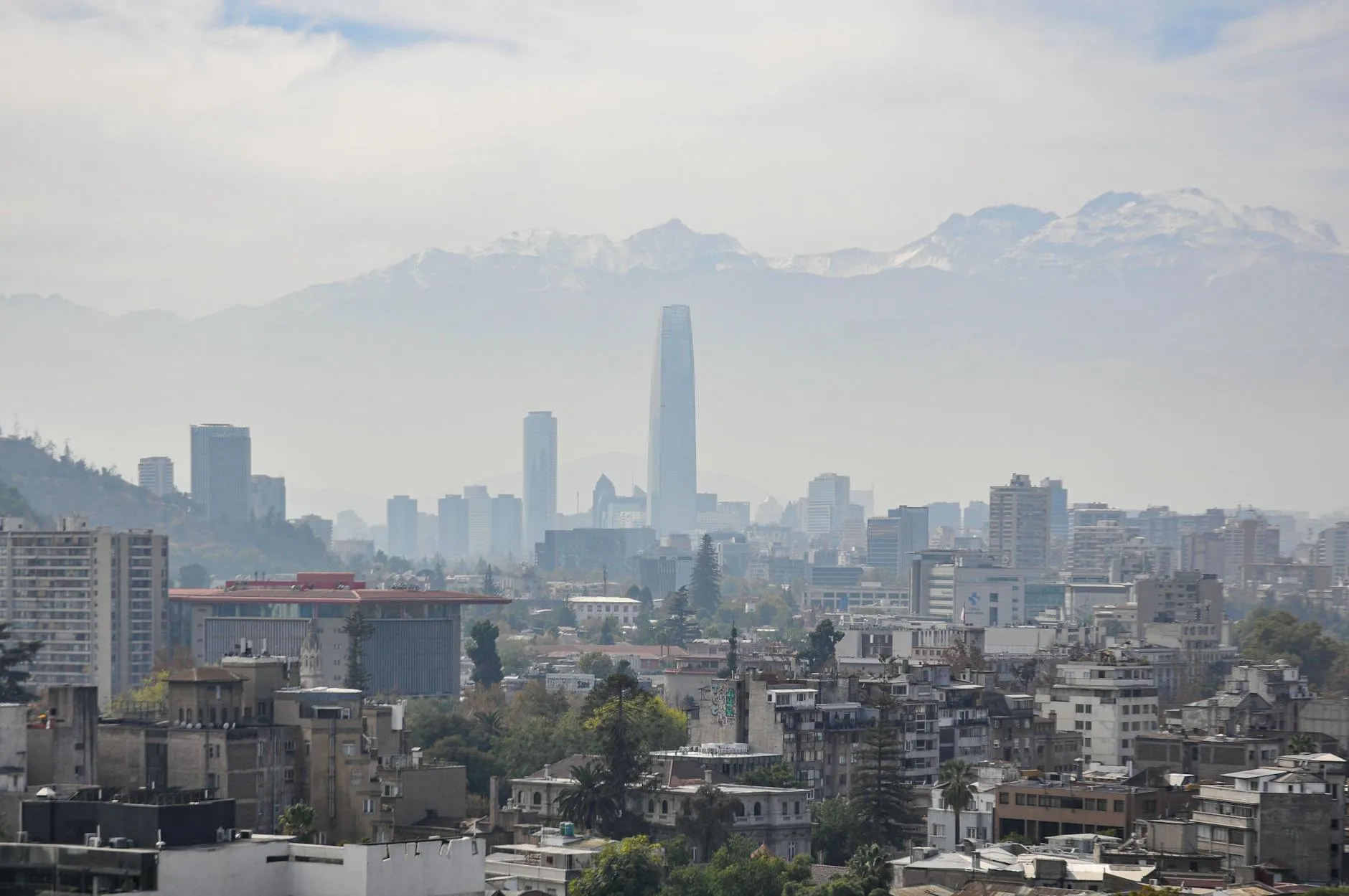
Santiago sits in a basin between the Andes (east) and Chilean Coastal Range (west), which traps cold winter air and pollution from cars + wood fires + industry. May to August mornings, AQI can hit hazardous levels, with the city visible only as a brown layer from up in Las Condes. The airport is at the western edge and slightly less affected, but morning visibility can briefly delay departures. Days when the city declares an “Alerta Ambiental”, restrictions on private cars apply; doesn’t affect taxis or buses. The smog clears mid-morning; the afternoon is usually clear blue skies even in winter.
Easter Island (Mataveri, IPC): 5h LATAM-only flight, ~CLP 350,000–700,000 round trip, 4–6 weekly. Book early (Dec–Feb summer + Jul school break sells out 2–4 months ahead). Don’t book a same-day onward connection — flights are operationally fragile and delays cascade. Patagonia (Punta Arenas PUQ, Puerto Montt PMC): LATAM/Sky/JetSmart daily from T1, ~CLP 80,000–200,000 r/t. Atacama (via Calama CJC): daily from T1, then 100 km transfer by van to San Pedro. All these are domestic and depart from T1; international-to-domestic transfer at SCL takes 90 minutes minimum.
Santiago tap water is safe to drink — including airport washroom taps. Chilean cities are unusual in LATAM in this regard; the water utility (Aguas Andinas) maintains strict drinking-quality standards. The catch: Santiago water has a high mineral content (calcium, magnesium — the Andes melt-water signature) and tastes “harder” than what most North American or European visitors are used to. Some travellers’ stomachs initially react. Bottled water airside (CLP 1,500–2,500 for 500 ml) is common from habit, not necessity. Hot drinks (coffee, tea) are obviously safe.
For Santiago and major tourist areas: Airalo, Holafly, GigSky and Saily all work fine — ~US$10–20 for 5–10 GB / 14 days. For travel beyond — Patagonia, Atacama, the Coastal valleys — buy a local SIM. Entel has the best Chilean rural coverage (especially in Patagonia and the Atacama); Movistar is second. The Entel kiosk at SCL T2 arrivals takes a passport and 10 minutes; ask for the “Plan Turista” bundle (~CLP 15,000–25,000 for 30 days unlimited domestic data).
Santiago’s tourist core — Las Condes, Providencia, Lastarria, Bellas Artes, Bellavista — is among South America’s safer urban districts, with active police presence. The Metro is well-policed at all hours. Avoid: centro at night (especially Plaza Italia and post-2019-protest impact areas), Recoleta and Conchalí outskirts, La Florida outskirts. The single biggest rule: do not hail street taxis; use Uber, DiDi or Cabify only. The SCL airport itself has standing security and the official taxi desk is 100% safe.
Chile is card-saturated airside and in tourist Santiago; cash matters in markets, food carts, smaller restaurants in non-tourist neighbourhoods, and rural Patagonia/Atacama. Withdraw CLP 200,000–400,000 in arrivals at a BCI, Banco de Chile or Santander ATM — both have decent rates. The CLP 20,000 note is hard to break in markets; ask for CLP 5,000s and 1,000s if possible. Tipping: 10% is included on most restaurant bills as “propina sugerida” — it’s not strictly mandatory but socially expected; just leave it on. Don’t double-tip.
❓ Frequently Asked Questions
📊 2026 Summary Data Table
| Feature | Current Data (2026) |
|---|---|
| IATA Code | SCL |
| Terminals | T2 international (live since 2022, fully ramped 2024, 14 contact gates, 200,000 m²) + T1 domestic only · connected airside corridor |
| Distance to Las Condes | 17 km via Costanera Norte expressway · 25–40 min off-peak · 60–75 min in rush hour |
| Primary Currency | Chilean Peso (CLP, $) · ~950 per USD · cards everywhere airside |
| Centropuerto bus | CLP 1,900–2,500 every 5–15 min · 06:00–23:30 · to Pajaritos Metro (25–35 min); + Metro to Las Condes ~25 min |
| Uber / DiDi / Cabify | CLP 12,000–25,000 to Las Condes · pickup at T2 Level 1 app zone · fully legal since 2023 |
| Train link | None — Metro Line 7 extension to SCL planned for 2028–2030 |
| Plaza Premium / Pacific Club | Plaza Premium ~US$48 / 3h (24/7, opened 2024); Pacific Club ~US$42 / 3h; both Priority Pass eligible |
| Reciprocity fee status | Abolished March 2014 · US/CA/AU pay nothing on entry · 90 days visa-free + paper Tourist Card (Tarjeta de Turismo) |
| Visa policy | Up to 90 days visa-free on arrival for EU/UK/US/CA/AU/NZ · extendable once for another 90 days at Departamento de Extranjería in Santiago · no |
| Climate | Mediterranean · warm dry summers (Dec–Feb, 25–33°C) · cool wet winters (Jun–Aug, 5–15°C with morning smog episodes) |
| Tap Water | Safe in Santiago (high mineral content) · bottled CLP 1,500–2,500 from habit not necessity |