Guayaquil José Joaquín de Olmedo Airport (GYE) — The Complete Master Guide 2026
The mainland gateway to Galápagos and Latin America’s most awarded medium-sized airport (multiple ASQ ‘Best in Region’ wins). Ecuador dollarised in 2000, the Galápagos National Park entry fee doubled to US$200 in mid-2024, and Ecuador’s ongoing internal-security situation since 2024 means tourist Guayaquil now sticks tightly to Las Peñas / Centro / Urdesa — the airport itself remains safe and well-policed.
⚡ 2026 Quick Reference — Key Facts at a Glance
2-storey, 8 contact gates + 4 remote stands · multiple ASQ awards
5 km · 10–25 min taxi off-peak · closest of the major LATAM airports
US Dollar (USD) · dollarised in 2000 · cards everywhere airside
~US$5–10 · flat zone-based at the desk · 10–25 min
~US$3–7 · pickup at Level 1 designated app zone
Priority Pass · international terminal · open 24 hours
US$200 · doubled mid-2024 · foreign tourists 12+
Don’t drink it. Bottled standard in Ecuador
🏢 1. The Single Terminal & the Galápagos Gateway
GYE runs on a single 2-storey terminal building with 8 contact gates and 4 remote stands. Modest by hub standards but consistently among Latin America’s best-rated medium airports — multiple ASQ ‘Best Airport in Latin America’ awards in the mid-2010s for cleanliness and efficiency. The airport handles ~6 million passengers a year. It is the primary mainland departure point for Galápagos flights — LATAM and Avianca operate the daily GYE–GPS (Baltra) and GYE–SCY (San Cristóbal) services that get tourists to the islands.
🛫 The Single Terminal — Compact & Efficient
Airlines: LATAM Ecuador (the dominant carrier and oneworld partner), Avianca Ecuador, JetSmart, Sky Airline, Aeroméxico, Copa, American, Delta, JetBlue, Iberia, KLM (seasonal), plus Spirit’s former routes now operated by JetBlue, Avianca and Volaris El Salvador.
Layout: Single concourse with 8 contact gates plus 4 remote stands for short-haul regional ops. Walk time check-in to furthest gate: 5–8 minutes. International and domestic share the same security checkpoint; segregation happens only at the gate level. Pre-Galápagos passengers go through the special INGALA Transit Control Card check at a dedicated counter before boarding.
🌏 Galápagos Connections — The Special Workflow
Going to Galápagos involves an extra layer. Before boarding, you must: (1) buy and check your INGALA Transit Control Card at the dedicated counter (~US$20, cash only or card); (2) pass through Galápagos-specific biosecurity luggage screening (no fresh fruit, plant matter, raw meat allowed onto the islands); (3) present your card and stamped passport at the gate. Most travellers connect via GYE because GYE-Galápagos is shorter (~1.5 hours) than UIO-Galápagos (~2.5 hours), and GYE flights are typically cheaper.
Park fee: Pay on arrival at Galápagos airport (Baltra GPS or San Cristóbal SCY). US$200 cash for adult foreign tourists as of mid-2024 (doubled from US$100); US$100 for those under 12. Andean Community nationals (CO/PE/BO) pay US$100. Cash only on arrival; no card on the islands. Bring exact change in small bills.
Quito (UIO) sits at 2,850 m elevation; Galápagos is sea-level. Aircraft can’t take off from Quito with a full tank for the long flight, so they hop to GYE for fuel before pushing west to the islands. UIO-Galápagos flights almost always stop in GYE for 60–90 minutes, adding ~3 hours to the journey vs a direct GYE-Galápagos flight. Most Galápagos-bound travellers therefore fly into GYE directly, overnight in Guayaquil if needed, and catch a morning flight to GPS or SCY.
🛂 2. Visa, USD & the Doubled Galápagos Fee
Ecuador is straightforward to enter. EU, UK, US, Canada, Australia, New Zealand and most western passports get up to 90 days visa-free on arrival — just a passport stamp, no online pre-registration. Ecuador dollarised in 2000, abandoning the Sucre after a banking crisis; USD is the de facto and de jure currency. The big 2024 entry-rule change is the Galápagos National Park entry fee doubling from US$100 to US$200 for adult foreign tourists.
90-Day Visa-Free Stamp · Extendable
EU/UK/US/CA/AU/NZ get up to 90 days on arrival; the officer enters days granted on the stamp. Stays can be extended once for another 90 days at a Migración office for ~US$140; up to 180 days per calendar year. Mexican and Cuban passports do require a visa for Ecuador — arrange before travel. Overstaying carries fines on exit. For long-stay digital nomads, the ‘Rentista’ visa is the path.
USD Currency Since 2000 · No FX
Ecuador dollarised in 2000 after a banking crisis collapsed the Sucre. USD is the legal-tender currency; small coins (centavos de dólar, the local cent equivalents) circulate alongside US coins. No FX needed coming from the US; bring your existing dollars. Cards work in tourist Ecuador (Guayaquil tourist core, Cuenca, Quito, Otavalo); cash matters in markets, food carts, smaller restaurants in non-tourist neighbourhoods, and the entire Galápagos islands once you’re past the cards-OK hotels.
Galápagos Park Fee Doubled in 2024
As of 1 August 2024, the Galápagos National Park entrance fee doubled from US$100 to US$200 for adult foreign tourists (12+); US$100 for under-12; US$100 for Andean Community nationals (Colombia, Peru, Bolivia). Pay cash only on arrival at GPS or SCY — no card. Plus US$20 for the INGALA Transit Control Card paid at GYE/UIO before boarding. Total add-on for a Galápagos trip: US$220 minimum on top of the flight cost.
Ecuador does not require a yellow fever certificate for general entry from Europe, the US, Canada or Mexico. You do need one if you’re flying onward to the Ecuadorian Amazon (Coca, Lago Agrio, Macas), the Galapagos region requires it as a precaution, or if you’re leaving Ecuador for Brazil’s Amazon, Peru’s Iquitos, or another country requiring proof. The yellow card is checked at onward gates, not at GYE arrivals from outside South America. Vaccination should be at least 10 days before travel. Most tropical-vaccine clinics in your home country can issue the card.
🚚 3. Transport: 5 km to Centro, Metrovía & the Security Reality
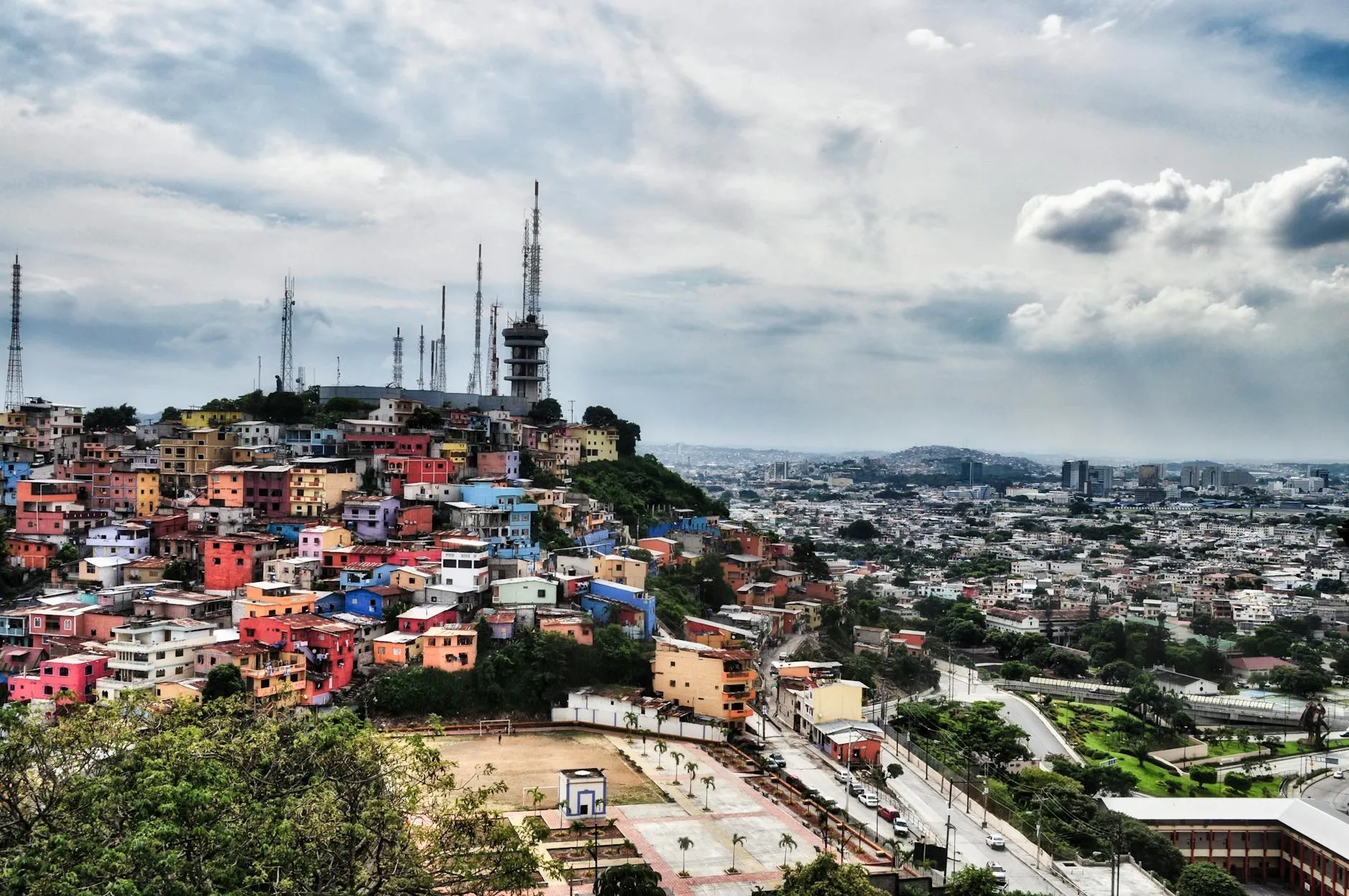
GYE is uniquely close to its city centre — 5 km to the Malecón 2000 / centro, 4 km to the Las Peñas historic district. Off-peak that’s 10–25 minutes by taxi. In rush hour (07:00–09:30 and 17:00–19:30), it stretches to 35–50 minutes. There is no airport rail; the Metrovía BRT system passes near the airport but isn’t recommended for the airport-transfer use case. The recurring theme: Ecuador’s post-2024 internal-security situation has changed how tourists move through Guayaquil, and the airport-to-city transfer is one of the trip’s safer legs precisely because it’s short.
⭐ Official Airport Taxis — Cheapest of Any LATAM Capital
GYE runs licensed taxi desks immediately past Customs in the Arrivals hall. Pay at the desk, get a slip, dispatcher hands you off to the next car. The price is fixed by destination zone — no haggling, no meter surprises. Yellow cars only, all licensed by the Comisión de Tránsito. All accept card.
US$5–10
US$5–9
US$6–10
US$10–14
📱 Uber, InDriver, Cabify & DiDi — Cheaper, Fully Legal
Uber, InDriver, Cabify and DiDi all operate at GYE. Pickups happen at a Level 1 designated app zone, signposted “Aplicaciones”. Uber is fully legal in Ecuador. Apps are typically 30–50% cheaper than the official desk for the same trip; the price difference is small in absolute USD (~US$2–4) but real.
🚌 Metrovía BRT — Skip It With Luggage
Metrovía is Guayaquil’s BRT system, with a station ~400m walk from the GYE arrivals hall (Terminal Terrestre). It runs to the city for US$0.30 per ride. Skip it. No luggage racks, gets crowded at peak hours, and the 400m walk to the station with luggage is genuinely unpleasant in 32°C humidity. The US$3–5 saving over Uber is meaningless on a vacation budget. Metrovía is a great way to explore the city on day 2; it’s a poor airport-transfer choice.
✈️ Connecting to Galápagos, Quito or Cuenca
Most Galápagos-bound travellers connect through GYE. LATAM and Avianca operate daily GYE-GPS (Baltra) and GYE-SCY (San Cristóbal); ~1.5 hours each. Allow 90 minutes for international-to-Galápagos transfer at GYE: clear immigration, exit, walk to domestic check-in, INGALA card purchase, biosecurity screening, normal security. GYE-UIO Quito: hourly LATAM/Avianca, ~50 minutes flight. GYE-CUE Cuenca: 4 daily LATAM/Avianca.
Ecuador declared an internal armed conflict in January 2024 over organised-crime escalation; the situation persists through 2025-26 with periodic state-of-emergency declarations. Tourist Guayaquil — Las Peñas, Centro / Malecón, Urdesa, Samborondón — remains generally safe with active military and police presence. The airport itself has standing military checkpoints since 2024 and is among the safer venues. Avoid: Suburbio, Trinitaria, Guasmo, Mapasingue Oeste — these were never tourist destinations and now require local guidance to enter. Don’t hail street taxis; use Uber/InDriver/Cabify only. Daytime tourism in the central zones, with proper transport between, is fine for most travellers; ask your hotel and the airport tourist desk for current advice.
🛍️ 4. Lounges: The Aeropuertos VIP Club
GYE’s lounge offering is solid for an airport its size: the Priority Pass-eligible Aeropuertos VIP Club in the international terminal, with a second branch in the domestic terminal. There is no Plaza Premium, no Avianca lounge and no American Admirals Club here; the Aeropuertos VIP Club is the lounge that matters, and it takes Priority Pass, so GYE travellers without airline status are well-served.
✨ Aeropuertos VIP Club GYE (international airside, Priority Pass)
Priority Passor paid day pass
Priority Pass · LoungeKey · Diners Club · paid day pass
24 hours daily (international terminal)
Yes / Yes
⭐ Aeropuertos VIP Club — Domestic Terminal (Priority Pass)
The domestic-terminal branch of the Aeropuertos VIP Club runs 04:00–23:00 and is also on Priority Pass, with a children’s play area (under-5s free). Use it if you are connecting onward to Quito, Cuenca or Galápagos from the domestic side. Alcoholic drinks here are pay-as-you-go rather than complimentary.
✈️ No airline-branded lounge (no Admirals Club)
GYE has no American Admirals Club and no Avianca lounge. American, Avianca and other carriers’ premium and status passengers use the Aeropuertos VIP Club (it is on Priority Pass) or wait at the gate. Miami-bound AAdvantage flyers should not expect a branded club here.
If you have an early-morning hop to Galápagos, the international Aeropuertos VIP Club is open 24 hours, so it is available before your boarding. Check in upstairs first, do the INGALA card and biosecurity screening, then head to the lounge for breakfast. Don’t skip the lounge in the rush — it’s the last decent breakfast before hours of island-hopping where food choices are limited and expensive.
🦞 5. Food & Duty-Free: Encebollado, Cacao Fino & Panama Hats
Encebollado is Ecuador’s national fish soup — a tomato-onion broth with chunks of albacore, yuca, lime, onion and chiffronaded coriander, eaten with a side of fried plantain chips and aji sauce. La Cuchara at the GYE airport food court does it for ~US$5–8 a bowl. The McDonald’s and Starbucks are at the same food court; skip them — you can have those anywhere. Encebollado is famously the best hangover cure in Latin America.
Ecuador grows excellent specialty coffee in the highlands — the Pichincha and Manabí regions produce fine cup quality. Sweet & Coffee at the GYE central food court does proper Ecuadorian single-origin (try the Pichincha or Manabí single-origin) for ~US$3–5. The smaller Café Galletti kiosk in the international concourse is where serious enthusiasts go — certified specialty arabica, ~US$5–8. Skip the airport Starbucks.
Ecuador is one of the world’s great fine-cacao origins — the ‘Cacao Nacional’ varietal is rare and prized. Pacari single-origin chocolate (US$5–12 per bar at duty-free, ~30% cheaper than US import) is the export-gift default; Republica del Cacao is the second-best Ecuadorian chocolate brand. “Panama Hats” are actually Ecuadorian — woven in Cuenca and Montecristi for centuries, the Panama name is from canal-era exports; GYE duty-free sells nice ones for US$25–200 depending on weave grade (Montecristi superfino is the splurge tier). Zhumir aguardiente (sugarcane spirit, US$8–15 a litre) is the local pisco-equivalent. Avoid airport-priced Otavalo textiles — Otavalo Saturday market is 70% cheaper.
Pilsener and Club are Ecuador’s two ubiquitous national beers; both are clean lager-style, US$1.50–3 a bottle airside vs ~US$0.80 in supermarkets. Try one before you leave — you won’t find them in your home country. The duty-free also sells Pilsener Light by the 6-pack (~US$8–10) for the carry-on home.
💡 6. Insider Tips: Galápagos Costs, Security, Climate, Spirit’s Gone
A Galápagos trip from GYE involves three mandatory add-ons beyond the flight: (1) INGALA Transit Control Card US$20 paid at GYE/UIO before boarding; (2) Galápagos National Park entrance fee US$200 for adult foreign tourists (12+, doubled mid-2024 from US$100), US$100 for under-12, US$100 for Andean Community nationals, paid CASH ONLY on arrival at GPS or SCY; (3) Inter-island ferry fees if hopping between islands (~US$30 each leg). Total mandatory add-ons: US$220 minimum. Bring cash USD in mixed-denomination bills.
Spirit Airlines collapsed in May 2026 and no longer operates any flights, including FLL/MIA – GYE. JetBlue absorbed FLL–GYE; Avianca and American picked up MIA–GYE; Volaris El Salvador serves the budget end. Old Spirit GYE tickets are essentially worthless — check your travel insurance for airline-insolvency coverage. Allow 1–2 weeks for refund processing through the bankruptcy estate.
Guayaquil sits on the Pacific coast at sea level: 26–33°C daytime year-round, 23–26°C overnight, humidity 70–90%. The wet season (December–April) brings heavy intermittent showers but also the warmest weather. The dry season (May–November) is cooler with clear sunny days and the famous garúa coastal mist on cool mornings. Schedule airport runs at 06:00–09:00 or after 18:00 if your luggage is heavy; midday is brutal. Air conditioning is universal in Guayaquil hotels and buses but not always reliable in older taxis — ask before getting in.
Ecuador tap water is not safe to drink, including airport washroom taps. Bottled water airside runs US$2–4 for 500 ml. The Aeropuertos VIP Club lounges have free filtered-water dispensers. Hot drinks (coffee, tea) are safe because boiling kills bacteria. In Guayaquil, the same rule applies. For Galápagos: all hotels and lodges provide bottled or filtered water; ice in tourist hotels is generally safe but ask if uncertain.
For Guayaquil and tourist Ecuador: Airalo, Holafly, GigSky and Saily all work fine — ~US$10–20 for 5–10 GB / 14 days. For travel beyond — Cuenca, Otavalo, Banos, the Amazon — buy a local SIM. Claro has the best Ecuadorian rural coverage; Movistar is second. The Claro kiosk at GYE arrivals takes a passport and 8 minutes; ask for the “Plan Turista” bundle (~US$15–25 for 30 days unlimited domestic data). Galápagos has limited cellular coverage in remote areas; expect data drops on uninhabited islands.
Guayaquil’s tourist core — Las Peñas, Centro / Malecón 2000, Urdesa, Samborondón — remains generally safe with active military and tourist police presence post-2024. The Malecón 2000 waterfront and the Las Peñas colonial district are walkable in daytime; both have police presence. The single biggest rule: do not hail street taxis; use Uber, InDriver, Cabify or DiDi only. Avoid all of: Suburbio, Trinitaria, Guasmo, Mapasingue Oeste, El Fortin. For solo Galápagos travel: extremely safe, both islands and live-aboard boats are tourist-saturated and well-monitored. The airport itself is among Latin America’s safest mid-sized airports.
Ecuador uses USD as its currency, so no FX is needed coming from the US. Cards work in tourist Guayaquil, Quito, Cuenca and most Galápagos hotels; cash matters in markets, food carts, smaller restaurants in non-tourist neighbourhoods, the entire Amazon, and on-the-island Galápagos shopping (most island hotels accept card, but vendors often don’t). Withdraw US$200–400 at a Banco Pichincha or Banco del Pacífico ATM at the airport — both have reasonable rates. Bring small denominations (US$5, US$10, US$20) — US$50 and US$100 bills are hard to break and sometimes refused due to counterfeit concerns. Tipping: 10% in restaurants, 10% on tours, US$1 per bag for porters.
❓ Frequently Asked Questions
📊 2026 Summary Data Table
| Feature | Current Data (2026) |
|---|---|
| IATA Code | GYE |
| Terminal | Single 2-storey terminal · 8 contact gates + 4 remote stands · multiple ASQ ‘Best in Region’ awards in mid-2010s |
| Distance to Malecón / Centro | 5 km · 10–25 min off-peak · 35–50 min in rush hour |
| Primary Currency | US Dollar (USD) · dollarised in 2000 · cards everywhere airside |
| Official airport taxi to Centro | US$5–10 · flat zone-based at the desk · cheapest official airport taxi in any LATAM capital |
| Uber / InDriver / Cabify | US$3–7 to Malecón · pickup at Level 1 app zone · Uber fully legal |
| Aeropuertos VIP Club | Priority Pass eligible · international terminal (24 hours) + domestic terminal (04:00–23:00) · paid day pass |
| Galápagos National Park fee | US$200 cash for adult foreign tourists 12+ · doubled mid-2024 from US$100 · plus US$20 INGALA Transit Card · total US$220 add-on |
| Spirit Airlines status | Collapsed May 2026 · FLL absorbed by JetBlue, MIA by Avianca and American |
| Visa policy | Up to 90 days visa-free on arrival for EU/UK/US/CA/AU/NZ · extendable once for another 90 days at Migración · no |
| Climate | Tropical Pacific coast · 26–33°C year-round · 70–90% humidity · wet Dec–Apr (warm, intermittent rain) · dry May–Nov (cooler, garúa coastal mist) |
| Tap Water | Not safe in Guayaquil (or Ecuador generally) — bottled water only (US$2–4 airside; lounge filtered water free) |