Carcassonne (CCF) Airport Guide 2026 — One Airline, One Walled City
Carcassonne (CCF) sits at Salvaza on the western edge of the city, close enough that the runway 27 threshold is 2.5 km from the centre and westerly landings cross the rooftops. One fact shapes everything else here: Ryanair carried virtually 100% of the 304,454 passengers who used the airport in 2025, across ten routes of which only three run all year. The €6 RTCA shuttle stops at the medieval Cité itself, ten minutes from the terminal — but it runs three to five times a day, each run tied to a specific flight. France is Schengen and Eurozone. Around you: a UNESCO fortified city, the Canal du Midi and the Corbières vineyards.
Last verified: September 2026.
⚡ 2026 Quick Reference — Key Facts at a Glance
CCF / LFMK — one small terminal at Salvaza, Route de Montréal, 11000 Carcassonne. Branded “Aéroport de Carcassonne Occitanie Sud de France”
RTCA airport shuttle, €6, free under 5. Outbound it stops at Gare SNCF, Le Dôme, Pont Neuf, Général Leclerc and the Cité Médiévale — 10 minutes from the Cité, 25 from the railway station; inbound the operator also lists Square Gambetta and Place Davilla
3 to 5 runs a day, each pinned to a departing flight. Inbound it simply leaves about 25 minutes after each aircraft lands — no fixed timetable
Valid all day on the whole RTCA network, so it doubles as a city bus ticket. Card payment on board or the RTCA app. Free Wi-Fi and USB sockets on the shuttle
Rank in front of the terminal, drivers available 24/7 — Taxis de Carcassonne, +33 4 68 71 50 50
P1 short, P2 medium, P3 long, all under photovoltaic canopies. First 15 minutes free on P1; kerbside drop-off at the terminal is banned
Euro (€) — France is in the Eurozone
None. The airport’s own service listings name a duty-free shop, a café, a newsagent, free Wi-Fi and an ATM — no lounge
Ryanair, and only Ryanair. Ten destinations, three of them year-round
Schengen — EES fully operational since 10 April 2026. Tangier is the one route outside the area; London, Manchester, East Midlands, Bournemouth, Dublin and Cork are outside Schengen too
Not in operation, no applications collected, no launch date published. €20 fee already set
🏢 1. A Monoline Airport With a Flying School Attached
Carcassonne is the clearest example in France of what a single low-cost airline does to a regional airport. Ryanair has flown here since June 1998 — London first, then Charleroi in 2001 and Dublin in 2005 — and by 2013 it was carrying almost every passenger through the building. In 2025 that was 303,991 low-cost passengers out of 304,454 total. Every other scheduled operator has gone: Air Nostrum stopped its Spanish flights in 2016, and the Paris-Orly link died on 11 June 2001 when its operator was liquidated and nobody took it on. There has been no flight to Paris from Carcassonne since.
The airport belonged to the French state until 2007, when it passed to the Languedoc-Roussillon region. It was run by the local chamber of commerce, then by Transdev from 2011 to 2019, and since 1 January 2020 by SPLAR, the regional public airport company that also operates Perpignan and Tarbes-Lourdes-Pyrénées. The three websites are identical, which is occasionally useful and occasionally confusing.
The site covers 110 hectares at 132 m elevation, with a paved runway of 09/27, 2,050 m, plus an 800 m grass strip. There is one small terminal. Behind the passenger operation sits the thing that makes the movement statistics odd: the École nationale de l’aviation civile has trained airline pilots and instructors on this field since 1970. That is why the airport logs around 20,000 aircraft movements a year against an average of seven commercial flights a day — most of what you hear overhead is a training circuit, not a 737.
The network, and how seasonal it really is
Ten destinations, all Ryanair:
| Destination | Season | Block time |
|---|---|---|
| London Stansted | Year-round | 1h55 |
| Manchester | Year-round | 2h05 |
| Brussels Charleroi | Year-round | 1h45 |
| Dublin | Summer | 2h20 |
| Cork | Summer | 2h05 |
| East Midlands | Summer | 1h55 |
| Bournemouth | Summer | 1h45 |
| Porto | Summer | 1h45 |
| Cagliari | Summer | 1h30 |
| Tangier | Summer | 2h00 |
Five of the ten are British or Irish, which tells you who the Aude’s foreign visitors and second-home owners are. Tangier is the outlier and the only non-European route — Ryanair added Morocco to a schedule otherwise built around northern Europe. The year-round column is the airport’s own current listing; seasons at a one-airline airport move more than most, so check the destination pages before you commit to a winter trip.
A practical consequence of a monoline airport: when Ryanair changes its mind, there is no second carrier. Book the return on the same airline and the same route, and be realistic about connections — there are none here.
Check-in and bags
The airport’s instruction is blunt: you must check in online. Airport check-in is charged by the airline, and at a terminal with a handful of desks that is not a queue you want to join. Arrive two hours before departure, or at least one hour if you have booked assistance. Boarding cut-off is on your boarding pass and the airport will not accept you after it.
Ryanair’s bag rules are the only bag rules that matter here, and they are the airline’s biggest revenue line — our Ryanair baggage guide sets out the free small-bag allowance, the priority cabin bag and the paid hold tiers, and the aifly baggage checker lets you compare before you book.
🛂 2. Schengen, the Euro, and Seven Routes That Cross a Border
France is a founding Schengen state and uses the euro. Look at the route map and you will see that most of it still crosses an external border. Brussels Charleroi, Porto and Cagliari are internal Schengen flights. London Stansted, Manchester, East Midlands and Bournemouth are UK. Dublin and Cork are Ireland — in the EU but not in Schengen. Tangier is Morocco. Seven of the ten routes are checked.
EES became fully operational across the Schengen area on 10 April 2026, after a progressive rollout that the European Commission began on 12 October 2025. It replaces the stamping of passports: every non-EU passport crossing the external border now generates a digital record — name, travel document, fingerprints and a facial image, and the date and place of entry and exit — so overstays are detected automatically. The first crossing is the slow one, because that is the biometric enrolment; every later crossing is a match against a file that already exists.
For a British passport this is the practical shape of it at Carcassonne: you are a third-country national at this border, the 90-days-in-180 rule applies to your time in the Schengen area, and the airport itself recommends arriving two hours before your flight because border-control times can be longer. At an airport whose British routes are the year-round backbone, that advice is not decoration.
The exemptions the airport applies:
| Passport / status | Short-stay visa? | EES applies? |
|---|---|---|
| EU, EEA, Switzerland, Andorra, Monaco | No — freedom of movement | No |
| UK | No — 90 days in any 180 | Yes |
| Ireland | No — EU citizen | No |
| USA / Canada / Australia / NZ | No — 90 days in any 180 | Yes |
| Morocco | Schengen visa required | Yes — linked to the visa |
| Long-stay (type D) visa holder, or family member with a residence card | Covered by the document | No |
If you are exempt, carry the document that proves it — the airport asks for it at the border.
ETIAS is not running. The European Commission’s own page states that ETIAS “is currently not in operation and no applications for travel authorisations are collected at this point”, and that the EU will announce the start date several months before launch. No date is published. The fee is set at €20, up from the original €7. Any website selling you an ETIAS today is selling you nothing.
One French detail worth knowing if you are flying with children: since 15 January 2017, a minor resident in France travelling abroad without a parent needs an autorisation de sortie du territoire — a form signed by a parent, accompanied by a photocopy of that parent’s ID.
🚌 3. The €6 Shuttle: It Stops at the Citadel, and It Runs Five Times a Day
There is no train station at the airport and no ordinary city bus route to it. There is one shuttle, run by RTCA, the Carcassonne Agglo transport authority, and the honest assessment is that it is unusually well-placed and unusually infrequent.
The route, in the direction city → airport, is Gare SNCF → Bunau Varilla → Le Dôme → Pont Neuf → Général Leclerc → Cité Médiévale → Airport. Read that stop list twice. The shuttle serves the medieval Cité directly, and the Cité is the last stop before the terminal — ten minutes. From the railway station it is 25 minutes. On the return leg RTCA also lists Square Gambetta and Place Davilla, and at the station exit the stop is immediately past the car park on your left.
| Detail | |
|---|---|
| Fare | €6 adult, free under 5. Card payment preferred; buy from the driver or in the RTCA app |
| Ticket validity | All day, on the entire RTCA network — urban and non-urban lines, everything except the tourist Petit Train. It is a day pass, not a single |
| City → airport | Timed to put you at the terminal one hour before your flight’s departure |
| Airport → city | Departs about 25 minutes after each aircraft lands. No published clock time — it goes when your flight is in |
| On board | Free Wi-Fi and USB charging sockets |
| How often | Three to five runs a day, one per departing flight, published as a seasonal timetable sheet |
That last row is the whole story. On the timetable in force from 24 August to 4 October 2026 there are four runs on a Monday, four on a Tuesday, three on a Wednesday, five on a Thursday, four on a Friday, three on a Saturday and four on a Sunday. If you are not on one of those flights, the shuttle is not for you — this is not a service you can turn up and use to get across town. Look up the current sheet on the RTCA site before you plan around it.
Two smaller inconsistencies worth knowing. The airport’s own page says the shuttle leaves 45 minutes after each arrival; RTCA, which actually runs it, says about 25 minutes. Take the operator’s figure and be at the door early. And the airport lists Square Gambetta and Place Davilla among the stops while the current outbound sheet does not — again, the operator’s sheet is the one to trust.
Taxis. There is a rank in front of the terminal and Taxis de Carcassonne say drivers are available around the clock on +33 4 68 71 50 50. No flat fare is published for the airport run, so ask before you get in. For a group of three or four arriving on a late flight, a taxi to the Cité is a reasonable call rather than a defeat.
Car hire. Avis, Enterprise, Europcar, Hertz and Sixt all serve the airport. You do not strictly need a car for Carcassonne itself — the Cité and the Bastide are walkable and the shuttle reaches both — but you do need one for the Corbières, the Minervois and the Cathar castles, which is what most people actually come for.
Parking. Three car parks — P1 short stay, P2 medium, P3 long — all under photovoltaic canopies, with a 2.80 m height limit. The first 15 minutes on P1 are free, which is the intended way to drop someone off, because stopping at the kerb beside the terminal is prohibited. Disabled bays are on P1 and, unlike some French airports, carry a reduced rate on presentation of a disability card at the airport information desk. Motorbikes park on P1 at P3 rates with the ticket validated at the desk. Spaces can be booked online through the airport’s partner; quarterly and annual subscriptions are arranged at the information counter. Overrunning a tariff band by one minute pushes you into the next one.
Getting around once you are in town
RTCA runs two other things worth knowing about, and your shuttle ticket covers one of them:
- Le TOUC — a free, fully electric shuttle circulating inside the Bastide Saint-Louis, the grid-plan lower town, from 2 June to 26 September 2026. No booking; you flag the driver down at a stop.
- Le Petit Train — the tourist train between Square André Chénier and the Cité, €7, running weekends in May and then daily from 13 June to 13 September 2026. It is the one thing your all-day shuttle ticket does not cover.
RTCA’s mobility agency is at 12 boulevard Camille Pelletan by Square Gambetta, open Monday to Friday 08:30–12:00 and 13:30–17:00.
🛋️ 4. No Lounge, One Duty Free, and an ATM Outside the Door
Carcassonne has no lounge. Not a paid one, not a contract lounge, not a Priority Pass room. The airport’s own service pages list a duty-free shop, a café, a newsagent, free Wi-Fi and a cash machine, and that is the complete inventory. At an airport running an average of seven commercial flights a day and served by one low-cost carrier, this is exactly what you should expect — but check it against your expectations before you buy a lounge membership on the assumption it will work here.
What does exist:
- Aelia Duty Free / Relay, a recently opened shop after security, a short walk from the gate.
- Free Wi-Fi, described by the airport as high-speed, available 24/7 across the whole terminal. Connect to the network named “Free wifi Airport” and a portal page opens.
- A cash machine outside the terminal, available 24/7. Note that word: outside. If you land needing euros, you will be getting them in the open air.
Accessibility. The airport provides PMR assistance and lists an access ramp, reserved parking, vehicles, lifts and a device for boarding and leaving the aircraft. The procedure matters: tell your airline or travel agent at the time of booking and up to 48 hours before departure, stating the nature of your disability and the assistance you need, then present yourself at the PMR reception desk two hours before your scheduled departure. Battery wheelchairs and oxygen are subject to the airline’s own restrictions, so check those separately. If you have booked assistance the airport asks you to arrive at least an hour ahead rather than the usual two.
One small irritation to plan around: the airport’s general enquiry line, 0820 67 34 11, is a premium-rate number charged at €0.17 a minute. Use the website’s contact form unless you need to speak to somebody urgently.
🍽️ 5. Bread&Co, Relay, and the Cassoulet You Should Actually Eat in Town
Landside, Bread&Co does breakfast in the morning, a homemade salad or a plat du jour at lunch, and a hot drink and something sweet in the afternoon, alongside a shelf of regional products. Relay sells press, books, travel accessories, regional souvenirs and confectionery. Both are open Monday to Sunday including public holidays, during terminal opening hours — and that is the caveat, because the terminal opens around the flight schedule rather than to a fixed clock. On a day with three departures there are long stretches when the building is quiet and the shutters are down.
The airside offer is the Aelia Duty Free / Relay unit past security. That is the list.
What to eat in the Aude instead
- Cassoulet. Carcassonne is one of the three towns that claim it, alongside Castelnaudary — up the road towards Toulouse, and the loudest claimant — and Toulouse itself. The Carcassonne version traditionally takes lamb or mutton alongside the beans, pork and sausage. It is a winter dish, it is enormous, and eating it at 35°C in August is a decision you will regret before the plane home.
- Corbières and Minervois. Both are AOP wines from the hills either side of the city, both are reds built on Carignan, Grenache and Syrah, and both are among the best value in France. The Minervois lies north of the Canal du Midi, the Corbières south towards the sea.
- Blanquette de Limoux. Made just south of Carcassonne, and by local account the oldest sparkling wine in France — it predates Champagne. Buy it there rather than at the airport.
- Regional products at Bread&Co and Relay if you leave it late: honey, confectionery, and the tinned cassoulet that is genuinely how most of it travels.
💡 6. Insider: The Cité, the Canal, and What the Aude Is For
Fly here when
- You are going to Carcassonne itself. The shuttle stops at the Cité. Very few airports in Europe put you inside a UNESCO World Heritage site for €6 and ten minutes.
- You want the Aude with a car. The Corbières, the Minervois, the Cathar castles and the Mediterranean beaches are all within an hour or so, and hire desks are at the airport.
- You are flying from Britain or Ireland. Five of the ten routes go there, three of them all year. Nothing else gets you into this corner of Occitanie as directly.
Fly somewhere else when
- Your dates are outside the summer season. Seven of the ten routes are summer-only, and one airline means no fallback. Toulouse is a straightforward run up the A61 and has a far bigger network; Montpellier and Perpignan are the other regional options. Run the comparison rather than assuming — the aifly price check is built for exactly that.
- You need a connection. There are none from here. Every Ryanair flight is a point-to-point.
- You want a lounge, a proper restaurant, or a Paris flight. None of the three exists at CCF, and the Paris route has been gone since 2001. Take the train from Carcassonne station instead.
The things worth your days
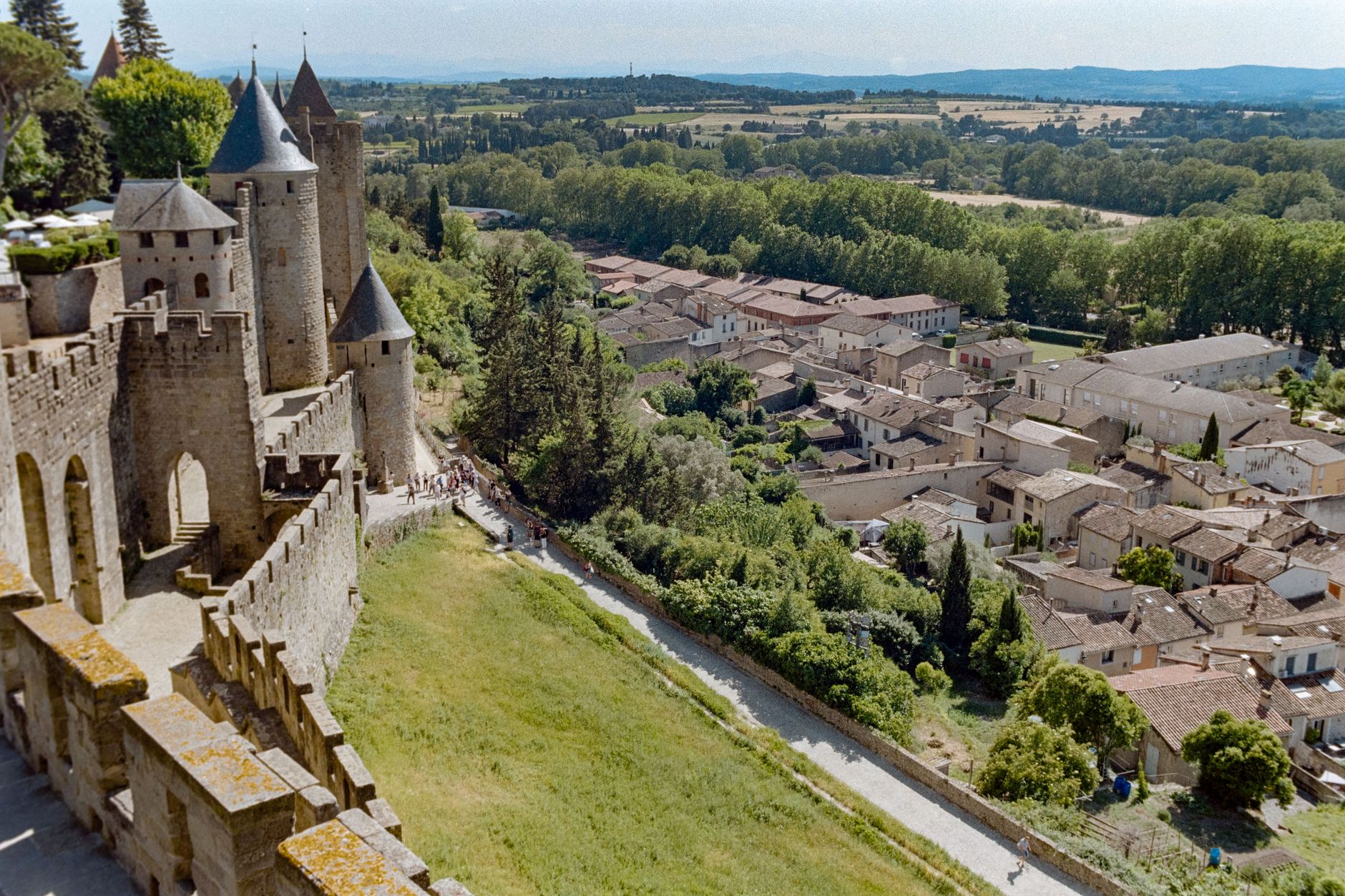
- The Cité de Carcassonne. A fortified settlement has stood on this hill since before the Romans. What you walk through today is a medieval walled town with 52 towers and 3 km of ramparts, the Château Comtal inside it and the Basilica of Saint-Nazaire at its heart. UNESCO lists it not only as an outstanding example of a medieval fortified town but for the restoration campaign led by Viollet-le-Duc, one of the founders of modern conservation — which is also why purists argue about the pointed slate roofs. Go early or go at night; the middle of a July day is the worst of it. In summer the Festival de Carcassonne puts theatre and concerts inside the walls.
- The Canal du Midi. 360 km of navigable waterway linking the Mediterranean to the Atlantic through 328 structures — locks, aqueducts, bridges and tunnels — built between 1667 and 1694 to Pierre-Paul Riquet’s design, and a UNESCO site in its own right. It runs straight through Carcassonne past the railway station, where the shuttle stop is signed Gare SNCF – Port du Canal. Hire a bike and ride the towpath under the plane trees, or take a short cruise from the port; either is a better use of an afternoon than a second circuit of the ramparts.
- The Bastide Saint-Louis. The lower town across the river — a 13th-century grid with a covered market, cafés on Place Carnot and the Cathedral of Saint-Michel. This is where people actually live, and where you will eat better and cheaper than inside the Cité.
- The Cathar castles. Lastours, Puilaurens, Peyrepertuse, Quéribus and the rest — ruined fortresses on limestone crags south and east of the city, most of them requiring a car and a decent pair of shoes. Peyrepertuse in particular is enormous and improbable.
- The vineyards. Minervois to the north, Corbières to the south, Limoux and its sparkling wine to the south-west. Tasting rooms are informal and often free; do not drive if you intend to take it seriously.
- Lac de la Cavayère. A lake on the edge of the city with beaches, a few kilometres from the Cité — the local answer to an August afternoon.
Practical odds and ends
- The shuttle ticket is a day pass. €6 covers your ride in and every RTCA bus for the rest of the day. Do not buy a second ticket.
- The inbound shuttle has no clock time. It leaves roughly 25 minutes after your aircraft lands, so do not go looking for a departure board.
- Check in online. Ryanair charges for the airport alternative, and it is the only airline here.
- Kerbside drop-off is banned. Use P1’s free 15 minutes.
- Aircraft cross the town on 60% of landings, low, on a westerly wind. If you are booking a hotel and you are a light sleeper, ask which side of the city it is on.
- Roaming: EU and EEA plans work with no action. A French prepaid SIM requires ID at purchase.
❓ Frequently Asked Questions
📊 2026 Summary Data Table
| Category | Detail |
|---|---|
| IATA / ICAO | CCF / LFMK |
| Official name | Aéroport de Carcassonne Occitanie Sud de France (formerly Carcassonne-Salvaza) |
| Address | Route de Montréal, 11000 Carcassonne, France |
| Location | Salvaza, on the western edge of the city; the runway 27 threshold is 2.5 km from the centre |
| Operator | SPLAR since 1 January 2020 (Transdev 2011–2019 before that); also runs Perpignan and Tarbes-Lourdes-Pyrénées |
| Site | 110 hectares, elevation 132 m; one small terminal |
| Runways | 09/27, 2,050 m paved; plus an 800 m unpaved strip |
| Annual passengers | 304,454 in 2025, of which 303,991 low-cost — 99.8%. 311,048 in 2024; 322,767 in 2023; 351,982 in 2019 |
| Movements | ~27,000 in 2025, but an average of only seven commercial flights a day — the rest is ENAC pilot training, based on the field since 1970 |
| Airlines | Ryanair only, flying here since June 1998 and carrying effectively all passengers since 2013. No Paris route since 11 June 2001 |
| Destinations | Year-round: London Stansted (1h55), Manchester (2h05), Brussels Charleroi (1h45). Summer: Dublin, Cork, East Midlands, Bournemouth, Porto, Cagliari, Tangier |
| Airport shuttle | RTCA, €6 adult / free under 5, valid all day on the whole RTCA network. Gare SNCF → Le Dôme → Pont Neuf → Général Leclerc → Cité Médiévale → Airport. 10 min from the Cité, 25 from the station. Wi-Fi and USB on board |
| Shuttle frequency | 3–5 runs a day, one per departing flight; outbound arrives 1 h before departure, inbound leaves ~25 min after each landing with no fixed clock time |
| Other RTCA services | Le TOUC — free electric shuttle in the Bastide Saint-Louis, 2 June–26 Sept 2026 · Le Petit Train to the Cité, €7, daily 13 June–13 Sept 2026 (not covered by the shuttle ticket) |
| Taxi | Rank in front of the terminal, 24/7 — Taxis de Carcassonne +33 4 68 71 50 50. No published flat fare |
| Car hire | Avis, Enterprise, Europcar, Hertz, Sixt |
| Parking | P1 short / P2 medium / P3 long, photovoltaic canopies, 2.80 m height limit. First 15 min free on P1; kerbside drop-off banned; disabled bays on P1 at a reduced rate with a disability card |
| Check-in | Online check-in required; airport check-in is charged by the airline. Arrive 2 h before, or 1 h if assistance is booked |
| Accessibility | Ramp, reserved parking, vehicles, lifts and a boarding device. Notify the airline at booking and up to 48 h ahead; report to the PMR desk 2 h before departure |
| Lounge | None |
| Food & retail | Bread&Co (café, landside) · Relay (press, books, souvenirs) · Aelia Duty Free / Relay after security · free Wi-Fi 24/7 (“Free wifi Airport”) · ATM outside the terminal, 24/7. Open during terminal hours only |
| Contact | +33 820 67 34 11 — a premium-rate number at €0.17/min; the website contact form is free |
| Currency / Schengen / EES | Euro — Eurozone / Schengen founding member / EES fully operational since 10 April 2026 |
| ETIAS | Not in operation, no applications collected, no date published; €20 fee already set |