Diyarbakır (DIY) Airport Guide 2026 — Tigris, Basalt Walls, One Runway
Diyarbakır Airport is 10 km from the city centre in the Bağlar district, and it is the aviation front door to a UNESCO World Heritage city on the upper Tigris. It handled 2,292,693 passengers in 2025 against a rated capacity of five million, so the single 95,691 m² terminal is never busy. The traffic is overwhelmingly domestic — 2,079,321 of those passengers flew inside Türkiye — with Pegasus, AJet, SunExpress and Turkish Airlines running the Istanbul and Ankara feed and a small German network on top. Three municipal bus lines are named for the airport. Currency is the Turkish lira, and Türkiye operates its own entry system rather than the EU’s.
Last verified: September 2026.
⚡ 2026 Quick Reference — Key Facts at a Glance
Diyarbakır (DIY / LTCC) — DHMİ-operated, opened 1952, joint civil/military field
Three municipal lines named for the airport: Z2, Z3 and Z7. Diyarkart city card
Havaş runs airport coaches at 17 Turkish cities and Diyarbakır is not one of them
Dedicated airport taxi cooperative plus eleven rental firms, all DHMİ-listed
10 km from the centre, Bağlar district. 686 m above sea level
Turkish lira (TRY) — inflation-volatile. Pay in lira, always decline DCC
One Priority Pass CIP lounge — landside, separate building, domestic flights only
Türkiye’s own system — 90 days visa-free in any 180 for US, UK, EU, Gulf, Japan, Australia; e-Visa at evisa.gov.tr for everyone else
Single 16/34 · 3,549 m concrete — long for a regional airport, built for hot-and-high
Diyarbakır Fortress and Hevsel Gardens Cultural Landscape, UNESCO-inscribed 2015
🏢 1. One Terminal, 95,691 m², and 686 Metres Above the Sea
Diyarbakır runs everything out of a single terminal building split internally into domestic and international sections. DHMİ puts the enclosed area at 95,691 m², of which the shared domestic-and-international departures hall accounts for 34,315 m², domestic arrivals 18,313 m² and international arrivals 16,002 m². Inside there is a café-bar, retail units and the rental desks.
Against a rated capacity of 5,000,000 passengers a year, DIY handled 2,292,693 in 2025 on 14,020 aircraft movements. That is under half the design load, and it is the defining fact about the passenger experience here: DIY is an easy airport. Check-in queues are short, security is fast, and the departures hall has space. Ninety minutes before a domestic departure is genuinely enough.
The split is lopsided, and it should shape how you book. Of those 2.29 million passengers, 2,079,321 flew domestically and only 213,372 internationally — under 10%. Diyarbakır is, functionally, a spoke on the Istanbul and Ankara networks with a small direct European overlay. If you are coming from outside Türkiye and you are not on one of the handful of German routes, you are connecting, and you are almost certainly connecting at Istanbul or Sabiha Gökçen.
The runway is the most interesting engineering fact here. DIY sits at 686 m above sea level on the Diyarbakır basalt plateau, and summers on this plain are severely hot. Thin, hot air means less lift and less engine thrust, so aircraft need more ground roll to get airborne — the classic hot-and-high problem. The answer is a 3,549 m runway, surfaced in concrete rather than asphalt: concrete holds its shape under sustained heat and heavy wheel loads where asphalt softens and ruts. That is a longer strip than Gaziantep, Trabzon or Iaşi has, and it is why a summer departure out of Diyarbakır is uneventful when the same aircraft at the same weight would be constrained elsewhere.
Diyarbakır is a joint civil and military airfield, shared with the Turkish Air Force. The only practical consequence for you is straightforward and worth respecting: do not photograph the apron, the taxiways or anything beyond the terminal windows. Take your pictures in the city, where the subject matter is far better anyway.
Who flies here. Turkish Airlines runs Istanbul. AJet flies Ankara, Bursa, Istanbul–Sabiha Gökçen and Trabzon, with seasonal Skopje. Pegasus covers Ankara, Istanbul–Sabiha Gökçen, İzmir, Ercan and Cologne. SunExpress carries the European traffic — Antalya, İzmir, Düsseldorf and Hannover year-round, with seasonal Berlin, Frankfurt and Stuttgart. Corendon adds seasonal Hannover, and Fly Kıbrıs serves Ercan.
That German list is diaspora traffic rather than tourism, and it behaves accordingly: it peaks at school holidays and religious festivals, not in August, and fares roughly double in those windows. Check the ticket type before comparing prices — Pegasus, AJet and SunExpress all sell fares carrying nothing but a personal item. The Pegasus, AJet and SunExpress baggage guides have the current allowances, and the baggage checker puts them next to each other.
🛂 2. Türkiye’s Entry System: Visa Exemption, e-Visa and the 60-Day Passport Rule
Türkiye is not an EU member and does not operate the EU’s border system. It runs its own: a wide visa exemption, an electronic visa at evisa.gov.tr for everyone else, and a passport-validity rule that is easy to fall foul of. All of this is from the Ministry of Foreign Affairs country list at mfa.gov.tr, read this month.
Visa-free for 90 days in any 180. Ordinary passport holders from the United States, Canada, the United Kingdom, Australia, New Zealand, Japan, Israel and the EU/EEA states need nothing in advance. Neither do Saudi Arabia, the UAE, Kuwait, Oman or Bahrain. Georgia, Azerbaijan, Kazakhstan, Kyrgyzstan, Ukraine, Moldova and Iran are also 90-day exempt, and Chinese ordinary passport holders became visa-exempt for 90 days on 2 January 2026.
Check your own country’s line rather than a general rule. The exemptions are not uniform in length or in how the clock runs. Russian ordinary passports get 60 days, not 90. Jordan, Lebanon and Qatar are written as 90 days within six months from first entry, which is a different calculation from a rolling 180-day window. Iraqi ordinary passport holders are exempt if they are under 15 or over 50, but those aged 15–50 require a visa.
The e-Visa, and its conditional trap. Indian, Armenian and South African ordinary passport holders, among many others, need a visa in advance. For a large group of nationalities the e-Visa is issued only to applicants who already hold a valid Schengen, US, UK or Irish visa or residence permit — you cannot simply pay and go. Apply at evisa.gov.tr, which issues in minutes; the lookalike agencies charge a markup for the identical document. Fees are set per nationality and revised periodically, so take the number from the official portal rather than from any guide, this one included.
Passport validity. Türkiye requires your travel document to be valid at least 60 days beyond the duration of stay you are granted. On a 90-day exemption that is 150 days from the date you land — not six months. Airlines apply a blanket six-month check at the desk regardless, so plan for six months and treat 150 days as the absolute floor.
Money. The Turkish lira (TRY) moves fast enough that any exchange rate printed here would be false by the time you read it, so check on the day. The mechanics are what matter: pay in lira, and when a card machine offers to bill you in euros, pounds or dollars, decline — that is dynamic currency conversion at the acquirer’s rate, and it always costs you. Use a bank-branded ATM (Ziraat, İş Bankası, Garanti, Yapı Kredi) rather than an independent exchange kiosk, and refuse the ATM’s own conversion offer too. Carry cash: Diyarbakır’s best eating is in small liver-kebab houses and bakeries inside the walls, and not all of them take cards.
🚌 3. The Z2, Z3 and Z7 — Diyarbakır Has a Real Airport Bus
This is where Diyarbakır quietly beats bigger Turkish airports. Havaş, the national airport coach operator, runs services at seventeen Turkish cities and Diyarbakır is not one of them. What Diyarbakır has instead is better: the metropolitan municipality runs three ordinary city bus lines named for the airport, at ordinary city bus prices.
From the municipality’s own route data, the airport stop is D0717 – HAVALİMANI, and these lines serve it:
- Z2 — Havalimanı ↔ Üniversite. The main line, running across the city to Dicle University.
- Z3 — Havaalanı ↔ Dağkapı. Dağkapı is the northern gate of the old city walls — which makes this the line you want if you are staying inside the historic quarter.
- Z7 — Havaalanı ↔ Üçkuyu TOKİ. The line for the newer housing districts.
Z3 is the one worth knowing about. Dağkapı puts you at the top of the walled city, a short walk from the Ulu Camii and the Hasan Paşa Hanı, which is where a visitor actually wants to be. Most airport-transport advice for Diyarbakır points you at a taxi; a bus that terminates at the old city gate is a better answer.
You need the card. Diyarbakır’s buses run on the Diyarkart city card. Buy and top one up before you travel rather than assuming you can pay a driver in cash. Fares are set by the municipality and revised with inflation — check the current tariff with Diyarbakır Büyükşehir Belediyesi or in the app rather than trusting a figure from a blog, because these numbers change several times a year in Türkiye.
Taxis and rental cars. DHMİ lists a dedicated airport taxi cooperative at the terminal, and eleven rent-a-car firms — Avis, Budget, Enterprise, Europcar, Garenta, Hertz, Sixt and several local operators. Ten kilometres is a short, cheap taxi ride by any standard; insist that the meter runs. Renting makes sense if Mardin is on your itinerary, because the drive southeast is one of the better road trips in Türkiye and there is no convenient scheduled alternative.
| Option | Route | Notes |
|---|---|---|
| Bus Z2 | Havalimanı ↔ Üniversite | The main airport line, across the city to Dicle University |
| Bus Z3 | Havaalanı ↔ Dağkapı | Best for visitors — terminates at the old city’s north gate |
| Bus Z7 | Havaalanı ↔ Üçkuyu TOKİ | For the newer residential districts |
| Diyarkart | — | The city card the buses run on. Buy and load it before you travel |
| Taxi | Anywhere | Dedicated airport cooperative. 10 km — insist on the meter |
| Rent-a-car | — | Eleven firms at the terminal. The right call if you are driving to Mardin |
| Havaş | — | Does not serve Diyarbakır. Do not go looking for it |
🛋️ 4. The Region’s Only Priority Pass Lounge — with Three Catches
Diyarbakır has something Trabzon and Gaziantep do not: a lounge that a Priority Pass actually opens. It is the CIP Lounge, and it is the only Priority Pass listing in southeastern Türkiye — the network’s Turkish coverage runs to Istanbul, Sabiha Gökçen, Ankara Esenboğa, Antalya, İzmir, Dalaman, Milas-Bodrum, Çukurova and Diyarbakır, and no others.
Read the small print before you count on it, because Priority Pass’s own listing carries three restrictions that matter:
- It is landside, and it is not even in the terminal. The lounge occupies a separate building next to the main terminal, with its own outdoor entrance. You use it before you check in and clear security, not after.
- Domestic flights only. Priority Pass classifies the lounge’s passenger type as domestic. If you are flying to Düsseldorf or Hannover, it is not for you.
- Three hours maximum, and you must show a boarding pass for confirmed same-day travel.
What is inside, per the same listing: air conditioning, a prayer room, computer workstations, a separate smoking area, and complimentary check-in assistance. Children under six enter free. There is no alcohol and no à la carte menu — this is a quiet room with refreshments, not a business-class lounge. Listed access hours are 00:00–23:59 daily, which in practice means it covers the whole operating day including the early Istanbul departures.
Should you use it? If you have a Priority Pass and an early domestic flight, yes — it is free to you and the alternative is the landside concourse. If you would be paying at the door, probably not: the main terminal is running at under half its capacity and the ordinary seating is perfectly comfortable. And if your flight is international, the question does not arise.
🍉 5. Liver Kebab for Breakfast, Stuffed Ribs, and the Watermelon
Diyarbakır cooks differently from anywhere else in Türkiye — heavier on sour flavours, lamb, and slow-cooked one-pot dishes, with a strong pastoral streak. A serious number of the city’s dishes now carry Turkish geographical-indication registrations through the Turkish Patent and Trademark Office, which is a useful signal of what is actually local rather than borrowed.
Ciğer kebabı is the breakfast. Skewered lamb liver, grilled over charcoal, eaten early in the morning with flatbread, raw onion, sumac and parsley, and often mint tea. It is a registered Diyarbakır product and it is what the city eats before work. If you only do one food thing here, do this, and do it before nine in the morning at a ciğerci inside the walls.
Kaburga dolması is the great special-occasion dish — a whole rack of lamb ribs, the cavity stuffed with spiced rice and slow-cooked until the meat gives way. It is registered as a Diyarbakır product, it takes hours, and the good places want notice. It is a dish to order for a table, not for one.
The watermelon is not a joke. Diyarbakır karpuzu holds its own geographical-indication registration, and the reputation for enormous specimens grown on the Tigris floodplain is real local pride rather than a marketing invention. Late summer is the season; the city runs a festival around it.
Also worth ordering: meftune, a sour, garlic-heavy lamb-and-vegetable stew that is the most distinctively Diyarbakır thing on most menus; örgü peyniri, the braided string cheese from this region, which turns up at every breakfast; and Karacadağ rice, grown on the volcanic slopes northwest of the city and prized well beyond it.
What to carry home. Karacadağ rice and örgü peyniri travel; the liver kebab does not. The terminal shop is small — buy inside the walls, in the bazaars around the Hasan Paşa Hanı, where you will pay a fraction of airside prices.
💡 6. 5.8 km of Basalt Wall, the Hevsel Gardens and the Tigris
Diyarbakır Fortress and Hevsel Gardens Cultural Landscape was inscribed on the UNESCO World Heritage List in 2015, and that inscription is the reason to make the trip. UNESCO’s listing covers a specific set of things, and they are all walkable in a day:
- The city walls — 5.8 km of black basalt fortification circling the old city, with towers, gates, buttresses and 63 inscriptions recording the successive powers that held the place. You can walk long stretches of the top.
- The İçkale, the inner castle, including the Amida Mound — the settlement layer that gives the city its ancient name.
- The Hevsel Gardens — roughly 700 hectares of cultivated ground on the slope between the walls and the Tigris, which fed and watered the city for millennia and are still farmed.
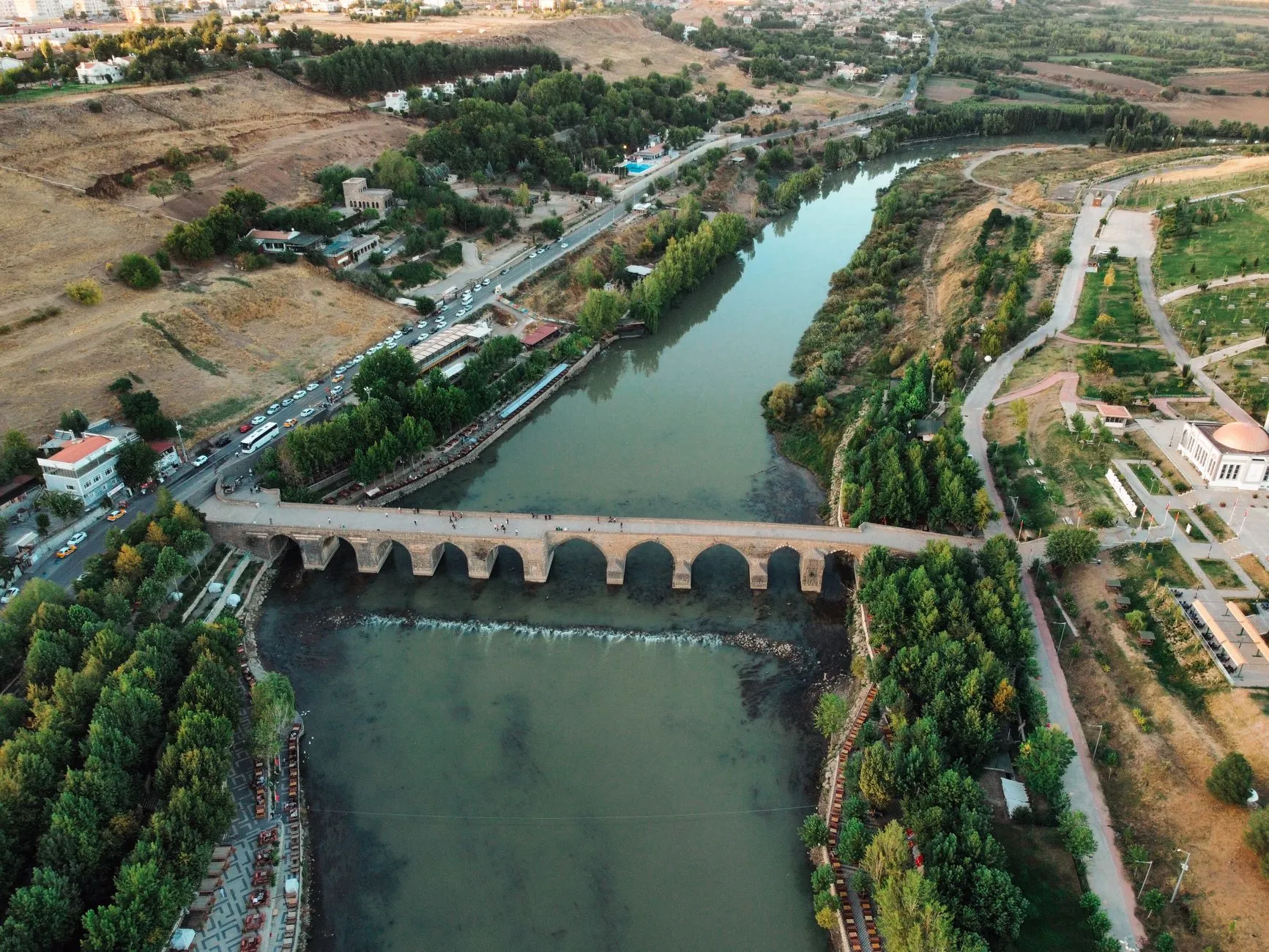
- The Anzele water source and the On Gözlü Köprü, the Ten-Eyed Bridge across the Tigris.
The escarpment above the Tigris is the view that explains the whole city. Go to the southern walls in the late afternoon and look down over the gardens to the river.
The Ulu Camii is the other landmark. The Great Mosque of Diyarbakır was commissioned by the Seljuk sultan Malik Shah and dated by an inscription on its western façade to 1091–1092 CE, which makes it the oldest mosque in Anatolia. It was modelled on the Great Mosque of Damascus, which Malik Shah had restored a few years earlier, and it looks nothing like the Ottoman domed mosques most visitors to Türkiye have seen. It sits in a courtyard in the middle of the old city, minutes from the Hasan Paşa Hanı, a 16th-century caravanserai now full of breakfast places and tea.
One caution about the guidebook claim you will hear. You will be told the walls are the second-longest after the Great Wall of China. Nobody serious stands behind that. What UNESCO actually records is 5.8 km of continuous basalt fortification with 63 dated inscriptions, which is remarkable enough without the superlative.
Mardin is the day trip. About 90 km southeast, a honey-coloured stone town stacked up a hillside over the Mesopotamian plain — a completely different landscape and architecture from Diyarbakır’s black basalt, and the natural pairing. It has its own small airport, but from Diyarbakır it is a straightforward drive or intercity bus, which is exactly what the eleven rental desks at DIY are for.
Timing. The Diyarbakır plain is brutally hot from June to early September — this is not coastal heat, it is inland plateau heat, and midday sightseeing on the walls is not sensible. April to early June and late September to November are the seasons. Winters are cold and clear.
On fares. DIY’s price peaks track the German school holidays and the religious festivals rather than the tourist calendar, because that is what the international network is for. If your dates can move, run them through our price checker — the gap between a festival week and the week either side of it is bigger here than the gap between carriers.
❓ Frequently Asked Questions
📊 2026 Summary Data Table
| Category | Detail |
|---|---|
| IATA / ICAO | DIY / LTCC |
| Official name | Diyarbakır Airport (Diyarbakır Havalimanı) |
| Operator | DHMİ — General Directorate of State Airports Authority. Joint civil/military field |
| Opened | 1952 |
| Location | Bağlar district, 10 km from the city centre |
| Elevation | 686 m above sea level — hot-and-high performance matters here |
| Terminal | One building, domestic + international sections, 95,691 m² enclosed |
| Hall areas | Shared departures 34,315 m² · domestic arrivals 18,313 m² · international arrivals 16,002 m² |
| Runway | 16/34 · 3,549 m concrete — longer than Gaziantep, Trabzon or Iaşi |
| Capacity | 5,000,000 passengers/year |
| 2025 passengers | 2,292,693 (2,079,321 domestic / only 213,372 international) · 14,020 movements |
| Main carriers | Turkish Airlines, Pegasus, AJet, SunExpress, Corendon, Fly Kıbrıs |
| Network shape | Istanbul/Ankara feed + a small German diaspora overlay (Düsseldorf, Hannover, Cologne) |
| Airport buses | Z2 Havalimanı ↔ Üniversite · Z3 ↔ Dağkapı (old city) · Z7 ↔ Üçkuyu TOKİ · Diyarkart card |
| Havaş | Does not operate at Diyarbakır |
| Taxi / rental | Dedicated airport taxi cooperative · eleven rent-a-car firms |
| Currency | Turkish lira (TRY) — volatile; decline DCC, use bank ATMs |
| Border regime | Türkiye’s own regime — not an EU or Schengen border. 90/180 visa-free for US/UK/EU/Gulf/JP/AU; e-Visa at evisa.gov.tr for others; passport valid 60 days beyond permitted stay |
| Lounge | Priority Pass CIP Lounge — landside, separate building, domestic flights only, 3-hour cap, no alcohol |
| UNESCO | Diyarbakır Fortress and Hevsel Gardens Cultural Landscape, inscribed 2015 — 5.8 km walls, 63 inscriptions, ~700 ha of gardens |
| Landmark | Ulu Camii, dated by inscription to 1091–1092 CE — the oldest mosque in Anatolia |