Zakynthos Dionysios Solomos Airport (ZTH) Airport Guide 2026 — One Airport, Two Seasons
Zakynthos International sits 4.3 km from Zakynthos town on the north edge of Laganas bay, and it is the most violently seasonal airport in the Mediterranean: Fraport Greece’s own figures show 528,968 passengers in July 2026 and 1,846 in the whole of February — with zero international passengers in January and February. There is no railway on the island, and the public bus runs seven times a day to the town only, finishing at 19:30, which is before most charter flights land. Greece is Schengen and Eurozone. British routes alone are 31% of the traffic, so EES is the main event at this border, not an edge case.
Last verified: September 2026.
⚡ 2026 Quick Reference — Key Facts at a Glance
Only 7 departures a day each way. Town → airport 08:15, 09:15, 10:45, 12:45, 15:30, 17:00, 19:15; airport → town 08:30, 09:30, 11:00, 13:00, 15:45, 17:15, 19:30. Stops at the town only — not at Laganas or Tsilivi. Stop is outside the Arrivals building
Rank in front of the terminal. No published airport tariff — agree the fare or confirm the meter before you load the bags
The default for most arrivals, because the great majority of flights land outside the bus’s 08:30–19:30 window
ZTH / LGZA — Zakynthos International “Dionysios Solomos”, operated by Fraport Greece
4.3 km from Zakynthos town; Laganas bay is immediately south
Euro (€) — Greece is in the Eurozone. Carry small cash for buses and village tavernas
None. Priority Pass lists six Greek airports and Zakynthos is not one; the airport’s own directory shows cafés and duty-free, no lounge
Schengen · EES live since 10 April 2026
The airport itself advises passengers on non-Schengen departures (i.e. the UK) to arrive when check-in opens, because emigration checks now take longer
Not yet running. The Commission states no ETIAS applications are being collected; the fee is set at €20
🏢 1. One Terminal, Five Security Lanes, and a Season That Fills Them
Zakynthos International Airport “Dionysios Solomos” — ZTH, ICAO LGZA — has a single 22,150 m² terminal completed in 2008, one asphalt runway 16/34 of 2,228 metres, and a car park immediately outside the door. It is named after the poet born on the island on 8 April 1798, whose Hymn to Liberty supplied the first two stanzas of the Greek national anthem when it was adopted in 1865. His statue stands in the main square of the town.
Fraport Greece — the Fraport AG / Copelouzos Group joint venture — took over the airport, along with thirteen other Greek regional airports, on 11 April 2017 under a 40-year concession. Its investment programme rebuilt and remodelled the terminal, added inline hold-baggage screening, took check-in counters from 15 to 20 and security lanes from 2 to 5. That last number is the one to hold on to: five lanes is what stands between a July charter wave and the gate.
The seasonality, in the operator’s own numbers
This is the single most important thing to understand about ZTH, and Fraport publishes the proof. From its 2025 traffic report:
| Month (2025) | Passengers | Flights |
|---|---|---|
| August | 527,049 | 3,233 |
| July | 519,679 | 3,149 |
| September | 402,034 | 2,664 |
| October | 146,917 | 1,170 |
| November | 7,204 | 136 |
| December | 4,604 | 114 |
| January | 3,792 | 109 |
| February | 1,188 | 32 |
Full-year 2025 came to 2,282,774 passengers, up 2.7% on 2024’s 2,223,010 — of which 2,182,625 were international, so ZTH is a 96% foreign airport. And the winter figures are not merely small. In December 2025 the international passenger count was one. In January and February 2026 it was zero.
Read that again, because it decides trips. Between roughly November and April, Zakynthos is not connected to Europe by air at all. What remains is the Athens domestic link — about 98 flights in January 2026, three a day — flown by Olympic Air and Sky Express. If you want the island out of season, you fly to Athens and connect, or you take the ferry to Kyllini on the Peloponnese.
The summer airlines
In season the airport lists close to forty carriers, and the shape of the list tells you what the island is. The volume comes from northern European leisure and charter operators: TUI Airways, Jet2.com, Ryanair, easyJet, Condor, Corendon Dutch, Transavia, Smartwings, Enter Air, Edelweiss, Jettime, Novair, Discover Airlines, Buzz, Wizz Air, Volotea, Vueling, LOT, SAS, Norwegian, Finnair, Brussels Airlines, British Airways, Swiss, Lufthansa, TAROM, AeroItalia and more. The Greek carriers — Aegean, Olympic Air, Sky Express — carry the domestic traffic.
Where those passengers actually come from, in July 2026:
| Country | Passengers, July 2026 |
|---|---|
| United Kingdom | 164,503 |
| Italy | 84,462 |
| Poland | 60,853 |
| Netherlands | 45,236 |
| Germany | 25,308 |
| Czech Republic | 22,379 |
| Greece (domestic) | 20,123 |
| Romania | 18,572 |
| Hungary | 15,385 |
| Austria | 13,583 |
| Total | 528,968 |
Because this is a charter airport, the bag is usually the deciding cost. Price yours with our baggage fee checker and check the specifics in the Jet2 baggage allowance guide, the TUI Airways baggage allowance guide or the Ryanair baggage allowance guide before you book. And because summer fares here swing enormously week to week, compare dates with our flight price checker rather than assuming August is August.
Be realistic about the turnaround
Five security lanes, 20 check-in desks, 3,233 flights in an August. That works out at over a hundred movements a day on a single runway with one terminal, and the whole operation is optimised around charter turnarounds rather than around your comfort. Departure days are slow. Arrive when your airline says, not when your instinct says.
🛂 2. Schengen, the Euro, and a Border Where EES Is the Main Event
Greece has been in the Schengen area since internal border checks with Greece were abolished in January 2000, and it uses the euro. Those are two different memberships and Greece holds both.
The EU Entry/Exit System (EES) became fully operational across all Schengen countries on 10 April 2026, ending the progressive roll-out that began in October 2025. Passport stamps are gone: non-EU nationals on short stays now have their facial image, fingerprints and travel-document data registered digitally on first entry, then checked biometrically on later crossings.
At most small European airports this is a footnote. At Zakynthos it is the defining border fact, because of the traffic mix. United Kingdom routes carried 164,503 of the airport’s 528,968 passengers in July 2026 — 31% of everyone who passed through — and British passport holders are precisely the group EES registers. Poland, Italy, the Netherlands, Germany, Czechia, Romania, Hungary and Austria are all inside Schengen and walk straight through. The British half of the terminal does not.
The airport says so itself. Its own homepage carries a standing notice that the EES is being applied at border control points, that waiting times are longer than usual at both arrivals and departures, and that passengers departing to non-Schengen destinations should arrive when check-in opens and complete all processing early, because emigration control now takes longer. Take that literally on a UK departure at peak season. The five security lanes are not the bottleneck; the passport desk is.
ETIAS is not in operation. The European Commission’s Smart Borders page states that ETIAS is not running and that no applications for travel authorisations are being collected, with the start date to be announced several months ahead. The fee is set at €20 by Commission Delegated Regulation (EU) 2025/1411; applicants under 18 or over 70 and qualifying family members of EU citizens are exempt from the fee but will still need an authorisation. Nobody can sell you a valid Greek ETIAS today.
On money: cash matters more here than at a mainland airport. Card acceptance is normal in Zakynthos town and the resorts, but island buses, small tavernas and beach kiosks are much happier with notes. Under EU rules you must declare €10,000 or more in cash when entering or leaving the EU, and the airport reminds departing passengers that the written declaration has to be made before you pass through the security checkpoint.
🚌 3. Seven Buses a Day, and Then You Are on Your Own
There is no railway on Zakynthos. Ground transport is a bus, a taxi, a pre-booked transfer or a hire car, and the honest ranking depends entirely on what time you land.
The public bus
KTEL Zakynthos runs a direct service between the airport and Zakynthos town. The stop is outside the Terminal Building in the Arrivals area. The published timetable is:
- Zakynthos town → airport: 08:15 · 09:15 · 10:45 · 12:45 · 15:30 · 17:00 · 19:15
- Airport → Zakynthos town: 08:30 · 09:30 · 11:00 · 13:00 · 15:45 · 17:15 · 19:30
Seven departures each way. First at 08:15, last at 19:30. That is the whole service.
Two limitations decide whether it is any use to you. First, it serves the town and nothing else — not Laganas, not Kalamaki, not Tsilivi, not Alykes. If your hotel is in a resort, the bus is a two-leg journey: airport bus into the town, then a KTEL local service out again (the Laganas–Zakynthos town line, for reference, costs €2.20). Second, and more seriously, a very large share of ZTH’s charter traffic lands outside 08:30–19:30. If your flight arrives at 22:40, as many summer charters do, there is no bus and there will not be one until the morning.
KTEL does not publish a fare for the airport line on its timetable page, so carry small euro notes and pay the driver. KTEL also reissues its timetables seasonally — check ktel-zakynthos.gr for your actual travel dates rather than trusting a screenshot.
Taxis
There is a taxi rank directly in front of the terminal. Unlike some Italian and Spanish airports, Zakynthos publishes no fixed airport tariff, so establish the price before you load your luggage — either confirm the meter will run or agree a flat fare out loud. Greek island taxis legitimately charge supplements for luggage and for night hours; the problem is not the supplement, it is discovering it at the destination.
Pre-booked transfers
For most people arriving at ZTH, this is the correct answer and there is no shame in it. The combination of late-night charter arrivals, a bus that stops at 19:30 and resorts the bus does not serve makes a pre-booked transfer the default. Book it with the accommodation or a transfer operator before you fly, and give the operator your flight number so a delay does not strand you.
Hire cars
Rental desks are in the terminal. A car is the right call if you intend to see the island rather than one beach — Zakynthos is 405 km² with 123 km of coastline, and the good parts (Vasilikos, Keri, the west-coast cliffs, Anafonitria) are poorly served by public transport. Note that the interior roads are narrow and steep, and that the whole Laganas bay shoreline is inside a national marine park with its own access rules.
Parking
Parking is run by Airport Parking Management and sits directly next to the terminal, with licence-plate recognition, controlled access, CCTV and a 24-hour intercom. A separate long-stay area is a short walk further out.
| Short-stay (adjacent to terminal) | Long-term | |
|---|---|---|
| 0–20 minutes | Free | — |
| 21–60 minutes | €5.00 | €5.00 |
| 1–2 hours | €6.00 | €8.00 (1–4 h) |
| 2–3 hours | €7.00 | — |
| 3–4 hours | €8.00 | — |
| 4–5 hours | €10.00 | €10.00 (4–24 h) |
| 5–24 hours | €12.00 | — |
| Each further day or part day | +€8.00 | +€5.00 |
The twenty free minutes are generous by European standards and make the short-stay lot a perfectly good place to meet an arrival — but not to wait out a delay.
| Option | Serves | Price | Frequency |
|---|---|---|---|
| KTEL bus | Zakynthos town only | Fare not published — carry cash | 7 per direction per day, 08:15–19:30 |
| KTEL local bus onward | e.g. Laganas from the town | €2.20 on the Laganas line | Frequent in season |
| Taxi | Anywhere | No published airport tariff — agree first | On demand at the rank |
| Pre-booked transfer | Anywhere, any hour | Varies | The realistic option for night arrivals |
| Hire car | The whole island | Varies | Desks in the terminal |
| Airport parking | — | 20 min free · €12 for 5–24 h · +€8/day | 24h, adjacent to terminal |
🛋️ 4. No Lounge, and Nothing Pretending to Be One
Zakynthos has no lounge. Priority Pass’s Greece directory enumerates the Greek airports where it has one — Athens, Thessaloniki, Heraklion, Rhodes, Corfu and Mykonos, six in total — and Zakynthos is not among them. The airport’s own shop-and-dine directory lists cafés, restaurants and duty free, and no lounge product of any kind. No airline operating here bases a premium cabin at ZTH, so there is no carrier lounge either.
What there is: free Wi-Fi on the network named Fraport-Free — connect and open a browser to reach the welcome page — charging points for mobile devices, and a first-aid post, with the airport information counters as the route to anything else.
Practically, on a busy August departure you should expect to spend your waiting time on a seat in the gate area with a coffee. Plan for it: charge everything before you leave the hotel, buy water after security, and do not count on finding a quiet corner. This is a one-runway leisure airport at full stretch, and it feels like one in the third week of August.
🍽️ 5. Ladotyri, Sartsa and Verdea
Airside and landside the food is straightforward: Street Food Republic, Pret A Manger, Refill Coffee & Bakery and The Barrels GastroPub across the Schengen, non-Schengen and all-users areas, plus Hellenic Duty Free Shops in departures and at baggage reclaim. It is competent and it is priced like an airport. The interesting eating is on the island.
Zakynthos has a genuinely distinct kitchen, less Aegean and more Venetian than most of Greece — the Ionian islands were never under Ottoman rule, and the food shows it:
- Ladotyri — “oil cheese”, a hard, sharp sheep’s cheese matured in olive oil rather than brine. Specific to the island and the thing to bring home.
- Prentza — a fresh, creamy island cheese you will not find on the mainland.
- Sartsa — the island’s signature plate: beef slow-cooked in a tomato-and-garlic sauce, served over pasta. Venetian ancestry, unmistakably.
- Skordostoumbi — aubergine cooked with a genuinely intimidating quantity of garlic.
- Mandolato — the local nougat with almonds, sold everywhere and the standard edible souvenir.
- Verdea — the island’s own white wine, a field blend of local varieties including Skiadopoulos, Robola, Goustolidi, Pavlos and Augoustiatis, traditionally aged in oak until it develops an oxidative, sherry-adjacent character. It is not made anywhere else in Greece and it is not what a supermarket assyrtiko has prepared you for. Try it before you buy a bottle.
If you have one meal to spend well, spend it in a village taverna inland or in Vasilikos rather than on the Laganas strip.
💡 6. Insider: Turtles, and What the Navagio Closure Actually Means
The loggerheads — the island’s real distinction
Laganas bay, which starts a couple of kilometres from the runway, holds the National Marine Park of Zakynthos, founded in December 1999 and covering 135 km². It protects the loggerhead sea turtle Caretta caretta, along with the Mediterranean monk seal, across six nesting beaches — Gerakas, Daphni, Sekania, Kalamaki, East Laganas and the Marathonissi islet — that together run to only about three miles of sand. Those few miles take 900 to 2,000 nests a year, roughly eighty per cent of all loggerhead nesting in the Mediterranean. Females come ashore to lay at night between May and August.
This is genuinely globally significant and it is why the bay has rules: fishing is prohibited inside the marine zones, speedboat access off the nesting beaches is banned, and nesting beaches carry night-time restrictions and limits on umbrellas and loungers in the sand. Follow the posted rules — they are the reason the nests are still there, and this is the single best reason to choose Zakynthos over any other Ionian island.
Navagio: read this before you book a “shipwreck beach” tour
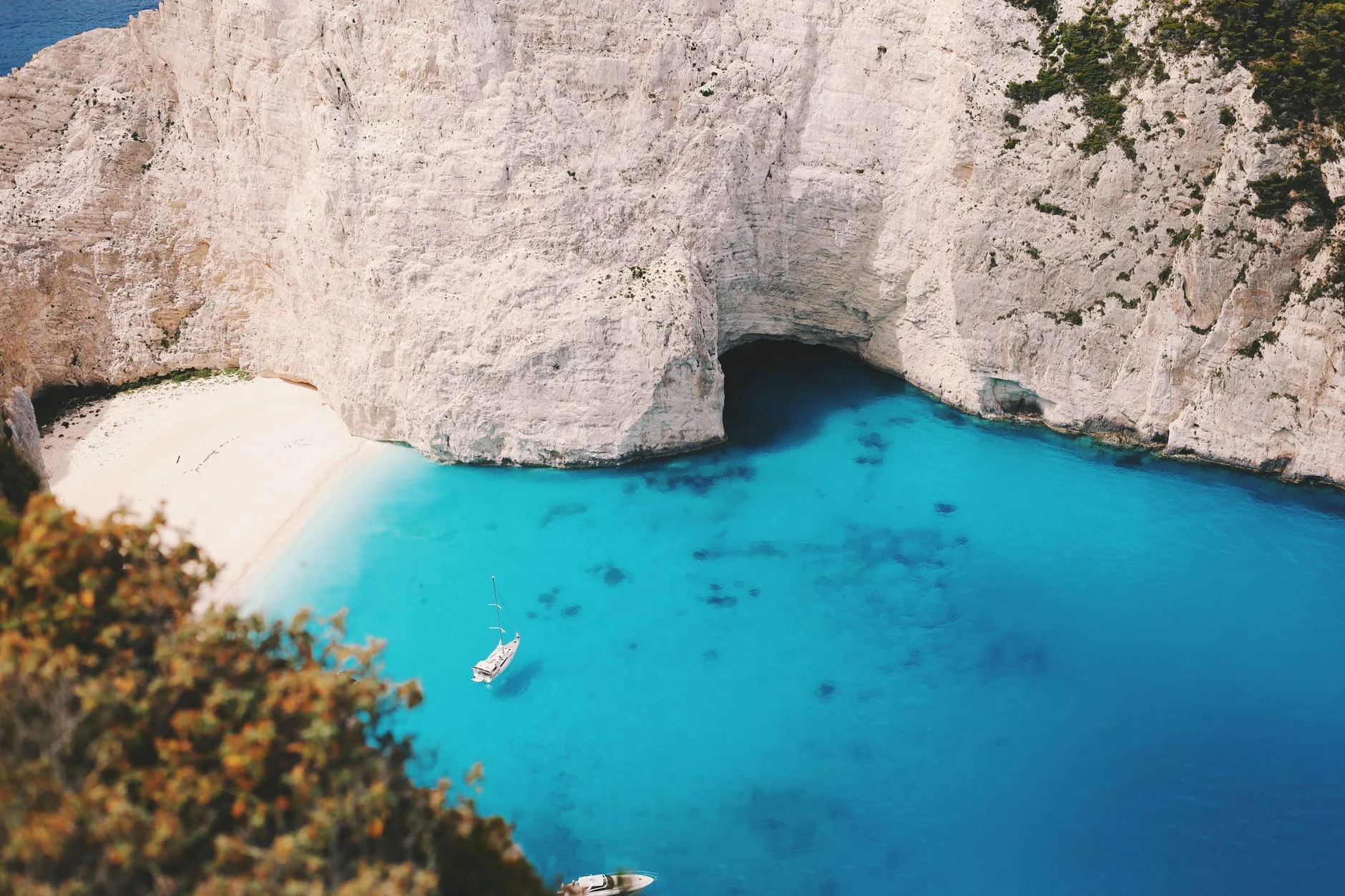
The cove with the rusting freighter Panagiotis is the image that sells this island, and the situation on the ground is not what most tour listings imply.
Access to the sand is prohibited. A Joint Ministerial Decision published in the Government Gazette imposes a complete ban on entry to both the “Prohibited Zone” and the “Controlled Access Zone” at Navagio on landslide and rockfall grounds, with the current instrument running until 31 October 2026. Vessels may not approach or anchor within 50 metres of the shoreline, and swimming is banned throughout the marine area between the two headlands of the cove. A free-access area near the wreck itself exists only for emergencies and rescue operations. The Municipality of Zakynthos enforces this and can impose administrative penalties.
What remains, and is worth doing: the clifftop viewpoint above Anafonitria, where a formal observation platform with proper fencing is the sanctioned way to look down into the cove; and boat trips that hold offshore, which will show you the bay and typically pair it with the Blue Caves at Cape Skinari, where the swimming is actually permitted and, honestly, better.
The practical instruction is simple. Restrictions here have been imposed, lifted and re-imposed over several seasons, so check the current decision before you pay for anything sold as a Navagio landing — boats are still marketed as though they can put you on the beach. If a tour promises you sand, it is either out of date or lying.
What else the island is for
Zakynthos town is a reconstruction: the magnitude-7.3 Ionian earthquake of 12 August 1953 destroyed most of the buildings on the island, and what stands now was rebuilt afterwards with the Venetian street plan and arcades reinstated. Knowing that changes how you read it — it is not a preserved old town, it is a careful replacement of one, and it works better than it has any right to.
Beyond that: Vasilikos and Gerakas in the south-east for the quietest good beaches and turtle nesting; Keri and the west-coast cliffs for the dramatic side of the island; the Blue Caves at the northern tip; and the interior villages, which most package visitors never see at all. The island is 405 km² with 123 km of coast and a resident population of about 41,000 — so in August the visitors outnumber the islanders many times over, and in February you will have the place almost entirely to yourself, if you can get there.
The honest verdict on this airport
ZTH is a well-run, recently rebuilt leisure airport that does one job — moving northern Europeans to a beach between May and October — and does it at a scale its single runway and five security lanes only just support. It is not a bad airport. It is a strictly seasonal one, with weak public transport, no lounge, no rail, and a border queue that falls almost entirely on British passengers. Fly here in season, book your transfer before you fly, arrive early for a UK departure, and do not plan a winter trip around it.
❓ Frequently Asked Questions
📊 2026 Summary Data Table
| Category | Detail |
|---|---|
| IATA / ICAO | ZTH / LGZA |
| Official name | Zakynthos International Airport “Dionysios Solomos” |
| Operator | Fraport Greece (Fraport AG / Copelouzos Group), since 11 April 2017 under a 40-year concession |
| Location | 4.3 km from Zakynthos town, on the north side of Laganas bay |
| Terminal | Single terminal, 22,150 m², completed 2008; upgraded by Fraport to 20 check-in counters and 5 security lanes |
| Runway | Single runway 16/34, 2,228 m asphalt |
| Passengers 2025 | 2,282,774 (2,182,625 international + 100,149 domestic), +2.7% on 2024 |
| Peak vs trough | August 2025: 527,049 passengers. February 2025: 1,188. International passengers: 1 in December 2025, 0 in January and February 2026 |
| July 2026 | 528,968 passengers, 3,232 aircraft movements |
| Top markets, July 2026 | UK 164,503 · Italy 84,462 · Poland 60,853 · Netherlands 45,236 · Germany 25,308 · Czechia 22,379 · Greece 20,123 |
| Winter service | Athens only — about 98 flights in January 2026 — on Olympic Air and Sky Express |
| Summer airlines | ~40 carriers: TUI Airways, Jet2, Ryanair, easyJet, Condor, Corendon, Transavia, Smartwings, Enter Air, Edelweiss, Wizz Air, Volotea, LOT, SAS, Norwegian, British Airways, Aegean, Sky Express and more |
| Public bus | KTEL, 7 departures per direction per day, 08:15–19:30, Zakynthos town only — no service to Laganas, Kalamaki or Tsilivi. Stop outside Arrivals |
| Taxi | Rank in front of the terminal. No published airport tariff — agree the fare first |
| Parking | 20 min free · €5 to 1 h · €12 for 5–24 h · +€8 per further day. Long-term: €10 for 4–24 h, +€5 per day |
| Lounge | None. Priority Pass lists 6 Greek airports (Athens, Thessaloniki, Heraklion, Rhodes, Corfu, Mykonos); ZTH is not one |
| Wi-Fi | Free, network Fraport-Free |
| Food & shops | Street Food Republic · Pret A Manger · Refill Coffee & Bakery · The Barrels GastroPub · Hellenic Duty Free |
| Currency / border | Euro (€), Greece in the Eurozone · Schengen since January 2000 · EES live since 10 April 2026 · ETIAS not yet in operation, fee set at €20 |
| EES exposure | UK routes were 31% of July 2026 traffic — the airport advises non-Schengen departures to arrive when check-in opens |
| Navagio beach | Landing prohibited under a Joint Ministerial Decision on landslide grounds — vessels must stay 50 m off and swimming is banned in the cove. Clifftop platform above Anafonitria and offshore boat trips only. Restrictions have been imposed and re-imposed across seasons: check the current decision before booking any tour promising a landing |
| Marine park | National Marine Park of Zakynthos, founded December 1999, 135 km², 6 nesting beaches, 900–2,000 loggerhead nests a year — ~80% of Mediterranean nesting |