Münster Osnabrück Airport (FMO) Airport Guide 2026 — The One That Kept Its Hub
Münster Osnabrück Airport (FMO) sits at Greven, 25 km north of Münster and 35 km south of Osnabrück, and its defining feature is a route Lufthansa has not cut: up to four flights a day to Munich, confirmed through the winter 2026/27 season. Around it sits a leisure network anchored on Antalya — up to seven departures a day in summer — plus Mallorca, the Canaries, the Greek islands, Zadar, London Stansted and Pristina. It handled roughly 1.25 million passengers in 2025 and 519,632 in the first half of 2026. Germany is Schengen and Eurozone. Buses run to Münster twice an hour; to Osnabrück, they do not run at all.
Last verified: September 2026.
⚡ 2026 Quick Reference — Key Facts at a Glance
FMO / EDDG — one building, Terminal 1 arrivals, Terminal 2 departures, Airportallee 1, 48268 Greven
25 km north of Münster · 35 km south of Osnabrück
S50 (~33 min direct) and R51 (~50 min, all stops) to Münster Hbf — two an hour Mon–Fri, thinner at weekends
There isn’t one. The Osnabrück airport bus was withdrawn in 2023. Best is RB66 rail to Kattenvenne + bus 140, ~42 min, a handful of times a day
Valid — the S50 and R51 are ordinary WestfalenTarif regional buses
From €39 a week on P6 Holiday Spar (online reservation compulsory); €69 for 14 days. Terminal drop-off free for 10 minutes, then €3 per 10 min
Euro (€) — Germany is in the Eurozone
Yes — airside opposite Gate C13, 05:00–21:00, €26 walk-in, Priority Pass / LoungeKey / Lounge Pass / Diners Club accepted
Desks open 2.5 hours before departure for every airline; self-service check-in and bag drop available
Schengen — EES fully operational since 10 April 2026. The airport itself warns of longer waits on the Antalya, Pristina and London flights
Not in operation, no applications collected, no launch date published. €20 fee already set
🏢 1. Terminal 1 In, Terminal 2 Out, and the Runway That Was Never Extended
FMO is one passenger building with two names. Terminal 1 is arrivals; Terminal 2 is departures and holds the check-in desks. The Service Point sits in Terminal 2 opposite the check-in counters and is staffed around the clock, which is unusual for an airport this size and genuinely useful if your inbound lands at 23:40. From the check-in hall you go up by lift or escalator to the first-floor security checkpoint and into the gate area.
The apron has five stands with air bridges, sized for 737s and A320-family aircraft. That is the whole airside estate, and the walk from security to the furthest gate is short enough that the airport’s advice to arrive 2.5 hours early is about queues, not distance.
The runway is the story
The single runway is 07/25, 2,170 m of asphalt. FMO spent years trying to change that: an extension to 3,000 m was approved in 2004 at a cost of around €60 million, and in May 2011 the Higher Administrative Court in Münster struck it down over errors in the planning procedure after challenges from environmental groups. The runway stayed where it was.
That single legal outcome explains the airport you are standing in. 2,170 m carries a narrowbody to Antalya, Hurghada or the Canaries and nothing further. There is no long-haul from FMO and there is no realistic path to one. What FMO does instead is sell you Munich, and let Lufthansa fly the long sector.
The traffic, honestly
2024 was a strong year at 1,283,691 passengers, up 29.7%. 2025 came in at roughly 1.25 million, down about 2% — and that small drop is the impressive number, because Lufthansa’s Frankfurt service ended at the close of 2024 and the airport replaced almost all of it. Against the last pre-Covid year, 2019, FMO is up about 26%. Average load factor in 2025 hit a record 83%. The first half of 2026 came in at 519,632 passengers, level with the year before.
The 2025 destination ranking tells you the shape: Antalya 398,000 · Palma de Mallorca 339,000 · Munich 233,000. Three carriers each took roughly a fifth of the traffic — SunExpress, Lufthansa and Ryanair.
Who flies here, and where
The current network is Alicante, Antalya, Chania, Fuerteventura, Gran Canaria, Heraklion, Hurghada, Corfu, London Stansted, Málaga, Mallorca, Munich, Pristina, Rhodes, Tenerife South and Zadar, flown by Lufthansa, Eurowings, Ryanair, Condor, SunExpress, Corendon, Pegasus, Mavi Gök, Ivy Air, GP Aviation and LEAV Aviation, the German leisure carrier that based an aircraft at FMO for summer 2026 and opened Fuerteventura, Crete and Rhodes.
Three route facts worth knowing before you book:
- Antalya runs up to seven times a day in the summer peak, split across SunExpress, Corendon, Pegasus and Mavi Gök.
- Mallorca runs up to five times a day, with Condor pushing a departure out at 04:15 and Eurowings at 05:00 — read the transport section before you assume you can get there.
- London Stansted is Ryanair, currently a Monday morning and a Friday night, and Pristina is Ivy Air, currently three evenings a week.
Bag rules differ sharply across that carrier list. Check the fare before you pay for it: our Ryanair baggage guide, Eurowings baggage guide, Lufthansa baggage guide, Condor baggage guide and SunExpress baggage guide all differ, and the aifly baggage checker compares them in one place.
Check-in
Desks open 2.5 hours before departure for all airlines, and the airport asks you to be there in that window. It has added self-service check-in counters — you check in, print your own boarding pass and bag label, then drop the bag at a second station — which cuts the desk queue considerably in the school holidays. Bring your passport or ID card and your booking; a visa too if your destination needs one. Oversized items — bikes, skis, golf, surfboards — go to the bulky baggage desk, and the airline charges for them, not the airport.
🛂 2. Schengen, Euros, and the Three Flights Where EES Bites
Germany is a Schengen founding member and it is in the Eurozone. On the Mallorca, Alicante, Málaga, Tenerife, Gran Canaria, Fuerteventura, Corfu, Crete, Rhodes, Zadar and Munich flights nobody checks your passport at the border, and the money in your pocket is already the right money.
Then there are the other three. Antalya, Pristina and London Stansted are external-border flights, because Türkiye, Kosovo and the United Kingdom are all outside the Schengen area — and so is Hurghada. FMO is unusual in saying so out loud: in its own summer 2026 briefing the airport warned passengers travelling to Antalya, Pristina or London that non-EU travellers may face longer waits because of the Entry/Exit System. When an airport publishes that about its own queues, believe it.
EES has been fully operational since 10 April 2026. It replaced passport stamping at the Schengen external border. Non-EU passport holders now have their name, travel document, fingerprints and facial image recorded with the date and place of each entry and exit, and overstays are flagged by the system rather than by an officer counting stamps. The first crossing is the slow one — that is the enrolment. Afterwards the check is a match against a record that already exists and it moves faster. On a small airport with one border control channel, a full Antalya wave enrolling for the first time is exactly the situation the airport is warning you about, so treat the 2.5-hour advice as a floor on those departures, not a suggestion.
ETIAS is not in operation. The European Commission’s own page states that ETIAS “is currently not in operation and no applications for travel authorisations are collected at this point”, and that the EU will publish the start date several months before launch. There is no date on that page. The fee has been fixed at €20, up from the original €7, with exemptions for under-18s, over-70s and family members of EU citizens. Anyone selling you an ETIAS today is selling you nothing.
| Passport | Visa for a short stay? | EES applies? | ETIAS when it launches? |
|---|---|---|---|
| German / EU / EEA / Swiss | No — freedom of movement | No | No |
| UK | No — 90 days in any 180 | Yes | Yes |
| Kosovo (biometric passport) | No — 90 days in any 180 | Yes | Yes |
| USA / Canada / Australia / NZ / Japan | No — 90 days in any 180 | Yes | Yes |
| Türkiye | Schengen visa required | Yes — linked to the visa | Covered by the visa |
Money at FMO is simple. Everything is euros. There is a cash machine, shared between Volksbank im Münsterland and Kreissparkasse Steinfurt, on the ground floor in the public part of the terminal; use it rather than a bureau, and remember that the bus fare is the only thing here likely to want small change. Duty-free tobacco is only for departures outside the EU, which at FMO means Antalya, Hurghada, Pristina and London — not Palma, not the Canaries.
🚌 3. Two Buses An Hour To Münster, and Nothing At All To Osnabrück
This airport is named after two cities and connected to one of them.
Münster: genuinely well served
Two RVM lines run between Münster Hauptbahnhof and the terminal:
| Option | Time | Price | Frequency |
|---|---|---|---|
| S50 Schnellbus, Münster Hbf ↔ FMO | ~33 min direct | WestfalenTarif stage fare; DeutschlandTicket valid | ~Hourly Mon–Fri (leaves FMO at :08), roughly 2-hourly Sat/Sun |
| R51 Münster Hbf ↔ FMO via Greven | ~50 min, all stops | Same | ~Hourly Mon–Fri (leaves FMO at :33), thinner at weekends |
| RB66 + bus 140 from Osnabrück Hbf via Kattenvenne | ~42 min when it connects | Crosses into Lower Saxony — check the through fare | Only a handful of usable connections a day |
| Taxi to Münster or Osnabrück | — | Metered; no published flat fare | Five firms operate at the terminal |
| Own car, P6 Holiday Spar | — | €39/week, €69 for 14 days, online reservation compulsory | A1, exit “Flughafen Münster/Osnabrück” |
| Terminal drop-off | — | 10 minutes free, then €3 per further 10 min | Number-plate recognition; pay at the machine |
Take the S50 if it lines up: 33 minutes direct is a good number for a 25 km airport run. The R51 takes about 50 minutes because it works its way through Greven, but between the two of them you get two buses an hour into Münster on a weekday, which is more than most German regional airports manage.
The edges are where it goes wrong, and they are worth writing down:
- Weekdays: the first direct bus leaves Münster Hbf at 05:46 (R51, reaching the terminal at 06:37); the S50 follows at 06:40. Coming back, the last bus to Münster Hbf leaves the airport at 20:33.
- Saturdays: the first direct bus from Münster Hbf is 07:50, and the last bus back into Münster leaves the airport at 18:33. That is early. A Saturday evening arrival has no bus.
- Sundays: the first direct bus from Münster Hbf is 10:20, reaching the terminal at 10:53. There is a rail-and-bus workaround via Greven that gets you there around 08:41, but there is no direct bus before mid-morning.
Now hold that against the schedule. Condor departs for Mallorca at 04:15 and Eurowings at 05:00. No bus of any kind exists at those hours on any day of the week. If your flight leaves before about 07:30, public transport is not an option and you need a car, a taxi or a hotel night nearby.
Osnabrück: say it plainly
There is no bus from Osnabrück to Münster Osnabrück Airport. The Osnabrück airport shuttle ran as the X150, then the X15, then the X52, and the city of Osnabrück withdrew its funding in April 2023 after the line averaged fewer than eight passengers a trip — most of them airport staff. Nothing replaced it. The airport’s own arrivals page names only the Münster buses.
What you can actually do from Osnabrück Hbf:
- RB66 to Kattenvenne, then bus 140 to the terminal. About 42 minutes door to door and the fastest option on paper — but bus 140 only reaches Kattenvenne a handful of times a day, so the connection exists in the early morning and late afternoon and often not in between. Check it for your specific flight rather than assuming.
- Regional bus or train to Münster Hbf, then the S50. Reliable, roughly 1 hour 15 minutes total, and twice the journeys to choose from.
- A taxi. For 35 km, at 04:00, with three people and luggage, this is frequently the right answer and nobody should pretend otherwise.
Note also that Osnabrück is in Lower Saxony while the airport is in North Rhine-Westphalia, so an Osnabrück–FMO journey crosses a tariff boundary. The DeutschlandTicket sidesteps that entirely — it is valid nationwide on regional buses and trains in 2nd class, which makes it the simplest ticket for anyone approaching FMO from the Osnabrück side.
Tickets
The S50 and R51 are ordinary WestfalenTarif regional buses. That matters: the €63-a-month DeutschlandTicket is valid on both, with no airport surcharge and no separate shuttle fare — unlike Dortmund, where the airport runs its own buses and no network ticket works. A single is a WestfalenTarif stage fare priced by distance; the honest instruction is to let the RVM or DB app price your exact journey rather than trust a round number you read somewhere.
By car
FMO has its own motorway spur from the A1 at the “Flughafen Münster/Osnabrück” exit, and the A30 exit at Ibbenbüren if you are coming from the Netherlands. The airport claims a maximum ten-minute walk from the outer car park to the departures terminal, and on the ground that is about right. P6 Holiday Spar is the cheap one — €39 for anything up to a week and €69 for up to a fortnight — and it must be booked online in advance. P2/P3/P4 Holiday I & II are €59 a week without a reservation, and the multi-storeys PA/PB and P5 are €69. Short-stay P1 is €39 a day and is for people who genuinely need the terminal door.
🛋️ 4. There Is A Real Lounge, and It Costs €26
FMO has a proper lounge, which is not something every 1.25-million-passenger airport can say. It sits airside, in the departure area behind security, opposite Gate C13, runs about 200 m², and opens 05:00 to 21:00, seven days a week — which covers the 04:15 and 05:00 departure wave at one end and the late Antalya returns at the other.
Access, in order of usefulness:
- Walk-in: €26 per person. No membership needed. For a two-hour wait with a family that is not obviously worth it; for a delayed evening flight on your own it usually is.
- Priority Pass, LoungeKey, Lounge Pass and Diners Club are all accepted. If you carry any of those cards this is a free stop, and it is one of only fourteen German airports on the Priority Pass network.
- Complimentary for Lufthansa frequent-flyer elites, Star Alliance Gold members, and Business Class passengers on Condor and Marabu.
Inside: seating, quiet work space, snacks and light meals, coffee and tea, beer, wine and spirits, soft drinks, flight monitors and the airport’s free Wi-Fi. It is a regional lounge, not a first-class product — but it is a genuine one, and at €26 it is priced honestly.
The rest of the terminal is well equipped for its size. Wi-Fi is free, unlimited and needs no password, in the public area and the gate area. There is a prayer room on the first floor of Terminal 1 in the public part of the building. The Service Point in Terminal 2, opposite the check-in desks, is staffed 24 hours and handles parking questions, lost luggage and anything else that goes wrong out of hours; Lost & Found is by the baggage belts in arrivals.
🍽️ 5. One Airside Concept, One Arrivals Café, and Töttchen In Town
FMO’s catering is compact and recently rebuilt, which is a better combination than it sounds.
“you are here” is the airside operation — a single combined duty-free, shop and food concept in the gate area, directly behind the security check, opening about two hours before departures. It covers cold and hot snacks, hot and cold drinks, wine, spirits and beer, tobacco, perfume and cosmetics, fashion accessories, toys and Münsterland-specific gifts. As duty-free goes it is small; as the only airside option it is adequate, and the food side is a good deal better than a vending machine.
Café Jetlag is landside, in Terminal 2 in the check-in area, in the public part of the building — so it works for people seeing someone off, and it has a large outdoor terrace, which is the best seat at this airport on a warm afternoon. Coffee, a Weizen, and a view of the ramp.
Tobacco is only sold duty-free to passengers leaving the EU — Antalya, Hurghada, Pristina and London. On a Palma or Tenerife flight you are inside the EU tax territory and that counter is closed to you.
Eat in Münster instead
Töttchen is the Münsterland’s own dish, and almost nobody outside the region has heard of it. It is a sweet-and-sour ragout: originally calf’s head with beef offal, onions and vinegar, cooked down into something between a stew and a sauce. It was poor people’s food, and modern restaurant versions have quietly upgraded the meat to veal and calf’s tongue while keeping the vinegar edge that defines it. In the southern Münsterland it still turns up at the Frühschoppen of a Schützenfest. Order it in an old-town Gaststätte in Münster; you will not find it at the airport, and you will not find it anywhere outside Westphalia.
Beyond that, the Westphalian standards are worth the suitcase space: Westfälischer Schinken, the juniper-smoked bone-in ham, and Pumpernickel, the near-black rye steamed for hours, which keeps for months and is the one genuinely practical thing to take home from this region. Neither counts as a liquid.
💡 6. Insider: Two Peace Treaty Cities, One Airport
Fly from here when
- You need to connect. This is the whole argument for FMO. Lufthansa runs up to four flights a day to Munich, confirmed for the winter 2026/27 season through to the end of March 2027, with connection times deliberately tuned for onward intra-European and intercontinental flights. Around 40,000 passengers used it in the summer holidays alone. Compared with Paderborn, 100 km south, which lost its hub link entirely in June 2026, that is a serious advantage.
- You want a lounge for €26 or you carry a Priority Pass. FMO has one; most airports its size do not.
- You are driving from the northern Münsterland, Emsland, the Tecklenburger Land or south Lower Saxony. The A1 spur puts the terminal minutes from the motorway, and €39 for a week of parking is competitive with anything.
- You want Antalya. Seven departures a day at peak, four carriers competing on the same route. That is real price pressure and it shows in the fares.
Fly from somewhere else when
- Your flight leaves before about 07:30 and you have no car. The first bus of the day cannot get you there, and Condor’s 04:15 to Palma is at the extreme end of that problem.
- You are starting in Osnabrück without a car. The airport is 35 km away with no direct bus. Hannover and Bremen are both reachable by direct train from Osnabrück Hbf, and depending on the fare that can be the better trip.
- You are flying back on a Saturday evening. The last bus into Münster leaves the airport at 18:33.
- You want a long-haul departure. 2,170 m of runway rules it out, permanently. Use the Munich connection or start at Düsseldorf.
- The fare gap is real. Düsseldorf, Dortmund, Bremen and Hannover are all within reach and all have deeper networks. Run the numbers instead of defaulting — the aifly price check exists for exactly this comparison.
What the two cities are actually for
FMO is the only airport in Germany named after two cities that were, for five years, the joint capital of European diplomacy.
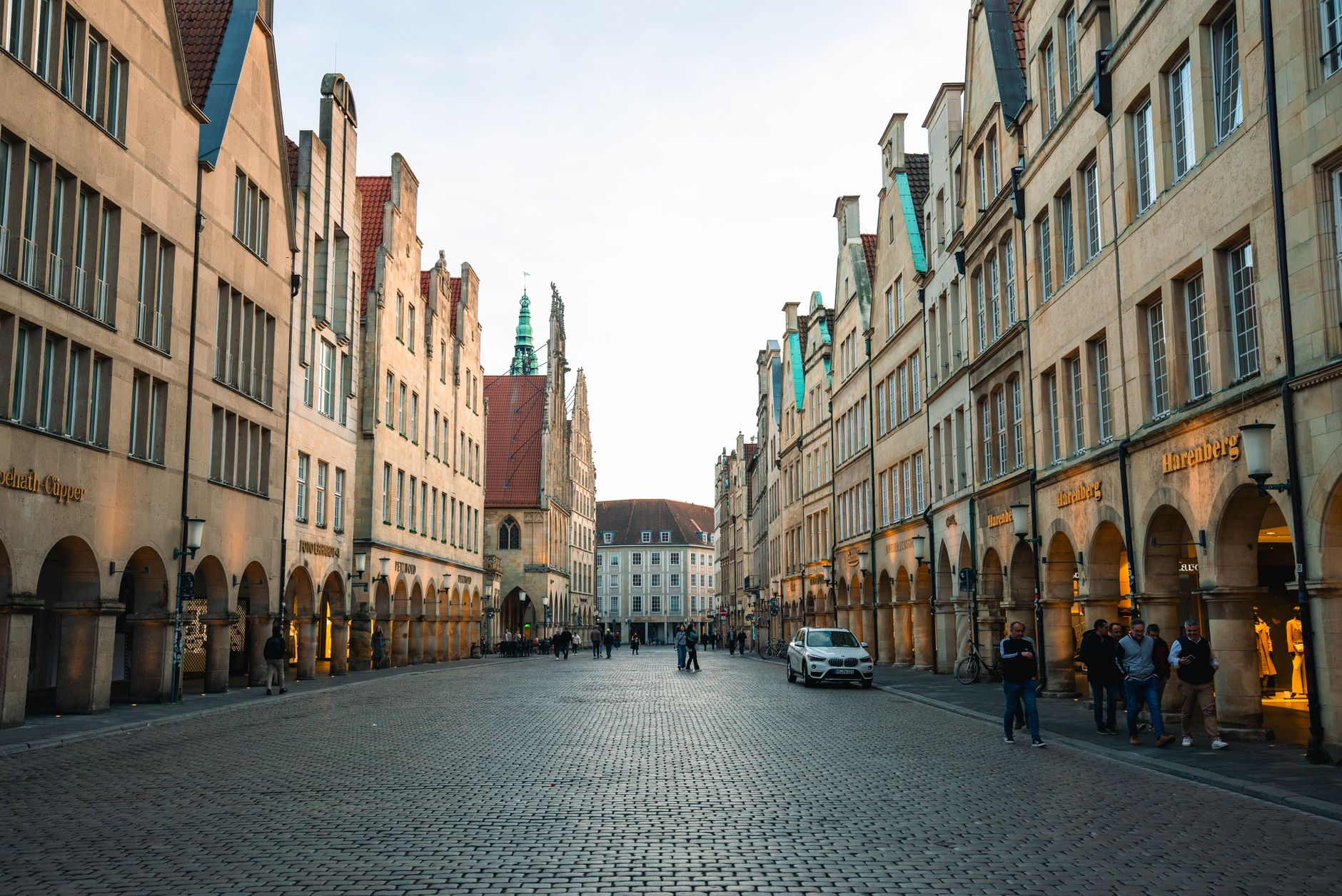
Münster and Osnabrück together hosted the Peace of Westphalia. The two cities were made neutral, demilitarised negotiating grounds because each side wanted to meet on ground it controlled: the Emperor, France, Spain and the Dutch talked in Münster; the Emperor and Sweden talked in Osnabrück. Both treaties were signed on 24 October 1648, ending the Thirty Years’ War. You can stand in the room. The Friedenssaal in Münster’s Gothic town hall on the Prinzipalmarkt is where the Münster treaty was signed, and it is open to visitors.
In Münster itself:
- The Prinzipalmarkt is the arcaded main street of gabled merchant houses that the city rebuilt after the war, and the town hall is on it. It is the single best thing to see in half an hour with a suitcase.
- St Paul’s Cathedral holds an astronomical clock of 1540 with hand-painted zodiac symbols that tracks the planets and plays its glockenspiel at noon. Time your visit for that.
- The Promenade is a ring of car-free path on the line of the old fortifications, encircling the entire old town. It is how locals move and it is the fastest way to see the shape of the city.
- Cycling. Münster calls itself Germany’s bicycle capital and has the numbers to back the claim — as far back as 2007, bicycle traffic (37.6%) overtook motor traffic (36.4%) in the city’s own modal split, and the local claim that there are more bikes than the roughly 306,000 inhabitants is repeated everywhere. Rent one. The Aasee, the lake on the edge of the centre, is a fifteen-minute ride from the Prinzipalmarkt.
In Osnabrück, 35 km the other way, the draw is the counterpart half of 1648 plus a very good modern museum in the Felix Nussbaum Haus, and the city that produced Erich Maria Remarque. It is a smaller, quieter and considerably cheaper base than Münster if you are staying a night around a flight.
Practical odds and ends
- The Service Point is open 24 hours. If your inbound lands late, or your bag does not, there is a human in Terminal 2. Use them.
- Book P6 online or you cannot use it. The cheapest car park at FMO requires an advance reservation; turning up hoping for a space is not how it works.
- Roaming: EU and EEA plans work with no action. Non-EU visitors buying a German prepaid SIM must register identity documents — that is federal law, not a shop rule.
- The 2.5-hour advice is real on three routes. For Antalya, Pristina and London, the airport itself has said EES may lengthen the queue. For Palma at 05:00, get there early for a different reason: everyone else is going too.
❓ Frequently Asked Questions
📊 2026 Summary Data Table
| Category | Detail |
|---|---|
| IATA / ICAO | FMO / EDDG |
| Official name | Flughafen Münster/Osnabrück |
| Address | Airportallee 1, 48268 Greven, North Rhine-Westphalia |
| Location | 25 km north of Münster; 35 km south of Osnabrück |
| Terminal | One building — Terminal 1 arrivals, Terminal 2 departures; five stands with air bridges |
| Runway | 07/25, 2,170 m asphalt. Extension to 3,000 m struck down by the Münster higher administrative court in May 2011 — no long-haul |
| Annual passengers | ~1.25 million in 2025 (−2%); 1,283,691 in 2024 (+29.7%); +26% on 2019. H1 2026: 519,632 |
| Load factor | Record 83% in 2025 |
| Top destinations 2025 | Antalya 398,000 · Palma de Mallorca 339,000 · Munich 233,000 |
| Hub connection | Lufthansa to Munich, up to 4× daily, confirmed through winter 2026/27 to end March 2027 |
| Airlines | Lufthansa, Eurowings, Ryanair, Condor, SunExpress, Corendon, Pegasus, Mavi Gök, Ivy Air, GP Aviation, LEAV Aviation |
| Destinations | Alicante, Antalya, Chania, Fuerteventura, Gran Canaria, Heraklion, Hurghada, Corfu, London Stansted, Málaga, Mallorca, Munich, Pristina, Rhodes, Tenerife South, Zadar |
| Bus to Münster | S50 ~33 min direct · R51 ~50 min all stops · two an hour Mon–Fri; first from Münster Hbf 05:46 weekdays / 07:50 Sat / 10:20 Sun; last back 20:33 weekdays, 18:33 Sat, 19:08 Sun |
| Bus to Osnabrück | None. X150 → X15 → X52 withdrawn April 2023. Alternative: RB66 + bus 140 via Kattenvenne, ~42 min, few connections |
| Ticket validity | DeutschlandTicket (€63/month) valid on S50 and R51 — ordinary WestfalenTarif buses |
| Parking | P6 Holiday Spar €39/week, €69/14 days, online booking compulsory · P2–P4 €59/week · PA/PB and P5 €69/week · P1 short-stay €39/day |
| Drop-off | Terminal Vorfahrt: 10 minutes free, then €3 per further 10 minutes; number-plate recognition |
| Check-in | Desks open 2.5 hours before departure, all airlines; self-service check-in and bag drop |
| Lounge | Airside opposite Gate C13, ~200 m², 05:00–21:00, €26 walk-in; Priority Pass / LoungeKey / Lounge Pass / Diners Club |
| Services | Service Point (Terminal 2) staffed 24 h · free unlimited Wi-Fi, no password · prayer room Terminal 1, first floor · ATM ground floor |
| Food & retail | “you are here” airside (duty free + food, from 2 h before departure) · Café Jetlag landside in Terminal 2 with terrace |
| Currency / Schengen / EES | Euro — Eurozone / Schengen founding member / EES fully operational since 10 April 2026 |
| ETIAS | Not in operation, no applications collected, no date published; €20 fee already set |