Iaşi (IAS) Airport Guide 2026 — Moldavia’s Wizz Air Base
Iaşi International Airport sits 8 km east of the city centre and is Romania’s third-busiest airport — 2,244,156 passengers in 2025, behind Bucharest Otopeni and Cluj-Napoca and comfortably ahead of Timişoara. It is a Wizz Air focus city, and the route map is diaspora traffic: Italy, Germany, Belgium, the UK, Spain. Express bus 50 runs from the terminal to the main railway station every 30 minutes for 4.00 lei, about €0.76. Two of the four terminals are in use — T4 for domestic and Schengen, T3 for everything outside it. Romania has been a full Schengen member since 1 January 2025, but it is not in the eurozone: the currency is the Romanian leu (RON).
Last verified: September 2026.
⚡ 2026 Quick Reference — Key Facts at a Glance
Iaşi International (IAS / LRIA) — run by Iaşi County Council, a Wizz Air focus city
Express, Aeroport ↔ Gara, every 30 min. Stops: Piaţa Unirii, Târgu Cucu
4.00 lei (~€0.76) single, valid 120 min across the whole CTP network. 3-day tourist pass 30.00 lei
From the driver, the 24Pay app, or the vending machine at the Airport stop
8 km east of the centre. Elevation 125 m
Romanian leu (RON) — Romania is in Schengen but not in the eurozone. €1 ≈ RON 5.25 (ECB, 4 Sep 2026)
Elite Air, Priority Pass, 06:00–21:00 daily, walk-up, 3-hour cap, hot and cold buffet
Full Schengen member since 1 January 2025 (air and sea since 31 March 2024)
Fully operational across Schengen since 10 April 2026 — biometrics for non-EU passports
T4 (2024) for domestic + Schengen · T3 for non-Schengen · T1 and T2 not in passenger use
🏢 1. Four Terminals, Two in Use, and Why the Split Matters
Iaşi has four numbered terminal buildings and you will only ever see two of them. That sounds like trivia until you work out which one your flight leaves from, because at Iaşi the terminal split is the border.
T4 is the airport now. It opened on 29 March 2024 after a €66 million contract, and it is a different order of building from what came before: 31,210 m², a rated processing capacity of 950 passengers per hour, and seven gates — three with air bridges and four at ground level. T4 handles domestic and Schengen flights, which since Romania’s full Schengen accession means the overwhelming majority of the schedule: every Wizz Air and Ryanair service to Italy, Germany, Spain, Belgium and France, plus the Bucharest shuttle.
T3 is the non-Schengen terminal. Opened in October 2015, it is much smaller — 320 passengers per hour and two boarding gates — and it now handles everything crossing the Schengen external border. In practice that means the flights to Türkiye, the UK, Ireland, Cyprus, Israel, Egypt and the UAE. T3 is where the EES biometric registration happens for non-EU passport holders, and it is a two-gate building doing it. If you are on the London–Luton, Liverpool, Dublin, Istanbul, Tel Aviv, Larnaca or Dubai service, budget more time than the T4 crowd does.
T1 and T2 are not passenger terminals any more. T2, built in 2012 for domestic flights, is earmarked for conversion to cargo; T1, the original, is offices and storage. Do not go looking for either.
One runway, and a plan for a longer one. Runway 14/32 is 2,400 m by 45 m of asphalt, with a Category I ILS on the 14 approach and ALSF-II approach lighting at both ends. The old 15/33 strip was converted to a taxiway when the new runway came into full use in October 2014. The airport’s long-term development programme includes a 600 m extension to 3,000 m, plus rapid-exit taxiways and a cargo terminal — announced, not built.
Who owns it matters, slightly. Iaşi is operated by Iaşi County Council, not by the national airports authority. That local ownership is a large part of why a regional airport in north-eastern Romania has spent the last decade in near-continuous construction while comparable airports elsewhere have not.
The airlines, and what the map tells you. Wizz Air is the airport, with a focus-city base and by far the widest network: Barcelona, Basel/Mulhouse, Beauvais, Bergamo, Billund, Bologna, Charleroi, Dortmund, Eindhoven, Istanbul, Larnaca, Liverpool, London–Luton, Madrid, Memmingen, Prague, Rome–Fiumicino, Tel Aviv, Treviso, Turin and Valencia. Ryanair adds Beauvais, Bergamo, Charleroi and Dublin. Austrian Airlines flies Vienna, which is the Star Alliance connection that puts Iaşi one stop from most of the world; TAROM and Animawings run Bucharest–Otopeni, which is the SkyTeam alternative. flydubai flies Dubai, HiSky flies Dublin, AJet flies Istanbul–Sabiha Gökçen, and Sky Express and SkyUp put on seasonal charters to Greece and Egypt.
Read that list again and the shape is obvious: northern Italy, Germany, Belgium, Spain, the UK. This is not a tourist map. It is the map of where people from Iaşi county work, and it behaves accordingly — fares spike hard around Orthodox Easter, Christmas, and the August return, and are cheap in between.
If you are pricing one of those, check the fare type before you compare. Wizz and Ryanair both sell a fare that carries nothing beyond a small personal item, and the cost of adding a cabin bag at the gate is punitive. Our Wizz Air, Ryanair, Austrian Airlines and TAROM guides carry the current allowances, and the baggage checker compares them directly.
🛂 2. Full Schengen Since 2025, EES Live, ETIAS Pending — and the Leu
Get the two facts about Romania that people most often mix up, in the right order.
Romania is a full Schengen member. Air and sea border controls came down on 31 March 2024, and land borders followed on 1 January 2025. There are no internal Schengen checks when you fly into Iaşi from Italy, Germany, Spain, Belgium, France, Austria or the Czech Republic — you walk off the aircraft into T4 and out. Time you spend in Romania counts against your 90-days-in-180 Schengen allowance like time anywhere else in the area.
Romania is not in the eurozone. The currency is the Romanian leu (RON), and it is not the euro, not the Moldovan leu, and not interchangeable with either. As at the ECB reference rate of 4 September 2026, €1 was worth RON 5.2530; the leu is managed in a fairly narrow band against the euro, so that number moves slowly, but check it before you convert anything large. Cards are accepted essentially everywhere in Iaşi, including on the airport bus via the app. Decline any card terminal that offers to bill you in euros instead of lei — that is dynamic currency conversion at a rate the merchant’s acquirer chooses. Use a bank ATM (BCR, BRD, Banca Transilvania, ING) rather than an independent exchange booth in the terminal, and refuse the ATM’s own conversion offer for the same reason.
EES has been fully operational since 10 April 2026. The EU Entry/Exit System replaces passport stamping for non-EU nationals on short stays: on entry, border officers record your travel-document data, four fingerprints and a facial image, and thereafter every entry and exit is logged electronically against that record. The European Commission reported that the system had registered over 145 million entries and exits in its first months of full operation. At Iaşi this happens at T3, the non-Schengen terminal — so British, Israeli, Turkish, Emirati and other non-EU passengers face it, while the Milan and Barcelona arrivals in T4 never see a border officer at all. Note the distinction on the Dublin service: the flight crosses the Schengen external border because Ireland is not in Schengen, but Irish citizens are EU citizens and are not enrolled in EES.
Who is registered, and who is not. Nationals of EU countries and of Iceland, Liechtenstein, Norway and Switzerland are not recorded in EES. Nor are nationals of Andorra, Monaco, San Marino or holders of Vatican passports; non-EU nationals holding a long-stay visa or residence permit issued by an EES country; or non-EU family members of an EU/EEA/Swiss citizen who hold a residence card. Everyone else on a short stay is registered, first time biometrically and thereafter by fingerprint. Add fifteen to twenty minutes to a first arrival at T3 and you will not be caught out.
ETIAS is coming and does not have a date. The European travel authorisation for visa-exempt non-EU nationals — British, American, Canadian, Australian, Japanese and so on — carries a fee of €20, with under-18s and over-70s exempt from the charge but still needing an authorisation. The “last quarter of 2026” target that was previously advertised has been withdrawn from the official EU material, so do not plan around a launch date. For a 2026 trip to Iaşi there is nothing to apply for; check the EU’s own portal before you fly rather than any commercial site, which will happily sell you something you do not yet need.
Do you need a visa for Romania? If you needed a Schengen visa before, you need one now, and it is valid for Romania. If you are visa-exempt for Schengen, you are visa-exempt here for 90 days in any 180.
🚌 3. Express Bus 50: 4 Lei, Every 30 Minutes, to the Station
Iaşi has one of the cleanest airport transport answers in the region, and it is worth stating precisely because most visitors default to a taxi they did not need.
Bus 50 is the airport line, and it is a proper express. CTP Iaşi runs it between the terminal and Gara, the central railway station, with departures every 30 minutes in both directions. Outbound from the station it calls at Gara → Piaţa Unirii → Târgu Cucu → Str. Moara de Vânt (request stop) → Aeroport. Coming back it runs Aeroport → Târgu Cucu → Piaţa Independenţei → Gara. Piaţa Unirii is the central square; if your hotel is in the middle of Iaşi, that is your stop, not the station.
The fare is 4.00 lei — about €0.76 — and it buys more than one ride. CTP’s published tariff sets a single urban ticket at 4.00 lei valid for 120 minutes, and after you validate it on bus 50 it works for any number of journeys on any CTP route in the urban area within that window. A two-journey ticket is 8.00 lei. If you are staying a few days, the 3-day tourist pass at 30.00 lei (~€5.70) or the 1-day pass at 13.00 lei is better value than singles. Travelling without a valid ticket carries a 99.00 lei penalty fare, so validate.
Three ways to buy, and one of them is at the stop. You can buy a single from the driver, through the 24Pay app (iOS and Android), or from the ticket vending machine at the Airport stop. That machine is the detail that makes this easy for an arriving foreigner — you are not dependent on the driver having change.
Taxis and ride-hail. Eight kilometres is a short run, and Iaşi has a functioning app-based taxi market as well as a rank at the terminal. The usual advice applies: use an app so the price is agreed before you get in, and treat a driver who quotes a flat fare at the kerb with suspicion. Bolt operates in Iaşi.
The one thing to know about onward travel. Gara Iaşi is the reason bus 50 terminates where it does. Romanian rail from Iaşi reaches Bucharest, Suceava, Cluj and the Moldavian towns, and the station is also where the intercity coaches leave from. If your real destination is Suceava or Bucovina, bus 50 to Gara and a train onward is a genuinely sensible plan.
| Option | Route | Price / frequency |
|---|---|---|
| Express bus 50 | Aeroport ↔ Gara via Piaţa Unirii, Târgu Cucu | 4.00 lei (~€0.76) · every 30 min · valid 120 min network-wide |
| 2-journey ticket | Same | 8.00 lei |
| 1-day pass | Whole CTP network | 13.00 lei (~€2.50) |
| 3-day tourist pass | Whole CTP network | 30.00 lei (~€5.70) — the right buy for a short stay |
| Ticket machine | At the Airport stop | Buy on arrival without needing the driver |
| 24Pay app | Whole network | iOS and Android |
| Taxi / Bolt | Anywhere | 8 km. Book through an app rather than the kerb |
🛋️ 4. Elite Air: One Lounge, and It Is Open to Everyone
Iaşi has a single lounge, the Elite Air, and unlike the equivalent at a lot of regional airports it is genuinely usable.
Per Priority Pass’s own listing it is open 06:00 to 21:00, seven days a week, on a walk-up basis with no pre-booking, with a three-hour maximum stay. Crucially, its access is not restricted by flight type: Priority Pass classifies it as open to international, domestic and in-transit passengers alike, so it works for the Bucharest shuttle out of T4 and the Luton service out of T3 alike.
What is actually in there, from the same listing: a hot buffet and a cold buffet, hot drinks, soft drinks, snacks, standard alcoholic drinks, Wi-Fi, televisions, newspapers and magazines, flight information, air conditioning and step-free access. Digital membership cards are accepted, so you do not need the plastic.
Is it worth it? If you hold Priority Pass, obviously yes — a hot buffet and a bar at no marginal cost beats a T4 gate seat. If you would be paying at the door, the calculation is different: the 2024 terminal is new, spacious and comfortable, and the food landside in Iaşi is dramatically better than any lounge buffet. The one case where the lounge earns a walk-in price is an early departure, when the 06:00 opening beats everything else in the building.
One planning note. The lounge closes at 21:00. Iaşi’s Wizz and Ryanair schedule includes late-evening departures, and if yours is one of them the lounge is not an option — plan on the terminal.
🍽️ 5. Moldavian Food, Cotnari Wine, and What Is Worth Carrying Home
Iaşi is the capital of Moldavia, the historical region, and Moldavian cooking is its own thing within Romania — more soured soups, more baked pastry, more cheese, and a heavy hand with lovage.
Ciorbă is the starting point: a soured soup, distinct from the clear supă, traditionally soured with fermented wheat bran and finished with leuştean — lovage — which is the single flavour that tells you which part of Romania you are in. Tochitură moldovenească is the regional signature main: pork stewed down hard, served with mămăligă (polenta), sheep’s cheese and a fried egg on top. Sarmale, cabbage rolls of minced pork and rice, are the national dish everywhere but they turn up here with a Moldavian accent. Pârjoale are flattened, herbed meat patties, and they are better than that description makes them sound.
The pastry is the thing to seek out. Moldavian plăcinte come in several forms, and the one to ask for by name is poale-n brâu — sweet cheese pastries where the corners of the dough are folded into the centre, “tucked into the belt”, like the hem of a shirt. They are also sold as brânzoaice. Eat them warm from a bakery, not from a supermarket shelf. Alivenci, a baked cornmeal-and-cheese slice, is the other regional plăcintă worth ordering.
Cotnari is the wine, and it is local in the strict sense. The Cotnari DOC — Romania’s highest wine classification — is in Iaşi county, northwest of the city near Hârlău, and it is a day trip rather than a distant region. The signature grape is Grasă de Cotnari, planted across roughly 510 hectares, alongside Tămâioasă românească (about 460 ha), Fetească albă (220 ha) and Frâncuşă (210 ha). Cotnari’s reputation is built on sweet and off-dry whites, and Grasă de Cotnari has been grown there since the reign of Stephen the Great in the fifteenth century. If you buy one bottle in Romania, buy this one, and buy it in the city rather than at the airport.
What travels. Cotnari wine. Ţuică and pălincă, the plum and fruit spirits, sold properly rather than as souvenirs. Sheep’s cheese if your flight is short. Everything else — the pastry, the tochitură — belongs in Iaşi and does not survive the trip.
💡 6. The Palace of Culture, the Pilgrimage, and Not Confusing Iaşi with Chişinău
First, the confusion to clear up. Iaşi is in Romania. Chişinău is the capital of Moldova, a separate country, about 100 km east across an international border. They are both in the historical region of Moldavia, both speak Romanian, and travel search engines cheerfully confuse them. If you booked IAS, you have booked Romania, and you are inside Schengen and inside the EU. Iaşi genuinely is the practical Romanian gateway for the Moldovan border region — but it is not Chişinău and the two require different paperwork.
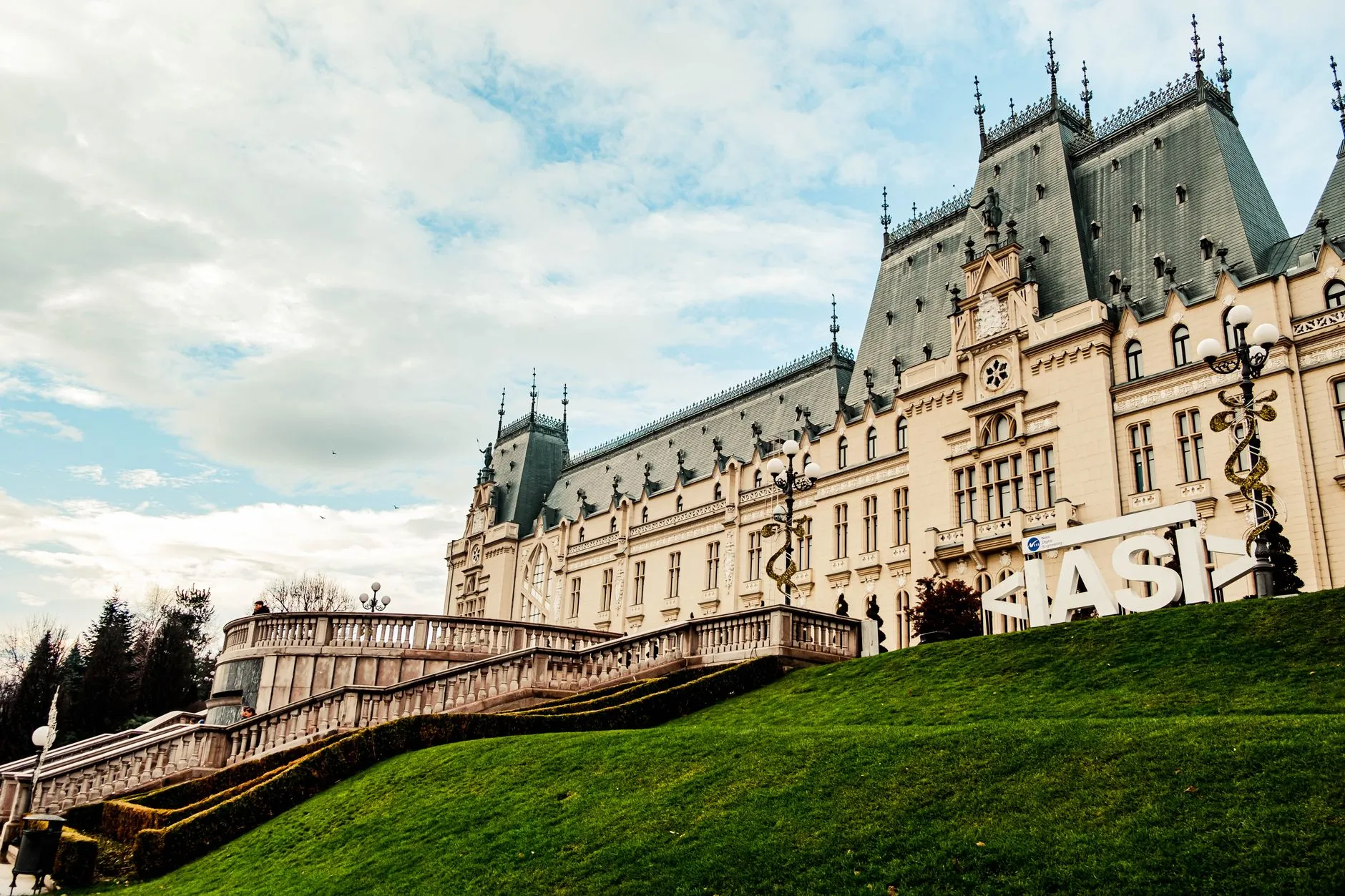
The Palace of Culture is the landmark and it is really four museums. The vast neo-Gothic pile at the end of Ştefan cel Mare boulevard houses the Moldova National Museum Complex: the History Museum of Moldova, the Ethnographic Museum of Moldova, the Art Museum and the Ştefan Procopiu Science and Technology Museum, plus a research and conservation centre. It sits on the site of the medieval princely court. Hours and the combined ticket price are on palatulculturii.ro — check them before you build a day around it.
The pilgrimage is the one date that will wreck an unplanned trip. Iaşi’s Metropolitan Cathedral holds the relics of Saint Parascheva, patron saint of Moldavia, and her feast day is 14 October. In the week running up to it the city hosts one of the largest religious pilgrimages in Europe — Church figures in recent years have run to 200,000–300,000 pilgrims, with queues stretching kilometres through the city centre. If you want to see it, it is extraordinary. If you were planning a quiet October city break, book around it: accommodation and the centre both fill.
Three more things in the city. The Three Hierarchs Monastery (Trei Ierarhi), a 17th-century church whose entire exterior is covered in carved stone bands, is a few minutes from the Palace. Copou Park is the old public garden on the hill, with the linden tree associated with the poet Mihai Eminescu. And the Alexandru Ioan Cuza University, founded on 26 October 1860 and the oldest higher education institution in Romania, gives Iaşi a student population that keeps the food and bars far better than a city of its size would otherwise sustain.
Bucovina and the painted monasteries — the honest version. The Churches of Moldavia were inscribed on the UNESCO World Heritage List in 1993: eight churches of the late fifteenth to late sixteenth centuries whose exterior walls are covered in Byzantine-style frescoes — Voroneţ, Suceviţa, Moldoviţa, Humor, Probota, Pătrăuţi, Arbore and the church in Suceava. They are genuinely among the most remarkable buildings in Europe. But be clear about the geography: they are clustered around Suceava, roughly 145 km northwest of Iaşi, and Suceava has its own airport with its own flights. From Iaşi they are a long day trip by car or an overnight — feasible, and worth doing, but Iaşi is not the nearest gateway and anyone who tells you otherwise is selling a tour.
When to come. May–June and September are the best weather. Late October to March is cold and the value is in the city itself rather than in day trips. Fares follow the diaspora calendar rather than the tourist one, so the expensive weeks are Orthodox Easter, Christmas, and the mid-August return — if your dates can move, run them through our price checker first, because at Iaşi the difference between a diaspora week and the week after it is bigger than the difference between Wizz and Ryanair.
❓ Frequently Asked Questions
📊 2026 Summary Data Table
| Category | Detail |
|---|---|
| IATA / ICAO | IAS / LRIA |
| Official name | Iaşi International Airport (Aeroportul Internaţional Iaşi) |
| Operator | Iaşi County Council — locally owned, not the national airports authority |
| Opened | 1926 — scheduled flights began 24 June 1926 |
| Location | 8 km east of Iaşi city centre · elevation 125 m (411 ft) |
| Terminals | T4 (opened 29 Mar 2024, 31,210 m², 950 pax/hour, 7 gates) — domestic + Schengen · T3 (2015, 320 pax/hour, 2 gates) — non-Schengen · T1/T2 not in passenger use |
| Runway | 14/32 · 2,400 m × 45 m asphalt · CAT I ILS on 14 · ALSF-II both ends · 3,000 m extension planned |
| 2025 passengers | 2,244,156 · 17,095 aircraft movements |
| National rank | Romania’s third-busiest — after Otopeni (17.0M) and Cluj-Napoca (3.58M), ahead of Timişoara (1.46M) |
| Main carriers | Wizz Air (focus city, 20+ routes), Ryanair, Austrian Airlines, TAROM, Animawings, flydubai, HiSky, AJet |
| Network shape | Diaspora traffic — northern Italy, Germany, Belgium, Spain, the UK — plus Vienna for global connections |
| Airport bus | Express 50, Aeroport ↔ Gara via Piaţa Unirii and Târgu Cucu, every 30 min |
| Bus fare | 4.00 lei (~€0.76) single, valid 120 min network-wide · 8.00 lei for two · 3-day tourist pass 30.00 lei · 99.00 lei penalty fare |
| Ticket purchase | Driver · 24Pay app · vending machine at the Airport stop |
| Currency | Romanian leu (RON) — Schengen but NOT eurozone. €1 ≈ RON 5.25 (ECB, 4 Sep 2026) |
| Schengen | Full member since 1 January 2025 (air/sea 31 March 2024) |
| EES | Fully operational since 10 April 2026 — biometric on first entry, at T3. 145M+ entries/exits logged EU-wide |
| ETIAS | €20 fee set; the Q4 2026 target has been withdrawn — no launch date is published. Nothing to apply for now |
| Lounge | Elite Air — Priority Pass, 06:00–21:00 daily, walk-up, 3-hour cap, hot + cold buffet, alcohol, Wi-Fi |
| City landmark | Palace of Culture — four museums of the Moldova National Museum Complex |
| Date to avoid or seek | St Parascheva pilgrimage, feast day 14 October — 200,000–300,000 pilgrims fill the city |
| UNESCO nearby | Churches of Moldavia (inscribed 1993) — eight painted churches around Suceava, ~145 km northwest |
| Not to be confused with | Chişinău, capital of Moldova, ~100 km east across an international border |