Rzeszów-Jasionka Ulma Family Airport (RZE) Airport Guide 2026 — The One-Euro Airport Train
Rzeszów-Jasionka is 7.8 km from the centre of Rzeszów on the airport’s own reckoning, and it does something almost no regional airport in Europe manages: a train from a covered station a three-minute walk from the terminal, into the city in 18 minutes, for 4.30 złoty — about €1. The airport handled 1,282,628 passengers in 2025, its best year ever, on a 3,200-metre runway that can take a Boeing 747. Ryanair flies most of the scheduled routes, but LOT runs a Dreamliner to New York Newark from here. Poland is in Schengen; Poland is not in the eurozone — you will be spending złoty. This is the airport for the Bieszczady, Łańcut and Podkarpacie.
Last verified: September 2026.
⚡ 2026 Quick Reference — Key Facts at a Glance
Jasionka Airport station, a 3-minute covered walk from the terminal by the P2/P3 car parks. POLREGIO to central Rzeszów in 18 minutes, 4.30 PLN normal single (≈ €1). Under-4s free. Pay the attendant by card or cash, or buy online
ZTM line 51 to the centre (Bardowskiego St), about 35 minutes. Ticket machine in the terminal or on board — cash in PLN, or card. ZG PKS lines 224 / 225 to the main bus station — driver, cash in PLN only
Private operators run from the terminal to Sanok, Lesko, Ustrzyki Dolne, Solina and Polańczyk in the Bieszczady (Softtravel), to Przemyśl via Łańcut, Przeworsk and Jarosław (Eurobus), to Lublin, and to Zakopane. Several need a phone reservation
Polish złoty (PLN) — Poland is in the EU and in Schengen but not in the eurozone. NBP mid-rate on 4 September 2026: €1 = 4.3179 PLN, £1 = 5.0264 PLN. Check the current rate
RZE / EPRZ — Port Lotniczy Rzeszów-Jasionka im. Rodziny Ulmów. One terminal on three floors, check-in desks 1–17, security on the 1st floor. 1,282,628 passengers in 2025 on a 3,200 × 45 m runway with ILS CAT II — one of Poland’s longest, open day and night all year, rated for wide-bodies up to the B747
15 destinations, 3 airlines — Ryanair (10), LOT (Warsaw, Gdańsk, New York Newark), Wizz Air (Rome Fiumicino, Podgorica), plus 16 summer charter destinations
One VIP Lounge, eastern end of the terminal — prepaid, minimum 24 hours in advance. Cards accepted. [email protected]
Exists, and it is expensive: 50 PLN for 1–2 hours, 150 PLN for 5–24 hours, up to 7 days at 450 PLN
Schengen. EES fully operational since 10 April 2026. Eight of the 15 scheduled routes cross an external border
Not in operation. The Commission states no applications are being collected; the fee is set at €20
🏢 1. One Terminal, Three Floors, and a Runway Built for Something Bigger
The official name is a mouthful — Port Lotniczy Rzeszów-Jasionka im. Rodziny Ulmów, the Rzeszów-Jasionka Airport named after the Ulma Family — and section 6 explains who they were, because it is the most important thing about this airport that has nothing to do with aviation.
Everything else about the place is unusually straightforward. One passenger terminal, arranged over three floors: check-in desks 1 to 17, the baggage carousels, the document-control desks, car hire and the meeting point downstairs; the security checkpoint on the first floor, along with the chapel; and an observation deck upstairs, which is a courtesy almost no European airport bothers with any more. Airport information will point you at any of it.
The runway is the surprise. RWY 09/27 is 3,200 metres by 45, with ILS CAT II on the 27 approach, a Vaisala meteorological system and no obstacles in the approach zones. The airport’s own technical page calls it one of the longest in Poland and states that it can take any aircraft including wide-bodies up to a Boeing 747, and that the airport is open day and night, all year. That is a runway built for a much larger operation than 1.3 million passengers, and it is the reason freighters and diversions turn up here.
The traffic, and the shape of it
Rzeszów’s passenger numbers, from the airport’s own statistics page: 772,238 in 2019, then a collapse to 235,190 in 2020 and 255,795 in 2021, then 731,141 in 2022, 1,020,189 in 2023 — the first million — 1,145,257 in 2024, and 1,282,628 in 2025. Through the first half of 2026 it had carried 516,325. This is one of the few Polish regional airports that is meaningfully bigger now than it was before the pandemic, and it is still growing.
Who actually flies here
The route map has changed a lot, so ignore anything you read that is more than a year old. The airport’s own summer 2026 timetable shows 15 scheduled destinations from three airlines:
- Ryanair — Alicante, Bristol, Dublin, Edinburgh, London Luton, London Stansted, Malta, Manchester, Milan Malpensa, Zadar. Ten routes, B737-800 and occasional A320, mostly two or three times a week each.
- LOT Polish Airlines — Warsaw up to four or five rotations a day on Embraer E170/E175/E190/E195 and 737 equipment; Gdańsk twice a week on an E175 in summer; and New York Newark on a Boeing 787-8 Dreamliner, one weekly rotation on the summer timetable through 19 October 2026.
- Wizz Air — Rome Fiumicino and Podgorica, both on the A321neo, both seasonal.
Then there is the charter programme, which is where a large share of the passengers actually are. For summer 2026 the airport lists sixteen charter destinations: Antalya, Bodrum and İzmir; Sharm El Sheikh, Hurghada and Marsa Alam; Heraklion, Rhodes, Zakynthos and Corfu; Djerba, Monastir and Enfidha; plus Mallorca, Burgas and Tirana. The charter carriers on the airport’s airline list include Smartwings, SkyUp, Sky Express, Air Albania, Air Montenegro and Fly Lily, alongside Lufthansa and airBaltic.
Two practical consequences. First, LOT’s Warsaw shuttle is the connection engine: four or five daily rotations into a hub with a genuine long-haul network, and a 50-minute sector. If you need to get from Podkarpacie to anywhere that Ryanair does not fly, that is how. Second, the Newark flight is real and it is direct — an unusual thing for an airport this size, and a reflection of how many people from this corner of Poland have family in New Jersey and New York.
Bags are where the money is on almost every route here. Check the allowance before you book, not at the gate: Ryanair, Wizz Air, LOT Polish Airlines, and on the charter side Smartwings, Sky Express, Air Albania and airBaltic. Or compare them in one place with the aifly baggage fee checker, and price the fare itself with the aifly flight price checker.
The family-and-seniors thing, which is not marketing
Rzeszów runs a “Family Friendly Airport” scheme with more substance than the name suggests. There are dedicated security lanes on the first floor for families travelling with children under five and separately for passengers aged 70 and over, wide marked parking bays near the terminal, parent-and-child rooms with changing tables, feeding chairs and bottle warmers, play areas inside the restricted zone, a water refilling station and a medical room. If you are flying with a toddler or an elderly relative, ask at the information desk — these lanes are signed but easy to miss.
There is also a chapel dedicated to St John Paul II on the first floor in front of the escalator, holding relics, with Sunday Mass at 13:00 and 15:10. It is open whenever the airport is.
🛂 2. Schengen, EES, and Why Your Money Is Not the Euro
Two facts that people constantly merge. Poland is in the Schengen area. The European Commission’s own Schengen history dates the abolition of internal border controls with Poland to 2007, so arriving from Rome, Milan, Alicante or Malta involves no passport control at all. And Poland is not in the eurozone: the currency is the złoty, and it is not going away.
Where the border actually bites at Rzeszów
Of the 15 scheduled destinations, eight are outside the Schengen area: Bristol, Edinburgh, London Luton, London Stansted and Manchester in the UK; Dublin, which is in the EU but not in Schengen because Ireland runs the Common Travel Area with Britain instead; Podgorica; and New York Newark. On the charter side, everything to Turkey, Egypt, Tunisia and Albania is an external-border crossing too. Alicante, Milan, Rome, Malta, Zadar, Mallorca, the Greek islands and Burgas are all inside Schengen; Warsaw and Gdańsk are domestic.
The EU Entry/Exit System became fully operational on 10 April 2026, and the European Commission’s Smart Borders page states it in those words. EES replaces the passport stamp for non-EU nationals on a short stay with a digital record — facial image, fingerprints and travel-document data captured on the first crossing, then a faster biometric check on later ones.
Read that carefully against who actually travels through Rzeszów, because it changes the advice. Most passengers on the Egypt, Turkey and Tunisia charters are Polish, which is to say EU citizens, and EU citizens are not registered in EES at all — those charter banks are not the queue problem people assume. The routes where EES genuinely bites are the ones carrying non-EU passports inbound: the UK services, and above all the weekly Newark arrival, which lands a Dreamliner’s worth of American passports at a terminal with a modest number of border desks. If you are arriving on either, allow real time; if you are meeting someone off the Newark flight, do not plan the day around a punctual pickup.
ETIAS is not in operation. The Commission’s own wording is that “ETIAS is currently not in operation and no applications for travel authorisations are collected at this point”, and that the EU will announce the start date several months before it launches. The fee is fixed at €20 by Commission Delegated Regulation (EU) 2025/1411, with under-18s, over-70s and qualifying family members of EU citizens exempt from the fee though still required to hold an authorisation once it starts. Nobody can sell you a valid Polish ETIAS today. Any website that offers to is taking your money for a form it cannot file.
Money: złoty, and the three ways to lose some
The NBP mid-rate on 4 September 2026 was €1 = 4.3179 PLN and £1 = 5.0264 PLN. Rates move, so check the current one — but that is the order of magnitude, and it is what makes the 4.30 PLN train ticket about a euro.
Three things to get right:
- Say no to dynamic currency conversion. Every card terminal and every cash machine in Poland will offer to charge you “in your own currency”. The exchange rate they use is worse than your bank’s, every time. Always choose to be charged in złoty.
- Use a bank’s ATM, not a standalone one. The independent machines that stand around airports and tourist streets charge a fee that a Polish bank’s own machine usually does not.
- The airport has a bureau de change — the terminal map lists an Exchange unit — and, like every airport bureau anywhere, its rate is the price of convenience. Change what you need for the train and nothing else.
Cards work essentially everywhere in Poland, including on the airport train, on ZTM line 51, and in village shops in the Bieszczady. The exception is specific and worth writing down: the ZG PKS 224 and 225 buses take cash, in złoty, from the driver only.
🚆 3. The 18-Minute Train, and the Bus That Goes to the Bieszczady
Most airport guides open the transport section by explaining that there is no train. This one does not.
The train
Jasionka Airport has its own railway station, next to the terminal by the P2 and P3 long-stay car parks. The airport puts the walk at three minutes, and the platform is covered — which in a Podkarpacie January is not a small detail. POLREGIO runs the service with modern 148-seat units that have power sockets, Wi-Fi and wheelchair spaces.
The numbers, from the airport’s own page:
- 18 minutes from the airport to the centre of Rzeszów.
- 4.30 PLN for a normal single — roughly €1 at the September 2026 rate.
- 2.71 PLN school-student rate, 2.11 PLN college-student rate, free for a child under 4.
- Buy from the train attendant with a card or cash, or online from the carrier.
Eighteen minutes and a euro. There is no airport transfer in Western Europe that competes with this, and it is the single best reason to fly into Rzeszów rather than driving from Kraków. The one thing to check is the timetable: this is a regional railway, not a metro, so the trains run to a published schedule rather than continuously. Look it up before a very early or very late flight.
The buses
If the train does not suit your hour, three public options leave from directly in front of the terminal:
- ZTM Rzeszów line 51 — to the city centre at Bardowskiego Street, about 35 minutes depending on traffic. Tickets from the machine in the passenger terminal or the machine on board, both taking cash in złoty or a card.
- ZG PKS “yellow line” 224 and 225 — to the main bus station on Artura Grottgera Street. Tickets from the driver, cash in złoty only.
The airport itself warns you to check the timetable before you travel and states plainly that it is not responsible for operators’ changes. Take that at face value.
The regional coaches — this is the section that matters
Rzeszów’s airport is the practical entry point to a large and thinly served region, and a set of private operators run scheduled minibuses and coaches straight from the terminal. From the airport’s own listing:
- Softtravel — airport → Rzeszów local bus station → Domaradz → Brzozów → Sanok → Lesko → Uherce Mineralne → Ustrzyki Dolne, and Krosno → Miejsce Piastowe → Iwonicz-Zdrój → Rymanów-Zdrój → Solina → Polańczyk. That is the Bieszczady, door to door from the terminal, with online booking.
- Eurobus — airport → Rzeszów Plac Wolności, and airport → Przemyśl via Rzeszów, Łańcut, Przeworsk and Jarosław. Phone reservation required.
- BP Tour — airport → Lublin via Nisko, Janów Lubelski and Kraśnik, and airport → Zakopane via Tarnów, Nowy Sącz and Nowy Targ. Phone reservation required.
- Bus Dej Express — airport → Tomaszów Lubelski via Łańcut, Jarosław and Lubaczów. Phone reservation required.
- RBUS — rbus-lotnisko.pl.
The reservation requirement is the catch. These are not turn-up-and-go services; several of them want a phone call in advance, and the phone call will probably be in Polish. Book before you fly.
Taxis and parking
The airport recommends using the taxi companies it holds contracts with, and there is a rank outside arrivals. It does not publish a fare table, so we are not going to invent one — agree the price or confirm the meter before you set off, and remember that on a normal weekday the train does the same journey in 18 minutes for four złoty. Long-stay parking is at P2 and P3, next to the railway station.
| Option | Destination | Price | Time |
|---|---|---|---|
| POLREGIO train | Rzeszów city centre | 4.30 PLN (≈ €1); under-4s free | 18 min, station 3 min from the terminal |
| ZTM bus 51 | City centre (Bardowskiego St) | Machine in terminal or on board; cash PLN or card | ~35 min |
| ZG PKS 224 / 225 | Main bus station (Grottgera St) | Driver only, cash in PLN | Varies |
| Softtravel | Sanok, Lesko, Ustrzyki Dolne, Solina, Polańczyk, Krosno | Online booking | The Bieszczady, direct |
| Eurobus | Łańcut, Przeworsk, Jarosław, Przemyśl | Phone reservation | Direct |
| BP Tour | Lublin · Zakopane | Phone reservation | Direct |
| Taxi | Anywhere | Not published — confirm before you travel | On demand |
🛋️ 4. One Lounge, and You Have to Book It a Day Ahead
Rzeszów has one VIP Lounge, in the eastern part of the passenger terminal. It is not a walk-up product and it is not a Priority Pass room: access is by prepaid booking made at least 24 hours in advance, through the airport’s own reservation form, with payment by debit or credit card. Contact is [email protected] or +48 885 500 194.
What you get is hot and cold drinks, snacks and sweets, somewhere to work, unlimited free Wi-Fi, press, television and live arrival and departure information. It is a competent regional lounge rather than a destination, and the 24-hour rule means it is useless as a fallback when your flight goes long — decide before you leave home or not at all.
The commercial offer in the rest of the terminal, from the airport’s own terminal map, is five units: Baltona Duty Free, Relay, One Minute, a Bistro & Cafe and an Exchange bureau. That is the lot. For an airport pushing 1.3 million passengers it is thin, and on a summer Saturday with three charters departing inside two hours it is visibly thin. Eat before you come, or eat in the city — the train back into Rzeszów takes 18 minutes and the city has actual restaurants.
Left luggage exists but is priced to discourage you. The published list: 50 PLN for one to two hours, 100 PLN for two to five, 150 PLN for five to twenty-four, 250 PLN for one to two days, and 450 PLN for up to a week with 100 PLN for each further day. Fifty złoty — around €11.60 — to leave a bag for two hours is a lot. Take it to town with you.
🍽️ 5. Proziaki, Żurek and What to Do With Two Hours in Rzeszów
The airport gives you a Bistro & Cafe. Rzeszów, eighteen minutes away, gives you a proper Polish provincial city that almost no foreign visitor eats in, at prices that will make anyone arriving from Western Europe recheck the bill.
Eat the regional things first:
- Proziaki — the Podkarpacie flatbread, raised with bicarbonate rather than yeast and cooked dry on a hot plate. Served hot with butter, or with cottage cheese, or alongside a bowl of soup. They are specific to this region and you will not find them in Warsaw.
- Żurek — sour rye soup, with white sausage and a boiled egg, sometimes served in a bread bowl. It is the national soup and Podkarpacie makes a good one.
- Pierogi ruskie — potato and twaróg curd cheese, fried in butter with onion. The default order, and the one to judge a kitchen by.
- Bigos — the hunter’s stew of sauerkraut, fresh cabbage, mushrooms and several meats, which is better in winter and better the second day.
- Kotlet schabowy with potatoes and mizeria, the dilled cucumber salad. The Sunday dish.
- Oscypek — the smoked sheep’s-milk cheese from the mountains south of here, grilled and served with cranberry. It is Podhale rather than Podkarpacie, but the Zakopane bus goes from the terminal, so it counts.
Drink kompot with lunch if it is offered — stewed fruit, unsweetened, served cold, and the thing every Polish household actually drinks with a meal.
To buy and take home: honey from the Bieszczady foothills, which is a genuine regional product rather than a souvenir; smoked plums and dried mushrooms from the same forests; and vodka, which Podkarpacie has been distilling industrially for a very long time — Łańcut’s distillery is one of the oldest in Poland. Buy all of it in a supermarket or a market hall in Rzeszów rather than in Baltona Duty Free, where you will pay several times the price for the same bottle.
💡 6. Insider: The Bieszczady, Łańcut, and the Family the Airport Is Named For
Markowa, and the name over the door
The airport is named after the Ulma family of Markowa, a village about eight kilometres from Łańcut and a short drive from the terminal. During the German occupation Józef and Wiktoria Ulma hid eight Jewish neighbours in their farmhouse. On 24 March 1944 German gendarmes shot the eight, then Józef and Wiktoria — who was seven months pregnant — and then their six children. Seventeen people died in a few minutes.
The Ulma Family Museum of Poles Saving Jews in World War II opened in Markowa on 17 March 2016 and is Poland’s first institution devoted to that subject. It is a small, severe, deliberately uncomfortable building, and it is the most serious thing you can do with an afternoon in this region. It is also the reason the name on your boarding pass is what it is. Go, or at least know why the airport is called that.
Łańcut
Łańcut Castle is on the Eurobus route from the terminal towards Przemyśl, and it is one of the most complete aristocratic residences in Poland — a magnate palace with its interiors, its library, its orangery and an unusually good historic carriage collection still in place. It survived the twentieth century largely intact, which in this part of Europe is close to a miracle. If you have one afternoon and no car, this is the easiest big thing to reach.
The Bieszczady
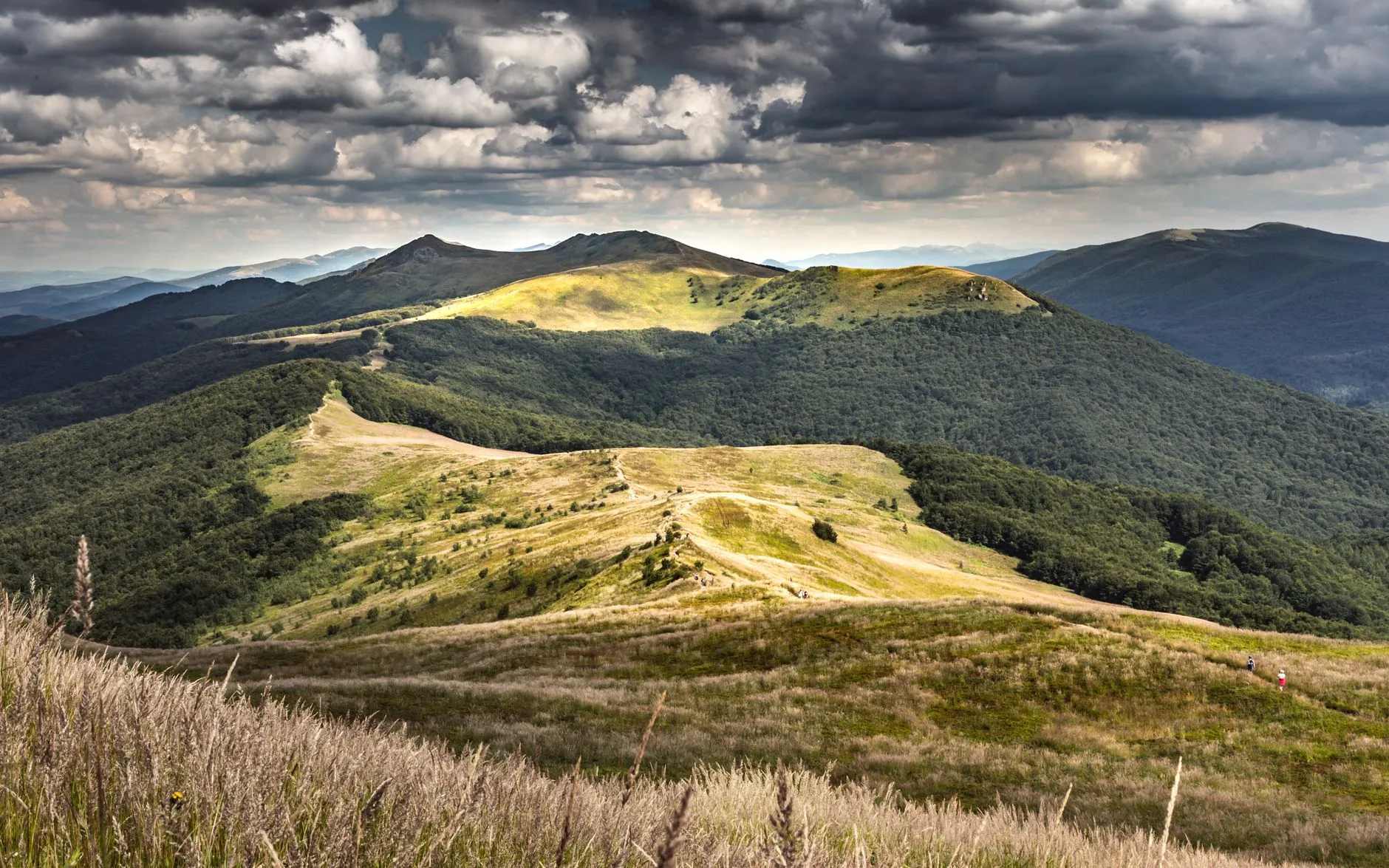
This is what the region is actually for. The Bieszczady are the far south-eastern corner of Poland, in the Outer Eastern Carpathians: the third-largest national park in the country, and the emptiest mountains in the European Union that you can reach on a scheduled flight. Their signature landscape is the połonina — high, treeless grass ridges above the beech forest, walkable for hours with nothing built in sight. Połonina Wetlińska and Połonina Caryńska are the two classic ridge walks. Below them, Lake Solina is a 22-square-kilometre reservoir on the San with a 150-kilometre shoreline, and Polańczyk on its edge is the local resort.
Be realistic about the distance: the trailhead village of Ustrzyki Górne is around 130 km south-east of Rzeszów, which is two and a half to three hours by road on national roads DK28 and DK84 through Lesko and Ustrzyki Dolne. The Softtravel coach from the terminal will get you as far as Ustrzyki Dolne, Solina and Polańczyk; for the park itself you want a car or a local connection. There is no railway into the high Bieszczady.
Two further things worth knowing. The Bieszczady have a genuine large-carnivore population — bears, wolves and lynx — which is exactly why the walking is what it is, and which means you follow the park’s rules on food and rubbish. And the region is thinly populated because of what happened here in the 1940s: the villages you walk past are often just foundations and an orchard, with a wooden or stone Greek Catholic church left standing. That absence is part of the landscape, and it is worth reading about before you go rather than after.
Rzeszów itself
Do not skip the city on the way through. The Rzeszów Cellars underground route runs 396 metres through 25 cellars beneath the market square, dug between the 14th and 18th centuries and reaching about ten metres down; the entrance is by the town hall at Rynek 26 and the exit comes up on the far side of the square. Above ground, Rzeszów is a compact, well-kept regional capital with a big student population, a proper market square, and a local economy built on aerospace — the Aviation Valley cluster in Podkarpacie is why an airport this size has a 3,200-metre runway and an engineering workforce that fills the Warsaw flights on Monday mornings.
The honest verdict on this airport
Rzeszów-Jasionka is one of the best-connected small airports in Europe on the ground and one of the thinnest in the terminal. An 18-minute, one-euro train from a covered platform three minutes from the door is genuinely class-leading; five retail units and a lounge you must book a day ahead are not. Fifteen scheduled routes, most of them Ryanair, one Dreamliner a week to Newark, and a Warsaw shuttle that is your route to everywhere else.
Fly here for the Bieszczady, for Łańcut, for Markowa, and because the alternative — landing at Kraków and driving three and a half hours east — is worse in every respect. Bring złoty for the bus driver, take the train, and eat in town.
❓ Frequently Asked Questions
📊 2026 Summary Data Table
| Category | Detail |
|---|---|
| IATA / ICAO | RZE / EPRZ |
| Official name | Port Lotniczy Rzeszów-Jasionka im. Rodziny Ulmów — Rzeszów-Jasionka Ulma Family Airport |
| Location | Jasionka, 7.8 km from Rzeszów city centre (airport’s own figure), Podkarpackie Province. About 450 hectares |
| Passengers | 1,282,628 in 2025 · 1,145,257 (2024) · 1,020,189 (2023, first million) · 772,238 (2019). 516,325 in the first half of 2026 |
| Terminal | One terminal, three floors. Check-in 1–17, security on the 1st floor, chapel on the 1st floor, observation deck |
| Runway | RWY 09/27, 3,200 × 45 m, ILS CAT II on 27, open 24 hours all year, rated to B747 |
| Scheduled airlines | Ryanair · LOT Polish Airlines · Wizz Air |
| Scheduled destinations | 15 — Ryanair: Alicante, Bristol, Dublin, Edinburgh, London Luton, London Stansted, Malta, Manchester, Milan Malpensa, Zadar · LOT: Warsaw (4–5 daily), Gdańsk, New York Newark (B787-8, weekly, summer) · Wizz Air: Rome Fiumicino, Podgorica |
| Charters (summer 2026) | 16 — Antalya · Bodrum · İzmir · Sharm El Sheikh · Hurghada · Marsa Alam · Heraklion · Rhodes · Zakynthos · Corfu · Djerba · Monastir · Enfidha · Mallorca · Burgas · Tirana |
| Train | Jasionka Airport station, 3-minute covered walk from the terminal. POLREGIO to central Rzeszów in 18 minutes for 4.30 PLN (≈ €1); students 2.71 / 2.11 PLN; under-4s free |
| City buses | ZTM 51 to Bardowskiego St, ~35 min, machine in terminal or on board (cash PLN or card) · ZG PKS 224 / 225 to the main bus station, driver, cash PLN only |
| Regional coaches | Softtravel (Sanok, Lesko, Ustrzyki Dolne, Solina, Polańczyk, Krosno) · Eurobus (Łańcut, Przeworsk, Jarosław, Przemyśl) · BP Tour (Lublin, Zakopane) · Bus Dej Express (Lubaczów, Tomaszów Lubelski) · RBUS. Several require a phone reservation |
| Taxi | Airport-contracted companies at the rank; no published fare table — confirm before you travel |
| Lounge | One VIP Lounge, eastern end of the terminal, prepaid, minimum 24 hours ahead, cards accepted |
| Shops and food | Five units: Baltona Duty Free · Relay · One Minute · Bistro & Cafe · Exchange |
| Left luggage | 50 PLN 1–2 h · 100 PLN 2–5 h · 150 PLN 5–24 h · 250 PLN 24–48 h · 450 PLN up to 7 days, then 100 PLN/day |
| Family facilities | Dedicated 1st-floor security lanes for families with under-5s and for passengers aged 70+, parent-and-child rooms, airside play areas, water refill point, medical room |
| Currency | Polish złoty (PLN) — Poland is in the EU and Schengen but not the eurozone. NBP mid-rate 4 Sep 2026: €1 = 4.3179 PLN, £1 = 5.0264 PLN. Refuse dynamic currency conversion; use bank ATMs |
| Border | Schengen — the Commission dates the abolition of internal border controls with Poland to 2007 · EES fully operational since 10 April 2026 · ETIAS not in operation, no applications collected, fee set at €20 · 8 of 15 scheduled routes cross an external border |
| Region | Ulma Family Museum, Markowa (opened 17 March 2016) · Łańcut Castle · the Bieszczady — połoniny, Lake Solina (22 km²), Ustrzyki Górne ~130 km / 2.5–3 h · Rzeszów Cellars, 396 m through 25 cellars under the market square · Aviation Valley aerospace cluster |